




Abstract
Drawing on data provided by 207 Anglican and Methodist ministry training candidates, who completed the Myers-Briggs Type Indicator and an 80-item battery of type-related prayer preference items, this study tested the thesis advanced by Michael and Norrisey that the Apollonian (NF) Temperament is associated with Augustinian prayer and spirituality. From the battery of eighty items, the analysis identified eleven items rated more highly by NF participants. These items produced a scale with a satisfactory alpha of .81 (offering internal consistency reliability). Consideration of these items alongside the secondary literature on Augustinian spirituality, and Augustine’s own account in his Confessions, showed that they mapped broadly onto the characteristics of Augustinian prayer and spirituality (offering content validity). These data support the hypothesized link between the Apollonian (NF) Temperament and Augustinian prayer and spirituality.
Introduction
Both psychological type and temperament theory have stimulated serious reflection on the connections between individual differences in personality and preferred spiritual pathways and prayer practices, as evidenced by studies like Baab (1998), Clarke (1988), Duncan (1993), Fowke (1997), Goldsmith and Wharton (1993), Hirsh and Kise (1998), Keating (1987), Martínez (2001), McGuinness (2009), Michael and Norrisey (1984), Osborn and Osborn (1991), and Williams (1987). There has, however, been less evidence of empirical studies focused closely on this area as evidenced by Ware et al. (1989), and Francis and Robbins (2008).
Psychological type theory as proposed by Jung (1971) distinguishes between two core mental processes, one concerned with gathering information (the perceiving process) and the other concerned with evaluating information (the judging process). Psychological type theory proposes that each of these processes is reflected in two contrasting functions: perceiving through sensing (S) and intuition (N), and judging through thinking (T) and feeling (F). Psychological type theory then distinguishes between the introverted and extraverted expressions of each of these four functions, resulting in eight function-orientations: introverted sensing, extraverted sensing, introverted intuition, extraverted intuition, introverted thinking, extraverted thinking, introverted feeling, and extraverted feeling. As developed and operationalized by the Myers-Briggs Type Indicator (Myers & McCaulley, 1985) the sixteen complete types are characterized by their preferred orientation, introversion (I) or extraversion (E), and by their preferred processes directed to the external world, judging (J) or perceiving (P).
Drawing on the building blocks of psychological type theory, Keirsey and Bates (1978) distinguished among four temperaments. This model of temperament theory privileged the perceiving functions (sensing and intuition) and distinguished two expressions of each of these functions. Sensing was distinguished by the orientation in which it was expressed: SJs were characterized as the Epimethean, and SPs as the Dionysian Temperament. Intuition was distinguished by the judging function with which it was paired: NFs were characterized as the Apollonian Temperament and NTs as the Promethean Temperament.
According to Keirsey and Bates (1978) the Epimethean Temperament (SJ) characterizes people who long to be dutiful and exist primarily to be useful to the social units to which they belong. The Dionysian Temperament (SP) characterizes people who want to be engaged, involved, and doing something new. The Promethean Temperament (NT) characterizes people who want to understand, explain, shape, and predict realities, and who prize their personal competence. The Apollonian Temperament (NF) characterizes people who quest for authenticity and for self-actualization, who are realistic and who have great capacity for empathetic listening.
Building on Keirsey and Bates’ (1978) characterization of these four temperaments, Oswald and Kroeger (1988) developed profiles of how these four temperaments may be reflected in four different styles of religious leadership. According to Oswald and Kroeger (1988) the Epimethean (SJ) Temperament shaped “the conserving, serving pastor.” They tend to be traditional in their approach, bringing stability and continuity in whatever situation they are called to serve. They proclaim a simple and straightforward faith, committed to down-to-earth rules for the Christian life. They serve as protectors and conservers of the traditions inherited from the past. They bring order and stability to their congregations, creating plans, developing procedures, and formulating policies; and they are keen that these procedures should be followed.
According to Oswald and Kroeger (1988) the Dionysian (SP) Temperament shaped “the action-oriented pastor.” They tend to be fun loving in their approach, possessing a compulsive need to be engaged in activity. They have little need for or interest in the abstract, the theoretical, and the non-practical aspects of theology and church life. They are flexible and spontaneous people who welcome the unplanned and unpredictable aspects of church life. They are entertainers and performers at heart. They are at their best in a crisis and are good at handling conflict resolution. They are better at starting new initiatives than at seeing things through.
According to Oswald and Kroeger (1988) the Promethean (NT) Temperament shaped “the intellectual, competence-seeking pastor.” They tend to be academically and intellectually grounded, motivated by the search for meaning, for truth and for possibilities. They are visionaries who need to excel in all they do, and they tend to push their congregations to excel as well. They make good teachers, preachers, and advocates for social justice. They see the value of opposing views and strive to allow alternative visions to be heard. They are more concerned with finding truth than with engineering harmony and compromise.
According to Oswald and Kroeger (1988) the Apollonian (NF) Temperament shaped “the authenticity-seeking, relationship-oriented pastor.” They tend to be idealistic and romantic, attracted to helping roles that deal with human suffering. They want to meet the needs of others and to find personal affirmation in so doing. They can be articulate and inspiring communicators, committed to influencing others by touching their hearts. They tend to be high on inspiration, but lower on the practical down-to-earth aspects of ministry. They are able to draw the best out of people and work well as the catalyst or facilitator in the congregation as long as others are on hand to work with and to implement their vision.
Working along similar lines to those followed by Oswald and Kroeger (1988), Michael and Norrisey (1984) developed profiles of how these four temperaments may be reflected in four different styles of prayer and spirituality. According to their model, the Epimethean (SJ) Temperament was reflected in the Ignatian tradition, with an emphasis on structured traditional prayer. People shaped by this temperament prefer to project themselves back into the biblical narrative or the historical setting, connecting the past events to contemporary life. The Dionysian (SP) Temperament was reflected in the Franciscan tradition, with an emphasis on going where the Spirit calls. People shaped by this temperament prefer to pray through acts of service and see the presence of God in the whole of creation. The Promethean (NT) Temperament was reflected in the Thomistic tradition with an emphasis on logical, orderly progression of thought. People shaped by this temperament prefer to pray through acts of study and striving after truth and goodness. They are future oriented. The Apollonian (NF) Temperament was reflected in the Augustinian tradition, with an emphasis on constant striving for future growth. People shaped in this tradition prefer to transpose the biblical narrative to the here and now with little concern for the historical setting.
Research Aim
Michael and Norrisey’s (1984) extrapolation from temperament theory to linking “different prayer forms for different personality types” has been commended and repeated in subsequent guides on personality and prayer (see e.g., Williams, 1987). The claims have not, however, been widely tested by empirical studies and the one study that set out to test aspects of the theory failed to support it (Ware et al., 1989). The aim of the present study is to revisit the data described by Francis et al. (in press) to test: whether from a diverse range of type-related items a group of items may emerge that are rated more highly by the Apollonian (NF) Temperament than by the other three temperaments; whether such items may cohere to produce a reliable measure that records significantly higher scores among NF participants than among NT, SJ, and SP participants; and whether such items may properly characterize Augustinian prayer and spirituality.
Method
Procedure
Over a nine-year period from 2008 to 2016 Anglican and Methodist ministry training candidates studying at Cranmer Hall, Durham, were invited to complete a measure of psychological type and a prayer preference questionnaire. Completed data across both measures were provided by 207 participants.
Measures
Prayer preferences were assessed by two sets of twenty items, incorporating the items published in the scales developed by Francis and Robbins (2008). The first set comprised ten items designed to assess each of the orientations (extraversion and introversion) and the attitudes (judging and perceiving). The second set comprised ten items designed to assess each of the functions (sensing, intuition, thinking, and feeling). The participants were invited to rate each item on a five-point Likert scale: agree strongly (5), agree (4), not certain (3), disagree (2), and disagree strongly (1).
Psychological type was assessed by the 126-item Form G (Anglicised) of the Myers-Briggs Type Indicator (Myers & McCaulley, 1985). This instrument proposes forced-choice questions to distinguish between the two orientations (introversion and extraversion), the two attitudes (judging and perceiving), the two perceiving functions (sensing and intuition), and the two judging functions (thinking and feeling). Introversion and extraversion are distinguished by questions such as: When you are with a group of people, would you rather join in the talk of the group (E), or talk with one person at a time (I)? Judging and perceiving are distinguished by questions such as: When you go somewhere for the day, would you rather plan what you will do and when (J), or just go (P)? Sensing and intuition are distinguished by questions such as: If you were a teacher, would you rather teach fact-based courses (S), or courses involving theory (N)? Thinking and feeling are distinguished by questions such as: Do you more often let your heart rule your head (F), or your head rule your heart (T)? Satisfactory psychometric properties for this instrument in studies among clergy were supported by Francis and Jones (1999).
Participants
The 207 participants comprised 112 men and 95 women; 161 were training for ministry in the Anglican Church and 46 were training for ministry in the Methodist Church. Among these 207 participants, 43% reported Apollonian (NF) Temperament, 28% Epimethean (SJ) Temperament, 21% Promethean (NT) Temperament, and 9% Dionysian (SP) Temperament.
Analysis
The data were analyzed by the SPSS statistical package employing the frequency, reliability, and analysis of variance routines.
Results
The first step in data analysis selected the items on which NFs recorded significantly higher endorsement than the other three temperaments. These items are listed in Table 1. The second step in data analysis explored the scaling proportion of these eleven items. The resulting scale generated a satisfactory alpha coefficient of .81 (Cronbach, 1951). The item endorsements, in terms of the sum of the agree and agree strongly responses indicate a fair range of item discrimination. On these grounds the new scale can be regarded as a reliable measure of prayer preference and spirituality endorsed by individuals recording the Apollonian (NF) Temperament.
Scale of Apollonian Prayer Preference (SAPP): Psychometric properties.
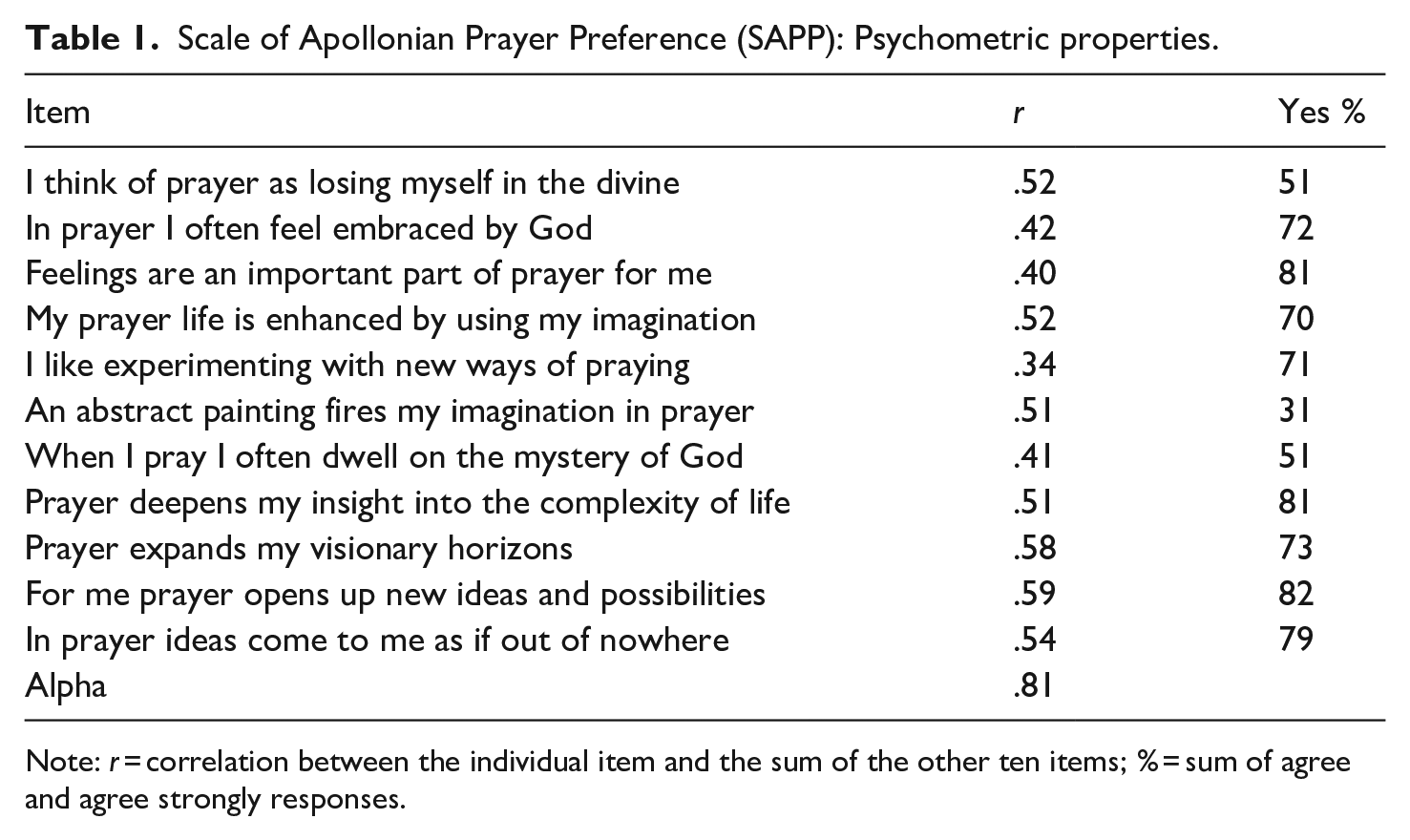
Note: r = correlation between the individual item and the sum of the other ten items; % = sum of agree and agree strongly responses.
Scores on the Scale of Apollonian Prayer Preference by temperament.
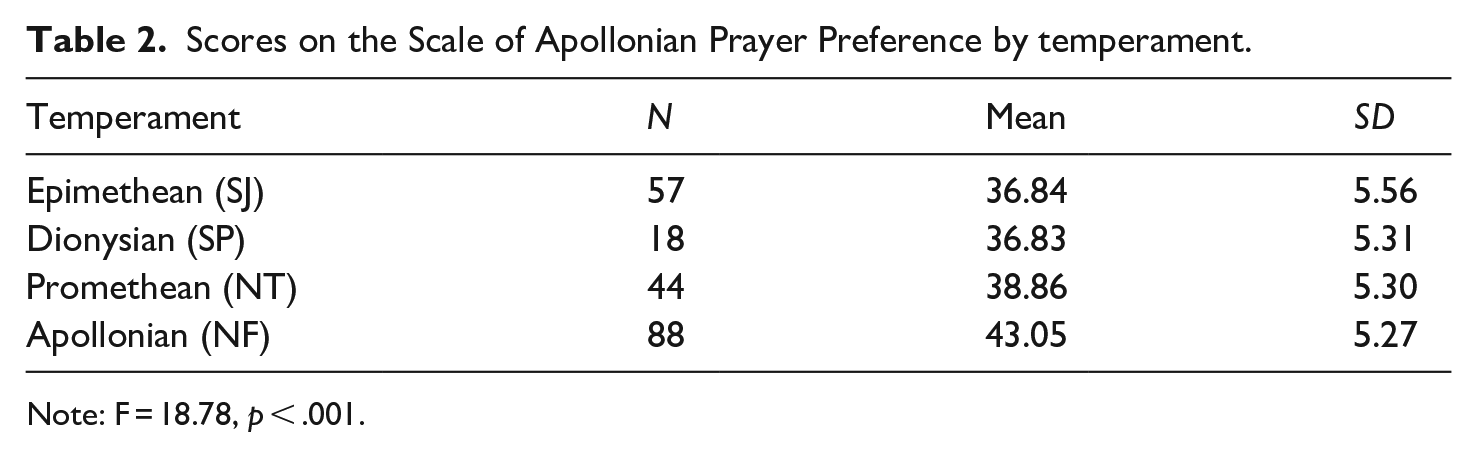
Note: F = 18.78, p < .001.
The third step in data analysis confirmed the construct validity of the newly proposed measure by setting out the mean scores recorded on this scale by the four temperaments: SJ, SP, NT, and NF. For these data the F ratio does not support the null hypothesis that there is no significant difference among the four means. The post hoc tests confirmed the NF group was the outlier (Table 2). On these grounds the new scale can be regarded as a valid measure of prayer preferences and spirituality endorsed by individuals recording the Apollonian (NF) Temperament.
Discussion
So far the present study has identified from a batch of eighty items designed to reflect psychological type related prayer preferences eleven statements that together differentiated the prayer preferences of the Apollonian (NF) Temperament from the prayer preference of the other three temperaments. Statistical data have supported the internal consistency reliability and construct validity of these items on identifying a distinctive NF prayer preference. Michael and Norrisey (1984) suggested that the spirituality and prayer preferences of the NF Temperament mapped onto the Augustinian tradition.
The aim now is to assess the extent to which the items selected by the present study are consistent with Michael and Norrisey’s account of the Augustinian tradition. They argue that: The key word to describe Augustinian prayer is
Other key characteristics of Augustinian prayer and spirituality noted by Michael and Norrisey (1984) include: the search for fuller, richer meaning; opening oneself to creative imagination; risk and experimentation with new approaches; dialogue between God and oneself; developing a deep loving relationship with God; valuing art that will express a rich relationship with God.
These descriptors offered by Michael and Norrisey (1984) resonate well with the statements identified by the present scale of NF prayer preferences. Here are people who think of prayer as losing themselves in the divine; who often feel embraced by God during prayer; and for whom feelings are an important part of prayer. Here are people who find that their prayer life is enhanced by their imagination; for whom prayer opens up new ideas and possibilities; and who find that ideas come to them as if out of nowhere when they pray. Here are people who like experimenting with new ways of praying and who find that their imagination is fired by abstract paintings as part of their experience of prayer. Here are people who find that prayer expands their visionary horizons and deepens their insight into the complexity of life.
We might therefore conclude, based on the data presented in this study, that NF prayer preferences do indeed accord with the Augustinian pattern. However, one further question arises. Does the pattern of spirituality and prayer identified by Michael and Norrisey (1984) as “Augustinian” properly warrant the use of that name? Michael and Norrisey present little or no evidence for their allocation of particular Christian spiritual traditions to each of the four temperaments, and they are somewhat uncritical in making these attributions. Does what we know about Augustinian spirituality, past and present, support the contention that NF prayer preferences, as demonstrated in the present study, might properly be called “Augustinian”?
In attempting to address this question we are immediately confronted with the historical complexity and breadth of Augustinian spirituality (Martin, 2003). Augustine of Hippo (354-430 CE) left a vast corpus of writings, including an autobiographical work (within which are many prayers), his Confessions, in which he describes his journey to Christian faith (Pine-Coffin, 1961). Additionally, there is a monastic rule, usually referred to as The Rule of St Augustine, although attribution of this to Augustine dates from a century after his death and there is much debate as to whether or not it was actually written by Augustine himself. There have, since then, been diverse interpretations of the Augustinian tradition, from medieval monastic communities eager to make authentic claims to being founded by Augustine, through to Catholic and Protestant claims to Augustinian orthodoxy during the Reformation, and then modern and post-modern interpretations. Summarizing all of this may lead only to broad generalities, but Thomas Martin has suggested that: Augustine’s spirituality has Christ at its centre; it is broad and sweeping in its concerns; it is imbued with a personalism that defuses its rigour and a sense of community that challenges all individualism; it is ever dynamic in its searching, yet ever securely anchored in God as truth. (Martin, 2003, p. 159).
Elsewhere, Martin (2005) has suggested that Augustinian spirituality contains ten essential elements: the centrality of Christ, an affirmation of grace, a search for God within, an emphasis on the communal nature of Christian life, the importance of love, the pursuit of truth, monastic life, continuing conversion of life, the importance of scripture, and an enduring impact on Christian spirituality and theology in the western Church. Some of these elements might perhaps seem more sensing than intuitive (e.g., the appeal to the authority of scripture) and more about thinking than feeling (e.g., the pursuit of truth and doctrinal theology). It has been suggested that Augustinian spirituality is marked by an “intellectual piety, a thinking spirituality” (Martin, 2003, p. 16), and this hardly seems to support the proposed association with an NF temperament. On the other hand, anyone who has read Confessions will be aware of the deeply and characteristically affective (feeling), intuitive and imaginative, mode of writing that Augustine adopted. Augustine, the theologian and writer, was clearly able to employ all of the psychological functions in the spiritual quest, but this does not undermine the intuitive and feeling elements of his spirituality that continue to inspire readers of his Confessions more than 1600 years later.
The wider literature on Augustinian spirituality provides further evidence for asserting that it is appropriate to refer to the NF temperament as Augustinian. For example, Clark (1984) writes of the interiority of Augustinian spirituality, suggesting that it is “rooted in the life of the mind and grows by love of the heart.” (p. 84). This reference to the “life of the mind” should not be understood as a thinking (T) rationality, but rather as a place of imaginative (N) and affective (F) encounter with the Trinity, as Clark demonstrates by reference to Augustine’s Confessions (p. 86). Again, Griffiths (2011) talks about Augustine’s commendation of tears and weeping to establishing affective (F) intimacy with God.
Perhaps the most important evidence, however, comes from Augustine’s Confessions, where it is easy to find examples of Apollonian prayer preferences emerging from the empirical research reported here. Augustine describes himself feeling embraced by God in prayer (Confessions X. 6), “losing” himself in the divine, as in his mystical experience at Ostia (Confessions IX. 10), expressing his feelings in prayer (Confessions X. 28), being imaginative/visionary in prayer (Confessions IX. 10), dwelling on the mystery of God (Confessions XI. 31), and gaining insight into life’s complexity through prayer (Confessions IX. 1). Indeed, none of the items in Table 1 seem alien to Augustine’s life of prayer as we read about it in his Confessions; all of which is a tribute to the visionary and creative breadth of his prayers.
It is therefore proposed, on the basis of the present study and with reference to the Augustinian corpus and tradition, that the prayer preferences of Christians with an Apollonian (NF) temperament, as understood by Keirsey and Bates (1978), might properly be described as Augustinian. Perhaps more importantly, however, the present study reaffirms the importance for Christians of finding a practice of Christian prayer that takes account of psychological type. For those with an Apollonian (NF) temperament, prayer needs to provide opportunities for affective and imaginative encounter with the Divine, for affirmation of the mystery of God, and creative exploration of new ways of praying.
Conclusion
This study set out to revisit the data collected on psychological type and prayer preferences as reported by Francis et al. (in press) in order to address three research questions. The first research question tested whether from a diverse range of type-related items a group of items may emerge that are rated more highly by the Apollonian (NF) Temperament than by the other three temperaments. Drawing on data provided by two hundred seven Methodist and Anglican ministry training candidates who had completed eighty type-related preference items and the Myers-Briggs Type Indicator, eleven items were identified in this category. The second research question tested whether this set of eleven items produced an Apollonian prayer preference scale with acceptable internal consistency reliability and construct validity. Both criteria have been satisfactorily met. The third research question tested whether the 11- item scale can claim to access criteria associated with Augustinian prayer and spirituality. Set alongside the descriptions of Augustinian prayer and spirituality proffered by Michael and Norrisey (1984), and Martin (2003, 2005), as well as the evidence from Augustine’s own writings in his Confessions (Pine-Coffin, 1961), this claim can be supported. By way of conclusion this study has offered original empirical support for the theory advanced by Michael and Norrisey (1984) that connected the Apollonian (NF) Temperament with Augustinian prayer and spirituality.
The two main limitations with the present study concern the limited range of prayer type-related items in the original survey and the restriction to one source of data, Anglican and Methodist ministry training candidates. Future studies may wish to refine a wider range of prayer type-related items and also give attention to the claims made by Michael and Norrisey (1984) regarding the spiritual traditions linked to the other three temperaments.
All participants were over the age of 18 and gave informed consent by participation in the project.
Footnotes
Declaration of Conflicting Interests
The author(s) declared no potential conflicts of interest with respect to the research, authorship, and/or publication of this article.
Funding
The author(s) received no financial support for the research, authorship, and/or publication of this article.
