



Abstract
This paper advances a biologically grounded philosophy of leadership through the lens of Natural Horsemanship. It reframes leadership as an embodied, sentient process rather than a purely cognitive or behavioral construct. Drawing from neuroscience, affective biology, sociology, and human resource development (HRD), it proposes that the horse–human relationship provides a living model for relational intelligence. The horse’s exquisite attunement to human emotion—mediated through limbic regulation and bio-behavioral synchrony—reveals that influence arises not from authority but from coherence. Leadership, like horsemanship, is a reciprocal act of co-regulation in which trust, safety, and communication are revealed through physiology before language. By examining the horse as a teacher of embodied awareness, this paper argues a framework for effective leadership that is deepened by self-sentience—the capacity to sense, regulate, and align one’s inner state with external expression. This framework calls for HRD to move beyond leadership models that privilege disembodied cognition and towards a dynamic of resonance where relational harmony replaces hierarchical control. In doing so, the horse becomes both metaphor and mentor, reminding HRD that the essence of leadership, like horsemanship, is felt within the harmony of the living systems we share.
Keywords
Introduction
There is an old saying that horses teach you about people. I believe that is true. And they teach you about the importance of sentience in leadership. Leadership, like horsemanship, begins in the quiet space between intention and perception. To work with a horse is to encounter a consciousness that feels before it thinks, that reads emotion before it reads instruction. Horses have evolved with extraordinary attunement to the emotional states of others—capable of detecting changes in human heart rate, muscle tone, and intention long before any overt cue is given (Althobaiti et al., 2019; Keeling et al., 2009). This level of perception moves the horse beyond a human companion. The horse becomes a living mirror: a biological feedback system through which we can observe the coherence—or incoherence—of our own presence; a mirror reflecting the state of our own being.
Natural Horsemanship rests upon this mirror. Natural Horsemanship is a philosophy of relational leadership grounded in trust, empathy, and nonverbal communication between human and horse. It teaches that the relationship between human and horse cannot be coerced into harmony; it must be cultivated through belief, coherence, and emotional clarity (Birke, 2007). The horse responds not to what we demand but to what we communicate through our state of self. In this sense, horsemanship becomes less an act of training and more an act of mutual regulation—a biological conversation between nervous systems (Jones, 2020).
In the field of human resource development (HRD), leadership is increasingly understood as a relational process rather than a positional role (Fairhurst & Uhl-Bien, 2012; Scott et al., 2018). A relational view also implies that influence is carried through moment-to-moment signals of safety, intention, and emotional regulation. Natural Horsemanship offers an analogue: horses rapidly detect (in)congruence and respond to perceived threat or trust. Similarly, employees and organizational systems interpret the affective field of leadership when deciding whether to engage, comply, resist, or withdraw. Leadership is cognitive. But it is also biological—mediated through regulated trust states, and the subtle dynamics of safety and connection (Carpenter, 2024).
This perspective foregrounds the idea that Natural Horsemanship offers a reflective metaphor—and a living model—for HRD leadership. It suggests that the horse’s sentience can illustrate the deep biological and ethical foundations of effective leadership, displaying that influence is not achieved through authority but through resonance. Drawing on insights from neuroscience, biology, sociology, and leadership theory, this perspective positions the horse as a teacher of relational intelligence. To lead well, as in working with horses well, is to become aware of one’s own signals, to act with intentional presence, and to cultivate relationships grounded in authentic sentience.
Next, the inquiry begins with the horse itself—not as symbol or tool, but as sentient being. The horse reads what we feel, not what we say, reminding us that understanding begins before words. To understand leadership through the philosophy of Natural Horsemanship, we must first attend to the horse’s way of interpreting that pre-verbal space: through safety cues, congruence, and embodied intent.
The Horse as Teacher: Biological and Relational Intelligence
A horse lives through feeling. Its world is composed of gradients of safety and threat, of trust and uncertainty. Every decision—whether to approach, to retreat, to yield, or to follow—is filtered through affective appraisal: Do I feel safe, or do I not? Within neuroscience, this adaptive orientation is rooted in the limbic system, the neural architecture governing emotional regulation, attachment, and nonverbal communication that underpins trust, safety, and relational synchrony (LeDoux, 1996; Porges, 2011). Research in comparative neurophysiology suggests that equine emotional and relational processes are mediated by homologous limbic circuitry, providing a neurobiological basis for the attunement and synchrony evident in constructive human–horse interaction (Jones, 2020; McBride et al., 2017). The horse’s brain—like the human’s—is fundamentally organized around the regulation of emotion and social connection (Proops et al., 2018; von Lewinski et al., 2013). Yet where humans often think their way into disconnection, the horse feels its way toward connection.
For this reason, Natural Horsemanship aligns with tenets of contemporary neuroscience that places emotion, not reason, at the core of intelligence. Damasio (1999) described emotion as the foundation of consciousness itself—the biological mechanism that gives rise to awareness and decision-making. Similarly, Panksepp’s (2004) affective neuroscience identified primary emotional systems (such as fear, care, and play) that organize social behavior across species. Horses, as herd animals, have become masters of affective attunement. Their survival depends on it. Within a herd, emotional signals travel almost instantaneously—what ethologists describe as “herd coherence” (Šárová et al., 2007, p. 328). The calm of one animal lowers the arousal of the group; the anxiety of one ripples outward like electric static.
This biological synchrony finds resonance in Porges’ (2011) Polyvagal Theory, which explains how mammals interpret cues of safety and danger through the autonomic nervous system. For example, when a human approaches a horse with tension, inconsistency, or fear, the horse perceives these cues through subtle changes in facial expression, posture, and breath. The horse’s nervous system then mirrors that state, entering its own vigilance (Baragli et al., 2017). Conversely, when the human’s physiological signals convey safety and clarity, the horse relaxes and (biological) connection becomes possible. This process is not metaphorical but measurable. Research in human–animal interaction demonstrates that horse–human engagement can synchronize horse-human physiology, reflecting shared states of calm or stress (Gehrke et al., 2011; Keeling et al., 2009). Such co-regulation exemplifies bio-behavioral synchrony (Feldman, 2012)—the mutual adjustment of physiological and emotional systems during social exchange. Accordingly, the horse becomes a teacher of our embodied self, illustrating that effective social exchange depends as much on physiological coherence as on cognitive strategy.
And so, Natural Horsemanship begins with the body—with how we breathe, move, and hold intention. It calls for authentic congruence, a harmony between what is inwardly felt and what is outwardly expressed. When words, tone, and movement cohere, the horse senses safety; when they conflict, it senses danger and withdraws. A horse wants to be led in a harmony of signals—where clarity and composure invite cooperation rather than compel it. A dynamic no different from how people follow leaders who embody congruence rather than command compliance (Ladkin, 2008).
Human-human leadership operates under the same biological milieu. Followers, teams, and organizations continuously regulate themselves in response to a leader’s embodied coherence (Byza et al., 2019). From an HRD perspective, these insights challenge the bias of traditional leadership development frameworks that are rooted in disembodied experiences (e.g., Maurer, 2002; Wang & Doty, 2022). Too often, leadership development privileges cognitive frameworks—models, competencies, and reflective exercises—largely omitting the embodied, sensory, or affective coherence of effective leadership. Authentic leadership addressed this coherence. Avolio and Gardner (2005), among others, described authentic leadership as a leadership style grounded in self-awareness, transparency, and moral integrity. Just as the horse resists manipulation or inconsistency, people resist leadership that feels dissonant or performative. In both cases, cooperation is founded on trust born of authenticity. The leader, like the horseman, must therefore cultivate biological regulation and self-sentience (i.e., embodied self-awareness) as the preconditions for influence.
Seen through this lens, the horse’s sentience reframes leadership not as control but as connection. The effective horseman does not impose will but invites coherence, establishing psychological safety through calm presence and ethical intent. Their authority is earned through attunement, not assertion. Likewise, effective HRD leaders foster environments of security and shared purpose, allowing others to engage willingly rather than fearfully (Ladkin & Taylor, 2010).
To learn from the horse, then, is to return leadership to its biological and moral roots. It is to recognize that power is not domination, but relational energy in motion. It is the mutual shaping of emotion, trust, and perception. As we move deeper into the interdependent ecosystems of modern organizations, this lesson grows ever more earnest: the future of HRD leadership may depend less on what leaders know and more on how they feel—and how they are felt—by others.
The Social Dance: Communication, Trust, and Relational Dynamics
The encounter between human and horse is, at its essence, a dialogue without words. The horse does not respond to instruction but to information, to the nuanced choreography of space, posture, rhythm, and energy. What emerges between horse and human is a social dance—a process of shared meaning-making rooted in mutual perception (Smith, 2015). This dance informs the relational underpinnings of leadership in HRD: influence arises not from authority, but from the quality of interaction that the leader sustains.
Sociologically, this dynamic echoes symbolic interactionism (Goffman, 1959; Mead, 1934), which posits that all social order is constructed through interpretation and response. Every movement of the horse—ears forward, tail flick, a step away or toward—constitutes a communicative act, just as the horseman’s gestures and tone signal intent. Each participant constructs meaning from the other’s conduct, and through this reciprocal process, a shared reality surfaces. When the horseman’s cues are inconsistent or emotionally misaligned, the horse hesitates; when they are clear, coherent, and compassionate, the horse relaxes into safety. The process mirrors how people in organizations interpret the leader’s “signals”—tone, transparency, and emotional consistency—as indicators of whether they are safe to engage (Williams et al., 2022).
To train—or rather, to partner—with a horse requires immersion in the horse’s semiotics. It demands what Merleau-Ponty (1962) called embodied knowing, a phenomenological awareness in which understanding arises through the body rather than abstract thought. The horseman learns to feel the horse’s micro-movements, to sense tension in the air, to anticipate shifts in balance and energy. This learning is tacit, somatic, and experiential—the kind of knowledge Polanyi (1966) described as “we know more than we can tell.” In this respect, Natural Horsemanship functions as an embodied pedagogy, inviting the horseman (and leader) to reconnect cognition and sensation, intellect and empathy.
Bourdieu’s (1977) notion of habitus—the system of embodied dispositions that shape social behavior—provides another interpretive lens. A skilled horseman carries an embodied habitus of calm, rhythm, and responsiveness; through repeated interaction, this habitus becomes second nature. Similarly, effective leaders cultivate an embodied repertoire of behaviors that convey trustworthiness, openness, and attunement. These are not learned through formal instruction but through lived experience and reflection—precisely the territory HRD inhabits (Davies & Wilson, 2003).
The horse’s response also reveals the sociological principle of reciprocal determinism—a dynamic interplay of self and environment (Tomasello & Rakoczy, 2003). A horse’s movement changes in response to human posture, which in turn reshapes the human’s behavior, creating a reciprocal feedback loop. Bandura (1986) described this as the foundation of social learning: behavior is both cause and effect of the environment it inhabits. The same applies to leadership: organizational cultures mirror the affective tone of their leaders (Jerab & Mabrouk, 2023). A leader’s anxiety breeds organizational reactivity; a leader’s calm presence invites stability.
These feedback loops expose a critical truth: leadership behavior is never unilateral. It is always a systemic dialogue in which messages are co-created and mutually reinforced. When leaders become aware of these feedback patterns—when they “listen” as much as they signal—they begin to exercise what Haver et al. (2013) referred to as emotional regulation. And what Goleman (1998) used to anchor emotional intelligence: the capacity to perceive, understand, and regulate emotions in self and others. The emotionally intelligent leader, like the intuitive horseman, listens beneath the surface of language, attending to energy, tone, and rhythm as vital cues to the relational field.
Bringing HRD into this social dance redirects attention from performative communication to relational coherence as the basis of leadership practice. Leadership is not defined by eloquence or persuasion but by alignment—between what one intends, what one expresses, and what others experience. The horse reveals this truth through immediate feedback: it reacts not to verbal command but to the felt coherence of the human’s presence. Similarly, employees perceive (in)congruence before they rationalize it; they read authenticity through patterns of behavior long before they interpret words.
The “social dance” between horse and human thus reframes leadership communication as a choreography of presence. It calls HRD to cultivate embodied literacy—the capacity to sense tension, rhythm, and affective atmosphere within organizational systems (Taylor, 2002). Building on this sensory capacity, leadership learning extends beyond skill acquisition toward aesthetic intelligence, the integrative awareness of timing, energy, and empathy that sustains relational flow (Brown, 2019; Ladkin, 2008). For HRD professionals, this invites a reimagining of leadership development as an arc of coherence, where trust emerges from reciprocal attunement.
The Ethical Turn: Humanism, Virtue, and the Willing Partner
Natural Horsemanship is not merely a technique; it is an ethic. Its central principle—that partnership emerges only through respect, empathy, and honest intent—situates it within a long lineage of humanistic philosophy. The horseman’s task is to persuade, not to dominate; to invite movement, not to impose it. This ethical orientation parallels the foundations of HRD leadership, which rests upon human dignity, mutual growth, and the pursuit of the greater good (Knowles et al., 2014). Both fields are animated by the belief that development cannot be coerced. It must be cultivated through trust, compassion, and autonomy.
At the core of Natural Horsemanship lies a moral symmetry: the horse gives freely only when it feels safe, understood, and respected. The horseman’s responsibility is to ensure that every interaction preserves the horse’s sense of security. This reflects the Aristotelian notion of virtue ethics, wherein ethical behavior arises from character rather than compliance (Snow, 2018). The virtuous leader acts rightly not because of rule or consequence but because moral intention has become habitual. In horsemanship, this translates to truthfulness: the horse cannot be deceived by pretense. False calm, hidden anger, or manipulative kindness are promptly sensed. The horse becomes a truth detector, exposing the gap between what one professes and what one truly feels.
Such moral clarity resonates with Ladkin’s (2010) conception of embodied leadership, situating leadership within the lived coherence between inner disposition and outward demonstration. The embodied leader, like the skilled horseman, recognizes that influence arises not from rhetoric but from presence—the coalition of intention, emotion, and action. Both embody a form of moral attunement in which credibility must be sensed. In both arenas, trust is the currency of influence, and empathy is the medium through which understanding flows. And from this understanding arises an ethical imperative: presence alone is not enough unless it serves the growth of another.
Servant leadership (Greenleaf, 2013) deepens this ethical parallel by extending embodied awareness into moral action. The servant leader’s orientation is toward the growth of others; influence is earned through care, not command. In the same way, the ethical horseman leads by serving the horse’s learning and comfort before seeking personal achievement. Both recognize that authority flows from the willingness of others to follow—not from a position of power. Whether with people or horses, leadership becomes an act of stewardship grounded in the genuine desire to see the other thrive.
Yet the horse introduces a further dimension to this ethical vision: posthuman humility. To learn from a horse is to acknowledge that intelligence, emotion, and consciousness are not uniquely human properties but shared capacities within the living world. The horse reminds us that leadership extends beyond human hierarchies. It is also a biological phenomenon of coordination, reciprocity, and care. This recognition invites HRD to embrace what Braidotti (2013) terms a posthuman ethics: an ethic of interdependence that situates leadership within the ecology of life rather than above it.
Leadership development, then, becomes an ethical reorientation toward relational stewardship—the cultivation of conditions in which others, human or animal, can thrive without fear. In organizational life, this ethos manifests as psychological safety (Edmondson, 2018): a climate where individuals feel secure enough to voice uncertainty, experiment, and take interpersonal risks. The parallel with Natural Horsemanship is obvious. A horse learns only when it feels safe to explore; employees learn when error is treated as information rather than failure. Both contexts depend on an environment where curiosity outweighs fear.
Achieving such ethical coherence requires the leader to engage in continuous reflective practice, a discipline central to adult learning theory (Mezirow, 1991). In horsemanship, reflection unfolds moment by moment—the horse’s behavior serves as an unfiltered mirror of the human’s inner state. The horse does not judge, but it reveals. Likewise, in organizations, followers mirror the leader through their engagement, morale, and performance (Gutermann et al., 2017). Reflection, therefore, extends beyond introspection; it is a relational and embodied process—a willingness to perceive oneself through another’s experience and to adapt in response.
Such reflection forms the bridge between theory and praxis within the developmental aims of leadership. For example, ethical leadership training often falters when ethics is taught as abstract principle rather than lived relational practice (Cunliffe, 2009). In this respect, the horse becomes a corrective presence, demonstrating that ethics is felt before it is reasoned—it resides in how one’s presence affects another. The ethical leader, like the skilled horseman, learns to embody patience, consistency, and empathy as physiological states rather than conceptual ideals.
For this reason, Natural Horsemanship reveals leadership as grace under responsibility—not the art of control, but the science of connection. Through attunement and humility, the leader transforms authority into trust and compliance into willingness. The horse thus serves as both metaphor and mentor, guiding a reimagined leadership hypothesis that privileges being over doing, authenticity over ambition, and empathy over efficiency.
Leadership as Co-Regulation: Lessons for HRD Practice
If the horse teaches one enduring truth about leadership, it is that control is an illusion, while coherence is power. The horse does not respond to hierarchy but to harmony. Its willingness cannot be forced through pressure; it is invited through attunement. This dynamic of co-regulation offers one of the most transferable lessons from Natural Horsemanship to contemporary leadership development in HRD. Co-regulation refers to the continuous exchange of emotional and physiological cues through which individuals influence each other’s states of safety, arousal, and attention (Feldman, 2012). In the equine arena, a horseman’s calm breathing can slow the horse’s heart rate, just as the horse’s relaxed posture invites the human to soften voice and stance. This shared regulation becomes the biological foundation of trust. In organizational life, similar dynamics unfold subtly every day: leaders and followers attune through micro-behaviors—tone, facial expression, pacing—that collectively shape the emotive climate of the workplace (Hoogeboom, 2019).
These insights carry important implications for HRD: leadership development must be designed not only to shape cognition but to recalibrate physiology. Practices such as mindfulness, breathing coherence, or reflective pause are not peripheral “soft skills” but instruments of regulatory leadership. When leaders learn to steady their nervous systems under pressure, they transmit safety to others, allowing collective intelligence to emerge. This is the neurological basis of psychological safety (Edmondson, 2018; Porges, 2011).
Within this co-regulatory frame, four interrelated HRD practices—coaching, team learning, feedback, and learning design—function as applied expressions of embodied leadership. Each represents a mode of relational regulation that mirrors the human–horse dynamic in Natural Horsemanship, where presence, rhythm, and attunement become the organizing principles of effectiveness.
First, coaching as attunement. Coaching, when viewed through the lens of co-regulation, becomes an act of attunement rather than instruction. The effective coach embodies the reciprocal rhythm foundational to Natural Horsemanship, where subtle shifts in breath, posture, and emotional tone shape the relational field. The grounded presence of a regulated coach draws the client’s nervous system toward balance, opening the physiological space for reflection and insight. Within this frame, inquiry shifts from a cognitive exercise to a relational bridge—questions are not meant to test comprehension but to evoke resonance. Such coaching aligns with affective neuroscience, which links self-regulation to empathic capacity and suggests that transformation begins when two nervous systems synchronize in trust and safety (Porges, 2011; Siegel, 2020).
Second, team learning as herd intelligence. In herd systems, survival depends on synchrony rather than dominance. Horses maintain cohesion through nonverbal calibration—adjusting direction, gait, and breathing rhythm in response to one another’s subtle cues. This herd intelligence embodies a distributed form of leadership in which alignment supersedes command (Carpenter, 2021). Similarly, HRD facilitators can design team learning processes that emphasize synchrony over hierarchy: structured listening circles, embodied check-ins, and shared pauses before decision-making cultivate collective rhythm and coherence. These practices operationalize the concept of emergent coordination in group dynamics (Uhl-Bien & Arena, 2017), allowing teams (and organizations) to move as integrated systems rather than as collections of competing individuals. Leadership becomes less about control and more about the capacity to sustain resonance across bodies in motion.
Third, feedback as a mirror, not a verdict. In the horse–human relationship, feedback is instantaneous, behaviorally precise, and emotionally neutral. A horse does not moralize or personalize response; it mirrors. By emphasizing immediacy and relational attunement, this counters the defensiveness commonly produced by traditional HRD feedback mechanisms that rely on evaluative judgment or postponed response (Argyris & Schön, 1996; Edmondson, 2018; Vince, 2001). When feedback becomes a mirror rather than a verdict, it serves as a real-time reflection of impact rather than an appraisal of worth. Embodied feedback loops—immediate, specific, and non-punitive—lower defensive arousal and preserve relational trust (Boyatzis, 2018). Therefore, the function of feedback extends beyond performance correction to relational calibration, enabling both parties to restore coherence after moments of dissonance. The ethic of mirroring thus becomes a cornerstone of psychologically safe organizational culture (Edmondson, 2018).
And fourth, learning design as embodied practice. Leadership development is often restrained by non-sentient notions—models, competencies, and frameworks divorced from the embodied experiences through which behavior transforms (Fugate et al., 2019). Yet adult learning theory has long recognized that transformation arises through experiential engagement and reflective coherence (Kolb, 2014). The inclusion of equine-assisted or other embodied learning modalities demonstrates how direct sensory encounters generate visceral insights into empathy, power, and authenticity. These experiences move learning from intellectual recognition to embodied realization (Stolz, 2015). And so, HRD curricula can incorporate movement, role play, breathing, and spatial awareness to re-anchor leadership in the body’s intelligence. Such practices operationalize the principle that leadership is a sentient process enacted through the nervous system. Because we learn not only by thinking differently but by feeling differently within relational fields.
Figure 1 considers these four practices form an integrated system of embodied HRD grounded in co-regulation. Coaching cultivates dyadic attunement; team learning expands synchrony across groups; feedback restores coherence; and learning design embeds these dynamics into the fabric of leadership development. Each practice translates the biological logic of the herd into organizational life, positioning HRD leadership as a discipline that develops not only minds and competencies but also bodies capable of coherence.
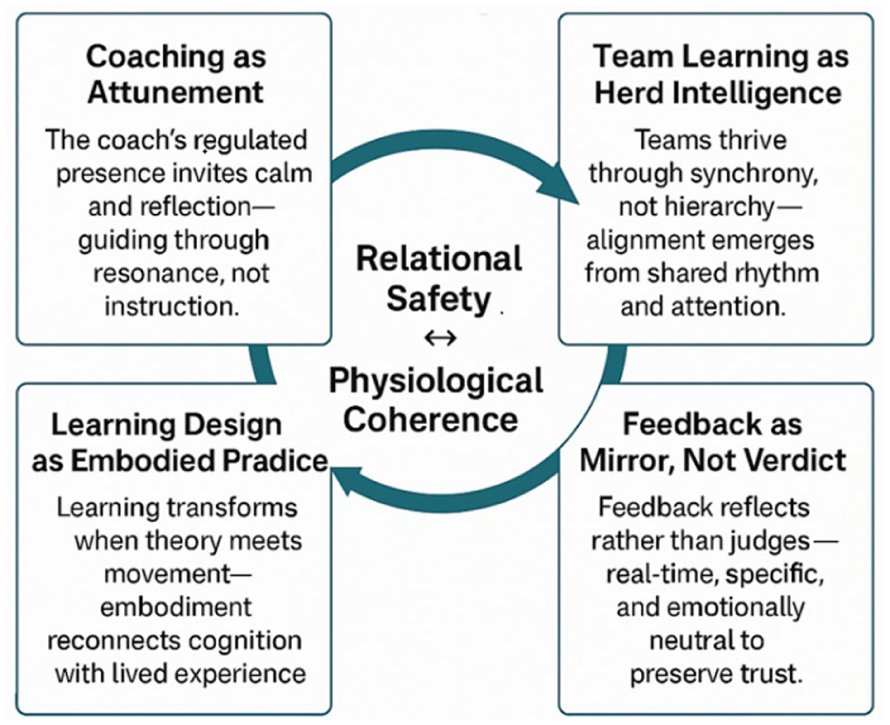
The co-regulatory model of embodied HRD leadership practices.
Natural Horsemanship also reminds us that effective HRD leadership and co-regulation both depend on mutual vulnerability (Nef, 1999). The horseman must relinquish the illusion of control, trusting that guidance will arise from shared rhythm. Similarly, leaders must risk openness—acknowledging uncertainty, receiving feedback, and adapting in the moment. This vulnerability is not weakness; it is the precondition for authentic connection (Zak, 2018).
From a systems perspective, co-regulation extends beyond dyads to the organizational field itself. Cultures, like individuals, can be either coherent or dysregulated. HRD professionals, as organizational developers, serve as “regulators of regulators,” helping leaders diagnose emotional climates and restore alignment through dialogue, restorative practices, and transparent communication (Gilley et al., 2011; Turner & Baker, 2018). Just as a seasoned horseman senses imbalance within the herd, HRD practitioners cultivate field awareness—a perceptual sensitivity to the undercurrents of fear, fatigue, or disengagement that destabilize collective functioning.
The essential insight from Natural Horsemanship for HRD is this: leadership effectiveness originates in embodied awareness and extends relationally. Co-regulation transforms leadership from a unidirectional act of influence into a mutual process of shared sentience. When leaders embody this principle, organizations move as herds do—fluid, responsive, and resilient.
Conclusion: The Sentience of Leadership
To stand before a horse is to stand before truth. One cannot fake calm, mask fear, or disguise intent. The horse reads the nervous system as openly as a book. Its feedback is immediate, unfiltered, and compassionate in its honesty. For the reflective leader, this encounter is revelatory: it exposes that leadership is not primarily about message, strategy, or charisma—it is about the embodied state. The sentience of the horse invites a reconceptualization of leadership as an emergent property of relationship rather than a possession of the individual. Leadership occurs in the spaces between beings, in the rhythms of mutual perception and emotional exchange. It is, fundamentally, a sentient phenomenon—a dance of awareness where biology and (sub)conscience intertwine.
This signals a conceptually important point for HRD. That traditional leadership frameworks miss the essence of transformation because they treat development as a cognitive or behavioral exercise—something to be learned about rather than lived through. What is often absent is the reciprocal embodiment of sentience: the understanding that leadership emerges from our capacity to sense, regulate, and respond within living systems. The horse exposes this omission with clarity. In the herd, leadership flows through attuned presence—passing fluidly to whoever embodies calm coherence. The strongest do not lead through control but through the stability they generate in others. This reframes HRD leadership development as a practice of relational regulation and embodied awareness, where transformation is born from entrusted sentience.
Natural Horsemanship is not about training horses; it is about refining humanity. It reminds us that every act of leadership is an act of learning, every interaction an experiment in trust. When leaders engage others as sentient partners—whether colleagues, communities, or creatures—they embody the deepest aim of HRD: to expand the human capacity to relate ethically, adaptively, and compassionately within the web of life. Natural Horsemanship restores leadership. It returns leadership to its oldest truth: relationship over control, resonance over authority, connection over command. And it calls upon HRD to cultivate leaders who, like the skilled horseman, understand that mastery is not measured by control but connection.
Footnotes

Funding
The author received no financial support for the research, authorship, and/or publication of this article.
Declaration of Conflicting Interests
The author declared no potential conflicts of interest with respect to the research, authorship, and/or publication of this article.