



Abstract
A multigenerational caregiving crisis is emerging at the interface of family and work, and human resource development (HRD) should pay attention. This perspective considers the impact of multigenerational caregiving-induced responsibilities on human capital frameworks, and their implications for HRD. We believe traditional models often neglect the unique challenges multigenerational caregivers face—such as stress, absenteeism, and constrained opportunities for self-development—which contribute to the erosion of human capital. This paper uses quantitative models to show that multigenerational caregiving is a critical driver of human capital depreciation. Integrating multigenerational caregivers into human capital discourse foregrounds the need for adaptive HRD strategies. These strategies should prioritize both human capital sustainability and workforce well-being, empowering organizations to support multigenerational caregivers and build a more inclusive, resilient workforce.
Keywords
There are only four kinds of people in the world. Those who have been caregivers. Those who are currently caregivers. Those who will be caregivers, and those who will need a caregiver.—Rosalyn Carter
The recent observance of National Caregivers Day (February 21, 2025), offered a timely opportunity to recognize the vital contributions caregivers make to families, communities, and society at large. Of particular importance are multigenerational caregivers (MGCs; Patterson & Margolis, 2019)—individuals who provide care across generational boundaries, such as for young children and aging parents. Often referred to as the “sandwich generation” (Miller, 1981, p. 419), these caregivers face competing role demands that can radically disorder their professional and personal lives (Griggs et al., 2020; Pashazade et al., 2024).
While precise estimates vary, recent data suggest that 18%–23% of Americans are considered MGCs, caring for both elderly family members and children under 18 (Burke, 2017; Pew Research Center, 2022). This growing demographic provokes the need for recognition to move beyond acknowledgment and critically address a pressing yet underexplored issue in human resource development (HRD): the impact of multigenerational caregiving (MGC) on human capital.
This paper presents a perspective on reevaluating human capital frameworks to address the competing demands of MGCs. We advance the central proposition that MGC constitutes a significant yet underrecognized source of human capital depreciation in contemporary labor markets. The intensity and duration of MGC duties impose psychosocial and temporal constraints that clearly impact capacity for professional development, health maintenance, and continuous skill acquisition (Bauer & Sousa-Poza, 2015). These constraints generate opportunity costs—such as reduced participation, absenteeism, and limited reskilling—that are rarely captured in traditional models of human capital. By extending human capital theory to account for MGC-induced depreciation factors, we offer an economic lens that links MGC burdens to macro-level workforce outcomes. This reframing foregrounds the need for HRD to adopt adaptive strategies that prioritize human capital sustainability and workforce well-being by addressing the fundamental pressures experienced by MGC employees. To anchor our perspective, we begin by revisiting the foundational concept of human capital and identifying its theoretical limitations in accounting for the caregiving realities faced by MGCs.
Human Capital
The concept of human capital, first introduced by Becker (1964 [2009]), provides an economic concept for the productive attributes of individuals—such as education, technical expertise, and workplace-relevant skills—that underpin productivity within industrial-capitalist societies. Although this model has traditionally served as a basis for understanding workforce dynamics, its limitations are becoming increasingly evident in the context of shifting societal structures, often referred to as “late modernity” (Côté, 2005, p. 224). For instance, though human capital models effectively describe the economic utility of workplace skills, their scope becomes limited when addressing the broader socio-economic challenges associated with caregiving.
Recent scholarship has offered important insights into the challenges MGCs face within the labor force. For example, elder caregiving has been shown to directly impact labor force participation, with caregivers often reducing work hours or withdrawing from the labor market entirely due to caregiving responsibilities (Lilly et al., 2007; Moussa, 2019). These effects are further nuanced by caregiving intensity, which disproportionately affect blue-collar workers who experience physical demands and limited flexibility, compared to white-collar workers, who struggle with balancing work-life integration (Cheng et al., 2020). And the implications extend beyond workforce participation, touching on caregivers’ psychological and physical health. Studies have documented the significant stress and health challenges associated with caregiving, which directly influence productivity and career longevity (Bauer & Sousa-Poza, 2015). Moreover, while organizational support mechanisms, such as supervisor encouragement and diversity management, have been identified as critical enablers of work-family policy utilization (Kim & Mullins, 2016), many organizations lack comprehensive policies to address caregiving needs (Matuszek & Bandow, 2016).
While these studies highlight the potential impact of MGCs on organizational outcomes, they do not explicitly address the need to reevaluate human capital frameworks to integrate caregiving demands as a central element of HRD. Pressures are faced by MGCs that extend beyond measurable workplace skills, imposing opportunity costs that are rarely accounted for in conventional frameworks. For example, the straightforward equation for quantifying the invisible overtime burden (

Where:
This equation considers that MGCs face heightened opportunity costs due to this unpaid caregiving labor, which directly limits their ability to invest in professional growth and exacerbates human capital depreciation. Expanding human capital models to reflect the nuanced realities of MGCs is critical to advancing HRD scholarship and practice, ensuring both the sustainability of organizations and the well-being of their workforce.
While this overview outlines MGC-related pressures on workforce participation, a more detailed perspective requires modeling how these pressures quantitatively affect human capital depreciation. In the next section, we extend this logic by embedding caregiving variables into established human capital and production models.
Integrating Multigenerational Caregiving into Human Capital Depreciation Models
Côté (2005) proposed narrowing human capital to workplace-specific skills, while introducing “identity capital” to capture broader identity-negotiation tasks like personal values, affiliations, and life planning—especially relevant in late modernity. Caregiving-induced responsibilities often intersect with these identity tasks, creating a complex dynamic that disrupts the balance between occupational and personal development. This interplay stresses the importance of modeling human capital depreciation as a function of caregiving duration and the intensity of caregiving demands.
The relationship between MGC and human capital investment further complicates the dynamics between such investments and their returns. While education, training, and health improvements traditionally enhance human capital, caregiving introduces depreciation factors—such as stress, absenteeism, and reduced opportunities for self-development—that diminish these gains. This heightened depreciation not only reduces the projected human capital but also impacts the return on human capital investment (R) by increasing opportunity costs (C) associated with caregiving. The dual burden of caregiving and professional responsibilities creates a compounded challenge, affecting both immediate productivity and the longer-term value derived from human capital investments. This relationship can be quantitatively represented as follows:

Where:
w1: wage without investment.
Caregiving-induced responsibilities increase challenges by limiting opportunities for further education, training, or self-care, thereby reducing resources. These compounded challenges hinder personal and professional growth. And they also directly influence productivity. The burden of MGC introduces depreciation factors into the human capital equation, potentially accelerating the erosion of skills and capacity over time, and can be represented mathematically as follows:

Where:
Caregiving-induced responsibilities lead to a higher Dt, reducing HCt+1 and contributes to human capital depreciation. This phenomenon extends beyond individual productivity, influencing productivity spillovers that shape organizational performance (Carpenter, 2020). As MGCs navigate their dual roles, their diminished capacity indirectly affects workplace outcomes, necessitating an examination of these dynamics through an aggregate production function:

Where:
Q: output.
A: technology level.
K: physical capital.
HC: human capital.
L: labor.
F: Represents the production function, which combines the inputs K, HC, and
So, in the context of MCG on human capital, the production function F (K, HC, L) serves as a conceptual “black box,” encapsulating how physical capital (K), human capital (HC), and labor (
Linear Model

In this model, the contribution of each input is additive and independent, suggesting that physical capital (
Interaction Model

In the interaction model, the contribution of each input (K, HC, and
Cobb–Douglas Production Model

In the Cobb–Douglas production model, the inputs of physical capital (
Threshold Model

In the Threshold Model, the production function
Dynamic Model

In the Dynamic Model, the production function
Policy-Sensitive Model

In the Policy-Sensitive Model, the production function
Collectively, these models illustrate how MGC-induced responsibilities can act as depreciation forces that erode individual capacity and organizational productivity. These insights form the basis for practical implications in HRD. Strategic interventions have the potential to preserve human capital (Park et al., 2021) by mitigating the long-term effects of MGC-induced capital loss.
Brief Implications for HRD
Including MGC factors in human capital models uncovers vital yet often overlooked implications for HRD. Especially when considering the compounded losses experienced by both employees striving to balance care and career, and organizations struggling to retain and support them. Traditional skill-based frameworks overlook the competing demands of MGCs, highlighting the need for a broader view of human capital depreciation. MGC-induced factors—such as mental strain, absenteeism, and reduced opportunities for self-development directly impact individual productivity. They also alter how human capital interacts with physical capital and labor, thereby affecting broader organizational outcomes. Quantitative models like Cobb–Douglas and Threshold frameworks highlight how MGC can reduce the elasticity or availability of human capital. In contrast, policy-sensitive and dynamic models emphasize the importance of targeted interventions in mitigating these effects.
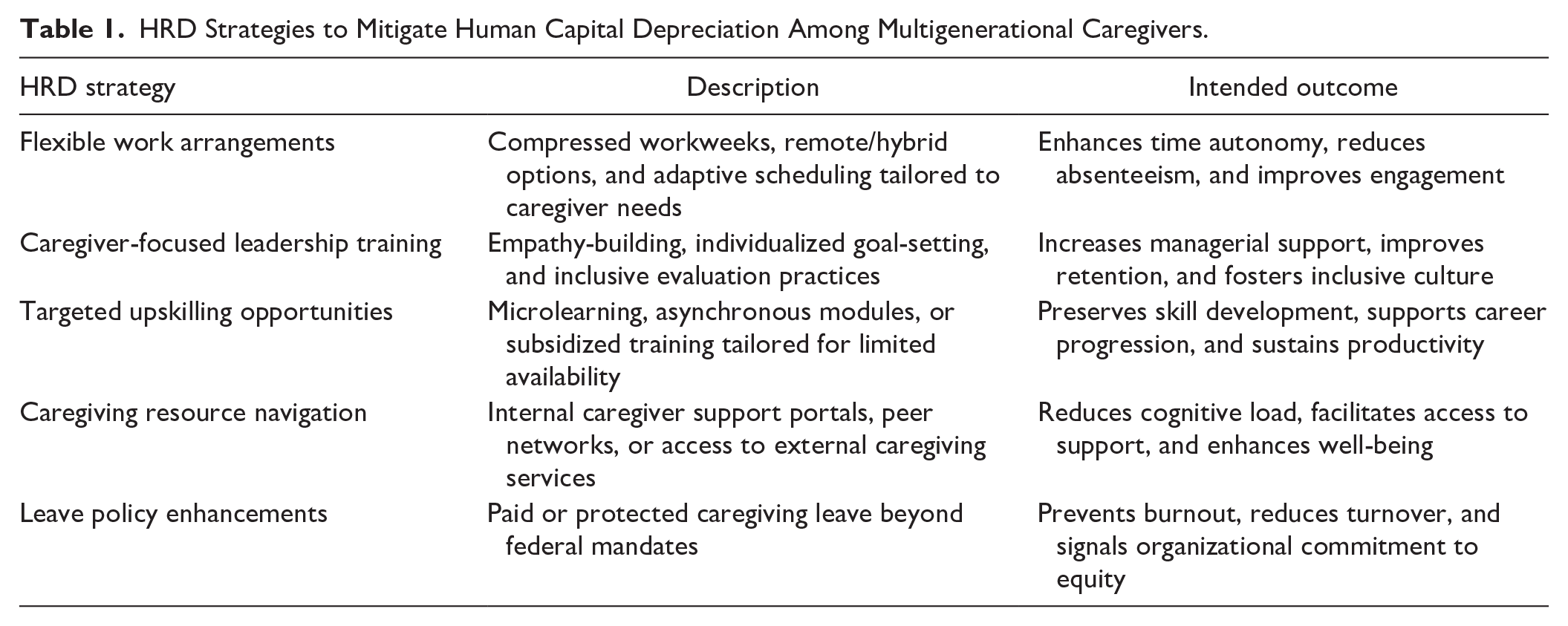
It is critical for HRD to incorporate strategies to address the challenges. These strategies help preserve human capital while strengthening commitment, reducing turnover, and fostering a more inclusive, supportive workplace culture. Table 1 presents targeted HRD strategies—like flexible scheduling, caregiver-aware leadership, and tailored upskilling—that address MGC constraints and offer practical approaches to reduce human capital loss while boosting retention, engagement, and productivity.
HRD Strategies to Mitigate Human Capital Depreciation Among Multigenerational Caregivers.
Integrating MGC realities into human capital models is not only strategic—it is a step toward equity. Women, who disproportionately shoulder caregiving roles, often face systemic barriers that quietly stall their careers (Patterson & Margolis, 2019). When HRD practices align with MGC realities, organizations foster inclusion, strengthen retention, and elevate engagement. This alignment enables HRD to address the evolving challenges of MGCs while sustaining organizational vitality amid changing workforce and demographic trends.
Conclusion
This perspective emphasizes the need to reimagine human capital frameworks to account for the unique and complex challenges faced by MGCs. Incorporating MGC into HRD discourse calls for a shift toward human capital models that enable organizations to better support caregivers and build a more inclusive, resilient workforce. To advance this agenda, HRD should embed MGC priorities into leadership training, performance evaluations, and workforce development planning. And organizations are encouraged to audit existing policies—such as leave structures, flexible work options, and training access—for their responsiveness to caregiving demands. Future research should explore the longitudinal effects of MGC on skill depreciation and career progression, as well as the impact of targeted interventions. HRD has the power to redefine the workplace by ensuring that those who care for others across generations are no longer invisible—but are seen, supported, and empowered to thrive.
Footnotes
Declaration of Conflicting Interests
The author(s) declared no potential conflicts of interest with respect to the research, authorship, and/or publication of this article.
Funding
The author(s) received no financial support for the research, authorship, and/or publication of this article.
