



Abstract
The purpose of the study is to understand how Japanese women become social entrepreneurs. The challenges in fostering women’s entrepreneurship include socio-cultural traditional views on women’s roles and expectations and insufficient support systems. Despite such challenges, the rise of Japanese women as social entrepreneurs has been observed in recent years as a unique response to natural disasters and crisis situations, such as the Tohoku earthquake in 2011 and the Kumamoto earthquake in 2016. Women felt the need to make positive changes and assist their country to build back. However, limited research exists that examines Japanese women social entrepreneurs’ development throughout their lives. Women social entrepreneurs may have gone through critically reflective moments through significant life events, which can eventually change the course of their professional paths. The methods of the study include in-depth, individual interviews with five women entrepreneurs, field observations, and a review of documents, including women’s organization websites, news articles, and social media. These findings provide both practical and scholarly insights that can be useful for the field of adult education and human resource development and women’s studies, highlighting how women maneuver challenging conditions, and how they effectively learn and transition from such challenges to become successful social entrepreneurs.
Keywords
As a social and economic issue, Japan has attempted to revitalize its economy in light of its aging population and low childbirth rate (Yokoyama & Birchley, 2020). According to government estimates, Japan’s population as of 2022 is 125 million, with 36 million people aged 65 years and older (Ministry of Internal Affairs and Communications, 2022). Analysts predict the population will fall below 100 million by 2053 (National Institute of Population and Social Security Research, 2017). Considering the shrinking labor population, closing the gender gap in the labor market would add 5.8 million employees and lift the gross domestic product in Japan by 10% (Matsui et al., 2019)
To sustain economic development in light of the population challenges, the Japanese government started to recognize the importance of supporting women’s creative and entrepreneurial potential by promoting social integration and reducing inequalities (Futagami & Helms, 2017; Yokoyama & Birchley, 2020). Prime Minister Kishida created the “New Capitalism” strategy that strives to support innovation and entrepreneurship (Government of Japan Public Relations Office, 2022). As part of the initiative, the Japanese government emphasized the United Nations Sustainable Development Goals (SDGs) and the support of women entrepreneurs as a part of the plan (Cabinet Secretariat, 2022).
Compared to traditional entrepreneurship, which is generally defined as pioneering an innovative product and/or a new business model pursuing profit (Eisenmann, 2013), social entrepreneurship refers to businesses for social benefits. In the context of Japan, social entrepreneurship has a variety of operation forms, such as cooperative organizations, not-for-profits, small businesses, and workers’ collectives (Fujii et al., 2013). Japanese social entrepreneurs advocate for varied social objectives by formulating economically viable strategies, launching new social ventures, and advancing social progress via novel products, services, and systems (Tanimoto, 2008; Yokoyama & Birchley, 2020). Community-level businesses that aim to solve community issues are common among Japanese social enterprises (Yamanaka, 2018). Examples of such problems include the declining birthrate and aging population, inequalities such as gender labor issues, and income disparities (Yamanaka, 2018).
The rise of Japanese women as social entrepreneurs has been observed in recent years, particularly as a unique response to natural disasters and crisis situations, such as Tohoku earthquake in 2011 and Kumamoto earthquake in 2016 (Nakamura & Horimoto, 2020; Ogawa, 2021). Women felt the need to make positive changes and assist their country to build back after each disaster (Nakamura & Horimoto, 2020; Nishiguchi et al., 2017). An increasing number of women have started businesses in childcare, nursing, education and learning support, entertainment, and recreation services, where their business goals are to satisfy the emerging needs of their local communities or society (Miyake & Kato, 2021). The portion of women who engage in social entrepreneurship has reached 67.5%, compared to 43.9% of men (Small and Medium Enterprise Agency, 2017).
Problem, Purpose Statement, and Research Questions
Even with the Japanese government’s support and an increasing number of women entrepreneurs/social entrepreneurs, women still face difficulties pursuing entrepreneurial paths. Despite being a highly developed country, Japanese women’s participation ratio in entrepreneurship, compared to men, is one of the 5 lowest out of 50 countries (Global Entrepreneurship Monitor, 2019). There are multi-layered challenges manifest in fostering women’s entrepreneurship culturally, socially, and structurally in Japan (Laratta et al., 2011; Nakamura & Horimoto, 2017, 2020). Japan’s traditional gender roles are “men at work, women at home” (Nakamura & Horimoto, 2017, p. 74). Male-dominated culture influences women to commit to family responsibilities such as child or elderly care, which makes it challenging for women to pursue entrepreneurship (Futagami & Helms, 2017). Furthermore, the traditional views on gender roles and expectations contribute to the masculinity stereotype toward leadership and entrepreneurship, which makes it difficult for women to assert themselves in leadership and entrepreneurship positions (Nakamura & Horimoto, 2020, 2021; Welsh et al., 2014). Related to the male-dominant work contexts, women have limited access to social networks to successfully carry out their enterprises as they are left out of the boys’ club activities, including securing investors (Sequeira et al., 2016).
Limited research exists that examines Japanese women social entrepreneurs’ development. Considering the dearth of research on this topic, it is important to examine the current state of women’s social entrepreneurship in Japan through their own voices. Therefore, the purpose of this study was to understand how Japanese women become social entrepreneurs. The research questions for this study were:
RQ1: How do Japanese women become social entrepreneurs?
a. What specific situations or contexts have shaped their experience as Japanese women social entrepreneurs?
b. How have their values and beliefs intertwined with or influenced their experience as Japanese women social entrepreneurs?
In the following sections, we outline the theoretical framework, then we discuss the methodology used in the study, followed by the findings and discussion, which include a model developed based on the findings. The paper concludes with the limitations and implications for future research and practices.
Theoretical Framework
Considering the context of the research participants, the theoretical framework of this study explores (1) women’s social entrepreneurship through an authentic leadership lens and (2) transformative learning experiences focusing on critical reflection within the context of Japan. Transformative learning emphasizes that women entrepreneurs examine triggering moments through critical reflection (Nakamura & Horimoto, 2020), which can provide useful insights for future practice and research in authentic entrepreneurial leadership development.
Significant life events can be seen as triggers that can make women face disorienting dilemmas and lead them to critically reflect on their lives (Mezirow, 2000). Women social entrepreneurs may have gone through critically reflective moments during significant life events, changing the course of their professional paths and leading them to transformative learning experiences (Futagami & Helms, 2017; Miyake & Kato, 2021). Through the process of women’s social entrepreneurship development, women may have also increased self-awareness of weaknesses, strengths, values and beliefs, which can be seen as critical components of authentic entrepreneurial leadership qualities as social entrepreneurs’ new social venture is perceived as an authentic behavior (Hmieleski et al., 2012; Jones & Crompton, 2009). This section describes the two key factors that impact women in developing social entrepreneurship in Japan.
Social Entrepreneurship Through an Authentic Leadership Lens
Despite the disagreements in defining social entrepreneurship, scholars generally describe social entrepreneurs as those who provide innovative or exceptional leadership in social enterprises and are striving to achieve a social mission by solving social problems and impacting their communities (Dato-on & Kalakay, 2016; Jackson et al., 2018; Sengupta & Sahay, 2017). Social enterprises are embedded in their local communities. Therefore, social entrepreneurship is highly contextual and differs depending on national, regional, and local situations and needs (Sengupta et al., 2018). Yet, no matter where social entrepreneurs are, they can communicate their vision and engage others to achieve common goals together (Sengupta & Sahay, 2017). In the case of Japan, there are three characteristics that social enterprises possess, aligned with the Japanese government’s definition, which are “social mission, social business and social innovation” (Kondo, 2017, p. 1).
To execute the social innovation vision to make a positive impact on society, authentic leadership plays a key role (Kelly, 2022; Zhou et al., 2014). The constructs of authentic leadership include understanding of self, including values and beliefs as a leader, inner moral compass, facilitation of positive psychological capacities, transparency when working with others, and fostering positive self-development, which are also critical components of social entrepreneurial qualities (Kelly, 2022; Zhou et al., 2014). When social entrepreneurs launch a new social venture, it is often tied to their values and beliefs, which is perceived as authentic behavior (Hmieleski et al., 2012; Jones & Crompton, 2009). Literature on authentic leadership suggests that successful leaders must have an in-depth understanding of their own strengths and weaknesses, and congruence between values and behavior to guide others to achieve common goals (Christo-Baker & Wilbur, 2017; Liu et al., 2015). To lead social innovation and change to make an impact on the community and society, authentic social entrepreneurs must find their values and missions and then clearly communicate what they stand for. Social entrepreneurs who display such authenticity in leadership might be better equipped to withstand the challenges typically encountered by new ventures, positively impact others, and realize the full potential of their vision (Jensen & Luthans, 2006). Furthermore, authentic leadership of social entrepreneurs creates positive psychological capital and demonstrates transparency in communicating with others so that their employees are inspired by the social entrepreneurial leader (Edú-Valsania et al., 2016; Wang et al., 2014).
However, the concept of authentic leadership is seen as gender-neutral (M. M. Hopkins & O’Neil, 2015). This is because the leadership phenomenon has traditionally been examined through a male-dominated lens, often overlooking gender differences due to societal norms and expectations (Kapasi et al., 2016). From the social construction perspective, the meaning of authenticity in leadership can be biased by social norms where male-dominant leadership exists (Gardiner, 2016; Kapasi et al., 2016). Scholars argued that women might not have been accepted by others as authentic leaders (M. M. Hopkins & O’Neil, 2015; Liu et al., 2015; Nakamura et al., 2022). There is a need to study women and what authenticity means to them from the lens of authentic leadership (Nakamura et al., 2022; Williams et al., 2021).
Critical Reflection Through the Lens of Transformative Learning Experiences
Developing authenticity in social entrepreneurial leadership can be tied to critical reflection from a transformative learning perspective (Mezirow, 2000). Authentic leadership can be developed through meaning-making of life experiences using critical reflection to increase self-awareness and develop values (Mälkki, 2012; Michie & Gooty, 2005). Mezirow’s (2000) view of transformative learning indicates that critical reflection could lead to disorienting dilemmas, resulting in changing frames of reference. Challenges play a pivotal role in an individual’s development (Kegan, 1994). Critical reflection is necessary to make meaning after people encounter challenges (Mälkki, 2012). In other words, as critical reflection involves a self-inquiry process that challenges one’s thinking and understanding of self and the world (Brookfield, 1995), triggering and challenging life events can lead to critically reflective moments that make people view their worlds differently. When confronted with significant life events, social entrepreneurs might encounter disorienting dilemmas, prompting them to critically reflect on and interpret their experiences, which can then shape their subsequent actions (Bagheri & Pihie, 2011). Through this meaning-making process, people could discover their core values and mission.
Mezirow’s (2000) transformative learning theory delineates two forms of change: epochal and incremental. Epochal change refers to “sudden, dramatic, reorienting insight,” and incremental change indicates “a progressive series of transformations in related points of view that culminate in a transformation in habit of mind” (Mezirow, 2000, p. 21). In other words, transformation can happen through a sudden insight or as a process of successive transitions due to critical reflection of specific assumptions about oneself and others until the underlying structure of assumptions is changed (Mezirow, 1981). Critical reflection of assumptions is, then, a key concept for understanding how adults learn to think for themselves, instead of acting based on concepts, values, and feelings of other people (Mezirow, 1994). Considering the two types of changes, social entrepreneurs may encounter a significant life-changing event in their lives that may lead to taking a social entrepreneurial path or experience a series of events that may eventually change the course of their professional paths.
In Japan, women often face the challenge of expressing their authentic selves. This is because authenticity is tied to adhering to commonly accepted values (Galloway et al., 2015). In a male-dominated leadership context, women are not traditionally seen as leaders. This further complicates their self-expression, as the traditional views on gender roles and expectations contribute to the masculinity stereotype associated with leadership and entrepreneurship (Nakamura & Horimoto, 2020, 2021; Welsh et al., 2014). Even though women face a variety of challenges, Japanese women social entrepreneurs possess a strong vision and mission and strive to sustainably manage their enterprises even in the face of adversity (Takimoto, 2011). Authentic leaders must have heightened self-awareness of their own strengths and weaknesses, as well as congruence between their values and behaviors. This allows them to thrive sustainably despite challenges they face (Christo-Baker & Wilbur, 2017). Triggering life events can prompt women social entrepreneurs to introspect deeply, clarifying their life’s purpose and steering them toward authentic entrepreneurial leadership.
Methods
This study follows a social constructivist paradigm using the constructivist grounded theory-inspired approach (Charmaz, 2014). The constructivist grounded theory emphasizes a socially shaped, relativist understanding and values multiple perspectives and self-reflection in research (Charmaz, 2014). It is especially suitable for multi-faceted and complex phenomena that have not been previously explored, facilitating the development of new theoretical models (Charmaz, 2014). Consequently, grounded theory was employed for this study due to the limited research on women’s social entrepreneurship in Japan, allowing for the construction of a theoretical model surrounding the journey of Japanese women’s social entrepreneurship.
Participants
Selection criteria for interview participants included women entrepreneurs with at least 3 years of social entrepreneurial work experience and with more than one employee. Participants were identified through purposeful sampling, drawing from the researchers’ networks. Theoretical sampling was then employed to further expand the pool of participants. The researchers sent an email explaining the study and asked if the identified women would be willing to participate.
Five women participated in the study. Following the constructivist grounded theory, we prioritized data depth and richness, especially in this pioneering research effort of Japanese women in social entrepreneurship (Charmaz, 2014). After interviewing five participants, we achieved data saturation, evidenced by recurring themes without new insights. The detailed nature of our research and the specificity of our demographic justified our sample size. Our goal was to highlight an uncharted domain, emphasizing our findings’ significance, despite the small sample. Participant selection was also influenced by data accessibility and collection feasibility (Maxwell, 2013). Given our study’s design and the challenges in recruiting women social entrepreneurs in Japan, we opted for a focused sample of five participants.
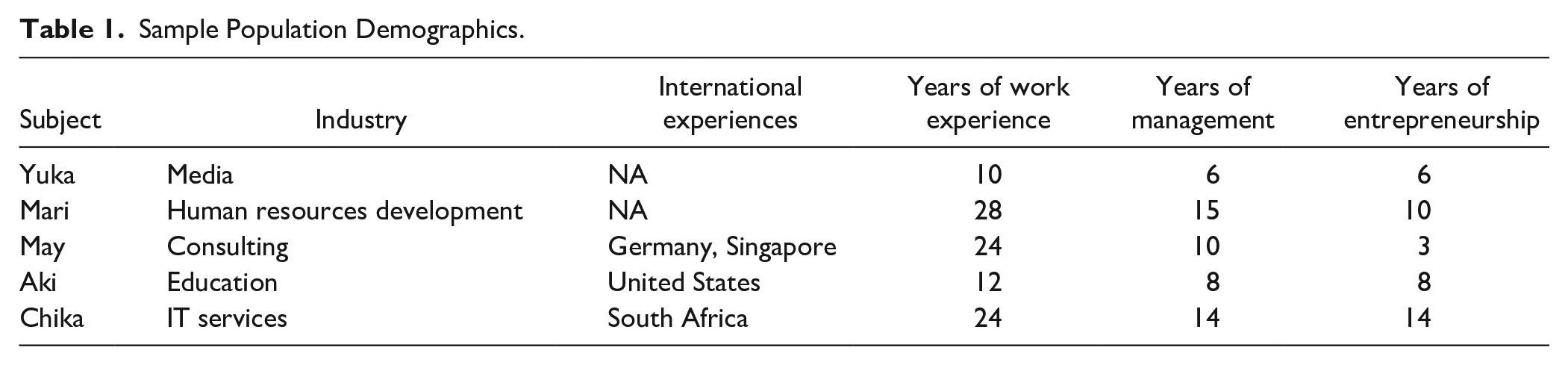
The participants’ average age was 45 years old, with a range between 33 and 52 years. All participants had more than 6 years of management experience. The management experience included both years that they supervised others in an organization where they were employed and years that they managed others in their social enterprise. The average time of entrepreneurial experience was 8 years. The participants represented the industries of media, human resources development, consulting, education, and IT services. Three out of five participants have international experience. International experiences indicate more than 6 months living experiences outside of Japan. To maintain confidentiality, we used a pseudonym for each participant in this paper, as Table 1 illustrates.
Sample Population Demographics.
Data Collection
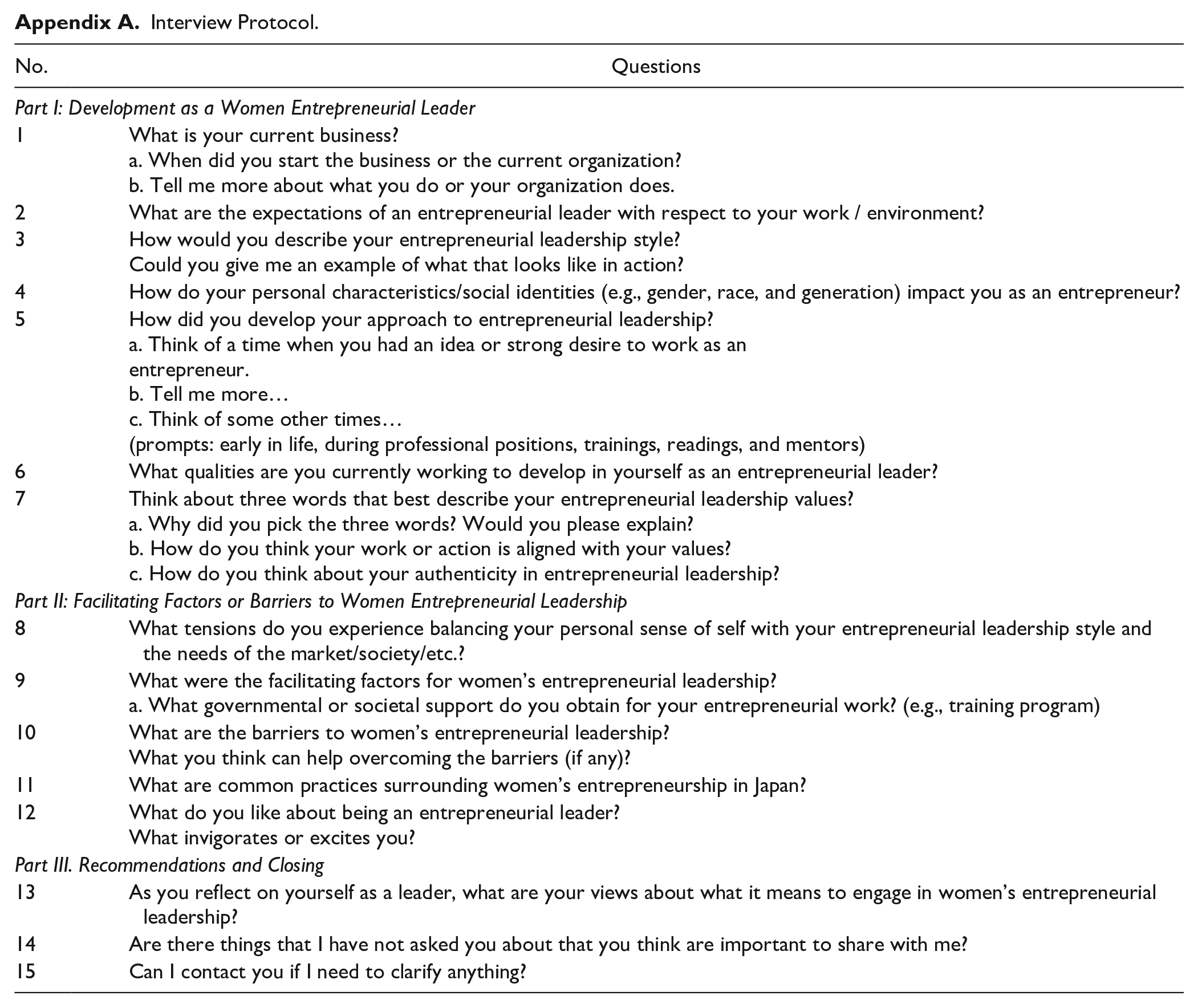
There were three parts to interviews, as the interview protocol illustrates in Appendix A. One was about development as a women entrepreneurial leader. The other was about facilitating factors or barriers to women’s entrepreneurial leadership. The final section consisted of reflective questions to explore if participants had additional comments or insights to share as they reflected on their entrepreneurial experiences. Overall, the interviews focused on particular episodes and stories of the participants’ social entrepreneurship experiences and the discoveries that formed their convictions as social entrepreneurial leaders.
Particularly, Part I was concerned with significant moments or events that participants perceived as triggers for their entrepreneurial path (Brookfield & Preskill, 2012). It also focused on participants’ self-awareness of strengths and weaknesses, values, and approaches to their social entrepreneurial leadership. Some sample questions included, “How did you develop your approach to entrepreneurial leadership? Think of a time when you had an idea or strong desire to work as an entrepreneur.” The critical incident approach allowed participants to recall significant moments or incidents that were unexpected for them and that potentially caused a disorienting dilemma (Brookfield, 2011). Some sample questions related to participants’ self-awareness of strengths and weaknesses, values, styles, and approaches to their social entrepreneurial leadership were, “What qualities are you currently working to develop in yourself as an entrepreneurial leader?” and “Think about three words that best describe your entrepreneurial leadership values?” Part II delved into facilitating factors or barriers to women’s entrepreneurial leadership. Some sample questions were, “What tensions do you experience balancing your personal sense of self with your entrepreneurial leadership style and the needs of the market/society/etc?” and “What were the facilitating factors for women’s entrepreneurial leadership?” Part III focused on the final reflections participants might want to share. A sample question was, “As you reflect on yourself as a leader, what are your views about what it means to engage in women’s entrepreneurial leadership?”
The interviews were conducted in Japanese either in-person or via video call (zoom), lasted 60 to 90 minutes, and were audio-recorded. When circumstances allowed, we visited the women’s workplace to conduct the interview. Two out of five interviews were conducted in-person at their workplace. Three of five interviews were done virtually. The two Japanese-born researchers took turns conducting interviews.
In constructivist grounded theory research, there is a strong emphasis on gathering rich data (Charmaz, 2014). During visits and interviews, we took extensive observation notes and reflective memos, either digitally or in notebooks. These observations and reflective memos deepened our understanding of how the participants managed and led their social enterprises. Specifically, observations supplemented or enriched interview data, allowing us to infer women’s perspectives (Bogdan & Biklen, 2007; Maxwell, 2013). Our memos contained both descriptive details and reflective insights, capturing our hunches and learnings, which assisted in interpreting the participants’ descriptions of their enterprises (Creswell & Creswell, 2018). Additionally, memoing encompassed documentation of the process and the identification of emerging themes post-interview (Charmaz, 2014). We also gathered archival data, such as the participants’ websites, social media, and news articles (Altheide & Schneider, 2013). This review further clarified and corroborated information derived from the interviews.
Data Analysis
Building on our orientation toward a social constructivist paradigm inspired by Charmaz’s (2014) constructivist grounded theory, we embraced the flexibility and reflexivity she champions. Adapting to our dataset’s demands, we implemented a multi-step constant comparative data analysis process (Charmaz, 2006, 2014). First, we transcribed interviews verbatim in Japanese. After completing the transcriptions, these Japanese transcripts were translated into English using Google Translate, ensuring their accessibility for the entire research team. Each English transcript was then independently reviewed by the Japanese researchers of our research team to check the accuracy of translations. Discussions were held on any translations that were not correctly captured until a consensus was reached and the meaning was clear to all members, leading to necessary revisions. Following this, during the initial coding phrase, we delved into more minute segments of data, which spurred the creation of a codebook and definitions. This foundation steered us to focused coding, synthesizing related codes to explain key segments of the data, and later to axial coding, where these synthesized codes coalesced into key categories. These categories were developed in an abductive manner, melding established literature frameworks with inductive, bottom-up ideas illuminated by our participants. Then we identified core themes. Unlike categories, which capture specific facets of the data, core themes are overarching narratives that weave through multiple categories, capturing the essence of the research. As we navigated through each coding phase, the team convened for collaborative discussions, refining codes, categories, and themes until a consensus materialized. A shared Google spreadsheet supported out real-time collaborative efforts (Ose, 2016). Our allegiance to the constant comparison method, especially during focused and axial coding, facilitated our thematic depth and precision (Charmaz, 2006; Saldaña, 2016). To round off, it’s pivotal to stress that our findings intimately resonate with the unique “time, place, culture, and situation” (Charmaz, 2006, p. 131).
Throughout the analysis process, we employed validity strategies to check the accuracy of the findings. Creswell and Creswell (2018) recommend one or more validity approaches to implement in the study. First, we triangulated multiple data sources including the field observation notes, interview memos, and other documents such as participants’ news articles, social media feeds, and blogs. We compared data sources with interview data during analysis. Second, to clarify our researcher bias, we engaged in self-reflection on our background throughout the analysis process. Especially considering that the two of us who conducted interviews are Japan-born researchers, we discussed any questions raised by the non-Japanese member of the research team to clarify Japanese culture-specific nuances and historical background during review of transcripts and in the coding process. This enabled us to check any potential biases we bring as Japan-born researchers to the analysis process. For reliability, each of us reviewed transcripts to make sure there were no errors. We also continually compared data with the codes and their definitions through frequent and constant communication between research team members either asynchronously through a shared google spreadsheet and emails and synchronously through the meetings.
Findings
Japanese women’s lived experiences as social entrepreneurs surfaced their leadership styles and approaches, a series of triggering events, and challenges and opportunities. The themes emerged through the data analysis included (1) Gendered Leadership Influences Women in Social Entrepreneurship, (2) Learning Throughout the Lifespan Influences Social Entrepreneurship, (3) Formal Learning as Opportunities for Professional and Social Entrepreneurial Leadership Development, (4) Self-awareness and Values Influence Social Entrepreneurship Approaches, (5) Critical Incidents as Catalysts for Social Entrepreneurship, and (6) Support and Challenges of Being Women Social Entrepreneurs. A model was developed that illustrates women’s social entrepreneurship in the context of Japan, as Figure 1 describes.
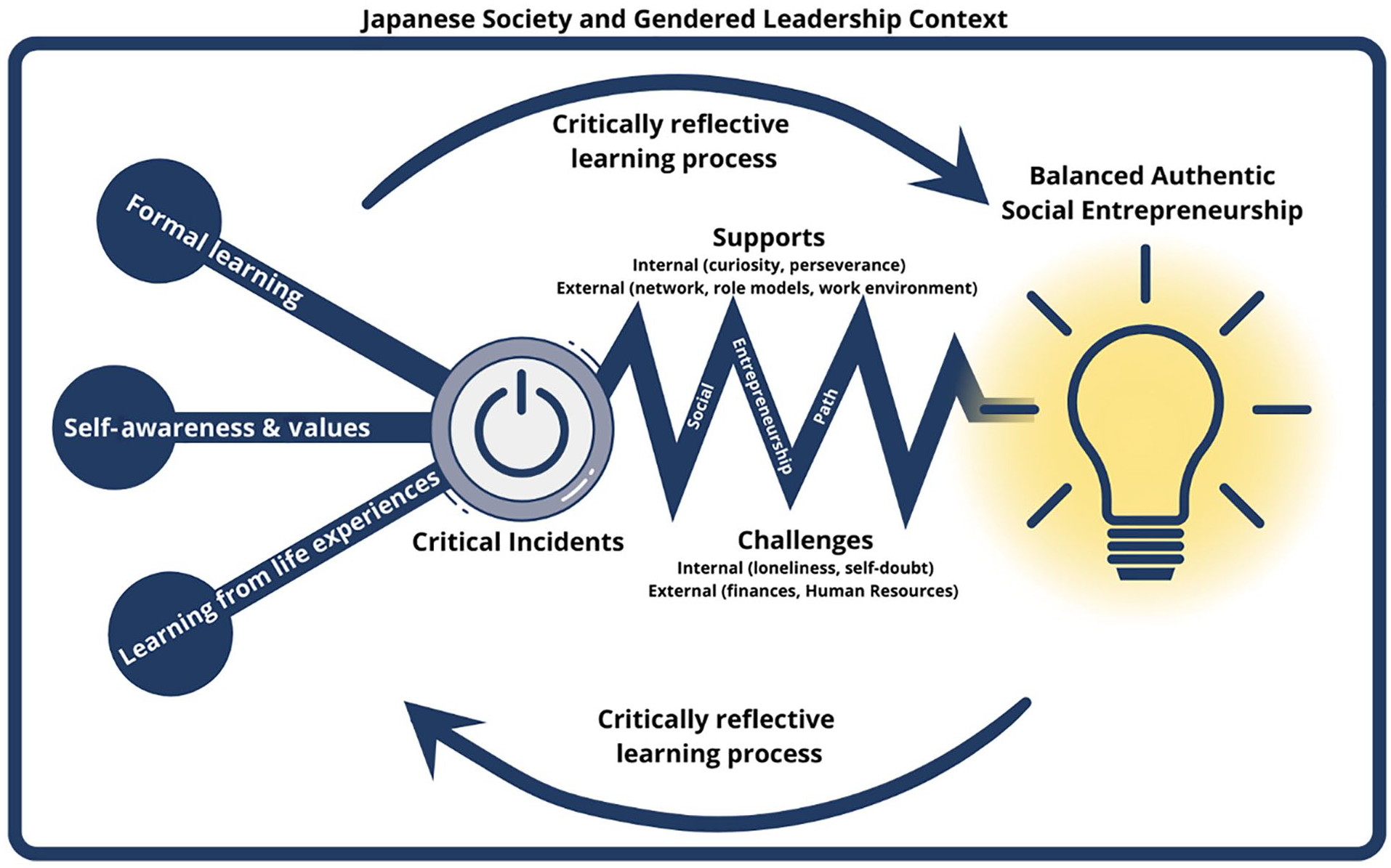
Japanese women social entrepreneurship development model.
Gendered Leadership Influences Women in Social Entrepreneurship
Findings indicated that women became social entrepreneurs largely because of the negative experiences in the Japanese societal and gendered leadership context. This is visually represented in the model by a square line that encompasses the various components. Participants revealed both disadvantages as well as advantages to gendered leadership, as sub-themes emerged. Gendered leadership refers to the influence of gender on leadership styles, behaviors, and experiences (Park, 2022).
The Japanese work environment is male-dominated and the boy’s club mentality exists and prevents women from pursuing leadership careers. This environment was perceived as a disadvantage for Japanese women. Each participant noted they faced discrimination and perceived themselves as underrepresented working professionals. For instance, Chika mentioned how Japanese society expects men to be a breadwinner. She said, “Men are raised to be breadwinners…. Men see their self-image as working professionals.” May mentioned that “most of the companies want [to hire] men, and macho [masculine] people who can work 24 hours a day,” implying that it is difficult for women to be successful, especially if they are expected to raise their children and take care of elderly parents, which are major social norms for women in Japan.
However, the participants reported that gender is also an advantage as Japanese women use more relational styles of leadership to create inclusive and collaborative work environments, which is different from hierarchical, traditional masculine leadership contexts in which Japanese companies operate. All participants indicated they value collaborators’ or co-workers’ strengths and like to embrace and foster others’ talents or leadership skills. Aki described her leadership style as “Okaasan[mother] style” of leadership. She said, “… I love finding strength, talents, gifts in other people….I enjoy building a team where everyone’s strength is appreciated and fully utilized.”
Learning Throughout the Lifespan Influences Social Entrepreneurship
Learning from challenging or successful life experiences and global exposure throughout the lifespan shaped participants’ social entrepreneurship approaches. In the model, “learning from life experiences” is represented as one of the three levers positioned on the left side. The participants shared lessons learned from past experiences, including past company experiences, early life lessons, and international experiences. All participants had company work experience prior to launching their social enterprise, and they described experiences like managing a large group of people or leading a large-scale project. However, at some point in their careers they began to think about what they could do differently.
Some obtained business-related skills or management from their previous work experiences. Aki gained managerial experience and education-related work, which helped her in pursuing and launching an enterprise. May indicated her experience of launching new businesses in her previous company helped her gain entrepreneurial skills. Yuka’s stories illuminated inspiring experiences from her youth, which set a foundation and interest in entrepreneurship. When she was a teenager, her sister, who is also an entrepreneur, invited her to a series of events with entrepreneurs. Yuka said: When I was a high school student, I was taken by my sister to the events…She was a representative of the student association, and she was invited to discussions of [politicians or the president of corporations] to talk about the future of Japan. Maybe my sister wanted to influence me.
She also had leadership experience in a management member club while she was in college, which also influenced her social entrepreneurship endeavors.
All participants had international experiences either living, working, and/or learning. May, Chika, and Aki lived or worked for more than 6 months outside of Japan. Yuka and Mari also had international experiences through volunteering work, an international competition, and attending a leadership development program. For instance, Aki lived in the United States for 20 years and her social enterprise is about building a bridge between Japan and the United States. May had lived in different countries including Germany and Singapore. She also had an experience attending a leadership program in Switzerland. Chika grew up in South Africa. Mari mentioned that she “go[es] abroad to learn, meet others and receive training, which is relatively expensive. [She] go[es] for about a month [every] year.” Likewise, Yuka explained her international work projects, such as a media campaign project. Each woman shared her international experiences as learning experiences for their growth and development. These experiences provided them with a new way of thinking and reflecting about who they are and what they are truly passionate about.
Formal Learning as Opportunities for Professional and Social Entrepreneurial Leadership Development
Participants were also critically reflective of their own self-doubt and reported they embraced moments of self-discovery, and the way intersecting/diverse elements of who they are impact and influence their leadership. In the model, “formal learning” is shown as one of the three levers positioned on the left side. May mentioned: I went to [a leadership development program] not because I am an entrepreneur, focusing on leadership, but also because I felt a lot of barriers when taking-on leadership in Japanese companies as a woman… I was pushed to seriously think about my authenticity in leadership no matter whether I am an employee or entrepreneur. … It was a process of clarifying what I want to be.
Similarly, Chika described how she obtained formal learning opportunities. She said: Basically when I don’t have an answer, I have to go to the person who has the answer…Whether it was a book or a seminar, so I’ve been attending high-priced seminars in Tokyo for about 10 years on a regular basis.
Mari reflected upon the formal evaluation feedback she received from her subordinates at her former place of employment: “I had subordinates, when I worked at a foreign-affiliated company, I learned that I did not do [empathetic listening], through 360-degree feedback.” While she initially had doubts about this feedback, it continues to provide her deep insights, even now: “I could not accept it [the feedback], but now I think I can understand it. This continues to be on my mind.”
Self-Awareness and Values Influence Social Entrepreneurship Approaches
The other theme is self-awareness and values influence social entrepreneurship approaches. In the model, this theme labeled as “values” is shown as one of three levers positioned on the left side. The sub-themes are knowing self through navigating self-identity and knowing self as a leader and leader values. Women social entrepreneurs know self through navigating self-identity and self as a leader and leader values in relation to their social contexts.
Knowing Self Through Navigating Self-Identity
The participants shared episodes demonstrating they know who they are in relation to others in society. For instance, Mari talked about her awareness of being neurodiverse by saying: When I got a position, my social reputation increased…and my father, who did not acknowledge my (dis)ability at all, said, ‘[She] is doing okay.’… and my mother or father started treating me [differently by saying], “It’s okay, she is doing fine even though she is different [autistic].”
May’s experiences of living in Germany allowed her to be aware of how she was a minority. When she returned to Japan, she also experienced being a gender minority as a woman in the business world. She said: I grew up in Germany when I was a kid. So, having lived as a minority in a certain community first led to what I am doing now, consulting and specializing in women, who are a minority in the Japanese business world.
Aki described how others see herself depending on whom she talks with as she changes her conversation styles to meet their social expectations. She said: The conversations are very different, like how I should present myself…with the Japanese people like I try to use my American. I’m not American, but I lived in America for 20 years. My husband is American [and I use his last name]. So sometimes they may [wonder] if she really [is] Japanese or American and I try to use the Americanized side of myself, so that they don’t try to put me in that Japanese female category.
Knowing Self as a Leader and Leader Values
The women expressed who they are as social entrepreneurial leaders. As an important aspect of knowing themselves as leaders, the participants underscored values that were important to them such as social responsibility, balance between individuality and relationality, creativity, and being true to themselves and others.
Many of them shared a strong feeling of social responsibility. Chika mentioned, “I think that the desire to change the world in the community through education has led to entrepreneurship.” Yuka shared her hope to inspire the next generation of managers and leaders to focus on social value. She said, “I'm writing a next-generation management model in which social value and economic value are created by solving social problems, by creating shared value…” Aki focused on people who suffered from the earthquake and decided to provide opportunities for students in Tohoku to connect with people overseas so that they know that “there are so many people outside Japan who care so much about them…and…I want them [to know] that the life is not just about hardship that they’re facing right now.” Furthermore, Mari mentioned her social business includes diversity and inclusion as she creates a workplace/leadership development training for people of different ages and disabilities. She is also “focusing on happiness. I look at what it means for people to work happily and it’s just that it is good to have an entrepreneurial mind to support people to work happily.”
Interestingly, the women entrepreneurs noted the importance of balancing individuality and relationality, which seemed to encompass two opposing mindsets—individual versus collective. They wanted to be treated as individuals and treat others as individuals by trusting and valuing each team member’s ideas/contributions and their creativity. They also desire collective/shared leadership and decision-making responsibilities. Yuka for example wanted to create a society that values individuality.
A place like a society where everyone can live individually by really recognizing each individuality. It’s kind of natural when you come to America. I don’t have that much sense in Japan, yet, so what can we do to create such a society?
Consequently, Mari said, “It’s okay to be selfish…I keep telling you that I do not live by the expectations of others.” Similarly, Chika said, “I just have to be myself, and so on.” Furthermore, Aki talked about the individuality of each staff. She said, “I’m in-charge of making decisions for everyone definitely, but I never see them as my subordinate…and I think, having appreciation for staff is extremely important.”
At the same time, the aspect of relationality was reported by the participants. They emphasized their work to cultivate a supportive and collaborative space, while keeping their individuality and respecting others’ individuality. Yuka, for example, talked about the importance of “co-creation of those who make it together” as opposed to being “competitive” with each other. Aki used the word “friendship” to describe her relationship building. She said, “I said friendship in the end, but I think that’s what I cultivate with my team members, with sponsors, with stakeholders and also with the [clients] that we work with.”
Critical Incidents as Catalysts for Social Entrepreneurship
The findings suggest that critical incidents, or triggering moments act as catalysts for social entrepreneurship. The “critical incident switch” is depicted at the center of the model, which is influenced by three levers of “learning from life experiences,” “formal learning,” and “values.” These incidents encompass both societal and personal events. The participants strongly felt their social responsibility when they encountered social or personal critical incidents. As a result, they became motivated to contribute to Japanese society by supporting local communities and/or a certain group of people who needed assistance or support through their social entrepreneurship work.
Societal Incidents
Some participants described critical incidents occurring at a societal level. Among these, the Tohoku earthquake tragedy, known as the 3.11 disaster (which occurred on March 11th) in particular, was transformative for many of the participants, changing the way they saw the world and their role in it. For example, Yuka mentioned that the “3.11 [earthquake] made me feel uncomfortable, and I was working through that uncomfortable feeling, so I thought I had to solve this.” Aki also said: I didn’t have a specific business idea and then the [3.11] earthquake happened and I started to talk to other people….I wanted to do something for students in Tohoku [the damaged area]. [At that time,] I was wondering…what should I do with my career?…and felt [that I needed to] just to go out there and do something for the people who need help.
Furthermore, Mari explained how the earthquake shaped her social entrepreneurship trajectory, even though she had already been a social entrepreneur before the 2011 earthquake hit Japan. She talked about her “ah-ha” moment because of the earthquake by saying, “there was also 3.11, around 2011 [this made me] start to focus on regional revitalization” which eventually led to her current social enterprise model.
Lastly, Chika acknowledged that because of COVID-19, her enterprise’s mission was re-confirmed and even expanded. Specifically, the pandemic resulted in more online/virtual work, which required additional technical and IT support—a gap and services that Chika’s enterprise was able to address and provide.
Personal Incidents
Giving birth, accompanying a husband’s overseas assignment, quitting a job, attending entrepreneurs’ events, and having leadership experience in a male-dominated company were all reported as personal levels of critical incidents. Chika said, “after all, I was a normal person until I gave birth to a child. After giving birth, I published a childcare information magazine, set a goal, and then woke up to the fun.” Illuminating triggering moments at the personal level. May discussed quitting her job to accompany her husband for his overseas business assignment. She could not get a full-time job in Japanese companies’ regional branches because of her status as a spouse. When she returned to Japan, it was difficult to secure a job as a mid-career, full-time position as opposed to contractual roles; this eventually led to her launching a social enterprise. Furthermore, Mari reflected on her experience as the youngest and only woman manager at a previous place of employment. During this time, she felt that continuing to work in such an environment would be a limitation for her, changing the course of her professional pathway to an entrepreneurial one. She said: The company itself is a male-centered company…, and it was the first time…that a woman became the manager of the marketing department. I was in my thirties and was the youngest…I didn’t think I was able to demonstrate my leadership skills at all. I felt like I couldn’t do it anymore, and I felt the limits.
Support and Challenges of Being Women Social Entrepreneurs
Finally, support and challenges of being women social entrepreneurs emerged as a theme from participants. Due to the inconsistent nature of the support and challenges faced—as women may experience them variably and not always concurrently—they are represented by a zigzag line, rather than a straight one, in the model. The sub-themes of support included both external (networks, a positive work environment, and having role models) and internal (curious and perseverance mindset) forms of support. The sub-themes of challenges were also expressed as external (financial challenges and human resources) and internal (loneliness and self-doubt).
External Support Factors
The participants perceived networks as external support factors. For example, Chika viewed networks as mutually beneficial. She said: There are so many people…who want to support me [and I will support others], so if you ask me to cooperate in this kind of situation, [I am happy to help you]…even if you can’t do it alone, you can do it if you have friends, right?
Interestingly, the lack of a supportive environment for women in traditional workplaces due to societal gender roles and expectations led the women participants to create environments that were more supportive for themselves and the people who work with them. In other words, the women were able to create a positive and collaborative work environment. For example, May said: It’s fun to work…If you do something that is unenjoyable, your life will be painful, so it [your job] should be fun for you, or for the people around you. I want to do something that seems like [fun].
In terms of having role models as the other external support factor, Yuka talked about how her family, such as her sister and father, was a strong influence in supporting her social entrepreneurship development. Alternatively, May’s role model was a senior colleague in her previous company. She said: I was watching him making a decision and launching [a business]. [He] greatly influenced me….I thought it would be great if I could become a person who could do my own business to solve the problems I wanted to solve.
Internal Support Factors
Curiosity and perseverance are two more support factors that are internal attributes or characteristics that help Japanese women in a social entrepreneurial role. May said, for instance, she has an “inquisitive mind.” She does not consider herself to be afraid of failure, that could limit her curiosity. Similarly, Mari said, “[my] curiosity is probably unusually strong. Why, rather than being scared of it, I choose to take a risk by trying it.”
External Challenges
On the other hand, the data also identified challenges: external (financial challenges and human resources) and internal (loneliness and self-doubt). Externally, there is a financial challenge for their organizations and for themselves. It is often a challenge to find investors to support their enterprises, For example, May said: Depending on entrepreneurial level, when you need funds, investors are most of the time men and they crush women’s ideas….from women’s points of view, women find problems to solve but there are no men who are interested in them or there are no scalable themes.
There is also a personal level of financial challenge because entrepreneurial work often comes with financial instability. Mari said, “ I think it’s about running out of money. So all you need is basic income…. It is money that supports everyday life.” The other external challenge is human resources. For instance, Mari talked about how challenging it is to find the right people for her regionally located enterprise. May, on the other hand, talked about how much effort she made to manage a group of women who were juggling child rearing and housework.
Internal Challenges
Internal struggles were also reported by the participants. Two women mentioned “loneliness.” Aki acknowledged that “loneliness” can come with being a leader. Mari said she was alone and felt isolated, which distracted her. Another psychological barrier was self-doubt in successfully carrying out social entrepreneurial work sustainably.
Model Overview Summary
As the model depicts in Figure 1, in the context of gendered leadership in Japanese society, the main bases that lead to women’s social entrepreneurial paths include their prior life experiences, formal learning, and values. With these elements, critical incidents are triggering moments that are shown as a “turn on” button to start the course of action of social entrepreneurship. Participants faced challenges and support both internally and externally as they worked on their entrepreneurial endeavor. Throughout the process of becoming a social entrepreneur, critically reflective learning is essential, allowing the women social entrepreneurs to test their own assumptions and make meaning of their lives. Self-reflection occurs throughout their lives per learning from experiences and formal learning as depicted in the model. This model illuminates a balanced authentic social entrepreneurship, shown as a light bulb. Japanese women social entrepreneurs who are authentic and true to themselves have a balanced approach between individuality and relationality, which can be unique to these women.
Discussion
The findings revealed women’s experiences as social entrepreneurs in the context of Japan, their strong passion and vision derived from critical incidents, resulting in critical reflection, continued self-reflective learning throughout their lifespan, as well as challenge and support factors.
Gendered Leadership Context That Fostered Social Entrepreneurial Mindset
Considering career paths for women, all participants had experienced the socio-cultural traditional stereotypes toward women in Japan (Futagami & Helms, 2017; Miyake & Kato, 2021) as they developed their approaches to social entrepreneurship. While overall a disadvantage, this gendered challenge in Japan might actually have contributed to certain advantages under the gendered leadership findings. The women reported that this inequitable condition caused them to be creative and cultivate their own paths through social entrepreneurship because they were not expected to work like men nor expected to follow a company’s typical career ladder (Nakamura & Horimoto, 2020; Hayami, 2021).
Developing Balanced Authenticity in Social Entrepreneurship Through Self-Reflective Learning
The findings also illuminated the power of self-reflection in developing women’s social entrepreneurship with a balanced, authentic approach. Self-reflection on early life events, formal learning opportunities, and prior work experiences also facilitated the women’s decisions to become social entrepreneurs. In fact, throughout their lifespan, participants continuously engaged in reflective learning that made them deeply think about who they are and what they strongly believe or value. Reflection is a learning process that supports people in understanding life and its meaning (Dewey, 1938). Self-reflection is a powerful tool to increase self-awareness by examining personal experiences, which has been documented as an important part of leadership development (Boud et al., 2013; Nakamura & Yorks, 2011). Furthermore, in-depth reflections enabled participants to obtain a clearer understanding of their values. As a result, they pursued their social mission and vision.
Each participant described themselves as a woman social entrepreneur with a strong sense of social responsibility, commitment, and clear values (Kondo, 2017; Sengupta et al., 2018; Sengupta & Sahay, 2017). These values can be further explained through the lens of authenticity in leadership in which leaders strive to demonstrate their values through action (social enterprise) (Christo-Baker & Wilbur, 2017; Liu et al., 2015). Furthermore, authentic leadership literature suggests that leaders need to have increased self-awareness and an in-depth understanding of their own strengths and weaknesses for successful leadership (Christo-Baker & Wilbur, 2017). The women social entrepreneurs showed their awareness in relation to others, sharing their marginalized experiences in terms of gender, neurodiversity, and/or ethnicity. Their relational styles of leadership, focusing on inclusive work environments that treat all employees with respect and value, regardless of their rank, is unique to women social entrepreneurs, as it is different from traditional entrepreneurship in Japan that is hierarchical and expected to display masculine leadership qualities (Nakamura & Horimoto, 2020, 2021; Welsh et al., 2014).
What is unique about the Japanese women social entrepreneurs in this study is that they brought their own feminine style (e.g., Aki’s “Okkasan style”) or relational leadership (e.g., Yuka’s mutual reliance in a flat vs. hierarchical organization), combined with innovative social action. More specifically, participants seemed to strike a balance between individualism and relationality as they wanted themselves and others to be independent, unique, and creative while valuing others’ individuality, talents and skills. While they emphasize the aspect of individuality, they also commented on the importance of harmony, teamwork, and collaboration, which can be explained from a relational (Uhl-Bien, 2006) or shard leadership (Döös & Wilhelmson, 2021; Zhu et al., 2018) perspective. Even though the relational and shared leadership concepts have been differentially described by scholars, both theoretical constructs emphasize leadership interactions as a social process of dialogic construction and collaboration (Uhl-Bien, 2006; Zhu et al., 2018).
Critical Incidents and Critical Reflection That Led to Social Entrepreneurial Paths
Zooming into the identified critical incidents, or the triggering moments that made the women look into social entrepreneurial paths, were the notable findings. Mezirow (2000) described that critical reflection moments could lead to disorienting dilemmas that make people view their world in a different manner. Some of the interviewees experienced disorienting dilemmas, critically reflected on what they wanted to do in their professional lives, and began their social enterprises, especially due to the 3.11 earthquake (Bagheri & Pihie, 2011). In the context of Japan, the earthquake was a shocking trigger for some of the participants, which made them step forward in the path of social entrepreneurship as they strongly felt the need to make positive changes and assist their impacted local areas and people.
For instance, Mari was already operating a social enterprise when the 3.11 earthquake hit Japan. However, the 3.11 earthquake appears to have triggered a series of incremental changes in her thoughts and habits, which led to her current social enterprise model focusing on local area revitalization (Mezirow, 1981, 2000). The accumulation of critical incidents of experiencing, living, or working as a minority and being a female manager in a male-dominated environment may have gradually led to the way that Mari thought about herself and her values as a social entrepreneur.
Therefore, Japanese women reported significant changes in their lives, at both a societal or personal level, which helped them to realize their social entrepreneurial values for work and eventually led them to take an entrepreneurial career (Sakata, 2018; Takimoto, 2011).
Supporting Factors and Barriers to Developing Women’s Social Entrepreneurship
In terms of supporting factors and barriers to developing women’s social entrepreneurship, both external and internal factors were identified. The financial component is one significant factor that greatly impacts their business operation and their own living. Internal factors were often described as psychological barriers, caused by gender bias, that were deeply embedded in Japanese society (The Small and Medium Enterprise Agency, 2014). As a minority entrepreneurial leader in the business community, the women felt lonely, isolated, or even self-doubt of their capability to be successful. On the other hand, networking (Bernardino & Freitas Santos, 2019), having role models, and education (Nakamura & Horimoto, 2017, 2020) were important support factors for the women social entrepreneurs.
Limitations
There are several limitations in this research of Japanese women social entrepreneurs’ lived experiences. First, the nature of this study, with its reliance on voluntary participation and in-depth exploration of the selected participants’ experiences, might have introduced potential selection bias. Those who were willing to share might have different perspectives or characteristics from those who chose not to participate or those who could not due to their demanding entrepreneurial schedules. Despite these challenges, future research could engage with participants over extended periods, allowing for deeper interviews or iterative data collection, aiming to gain a more in-depth and comprehensive understanding of their experiences. In addition, future research can include the comparison between groups based on their past experiences such as international versus domestic, between women entrepreneurs and women social entrepreneurs, or even a comparison between women and men social entrepreneurs focusing on their gendered authenticity surrounding social entrepreneurship in Japan. Cross-country comparisons of women’s social entrepreneurship can also be another interesting angle, comparing urban and rural endeavors. Furthermore, follow-ups on the participants’ entrepreneurial path over time, as a longitudinal study, could detail rich storylines that explain participants’ developmental pathways as social entrepreneurs.
Implications for Future Research and Practice in AEHRD
The study, grounded in its model, presents significant implications for adult education and human resource development (AEHRD). Within the social entrepreneurship framework and influenced by authentic leadership, the findings emphasize reflective practices, crucial in the gendered leadership landscape of Japan. This study suggests these reflective habits are central for women leading social endeavors. Aligning these practices with AEHRD can pave the way for updated adult learning curricula and HRD strategies, suited to today’s socially-driven professional and educational scenarios.
For AEHRD research, the proposed model can act as a benchmark to investigate “balanced authenticity” across diverse populations. Such research can explore how authenticity interfaces with concepts like relational leadership (Uhl-Bien, 2006), as well as shared leadership’s dialogic social construction and collaboration (Döös & Wilhelmson, 2021; Zhu et al., 2018). Additionally, the study highlights the pivotal role of critical and self-reflection in shaping women’s entrepreneurial endeavors in a gendered context. Investing in ways to promote these reflective practices among women can be valuable for future research.
In a practical AEHRD context, creating spaces for reflection is crucial for aspiring women social entrepreneurs. Such environments can guide them toward relational leadership styles, emphasizing inclusivity. AEHRD practices can thus champion settings that emphasize mutual understanding and dialog-driven critical reflections. Examples include developing learning communities of practice (Eslahchi & Osman, 2021; Hafeez et al., 2021) or peer coaching (Hopkins et al., 2022), so that women leaders can engage in reflective conversations and share their experiences with each other.
Self-reflection at personal and societal tiers is pivotal. It helps test assumptions and derive meaning from experiences, guiding women in their entrepreneurial roles. Leveraging adversity and challenges can bolster women in social entrepreneurship, using these experiences as catalysts for societal impact. Networks, mentoring, and continuous learning are invaluable assets for these women. By fostering self-awareness and leveraging both informal and formal learning opportunities, women can carve successful paths in social entrepreneurship. Engaging with networks, as indicated by study participants, is essential, allowing women to expand their perspectives, validate thought processes, and receive vital feedback.
Conclusion
This study showed Japanese women’s lived experiences in becoming social entrepreneurs. The critical incidents and reflective learning processes are part and parcel of building social entrepreneurship. Balanced authentic leadership is a core of their approach to social entrepreneurial leadership as well. We hope that the findings of this study help deepen an understanding of the current state of women social entrepreneurs in Japan. We also believe that this study provided practical and scholarly insights, illuminating the role of reflection in authentic leadership and social entrepreneurship that can be useful for the fields of AEHRD and women’s studies by highlighting how women maneuver challenging conditions to effectively learn and become successful social entrepreneurs.
Footnotes
Appendix
Interview Protocol.
| No. | Questions |
|---|---|
| Part I: Development as a Women Entrepreneurial Leader | |
| 1 | What is your current business? a. When did you start the business or the current organization? b. Tell me more about what you do or your organization does. |
| 2 | What are the expectations of an entrepreneurial leader with respect to your work / environment? |
| 3 | How would you describe your entrepreneurial leadership style? Could you give me an example of what that looks like in action? |
| 4 | How do your personal characteristics/social identities (e.g., gender, race, and generation) impact you as an entrepreneur? |
| 5 | How did you develop your approach to entrepreneurial leadership? a. Think of a time when you had an idea or strong desire to work as an entrepreneur. b. Tell me more… c. Think of some other times… (prompts: early in life, during professional positions, trainings, readings, and mentors) |
| 6 | What qualities are you currently working to develop in yourself as an entrepreneurial leader? |
| 7 | Think about three words that best describe your entrepreneurial leadership values? a. Why did you pick the three words? Would you please explain? b. How do you think your work or action is aligned with your values? c. How do you think about your authenticity in entrepreneurial leadership? |
| Part II: Facilitating Factors or Barriers to Women Entrepreneurial Leadership | |
| 8 | What tensions do you experience balancing your personal sense of self with your entrepreneurial leadership style and the needs of the market/society/etc.? |
| 9 | What were the facilitating factors for women’s entrepreneurial leadership? a. What governmental or societal support do you obtain for your entrepreneurial work? (e.g., training program) |
| 10 | What are the barriers to women’s entrepreneurial leadership? What you think can help overcoming the barriers (if any)? |
| 11 | What are common practices surrounding women’s entrepreneurship in Japan? |
| 12 | What do you like about being an entrepreneurial leader? What invigorates or excites you? |
| Part III. Recommendations and Closing | |
| 13 | As you reflect on yourself as a leader, what are your views about what it means to engage in women’s entrepreneurial leadership? |
| 14 | Are there things that I have not asked you about that you think are important to share with me? |
| 15 | Can I contact you if I need to clarify anything? |
Declaration of Conflicting Interests
The author(s) declared no potential conflicts of interest with respect to the research, authorship, and/or publication of this article.
Funding
The author(s) received no financial support for the research, authorship, and/or publication of this article.
