



Abstract
The purpose of this conceptual paper is to explore the complexities and connections between women, femme, and nonbinary (WFN) collective social entrepreneurs, social movement learning (SML), and critical participatory action research (CPAR) within the fields of adult education (AE) and human resource development (HRD). WFN collective social entrepreneurship serves as a reaction and solution to system failures, by creating supportive learning environments. We discuss the potential of social movement learning (SML) in these collectives, offering marginalized learners opportunities for skill development, knowledge sharing, and social impact efforts. This paper proposes using CPAR as a research approach to support social movements and amplify marginalized voices. CPAR can illuminate the development and learning networks of WFN social entrepreneur collectives and emphasize the importance of inclusive and intersectional approaches in entrepreneurial education and research within AE/HRD.
Keywords
Adult education (AE) and human resource development (HRD) encompass various efforts to identify and support entrepreneurial learning. Social entrepreneurship research is growing to include more diverse perspectives (Conway Dato-on & Kalakay, 2016). The interplay of AE and HRD is well-suited to address the emerging trends seen in research on community-based, socially engaged entrepreneurs (Bierema, 2010; Knox & Fleming, 2010). Faminow et al. (2009) emphasize that social entrepreneurship, through a co-active and innovative learning process, “leads to transformations beyond the scope of the social problems that were the initial focus of concern” (p. 436). In light of recent reconceptualization of social entrepreneurship as a learning process, scholars are attempting to reconcile the question of whether dominant theoretical constructs can incorporate underrepresented diverse groups (e.g., women, people of color, immigrants, or people from emerging economies) within their scope (Brush et al., 2004). However, integrating consideration for diverse groups into dominant theoretical constructs is complicated by complex social systems in which people live and work.
Complex social systems include social locations and learning environments. Organizational systems as social systems and learning environments tend to be understood as large, structured organizational settings with hierarchies and cultures. With entrepreneurial endeavors, however, practices, environments, and learning are varied and flexible. Variation in experience for entrepreneurs offers scholars and practitioners opportunities to engage in more inclusive and intersectional approaches (Sisco et al., 2019) that also help reconceptualize entrepreneurial learning in community-based settings. Entrepreneurial work conducted within or outside an organization can be explored through an AE/HRD perspective to capture the nuance in this organizational experience.
Social entrepreneurship, links learning to economic access—a shared goal of AE/HRD—bridging the gap between academia and practice (Fayolle, 2013). Also, aligning adult education with workforce preparation and community development efforts reorients community-based learning around issues of social justice that extend beyond institutional education. Challenges persist, however, through dominant conceptions of entrepreneurship. Krause (2020) writes that “entrepreneurship exploits and thrives on capitalism, which has as its primary purpose of creating wealth” (para. 3). Wealth creation often occurs at the expense of people, communities, the environment, and anything that does not contribute to wealth creation (Da Costa & Silva Saraiva, 2012). Collective social entrepreneurship conceptualizations broaden the definition beyond profit-driven goals and co-activate to align “efforts to bring about new economic, social, institutional, and cultural environments through the actions of an individual or group of individuals” (Rindova et al., 2009, p. 477). With this definition in mind, we have chosen to center our attention on collective social entrepreneurship as the primary focus of this conceptual paper through the lens of Critical Human Resource Development (CHRD).
We engage critical, queer, and feminist perspectives that are integrated into CHRD and aligned with community-based collective social entrepreneurial efforts (Sisco et al., 2019). CHRD allows us to highlight and understand two key ideas. First, the goal of entrepreneurship is to make as much money as possible no matter the cost; and second, collective social entrepreneurship can be a liberatory mechanism in which entrepreneurship leads to freedom and wealth not attainable in traditional forms of employment for people with marginalized identities. We address this by considering economic access for people who have historically been excluded from accessing the formal economy to support themselves and their families while also promoting community social benefit. CHRD asserts inclusion and human rights for people, employed in organizations, with marginalized identities (Bierema, 2002; Bohonos & Sisco, 2021; Byrd, 2014; Collins, 2012; Pleasant, 2017; Rocco et al., 2014; Sisco et al., 2019), which is also relevant to collective social entrepreneurs.
Researchers and practitioners in AE/HRD increasingly engage in scholarship and practice supporting the human rights of adults engaging in organizational work (Kwon & Nicolaides, 2019; Sisco et al., 2019). This extends into Women, Femme, and Nonbinary (WFN) collective social entrepreneurial efforts that occur once people leave traditional forms of employment in pursuit of self-employment (Ray, 2021). WFN collective social entrepreneurs inhabit marginalized identity(ies) and enter entrepreneurship because of broader social system (organizational) failures (Collins, 2015; Ray & Zarestky, 2022; Sisco et al., 2019). WFN collective social entrepreneurs are organized in various ways in various locations. For example, the mission of a DC WFN social entrepreneur collective, Femme Fatale DC, is to engage in grassroots retail with a political message (Femme Fatale, 2022). While in Texas, The Women Entrepreneurs group, WE, organizes around community building and learning to fight loneliness and overwhelm (Wilson, 2023). Lack of policy protection, structural barriers, and professional isolation are more evident for people with feminized identities where access to work is influenced by gender norms.
Social Systems and Gender Identity
Social system failures (access to healthcare, childcare, retirement, legal restrictions based on gender identity and sexual orientation, gender and racial bias, and structural racism) extend to workers who are vulnerable based on the precarious nature of employment options including part-time, temporary, and on-demand work (Evans, 2019; Tams & Arthur, 2010). CHRD offers connections between organizations (entrepreneurial collectives), conflicting goals (personal needs and social restrictions), integration and interplay of people, systems, and society, unfolding and enfolding dynamics of reality, and all its human and material contents which can lead to various perspectives needing to be considered rather than standardization (Kwon & Nicolaides, 2019).
We challenge the broader discriminatory discourse of social entrepreneurship that tends to exist in counter-masculine authority narratives and limits the capacity of researchers to further nuance and expand gender beyond a binary (Marlow, 2020). Social entrepreneurship by people identifying as WFN can be viewed as a social critique of the traditional workplace (Marlow, 2020). WFN collective social entrepreneurs embody this critique in the existing social structure (Ertan, 2022) and have a greater likelihood to contribute to social good, with 45% of social entrepreneurs estimated to be WFN, despite making up only 30% of all entrepreneurs (Global Entrepreneurship Monitor, 2021). Further, the umbrella of social entrepreneurship grounded in the ideas of activism specifically aims to alter public perceptions through various methods (legislation, lobbying, social media campaigns, etc.) (Hasan et al., 2020).
Engaging in WFN collective social entrepreneurship is necessary to navigate the social system’s unfavorable economic and workplace environments that were not designed with WFN workers in mind (Marlow, 2020; Piperopoulos, 2012; Williams et al., 2021). Nations and markets often drive changes in various social, economic, and political spheres, while collective action and social movements unite people and organizations (Grenier, 2019). Such movements allow for the examination of the status quo, attempt redistribution of resources, and are sites of learning and collective action (Merriam & Grenier, 2019).
Purpose
The purpose of this paper is to discuss the complexities of women, femme, and nonbinary (WFN) collective social entrepreneurship and the connection to social movement learning (SML) and critical participatory action research CPAR. Broader social and structural system failures force people into forging their path in often uncertain terrain. WFN collective social entrepreneurs who find their way into communities of support and practice generate and share content, collaborate, and facilitate formal, informal, and nonformal learning (Harasim, 2017).
This type of unplanned, spontaneous collective action within the context of entrepreneurship presents an opportunity to captivate marginalized learners in social movement learning (SML) to adapt to the future of work outside the bounds of traditional jobs (Chalofsky, 2019; Scully-Russ & Torraco, 2020). SML occurs within and as a result of social movements and can be fostered in social spaces. SML informs WFN entrepreneurs access to resources and connectivity that leads to social innovation (Bennett & McWhorter, 2019). Social innovation can include collective efforts around training and development opportunities, knowledge sharing, and social impact efforts, to inform systematically documented research (Bennett & McWhorter, 2019; Merriam & Grenier, 2019).
Critical participatory action research (CPAR) is a research approach that fosters knowledge creation for the public good (Fine et al., 2021). It can be applied in support of social movements to uplift silenced voices and perspectives as well as the ongoing process of capacity building (commitment to learning, adaptability, and a focus on long-term sustainability) within organizations. Kastner and Motschilnig (2022) demonstrate a connection between adult learning, participatory research, and transformative learning which provides an opportunity to further examine WFN social entrepreneur collectives’ development learning (and other) support networks.
Social Movements and Collective Social Entrepreneurship
Viewed as a “social movement in the workplace” (Chalofsky, 2019, p. 94), social entrepreneurship offers a pathway for integrating WFN social entrepreneur collectives. These collectives mutually influence and are influenced by the external context of social movements (Montgomery et al., 2012). Historically, social movements have been pivotal in shaping new industries, markets, and landscape changes (Montgomery et al., 2012). Social movements are “moments of change occurring at macro, meso, and micro levels within society, triggered by critical junctures” (Della Porta, 2020, p. 558). These junctures present opportunities for innovation that are enduring. Notable recent instances include the rise of sustainable industries and products (Sine & Lee, 2009; Weber et al., 2008) and ongoing collective movements like Black Lives Matter (Sisco et al., 2019).
Social movements play a large role in influencing collective social entrepreneurial activity. All industries require collective action and share social movement patterns (Lechner & Pervaiz, 2022). Social movements also explicitly engage with social change, understanding that the creation of new or significantly overhauled industry is a key and necessary contributor to social progress (Hung & Whittington, 2011) and provide a lens for understanding the role of networks and collectives in accessing resources (Durand & Georgallis, 2018). Social movements are anti-institutional (outside of the inflexible organization in service to profit generation) and exist in opposition to dominant social norms (conformity in service to wealth creation at the expense of human learning and thriving; Eyerman & Jamison, 1991). This perspective aligns with the experience of a WFN entrepreneur whose identity situates them outside of mainstream gender expectations.
Social Movement Organizations
Social movement organizations (SMOs) are critical to maintaining social movements and we situated WFN social entrepreneur collectives as SMOs. SMOs sustainably foster and maintain the energy within movement communities by establishing organizational processes that support long-term goals after the initial excitement begins to dissipate (Staggenborg & Hassan, 2015). SMOs cultivate shared values and emotional connections (Glaeser, 2003) functioning as formal or semi-formal organizations in support of social movements (Montgomery et al., 2012). These functions can include collecting resources, maintaining and coordinating, defining organizational goals, as well as selecting, training, and replacing members (Walker & Martin, 2018).
WFN collective social entrepreneurs engage in similar functions centering the “social” in social movements—emphasizing emancipatory and world-making facets to build community (Hjorth, 2013; Mair & Martí, 2006; Rindova et al., 2009; Sarasvathy, 2021). Community co-ops are social entrepreneurial ventures that create platforms in which collective social entrepreneurs, as social movements, access a wider net of resources for organizing and potential growth (Spear, 2006). SMOs may serve as a mediating body between social movements and social entrepreneurs that advances movement goals through collective action—linking location-based entrepreneurial ecosystems (Audretsch & Belitski, 2017; Brown et al., 2017). Collective action in entrepreneurial ecosystems depends on trust, common goals, and shared values fostered by bodies and spaces that are inclusive, collaborative spaces are necessary within entrepreneurial ecosystems (Shore et al., 2011).
WFN collective social entrepreneurship, when placed in frameworks like an SMO or co-op, creates knowledge and cost-sharing while developing a publicly unified narrative that can be leveraged to support greater growth and visibility within ecosystems (Montgomery et al., 2012). This “multivocality” emerges within collective social entrepreneurship spaces and increases the reach into multiple diverse communities and spaces, expanding the likelihood of success (Carolan, 2008). SMOs, co-ops, and social movements provide the spaces and platforms for WFN voices to be centrally elevated in conversation (Carolan, 2008; Shore et al., 2011). As a result, these spaces benefit from strategies that de-commodify engagement and elevate horizontal power structures (Gibson-Graham et al., 2013).
Social Entrepreneurs and Social Movement Learning
Social entrepreneurs who engage in entrepreneurship are disproportionately impacted by systemic barriers and confront cultural norms that require challenging and highlighting resource gaps (Mair & Martí, 2006). Emerging research on collective entrepreneurship and collective action within entrepreneurship confronts this tension with the ways that collective social entrepreneurship accesses resources (training, skill development, social support, and financial support) both new and existing (Montgomery et al., 2012). Successful social change, as an implicit and explicit goal of social entrepreneurship, relies on effective collective action for success (Montgomery et al., 2012). Like social entrepreneurship, SML must address “whole people, whole systems, and whole societies” (Kwon & Nicolaides, 2019, p. 269).
This “whole” approach engages stakeholders in the co-creation of society based on existing divides within broken social systems rather than striving for an oversimplification or reductive approach to problem-solving (Barad, 2007; Kwon & Nicolaides, 2019). These stakeholders are needed to form a diverse and inclusive research team with members who bring varied perspectives, skills, and experiences. This effort to co-create with WFN community social entrepreneurs involves a “move toward a co-creative society [that] demands ideological divides and organizational boundaries be accepted and included rather than confronted and resolved” (Barad, 2007, p. 269). A critical approach to organizational practices about learning and knowledge production because of social change is core to operationalizing SML (Kwon & Nicolaides, 2019). SML aligned with CPAR is participative and engages members in reflective practice providing opportunities for co-created futures while also supporting individual entrepreneurial goals. Participation and co-creation are central to an action research approach.
Fostering Social Movement Learning Through Critical Participatory Action Research
Action research is both theoretical and practical (Lewin, 1951). Action research is experientially grounded in change and situates learning through change as the best way to truly understand a phenomenon. Critical Participatory Action Research (CPAR) is grounded in the idea that “[r]esearchers contribute an important set of skills through their active involvement, including the ability to make sense of group dynamics and to identify the need for change, the problems involved, the steps required to bring about change and the appropriate methods to measure, monitor and evaluate results (Chevalier & Buckles, 2013, p. 12). CPAR is shaped by feminist theory and social justice principles, defined as a framework to engage with communities in addressing social injustices (Fine & Torre, 2021, p. 3).
CPAR hasn't been directly linked to SML, despite connections. Connections are evident in a study where Latina immigrant women engaged in participatory theater for social change (Sánchez Ares, 2015). They are also demonstrated in the interconnectedness of transformative learning, adult basic education, and participatory research to create democratic learning spaces (Kastner & Motschilnig, 2022). CPAR is research for the public good, challenging dominant knowledge views, supporting social movements, and amplifying marginalized voices (Fine & Torre, 2019). The structural models, methods, and activities in CPAR literature are valuable to AE/HRD professionals, theorists, and communities promoting social change and SML.
CPAR provides a structure and approach to foster and support social movements and SML, however, there is a dearth of research that uses these methods within collective social entrepreneurship networks. Research on the world-making facets of entrepreneurship understands it as “fundamentally a process of social change” (Calás et al., 2009, p. 553). As a social movement, WFN collective social entrepreneurship is emancipatory in its amplification of cracks within dominant social structures to challenge and create space to break free from constraints (Rindova et al., 2009). CPAR challenges conventional views of science and research, questioning the origin and legitimacy of knowledge creation (Fine & Torre, 2021). CPAR falls under the broader umbrella of participatory research, encompassing various terms that describe research focused on involving those most affected by an issue. This entails collaborative data collection, analysis, experiential learning, and action for improvement (Fine & Torre, 2021; Kastner & Motschilnig, 2022). Participatory research terms also include community-based participatory research (McFarlane, 2022), street science (Corburn, 2005), popular epidemiology (Froeling et al., 2021), and classroom action research (Semathong, 2023). While CPAR is underused in AE/HRD (Vaioleti & Morrison, 2016), it is extensively employed in disciplines such as public health (Oetzel et al., 2018), youth education, and psychology (Fine et al., 2021), and indigenous studies (Tuck, 2009).
Supporting WFN Collective Social Entrepreneurship Through SML and CPAR
SML and CPAR are co-created making them useful for work with WFN collective social entrepreneurs. Collectives provide space for various experiences and truths that must be navigated when engaging in entrepreneurship that benefits not only the individual but also the broader community, which in turn provides additional support to individuals. This co-creation is the development of a functional blueprint that can be operationalized by the collective. As aforementioned entrepreneurship for people with gender-expansive identities offers an alternative to employment in traditional workplaces (Marlow, 2020; Piperopoulos, 2012; Williams et al., 2021). Engaging in collective social entrepreneurship provides reimagined work and collectively challenges the status quo that has not included WFN people.
Collective social entrepreneurship for WFN entrepreneurs establishes a blueprint or framework to understand how collectives can subvert the problems of a lack of legitimacy, open hostility, and a lack of institutional infrastructure (Sine & Lee, 2009) to construct and reclaim narratives as they build the world that serves them best and that we all live in (Greenman, 2011; Lindgren & Packendorff, 2006; Seanor et al., 2014). SML engages in a broader understanding of the various parts of self, community, and society. The social is political and the political is social when we think about the social environment for WFN entrepreneurs who engage in blueprint development or worldmaking (Hjorth, 2013; Mair & Martí, 2006; Rindova et al., 2009).
Engaging in the analysis of the social environment to rebuild is a process of social change. WFN collective entrepreneurship is emancipatory and challenges the existing dominant social world (Rindova et al., 2009) through the development of relationships and networks; alternative knowledge production; social change and transformation; and individual and collective learning. In Figure 1, we provide insight into the ways that WFN collective social entrepreneurship within the broader social environment can be enhanced through CPAR and SML to engage in these recursive systems of learning, understanding, and acting to enact social change. Operationalizing social movement learning and critical participatory action research involves creating an inclusive and empowering environment addressing the unique challenges faced by these WFN collective social entrepreneurs we have condensed these points from our earlier explanation into four process categories. We depict these four process categories in Figure 1. Followed by a brief explanation.
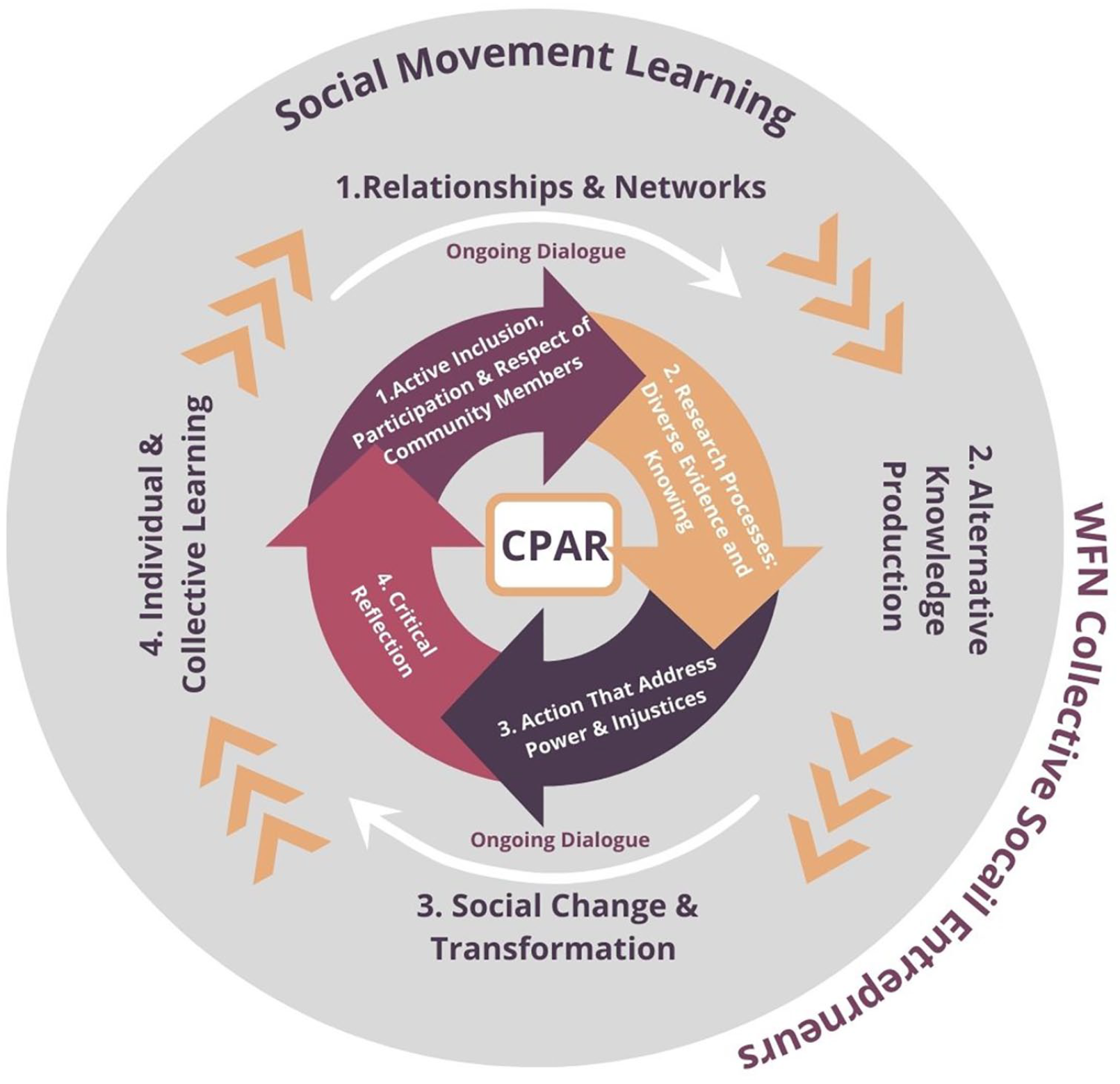
WFN collective social entrepreneurship through CPAR and SML.
● Assemble diverse and intersectional teams that include WFN individuals.
● Ensure that the team reflects the varied backgrounds, experiences, and identities of the target group.
● Foster a sense of community among WFN entrepreneurs, providing spaces for networking and mutual support.
● Conduct a comprehensive needs assessment that considers the diverse experiences and challenges of WFN entrepreneurs.
● Use diverse research methods that accommodate different communication styles, ensuring that the voices of all participants are heard.
● Collect data with members of the community through surveys, interviews, and focus groups to identify specific learning gaps, barriers, and opportunities within this diverse group.
● Advocate for policy changes and societal shifts that address the unique challenges faced by WFN entrepreneurs, leveraging the collective experiences and insights generated through research and learning initiatives.
● Design and implement a participatory action research plan that integrates intersectionality, recognizing the interconnected nature of various identities and social factors.
● Develop training programs that are customized to address the unique needs and challenges faced by WFN entrepreneurs.
● Include modules on inclusive leadership, diversity, and inclusion in business, and navigating gender-related biases in entrepreneurial spaces.
● Facilitate knowledge-sharing initiatives, such as mentorship programs and peer-to-peer learning opportunities.
● Establish platforms and mechanisms for inclusive learning that accommodate diverse learning styles and preferences.
● Integrate the research findings into the learning programs, ensuring that they are relevant and applicable to the diverse experiences of women, femmes, and nonbinary entrepreneurs.
It's essential to recognize the fluidity of this process and the need for ongoing dialogue. Regular feedback loops, ongoing evaluation, and flexibility in program design are crucial to ensure that the initiatives are flexible and responsive to the evolving needs and identities within WFN social entrepreneur collectives. Through this process, a holistic and inclusive approach to social movement learning and critical participatory action research the goal of social entrepreneurship supports successful social change, and effective collective action (Montgomery et al., 2012). This process requires questioning and pushing back on capitalist hegemony in dominant conceptions of entrepreneurship and leads to structural inequality (Da Costa & Silva Saraiva, 2012). As depicted in Figure 1, the key tenets of CPAR include inclusion in the research process of the people most impacted; strong objectivity through self and group reflection (bringing together diverse points of view, evidence, and knowing through feedback loops and dialogue); an intentional focus on how “experiences are shaped by history and geography, social power and policies, structures, institutions, ideologies relationships and social movements” (Fine et al., 2021, p. 348). WFN collective social entrepreneur spaces diminish the patriarchal and hierarchical practices that were previously experienced in traditional organizations (Gibson-Graham et al., 2013).
Entrepreneurial and collective action research, in various disciplines, includes questions about how to conceive entrepreneurial collective action and why entrepreneurship as a phenomenon requires collectives. These areas of focus offer opportunities for the development of resources helping support the needs of WFN collective social entrepreneurs as well as building capacity within the collective. This potential alignment has implications for research, policy, and practice.
Significance and Implications for Adult Education and Human Resource Development
AE/HRD educators and scholars are well suited for this challenge to engage in education practices and efforts that empower access to high-quality employment in the local and global community (McLean & Osman-Gani, 2014; Zarestky & Collins, 2017). There is a need for further emphasis on developing community-based entrepreneurs engaged in social entrepreneur efforts that support broader UN sustainable development goals and address social justice issues by engaging in SML. AE/HRD practitioners serve as primed partners to local community-based entrepreneurs who occupy individual entrepreneurial pursuits and entrepreneurial collectives that work to rectify or circumnavigate oppressive structures to achieve pressing social needs like food security, equity, sustainability, education, and access to decent work for all (United Nations, 2015). Further, we highlight the implications for research (more community-engaged research is needed), policy (alignment with global goals and sustainable funding), and practice (civic engagement to address key support mechanisms for WFN entrepreneurs; further collaborations for sustainable funding and training needs; and CPAR as a facilitator of relationship building and social change).
Implications for Research
Academia does not always recognize the value of CPAR because of conflicting values. These values include financial support from external funders, global recognition at odds with community needs, and political interests reaching into academic spaces. Academic environments are seats of power, and acknowledging systems of power within the higher education environment is necessary for those who engage in CPAR work or scholarship. CPAR is a time-consuming and relationship-laden method that offers direct support to communities not always engaged or valued in academia. CPAR bridges scholarly work and community-based efforts as depicted in Figure 1. When fostering or supporting SML, scholars can use CPAR to design collaborative efforts alongside communities. These efforts also can develop into opportunities for long-term longitudinal research and opportunities for grants that support ongoing research in partnership with community members.
For WFN entrepreneur collectives, such communities are situated within precarious environments, with members experiencing various risks to their personal and psychological safety (Fine & Torre, 2019; Ray, 2021). CPAR facilitates a collaborative research approach that can facilitate the use of various types of methods: including quantitative, qualitative, visual, or embodied methods. Employing CPAR frameworks not only ensures research rigor and validity but also expands the scope of research relevance (Minkler et al., 2012, p. 12). Relevant research that is meaningful to communities brings together disparate institutions and forges partnerships between academics and community members to develop and pursue solutions to complicated real-world problems. These partnerships offer opportunities to make research and learning accessible and meaningful in communities.
Implications for Policy
Implications for policymakers involve creating an inclusive policy environment that addresses power imbalances, fostering learning and capacity building, and adopting holistic approaches. Various collectives actively support community, national, and global policy change. In addition to the aforementioned WFN entrepreneur collectives (Femme Fatale DC and WE), others like Foodhini provide opportunities for immigrants and refugees to provide meal prep services (cooking food from their home country for people to order and enjoy at home; Splitter, 2020). Foodhini provides Links to the UN Refugee Agency on social media, Humanitarian assistance, food menu delivery services, Ethiopian Community Development Council, Inc, Lutheran Social Services National Capital Area. This is an example of a collective social entrepreneurial organization that participates that aligns with a global mission. Further exploring this and aligning this work with the UN sustainable development goals has holistic implications for policy to address global power imbalances.
Paying attention to and supporting the work of collectives that act locally and think globally offers relevant insight into policy-making decisions. Additionally, social entrepreneur collectives can serve as sites of research and connect research to further enhance holistic policy approaches. Thinking about social entrepreneur collectives as being aligned with workforce development efforts offers opportunities to target funding support including seed grants for economic development and other goals embedded into WFN Collective Social Entrepreneurship efforts.
Questions to consider about policy related to practice for WFN entrepreneurs: Is it an advantage or disadvantage to be outside of traditional employment? What are the ramifications of accepting state-sponsored funding? Being inside or outside traditional systems in the United States is complicated without a clear answer. The social environment of any community, state, or nation is linked to various available benefits (safety nets, financial support during hardship, and physical security efforts), which are often offered through government services. For example, in Washington DC, the Mayor’s office has a special initiative to support community involvement and small business development with various grant opportunities (Mayors Office of Community Affairs, n.d.). Yet accepting money can come with certain strings attached and oversight that can feel risky for WFN entrepreneurs even in a liberal-leaning area of the US. This “risk” is linked to identity and lived experiences that pose a threat to physical and psychological safety. One potential option is to focus funding and support efforts on existing community collectives that are evident in grassroots community organizations. Additionally, focusing on sustainable, longer-term support rather than one-time funding infusions would offer sustainable support for WFN collective social entrepreneurs. These are all efforts that would benefit from a holistic policy environment that addresses power imbalances while fostering learning and capacity building.
Implications for Practice
AE/HRD involves building relationships and addressing local community needs (Bierema, 2002; Bohonos & Sisco, 2021; Kwon & Nicolaides, 2019; Sisco et al., 2019). These community needs include civic engagement to address key support mechanisms for WFN entrepreneurs; further collaborations for sustainable funding and training needs; and CPAR as a facilitator of relationship building and social change. Connections established through civic engagement can align with research that benefits both practitioners and entrepreneurs. A key need for WFN collective social entrepreneurs, like all entrepreneurial organizations, is field building (working together toward a common goal), networking, and business learning (Bruneel et al., 2012; Patton et al., 2009; Van Rijnsoever et al., 2017). Scholarship lacks clarity around these support mechanisms, which offers opportunities for further scholarship and collaboration (Bergman et al., 2022).
Further collaboration enables opportunities for creative solutions and sustainable program development that contribute to community development efforts. Expanding AE/HRD practice beyond traditional corporate settings and outside academic environments is essential for working with WFN community-based social entrepreneurs. This expansion encompasses providing courses or training to adult learners and HRD students (Hughes & Byrd, 2017). This not only fosters positive interdisciplinary connections between students, the university, and the community but also has the potential to bring about positive changes in the workforce post-graduation.
Fostering interdisciplinary connections is also facilitated through approaches like CPAR. CPAR is an interdisciplinary approach that can strengthen connections between higher education institutions and WFN community-based social entrepreneurs. The key values of participatory research intersect with and emphasize community engagement which is a core practice in AE/HRD. Engaging with stakeholders through CPAR openly grapples with dimensions of race, ethnicity, racism, gender identity, and social class and embodies the concept of “cultural humility” (Minkler et al., 2012, p. 11) which is core to practice with marginalized members of communities. CPAR values emphasize the importance of recognition, building, facilitation, fostering, integration, focus, development, and dissemination (Minkler et al., 2012). By embracing these values in practice, scholars and practitioners can co-navigate complex aspects of identity and social dynamics.
Conclusion
Working in “wholes” (Kwon & Nicolaides, 2019, p. 269) demands that we continuously learn to enact new forms of leadership and cultivate conditions that reward trusting relationships. This can be achieved through practices like consistently practiced collective feedback and dialogue where outcomes are collaboratively generated. Entrepreneurs, particularly those from marginalized groups like WFN entrepreneurs, face disproportionate impacts from systemic barriers, cultural norms, and resource gaps. This recognition is crucial in understanding the unique challenges faced by these entrepreneurs and others in local and global settings during times of economic uncertainty and increasing disparities. Collective social entrepreneurship is a response to the challenges faced by individual entrepreneurs. It emphasizes collective action within entrepreneurship through shared resources like training, skill development, social support, and financial support.
Collective social entrepreneurship for WFN entrepreneurs is connected to achieving broader social change. Similarly, SML emphasizes the need to engage stakeholders in co-creating society based on looking for remedies to existing divides within a broken social system. SML argues against oversimplified approaches to problem-solving and calls for a comprehensive understanding of societal issues in the same way as CPAR. We highlighted the integration of CPAR into SML as a theoretical and practical approach to fostering social movements. Both engage with communities, challenging dominant knowledge views, and amplifying marginalized voices. Co-creation is useful for working with WFN collective social entrepreneurs since the development of a functional blueprint is a process in progress but continually evolving. The fluidity of the process requires ongoing dialogue, regular feedback loops, and flexibility in program design to ensure that initiatives remain responsive to the evolving needs within WFN social entrepreneur collectives.
Despite the fluid nature of collective social entrepreneurship, four process categories for engaging include active inclusion, diverse research processes, addressing power and injustices, and critical reflection. These processes are essential for supporting WFN collective social entrepreneurship through SML and CPAR. The implications for research, policy, and practice suggest that focusing on questions about entrepreneurial collective action and understanding why entrepreneurship requires collectives can contribute to the development of resources supporting the needs of WFN collective social entrepreneurs and other marginalized people engaged in the broader workforce. These efforts serve to liberate and enact the full potential of humanity and its abundance of diversity.
Footnotes
Declaration of Conflicting Interests
The author(s) declared no potential conflicts of interest with respect to the research, authorship, and/or publication of this article.
Funding
The author(s) received no financial support for the research, authorship, and/or publication of this article.
