



Abstract
Background:
Environmental screening and mapping (ESM) tools can characterize the spatial distribution of environmental hazards and their effects, health status, and demographics of communities. For communities impacted by environmental injustices, ESM tools can play an important role in identifying areas facing cumulative impacts (CI).
Methods:
We identified 36 state and federal ESM tools to analyze. Map layers/indicators were organized by subcategories within nine broad categories. A framework was used to assess tools: number and variety of indicators and layers included; types of geospatial options available to view data; presence and type of qualitative data included; and type of methodology used for creating indices.
Results:
A total of 197 subcategories were identified. The most common subcategories used across tools were race/ethnicity (n = 31), income/poverty (n = 31), and designation for priority or EJ areas (n = 29). Few tools included layers for structural racism, qualitative data, and those relevant to rural communities. Most tools (n = 32) utilized composite measures or thresholds to identify impacted areas, often at the census tract level.
Discussion:
To ensure tools accurately reflect communities’ lived experiences, community engagement is essential. Tools should incorporate qualitative data, expand the use of indicators relevant to rural communities, offer differing geospatial units to view data, and incorporate measures of structural racism and inequity. While ESM tool indices can help identify impacted areas, limitations still exist. However, the use of ESM tools to address CI has great promise.
Conclusion:
Enhancing ESM tools for environmental decision making can support community-led and government actions to address CI and promote environmental justice.
INTRODUCTION
Cumulative impacts (CI) and cumulative impact assessments (CIA) offer a promising conceptual means for characterizing the “totality of exposures to combinations of chemical and nonchemical stressors and their effects on health, well-being and quality of life.” 1 In light of the social and biological vulnerabilities that shape whether and how environmental stressors are experienced, a CIA framework attempts to characterize a fuller range of real-world population exposures and a wide range of impacts beyond just physical health. 2 Importantly, incorporating CIA into environmental and other decisions would presumably guide actions that reduce adverse exposures and outcomes in overburdened communities, direct investments to areas in need, and support healthy, sustainable economic growth that does not depend on marginalized and disenfranchised communities bearing the burden of unwanted land uses and being deprived of health-promoting resources and infrastructure.
With advances in geospatial information systems and visualization tools in recent years, environmental screening and mapping (ESM) tools have played a key role in visualizing some aspects of CI, 3 particularly the distribution of sources of environmental stressors, population health status, demographics, and/or sensitive receptors. 4 CalEnviroScreen (launched April 23, 2013 5 ) is one of the first mapping tools that has since been used by other states as a model. 6 Currently in its 4th version, CalEnviroScreen includes a composite indicator that incorporates information about exposure, environmental effects, health, sensitive/susceptible populations, and social vulnerability. 7
This study builds on existing research 8 to better understand, across a set of 36 ESM tools, what indicators and layers are commonly included (or excluded), how ESM tools identify priority/impacted areas, what geospatial options are most common for viewing data, and what types of qualitative data are integrated into ESM tools. Additionally, we describe a community-engaged approach to conducting this study.
METHODS
Community engagement approach
This work was initiated to inform recommendations to state agencies on how to incorporate CI into environmental decision making. Two community partners contacted the research team to assess existing ESM tools and present findings to the NC Department of Environmental Quality (NCDEQ) Secretary’s Environmental Justice and Equity Advisory Board (EJEAB). This request stemmed from the community partners’ desire to inform the board about CI, including definitions and available tools/methods, ultimately aiming to guide policy recommendations on state permitting processes. Research objectives were identified by partners, and the team began reviewing government agencies’ definitions of CI. The research team met regularly with partners to share findings and provide progress updates.
After presenting initial findings to the EJEAB and NC EJ Community Connector Initiative (EJCCI), and with additional guidance from our partners, the project was expanded to assess indicators across state, federal, and academic ESM tools, with a specific interest in data layers related to racism and rural areas, based on communities served by our partners. We also compared how tools define and apply thresholds to identify impacted areas to inform recommendations for an NC executive order on EJ. 9 A ground truthing approach was used, whereby two partners reviewed how ESM tools characterized their rural counties in NC based on available data layers related to health, demographics, housing/neighborhood, and equity. Though we ultimately decided to exclude the analysis of CI definitions from this article, reviewing the definitions helped inform the ESM tool analysis.
Analysis framework
The research team used the following framework to assess ESM tools: (1) number and variety of indicators and data layers included in each tool (e.g., race/ethnicity, broadband access); (2) geospatial resolution of data represented (e.g., census tract, county); (3) presence and type of qualitative data included as a map feature; and (4) type of indices or composite measures used for identifying impacted areas (e.g., summation, thresholds).
Identification of ESM tools
To identify ESM tools, the research team conducted a broad Google search using key terms “environmental justice,” OR “cumulative impacts,” OR “hazard,” AND “mapping tool.” This uncovered peer-reviewed and gray literature and state environmental department websites describing ESM tools used across various states and federal entities. 10 We also solicited recommendations about ESM tools from two U.S.-based EJ scholars via email and presented initial research to the EJEAB and EJCCI for additional recommendations. Sixty-four tools were initially identified.
Inclusion criteria
To determine which tools to include in this analysis, several exclusion criteria were considered: maps that were not interactive (n = 8); maps that did not represent state- or nation-wide data (n = 6); international tools (n = 1); tools that were no longer active or were retired at the time of our search (n = 4); and tools that focused only on one dimension of environmental exposure (e.g., well water quality) or that did not include data layers for either environmental justice (EJ), health, or social vulnerability were excluded (n = 9). This left 36 ESM tools to analyze.
Categorization of map indicators and layers
Microsoft Excel was used to organize all layers represented across the 36 tools. Within Excel, each tool was assigned a row. Nine broad categories of layers were identified, and each category was assigned to a separate sheet within the Excel file. On each sheet, subcategories were added, one per column. Broad categories were defined as overarching themes unifying a group of related subcategories. Subcategories were composed of one or more related indicators or layers. Though some ESM tools do not always make the distinction, 11 the terms “indicator” and “layer” are distinct –the first describing the data as obtained from its respective data source, and the latter describing the spatial representation of that data on a map. Both terms are used throughout this article.
The initial set of broad and subcategories were based on EJScreen’s layer categories
12
because it is a reputable federal tool and, since 2015, has compiled national data in a consistent manner with a focus on EJ.
13
EJScreen has informed the development of other tools,
14
uses composite measures (i.e., combining multiple indicators into one measure), and includes data at the census block group,
15
the second smallest geographic unit available for census data.
16
As we encountered map layers that did not fit into the existing set of subcategories, a new column was created on the appropriate sheet and a new subcategory named. To clarify how broad, subcategories, and indicators/layers were defined, see the example below:
BROAD: Demographics SUB: Income/Poverty INDICATOR/MAP LAYER: Percent Below Federal Poverty Level
Each tool was reviewed, documenting the layer/indicator name in the appropriate column, type of qualitative data presented (if applicable), and geographic unit at which the layer was represented (e.g., census tract, block group, county). If a tool included multiple indicators for a given subcategory, all were noted. Data entry occurred from November 2023 to May 2024. Any updates to the tools performed after May 2024 are not reflected in this analysis.
RESULTS
Indicators & layers
Of the 64 tools initially identified, 36 tools met inclusion criteria and were analyzed (see Supplementary Appendix for the full list of tools identified). Map layers were organized by subcategory under nine broad categories: demographics, environmental, health, housing/neighborhood, climate change, transportation, educational opportunities, equity, and geography/political (see Table 1 for examples of each broad category). A total of 197 subcategories were identified.
List of Subcategories Included in Four or More Environmental Screening and Mapping Toolsa

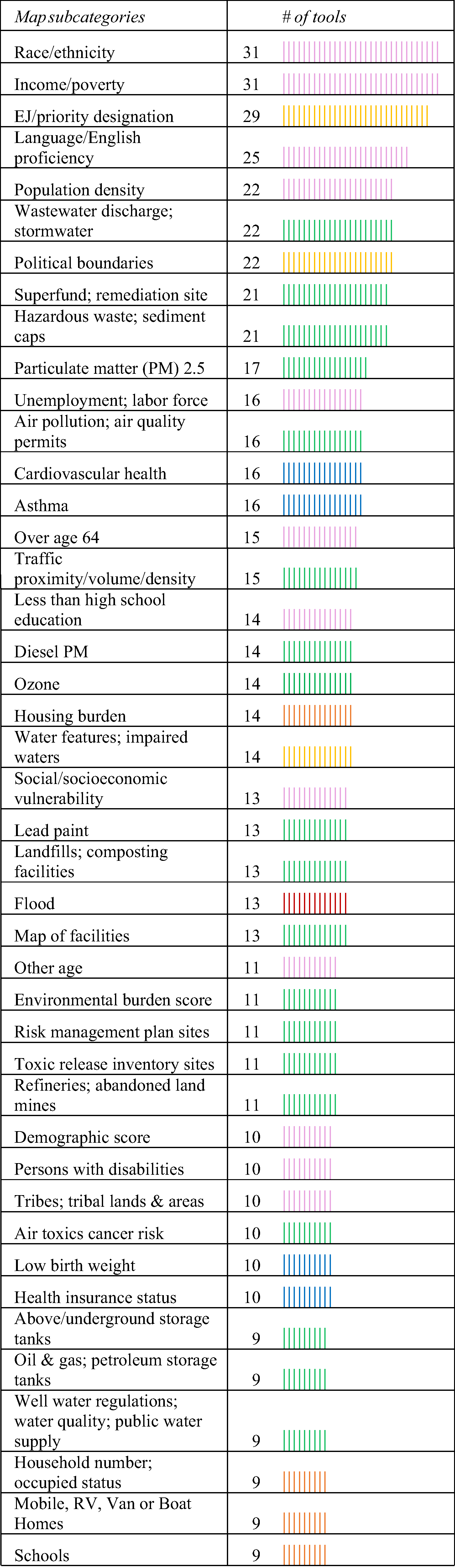
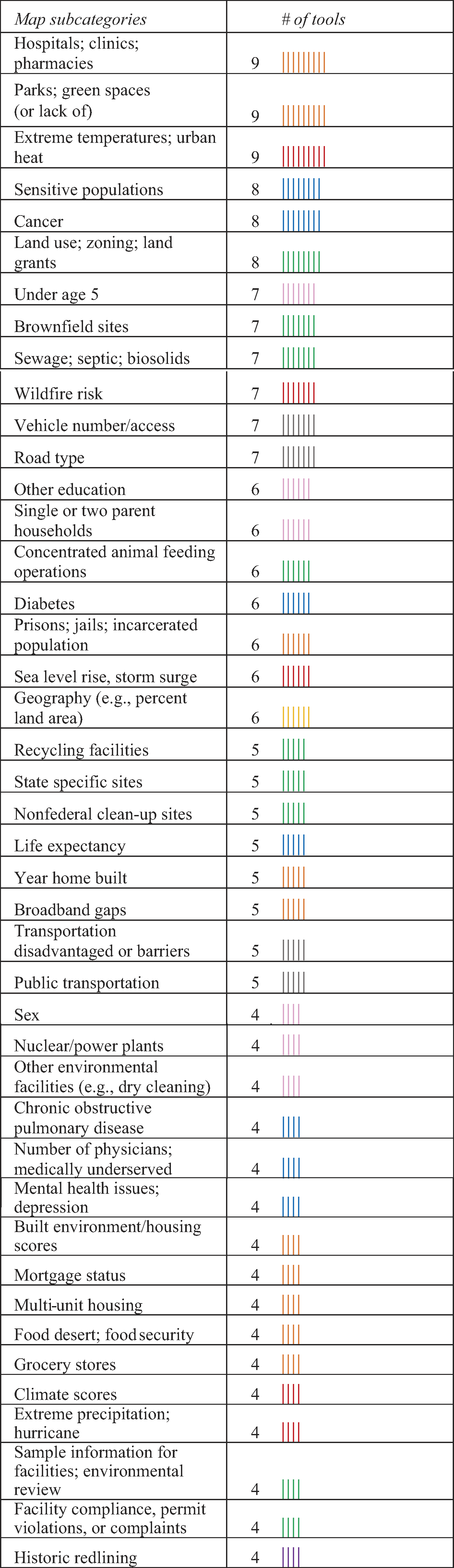
Note: Only one tool included map layers under the broad category of “Educational Opportunities;” thus, these layers are not included in this table.
Key of Broad Categories:
 , Demographic;
  , Environmental;
  , Geography/Political;
  , Health;
  , Housing/Neighborhood;
  , Climate;
  , Transportation;
  , Equity.
Subcategories included in less than four tools are listed below.
Work location (e.g., in-state, in-county, outdoors); percent with college degree; pesticide use; meat packing facilities/industrial food suppliers; COVID-19; preterm births/birth rate; infant death rate/infant mortality; premature deaths/deaths of despair; home value; rent amount; urban vs. rural designation; group quarters; overcrowded/undercrowded housing; lack of walkability; drought; airports; agriculture (e.g., croplands, orchards, dairies); wildlife management areas/hunting on managed lands; fishing/marine access sites/boat launches; energy costs/energy burden or vulnerability; nonattainment area; other municipal buildings & parking; environmental department/field offices; storymaps.
Female household/female labor force and child status; employed by Armed forces; marital status; children living in poverty; population aged 65 and older living alone; place of birth; nonhazardous treatment storage and disposal facilities; arsenic, cadmium, lead, and manganese; electric transmission lines/electric utilities; stroke; high blood pressure; blood lead levels; body mass index/obesity; public housing; subsidized housing/housing funding source; colonias; unoccupied housing; year when owner/renter moved into home; noise (percent of population exposed to A-weighted, average sound level for the day from aviation, rail, and interstate road noise); alcohol outlet density; housing habitability (e.g., lack of kitchen/plumbing); retail density/shopping; home fuel type; technology access (e.g., smartphone, tablet, computer); place of worship; expected population change due to climate change; crashes (involving fatalities, serious injury, and alcohol use); people driving alone; driving time; active commuting/work transportation type (e.g., bike, bus); projects of interest; Gini coefficient of inequality; residential segregation; voter participation/census response rate; public involvement (e.g., zero-emissions vehicle rebates, climate-smart communities grants); tourism recreation (e.g., campgrounds, trails, visitor center); military location.
Workers at risk (e.g., job displacement, with/without unemployment insurance); self-employment income; civilian veterans; other air pollutants (e.g., nitrogen dioxide, sulfur dioxide); formerly used defense sites; risk-screening environmental indicators (RSEI) scores; gestational age; child mortality rate; independent living/self-care difficulty; arthritis; chronic kidney disease; cognitive/visual/hearing difficulty; physical health not good; health risk behaviors (e.g., smoking, binge drinking); live birth rate; heat illness; carbon monoxide poisoning; injuries from chemical releases; birth defects; multigenerational households; renter vulnerability; childcare facilities; farmworker housing; neighborhood safety; people experiencing homelessness; shelter in place mandates; residential subdivision; rent utility status; crime/violence; expected agricultural loss rate; expected building loss rate; climate smart communities/climate projections; tsunamis; air conditioning; high environmental exposures for workers; transportation expense; high volume roads; school proficiency; absent students/idle teenagers; educational staff diversity; per pupil education spending; student suspension rate/youth status offenses; students eligible for free & reduced meal program; student homelessness; location quotient; race of police force/use of force incidents/law enforcement personnel; race/ethnicity of electees; algal blooms; commercial or individual development; net migration/new residents.
Only one tool, the Healthy Places Index (CA), included data across all nine broad categories. 17 On average, tools displayed data for five broad categories, with demographics, environmental, neighborhood/housing, health, and geography/political being the most frequently represented. The total number of subcategories represented within a given tool ranged from 1 to 111. Within the demographics category, most tools included layers related to race/ethnicity (n = 31, 86% of tools), income/poverty (n = 31, 86%), and language (e.g., English proficiency, language spoken at home; n = 25, 69%). The most frequently included environmental layers fell under the subcategories of stormwater, wastewater discharge, and groundwater threats (n = 22, 61%); federal clean-up sites (n = 21, 58%); hazardous waste (n = 21, 58%); and particulate matter 2.5 (n = 17, 47%). The top health subcategories represented were asthma (n = 16, 44%) and cardiovascular health (n = 16, 44%). Within the broad category of neighborhood/housing, many tools included a layer related to housing cost burden (n = 14, 39%).
Consistently absent from ESM tools were layers to highlight historical or contemporary discrimination, racism, or structural inequities. For example, only a few tools included data related to historic redlining (n = 4, 11%), racial residential segregation (n = 2, 6%), economic inequality (e.g., Gini coefficient, n = 2, 6%), political inequality (e.g., race/ethnicity of elected officials, n = 1, 3%), or structural violence (e.g., race of police force, n = 1, 3%; use of police force, n = 1, 3%).
Similarly, many ESM tools lacked key layers for rural communities; for example, grocery stores and medically underserved areas were each only present in four tools (11%). Despite the heavy reliance on private wells in rural areas, 18 only 25% of analyzed tools (n = 9) included layers for well water regulations, water quality, or public water infrastructure. Furthermore, few tools mapped data on broadband access (n = 5, 14%) or transportation infrastructure (n = 5, 14%). Finally, few layers related to agricultural activities, such as concentrated animal feeding operations (n = 6, 17%) and pesticide use (n = 3, 8%), were included in tools.
Use of indices
Nineteen of the 36 tools (53%) allowed for some extent of data overlay, but these capabilities varied widely across tools. Most tools included a layer for EJ or priority areas (n = 29, 80%), often represented via an overall score or shaded area. The methods for designating such areas varied widely. Many tools established composite measures (n = 32, 89%), helpful for assessing CI. 19 These tools calculated the measure either through summation (n = 5) or multiplication (n = 14). With summation, a percentile ranking across different indicators is summed or averaged to create an overall score. With multiplication, indicators are multiplied to calculate an overall score. Other tools used thresholds, in which one (solo) or more (combination) criteria must be met to receive a designation (n = 11). One tool offered a self-designation process whereby communities can submit an application to receive an EJ designation, 20 and another tool used both threshold and summation techniques. 21
Spatial resolution of data
Geospatial area of analysis is an important consideration for CI. 22 Most tools reported data at the census tract level, though 16 tools (44%) allowed the user to toggle to a different geospatial resolution. The Healthy Places Index (CA) was the most comprehensive tool with 14 different geographic units (see Table 2). 23 Of the 32 tools that employed threshold or composite scoring approaches, seven tools (19%) analyzed thresholds, indices, or summed scores at the census block level.
Composite and Threshold Methods Used by Environmental Screening and Mapping Tools to Identify Impacted Areas
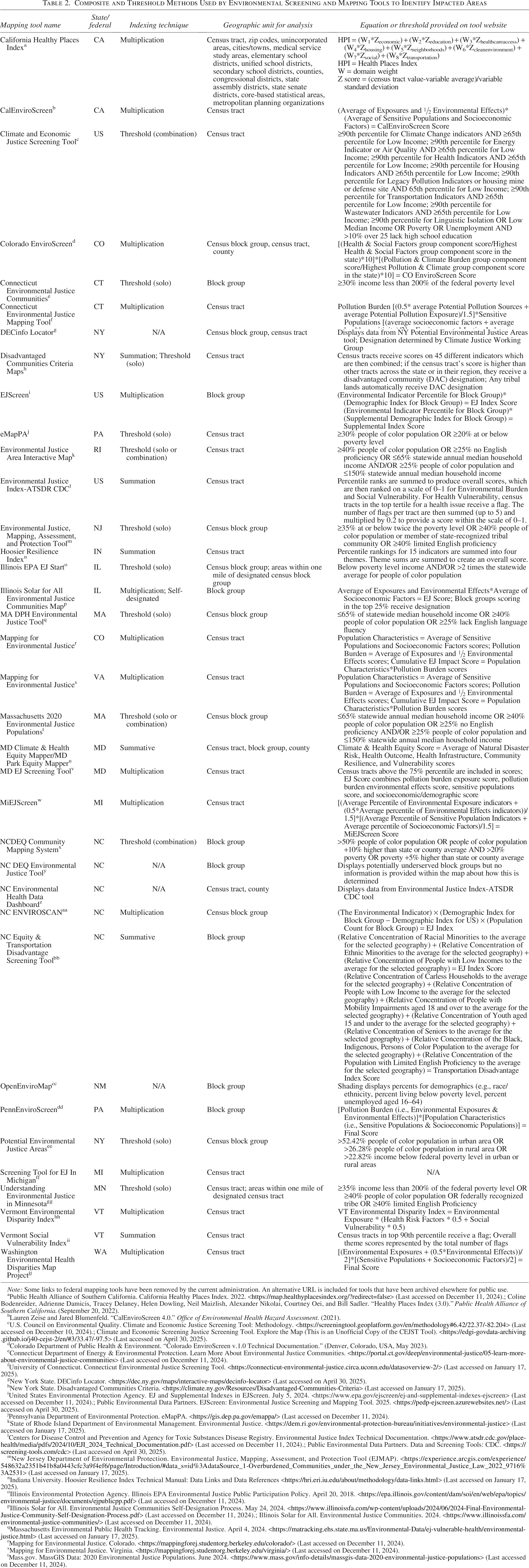
Note: Some links to federal mapping tools have been removed by the current administration. An alternative URL is included for tools that have been archived elsewhere for public use.
Public Health Alliance of Southern California. California Healthy Places Index. 2022. <https://map.healthyplacesindex.org/?redirect=false> (Last accessed on December 11, 2024).; Coline Bodenreider, Adrienne Damicis, Tracey Delaney, Helen Dowling, Neil Maizlish, Alexander Nikolai, Courtney Oei, and Bill Sadler. “Healthy Places Index (3.0).” Public Health Alliance of Southern California. (September 20, 2022).
Lauren Zeise and Jared Blumenfeld. “CalEnviroScreen 4.0.” Office of Environmental Health Hazard Assessment. (2021).
U.S. Council on Environmental Quality. Climate and Economic Justice Screening Tool: Methodology. <https://screeningtool.geoplatform.gov/en/methodology#6.42/22.37/-82.204> (Last accessed on December 10, 2024).; Climate and Economic Screening Justice Screening Tool. Explore the Map (This is an Unofficial Copy of the CEJST Tool). <https://edgi-govdata-archiving.github.io/j40-cejst-2/en/#3/33.47/-97.5> (Last accessed on April 30, 2025).
Colorado Department of Public Health & Environment. “Colorado EnviroScreen v.1.0 Technical Documentation.” (Denver, Colorado, USA, May 2023).
Connecticut Department of Energy & Environmental Protection. Learn More About Environmental Justice Communities. <https://portal.ct.gov/deep/environmental-justice/05-learn-more-about-environmental-justice-communities> (Last accessed on December 11, 2024).
University of Connecticut. Connecticut Environmental Justice Screening Tool. <https://connecticut-environmental-justice.circa.uconn.edu/datasoverview-2/> (Last accessed on January 17, 2025).
New York State. DECinfo Locator. <https://dec.ny.gov/maps/interactive-maps/decinfo-locator> (Last accessed on April 30, 2025).
New York State. Disadvantaged Communities Criteria. <https://climate.ny.gov/Resources/Disadvantaged-Communities-Criteria> (Last accessed on January 17, 2025).
United States Environmental Protection Agency. EJ and Supplemental Indexes in EJScreen. July 5, 2024. <https://www.epa.gov/ejscreen/ej-and-supplemental-indexes-ejscreen> (Last accessed on December 11, 2024).; Public Environmental Data Partners. EJScreen: Environmental Justice Screening and Mapping Tool. 2025. <https://pedp-ejscreen.azurewebsites.net/> (Last accessed on April 30, 2025).
Pennsylvania Department of Environmental Protection. eMapPA. <https://gis.dep.pa.gov/emappa/> (Last accessed on December 11, 2024).
State of Rhode Island Department of Environmental Management. Environmental Justice. <https://dem.ri.gov/environmental-protection-bureau/initiatives/environmental-justice> (Last accessed on January 17, 2025).
Centers for Disease Control and Prevention and Agency for Toxic Substances Disease Registry. Environmental Justice Index Technical Documentation. <https://www.atsdr.cdc.gov/place-health/media/pdfs/2024/10/EJI_2024_Technical_Documentation.pdf> (Last accessed on December 11, 2024).; Public Environmental Data Partners. Data and Screening Tools: CDC. <https://screening-tools.com/cdc> (Last accessed on April 30, 2025).
New Jersey Department of Environmental Protection. Environmental Justice, Mapping, Assessment, and Protection Tool (EJMAP). <https://experience.arcgis.com/experience/548632a2351b41b8a0443cfc3a9f4ef6/page/Introduction/#data_s=id%3AdataSource_1-Overburdened_Communities_under_the_New_Jersey_Environmental_Justice_Law_2022_9716%3A2531> (Last accessed on January 17, 2025).
Indiana University. Hoosier Resilience Index Technical Manual: Data Links and Data References <https://hri.eri.iu.edu/about/methodology/data-links.html> (Last accessed on January 17, 2025).
Illinois Environmental Protection Agency. Illinois EPA Environmental Justice Public Participation Policy. April 20, 2018. <https://epa.illinois.gov/content/dam/soi/en/web/epa/topics/environmental-justice/documents/ejpublicpp.pdf> (Last accessed on December 11, 2024).
Illinois Solar for All. Environmental Justice Communities Self-Designation Process. May 24, 2024. <https://www.illinoissfa.com/wp-content/uploads/2024/06/2024-Final-Environmental-Justice-Community-Self-Designation-Process.pdf> (Last accessed on December 11, 2024).; Illinois Solar for All. Environmental Justice Communities. 2024. <https://www.illinoissfa.com/environmental-justice-communities/> (Last accessed on December 11, 2024).
Massachusetts Environmental Public Health Tracking. Environmental Justice. April 4, 2024. <https://matracking.ehs.state.ma.us/Environmental-Data/ej-vulnerable-health/environmental-justice.html> (Last accessed on January 17, 2025).
Mapping for Environmental Justice. Colorado. <https://mappingforej.studentorg.berkeley.edu/colorado/> (Last accessed on December 11, 2024).
Mapping for Environmental Justice. Virginia. <https://mappingforej.studentorg.berkeley.edu/virginia/> (Last accessed on December 11, 2024).
Mass.gov. MassGIS Data: 2020 Environmental Justice Populations. June 2024. <https://www.mass.gov/info-details/massgis-data-2020-environmental-justice-populations> (Last accessed on December 11, 2024).
University of Maryland. About the MD Climate & Health Equity Mapper. <https://p1.cgis.umd.edu/mdclimateequity/help.html> (Last accessed on January 17, 2025).
Maryland Department of the Environment. MDE’s Environmental Justice Screening Tool. <https://mde.maryland.gov/Environmental_Justice/Pages/EJ-Screening-Tool.aspx> (Last accessed on December 11, 2024).; Jan-Michael Archer and Sacoby Wilson, “MD EJSCREEN v2.0: A Tool for Mapping Environmental Justice in Maryland,” PowerPoint Presentation, CEJSC Meeting, February 25, 2020. <https://mde.maryland.gov/programs/Crossmedia/EnvironmentalJustice/Documents/mdejscreen-cejsc-2-25-2021v1.pdf>
Department of Environment, Great Lakes, and Energy. MiEJScreen: Environmental Justice Screening Tool (Version 1.0). <https://www.michigan.gov/egle/maps-data/miejscreen> (Last accessed on October 29, 2024).
North Carolina DEQ. Community Mapping System: Glossary of Terms and Definitions. <https://www.deq.nc.gov/ej/nccms/nccms-glossary-terms-updated-january-2022/download?attachment> (Last accessed on December 11, 2024).; North Carolina Environmental Quality. DEQ North Carolina Community Mapping System. <https://www.deq.nc.gov/outreach-education/environmental-justice/deq-north-carolina-community-mapping-system> (Last accessed on December 11, 2024).
NC DEQ. Environmental Justice Tool. 2025. <https://ncdenr.maps.arcgis.com/apps/dashboards/5b65176a2d494271a871563846c974d7#ObjectID=144122> (Last accessed on April 30, 2025).
NC Department of Health and Human Services. NC Environmental Health Data Dashboard. 2025. <https://epi.dph.ncdhhs.gov/oee/programs/EnvPubHealthTracking.html> (Last accessed on January 17, 2025)
NC ENVIROSCAN. Environmental Justice Indicators. <https://enviroscan.org/environmental-justice-indicators> (Last accessed on December 11, 2024).
N.C. Department of Transportation. N.C. Equity & Transportation Disadvantage Screening Tool. <https://storymaps.arcgis.com/stories/7e3bbd00fe014a77b5f1620334209712> (Last accessed on January 17, 2025).
New Mexico Environment Department. OpenEnviroMap Home. 2025. <https://gis.web.env.nm.gov/oem/help/> (Last accessed on April 30, 2025).
Pennsylvania Department of Environmental Protection. PennEnviroScreen. 2024. <https://gis.dep.pa.gov/PennEnviroScreen/> (Last accessed on December 11, 2024).; Pennsylvania Department of Environmental Protection. “Environmental Justice Policy and PennEnviroScreen,” PowerPoint, September 2023. <https://files.dep.state.pa.us/Energy/Office%20of%20Energy%20and%20Technology/OETDPortalFiles/Climate%20Change%20Advisory%20Committee/2023/10-24-23/2023-09_AdvisoryBoards_EJPolicy_PennEnviroScreen.pdf>
New York State Department of Environmental Conservation. Maps & Geospatial Information System (GIS) Tools for Environmental Justice. 2020. <https://dec.ny.gov/get-involved/environmental-justice/gis-tools> (Last accessed on January 17, 2024).
Meg Wilcox. “Researchers hand Michigan officials a tool to remedy environmental injustice. Will they use it?” Environmental Health News (July 25, 2019).
Minnesota Pollution Control Agency. Understanding Environmental Justice in Minnesota. <https://experience.arcgis.com/experience/bff19459422443d0816b632be0c25228/page/Page/?views=Introduction> (Last accessed on January 17, 2025).
Qing Ren and Bindu Panikkar. VT Environmental Disparity Index. 2021. <https://www.arcgis.com/apps/webappviewer/index.html?id=68a9290bde0c42529460e1b8deee8368> (Last accessed on December 11, 2024).
Vermont Department of Health. Vermont Social Vulnerability Index (SVI). <https://ahs-vt.maps.arcgis.com/apps/MapSeries/index.html?appid=9478be15d6d4410f8eef8d420711310b> (Last accessed on January 17, 2025).
Department of Environmental and Occupational Health Sciences. Washington Environmental Health Disparities Map Project. 2024. <https://deohs.washington.edu/washington-environmental-health-disparities-map-project> (Last accessed on December 9, 2024).; University of Washington Department of Environmental & Occupational
Health Sciences and Washington State Department of Health. “Washington Environmental
Health Disparities Map: Cumulative Impacts of Environmental Health Risk Factors Across
Communities of Washington State: Technical Report Version 2.0.” University of Washington Department of Environmental & Occupational Health Sciences and Washington State Department of Health. (July 2022).
Qualitative data
Few tools (n = 3, 8%) included qualitative data or incorporated resources about ongoing EJ and policy issues impacting local communities. The Healthy Places Index (CA) included policy opportunities for a wide range of map layers (e.g., education, safe drinking water, park access, public transit access) as well as resources related to extreme heat and climate change (e.g., weatherization assistance programs, transformative climate communities programs, urban greening for schools). 24 Colorado EnviroScreen included a Storymaps feature that incorporated the experiences of those living in an area to complement the displayed data. 25 Importantly, these qualitative data were not integrated into any overall score to identify EJ or priority areas. 26 Virginia’s Mapping for EJ tool allowed users to select areas across the state to learn about environmental issues of greatest concern, local organizations and their contact information, and media references about these issues and organizations. 27
DISCUSSION
Only 18 U.S. states had ESM tools that met inclusion criteria for analysis (CA, CO, CT, IL, IN, MA, MD, MI, MN, NC, NJ, NM, NY, PA, RI, VA, VT, WA), with some states having multiple tools. While ESM tools with a national focus provide useful data that states can use, state-specific tools can better represent unique aspects of local communities. 28 Moreover, the potential for priority shifts and poor enforcement at the federal level further promotes the need for state ESM tools. 29 Based on this analysis, several changes can improve ESM tools’ ability to identify and accurately represent areas experiencing disproportionate exposure and/or outcome burdens. These changes include expanding which indicators and layers are reported/displayed and with varying geospatial options, incorporating considerations for structural inequities and rural areas, and engaging impacted communities in tool design to improve ESM tools’ relevance and useability.31
Ground truthing, community engagement, and qualitative data
CalEnviroScreen 30 and the Washington Environmental Health Disparities Map Project 31 have documented extensive community engagement approaches, which can serve as examples for other states. 32 Additionally, a review that characterized 25 state and national tools highlights how community engagement can boost tools’ use across key constituent groups, increase the types of indicators included, and enhance locally relevant information about environmental and social stressors. 33 Knowing what data are most meaningful for impacted communities can increase the use of ESM tools and their effectiveness for a range of uses, including education/information, advocacy, and regulation. 34 Thus, meaningful public engagement during tool conception and development is critical.
Given concerns with rural data representation in ESM tools, 35 our team implemented an abbreviated ground truthing approach to review how some tools represented two rural counties in NC. We documented the layers displayed across three state (NCDEQ Community Mapping System, NC DEQ EJ Tool, and NC ENVIROSCAN) and three federal tools (EJScreen, EJ Index, and Climate and Economic Justice Screening Tool) for both counties. We then met with two rural, grassroots organizations based in each county and asked them to describe how well the map layers represented the real-world circumstances of residents across their county. The differing geospatial scales and variability in data units used across tools made comparisons challenging. While federal data may have less precision due to undersampling and undercounting, 36 state maps often lacked layers that reflected rural communities’ experiences (e.g., year home built, location of grocery stores, medically underserved). However, federal tools were less accurate in identifying low-income areas and the prevalence of asthma in communities. Furthermore, our partners expressed concern that many of the layers were not displayed at a small enough spatial resolution to truly reflect community impacts.
While our approach is limited to only two counties, ground truthing reveals opportunities to expand map layers in state tools to better reflect communities’ experiences, especially as state tools may be better equipped to depict diverse geographies, regional issues, relevant data, and community concerns. 37 Implementing more extensive ground truthing practices can help ensure that data are relevant and accurate, especially for rural communities and other populations disproportionately impacted by environmental injustices. 38
Meaningfully engaging communities and residents when developing tools can also illuminate data gaps, inconsistencies with data collection, and opportunities for new indicators. 39 For example, the town of Badin, NC, housed an aluminum smelting company, which engaged in discriminatory hiring practices against Black employees and disposed of hazardous waste throughout West Badin, a predominantly Black and segregated community. 40 While the Alcoa facility has been closed since the mid-2000s, NCDEQ maintains active permits for wastewater disposal by the company in Badin. 41 Other Alcoa facilities in the United States are designated as EPA Superfund sites on the National Priority List (NPL), but West Badin residents and former employees are still advocating for this designation to access federal support because NCDEQ has failed to enforce clean-up. 42 Superfund designation is not without challenge, as it often takes many years to reach completion, results in property value decline, and can cause forced relocation of some residents. 43 However, the site assessment and hazard ranking process, required of any site that is under review for addition to the NPL, can shed light on the site’s potential to pose a health threat. 44 Including sites like Badin in ESM tools could help formally identify areas that may likely require remediation efforts.
ESM tools may also incorporate qualitative data and seek data from a range of sources to further contextualize the setting, populations, stressors, and outcomes communities experience. Previous research has documented many tools’ reliance on federal data from the EPA and U.S. Census, yet alternative data sources can better reflect local EJ priorities and diverse experiences within and across communities. 45 Only three tools in our analysis included qualitative data, additional information, and/or policy resources underscoring residents’ concerns and advocacy efforts. 46 Moreover, only the Illinois Solar for All tool offered a process by which communities could self-designate EJ areas, 47 which may be especially helpful for rural and Indigenous communities (especially those who may not be federally or state recognized). These tools demonstrate the feasibility and value of including such types of data, which could better describe the unique circumstances of Badin and other communities that experience environmental injustices.
Considerations for rural communities and geospatial units
Community engagement can also enhance ESM tools’ ability to represent exposures and impacts on rural populations. Two tools considered urban/rural designation as a map layer 48 and only one tool included special considerations for rural vs. urban areas in defining thresholds to designate priority impacted areas. 49 Furthermore, many tools exclude indicators that would be relevant to rural communities (e.g., broadband access, data on private well water quality). In some cases, these data are difficult to obtain or not yet systematically organized at a state level. 50 Furthermore, lack of data in rural areas may limit consideration of these regions within ESM tools. While urban areas are growing, many rural areas are experiencing outmigration. 51 This could lead to difficulties with collecting new data in these areas. For example, with rural hospitals closing, some health indicators may become more difficult to track. 52 Collecting accurate data may also be hindered by a lack of internet access. 53 Moreover, the absence of state or federal environmental monitoring stations in rural areas limits the amount of measured data available on specific pollutants. 54
Regarding the spatial unit of assessment, previous studies 55 and a recent report by the National Academies of Science, Engineering, and Medicine noted the challenges of using aggregate spatial units like census tracts for analysis, as they may not align with innate physical boundaries or with resident-identified boundaries for communities/neighborhoods. 56 Moreover, the census itself fails to explore community risk perception, often undercounts vulnerable populations, and overlooks differences in daytime (i.e., school or work setting) and nighttime (i.e., residential) exposure. 57 Thus, community-informed considerations for geospatial units in ESM tools are especially important for rural areas.
Measuring structural racism and inequities
While race/ethnicity has long been identified as a key factor in the siting of environmental hazards, 58 some ESM tools do not include indicators of race/ethnicity (n = 5, 14%). Other tools, such as CalEnviroScreen, do not consider race in their EJ Scoring method and instead conduct a separate analysis correlating race and CI. 59 Despite many tools being ostensibly developed to help combat racially discriminatory effects of environmental decision making, even fewer tools included measures of racism, a key determinant of environmental injustice. 60 The exclusion of race and racism may be intended to insulate decisions informed by CIAs and these tools from legal action, as numerous challenges to race-conscious decision making have been successful. 61 However, failure to consider race not only overlooks evidence of disparate impacts and variations in how different populations experience inequities, but may threaten to exacerbate them. 62 Ultimately, including measures of race and racism is critical for developing policies that account for the disadvantages experienced by communities of color to improve outcomes for those communities. 63
As researchers continue to develop new ways to quantify racism, ESM tools can incorporate existing measures of racism with guidance from the current literature. 64 For example, when considering COVID-19 outcomes at the county level, where persistent racial disparities accentuated the threat of racism on health, 65 Tan et al. considered residential segregation, racial gaps in socioeconomic outcomes (employment and poverty), and Black-white incarceration ratios as indicators of structural racism. 66
Others have considered ways to combine multiple measures of racial inequity to develop composite indicators of structural racism. 67 Mesic et al. proposed integrating residential segregation and Black-white ratios in economic status, education, incarceration, and employment to create a state racism index to investigate fatal police shootings. 68 Only one tool in our analysis included an indicator that was remotely related to police violence, that being the race of police force/use of force (n = 1, 3%). 69 Another study on the impacts of air pollution on cancer used seven indicators, informed by community contributors, to represent structural racism (education, residential segregation, economic status, employment, homeownership, incarceration, and political participation). 70 Lastly, a review of studies regarding access to food retailers in the United States identified racial differences in socioeconomic status, gentrification, and racial segregation as common proxies for structural racism. 71 Where data is available, ESM tools could include the indicators mentioned above to illuminate where structural racism is most severe and how it interacts with other mapped stressors.
Lastly, the inclusion of indicators relating to political power and civic engagement (which often correlate with race) can further illuminate barriers to accessing decision-making processes and identify leverage points for action. In this analysis of ESM tools, only the Healthy Places Index (CA) included indicators for race/ethnicity of elected officials, 72 and only two tools included voter participation or census response rate (n = 2, 6%). 73 In a recent study, Mohottige et al. identified lower election participation as an indicator of “downstream sociopolitical manifestations of structurally racist residential and economic policies observable at the neighborhood level.” 74 Recognizing that many decisions around facility siting, how permits are granted, and where state and federal funds are invested locally may be heavily shaped by local decision makers, incorporating indicators of political power into ESM tools can shed light on which geographies and populations may be most severely impacted due to limited political power.
Indices & using ESM tools for Decision Making
As a potential approach for identifying CI, most ESM tools incorporated indices or composite measures by combining multiple indicators to identify impacted areas (n = 32, 89%). While caution with a one-size-fits-all approach is warranted, 75 the use of ESM tools for CIA to inform permitting decisions, policy, and funding allocation 76 has great promise. As one example, New Jersey’s (NJ) EJ Mapping, Assessment, and Protection Tool can inform permitting decisions as part of the state’s EJ Law. This law, driven by community-led efforts and informed by implementing regulations formally adopted in 2023, 77 requires denial of individual permits for certain types of facilities 78 if the facility is projected to have a disproportionate impact on an overburdened community and there is no compelling public interest within the proposed host community. 79 The law obligates a permit applicant to submit an “environmental justice impact statement” and permits the use of the state’s EJ Mapping, Assessment, and Protection Tool to obtain the required information for submission. 80 While imperfect, this example shows how states can incorporate the use of ESM tools to guide agency decision making and implement similar laws to protect environmentally overburdened communities from further harm.
In contrast, despite a comparable legal obligation codified in NC’s Solid Waste Management Act of 2007 (whose passage was the result of significant community organizing), agency inaction hinders effective implementation. 81 A 2007 study of these facilities in NC revealed disproportionate siting in communities of color, low-income communities, and rural communities, 82 and the act explicitly cites CI as a reason for denying permits for these facilities. 83 Yet unlike in NJ, the state environmental agency has never proposed related rulemaking to codify the required analysis, nor has it ever denied or conditioned a permit based on an analysis of CI, including via the use of ESM tools. However, there are signs of change, as former NC Governor Roy Cooper established an EJ Advisory Council tasked with creating an EJ mapping tool and proposing recommendations on CI frameworks and methodologies. 84 Similar strategies could be implemented by other states.
With any administrative changes at the federal, state, or local level, there is a risk of de-prioritization of EJ initiatives, which can impact access to data and ESM tool features designed to inform environmental decision making. 85 The risk of losing access to valuable data may prompt efforts by researchers, community leaders, and other interest holders to download existing data and create new dashboards for public access, while also collecting new data from various sources. As links to federal mapping tools are removed by the current administration, public databases have served as useful alternatives to archive essential data. 86 Such efforts can sustain informed environmental decision making in changing political landscapes. The loss of access to these data and tools may exacerbate exposures and health inequities in vulnerable communities.
CONCLUSION
Residents and other EJ advocates often look to state agencies to engage in community-informed decision making to reduce exposure to stressors and eliminate health inequities. We encourage state agencies to (1) support the development of ESM tools with state-specific indicators and layers, composite measures, and varying geospatial units informed by and with impacted communities; (2) meaningfully engage interested parties in tool conception, design, and maintenance processes, especially impacted and rural communities; (3) identify appropriate measures of structural inequities to incorporate into ESM tools; (4) incorporate qualitative data into ESM tools to fill existing data gaps; and (5) require ESM tool use for environmental- and EJ-relevant decision making. Advocates and impacted communities can play an essential role in ground truthing existing and new ESM tools to ensure that overburdened communities can be identified using newly developed tools. Implementing recommendations to improve ESM tools’ use for identifying and addressing CI can promote EJ and thriving communities.
AUTHORS’ CONTRIBUTIONS
L.B.S. provided methodology, validation, formal analysis, data curation, writing—original draft, writing—review and editing, and visualization. S.W.W. provided conceptualization, validation, writing—original draft, writing—review and editing. W.H. provided conceptualization, validation, writing—original draft, writing—review and editing. K.K. provided methodology, formal analysis, data curation, and writing—review and editing. S.T. provided writing—original draft and writing—review and editing. C.G.W. provided conceptualization, methodology, validation, formal analysis, data curation, writing—original draft and writing—review and editing, visualization, and supervision.
Footnotes
ACKNOWLEDGMENTS
The authors would like to thank members of NC environmental justice organizations, community residents, and board members who informed the direction of this research. We are especially grateful to the Anderson Community Group for their time and expertise shared during our ground truthing process. As this research largely took place at the University of North Carolina at Chapel Hill, we also recognize the historic contributions of people who were enslaved and their descendants, as well as the Indigenous peoples on whose stolen land the university still stands.
AUTHOR DISCLOSURE STATEMENT
No competing financial interests exist.
FUNDING INFORMATION
This work was funded in part by the Z. Smith Reynolds Foundation.
Supplemental Material
Supplementary Material
Please find the following supplemental material available below.
For Open Access articles published under a Creative Commons License, all supplemental material carries the same license as the article it is associated with.
For non-Open Access articles published, all supplemental material carries a non-exclusive license, and permission requests for re-use of supplemental material or any part of supplemental material shall be sent directly to the copyright owner as specified in the copyright notice associated with the article.
