




Abstract
This study explores the lived experiences of displaced Ukrainian women residing in homestay arrangements with Canadian hosts in Toronto, highlighting how informal hospitality practices shape refugee integration and emotional well-being. Drawing on the concept of hospitableness as a moral and relational practice, the research examines how notions of care, reciprocity, and power are negotiated in domestic, non-commercial spaces. Using qualitative data from an original photovoice project, the study re-analyzes interviews with 18 Ukrainian women who lived with Canadian host families following their displacement due to the Russian invasion. Thematic analysis revealed four key themes: (a) domestic hospitality as a moral practice grounded in empathy and solidarity; (b) navigating cultural and gender norms in shared spaces; (c) emotional labor, power, and reciprocity; and (d) the role of hospitableness in fostering long-term integration. The findings highlight the emotional complexities and gendered expectations embedded in these arrangements, including pressures to express gratitude and perform caregiving roles. The study offers critical insights into the under-theorized domain of informal hospitality in refugee resettlement and calls for policy and practice frameworks that recognize and support the relational, emotional, and ethical dimensions of hosting. By reframing homestay hospitality through a lens of justice and care, the study contributes to more inclusive and culturally responsive approaches to refugee hospitality and support.
Introduction
Since the onset of Russia’s invasion of Ukraine, over 5.5 million people have been displaced, with women and children comprising approximately 90% of those fleeing the country (United Nations High Commissioner for Refugees (UNHCR), 2022). In response, numerous host nations, including Canada, have undertaken substantial efforts to provide temporary housing and support for the influx of Ukrainian refugees (Angenendt et al., 2022; Antezza et al., 2022; Lloyd & Sirkeci, 2022; Trojanek & Gluszak, 2022). Hospitality is often portrayed as a kind and moral gesture toward strangers, rooted in long-standing cultural and ethical traditions. However, this perspective can oversimplify and depoliticize the concept, especially in contemporary migration contexts where power dynamics and structural inequalities are at play (Boudou, 2020; Luccioni, 2023).
Homestay hosting offers refugees housing to support their integration, but these well-meaning arrangements can lead to complex dynamics affecting both hosts' and guests' well-being (Al-Hamad et al., 2024). Hosting has become an increasingly significant form of informal hospitality worldwide, offering alternatives to commercial lodging that foreground cultural exchange, economic opportunity, and social engagement (Đặng Thị Hải, 2022; Dol Raj, 2023). Often embedded within personal and domestic spaces, homestays blend private and public spheres and challenge conventional understandings of hospitality (Kalsom, 2007; Kayat, 2011; Moysidou, 2020). While traditionally associated with rural and community-based tourism, the practice of homestay hosting has evolved to include urban contexts and humanitarian responses, such as the hosting of displaced populations (Al-Hamad et al., 2025; Margutti et al., 2020; Matteo & Clément, 2023). These arrangements reveal the multifaceted nature of informal hospitality, which involves complex negotiations of ethics, care, regulation, and social relationships (Aziz & Selamat, 2016; Kalsom, 2007; Moysidou, 2020).
Traditional host-guest dynamics often reinforce power imbalances, with hosts holding greater control, which can result in conditional forms of hospitality, framing refugees as temporary visitors instead of full members of the community (Sperandio & Lampredi, 2024). The informal nature of homestays presents both benefits and challenges. For instance, in Southeast Asia and the Himalayas, homestays have fostered rural development, sustainable tourism, and cultural preservation (Dol Raj, 2023; Kour & Jasrotia, 2022). Hosts and guests often engage in mutual learning experiences that contribute to cultural continuity and community resilience (Al-Hamad et al., 2025; Hawa Husna Ab et al., 2024; Sunil, 2023). However, the lack of standardized training and regulatory oversight has hindered the development of quality service frameworks and ethical guidelines (Al-Hamad et al., 2024; Anjali & Sharma, 2018; Dol Raj, 2023). This tension between the informal structure and the expectations of professional hospitality underscores the need for context-specific approaches that balance authenticity with accountability (Aziz & Selamat, 2016). More recently, homestays have also gained attention in migration and refugee studies, where they serve as grassroots forms of temporary housing and support for displaced individuals (Al-Hamad et al., 2025; Matteo & Clément, 2023). Unlike institutional or state-sponsored accommodation, homestays offer intimate, relational forms of hospitality within the host's personal living space (Al-Hamad et al., 2025; Matteo & Clément, 2023). These settings challenge conventional hospitality norms and demand new understandings of how safety, reciprocity, and cultural difference are managed (Al-Hamad et al., 2024, 2025; Margutti et al., 2020).
Central to this housing arrangement is the gendered dimension of home-based hospitality (Gesthimani & Phiona, 2023; Margutti et al., 2020; Moysidou & Stanley, 2023). Studies indicate that traditional gender roles often prevail in these contexts, with women assuming most domestic responsibilities and emotional labor (Aziz & Selamat, 2016; Matteo & Clément, 2023). The domestic setting intensifies these dynamics, as home becomes both a site of labor and care (Di Domenico, 2008; Rivka, 2022; Sunil, 2023). This is especially pronounced in migrant and refugee contexts, where women navigate dual challenges of displacement and domestic expectations (Al-Hamad et al., 2025; Sunil, 2023).
While some contexts demonstrate shifts toward egalitarian roles, such as the Taneyan Lanjhang houses of Indonesia (Bhanuwati & Subroto, 2024), these changes remain uneven and contested. Within the context of homestay hosting, gender is not recognized as a static or inherent identity, but as a performative and socially negotiated construct (Bhanuwati & Subroto, 2024; Gesthimani & Phiona, 2023; Margutti et al., 2020). This conceptualization becomes particularly salient, as gender roles are not merely reproduced but actively performed, contested, and reconfigured through the rhythms of daily life (Bhanuwati & Subroto, 2024; Gesthimani & Phiona, 2023; Margutti et al., 2020). The intimate and relational nature of shared domestic spaces invites ongoing negotiations of identity, responsibility, and authority, often revealing the fluidity and contextual variability of gendered expectations (Al-Hamad et al., 2025; Di Domenico, 2008). Migration and displacement further complicate these roles, introducing new power dynamics and dependencies that shape both hosts’ and guests’ experiences of home and hospitality (Al-Hamad et al., 2025).
Homestay hosting reflects an underexplored yet critical site of contemporary hospitality, one where relational care, cultural negotiation, and social responsibility converge (Aziz & Selamat, 2016; Kalsom, 2007; Kour & Jasrotia, 2022). The intersections of informal hospitality, migration, and gender reveal deep complexities that merit greater scholarly attention. While the benefits of homestays for cultural exchange and community development are widely documented, the hospitableness experiences within these arrangements remain insufficiently understood. Moreover, refugee hosting in private homes presents unique emotional and ethical demands that differ significantly from commercial hospitality contexts (Al-Hamad et al., 2024). Existing research often emphasizes economic or cultural outcomes of homestay within the context of migration (Al-Hamad et al., 2025; Matteo & Clément, 2023), failing to acknowledge the role of homestay arrangements as mechanisms of unregulated hospitality governance. In addition, the function of homestay hosting as a form of informal hospitality management for migrant women within domestic, non-commercial spaces remain under-theorized (Aziz & Selamat, 2016).
There is a gap in understanding how hospitableness is shaped in migration and homestay contexts, where institutionalized hospitality can reinforce power imbalances (Luccioni, 2023). Homestay hosting represents a distinct and under-theorized form of informal hospitality that differs from both state-managed resettlement and private sponsorship models. While existing studies have explored formal hosting and sponsorship arrangements, little attention has been paid to how non-institutional, domestic spaces operate as sites of care, negotiation, and power within refugee support systems. This study contributes new knowledge by reframing homestay hosting as a form of informal hospitality management situated within the moral and relational dimensions of everyday life. Specifically, it examines how displaced Ukrainian women experience and enact hospitableness within shared living spaces, foregrounding the emotional labor, reciprocity, and gendered expectations that shape these interactions. By applying the concept of hospitableness as an analytical lens, the study extends hospitality theory beyond economic and service-based contexts to illuminate the ethical and affective dimensions of refugee hosting. Through its focus on women’s lived experiences in Toronto, this research advances scholarship on migration and hospitality by revealing how domestic, non-commercial hosting practices foster belonging and integration while simultaneously reproducing and challenging traditional gender and power relations. This paper explores how homestay hosting arrangements for displaced Ukrainian women in Toronto function as a form of informal hospitality management within domestic, non-commercial spaces. It also examines how these women navigate notions of hospitableness, safety, reciprocity, and cultural difference in shared living arrangements by analyzing how hospitality is extended, received, and negotiated within these humanitarian and non-institutional hosting settings.
Theoretical Framework
This study is grounded in the concept of hospitableness (Lashley, 2015) as a guiding theoretical lens to explore how informal homestay hosting functions as a moral and relational practice in the context of refugee displacement. Hospitableness extends beyond the transactional focus of commercial or institutional hospitality to encompass ethical, affective, and community-based forms of care (Bulley, 2023; Lashley, 2015; Tracy-Lesley, 2023). Rather than being limited to service provision, it embodies the sharing of space and resources that are often without expectation of return as an expression of care, solidarity, and social responsibility (Sienny, 2005). This understanding positions hospitableness not only as a personal virtue but also as a socially embedded practice capable of shaping community life and non-commercial support systems (Sienny, 2005). Within this framework, hospitality is not merely a service exchange but a moral encounter that involves sharing domestic space, negotiating boundaries, and constructing belonging through everyday acts of care and reciprocity (Moysidou, 2020). This approach aligns directly with the study’s research questions, which examine how displaced Ukrainian women experience, interpret, and enact hospitableness in shared domestic spaces with their Canadian hosts.
Existing scholarship on private sponsorship and refugee hosting has demonstrated that hosting is a deeply relational and power-laden practice shaped by cultural norms, emotional labor, and ethical responsibility. Studies such as Merikoski (2021) and Monforte et al. (2021) emphasize that private hosting often blurs familial and social boundaries, producing both solidarity and tension. Heins and Unrau (2018) further conceptualize refugee hosting through a “neo-Maussian” lens of gift and reciprocity, illustrating how acts of care and giving can reinforce or challenge asymmetrical power relations. Drawing on neo-Maussian gift theory, refugee hosting is conceptualized as a relational practice shaped by expectations of giving, receiving, and reciprocating (Heins and Unrau, 2018), which helps illuminate the ethical tensions, power asymmetries, and normative ambiguities underlying refugee–host relations and contemporary debates on integration. Similarly, Merikoski (2021) reveal the political and emotional dimensions of domestic hospitality, showing that hosting refugees within private homes becomes a moral and sometimes contentious act that reflects broader debates around citizenship, belonging, and social justice. Building on these foundations, this study advances the literature by shifting focus from formal and state-managed sponsorship models to informal, non-institutional homestay hosting spaces where care, obligation, and agency are negotiated in unregulated and intimate domestic settings.
The moral dimension of hospitableness is richly embedded in various cultural and religious traditions, where it is conceptualized as an ethical imperative to welcome the stranger (Bulley, 2023; Margutti et al., 2020). In early Judaic, Christian, and Islamic teachings, hospitality is framed as a sacred duty, emphasizing the importance of unconditional care and protection for outsiders (Melton, 2014; Pohl, 2011). This ethos persists in contemporary contexts, particularly in non-commercial homestay settings, where the exchange between host and guest is shaped by shared moral values and mutual respect (Margutti et al., 2020). In such spaces, hospitality operates as a moral economy, requiring participants to negotiate social norms and ethical expectations rather than relying solely on economic transaction (Camargo, 2015; Margutti et al., 2020; Sienny, 2005).
The notion of hospitableness fosters emotional and spatial intimacy, enabling connections that transcend transactional encounters (Bulley, 2023; Margutti et al., 2020). It involves the co-creation of meaningful social interactions that support trust, empathy, and a sense of belonging (Al-Hamad et al., 2025). These relational dynamics are particularly evident in community-based initiatives, such as crafting or knitting groups, where hospitality is not merely symbolic but actively cultivates interpersonal bonds and community well-being (Tracy-Lesley, 2023). Likewise, hospitableness in community support programs aimed at children and families has been shown to counteract social fragmentation by creating inclusive environments where individuals feel seen and supported (Melton, 2014; Pohl, 2011). While often linked to commercial service, hospitableness has the potential to foster more inclusive and caring practices by emphasizing warmth, attentiveness, and human connection (Margutti et al., 2020; Sienny, 2005). Scholars such as Lashley (2015) and Camargo (2015) argue that hospitableness should not be reduced to customer service but rather reclaimed as a practice of ethical care that prioritizes human dignity over profit.
Hospitableness offers a valuable lens for exploring refugee hosting by framing hospitality as an ethical and relational commitment rather than a mere act of charity (Bulley, 2023; Camargo, 2015). This perspective highlights how power, belonging, and care are negotiated in domestic spaces and calls for a shift toward justice-driven, community-based practices (Đặng Thị Hải, 2022; Bulley, 2023; Gesthimani & Phiona, 2023). In homestay hosting contexts, it challenges narratives of dependency, fostering mutual recognition and shared humanity (Telfer, 2001). Grounding this study in the moral and relational aspects of hospitableness allows for deeper insight into how everyday acts of care shape host-guest experiences of displaced Ukrainian women with their Canadian hosts in Toronto and contribute to more equitable models of informal support.
By centering hospitableness as both a theoretical and analytical tool, this study contributes to a more nuanced understanding of how ethical care and gendered expectations intersect in non-commercial refugee hospitality. Drawing on scholars such as Moysidou (2020) and Di Domenico (2008), we position hospitableness as a gendered and performative practice, enacted through emotional labor and everyday domestic routines. For displaced women, these acts often entail balancing gratitude and autonomy, navigating power dynamics, and redefining belonging within shared homes. This relational and moral framing allows the analysis to move beyond the binary of host and guest to reveal how hospitality is co-constructed through reciprocal though unequal interactions. In doing so, the study bridges gaps between hospitality management, migration studies, and feminist care ethics, providing an integrated lens through which informal hosting arrangements can be theorized as both an expression of moral responsibility and a site of negotiation, resistance, and resilience.
Guided by this framework, the present study applies the lens of hospitableness to interpret how displaced Ukrainian women navigate shared domestic spaces and relational care within host–guest interactions. This theoretical grounding directly informs the study’s qualitative design, emphasizing participants’ lived experiences and moral interpretations of everyday hospitality. By connecting the ethical, gendered, and emotional dimensions of hospitableness to the empirical exploration of homestay hosting, the analysis seeks to illuminate how informal, non-commercial hospitality arrangements both reflect and transform broader structures of belonging, reciprocity, and integration.
Method
The original study employed a photovoice method, a qualitative community-based participatory action research approach grounded in critical consciousness theory (Freire, 2020). This study employs secondary analysis of qualitative data (Chatfield, 2020; Heaton, 2012) of previously collected qualitative data to explore new dimensions of refugee hosting experiences (Al-Hamad et al., 2025). By re-analyzing interview transcripts from an earlier study, the research aims to generate fresh insights around hospitality practices within homestay hosting arrangements. This approach allows for a deeper examination of emerging themes related to hospitableness, gender dynamics, and informal care practices within homestay arrangements, offering an enriched understanding of refugee hospitality, integration and support. Heaton (2012) outlines three main purposes for conducting secondary qualitative analysis: to investigate new research questions using existing data, and to compare new analytical findings with those from the original analysis to verify, challenge, or further refine the initial conclusions. This paper centers on highlighting Heaton’s first purpose: utilizing existing data to investigate new research questions.
Secondary analysis of qualitative data offers several advantages, including time and resource savings, access to rich existing datasets, and reduced participant burden (Chatfield, 2020). It enables researchers to revisit valuable data that are often from hard-to-reach populations or sensitive topics while maximizing the impact of participants' original contributions (Chatfield, 2020; Chew-Graham et al., 2012). It also provides opportunities to amplify voices that may have been previously overlooked due to social or cultural barriers (Chatfield, 2020; Chew-Graham et al., 2012). However, challenges include ensuring the data is suitable for new research questions, addressing ethical concerns around consent for reuse, and maintaining confidentiality without compromising data integrity (Chatfield, 2020).
Guided by the theoretical lens of hospitableness, this study addressed the following research questions: (a) How do displaced Ukrainian women experience and interpret hospitableness within homestay hosting arrangements in Toronto? (b) How are care, reciprocity, and power negotiated within these informal, non-commercial domestic spaces? (c) In what ways do gender and cultural expectations shape host–guest relationships and influence refugees’ sense of belonging and integration?
The semi-structured interview guide for the original study (Al-Hamad et al., 2025) was developed collaboratively by the research team based on a review of literature on hospitality, migration, and gendered care practices. Questions were designed to explore participants’ experiences of living with Canadian hosts, focusing on perceptions of safety, belonging, reciprocity, and cultural adjustment. Example questions included: “How would you describe your relationship with your host family?” “In what ways did you feel welcomed or supported?” “Were there any challenges or misunderstandings in daily routines or communication?” and “How did living in a host’s home shape your sense of independence or belonging?” The guide was reviewed by two qualitative researchers and pilot-tested with two participants to ensure cultural sensitivity and clarity.
Ethics approval for the original study included permission to use the data for five years, with participants providing informed consent for potential secondary analysis. Following ethics approval (REB# 2023-209), Ukrainian refugee women were recruited through the research team’s well-established connections with newcomer support organizations across the Greater Toronto Area. Recruitment strategies included the distribution of flyers, social media outreach, and announcements through Ukrainian cultural and religious institutions.
Data Collection
A total of 18 women who had arrived in Canada within the previous year and lived with a host family were enrolled in the original study. Data collection took place between September 2023 and January 2024. Each participant took part in an individual semi-structured interview conducted via a secure Zoom platform. These one-on-one sessions lasted approximately 45 to 60 minutes and were designed to encourage in-depth reflection on their homestay hosting experiences. All participants were able to speak and understand English sufficiently to participate in the interviews. During the interviews, the research team also recorded field notes to capture participants' emotional responses and contextual observations. Participants selected pseudonyms to protect their identities and maintain confidentiality throughout the study. As a gesture of gratitude, each participant received a $25 CAD coffee shop gift card for their time and contributions. All participant names used in this manuscript are pseudonyms and have been disguised to protect confidentiality and participant privacy. (See Table 1 for demographic profile of participants).
Demographic Profile of Displaced Ukrainian Women Participants (n = 18).
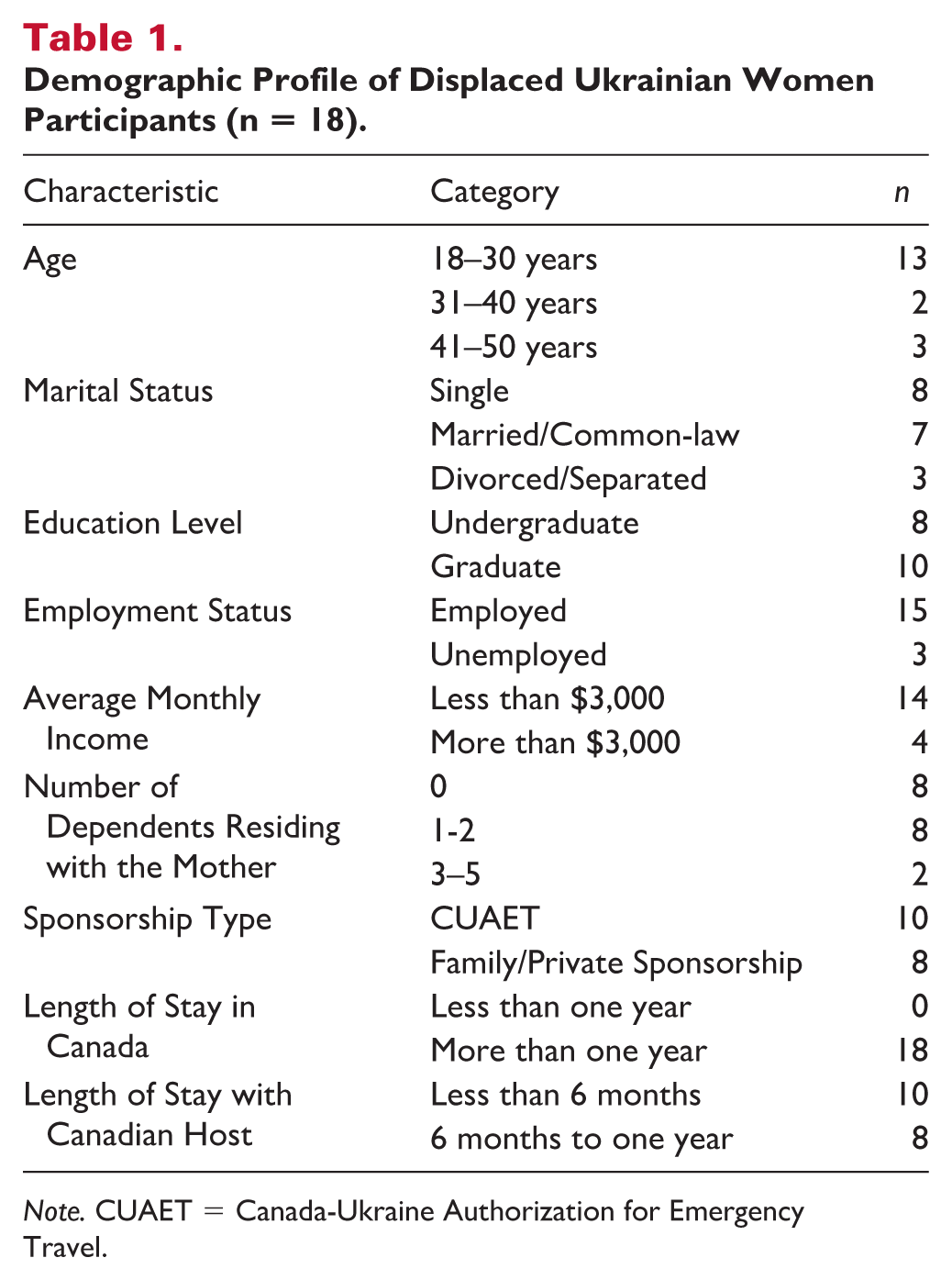
Note. CUAET = Canada-Ukraine Authorization for Emergency Travel.
Data Analysis
The primary researcher, alongside a researcher from the original study and a research assistant, conducted multiple close readings of the verbatim transcripts, this time with a renewed focus and emphasis tailored to the objectives of the current study. The analysis of interview data followed Braun and Clarke’s (2019) approach to thematic analysis, a method used to identify, interpret, and make sense of patterns across qualitative data. NVivo 12 software, which facilitated systematic data management, coding, and organization was used for qualitative data management. A line-by-line coding process was employed, allowing initial codes to be organized into broader conceptual categories. These were structured as parent nodes, with recurring and meaningful subthemes nested as child nodes within them. Through iterative analysis, related codes were consolidated into overarching themes that captured the core elements of participants' shared experiences. To illustrate these themes and enhance the clarity of findings, representative quotations were selected that reflected the common narratives expressed by the Ukrainian refugee women. Observational field notes were also incorporated into the coding process, particularly to account for emotional cues that could enrich contextual interpretation.
To visually represent the most frequently referenced codes across participant narratives, a word cloud was generated using NVivo-exported data (See Figure 1). Terms such as hospitality, power, reciprocity, stability, safety, adaptation and gratitude appeared most often, reflecting the emotional and practical dimensions of displaced Ukrainian women’s homestay experiences in Canada. This visualization supports the thematic analysis, highlighting participants’ emphasis on the interconnected needs for security, emotional support, and cultural integration in host-guest dynamics. To ensure analytic rigor and consistency, the research team engaged in regular debriefing sessions to review coding decisions and thematic development. Measures to establish trustworthiness included member checking and confirmability procedures, in line with Anney (2014). A summary of the thematic findings was shared with six participants, three of whom confirmed that the themes accurately represented their experiences, while the remaining three did not respond. Confirmability was further supported by the maintenance of detailed documentation, including reflective journals, coding memos, and an audit trail throughout the research process.
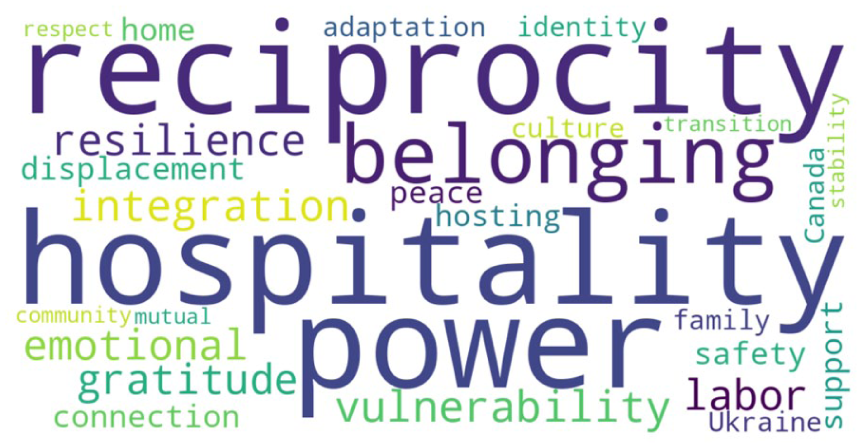
Word Cloud of Key and Frequently Referenced Codes Across Participant Narratives.
Results
Domestic Hospitality as Moral Practice
Participants described homestay hosting as a moral and civic practice. They also shared that their hosts were often motivated by a sense of ethical duty and emotional responsibility, offering support without expectation of financial compensation. For many Ukrainian women, this form of hospitality was perceived as genuine and compassionate, creating a sense of safety and human connection during a time of displacement. Many Ukrainian women described that the non-commercial model of hospitality that is grounded in care, empathy, and solidarity challenged conventional norms of guest-host relationships. It fostered a sense of belonging that extended beyond physical shelter, reflecting the potential of domestic spaces to become sites of moral engagement and mutual respect. Natalia shared her experience and said, “They didn’t ask for anything. They just opened their home because they felt it was the right thing to do. It made me feel like I was not alone."” (Natalia, 34 years old, employed, married, no children).
A central feature of participants’ experiences was the non-commercial nature of the hospitality they received. Unlike formalized service arrangements or temporary rentals, these hosting relationships were based on generosity, trust, and human solidarity rather than financial transactions. The absence of commercial exchange was significant for many Ukrainian women, as it fostered a sense of dignity and belonging rather than dependency or indebtedness.
This form of hospitality emphasized relational care over economic benefit, where support was offered freely and intentionally. Participants noted that their hosts welcomed them not out of obligation or gain, but from a genuine desire to help, reflecting a form of civic compassion rarely captured in institutional or market-based models of refugee support. This moral grounding shaped the women’s perception of their hosts and deepened their emotional connection to the households in which they lived. Yara shared her experiences and stated, “It wasn’t like paying rent or being a guest in a hotel. It felt more like staying with family and with someone who cares without expecting something back.” (Yara, 32 years old, unemployed, married, one child residing with the mother).
Navigating Cultural and Gender Norms in Shared Spaces
Participants highlighted the challenges of adapting to new household dynamics shaped by cultural and gendered expectations. Living in shared domestic spaces requires ongoing negotiation of roles, privacy, and daily routines. Some women felt pressure to conform to unspoken norms around cleanliness, caregiving, and emotional labor, often rooted in traditional gender roles. Expressions of gratitude, while genuine, were sometimes expected or assumed by hosts, placing emotional strain on guests who already felt vulnerable. These interactions revealed subtle power dynamics in the home, where hospitality was intertwined with expectations of femininity, compliance, and domestic contribution. Tania shared her experience and stated: I always made sure to clean and help around the house not because they asked, but because I felt I had to show I was grateful. Sometimes I didn’t know if I could use the kitchen or when it was okay to have a shower and it wasn’t my space, so I tried not to take up too much room. (Tania, 30years old, single, employed with no children)
Participants frequently encountered implicit gendered expectations within their host households. As women, they were often expected to take on caregiving roles or perform acts of domestic labor such as cleaning, cooking, or helping with children, as unspoken expressions of gratitude. While some hosts framed these tasks as optional or collaborative, the participants described feeling an internalized pressure to "earn" their place in the home by fulfilling traditionally feminine roles. These expectations reflected broader cultural assumptions about women's responsibilities in domestic settings, where emotional labor and caregiving are often undervalued yet implicitly demanded. For many participants, this meant balancing their own needs and trauma recovery with the constant effort to remain agreeable, helpful, and appreciative. The desire to avoid conflict or appear ungrateful frequently outweighed their own comfort or autonomy. This dynamic, while often subtle, underscores how gender and cultural norms continue to shape interpersonal relationships in informal hospitality settings, especially when power is unevenly distributed between host and guest. Tetiana shared her experience, Even when I was tired or sad, I felt like I had to smile and help in the kitchen. I didn’t want them to think I was ungrateful, or it felt like part of being a good guest, and a good woman. (Tetiana, 33 years old, married, unemployed, no children)
Power, Reciprocity, and Emotional Labor
Participants spoke about the emotional complexities involved in both receiving and participating in hospitality. While grateful for the support, many described a constant effort to maintain dignity and emotional balance within relationships marked by unequal power dynamics. These dynamics often require guests to manage their emotions carefully, avoid conflict, and present themselves as appreciative even when struggling internally. Navigating these imbalances often meant suppressing personal needs or discomforts to preserve harmony. At the same time, some participants expressed a desire to give back or support their hosts in return, highlighting their commitment to reciprocity despite their limited resources. These experiences reflect the hidden emotional labor embedded in informal hosting arrangements, in which gratitude, dependency, and care are often silently negotiated. Maria stated, “I was thankful, but it was also hard. I didn’t want to be a burden, so I tried to always be kind and helpful, even when I felt overwhelmed.” (Maria, 39years, divorced, unemployed, no children).
For many participants, navigating the host-guest relationship involved a delicate balance between gratitude and personal dignity. While they were appreciative of the support received, the inherent power imbalance, where hosts controlled the space and often set the terms of cohabitation, could lead to feelings of vulnerability and disempowerment. Participants described conscious efforts to avoid overstepping, minimizing their presence, and contributing in non-financial ways, such as cleaning or offering child care or emotional support, to retain a sense of agency. These strategies were not only about fulfilling social expectations but also about preserving self-respect in unfamiliar and often uncomfortable environments. Participants reflected on how they constantly assessed their actions, trying to avoid appearing needy or ungrateful, while also struggling with the emotional toll of being in a dependent position. The desire to maintain autonomy and dignity, despite limited control over their living situations, reveals the complex negotiation of identity, worth, and belonging within these asymmetric arrangements. Nataliya shared her experience and stated, “I didn’t want to feel like I was just taking. I helped when I could, even just listening or being kind. It made me feel like I still had something to give.”( Nataliya, 42 years old, single, no children, unemployed).
Hospitableness and Long-Term Integration
Participants described domestic hospitality as playing a pivotal role in their early sense of safety, trust, and belonging in Canada. Supportive host relationships helped ease their transition, foster emotional stability, and encouraged engagement with local communities. These experiences often extended beyond temporary shelter, shaping how participants viewed their place in Canadian society and their potential to rebuild their lives. Such accounts highlight the long-term value of hospitableness not only as immediate relief but as a foundation for integration. Participants emphasized the importance of being treated with dignity and compassion, suggesting that informal hospitality models can complement formal refugee support systems that recognize and strengthen relational forms of care as part of broader integration strategies. Anna shared that “My host made me feel like I belonged here and not just as a guest, but as part of the community. That gave me hope for starting over.” (Anna, 45 years old, separated, unemployed, no children).
Participants reflected on how the warmth and support offered by their hosts played a crucial role in shaping their early resettlement experiences and long-term integration. Beyond providing physical shelter, domestic hospitality fostered emotional safety, trust, and a sense of inclusion. For many women, being welcomed into a host’s home helped restore a sense of normalcy and stability, reinforcing their belief that they could rebuild their lives in Canada. Women shared that these positive early experiences served as a gateway to broader community engagement, such as joining local events, enrolling in educational programs, or pursuing employment opportunities. Participants emphasized that being treated as part of the household rather than as a temporary outsider deepened their feelings of belonging and strengthened their connection to Canadian society. Aleksandra stated:
My host made me feel like I belonged here not just as a guest, but as part of the community. That gave me hope for a starting over. Because they welcomed me without judgment, I started to believe that maybe I could stay here and build something new. It changed how I saw my future. (Aleksandra, married, 36 years old, two children residing with the mother).
Discussion
This paper examines how homestay hosting for displaced Ukrainian women in Toronto operates as informal hospitality within domestic, non-commercial settings. It explores how hospitableness, safety, reciprocity, and cultural differences are experienced and negotiated in these shared living arrangements. The participants in this study were displaced Ukrainian women, and most were young adults, with a mix of single, married, and separated individuals. They held either undergraduate or graduate degrees, and the majority were employed at the time of the study with modest monthly incomes. Most participants had a small number of dependents and had arrived in Canada through either the CUAET program or family/private sponsorship. All participants had been in Canada for over a year and had lived with a Canadian host for a period ranging from a few months to one year. The findings offer practical and theoretical insights into how homestay hosting of displaced Ukrainian women as a form of informal hospitality practices can influence both host and guest social behaviors (Alrawadieh et al., 2023), social cohesion (Kim, 2020), and longer-term integration outcomes (Boccagni & Giudici, 2021).
The study reveals that domestic hospitality is a moral practice in homestay hosting contexts in which refugee hospitality is often viewed as a moral duty rooted in cultural traditions (Rottmann & Nimer, 2021). Central to this practice is recognizing refugees as individuals with rights and dignity, which is key to fostering belonging and social acceptance (Kim, 2020). The findings revealed that refugee hospitality is a transformative practice that blurs the lines between natives and displaced women, complicating notions of integration and support (Boccagni & Giudici, 2021). It highlights the need to view domestic hospitality through a multi-scalar lens, connecting local acts with broader societal shifts in how home and belonging are understood (Boccagni & Giudici, 2021). Host family hospitality routines and interactions created spaces where foster carers and women could build a sense of belonging, helping to form deeper, more meaningful relationships that went beyond basic hospitality and developed into familial closeness (Sirriyeh, 2013). The study found that domestic hospitality in refugee hosting is driven by a moral and emotional responsibility, with hosts often viewing refugees as family (Monforte et al., 2021). These close bonds highlight the ethical and supportive role of hospitality in helping refugees through challenging times (Kim, 2020). In addition, domestic hospitality for displaced people is seen as an ethical act, offering care, belonging, and cultural exchange. It goes beyond shelter, reflecting a moral commitment to supporting vulnerable individuals (Horgan, 2013).
The findings highlight how displaced Ukrainian women navigate their roles as hosts and guests, using hospitality to assert their identities and counter discriminatory narratives (Rottmann & Nimer, 2021). By building connections and drawing on some cultural similarities between Ukraine and Canada, they reclaim their place in families and communities, turning hospitality into a tool for resistance and social inclusion (Rottmann & Nimer, 2021). The study shows that hospitableness in refugee hosting promotes empathy and positive attitudes, framing it as a moral practice (Alrawadieh et al., 2023). In the context of the Ukrainian refugee crisis, hosting becomes more than shelter as it fosters social good, personal fulfillment, and advocacy, going beyond traditional, commercial notions of hospitality (Alrawadieh et al., 2023). The findings highlight the emotional labor and power dynamics in refugee hosting, where managing routines and emotional bonds can strain reciprocity (Luczaj, 2024). Hosts may face stress and neglect their own families, underscoring the complex relationships involved and the need to better understand these dynamics (Luczaj, 2024).
The study found that hospitableness improves host-refugee relations by fostering empathy, positive attitudes, and overall satisfaction with the hosting experience (Alrawadieh et al., 2023). While it may not directly lead to advocacy, it indirectly encourages support for refugee hosting by creating meaningful and rewarding interactions (Alrawadieh et al., 2023). This suggests that promoting hospitableness can be an effective strategy to increase public engagement in refugee support. The findings examine power and reciprocity in private refugee hosting, showing how emotional labor and a sense of responsibility lead hosts to treat refugees like family (Monforte et al., 2021). This blurs host-guest roles and creates deep emotional bonds, highlighting that while hospitality is generous, it also demands significant emotional investment (Monforte et al., 2021). Similarly, the study views refugee integration through reciprocity, where hosts engage in emotional labor as part of a mutual exchange (Heins & Unrau, 2018). Heins and Unrau (2018) framed the mutual exchange within a neo-Maussian lens, and they highlight the power dynamics and complexities of hosting, showing how these relationships shape both challenges and rewards in fostering refugee integration. The study frames hospitality within the context of forced migration as a political act, involving complex power dynamics and emotional labor (Merikoski, 2021). While hosting can foster reciprocity and moral fulfillment, it also challenges local norms and may provoke mixed emotions, revealing the delicate balance of care and control in these relationships (Merikoski, 2021). The study shows how women-led refugee support that uses familial and maternal narratives to create welcoming spaces, challenging border politics and promoting inclusive, gendered hospitality. This is consistent with a study conducted by Stivens (2018) on how women-led refugee support groups in Australia use gendered, family-based hospitality to counter exclusionary border politics by drawing on maternal and kinship narratives to create welcoming spaces that reflect women’s political agency and emotional labor and to promote a more inclusive and compassionate approach to refugee support.
Implications
This study contributes to the growing scholarship on social hospitality, highlighting the need for more inclusive, gender-aware, and culturally responsive hospitality and homestay frameworks in both policy and practice. The findings from this study have important implications for research, policy, and practice in the fields of refugee integration, informal hospitality, and gender-responsive care. First, this research contributes to the growing body of scholarship that recognizes hospitableness as a relational, moral, and gendered practice (Bulley, 2023; Lashley, 2015). Future research should further investigate how informal domestic hosting arrangements impact refugee well-being over time and how host-guest dynamics differ across cultural and national contexts. Longitudinal studies could also explore how these relationships evolve and influence long-term integration trajectories for displaced populations.
From a policy perspective, the study underscores the need to formally acknowledge and support homestay hosting arrangements within broader refugee resettlement frameworks. While these practices are typically unregulated, they provide critical early-stage support, offering displaced individuals both shelter and emotional care (Boccagni & Giudici, 2021; Matteo & Clément, 2023). Policymakers should consider developing community-based support structures that recognize the emotional labor of hosts and provide training, resources, and financial support to facilitate ethical and sustainable hosting models. Such frameworks could also include pathways for mediation and conflict resolution to manage relational strain in host-guest arrangements (Monforte et al., 2021).
From a practical perspective, this study highlights the importance of fostering hospitable environments that go beyond temporary shelter to support refugee agency, dignity, and belonging. Service providers and settlement agencies can play a key role by offering culturally responsive training for hosts and promoting co-housing models that are rooted in mutual care rather than charity. These practices can enhance social cohesion, challenge stereotypes, and foster more inclusive communities (Alrawadieh et al., 2023; Rottmann & Nimer, 2021). Finally, integrating hospitableness as a principle into host training programs could help shift attitudes toward hosting as a shared social responsibility rather than a benevolent act, ultimately strengthening community resilience.
Actionable Insights for Hospitality Management
This study offers timely insights for hospitality managers seeking to engage with socially responsive and inclusive hospitality practices. First, the homestay hosting model illustrates the transformative power of relational hospitableness as a practice grounded in empathy, dignity, and non-commercial care. Managers can draw from these findings to train staff in cultivating emotional intelligence and trauma-informed service, especially when supporting vulnerable or displaced guests. Second, the findings suggest that hospitality providers should develop gender-sensitive protocols, as displaced women often face implicit domestic expectations and emotional labor burdens. Integrating equity-focused frameworks into host training can mitigate power imbalances and foster mutual respect. Third, the informal host-guest dynamics studied here emphasize the need for clear guidelines, boundaries, and expectations to ensure safe and respectful shared living experiences—applicable to both humanitarian and experiential lodging models. Finally, hospitality managers can explore partnerships with community organizations to support integration pathways and leverage domestic hospitality as a vehicle for social cohesion and corporate social responsibility.
Strengths and Limitations
A key strength of this study lies in its use of a community-based participatory approach, which amplified the voices of displaced Ukrainian women and centered their lived experiences in understanding the emotional and relational dynamics of homestay hosting. The qualitative design, combined with thematic analysis, provided rich, nuanced insights into how hospitality is negotiated within domestic, non-commercial settings. However, several limitations should be noted. One limitation of this study is its reliance on secondary data analysis, which may restrict the depth of exploration compared to primary data collection (Chatfield, 2020). The study sample was limited to 18 participants in the Greater Toronto Area, which may not fully capture the diversity of experiences among Ukrainian refugees across Canada or in other national contexts. In addition, the study relied on retrospective accounts of hosting experiences, which may be subject to recall bias or influenced by the participants’ current circumstances. Finally, the perspectives of Canadian hosts were not included in this study, which limits a full understanding of the mutual dynamics of domestic hospitality and reciprocity.
Conclusion
This study sheds light on the underexplored dynamics of homestay hosting as a form of informal hospitality among displaced Ukrainian women in Toronto. By framing domestic hospitality as a moral, relational, and gendered practice, the study reveals how hosts and guests co-construct spaces of care, belonging, and negotiation amid broader structural inequalities. The findings demonstrate that hospitableness, when rooted in empathy, reciprocity, and dignity, can foster meaningful integration experiences and support emotional well-being for refugees. As global displacement continues to rise, recognizing and strengthening these informal networks of care can serve as a vital complement to formal resettlement efforts. Advancing inclusive, community-based hosting models can help transform temporary accommodation into enduring foundations for shared futures. Homestay hosting offers a unique form of informal hospitality that blends cultural exchange, economic opportunities, and social engagement, making it a vital component of refugee and migrant settlement and integration. By fostering collaboration among stakeholders and implementing supportive policies, inclusive models, and structured pathways for hosts and guests, homestays can be a successful hospitality framework that continues to thrive, benefiting both local communities and refugees alike.
Footnotes

Funding
The authors disclosed receipt of the following financial support for the research, authorship, or publication of this article: This work was funded by the Social Sciences and Humanities Research Council (SSHRC) through an Insight Development Grant (grant number 430-2023-00080). SSHRC had no role in the design, execution, analysis, or writing of the manuscript.
Declaration of Conflicting Interests
The authors declared no potential conflicts of interest with respect to the research, authorship, or publication of this article.