



Abstract
This study investigates how managers’ and targeted Asian employees’ responses to customer-perpetrated racial discrimination affect the observing customers’ perceptions and behavioral intention. Using two experimental designs, Study 1 examines the effect of managers’ responses (i.e., avoidance, employee support, and customer support), and Study 2 tests targeted employees’ responses (avoidance, confrontation, and venting) to racial discrimination on observing customer’s revisit intention. In addition, this study examines the moderating role of the severity of racial discrimination. Across two studies, this research provides evidence that observing customers tend to rate managers as fair when they support the targeted employees. Also, observing customers rate the targeted employees as competent when they professionally confront the customers which led to a higher level of revisit intention. This study expands the hospitality literature by focusing on racial discrimination against Asian American and offers practical guidance on how managers and employees should respond to racial discrimination.
Keywords
Introduction
Racial discrimination creates a challenging work environment for employees of color. Employees of color in the hospitality industry tend to suffer from higher levels of racial discrimination and, thus, report lower levels of career satisfaction, which can further lead to their career derailment (Shum et al., 2020). Racial discrimination can be particularly problematic in the restaurant industry, given that it is the nation’s second-largest private sector employer in the United States (National Restaurant Association, 2022), and employees of color make up one-third of its workforce (Zippia, 2022). One major form of racial discrimination in the hospitality industry is discrimination against employees of color by customers (Madera et al., 2017). Because of the common business practice of “customer is always right” and heavy reliance on customers’ tips for the wage (Good & Cooper, 2016), restaurant employees are expected to tolerate unfair treatment from customers and follow the service rules (Baker & Kim, 2021). Furthermore, the desire to satisfy customers can make managers tolerate discrimination against employees. The management often overlooks restaurant employees being a victim of discrimination (Handy, 2006), which indirectly allows customers to discriminate against restaurant employees and make them vulnerable to discrimination.
Among employees of color, Asian Americans are the fastest-increasing labor force in the hospitality industry, which increased by 64% since 2010 (Zippia, 2022). While racial discrimination against Asian American employees is not a new social phenomenon, the spike of anti-Asian racism during the COVID-19 pandemic added additional hardship for them as they constantly work with a diverse workforce and customers. For example, during the COVID-19 pandemic, approximately 80% of Asian American workers reported experiencing racial discrimination, while only 40% felt empowered or supported professionally (Suh et al., 2021). Even after the COVID-19 pandemic, the majority of Asians believe anti-Asian discrimination is a major problem, yet too little attention has been paid to their experiences of discrimination (Ruiz et al., 2023). Moreover, the consumer anxiety associated with COVID-19 results in brand boycotting behaviors of Asian restaurants (Legendre et al., 2022). Asian restaurants experienced an 18.4% decrease in traffic which caused approximately $7.42 billion in lost revenue in 2020 (J. T. Huang et al., 2023). However, the widespread “model minority” stereotype minimizes and invalidates Asian Americans’ experiences of racism and racial discrimination (Yoo, Steger, & Lee, 2010). Despite the unique societal and economic challenges faced by Asian American employees in the restaurant industry, extant literature on workplace racial discrimination against Asian Americans has been limited (Chui et al., 2022; Jun & Wu, 2021). The spurred and persistent anti-Asian racial discrimination calls for a more scholarly investigation of its effects in the hospitality industry and what employers and employees can do to handle it. Therefore, this study investigates the effects of racial discrimination among Asian American employees in the restaurant industry.
In addition, due to the unique nature of the restaurant sharing the physical environment with others (K. Kim & Baker, 2020), the customers who exist in the same environment can easily witness an incident of racial discrimination targeting employees that affects the overall service climate. Extant literature has shown that witnessing the unfair customer behaviors against employees and how employees handle the incident can provoke deontic reactions and influence the observing customer’s own service experience (Folger, 2001; Henkel et al., 2017; Kamran-Disfani et al., 2023). The persistent and pervasive racial discrimination against Asian American employees call for a scholarly investigation on what managers and targeted employees can do to handle racial discrimination and how their responses will be perceived by other customers.
Despite the recent surge of anti-Asian discrimination and its harmful effects on Asian American workers (Chui et al., 2022; Jun & Wu, 2021), there are gaps in the hospitality literature on the impact of racial discrimination particularly against the Asian American workforce. Compared to non-race-specific stressful events such as customer incivility that any service employee can face, racial discrimination is a social identity threat that results in long-lasting traumatic stress reactions with detrimental psychological and physiologic outcomes among people of color (Carter, 2007; Pieterse & Carter, 2007; Reeves et al., 2024). As targeted individuals’ appraisal of the stressful events and their position in a social structure determines the types of stress-coping responses (Lazarus & Folkman, 1984), more investigations on how managers and targeted employees’ responses to race-specific incidents are perceived by observing customers are warranted. To fill these gaps in the literature, the main goal of this research is to examine how the ways managers and targeted Asian American employees handle racial discrimination affect the observing customers’ perception and their subsequent behavioral intentions. Specifically, this study examines (1) how different types of managers’ responses to discrimination affect the observing customers’ perceived fairness of the manager and (2) how targeted employees’ responses affect observing customer’s perceived competence of the employee, and in turn, affect their revisit intention. In addition, given that the forms of anti-Asian discrimination range from blatant discrimination (e.g., racial slurs, blame for COVID-19) to subtle discrimination (e.g., avoidance and distancing) (Gardner et al., 2022) and its potential impact on the observing customers’ perceptions, this study further tests whether these associations vary by the severity of racial discrimination.
Theoretical Background
Observing Customers and Deontic Justice Theory
Restaurant experiences tend to be consumed in shared social settings where customers can observe other parties and influence each other (Grove & Fisk, 1997). Previous studies have shown that disruptive or negative behaviors of other customers have a significant effect on observing customer experiences, such as negative emotional responses (Miao & Mattila, 2013) or dissatisfaction with the service (Grove & Fisk, 1997). Relatedly, recent discrimination literature documents that vicarious (indirect) racial discrimination predicts severe psychological distress (Macaranas et al., 2023), depressive symptoms (Holloway & Varner, 2021), and anxiety (Chae et al., 2021). As such, racial discrimination has profound spillover effects, even among those who were not directly targeted. Deontic justice theory purports that individuals inherently maintain ethical standards and thus react to perceived unfair treatment toward others when it violates their norms of justice (Folger, 2001). According to this theory, the motivation to redress injustice on behalf of the victims stems from their innate moral institution rather than self-interest (Cropanzano et al., 2017). As such, customers who witness unfair treatment against employees of color (e.g., racial discrimination) may experience deontic reactions that motivate them to remedy the unjust behaviors. Given that it is difficult for customers to directly challenge the other perpetrating customers with no direct relationship, they may engage in other forms of deontic reactions (K. Kim & Baker, 2020). By observing how other actors (i.e., managers and target employees) respond to the unjust situation, the witnessing customers can assess to what extent justice was restored and decide whether they would indirectly aid the managers’ or employees’ attempts (e.g., by supporting the business). As such, a growing body of hospitality research applied deontic justice theory to investigate how customer incivility toward employees affects the observing consumer behaviors (Hwang et al., 2022; K. Kim & Baker, 2020). For example, previous studies tested the effects of overhearing a fellow customer’s illegitimate complaints in a restaurant setting and subsequent service recovery on the customers’ behavioral reactions (K. Kim & Baker, 2020). Another research tested the effects of witnessing a fellow customer’s incivility toward a cashier at a restaurant on the revisit intention (Hwang et al., 2022). While these studies focused on the effects of customer incivility, racial discrimination is a unique stressor that merits separate investigations in that it uniquely predicts psychological outcomes (e.g., distress, depressive symptoms) over and beyond general stressful events (i.e., not specific to race) (Gee et al., 2007; Wei et al., 2010). Previous studies also suggest that the coping strategies typically used to respond to nonracial stressors are different from the strategies used to cope with racism (Brown et al., 2011; Hoggard et al., 2012). For example, a study of African Americans found that, compared to nonracial situation, they use more confrontational, ruminative, and avoidant coping strategies and less problem-solving strategies when facing racially stressful situations (Hoggard et al., 2012), suggesting a need for understanding coping strategies specific to racial discrimination. This study expands the focus of existing literature from general stressors (e.g., customer incivility) to race-specific stressors (e.g., racial discrimination) against Asian American employees, a stigmatized yet understudied group of employees in the hospitality industry. Furthermore, our study advances the deontic justice theory by applying it to an understudied unjust social problem—racial discrimination—in the hospitality industry and by testing how involved parties’ reactions to discrimination can provoke third-party customers’ deontic reactions and the subsequent consumer behaviors. Specifically, this study examines how managers’ and targeted employees’ responses to discrimination affect the observing customers’ perceptions and reactions.
Manager Responses to Racial Discrimination
Owing to the existence of power relationship between customers and employees, employees have limited latitude to handle customer mistreatment (Grandey et al., 2004) and therefore become more vulnerable to racial discrimination. In fact, uncivil customers take advantage of the perceived power disparity and use it to demand unreasonable treatment during interaction (Kamran-Disfani et al., 2023). As managers have the authority to allocate resources to employees and mediate conflicts, they can play a key role in alleviating unfair treatment of customers to their employees (Baker & Kim, 2020). One way that managers can handle consumer-perpetrated discrimination is to support the targeted employee. Discrimination literature documents that social support from family, friends, or significant others buffers the negative physical and psychological effects of discrimination among Asian Americans (S. Lee & Waters, 2021; Mossakowski & Zhang, 2014). Relatedly, previous hospitality research found that managerial support toward employees mitigates the detrimental psychological effects of customer incivility among the targeted employees (Baker & Kim, 2020). Similarly, Zhu et al. (2019) found that frontline service employees who encountered customer incivility tend to provide extra-role customer service only when they perceive high levels of support from their supervisor.
While managers’ support toward employees can mitigate the adverse effects of discrimination, the pressure to satisfy their customers may lead them to disengage from the situation by avoiding the problem and letting employees deal with the mistreatment on their own. Furthermore, managers can even take the perpetrating customer’s side and support the customer, following the “putting the customer first” mantra (Kamran-Disfani et al., 2023). In fact, a study found that managers in the hospitality sector tend to have dismissive attitudes toward customer misbehaviors toward their workers, such as expecting them to tolerate misbehaviors (Booyens et al., 2022). For example, a study of workplace sexual harassment reveals that managers are less likely to label an incident as sexual harassment and recognize organizational responsibility when the same sexually harassing behaviors were committed by customers than by coworkers (Madera et al., 2017). Relatedly, many employees feel that the organization only cares about the customers and has little care for the employees (J. Yoo & Arnold, 2016). Although managers’ such responses may satisfy the perpetrating customers, the absence of managerial support toward employees can even amplify the adverse effects of discrimination on employees and lead to the detriment of the service climate (Jung et al., 2017). For example, evidence suggests that, compared to laissez-faire leadership (e.g., having the employees deal with customer problems on their own as it is their responsibility), empowering leadership (e.g., authorizing the employees to act as they think is right using their discretion) of supervisors can better mitigate the detrimental effects of customer incivility on the targeted employee’s psychological and behavioral outcomes (Boukis et al., 2020). Yet, despite the growing evidence suggesting the profound effects of managers’ responses to unfair customers, it is unclear how different types of manager’s responses would affect observing customers’ attitudes and behaviors.
Previous research supports that customers’ fairness perception is one of the essential components of customer satisfaction (Oliver, 1997). When customers believe the transaction violates fairness, they are likely to experience anger and retaliate or avoid the parties involved, leading to lower behavioral intention (Campbell, 1999). Consequently, perceived fairness in how managers handle the customer who discriminates against their employees can play a crucial role in explaining the observing customers responses to the observed interaction. According to deontic justice theory, individuals make their moral decisions by observing a triggering event (e.g., customer-perpetuated racial discrimination) and evaluating the moral appropriateness of the event based on their own self-based justice rules (Cropanzano et al., 2017). Since racial discrimination is fundamentally unfair and the power differential makes it difficult for the targeted employees to take actions, the observing customers are likely to expect a manager to intervene to address the injustice on behalf of the targeted employee (Gong et al., 2014). Hence, observing customers may expect employees to be helped by their managers and may consider the absence of managerial support to be unfair. Failing to provide such support for the employees by taking no action or even taking customers side and ignoring the damage inflicted on employees, lead to perceived injustice (Vermunt & Steensma, 2005).
In turn, based on their assessment of the fairness of the managers’ response (i.e., the way managers handle discrimination), deontic justice can affect their subsequent consumer behaviors. Observing customers may perceive behaviors, such as not revisiting the restaurant, as ways of promoting justice, especially when they believe that the manager’s response did not adequately restore justice. This theoretical notion is consistent with the evidence that customers’ perceived ethicality of a company promotes their positive word-of-mouth (Markovic et al., 2018) and loyalty to the company (Singh et al., 2012). Relatedly, K. Kim and Baker (2020) document that observing customers’ reaction to the service recovery treatment of other customers’ illegitimate complaint depends on their evaluation of the fairness of the treatment. Yet, limited research investigated how observing customers’ fairness perceptions toward manager’s responses to discrimination affects their behavioral intention. Based on the deontic justice theory and empirical evidence, we contend that managers’ employee-supporting responses to a discriminatory customer can be perceived as a restoration of justice, whereas avoidance or customer-supporting responses can be perceived as a lack of justice. Furthermore, observing customers’ higher fairness perception of the managers’ response may lead to their stronger willingness to revisit the restaurant. To this end, we propose to test the following research hypotheses:
Targeted Employee Responses to Racial Discrimination
In addition to the manager’s responses to discrimination, how the targeted employees deal with consumer-perpetrated racial discrimination can also affect observing customers. In fact, previous studies highlighted the importance of victim’s coping responses to racial discrimination as how victims cope with stress can either reduce or amplify the effects of adversity (Lazarus & Folkman, 1984). The transactional theory of stress and coping theorizes two primary stress coping strategies: problem-focused coping and emotion-focused coping (Lazarus & Folkman, 1984). Problem-focused coping refers to ways to actively manage or fix the stressful situation (e.g., confronting the situation directly, making a formal complaint), and emotion-focused coping refers to approaches to regulate emotional responses to the stressors (e.g., disengaging from the stressor or venting emotions) (Lazarus & Folkman, 1984). While both types of coping consist of a range of different behaviors, this study aims to examine the effects of three viable types of responses—confrontation (i.e., expressing one’s concerns and confronting the sources of stress) as a form of problem-focused coping, and avoidance (i.e., distancing oneself from the stressor) and venting emotions (i.e., getting upset and showing emotions) as forms of emotion-focused coping—that the restaurant employees may adopt in the moment of discrimination and can be observed by other customers. Studies have shown that targeted employees tend to use emotion-focused coping, particularly avoidance strategies, more often than problem-focused strategies, such as confrontation, in response to mistreatment or incivility at work (Cortina & Magley, 2009; Salin et al., 2014). In addition, because it is difficult for service employees to completely avoid interacting with customers, another common response to discrimination can be to vent their emotions to the perpetrating customer (Yagil, 2018). Specifically, studies have shown that mistreatment from customers can cause emotional exhaustion among employees and can transit to their retaliation intention or aggression against the unfair customers (Chan et al., 2022).
When responding to workplace incivility, avoidance leads to negative outcomes, such as emotional exhaustion or lower psychological forgiveness, while confrontation is related to positive outcomes, such as higher psychological forgiveness (Hershcovis et al., 2018). Relatedly, despite the frequent use of avoidance strategies or other passive strategies, targeted employees tend to wish they could have used more assertive strategies (Salin et al., 2014). Evidence also suggests that employees’ reciprocation of uncivil customer behaviors can escalate conflict and service failure (Andersson & Pearson, 1999), suggesting that venting emotions may not result in positive outcomes. Even though emotion-focused coping strategies (e.g., avoidance and venting emotion) may lead to negative relational and behavioral employee outcomes, employees of color tend to choose such strategies rather than problem-focused coping (e.g., confrontation) when experiencing racial discrimination at work because of the potential costs of confrontation and the lack of institutional support (Li et al., 2021). Despite the current knowledge base of how coping responses can modify the effects of customer mistreatment, there is limited research on how the employee’s coping responses are perceived by observing customers and affect their attitudes toward the employees and subsequent behaviors.
When encountering racial discrimination, the targeted employees should demonstrate their ability to handle the situation. Especially in the service setting, competence is a critical measure that determines the interaction quality of service encounter (Gronroos, 1990) and employees need to maintain impressions of competence by being efficient and knowledgeable to perform their job. Observing customers may use employees’ responses to the perpetrating customer as an indicator of competence. We argue that customer-perpetrated racial discrimination provokes deontic reactions among the observing customers, such that they would perceive the targeted employees’ efforts to restore justice as deemed appropriate and competent. For example, Habel et al. (2017) found that observers perceive employees as more competent when they follow the service rules on misbehaving customers and, in turn, reported higher customer loyalty. In addition, Henkel and colleagues (2017) showed that observing customers rated the targeted employee of customer incivility as more competent when they politely reprimanded an uncivil customer than when they responded in a submissive manner. In contrast, uncivil employee responses (e.g., responding impolitely and reciprocating customer incivility) negatively affected observing customers’ service experiences (Henkel et al., 2017). In similar, observing customers tend to perceive the targeted employees’ constructive resistance to customer incivility as more competent compared to submissive reactions (Kamran-Disfani et al., 2023). Another study found that employee’s use of “necessary evil,” which causes “unpleasant experiences to dysfunctional customers for the benefit of other customers, employees and the organization as a whole,” positively influenced observing customers’ perceptions of justice and their willingness to spread positive word of mouth (Y. S. Huang et al., 2022, p. 743). As such, although confrontation may not be congruent with the “customer is always right” norm in the hospitality industry, in the moment of injustice, assertive problem-focused responses can be perceived as a more appropriate and competent way of handling the problematic situation compared to passive or reciprocating responses and, in turn, can yield more positive responses from the observing customers that benefit the firm (e.g., revisit intention) (Kamran-Disfani, 2023).
Severity of Racial Discrimination
Racial discrimination in the workplace can take many forms. While blatant forms of racial discrimination can be overt, easily recognizable, and intentional (e.g., verbal harassment, racial slurs, and physical assault), subtle racial discrimination can be difficult to recognize and seemingly innocuous (e.g., microaggression) (Jones et al., 2016). Since the COVID-19 pandemic, Asian Americans have experienced a spike in overt racism in that nearly 67% of reported anti-Asian hate incidents involved harassment, including verbal hate speech or inappropriate gestures, and 17% of incidents involved physical violence (Stop AAPI Hate, 2022). Asian Americans also face unique forms of subtle racial discrimination compared to other marginalized groups (Sue et al., 2007). For example, Asian Americans are often assumed to be “perpetual foreigners” regardless of where they are born or how long they have lived in the United States (Wu, 2002) and seen as “model minorities” who are immune to racism (Yoo, Burrola, & Steger, 2010). Although subtle forms of discrimination are equally damaging compared to overt forms of discrimination (Jones et al., 2016), the targets of subtle discrimination can struggle with defending themselves against it due to its ambiguity, difficulty in its detection, and lack of clear options for reporting or responding to it (Sue, 2010).
Owing to its subtle and ambiguous nature, observers may underestimate the negative effects of subtle discrimination and perceive it as less threatening to the target than overt discrimination. Bystander literature suggests that the perceived severity of situations affects the bystanders’ helping behaviors (Desrumaux et al., 2015; Jungert & Holm, 2022). For example, as bystanders of workplace bullying judged the act of the perpetrator as more serious and inequitable, they were more likely to attribute the responsibility to the perpetrator and were more willing to help the victim (Desrumaux et al., 2015). In similar, jurors who read severe workplace harassment vignette were more likely to perceive that the targets should be compensated for their suffering, compared to those who read mild harassment scenario (Cass et al., 2010). Applied these findings to this study context, the severity of discrimination (subtle vs. blatant) may affect the ways observing customers perceive managerial and employee responses to discrimination. Specifically, when observing blatant forms of discrimination, the witnessing customers may be more likely to perceive that the situation is less equitable and that the targeted employees deserve more support, leading them to support the targeted employee’s assertive responses or manager’s support to the employee, compared to when observing subtle forms of discrimination.
The following sections detail the two studies designed to test the hypotheses. Study 1 examines the impact of manager’s response to racial discrimination against employees on observing customers’ revisit intention mediated by perceived fairness of manager response (H1, H2) and the moderating effect of severity of discrimination (H5). Study 2 examines the influence of employee’s response to racial discrimination against employees on observing customers’ revisit intention mediated by employee’s perceived competence (H3, H4), and the moderating effect of severity of discrimination (H6).
Methodology
Pretest
Two pretests, one pretest for each study, were conducted to evaluate the effectiveness of the content and strength of manipulation stimuli differently as intended. Using a convenience sampling method, students enrolled at a University in the Southeast region of the United States were recruited to conduct a series of pretests, resulting in 73 participants in Study 1 and 78 participants in Study 2. Results from pretests confirmed the effectiveness of all manipulations of experimental stimuli. Based on the successful pretest results, the same experimental stimuli and same measurements in the main study were used.
Study 1
Study Design and Procedure
To examine the effect of the managers’ responses to customer-perpetrated racial discrimination against Asian employees on observing customers, a 3 (Manager’s response: avoidance vs. employee-support vs. customer-support) × 2 (Severity of discrimination: blatant vs. subtle) scenario-based between-subjects design was used (Figure 1). A total of 300 respondents were recruited from Prolific, a data panel that provides quality data suitable for recruiting subjects for social science experiments (Palan & Schitter, 2018). To ensure quality, only participants who dine out in a restaurant at least once a week were included in the sample and respondents who failed quality control checks were omitted. Final analysis included 280 samples. Gender (male = 46.10%) and age (m = 35.32 years) of participants were well-distributed among the sample. Around 76.40% of the respondents were Caucasian, followed by Asian (7.50%), African American (6.40%), and more than half (66.10%) had at least a college degree.
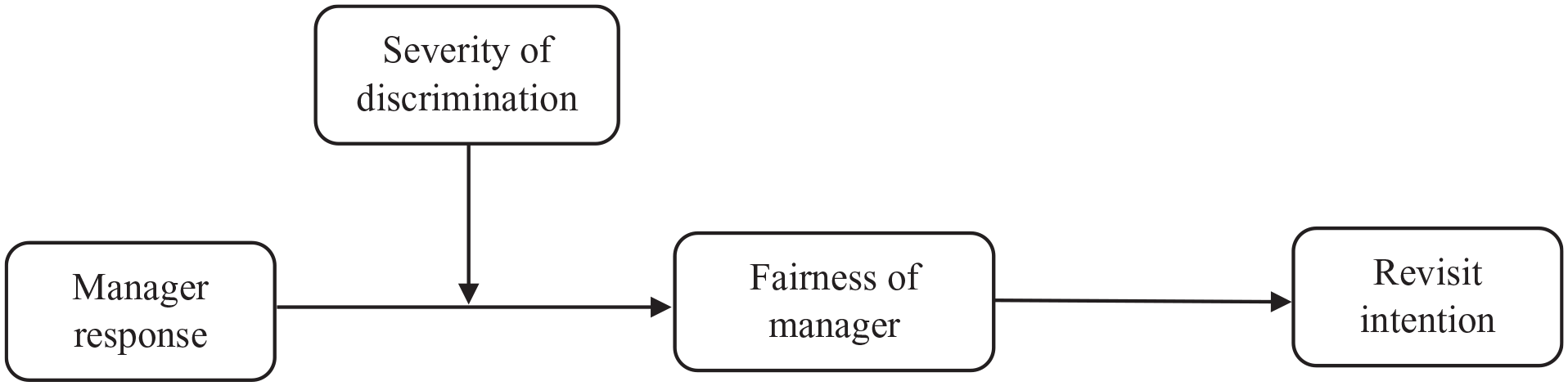
Conceptual Model for Study 1.
Stimuli and Measurements
The stimuli presented a hypothetical scenario where respondents imagined dining at a restaurant and overheard the conversation between the Asian servers and other customers sitting next to them. The manager’s response was manipulated at three levels: avoidance, employee support, and customer support based on Kaufmann and Beehr (1986) study. Participants in avoidance conditions were given a scenario where the manager, who observed the situation in a near distance, avoided and ignored the situation and did not step into the conversation. In the employee-supporting conditions, the manager informed the customers that the restaurant does not tolerate customers disrespecting employees and insisted that the customers were no longer welcome there, given their harassment toward their employees and asked them to leave. In the customer-supporting condition, the manager apologized to the customer for the inconvenience their employees may have caused and informed the customer that he or she would change the server for them. The severity of discrimination from other customers was manipulated at two levels suggested by Yoo, Steger and Lee (2010): blatant and subtle. In the blatant discrimination condition, the other customers verbally assaulted the server using racially discriminatory words and making fun of the Asian server based on race. In the subtle condition, the other customers questioned the Asian server’s English proficiency (despite the server speaking English fluently), overlooked the server, and insisted that they wanted someone else who speaks English to serve them.
All measurement items were adopted from previous studies to ensure validity and reliability and were measured on a 5-point Likert-type scale. For manipulation checks, the type of discrimination was measured with six items, for example, the customers sitting next to you (the perpetrating customers) view the Asian servers with suspicions because they are Asian; α= .85, (Yoo, Burrola, & Steger, 2010), and the manager’s response was measured with five items (e.g., the manager avoids and ignores the conversation between the customers sitting next to you and the Asian server; α= .91) (Kaufmann & Beehr, 1986). Perceived fairness was measured with three items (e.g., when considering the treatment that the Asian servers received from the manager, how fair do you think it was?; a = .98) (Van den Bos & Lind, 2001), and revisit intention was measured with two items (e.g., How interested are you to dine at this restaurant again?; α= .98) (Wang & Mattila, 2015). Appraisal of discrimination was measured with three items adapted from Operario and Fiske (2001) (e.g., “To what extent are you personally a target of discrimination because of your race or ethnicity,” α= .93).
Manipulation Checks
A series of analyses of variance (ANOVAs) were conducted to test the effectiveness of the manipulation of manager’s response. Planned comparisons show that the participants perceived a higher level of support toward the targeted employee in employee-support condition than in customer-support and avoidance conditions, F(2,277) = 435.81, p < .001; MEemployee Support = 4.52 versus MCustomer Support = 1.68 versus MAvoidance = 1.30. Also, participants perceived a higher level of support toward the customer in customer-support condition compared to employee-support and avoidance conditions, F(2,277) = 190.26, p < .001, MCustomer Support = 4.46 versus MEmployee Support = 1.38 versus MAvoidance = 2.63. Participants perceived a higher level of avoidance in the avoidance condition than in employee-support and customer-support conditions, F(2,277) = 245.8, p < .001, MAvoidance = 4.64 versus MEmployee Support = 1.35 versus MCustomer Support = 2.07. Manipulation of type of discrimination was also significant, F(1,278) = 338.68, p < .001. The blatant condition elicited significantly higher blatant discrimination compared to the subtle condition (MBlatant = 4.32 vs. MSubtle = 2.58). Respondents perceived the given scenario (M = 4.03, SD = .97) as realistic, and there was no significant difference among different conditions regarding realism perceptions. Taken together, these results indicated successful manipulations.
Hypothesis Testing
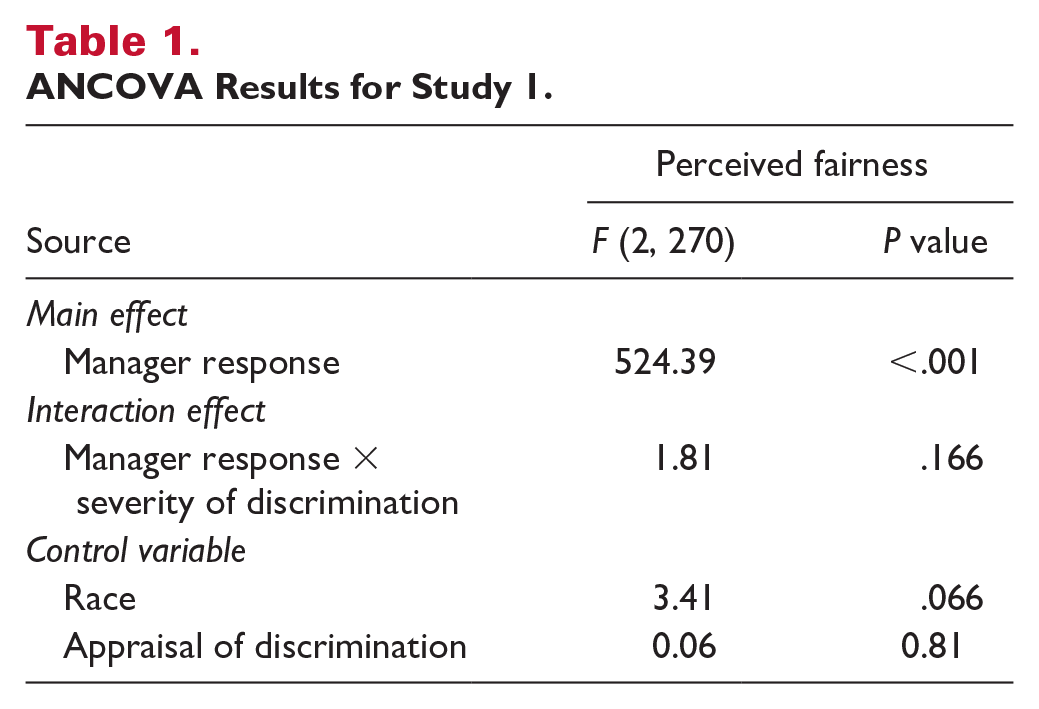
To examine the main effects of manager’s response and its interaction effect with the severity of discrimination on perceived fairness of the manager’s response, we conducted two-way analysis of covariance (ANCOVA). We controlled respondents’ race and appraisal of discrimination as previous studies found that individuals race and beliefs or appraisals regarding discrimination have a potential effect on their perception toward the discrimination (e.g., Operario & Fiske, 2001). The main effect of the manager’s response was significant, F(2,270) = 514.39, p < .001 (Table 1), supporting H1. To further test the relative effect of manager’s response, we conducted a series of planned contrasts. We found that the participants in the employee-support condition perceived significantly higher perceived fairness of the manager’s response than those in customer-support, MEmployee Support = 4.61 versus MCustomer Support = 1.38, t(176) = 29.86, p < .001, and avoidance conditions, MEmployee Support = 4.61 versus MAvoidance = 1.46, t(178) = 25.29, p < .001. However, there was no significant difference between the customer-support and avoidance conditions, MCustomer Support = 1.38 versus MAvoidance = 1.46, t(198) = 1.10, p > .10. The results from ANCOVA of the interaction effect between the manager’s response and the severity of discrimination was not significant, F(2,270) = 1.81, p = .17, failing to support H5. Contrary to what we hypothesized, there was no impact of severity of discrimination on respondent’s perceived fairness of manager regardless of the different managers’ responses.
ANCOVA Results for Study 1.
In addition, to examine the mediation effect of perceived fairness of manager, bootstrap tests of mediation (Model 4; Hayes 2017) with 5,000 samples were conducted. In support of H2, fairness of the manager mediated the relationship between the manager’s response to discrimination and observing customer’s revisit intention (95% confidence interval [CI] = [.89, 1.31]). In other words, customers were less likely to revisit the restaurant when they observed the manager avoiding intervention or supporting the perpetrating customer as they perceived such responses as unfair toward the targeted servers.
Study 2
Study Design and Procedure
To examine the effect of the targeted Asian employee’s response to racial discrimination on observing customers, A 3 (Employee’s response: avoidance vs. confrontation vs. venting) × 2 (Severity of discrimination: blatant vs. subtle) scenario-based between-subjects experimental design was used (Figure 2). A total of 250 respondents were recruited from Prolific and to ensure quality, only participants who dine out in a restaurant at least once a week were included in the sample by adding a screening question. Respondents who failed quality control checks were omitted. The final analysis included 227 respondents. Gender (Male = 50.2%) and age (M = 36.67 years) of participants were well-distributed among the sample. About 75.3% of the respondents were Caucasian, followed by African American (8.80%), Hispanic (7.00%), and more than half (70.40%) had at least a college degree.
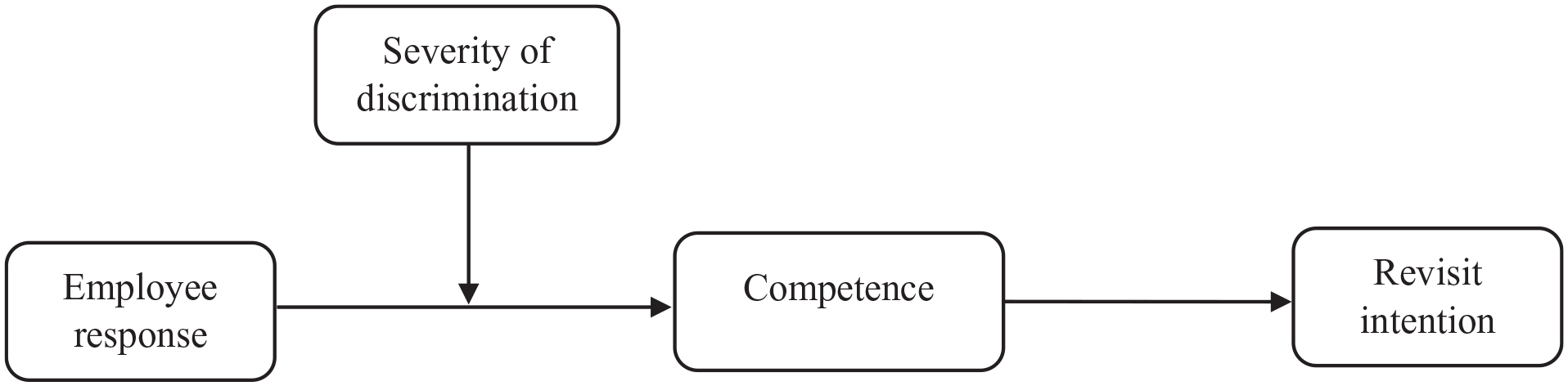
Conceptual Model for Study 2.
Stimuli and Measurements
The stimuli presented a hypothetical scenario where respondents imagined dining at a restaurant and overheard the conversation between the Asian server and other customers sitting next to them. Asian servers’ responses to discrimination were manipulated at three levels: avoidance, confrontation, and venting based on Hershcovis et al. (2018) study. Participants in avoidance conditions were given a situation that the Asian server did not take any actions against the perpetrating customers and avoided the situation by leaving the table. In the confrontation condition, the Asian server confronted the customers by asking them to clarify their comments and their meaning in a respectful manner. In addition, the Asian server politely informed the customers that if they repeat disrespectful comments, they will not tolerate it and would report it to the manager. In the venting condition, the Asian server started crying and raising their voice at the perpetrating customers to express and vent their negative emotions. The same manipulation for the severity of discrimination was used as Study 1.
All measurement items were adopted from previous studies to ensure validity and reliability and were measured on a 5-point Likert-type scale. For manipulation checks, Asian servers’ responses were measured with five items (e.g., the Asian servers avoided doing anything about the situation; α= .82) (Gelbrich, 2010; Tobin et al., 1989) and perceived employee competence was measured with 2 items (e.g., the Asian servers were efficient; α= .85) (Grandey et al., 2005). Other measures were the same as Study 1.
Manipulation Checks
To test the effectiveness of the manipulation of the Asian employee’s response, a series of ANOVAs were conducted. Planned comparisons show that the participants perceived a higher level of confrontation in confrontation condition than in venting and avoidance conditions, F(2, 224) = 83.26, p < .001; MConfrontation = 3.64 versus MVenting = 2.97 versus MAvoidance = 1.51. Also, participants perceived a higher level of venting in venting condition compared to confrontation and avoidance conditions, F(2,224) = 107.28, p < .001, MVenting = 3.00 versus MConfrontation = 1.59 versus MAvoidance = 1.24. Participants perceived a higher level of avoidance in the avoidance condition than in confrontation and venting conditions, F(2,224) = 108.54, p < .001, MAvoidance = 4.04 versus MVenting = 1.67 versus MConfrontation = 2.00. Manipulation of the severity of discrimination was also significant, F(1,225) = 235.60, p < .001. The blatant condition elicited significantly higher blatant discrimination compared to the subtle condition (MBlatant = 3.71 vs. MSubtle = 2.41). Respondents perceived the given scenario (M = 4.04, SD = .99) as realistic, and there was no significant difference among different conditions regarding realism perceptions. Taken together, these results indicated successful manipulations.
Hypothesis Testing
To examine the main effects of the Asian employee’s response and its interaction effect with the severity of discrimination on the perceived competence of the employee, we conducted two-way ANCOVA controlling for respondent’s race and appraisal of discrimination. The main effect of the employee’s response was significant, F(2,219) = 9.43, p < .001, (Table 2), supporting H3. To further test the relative effect of the employee’s response, we conducted a series of planned contrasts. We found that the participants in confrontation condition perceived significantly higher competence of the employee than those in venting condition, MConfrontation = 4.79 versus MVenting = 4.34, t(141) = 4.12, p < .001, and avoidance condition, MConfrontation = 4.79 versus MAvoidance = 4.60, t(164) = 2.04, p < .05. In addition, participants in avoidance condition rated the employee’s competence higher than those in venting condition, MAvoidance = 4.60 versus MVenting = 4.34, t(143) = 2.10, p < .05. Overall, venting was the least effective way to show employees’ competency toward the observing customers.
ANCOVA Results for Study 2.
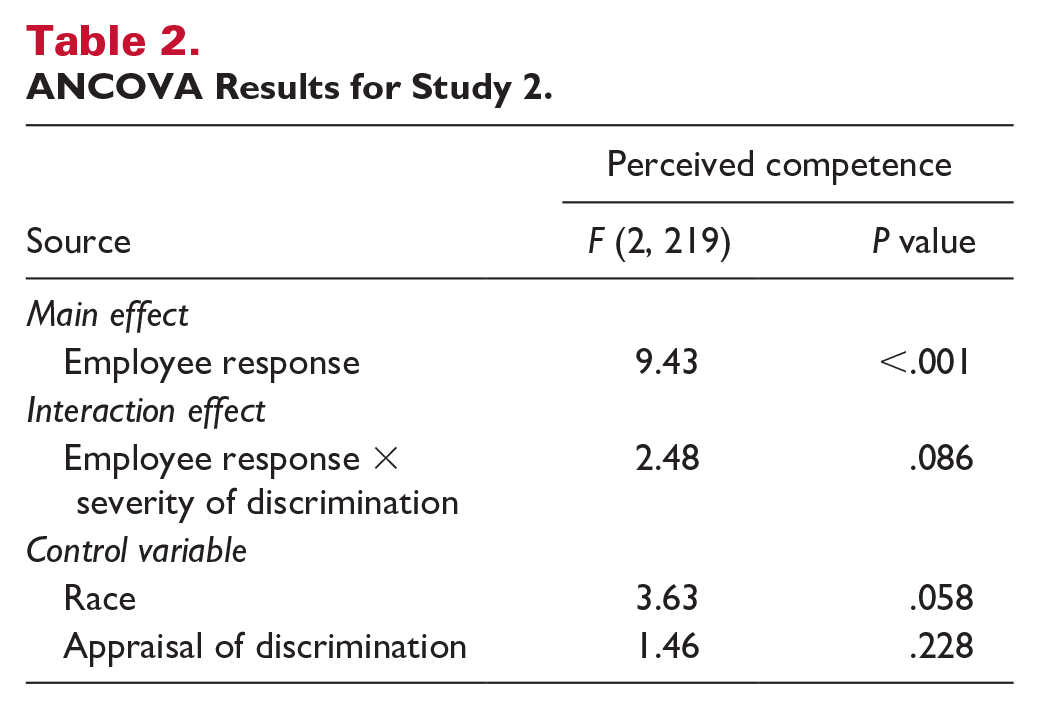
The results from ANCOVA of the interaction effect between the employee’s response, and the severity of discrimination was marginally significant, F(2,219)= 2.48, p < .10, supporting H6 (Figure 3). Simple main effects showed that, under avoidance condition, there was a significant difference between blatant and subtle discrimination in perceived competence of the employee, MBlatant = 4.73 versus MSubtle = 4.45, F(1,220) = 4.83, p < .05. However, under venting condition, there was no significant difference between blatant and subtle discrimination on perceived competence of the employee, MBlatant = 4.25 versus MSubtle = 4.43, F(1,220) = 1.60, p > .05. Similarly, there was no significant difference between blatant and subtle discrimination when it comes to confrontation condition, MBlatant = 4.79 versus MSubtle = 4.77, F(1,220) = 0.23, p > .05. Thus, when employees confronted the perpetrating customers in a respectful manner, regardless of the severity of discrimination, respondents perceived a high level of competence from the employees. However, when the employee used avoidance, respondents rated the response as more competent when the discrimination was blatant.
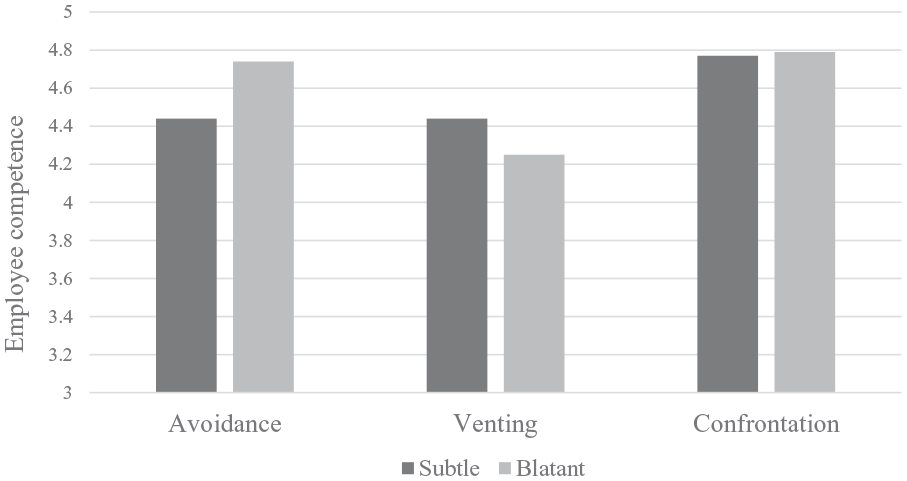
Interaction Effect of Employee Response and Severity of Discrimination.
In addition, to examine the mediation effect of the perceived competence of the employee, bootstrap tests of mediation (Model 4; Hayes, 2017) with 5,000 samples were conducted. In support of H4, perceived employee’s competence mediated the relationship between employee’s response against discrimination and observing customer revisit intention (95% CI = [.0036, .0955]). In other words, customers were less likely to revisit the restaurant when they observed employees involved in venting or avoidance than confrontation as they perceived such responses as incompetent.
Discussion
Our study results add a new perspective on how restaurant manager’s response and employee’s response to customer-perpetrated racial discrimination can affect observing customers’ perception toward the manager, employees, and, eventually, the firm. Results of Study 1 suggest that the manager’s employee-supporting response has the most powerful effect on increasing other customers’ perceived fairness of the manager, which in turn increases their revisit intention. Customers were less likely to revisit the restaurant when they observed the manager avoided the situation or sided with the customer as they perceived such behavior as unfair toward the targeted employees. The severity of discrimination did not moderate the relationship between the manager’s response and the perceived fairness, indicating that the employee-supporting response is considered fair compared to other responses, regardless of the severity of discrimination. When it comes to the targeted employee’s response, Study 2 showed that the observing customers perceived the employees’ problem-focused response (i.e., confrontation) as more competent, compared to emotion-focused responses (i.e., avoidance and venting). In turn, the higher level of perceived employee competence led to a higher level of revisit intention. It is also notable that the severity of discrimination moderated these associations. When the employee avoided the blatantly discriminatory situation, observing customers tended to perceive such a response as competent, compared to when the server avoided the subtly discriminatory situation.
Theoretical Contributions
This research has several theoretical implications for hospitality and tourism research.
First, our study expands the customer incivility literature to further ponder the impact of racial discrimination against Asian American in the restaurant industry. While extant literature stresses the significance of customer uncivil behavior toward restaurant employees, there has been lack of scholarly attention to customer incivility against marginalized employees (Baker & Kim, 2021; Han et al., 2016). To date, only a handful of research in the hospitality discipline investigated the effects of racial discrimination, and these studies focused on employee-driven discrimination against minority customers (Brewster & Brauer, 2017; Min & Joireman, 2021; Zhang et al., 2022). Yet, no hospitality research has investigated the impact of racial discrimination against Asian American employees. Furthermore, while Asian Americans are the fastest-growing labor force in the hospitality sector (Zippia, 2022) and face unique forms of racial stereotypes and discrimination (Yoo, Steger, & Lee, 2010), the extant literature on workplace racial discrimination has largely focused on experiences of other people of color (Chui, 2022; Jun & Wu, 2021). Given the rising prevalence of anti-Asian discrimination and hate crimes since the COVID-19 pandemic (Stop AAPI Hate, 2022; Suh et al., 2021), this study contributes to the growing demand for understanding of how to respond to racial discrimination against Asian American employees in the hospitality service setting.
Second, while the previous research has predominantly examined the impact of customer incivility on the targeted employees (Baker & Kim, 2021; Balaji et al., 2020), this study focused on the impact of discrimination on third-party customers. Our study results highlight that observing how managers and the targeted employees handle racial discrimination affects the witnessing customers’ perceptions and subsequent consumer behaviors. Supporting the deontic justice theory, we found that customers who observed other customer’s discriminatory misconduct committed to employees of color feel principle moral obligations to uphold the norm of justice (Cropanzano et al., 2017) which led them to engage in behaviors to restore the justice. Thus, observing customers tended to rate managers as fair when they supported the targeted employee. In addition, observing customers rated employees more competent when they professionally confronted the perpetrating customers. Overall, our study results highlight that observing customers support the restaurants’ efforts of restoring justice and are willing to compensate for such efforts.
Third, despite the important role managers play in alleviating unfair treatment of customers against employees (Boukis et al., 2020; Zhu et al., 2019), less research has investigated managers’ responses to uncivil or unfair customer behaviors. The unique characteristics of the hospitality industry and the power differential between the employees and customers make it difficult for employees to respond to uncivil and unjust customers (Baker & Kim, 2021). Thus, it is critical to examine what managers can do to effectively handle unfair customer behaviors and minimize their negative effects. However, managers may also feel pressure to satisfy the perpetrating customer and avoid conflicts with customers. Consistent with the existing literature (Baker & Kim, 2020) and deontic justice theory (Cropanzano et al., 2017), our study results suggest that providing support for the targeted employee can be considered fair from the observing customers’ standpoints. Overall, these results highlight that managers’ efforts to promote justice when handling racial discrimination affect the observing customers’ perceptions and their future consumer behaviors.
Fourth, there is a call for more research examining the frontline employees’ responses to unfair customers (Balaji et al., 2020), as incivility is emerging as a major issue that affects hospitality employee’s high turnover rate (B. Kim et al., 2023). While eliminating uncivil customers is improbable, previous research suggests that how employees respond to customer mistreatment can either mitigate or aggravate the severity of a situation (Hershcovis et al., 2018). Our study expanded the current knowledge base by testing whether the ways employees respond to discrimination can affect the third-party customers’ perceptions and subsequent behaviors. The result of this study suggests that observing customers tend to perceive employees as more competent when they confronted the perpetrating customers in a respectful manner, compared to when they distanced themselves from the customers or venting their emotions to them. Supporting the deontic justice theory (Cropanzano et al., 2017), observing customers use employees’ response to perpetrating customers as an indicator of competence (Habel et al., 2017) which eventually helps them to root for the targeted employees’ attempts to restore justice in the face of racial discrimination.
Practical Contributions
This study provides several practical insights for the hospitality industry to develop effective service strategies. First, our study results underline the importance of managers’ roles in handling customer-perpetrated racial discrimination against Asian American employees. We found that observing customers are likely to perceive managers as fair when they support employees being discriminated against by the customers, regardless of the severity of discrimination. Given that managers tend to perceive customer mistreatment less negatively than mistreatment committed by others (Madera et al., 2017), managers need to be able to recognize customer-perpetrated racial discrimination and its seriousness. Although managers may be in a difficult position to take employees’ side and confront the perpetrating customers, our study results showed that such managers’ efforts to restore justice induced positive perceptions among the third parties that, in turn, led to higher revisit intention. While confronting discriminating customers may have a risk of losing them, in the long term, it will positively affect other customers who observe and judge the incident. In other words, managers should not be timid of confronting customers who discriminate against their employees. Managers should be regularly present in the service environment to monitor the interactions between employees and customers and be ready to intervene if necessary.
Second, given that most service employees of color are not well-trained to cope with racial discrimination, our study provides guidelines for employees on how to deal with customer-perpetrated racial discrimination. Our findings suggest that observing customers are more likely to praise employees’ competence when they use problem-focused coping responses (i.e., confrontation) than emotion-focused coping responses (i.e., avoidance and venting emotion). However, previous research suggested that targeted employees are more likely to use avoidance or other passive strategies even when they wish to use more assertive strategies (Salin et al., 2014). It again highlights the essential roles of managers and firms that facilitate and promote a working environment for employees where they feel safe to utilize assertive problem-focused coping strategies. Accordingly, to promote more practical and feasible employee response strategies, firms should develop open communication channels for employees to fully share their racial discrimination experiences and the barriers that prevent them from assertively handling the discriminatory incident. In addition, firms can provide training opportunities for employees, such as roleplaying with scenarios or regular open-discussion sessions, to educate them how to effectively deal with racially discriminatory treatments from the customers in a professional manner. The training can also provide tools for managing emotional reactions to customer-perpetrated discrimination by, for example, promoting customer-based perspective-taking (L. Lee et al., 2020), to prevent them from internalizing the discriminatory messages.
Finally, a major takeaway from our study is that managers’ and employees’ proper responses to customer-perpetrated racial discrimination is not only critical for the sake of targeted employees themselves but also for other customers who observe the incidents. The firms should develop a more assertive protocol to deal with racial discrimination as it affects other customers’ experiences and future behavioral intentions, which can eventually affect the sustainability of their business. The credo in the hospitality industry—“the customer is always right” and forcing employees to tolerate customer mistreatment—is harmful to the industry and needs to be changed (Baker & Kim, 2021). Instead, our study results provide support for the zero-tolerance policy pertaining to racial discrimination to protect their employees and promote better service experiences for other customers.
Limitations and Future Research
This study has several limitations that need to be supplemented by future research. First, while current research examined the responses to discriminatory treatment from two main actors in a service environment, namely, managers and employees, previous research showed that coworker’s support can also help targeted employees (Han et al., 2016). Investigating the role of coworkers who work in the same work environment and who may have experienced similar unfair treatment would be of significant value to add to the literature. Second, along with the spike of anti-Asian hate and racism during the COVID-19 pandemic and the calls for more scholarly investigation to its effects in the hospitality industry, our study focused on examining racial discrimination against Asian restaurant employees. However, given that other groups of color are still taking a large share of the labor force in the hospitality industry, future research should investigate racial discrimination against other races such as African American and Latinx. Third, while this study focused on examining one behavioral intention of observing customers, future research may test other victim-aiding behaviors such as tipping behavior or willingness to purchase more, or perpetrator-directed behavior such as punishing the discriminating customers. Finally, there were a small number of people of color represented in our study sample. As individuals may recognize and perceive workplace racial discrimination differently based on their racial group membership (Offermann et al., 2014), future studies can examine whether and how the effects of racial discrimination on observing customers’ behaviors vary by their racial backgrounds.
Footnotes
Declaration of Conflicting Interests
The author(s) declared no potential conflicts of interest with respect to the research, authorship, or publication of this article.
Funding
The author(s) received no financial support for the research, authorship, or publication of this article.
