




Abstract
Consumers are drawn to the inherent quality of a product or service and how it is portrayed and described. This study investigated the impact of language used in property titles on pricing strategies and financial performance in peer-to-peer (P2P) accommodations by adopting the Language Expectancy Theory (LET) as a theoretical framework. The findings of this study demonstrate the significance of linguistic styles in property titles for determining P2P room rates, rental volume, and overall performance. Property titles that exhibit formal, logical, and hierarchical thinking are perceived as more sincere, personalized, and informative, resulting in higher rates, more significant rental volumes, and improved overall performance. On the contrary, properties with titles that convey expertise, and confidence, or adopt a positive and upbeat style tend to put lower room rates and yield lower performance yet generate higher volumes. This study expands the application of LET to P2P communication between an Airbnb host and a potential guest.
Introduction
Consumers are attracted not only by the innate quality of a product or service but also by how it is depicted and described. Previous literature in marketing found that the product description language is an important determinant of consumer choice and sales. For instance, Pryzant et al. (2017) investigated the relationship between sales and the narratives in product descriptions and demonstrated that the writing style and word usage could predict consumer purchasing behavior. Specifically, they found that polite language that invokes culture or authoritative sources has a positive effect on product sales. Despite this, there appears to be a lack of research in the hospitality literature into the language employed in service descriptions. To address this, this study explores the implications of the titles created by Airbnb hosts to describe property listings. Exploring the property titles is an intriguing concept, as they provide potential guests with essential details about the listed rooms and are widely considered the most successful way to advertise them on Airbnb (Koh et al., 2021). Therefore, this research focuses on the relationship between Airbnb property room rates, rental volumes, and financial performance, and the language style used in the title of the property listing by the host.
Airbnb hosts should use active language when describing their property because it is the first information potential guests encounter when browsing the search results. Unlike hotel names, which are usually standardized by hotel chains, titles of Airbnb properties tend to be more creative to catch the instantly catching attention of the guests “Private Guest Suite,” “Peaceful Private Room,” “Your Own Little House,” and “Airy Modern Apartment Across from the Beach”. Furthermore, a consumer’s decision involves choosing one of several alternatives characterized by different attributes. This implies that service providers want to improve their competitiveness relative to close competitors and identify the critical aspects of their strength, thereby generating a competitive advantage. Thus, a property’s unique features should be highlighted in the title to attract potential customers and charge higher rates.
According to Language Expectancy Theory (LET), which explains the effect of different linguistic variations on individuals who use persuasive messages, language is a rule-governed system, and people develop expectations regarding message strategies employed by others in persuasive attempts (Burgoon, 1995). It focuses on how message features such as intensity, length, and word choice positively or negatively “violate” expectations regarding appropriate communication (Averbeck, 2010). Burgoon et al. (1975) argued that strategic linguistic choices could significantly predict persuasive success. This current study tries to understand how strategic linguistic choices (i.e., the titles of Airbnb properties) are related to pricing strategy (i.e., property rental rates), rental volume (i.e., occupancy rate), and financial performance (i.e., RevPAN, Revenue per available room night) using a hedonic pricing model. The hedonic pricing model has been accepted as the preferable way to gauge intangible values by estimating the implicit prices of a set of individual characteristics that comprise an item or good for sale. A gap in the literature on hedonic pricing models has been identified by reviewing previous literature published in refereed journals, as the language used by service providers such as hoteliers and Airbnb hosts has not been explored. This study aims to bridge this gap by investigating the relationship between the language used in a property title and room rates in the P2P accommodations market through the lens of LET.
Literature Review
Previous research has demonstrated the importance of communication content and language choice for advertising and persuasion. Previous literature in marketing has found that language choice in advertisements can influence consumers’ attitudes toward the advertisement and the product and their intention to buy the product (Krishna & Ahluwalia, 2008). For example, Pyun and Jang (2015) attempted to identify effective advertising language for tourism destinations and found the matching effect of advertising language (i.e., cognitive vs. affective) with destination type impacts travelers’ attitudes and behavioral intentions.
According to LET, strategic linguistic uses can significantly predict positive behavioral changes (Burgoon et al., 1975). LET assumes that language is a rule-governed system, and consumers may develop expectations about the language or message strategies in response to persuasive attempts (Burgoon, 1995). LET helps to identify how the various features of any given message positively or negatively conform to macro-level expectations about what constitutes effective communication attempts (Burgoon et al., 2002). The message senders’ language may comprise two types of expectancy violations: positive and negative violations (Jensen et al., 2013). If the language negatively violating the expectation (i.e., an “unpleasant surprise”) is used, the message and/or the source will be negatively assessed and result in little to no attitude change (Averbeck, 2010; Burgoon, 1995; Burgoon & Miller, 1971). On the contrary, a positive violation of expectation (i.e., “pleasant surprise”) facilitates effective persuasion and results in attitude change in the desired direction of the sender (Hamilton et al., 1990) and source credibility (Burgoon, 1995). From a LET perspective, users in online transactions tend to pay close attention to the few communication cues available (Flanagin, 2007) and Airbnb property titles can be the crucial component of such communication cues. In this respect, a property title that reduces uncertainty can be important for building potential guests’ trust and increasing guests’ expectations.
LET has often been applied to research investigating the effects of textual information (e.g., online reviews) on potential consumers (e.g., Jensen et al., 2013). Larrimore et al. (2011) examined the relationship between language use and persuasion success in the P2P lending environment and found that the use of lengthy narratives, concrete descriptions, and quantitative words is positively related to funding success. Similarly, Parhankangas and Renko (2017) found that linguistic styles boost the success of social crowdfunding campaigns. Lee and Yu (2020) utilized a natural language processing technique to extract a set of linguistic styles and content cues from their tweet sample and employed the Linguistic Inquiry and Word Count (LIWC) to analyze each of the tweet samples systematically. According to Lee and Yu (2020), using concrete language in disaster tweets is the expected norm, leading to a higher likelihood of retweeting behavior from the uncertainty reduction perspective, while emotionally framed disaster tweets are less viral. The findings of their study reveal that the fit between language use and the expected communication norm is critical in improving communication performance during disaster emergencies. Furthermore, Koh et al. (2020) investigated the role of linguistic styles that are effective in pitches in restaurant crowdfunding drawing on the LET and uncertainty reduction theory. According to Koh et al. (2020)’s study, concrete project descriptions that deliver stories with fewer usage of first-person pronouns are likely to succeed in restaurant fundraising. The most recent research by Koh et al. (2021) investigated the listing title’s impact on a property’s financial performance in P2P. They examined the linguistic styles of listing titles and compared Airbnb listings of different countries. Although the study’s findings suggested that Airbnb properties in each country have significantly different linguistic styles affecting financial performance by location, the study did not include listing titles that use the native language. As a result, residents’ original cultural background and linguistic characteristics were ignored, which could ultimately mean that the underlying factors affecting financial performance were overlooked. Therefore, this study controlled for cultural variation by analyzing the U.S. market only; however, geographical variation was still explored.
Scholars have called for broadening the research scope by examining language features in various communication contexts (Averbeck & Miller, 2014; Burgoon, 1995; Burgoon et al., 2002). However, LET has been limited in its application to P2P accommodation sharing. This study responds to this call by extending the LET application to other accommodation types and examining the role of language style in property titles on Airbnb host pricing decisions (i.e., ADR), rental volume (i.e., OCC), and its impact on financial performance (i.e., occupancy and RevPAN) by applying a hedonic pricing model. The hedonic pricing model argues that products and services are a bundle of objective attributes rather than homogeneous components (Lancaster, 1966). The hedonic pricing model has been frequently used to examine pricing determinants in various contexts. Several scholars have applied a hedonic pricing model to the P2P sharing context (e.g., Chen & Xie, 2017; Gibbs et al., 2018; Tang et al., 2019; Teubner et al., 2017). However, previous research on Airbnb pricing has mainly included property attributes (e.g., property size, amenities) and customer evaluations (e.g., review rating) as price determinants in the hedonic pricing model and no research has investigated the language style used in the property title.
Research Method
In this study, the hedonic price model enables researchers to deal with the formidable measurement challenges by identifying the implicit values of language-generating Airbnb accommodation characteristics. Data were obtained from AirDNA, a third-party Airbnb database organization. AirDNA provides descriptive data for every single property, along with financial performance metrics. The top four Airbnb markets in the United States (New York 96,852; Los Angeles 28,741; Miami 23,163; San Francisco 21,178) were selected, and 169,934 properties in operation as of January 2017 were used for data analysis.
Based on the literature review (e.g., Chen & Xie, 2017; Ert et al., 2016; Gibbs et al., 2018), three categories of Airbnb accommodation-related variables are identified (i.e., accommodation features, transaction characteristics, and host reputation) and these variables are included in data analysis together with linguistic scores of Airbnb property titles. Descriptive statistics of these variables are presented in Table 1. About 60% of the properties are hosted by Superhosts, and five words, on average, are used in the property titles. There are about eleven photos posted on the property listings, and about nine reviews are visible per property.
Variables for the Hedonic Pricing Model.
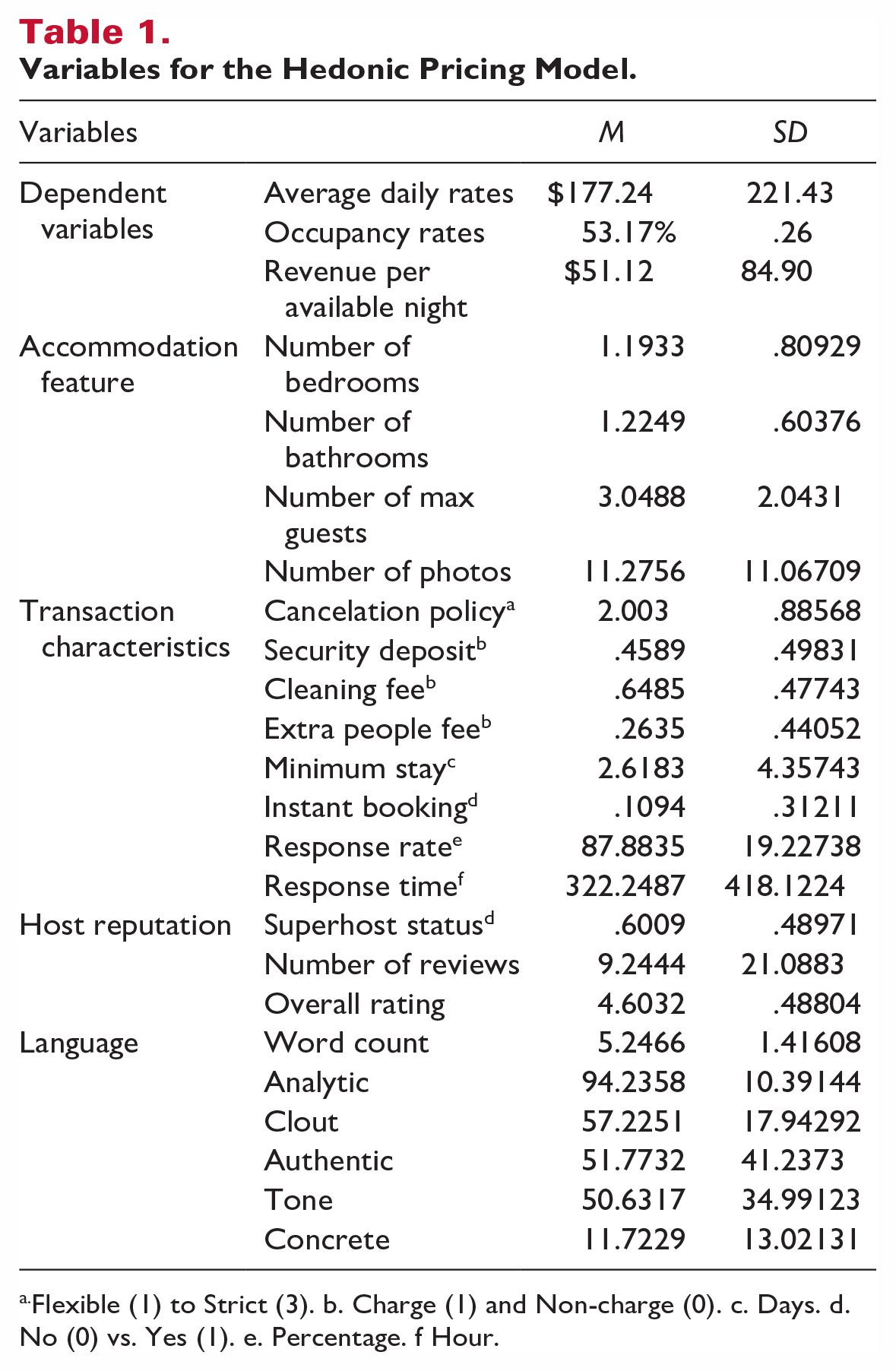
Flexible (1) to Strict (3). b. Charge (1) and Non-charge (0). c. Days. d. No (0) vs. Yes (1). e. Percentage. f Hour.
Airbnb’s property titles are considered persuasive messages in this study. As the first piece of information that potential guests see, Airbnb hosts utilize their titles as promotional messages to emphasize the strengths of their property and stand out from the competition. The content analysis was performed from the property titles using LIWC, which are widely used language analysis tool in psychology research by calculating values to quantify the linguistic cues (Boyd & Schwartz, 2021; Shafqat et al., 2016; Tausczik & Pennebaker, 2010). LIWC provides the property titles on four different dimensions (scale ranging from zero to 100): Analytical thinking (Are the descriptions written in a formal, logical, or hierarchical way?), Clout (Are the descriptions written from the perspective of high expertise and are confident?), Authentic (Are the descriptions written with a more honest, personal, and disclosing text?), and Emotional tone (Are the descriptions written more positive or upbeat way?) (Pennebaker et al., 2015; Tausczik & Pennebaker, 2010). The scores for these four dimensions and word counts were included in the regression model as linear independent variables. In addition, this study also calculated if the descriptions use more concrete words by using articles, prepositions, and quantifiers. Indeed, concrete words have been known to reduce uncertainty about the property and strengthen confidence when predicting consumers’ behaviors according to uncertainty reduction theory (Larrimore et al., 2011). The concrete words variable, ranging from zero to 100, was included in the regression models. Descriptive results of the linguistic measures are shown in Table 1 as well.
The Average Daily Rates, Occupancy Rates, and Revenue Per Available Night were calculated to be analyzed as dependent variables. All three dependent variables were annualized in 2017. The results show that, for the sample, the mean score of average daily rates was $177.24, occupancy rate 53.17%, and revenue per available night was $51.12. The dummy variables of four cities and types of listings are included in the model as control variables. In addition, a dummy variable indicating if single or multiple properties manage the property is also included as a control variable. A total of three linear multiple regression models are tested in this study.
Results
About 53% of properties are operated by single property owners. Table 2 shows the results of the regression analyses, and all regression models fit the data very well. A variance inflation factor (VIF) is a measure of the amount of multicollinearity in regression analysis. None of the independent variables show a VIF of greater than 10, which—according to Ott and Longnecker (2001)—is a cutoff value for an acceptable level of multicollinearity. The results of the regression analyses show that the relationships between independent variables and dependent variables are dynamic so that detailed interpretation is required. Note that three control variables are included in the regressions to control the variations based on locations, listing types, and hosts with multiple listings to enhance the research results’ generalizability.
Multiple Regression Analyses Results.
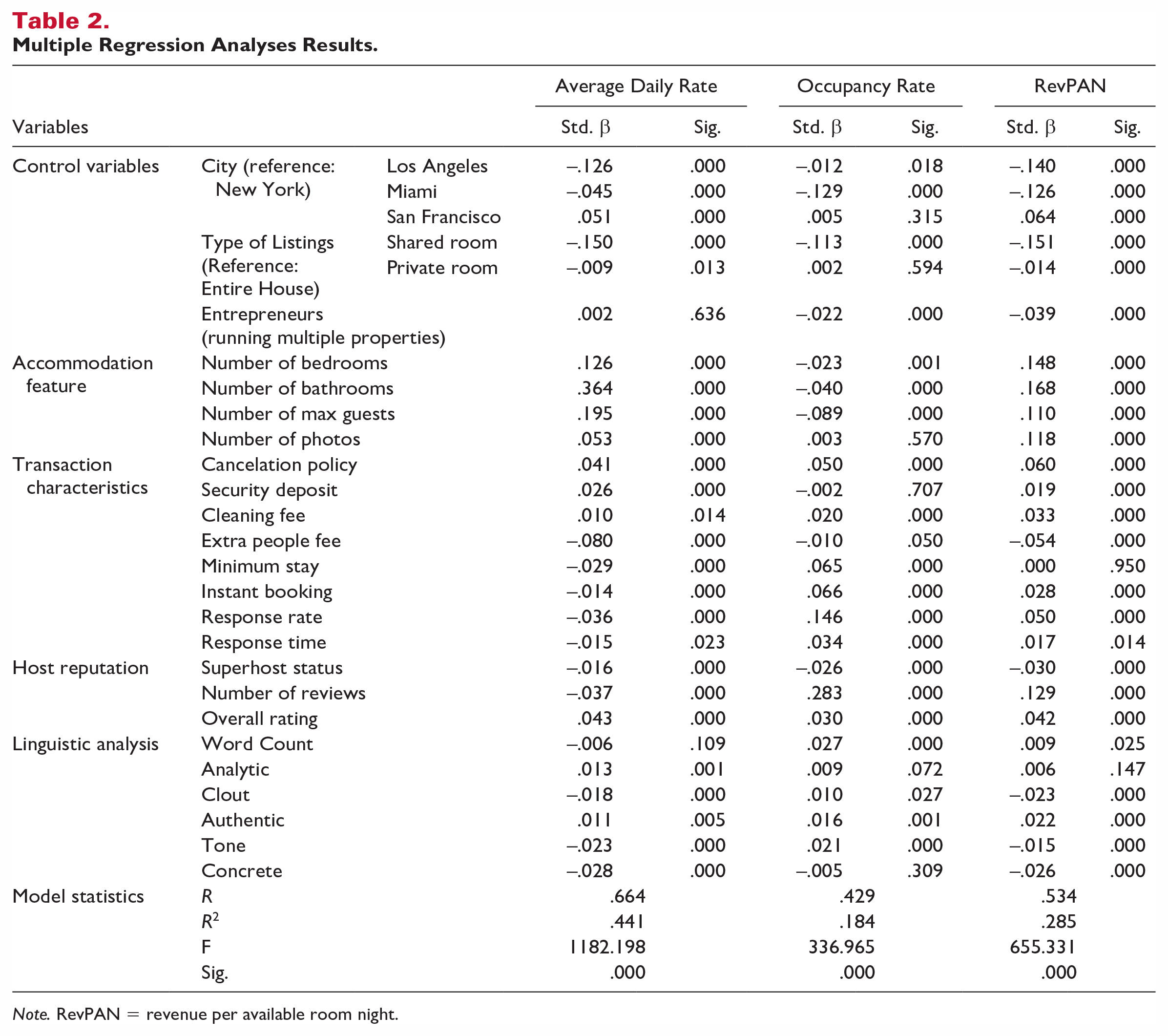
Note. RevPAN = revenue per available room night.
Price (Average Daily Rates)
All accommodation features and most transaction characteristics have significant positive relationships with room prices, while cancelation policy, security deposit, and cleaning fees have positive relationships with room prices. Superhost status, number of reviews, and host reputation have significant negative relationships with room prices, although overall, all rating has a significant positive relationship with the room price. Although the number of words used in the description is not significantly related to price, all linguistic measures have statistically significant relationships with room prices. Specifically, the Clout, Tone, and Concrete scores are significantly negatively related to room prices, while Analytic and Authentic scores positively correlate with room prices.
Rental Volume (Occupancy Rates)
All accommodation features have significant negative relationships with occupancy rates, except the number of photos is non-significant. Most transaction characteristics have significant negative relationships with occupancy rates except cancelation policy and cleaning fees. Host reputations are likely to have positive relationships with occupancy rates, but Superhost status is still found to be negatively related to occupancy, as is the case for room prices. All linguistic measures have significant positive relationships with occupancy rates except Analytic and Concrete, which were found to be non-significant.
Performance (RevPAN: Revenue Per Available Night)
All accommodation features have significant positive relationships with revenue per available night. Most transaction characteristics have significant positive relationships with revenue per available night except extra guest fee, which was negatively related. Similar to occupancy rates, host reputations are likely to have positive relationships with revenue per available night, but Superhost status is again found to be negatively related to revenue per available night. Clout, Tone, and Concrete linguistic measures have significantly negative relationships with revenue per available night, while the number of words, Analytic, and Authentic descriptions have significant positive relationships with revenue per available night.
Discussion and Conclusion
This research adopts LET perspectives, arguing that strategic linguistic choices are significant predictors of positive behavioral changes (Burgoon et al., 1975). This study found that linguistic styles used in a property title have been found as key elements of determining P2P room rates, rental volume, and performance. Property titles with a fewer number of words fetch higher prices but are low on rental volume or performance. Property titles demonstrating formal, logical, and hierarchical thinking are considered more honest, personal, and revealing, which translates into higher rates, larger rental volumes, and better overall performance as well. Properties with titles that project expertise and confidence or are more positive or upbeat in style tend to have lower rates and yield lower performance but generate higher volumes. Property titles using more concrete words (e.g., articles, prepositions, and quantifiers) show lower room rates and performance.
As for accommodation features, it is not surprising that properties with more bedrooms and bathrooms rent out at higher prices but have lower rental volumes. However, it is interesting that properties with more photos uploaded have charged higher rates and shown more considerable rental volume and higher performance. It is suggested that property operators upload more photos to their postings to improve performance. Regarding the transaction characteristics, the results show that charging extra guest fees negatively affects price, rental volume, and performance, while properties with minimum stay requirements, instant booking options, and higher response times show lower prices but higher rental volumes and performance. Interestingly, the results show that properties with more strict cancelation policies charged higher prices, sold more rooms, and generated higher performance. Property owners may not have to loosen their cancelation policies or extra guest charges to boost overall higher performance, although cautious strategies have to be considered. In addition, the roles of host reputation in the results have been interesting. The properties with Superhost status have charged less and shown lower rental volume and performance despite our findings that overall ratings are positively related to all dependent variables. It is also interesting that the number of reviews is negatively related to price but positively to rental volume and performance. It is suggested that property owners carefully manage the property postings based on their overall property management goals.
Implications
Understanding how linguistic styles affect customers’ response and behavior can play an invaluable role in developing effective marketing strategies in the hospitality industry. The impact of linguistic styles in communication and marketing material and the role of language in describing the property and hospitality services of businesses has yet to be explored adequately by scholars in the hospitality sector. The findings of this study reveal several practical implications for hospitality practitioners. It confirmed the importance of the linguistic style used in a property title in P2P property rental transactions, which may also apply to other lodging industries. Boutique and independent hotels may benchmark the strategies of Airbnb hosts when creating titles that capture the interest of potential guests and persuade them to book.
The results of this study suggest that hotel managers should pay more attention to the linguistic style and keywords used to describe their property to increase room rates and improve financial performance. To improve financial performance, lodging owners must describe their property formally, logically, and hierarchically so prospective guests will perceive them as being more honest, personal, and revealing. On the contrary, concrete words such as articles, prepositions, and quantifiers should be avoided. Finally, despite their key role in affecting guests’ hotel decisions when selecting a hotel, property attributes (e.g., location) and features (e.g., room size) are usually unable to be significantly changed due to practical restrictions, whereas hotel management can easily modify the description of their property. Leveraging storytelling and narrative-driven techniques can further help hospitality businesses create a more vivid portrait of their service offerings and creative representation of their property in the minds of guests, which in turn will help shape their online and offline feedback.
In addition to practical implications, the results of this study open up uncharted research territory in the hospitality literature, offering an extension of LET theory to P2P transaction between Airbnb hosts and potential guests. Previous studies in hospitality have mostly been interested in the impacts of room rates, hotel attributes, and online customer reviews on customers’ decision-making process and hotel performance. This study shows that linguistic style and keywords matter to the financial performance of the property. This study can also contribute to the theoretical development of a framework for hosts’ strategic behavior on P2P sharing platforms; this is an area that has not been explored in depth in hospitality literature so far.
Limitations and Suggestions for Future Research
Several limitations of this study should be acknowledged. This study only focused on the top four U.S. markets during January 2017 (before the pandemic); thus, this study’s findings may not fully represent the entire lodging industry. Additional platforms or other hospitality areas may also be explored. In addition, the geographical location of properties and/or competitive dynamics may be considered in future research to control for the confounding effect—although language variation was controlled in this study.
The next major step of this research will be to build a comprehensive pricing theory for the lodging industry and action strategies by considering management’s decision-making processes. The authors strongly encourage scholars working in hospitality management to discuss further their views on the unique features of pricing decisions on P2P transactions. Furthermore, further research can incorporate additional components into the hedonic pricing model to discover the untapped worth of service offerings.
We encourage future researchers to explore further how language style, specific words, or expressions used in a hotel property description can change a potential guest’s perceived value by applying an experimental design and evaluating whether property photos moderate the relationship. In addition, psycholinguistic approaches (Pennebaker et al., 2001; Pennebaker & Graybeal, 2001) may also be suggested to analyze function words and language structures of property titles and descriptions.
Footnotes
Declaration of Conflicting Interests
The author(s) declared no potential conflicts of interest with respect to the research, authorship, or publication of this article.
Funding
The author(s) received no financial support for the research, authorship, or publication of this article.
