



Abstract
The nexus between tourism and quality of life (QoL) has been widely discussed in the literature. There is an extensive research that examines the connection between tourism activities and QoL. Although the existing studies converge in that QoL and well-being should be incorporated and made a central aspect of tourism policies and strategies, the current literature lacks an integrated comprehensive approach to how QoL can be incorporated into tourism decision-making. Tourism decision-making organizations have yet to integrate QoL into the assessment of important strategy-related benchmarks (e.g., performance, tourism satellite accounts, demand, and resource integration). Thus, the objective of this article is to offer a conceptual framework integrating QoL and tourism public policy. The suggested model provides guidelines regarding the implementation of QoL at different stages of policy development. The framework will provide a guide for tourism destinations in formulating and implementing policies with a focus on improving the community’s QoL.
Introduction
Research on quality of life (QoL) and well-being in tourism and hospitality has been among the most prevalent topics of interest over the past decades. Current research has mainly concentrated on the effects of tourism experiences and tourism development on residents’, tourists’, and employees’ QoL, mapping out its antecedents and less often consequences (e.g., H. Kim et al., 2015; Lehto et al., 2023; Lin et al., 2013; Wang et al., 2021, 2022). However, only a few studies have touched on how QoL itself should be incorporated into public policy formulation. Public policy formulation and implementation play an important role in shaping the tourism industry, promoting its positive effects, and mitigating negative outcomes on the destination (Aguinis et al., 2023). Thus, policies related to tourism performance, tourism demand, tourism satellite accounts, and resource integration should all incorporate QoL elements, so they are more objective, comprehensive, and effective. This is also more important for public policies in places where destinations derive their main economic and social activities from the tourism sector (Baptista et al., 2019).
Recently, more research has started to recognize the importance of integrating QoL domains into the development of performance, demand, and other related frameworks such as competitiveness and attractiveness of destinations (e.g., Croes et al., 2020; Dwyer, 2022a; Modica & Uysal, 2016; Uysal & Sirgy, 2019). These studies suggest that comprehensive measures of tourism benchmarks (i.e., performance, demand, competitiveness, etc.) need to account for QoL domains to be more robust and objective. Specifically, it is proposed that the development and implementation of QoL indicators can serve as a basis for tourism policies that are aimed at enhancing not only stakeholders’ well-being and QoL but also the attractiveness of destinations to visit and reside. Otherwise, public policies may fail to address important issues surrounding tourism activities at the destination, resulting in partial or no support for tourism-driven development activities. This equally applies to whether QoL domains are incorporated at macro (i.e., destination) or micro (i.e., firm) levels. There is always a benefit to achieving a more accurate public policy formulation when policymakers fully consider the importance and consequences of economic and QoL elements. Having informed public policy formulation should also help sustaining local support and ensuring effective and sustainable use of resources.
Following Uysal and Sirgy’s (2019) study, there is an ongoing conversation on the need to implement QoL measures (both objective and subjective) in evaluating and developing tourism policies (Berbekova et al., 2022; Uysal, 2019). Considering the ultimate “end goal” to improve the QoL of all stakeholders involved in the wider tourism and travel industry, there is a pressing need to develop appropriate measures to inform public policy for tourism destinations. The implications are to develop policies that promote sustainable tourism development, accounting for QoL. Such measures will aid policymakers in making strategic decisions regarding further tourism development.
Despite the plethora of studies examining the connection between residents’ QoL and tourism (e.g., Ouyang et al., 2019; Wang et al., 2022), there is a lack of understanding of how research on QoL can define public policies in tourism. In a recent review of public policy implications of tourism and hospitality research, Aguinis et al. (2023) emphasize the importance of challenging the traditional view regarding the conceptualization and measurement of tourism success for effective public policy solutions. Thus, the main objectives of this conceptual paper are to critically address the knowledge gap regarding the public policy function of QoL indicators in tourism and consequently suggest a conceptual framework of QoL and tourism public policy. The article develops a conceptual model of how subjective and objective QoL indicators can be incorporated in formulating and implementing public policies for tourism destinations. The reiterative framework is organized across five connected stages, and research propositions are formulated for each. The propositions are developed in a way to encourage empirical studies with a focus on exploring the potential to implement and subsequently measure the effectiveness of tourism policies that incorporate QoL. The article further addresses the implications for public policy and discusses how to bridge the gap between policies that ignore QoL indicators versus policies that account for them. The study concludes by highlighting current challenges for public policies to achieve tourism development and enhance communities’ QoL.
Literature Review
In line with the objectives of this article, the following two sections elaborate on QoL research in tourism and discuss the discourse of public policy surrounding tourism development and QoL. These two sections serve as the foundation of our conceptual model.
QoL and Tourism—A Reciprocal Connection
The concept of QoL has gained wide recognition following the social indicators movement in the 1960s, which advocated for broadening the perspective on well-being by complementing economic measures with social indicators (Land & Michalos, 2018; Noll, 2018). It was argued that the conventional economic variables, such as gross domestic product (GDP) cannot adequately reflect and thus, accurately measure the multidimensional nature of well-being (Land et al., 2012). As such, the inclusion of QoL indicators can successfully aid policymakers in capturing a more comprehensive outlook on social progress (Adler & Seligman, 2016). Historically, the social indicators research has focused on identifying ways to enhance the population’s QoL (Sirgy, 2008). Thus, the juxtaposition of QoL research with public policy has been inevitable and serves the public interest.
In the context of tourism, the QoL and well-being concepts remain one of the most dominant in contemporary research, with recent studies focusing on novel determinants of community/residents’, tourists’, or employees’ well-being (e.g., Baker & Kim, 2020; Guzzo et al., 2022; Wang et al., 2022). As noted above, numerous studies investigated how tourism experiences may affect the overall QoL or certain life domains of major tourism stakeholders. This area of research converges in acknowledging that tourism value should be understood not only in terms of its economic benefits but also recognize its non-material outcomes and its potency to enhance QoL. Although research on the impacts of tourism on all stakeholders’ QoL (i.e., residents, employees, tourists) is critical in developing appropriate tourism policies, this article addresses the public policy implications of QoL research from the community/destination residents’ perspective. For a recent overview of the three main research directions in QoL and tourism, theoretical frameworks, and current challenges, see Uysal et al. (2016) and Berbekova and Uysal (2021).
The nexus between tourism development and community QoL has been analyzed by employing two main approaches to measuring QoL: subjective (e.g., Wang et al., 2022) and objective (e.g., Ridderstaat et al., 2016a). The subjective measures may include residents’ perceived happiness and QoL, life domain satisfaction, and overall life satisfaction as it relates to tourism development in the destination (Diener, 2006; Sirgy, 2010). The objective measures reflect the external life conditions in the community and encompass several pillars such as economic (e.g., income per capita), environment (e.g., CO2 emissions), social (e.g., adult literacy rate, number of hospital beds), leisure (e.g., number of recreational parks), degree of accessibility to amenities and social services, etc. (Sirgy & Uysal, 2016). Regardless of the approach, the main objective of such studies is to explore the role of tourism development in enhancing the overall QoL in the destination. Recently, Uysal and Sirgy (2019) note that these subjective and objective QoL indicators should be a part of novel combined measures of performance, which will simultaneously include both traditional measures of performance and also account for QoL. The set of such indicators on a macro level should be destination-specific and will be contingent on the resources available and certain challenges that the destination experiences as it pertains to tourism development (Uysal, 2019; Uysal & Sirgy, 2019). Similarly, Croes (2016) notes that residents’ well-being should be taken into account in assessing the small island (micro-states) destination’s success. Thus, the author notes that the evaluation of community well-being will aid in formulating successful tourism policies for small island destinations, considering their limited resources and opportunities. Dwyer (2022a) also argues that community well-being should be viewed as an all-encompassing measure of destination performance. Thus, the conventional destination performance indicators should be filtered through a combination of objective and subjective QoL indicators to reveal how tourism impacts can be transferred into community well-being. These studies suggest that for better informed public policies, tourism planners should aim to include QoL indicators. Table 1 provides the examples of objective and subjective QoL indicators of community/residents’ well-being.
Examples of Objective and Subjective QoL Indicators.
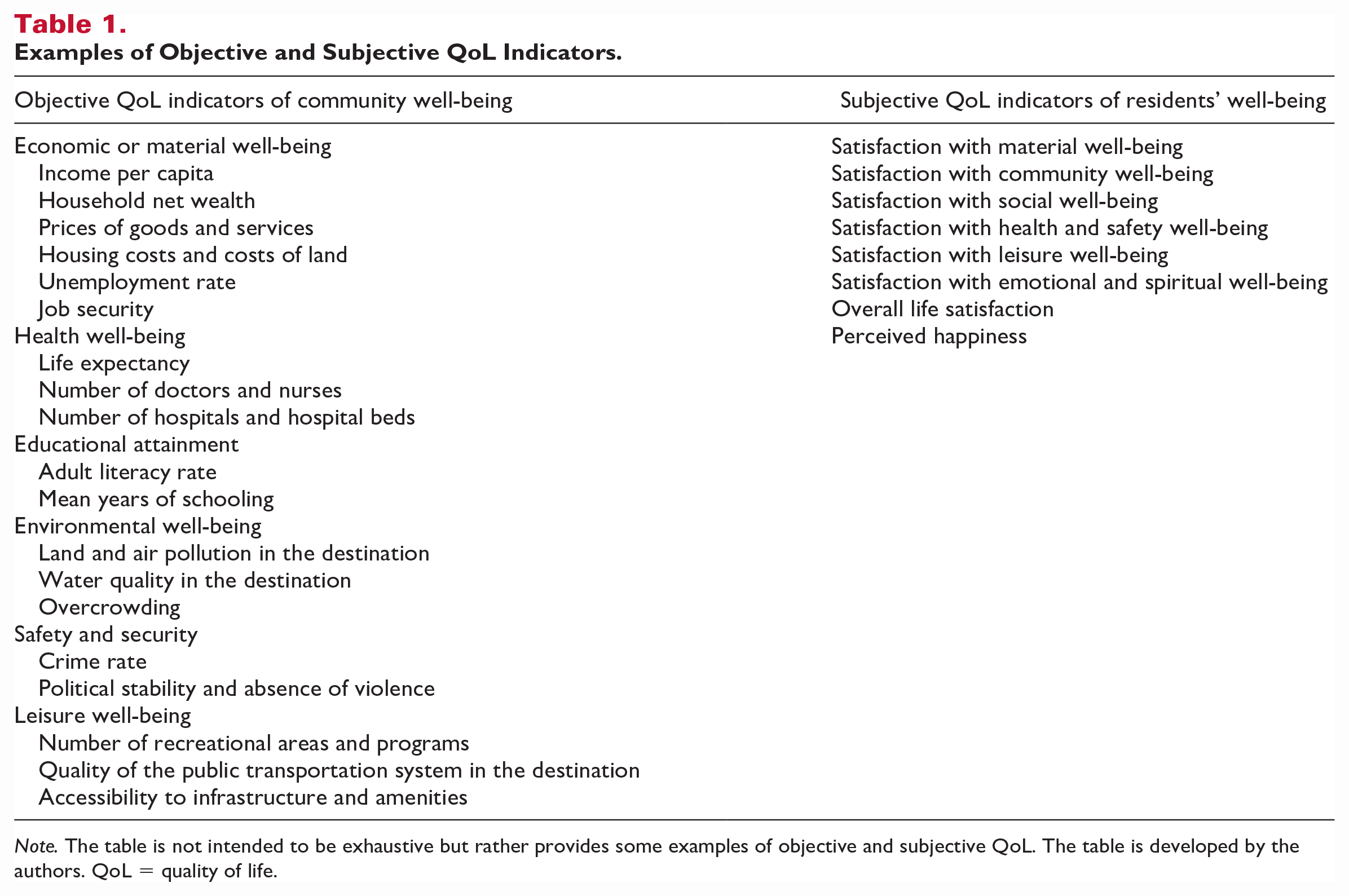
Note. The table is not intended to be exhaustive but rather provides some examples of objective and subjective QoL. The table is developed by the authors. QoL = quality of life.
Public Policy Function of QoL Indicators
Scholars in social indicators research have long promoted the application of QoL indicators for policy development and evaluation (e.g., Bache, 2013; Hicks et al., 2013; McGregor et al., 2009). As noted by Land et al. (2012), QoL indicators serve a public policy function and can be employed to identify and set the policy goals; monitor and consequently assess the efficiency of policy outcomes. To fulfill this function, the key QoL indicators should be determined, and a causal framework, indicating a variety of policy actions and outcomes, needs to be developed (Hagerty et al., 2001; Land et al., 2012). Thus, Coggburn and Schneider (2003) suggest a holistic model of evaluating government performance that will account for relevant QoL indicators. The inclusion of such indicators will aid policymakers in highlighting policy impacts that are more salient to the population (Coggburn & Schneider, 2003).
Similarly, the issues of public policy are key aspects of tourism development processes on different levels. They are essential in regulating the tourism industry, planning, resource configuration, and sustainability practices (Hall, 1999; Morgan, 2012). Despite the acknowledged significance, surprisingly, there are only a few studies that provide a comprehensive framework for tourism public policy (e.g., Amore & Hall, 2017; Guo et al., 2019; Pforr, 2005; Shone & Memon, 2008). The scarcity of research-based implications in tourism was confirmed in a recent review by Aguinis et al. (2023). The authors noted that while studies may include general discussions on policy implications, the majority of them do not suggest an effective mechanism for how their findings can be translated into public policies within the context of QoL. Moreover, with a few exceptions (e.g., Dwyer, 2021), the public policy literature in tourism does not discuss the importance of incorporating QoL indicators into policy development efforts. This could be due to the high fragmentation in tourism governance in the destination, which is commonly characterized by the lack of a single governing body regulating tourism planning and development. Hall and Jenkins (2004) noted that considering the dynamic and complex nature of the tourism industry, public policy should be viewed as a process. Thus, the goals of tourism public policy are defined by a broader framework that encompasses the political, economic, and social qualities of the society (Hall & Jenkins, 2004).
The role of public policy in tourism has been long characterized by the “corporatist model” (Hall & Jenkins, 2004, p. 527) that places performance, efficiency, and investment returns at the center of policy planning and implementation. Indeed, the existing forecasting and demand/performance models that policymakers use as a base for policy formulation primarily include only economic variables. However, such a perspective may result in misleading conclusions and consequently ineffective policy actions and impacts. Dredge and Jamal (2015) pointed out the lack of policy research in tourism that concentrates on acknowledging the value of tourism beyond its role in the economic development of destinations. Considering the ultimate “end goal” of tourism development to enhance QoL and well-being of the community and the residents, new measures to monitor tourism benchmarks are needed. As such, the convergence of conventional measures and QoL indicators that is proposed by this article will promote responsible and sustainable tourism development. These combined measures should be an integral part of tourism policies to obtain the impacts of tourism development on a range of QoL dimensions effectively.
For example, Dwyer (2021) promotes the need to assess the efficacy of sustainable tourism development in the destination from a well-being perspective. The author notes that the application of the capital’s approach to understanding tourism development can be a good starting point to prompt changes in the public policy realm and will contribute to enhancing residents’ well-being. Berbekova and Uysal (2021) note that certain destinations have already included QoL in their strategic agendas. The authors discuss how the Vienna Tourism Board has incorporated the residents’ QoL as an important performance outcome of the city’s tourism development along with the number of visitors and overnight revenues.
As the preceding sections demonstrate, while acknowledging the importance of reassessing tourism value in terms of its contribution to QoL, the current literature in tourism policy research needs further enhancement in terms of providing a mechanism for incorporating QoL indicators in tourism policies. We suggest a conceptual model of QoL and tourism public policy, integrated across five main steps. The model provides guidelines on the inclusion of objective and subjective QoL indicators at different stages of policy development and implementation.
Conceptual Framework of Tourism Public Policy Accounting for Community QoL
Based on the notion that QoL indicators serve a public policy function and the public policy literature in tourism, we propose the following conceptual model for the public policy process that accounts for QoL indicators (see Figure 1). This model includes five pillars: goal setting, formulation and development of tourism benchmark, implementation-strategy development, monitoring, and assessment of policy impacts.
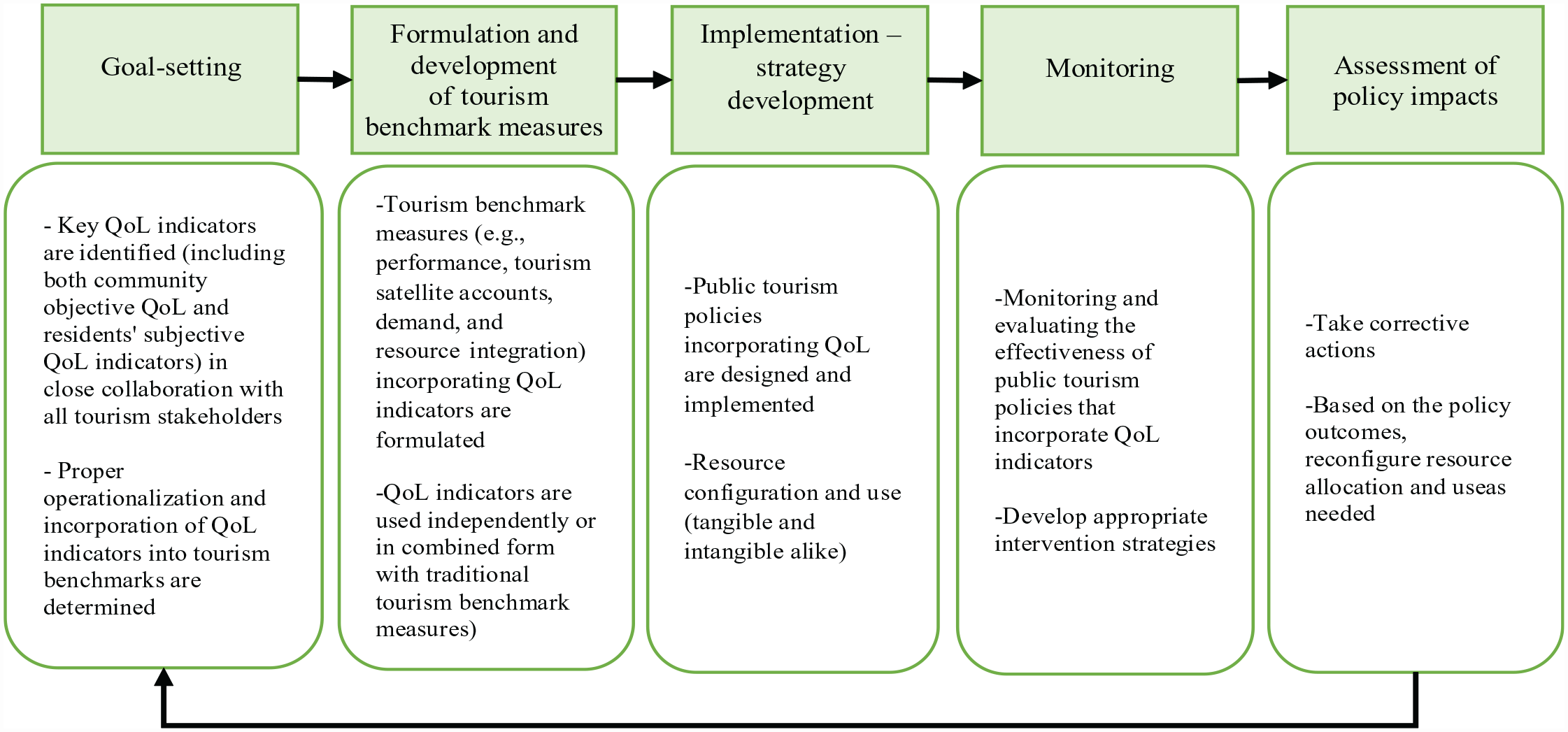
Tourism Public Policy Process Accounting for Community QoL.
Goal-Setting
The tourism policy process starts with goal-setting based on mutually accepted principles and protocols that guide strategies and actions. At this stage, it is important to identify the key QoL indicators that should be included in tourism benchmark measures. These indicators, unique to the place in mind, should reflect both subjective and objective QoL assessments (for examples see Table 1). The subjective indicators will cover residents’ perceived happiness, satisfaction with certain QoL domains, connected with relevant tourism impacts, and overall life satisfaction. Thus, for example, measures of residents’ satisfaction with material, community, health and safety, and emotional QoL can be incorporated as a function of perceived economic, social, cultural, and environmental, impacts of tourism (K. Kim et al., 2013).
The objective measures can encompass a range of QoL domains, covering economic, educational, health, environmental, safety, and security conditions, leisure and recreational opportunities in the destination, etc. A variety of proxies can be used to measure each of the abovementioned domains. Tourism planners can consult the existing research on objective QoL indicators to identify the most appropriate for a specific destination to align with its strategic objectives. This may include publications in social indicators research, QoL studies in tourism, as well as statistical yearbooks, and international, and regional tourism organizations. For example, Dwyer (2022a) notes that destinations could adopt the Better Life framework proposed by the Organization for Economic Co-operation and Development to identify the set of relevant QoL indicators. The challenge for policy planners is to include relevant measures that have an explicit public policy purpose. Rather than aiming at covering all QoL domains, this process should be guided by the uniqueness of the destination. Thus, this list of indicators will be contingent on the nature of the destination (e.g., urban, city, rural, island, or microstate) and levels of development (Uysal et al., 2012).
As every destination has its unique challenges and opportunities, the QoL and performance indicators should reflect place-dependent characteristics. Once the QoL indicators are determined, proper conceptualization and operationalization of indicators should be agreed upon. It is critical to recognize that the definition and the meaning attached to QoL can be different across different cultures and destinations. Moreover, the policy formulation and further implementation are contingent on the societal context (Krutwaysho & Bramwell, 2010). Thus, as needed, the measures of subjective QoL should be amended to reflect the residents’ understanding of the concept. Considering the discussion above, we propose:
Formulation and Development of Tourism Benchmark
At this stage, the decision on how the identified QoL indicators will be implemented should be made. First, policymakers need to specify the tourism benchmark measures such as destination performance, tourism demand, and tourism satellite accounts. Next, it should be determined in what form QoL indicators will be implemented in the assessment. Dwyer (2022a) notes that there are two approaches to this challenge. The first approach considers treating QoL indicators for inclusion in performance measures and advocates for implementing QoL independently or in some combined forms with traditional measures (e.g., number of arrivals, tourism receipts), implying that there is an overlap between them (e.g., Berbekova et al., 2022; Uysal & Sirgy, 2019). The second approach argues for the development of “well-being lens” based on a set of QoL measures (Dwyer, 2021, 2022b) through which tourism performance is evaluated to determine the impacts on community QoL.
Aligned with the first approach, several studies argued for the need for a broader perspective of destination performance, tourism satellite accounts, tourism demand, and resource integration (Assaf & Tsionas, 2015; Berbekova et al., 2022; Croes, 2012). Measurement and continuous evaluation of industry performance is an essential procedure in understanding the effectiveness of resource configuration, promotion activities, as well as formulation and implementation of strategic plans (Kubickova & Martin, 2020; Salinas Fernández et al., 2020). Although the conventional measures of tourism performance (i.e., number of arrivals, tourism expenditure, contribution to GDP) provide important information, they cannot capture a holistic picture of the industry performance. The complex and dynamic nature of the tourism industry calls for the incorporation of a broader set of contextual indicators to measure performance. For example, Assaf and Tsionas (2015) emphasized the need to account for destination quality factors, such as tourism infrastructure quality, human resources, and environmental quality, etc. Similarly, Croes and Kubickova (2013) note that tourism performance can be affected by a variety of contextual factors in the destination. Berbekova et al. (2022) found that the sets of traditional performance measures and objective QoL indicators, reflecting five well-being domains, share a common variance, suggesting that certain QoL indicators can be used as performance measures. A similar notion lies in the basis of the Travel and Tourism Competitiveness Index (TTCI) report. The TTCI contends that destination competitiveness is a function of available resources and infrastructure in the destination, tourism policies, and enabling environment, which encompasses some QoL indicators.
The same approach can be applied to demand forecasting and modeling. Most existing studies operationalize tourism demand as a function of economic determinants such as exchange rates between the source and destination markets, tourists’ income, commonly measured through GDP per capita, and destination price (Song et al., 2019). Although novel variables are constantly introduced in demand modeling, they are mostly concerned with the analysis of tourists’ search queries or the availability of information and communication technologies in explaining the demand to travel (e.g., Önder et al., 2020; Wen et al., 2019). Considering the importance of QoL variables in tourism, it is surprising that only a few studies explore the effect of QoL on tourism demand (e.g., Fu et al., 2020). The QoL indicators have the potential to aid our understanding of both inbound and outbound tourism drivers. It is suggested that outbound demand is formed by a variety of factors, beyond the economic welfare of tourists. Thus, the QoL conditions in the source market, including the state of education and health sectors, safety and stability, environmental conditions also define the demand to travel. Similarly, the state of QoL in the destination can affect tourism and travel flows.
To sum up, combining the objective and subjective measures of community/residents’ QoL will be a better foundation for public policy and the establishment of an appropriate benchmark. Although the application of subjective measures is dominant in tourism research, their sole application may not provide a complete view on the community QoL. As noted by Austin (2016, p. 18), the subjective QoL approach can be defined as “value-monism,” which focuses solely on the individual subjective state of well-being. As opposed to it, the “value-pluralism” approach accounting for a wider set of factors, including objective, external conditions can offer a more comprehensive public policy framework. Austin (2016) notes that Sen’s Capabilities theoretical framework can be a good working example of the “value-pluralism” approach. Sen’s Capabilities theory has been employed in exploring the relationship between tourism and human development (e.g., Croes, 2012).
In addition, at this stage of policy planning and formulation, the relative importance of QoL indicators is determined. Depending on the destination, the importance of certain QoL indicators will vary. For example, if destinations aim to develop a QoL index, indicators may be assigned different weights, which is a common practice in social indicators research (Hagerty & Land, 2007). Thus, we propose:
Implementation
This stage of tourism policy is concerned with implementing tourism policies for the destination, accounting for the community and residents’ QoL. At this stage, the focus of destination policymakers is on implementing policies that will regulate and facilitate tourism development in a way that enhances community QoL. These policies should be based on the established benchmarks that incorporate QoL indicators. The policy actions should be developed in close collaboration with all stakeholders within the industry, and thus, unanimously reflect the destination’s commitment to improving the community and residents’ QoL. Some examples of such policies may include designing programs aimed at empowering residents through tourism development, thereby improving their material and overall QoL. Moreover, expanding the sustainability practices at the destination to preserve the natural environment and cultural heritage. In addition, the mechanisms of how the designed policies will be implemented and affect different domains of QoL must be specified. This way, policymakers can engage in predicting the potential effects of new programs and policies (Hagerty et al., 2001).
Special emphasis should be devoted to resource configuration (tangible and intangible alike) and resource use in implementing the policies formulated. Resource allocations and configurations should be linked to the established priorities of the goals identified. This process should be guided by sustainability and accessibility principles:
Monitoring
Monitoring and evaluating the effectiveness of public policy actions that incorporate QoL indicators is an important step in assessing the overall tourism policy. This step helps in identifying the inefficiencies of certain actions and thus, taking appropriate intervention strategies. Following a systematic approach, policymakers should analyze and respond to intermediate tourism-related policy outcomes. As needed, the measures of subjective and objective QoL indicators can be amended at this stage to better reflect the cultural and societal context of the destination. Moreover, the monitoring process will help in measuring the predictive power of the indicators developed (i.e., how well they predict the performance/satisfaction/attitudes) and validate them over time. Some of these indicators may even change their meanings, thus constant monitoring is important.
It is essential to also keep in mind the development cycle of the place as a destination. As the destination community goes through structural changes over time, the behavioral responses of residents to those changes would also shift (Uysal et al., 2012). Assessing and monitoring such changes and their predicted influence on indicators, thus policy implementation is paramount. The policy changes may be also induced by sudden events, like crises (e.g., health-related, human-caused, natural disasters) that may drastically affect the operations within the industry. Thus, we propose:
Assessment of Policy Impacts
As the framework suggests, the tourism policy formulation is a reiterative process that constantly takes new inputs from evaluating the public policy outcomes. Thus, this stage is concerned with an overall assessment of the policy implications in enhancing community and residents’ QoL. The selected objective and subjective QoL indicators are evaluated following the approach chosen in the second stage. As needed, amendments are made in reconfiguring available resources. At this stage, the indirect effects of tourism development should be appraised as well. Tourism development should benefit not only those that are directly tied to tourism activities but also those that are part of a wider tourism system. Thus, the assessment of policy outcomes serves as a reflective exercise to inform a new cycle of tourism policy development and implementation.
It is important to monitor and assess the public policy outcomes over time. The examination of time-series data will aid managers in determining trends and relationships between certain policies and QoL variables. Moreover, destinations can identify a cluster of relevant competitors to compare tourism performance incorporating QoL indicators. Thus, we propose:
Policy development and formulation need to be an informed decision process, by which integrated steps are developed. The provided model can be used as a tool in considering the public policy function of QoL in tourism research.
Conclusion
Despite the abundance of studies that focus on the connection between tourism, QoL, and well-being, the existing research lacks engagement with the public policy literature. With continuous interest in this topic, our understanding of the QoL concept, its operationalization, and application has improved, and thus, we are more equipped to use QoL to affect public policy and tourism development strategies in the destination. This article suggests that policymakers should adopt a more holistic approach to tourism benchmark measures, including tourism satellite accounts, destination performance, and tourism demand moving beyond conventional arrivals and tourism expenditures. Thus, the achievement of residents’ subjective well-being and community objective QoL should be the guide for public policies in tourism.
The incorporation of QoL elements for better public policy formulations is consistent with the notion of “designing for quality of life” (Dwyer, 2022a; Uysal et al., 2020). Thus, Uysal et al. (2020) argue that designing destinations for a quality tourism experience should be guided by principles of accessibility and sustainability and enhancement of QoL and well-being for all stakeholders involved in the tourism system. Uysal et al. (2020) note that such an approach will not only contribute to improving tourists’ and residents’ well-being alike but also support the livability of destinations. Similarly, Vogt et al. (2020) propose a framework for destination planners that accounts for community QoL and concentrates on improving the place value of the destination through tourism development.
This article provides a conceptual framework of tourism public policy development and implementation, accounting for subjective and objective QoL indicators. It draws on the argument that each destination has its unique characteristics, resource base, and different levels of development. Thus, the policies formulated should reflect that. The policymakers should implement the most relevant QoL pillars, mirroring the challenges that the destination faces. Thus, these indicators should be place-specific. Future research can use the provided framework to assess the effectiveness of public policies in tourism. The formulated research propositions can serve as a basis for empirical studies to analyze the inclusion of QoL indicators at different stages of policy development and implementation. Considering the unique characteristics of each destination, a case study approach, with a mixed-methods research design is recommended to establish evidence-based policy implications. Moreover, the policies should be formulated at the intersection of QoL, sustainability, and resource allocation concepts.
The institutionalization of tourism programs including QoL will require a high level of collaboration between tourism stakeholders, including effective and coordinated stewardship efforts, in the destination. Securing intraregional and inter-organizational partnerships in identifying relevant, place-specific QoL indicators, implementing the QoL indicators in benchmark measures, monitoring and consequently assessing the public policy impacts should be critical and central to the success of the policy implementation process. Moreover, the application of QoL indicators to tourism benchmark measures requires an interdisciplinary approach. Thus, the social indicators’ research, well-being, and happiness studies can inform the policy formulation at the stage of goal-setting and policy implementation.
In conclusion, the focus on QoL should become a guiding philosophy for all destination stakeholders, affecting the planning, promotion, and business practices. As the governance in the tourism industry is highly fragmented, the successful implementation of the QoL agenda demands destination stewardship. Destination stewardship can help bring the QoL and well-being issues to the front of tourism public policy discourse by focusing on tourism stakeholders’ inclusion and representation. It is hoped that the proposed framework can contribute to the guided change in tourism policy and aid in bridging the gap between knowledge and policy.
Footnotes
Declaration of Conflicting Interests
The author(s) declared no potential conflicts of interest with respect to the research, authorship, or publication of this article.
Funding
The author(s) received no financial support for the research, authorship, or publication of this article.
