



Abstract
Based on the Protection Motivation Theory (PMT), this study investigates the impact of risk perception (threat appraisal and coping appraisal) and trust in the destination government on tourists’ self-protective behavior. Survey data from 450 international tourists from the United States were collected through mTurk and analyzed using structural equation modeling (SEM) with SmartPLS 3.0. The results suggest that tourists’ self-protective behavior is directly influenced by their perception of threats and the appraisal of coping mechanisms, but not by trust in the destination government. However, trust in the destination government has an indirect effect on self-protective behavior mediated by threat appraisal and coping appraisal. Thus, tourism stakeholders must focus on building and maintaining trust in government to encourage compliance and self-protective behavior of tourists. Limitations, implications, and suggestions for future research are further discussed.
Keywords
Introduction
Tourism has become the world’s third largest exporter, with many destinations leveraging international tourism for economic growth, job creation, and improved quality of life for residents (Schubert et al., 2011). Given the fragmented nature of tourism, scholars argue that only the government has the legitimacy and the power to implement policies for tourism development (Devine & Devine, 2011). The need for government oversight was further heightened during the COVID-19 pandemic as governments worldwide took restrictive measures to protect their citizens and curb the spread of the virus, creating a multidimensional crisis that endangered public health, undermined economic development and social stability, and challenged effective governance (Hsieh et al., 2021).
Trust plays a significant role in tourists’ decision-making process, affecting factors such as satisfaction, revisit intentions, commitment, and loyalty (Li et al., 2019; Su et al., 2014). It has also been found to affect risk perception and emotional attachment to a destination (Hyun & Han, 2015; Li et al., 2019). While traveling, tourists pay closer attention to health and safety practices at destinations, avoiding dangerous situations or potentially changing their travel plans to decrease uncertainty and perceived risk (Wang et al., 2019), as seen during the COVID-19 crisis.
Studies on trust have focused on either organizational trust (e.g., trust in government or online travel agencies) or interpersonal trust (e.g., trust among tourists, residents, and travel guides; Chang, 2014; Nunkoo et al., 2012). From the destination perspective, trust is a multidimensional construct that includes trust in public and private institutions. From the tourist perspective, trust affects travel behavior. However, there is limited research on the role of government and tourism authorities in reducing risk and increasing trust among tourists (Hsieh et al., 2021), making further studies on this topic, particularly trust in destination authorities (government), necessary.
The Protection Motivation Theory (PMT; Rogers, 1975) explains how individuals respond to threats or risks by reducing risk-taking behaviors. PMT states that individuals’ self-protective behavior depends on two factors: threat appraisal and coping appraisal. Threat appraisal allows individuals to assess the severity of a situation and its likelihood. On the contrary, coping appraisal includes an individual’s belief in their ability to carry out recommended actions (self-efficacy), the efficacy of those actions in removing the threat (response efficacy), and the response cost/benefit of the coping strategy, leading to high-risk or risk aversion behaviors.
As previous studies have examined trust and protection behavior separately, the primary objective of the current study is to incorporate these two concepts to further our understanding of tourists’ self-protection behavior. Specifically, the study (a) assesses the effectiveness of the PMT model in measuring tourists’ self-protection behavior in a pandemic context and (b) analyzes the role of trust in destination government in predicting tourists’ self-protection behavior. The research offers new theoretical insights by including the trust in destination government in a pandemic context and extends PMT into tourism and crisis management literature. The findings will guide destinations on how to manage crisis response and understand the role of trust in shaping tourist behavior.
Literature Review
Role of Trust in Government
The concept of consumer trust has been widely researched and supported in the literature, as it is believed to have a significant impact on consumer behavior (Chang, 2014; Golembiewski & McConkie, 1975; Li et al., 2019). In tourism, trust is considered a key concept and plays a crucial role in reducing travel risk and uncertainty (Choi et al., 2016), improving tourist satisfaction (Kim et al., 2011), fostering destination loyalty (Al-Ansi & Han, 2019; Elbaz et al., 2021), shaping destination choice (Chen & Phou, 2013), and promoting revisit intention (Abubakar & Ilkan, 2016; Hassan & Soliman, 2021). Despite its importance, studies on the role of trust in international travel and its impact on travel behavior are sparse (Zheng et al., 2022).
During times of crisis, trust in government is considered a vital aspect of the political system. The adverse impact of the pandemic has led to a renewed focus on trust in government as promoting cooperative and altruistic behavior (Han et al., 2023). Research has shown that trust in government is linked to higher regulatory compliance (Citrin & Stoker, 2018; Nutbeam, 2020; Prati et al., 2011), increased adoption of preventive measures (Vinck et al., 2019), and reduced need for decision justification (Tyler, 1998). Destinations with high levels of trust are better equipped to handle crises (Yang et al., 2021) as trust plays a crucial role in shaping individuals’ risk assessment (Fong et al., 2020; Nunkoo et al., 2012) and promoting precautionary behavior (Hsieh et al., 2021; Shanka & Menebo, 2022). Thus, in high-risk and uncertain situations, trust is especially important in predicting risk perception, perceived efficacy of coping mechanisms, and compliance behaviors (Blair et al., 2017; Fong & Chang, 2011; Liu & Mehta, 2021; Siegrist et al., 2003).
In a recent study of vaccine acceptance among health care workers in the United States, Shekhar et al. (2021) found that while most participants trusted health care professionals, half of them did not trust the information provided by the government on COVID-19, and one third did not trust regulatory authorities such as the Centers for Disease Control and Prevention and Food and Drug Administration that guided vaccine development. While many studies support the positive relationship between trust and self-protective behavior (Al-Rasheed, 2020; Blair et al., 2017; Lim et al., 2021; Tang & Wong, 2003), Clark et al. (2020) reported that trust in government is not a significant predictor of self-protective behavior. Furthermore, some studies found a negative relationship between trust in government and protective behavior (Guglielmi et al., 2020; Han et al., 2017; Terpstra, 2011). Thus, the effects of trust on individual behavior can vary in different contexts (Viklund, 2003). For example, the effect of trust in government on compliance was significant in Italy and South Korea, but not in the United States (Travaglino & Moon, 2020). Therefore, during a pandemic, understanding the association between trust in government and self-protection behavior is important in tourism (Han et al., 2023), leading to the first proposed hypothesis:
Trust in government is crucial when it comes to shaping individuals’ beliefs and risk perception during a pandemic (Han & Yan, 2019; Liu & Mehta, 2021). People rely on their trust in the government to evaluate threats and make decisions when they have limited information or cognitive capacity (Han et al., 2017; Siegrist et al., 2003). Those with a high level of trust in the government are more likely to comply with government policies because they view the government’s decisions as credible (Nakayachi & Cvetkovich, 2010). In a study of participants from 58 countries, Pak et al. (2021) found that the likelihood of complying with strict measures was twice as high for those with high level of trust in government compared with those with low level of trust. This was observed during COVID-19 where at the beginning of the pandemic, some destinations have seen the citizen’s trust in government to be depleted due to their perception of insufficient government measures being put in place (Hale et al., 2020). However, as governments implemented policies addressing these concerns, some destinations saw an increase in trust (Galle et al., 2020; Mansoor, 2021). Trust in government information is also important as false information can erode confidence (Melki et al., 2021). Trust in the government can increase the public’s understanding of the threat and the importance of preventive measures (Shanka & Menebo, 2022). Conversely, the lack of trust in the government can lead to an underestimation of risk (Scandurra et al., 2023), reduced efficacy of coping mechanisms (Fong & Chang, 2011; Hsieh et al., 2021), and higher vaccine hesitancy (Larson et al., 2018; Trent et al., 2022). Thus, this discussion leads to the next two proposed hypotheses:
Protection Motivation Theory
Several theories investigated how and why individuals decide to adopt health protection behavior. Such theories and models include the health belief model (Champion & Skinner, 2008), theory of reasoned action (Conner et al., 2017), subjective expected utility theory (Li et al., 2009), social cognition theory (Bandura, 1994), theory of planned behavior (Ajzen, 1985), and PMT (Rogers, 1975; Wang et al., 2019). Among these theories, the PMT is the most comprehensive and extensively used (Floyd et al., 2000; Milne et al., 2000; Wang et al., 2019). PMT was originally proposed by Rogers (1975) to explain the effects of fear appeals. He argued that the presence of a threat gives an indication for actions (e.g., threat assessment) that can in turn be undertaken to avoid consequences (Seow et al., 2021). According to PMT, “people appraise the severity and likelihood of being exposed to a depicted noxious event, evaluate their ability to cope with the event, and alter their attitudes accordingly” (Rogers, 1975, p. 100).
Specifically, individuals’ response to threats is determined by two cognitive processes: threat appraisal and coping appraisal. According to the PMT, threat appraisal measures maladaptive response that evaluates the component of risk analysis that is relevant to an individual’s perception of how threatened they feel. It is captured by two components: perceived vulnerability and perceived severity. In this study, perceived vulnerability assesses how susceptible an individual feels toward COVID-19. Perceived severity assesses how serious an individual feels COVID-19 is to them. Previous studies have reported that the perceived threats (including health risks, national disasters, and terrorism) trigger a defensive response and adaptation of precautionary behaviors (Kozak et al., 2007; Kim et al., 2022). Similarly, higher threat appraisal can lead people to take the threat more seriously, increasing their likelihood of adopting self-protection measures (Chen & Yang, 2019; Zheng et al., 2021).
According to PMT, coping appraisal measures adaptive response, which evaluates the risk analysis component relevant to an individual’s assessment of the recommended coping response. It is captured by three components: response efficacy, self-efficacy, and response cost. Response efficacy is the belief that by following the protection action, it will effectively protect the self from the effects of COVID-19. Self-efficacy is the perceived ability of the individuals to carry out the protection actions. Response cost is the perceived cost incurred by an individual in performing the recommended response. As response efficacy and self-efficacy increase, the probability of an individual engaging in self-protection behavior and response cost decreases the probability of an individual engaging in self-protection behavior (Floyd et al., 2000; Milne et al., 2000). Studies have applied PMT to the tourism context, focusing primarily on perceived vulnerability (Law, 2006; Schroeder et al., 2016) and perceived severity (Lu & Wei, 2019; Qi et al., 2009; Slevitch & Sharma, 2008). Wang et al.’s (2019) study was one of the first studies to fully test PMT by investigating tourists’ self-protective behavior against rabies while traveling to Asian countries. Other studies have added additional constructs to PMT, such as perceived government support (Ruan et al., 2020), perceived destination support (Zheng et al., 2021), mass-media coverage (Qiao et al., 2022), and media engagement (Bhati et al., 2021). However, the role of government and the concept of trust have not been included in the model.
Health-related crisis management in tourism literature is divided into three streams: impacts on the industry (Abbas et al., 2021; Papatheodorou et al., 2010; Pine & McKercher, 2004), forecasting demand (Karl et al., 2021; Polyzos et al., 2021), and estimating impacts on tourist behavior (Chen et al., 2020; Miao et al., 2021; Valencia & Crouch, 2008). The studies on tourist behavior have mostly focused on travel avoidance (Cahyanto et al., 2016; Chua et al., 2021; Nazneen et al., 2021; Zheng et al., 2022). However, other post-COVID travel behaviors such as disruptive travel behavior, rational travel behavior, and compensative travel behavior also need equal research attention (Miao et al., 2021). It is crucial to understand tourists’ sentiments and the likelihood of compliance with policy measures during a health crisis.
Most tourism studies have used behavior intentions as the outcome variable (Chen et al., 2020; Horng et al., 2014; Hsieh et al., 2021; Rather, 2021; Ruan et al., 2020; Seow et al., 2021; Verkoeyen & Nepal, 2019). Some studies have used intentions to engage in protection behavior as the outcome variable (Fisher et al., 2018; Wang et al., 2019). Although intentions can be a good predictor of actual behavior, it may not always be the case (Horng et al., 2014). Therefore, the current study uses self-reported actual behavior instead. The preceding discussion leads to the next two proposed hypotheses:
Several studies suggest that trust has an indirect effect on individuals’ intentions and behaviors. For example, Liu and Chu (2022) found that in the context of COVID-19 vaccines, trust in public health agencies influenced vaccine intention and uptake through perceptions of the vaccine and emotions. Similarly, Flynn et al. (1992) found that trust in the government directly affected risk perceptions, which in turn influenced attitudes toward a high-level radioactive waste repository. Gursoy et al. (2017) reported that residents’ positive views of mega-events mediate the relationship between trust in government and support for such events. However, this mediation was not significant in the case of the negative impacts of mega-events. The role of risk assessment as a mediator between trust and self-protection behavior is ambiguous and will depend on the level of risk and individual health behavior during travel. Therefore, the mediating relationship cannot be established a priori but is an empirical question, leading to the next two proposed hypotheses:
Based on the theory and literature review, it is evident that high threat appraisal and high coping appraisal increase the probability of tourists’ engagement in self-protection behavior, leading to the proposed conceptual model illustrated in Figure 1:
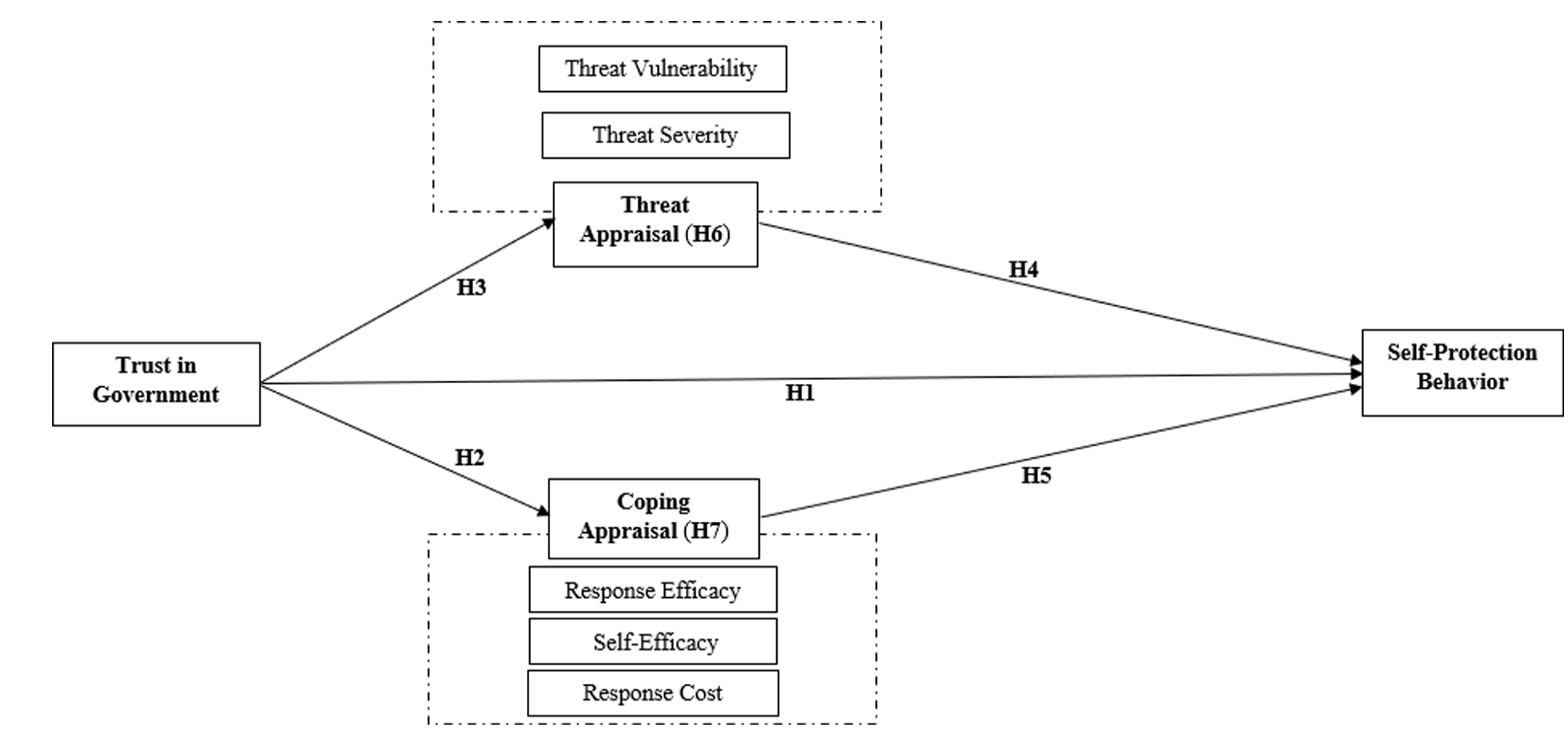
Proposed Conceptual Model.
Method
To test the proposed conceptual model, a self-administered online survey was conducted using Mechanical Turk (mTurk) during the months of March through August 2022. The scales for threat appraisal (TA; threat vulnerability, threat severity), coping appraisal (CA; response efficacy, self-efficacy, response cost), trust in government (TG), and self-protection behavior (SPB) were all adapted from previous research. Specifically, threat vulnerability was measured using three items derived from Zheng et al. (2021). Four items used to measure threat severity were derived from Qiao et al. (2022). The four items measuring response efficacy were derived from Kim et al. (2022). Self-efficacy was measured using four items and response cost was measured using three items obtained from Zheng et al. (2021) study. Trust in government was measured using six items from Shanka and Menebo (2022). Similarly, self-protection behavior was measured using seven items derived from Shanka and Menebo (2022) and Wang et al. (2019). The items were revised to fit the context of the COVID-19 pandemic and each item was measured on a 5-point Likert-type scale, ranging from 1 = strongly disagree to 5 = strongly agree.
First, a pretest was conducted, using 190 samples in March 2022. After minor adjustments were made to the wording of the items to ensure clarity, a total of 537 surveys were collected in August 2022. The survey respondents were U.S. residents over the age of 18, who had traveled internationally within the last 2 years. Multiple qualifying questions and attention check questions were asked to ensure data quality. After removing incomplete surveys and those with duplicate IP addresses, a total of 450 valid surveys were retained for final analysis.
The data were analyzed in two steps. First, the descriptive statistics were calculated using the Statistical Package for the Social Sciences (SPSS) 23.0. As threat appraisal and coping appraisal were second-order reflective-formative constructs, these were analyzed using the disjoint two-stage approach (Becker et al., 2012). Following the recommendations of Hair et al. (2017), the measurement model and structural model were tested. The measurement model established the reliability and validity of the constructs, and the structural model ascertained the significance of the hypothesized relationships through structural equation modeling (SEM) using partial least square (PLS) estimation with SmartPLS 3.0. PLS was chosen over traditional co-variance-based (CB) SEM as it enables the estimation of complex models without imposing distribution assumptions on the data and has higher efficiency in parameter estimations (Hair et al., 2017).
Results
Descriptive Statistics
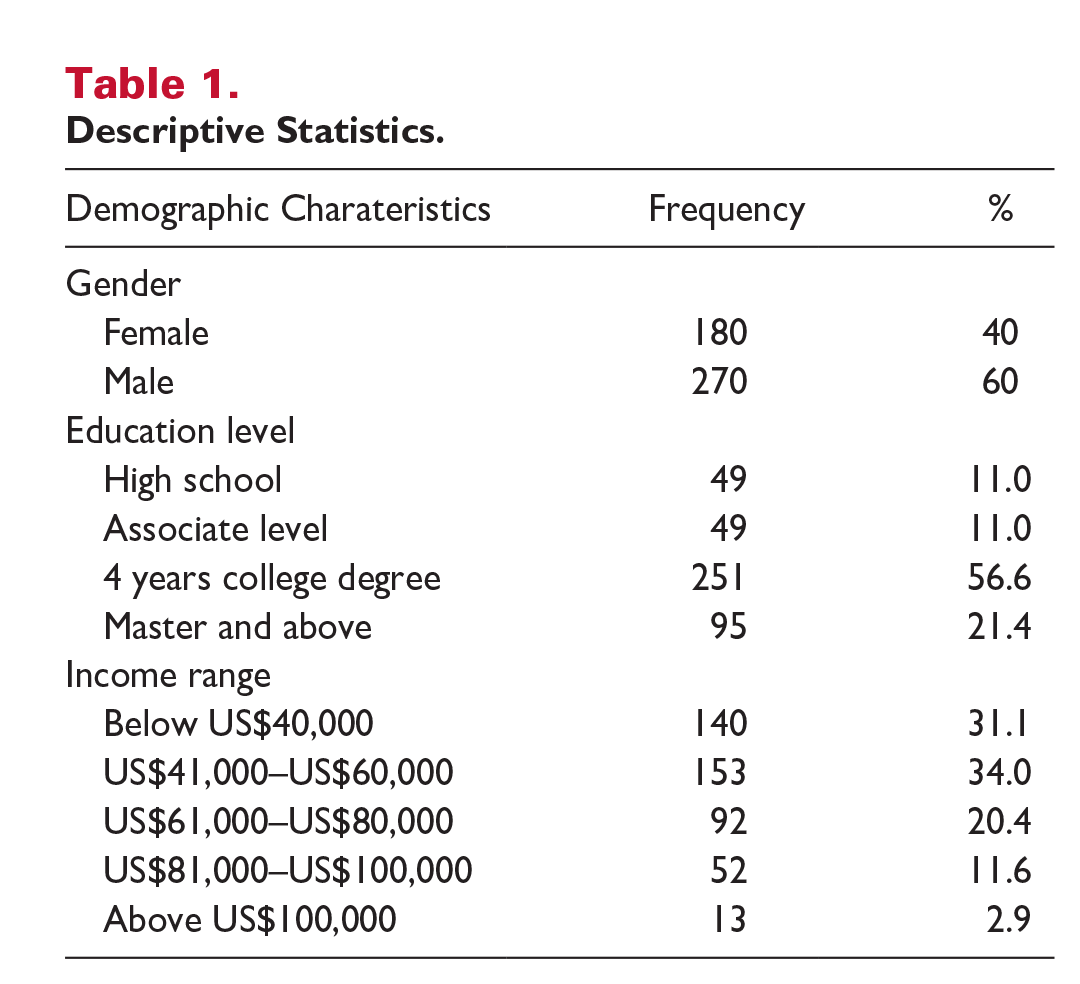
The descriptive results are summarized in Table 1. The results indicate that 40% of the respondents were female, with a majority (almost 80%) having at least a 4-year college degree with 20% earning between US$60,000 and US$80,000.
Descriptive Statistics.
Nonresponse Bias
The study used the methods outlined by Armstrong and Overton (1977) to determine whether there was a nonresponse bias present. The chi-square test was used, and it was found that there were no significant differences between the first 5% of respondents and the last 5% of respondents on demographic variables or the items being measured. Hence, it can be concluded that there was no issue with nonresponse bias in the study.
Common-Method Bias
The study, using Kock’s (2015) methodology, assesses the risk of common method bias. The results in Table 2 show that the variance inflation factors (VIFs) in the internal models, after undergoing a thorough collinearity examination, are below the 3.3 limit. This indicates that the model is devoid of common method bias (Kock, 2015).
Common-Method Bias (Inner VIF).
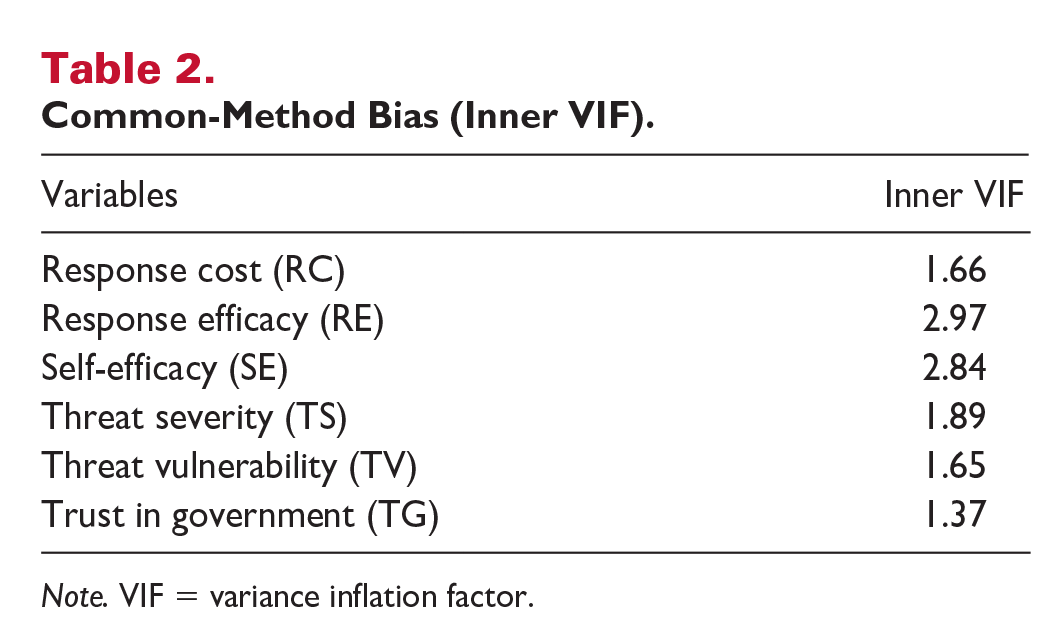
Note. VIF = variance inflation factor.
Measurement Model
The evaluation of the measurement model rests on the quality of individual constructs included in the model. The quality criteria were assessed with the factor loadings, followed by the construct reliability and construct validity. The factor loading refers to “the extent to which each of the items in the correlation matrix correlated with the given principal component” (Pett et al., 2003, p. 299). In the study, two items in self-protection behavior, one item in threat severity, and one item in response efficacy had factor loadings less than the recommended value of 0.70 (Hair et al., 2017) and were removed (see Table 3). According to Hair et al. (2017), multicollinearity is not an issue if the VIF value is below 5. The VIF values for all the indicators were below the recommended threshold. Reliability refers to “the extent to which a measuring instrument is stable and consistent” (Mark, 1996, p. 285). Cronbach’s alpha statistics and average variance extracted (AVE) analysis helped establish the measures’ reliability and validity. Both indicators had reliability statistics over the required threshold of .70 (Hair et al., 2017). The results for factor loading, VIF, Cronbach’s alpha, composite reliability, and AVE are presented in Table 3.
Factor Loadings, Multicollinearity Statistics (VIF), and Construct Reliability Analysis.
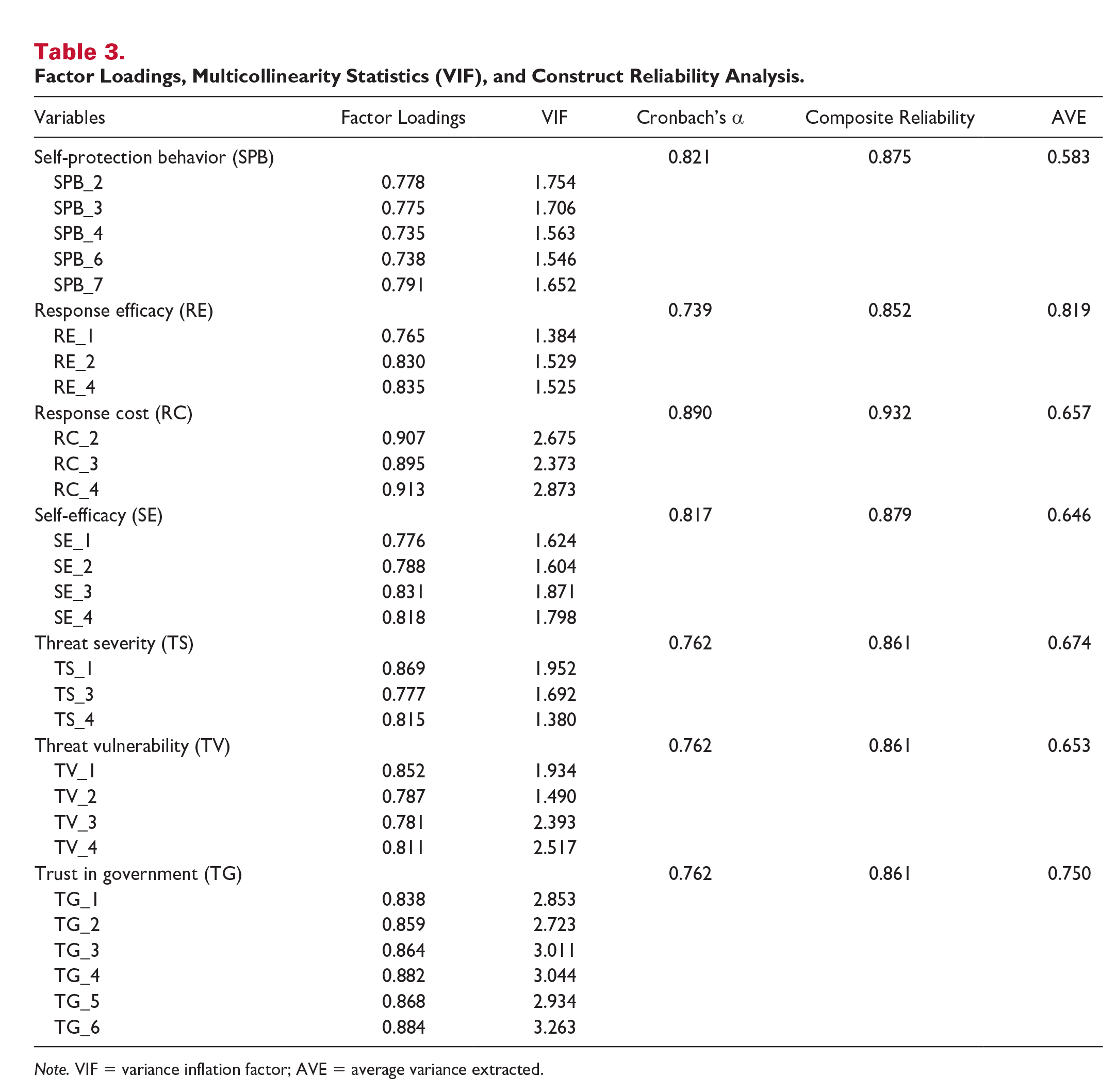
Note. VIF = variance inflation factor; AVE = average variance extracted.
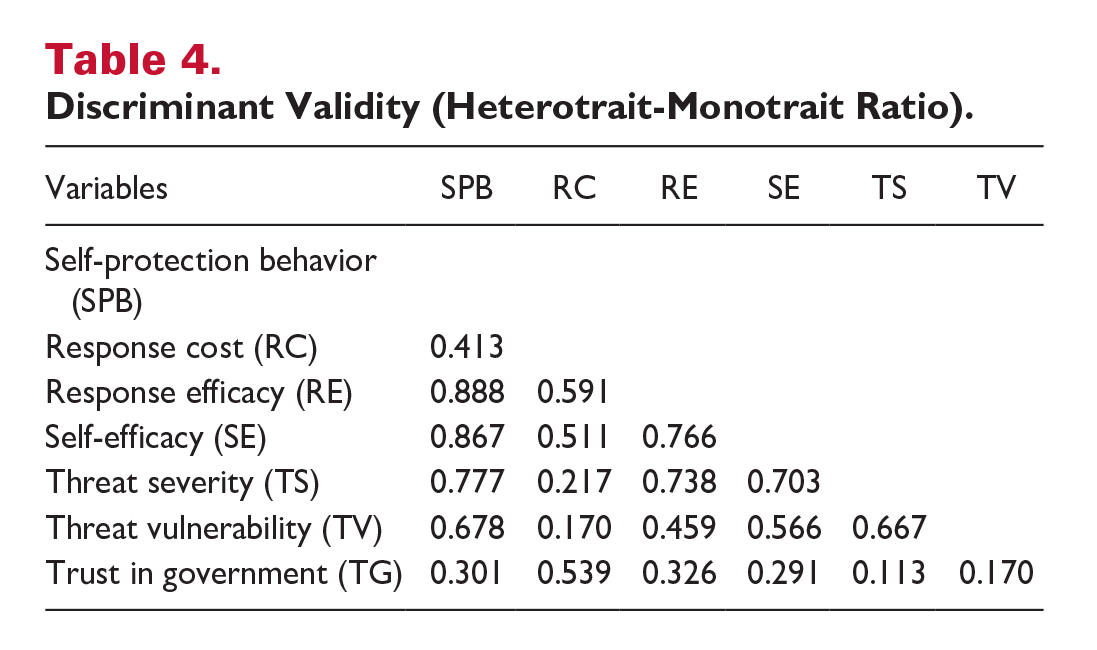
Discriminant validity refers to the degree to which measures of the different constructs are distinct. If two or more concepts in the model are distinct, then valid measures of each should not correlate too highly (Bagozzi et al., 1991). Discriminant validity was tested using Heterotrait-Monotrait Ratio (HTMT). According to HTMT, discriminant validity is established when the HTMT ratios for the constructs are less than the required threshold of .90 (Teo et al., 2008). The threshold for the HTMT ratio was met, and it is presented in Table 4.
Discriminant Validity (Heterotrait-Monotrait Ratio).
This study has two higher-order constructs, namely, coping appraisal (CA) and threat appraisal (TA), and five lower-order constructs, namely, response efficacy (RE), self-efficacy (SE), response cost (RC), threat vulnerability (TV), and threat severity (TS). To establish the higher-order construct validity, outer weights, outer loadings, and VIF were used. The outer weights were found to be significant at .05, as recommended by Hair et al. (2017). Each of the lower constructs also had outer loading greater than .50, following Sarstedt et al. (2019). VIF values accessed the check for collinearity, and all VIF values were less than the recommended value of five (Hair et al., 2017). Thus, the higher-order construct validity was established as presented in Table 5.
HOC Validity.
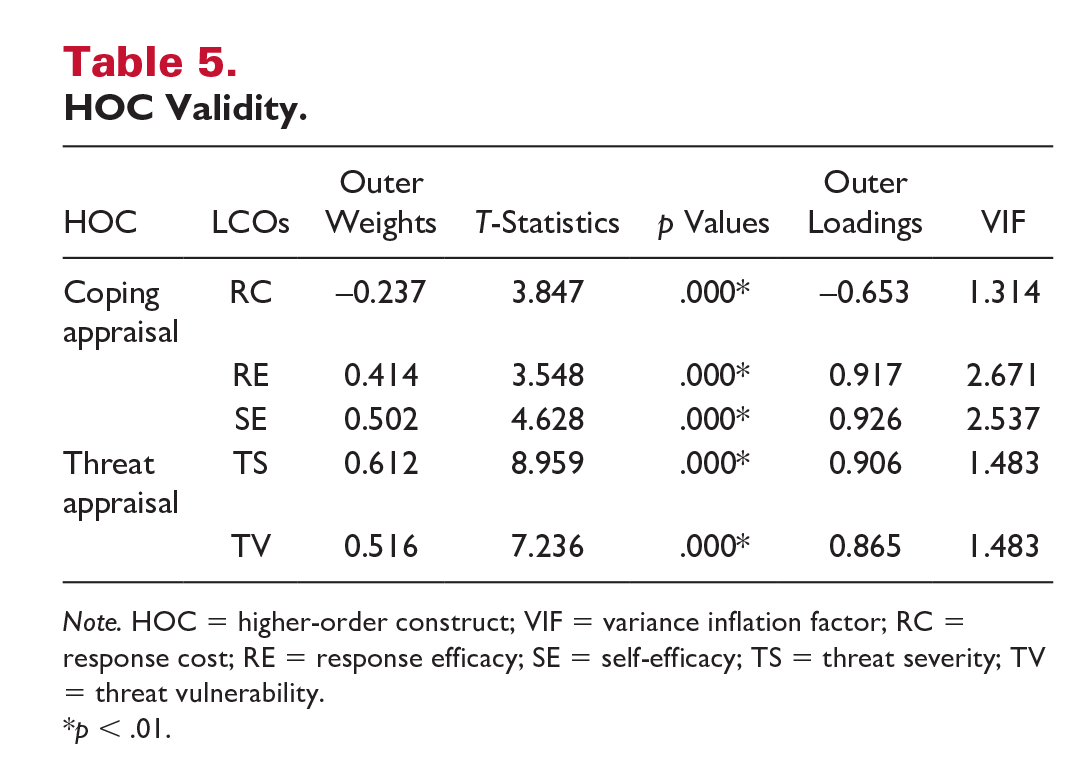
Note. HOC = higher-order construct; VIF = variance inflation factor; RC = response cost; RE = response efficacy; SE = self-efficacy; TS = threat severity; TV = threat vulnerability.
p < .01.
Structural Model
For the structural model assessment, the coefficient of determination (R2), standardized path coefficient, and predictive relevance (Q2) were examined. First, the R2 value of .65 suggests a high predictive power of the model for both constructs. Second, the predictive relevance of both dependent variables was accessed using Q2 by generating the cross-validated redundancy measure as suggested by Hair et al. (2017) and was found to be 0.372. The predictive relevance value (Q2) was above zero, indicating that constructs are well constructed, and the model has predictive relevance. The structural results of the model with the standardized path coefficient are presented in Table 6.
Results of Path Relationships.
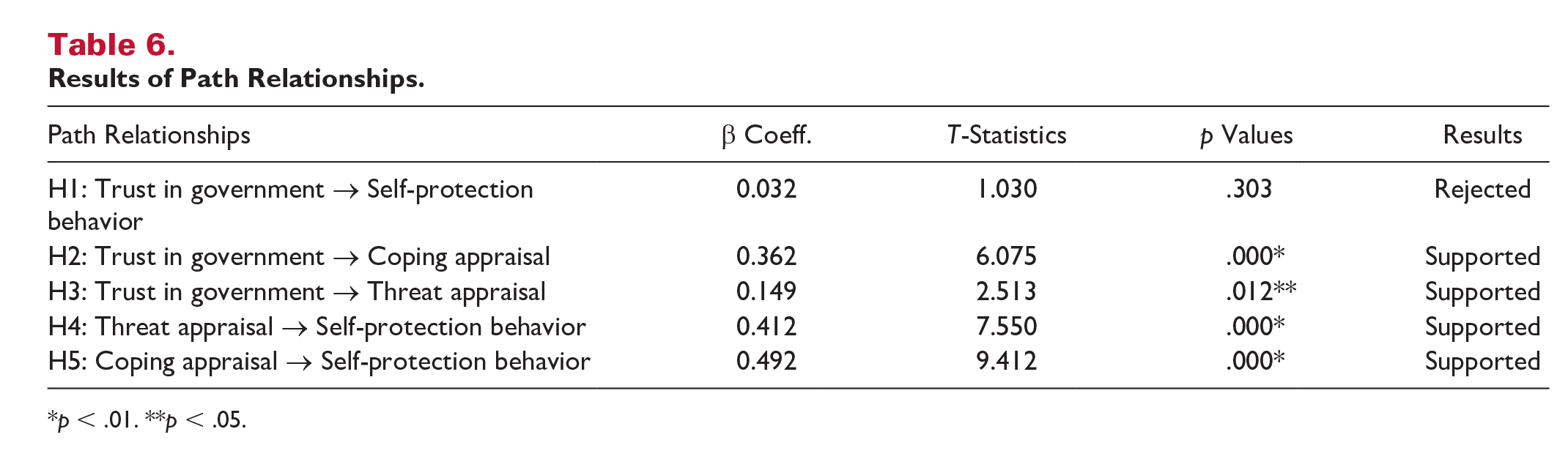
p < .01. **p < .05.
Although the direct relationship between trust in the destination government and self-protection behavior was not found to be significant, further mediation analysis was run to assess whether there is an indirect relationship between the two constructs. The results in Table 7 revealed a significant mediating role of threat appraisal (TA; β = 0.061, t = 2.229, p = .026) and coping appraisal (CA; β = 0.178, t = 5.048, p = .000) in the relationship between trust in government (TG) and self-protection behavior (SPB) using a 95% bias-corrected confidence interval. The total effect of TG on SPB was significant (β = 0.272, t = 5.274, p = .000); however, with the inclusion of the mediators, the direct effect was not significant (β = 0.032, t = 1.030, p = .303).
Mediation Results.
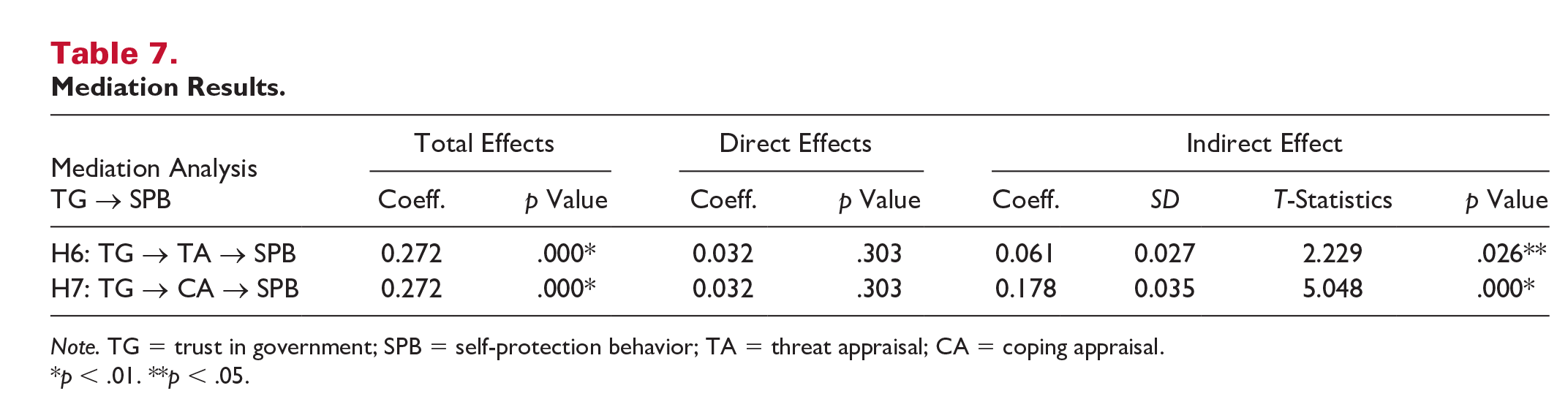
Note. TG = trust in government; SPB = self-protection behavior; TA = threat appraisal; CA = coping appraisal.
p < .01. **p < .05.
Discussion
The objectives of the study were to assess the effectiveness of PMT in predicting tourists’ self-protection behavior in a context of a pandemic and to understand the role of trust in government in the process. This study differs from prior research in that it considers both threat appraisal and coping appraisal as predictors of tourists’ self-protective behavior and expands the PMT model by including trust in destination government.
The results confirm that threat appraisal (threat severity and threat vulnerability) and coping appraisal (self-efficacy, response efficacy, and response cost) are significant predictors of self-protective behavior (Ruan et al., 2020; Shanka & Menebo, 2022; Wang et al., 2019). However, previous studies have shown inconsistencies in the strength of these two constructs in predicting behavior. For instance, Ruan et al. (2020) found that threat appraisal had a stronger association with the protection motivation construct, while this study and studies by Horng et al. (2014) and Wang et al. (2019) suggest that coping appraisal has a stronger association. One possible explanation for the variation in results can be due to the time the data were collected (Summer of 2022). As the data were collected during 2022, the population had already been living with COVID-19 for over 2 years. At the beginning of the pandemic, people may have felt overwhelmed, anxious, and stressed due to the uncertainty and fear of getting infected. However, as time progressed, citizens adapted to the new normal, causing a decline in their perception of the risk of COVID-19 infection, thus decreasing the strength of threat appraisal in predicting self-protection behavior. In psychology, this phenomenon is known as habituation, where the strength of an individual’s response to a stimulus after repeated exposure decreases significantly (Kurita et al., 2023; Rankin et al., 2009).
Another possible explanation is that tourists made decisions to engage in self-protection activities based on their evaluation of the effectiveness of the protocols being implemented. Evidence from the recent pandemic has shown that evaluation of the safety protocols is heavily influenced by the public’s perception of the government. For example, the Portuguese government utilized the military in its response to the COVID-19 pandemic. This decision has been seen as a critical component of the Portuguese government’s efforts to contain the spread of the virus and protect the health and safety of its citizens. By leveraging the resources and expertise of the military, the Portuguese government was able to effectively respond to the rapidly evolving situation and manage the impact of the pandemic in the country (Hatton, 2021). This further strengthens the importance of coping appraisal in predicting self-protection behavior.
Finally, response cost, one of the three components of coping appraisal, also might be a reason why coping appraisal was found to have stronger influences on tourists adopting self-protection behavior. During the pandemic, there were several cases where tourists were penalized for not following destination protocols. For example, an American student was jailed for 2 months for violating the 2-week quarantine while traveling to Cayman Islands (Buckley, 2021). Similar incident happened in Honolulu where a tourist was arrested for breaking the state’s mandatory 14-day quarantine (Sloss, 2020). Therefore, because of the high cost associated with not following the protocols, tourists might be motivated to either adopt self-protection behavior or avoid the destination altogether.
In the context of trust in government, findings suggest that trust has a significant impact on threat appraisal and coping appraisal (Gilles et al., 2011; Hsieh et al., 2021), which further supports the earlier discussion. It is noteworthy to mention that contradictory to previous studies (e.g., Al-Rasheed, 2020; Kim et al., 2022; Shanka & Menebo, 2022), trust in the government does not have a direct impact on tourists’ adoption of self-protection behavior. Contradictory to our findings, Ruan et al. (2020) using perceived support of the government found a negative significant relationship with protection behavior. Due to the disparity in the findings, further analysis was conducted. While the direct relationship between trust in government and self-protective behavior was insignificant, the indirect relationship shows that both threat appraisal and coping appraisal positively mediate the relationship between trust in destination government and tourist’s adoption of self-protection behavior. This finding is of particular importance because no other research has explored such mediating relationships.
Explanation for such findings could be that trust in government is a complex and multifaceted concept, influenced by various individual, societal, and contextual factors such as political ideology, historical context, media exposure, demographic and cultural factors, personal experience, personality traits, and cognitive biases (Kim et al., 2022), influencing how individuals assess the risk of COVID-19. For example, individuals who identified themselves as conservative tend to have a lower perception of the risk posed by the virus compared with those who identified themselves as liberal (Pak et al., 2021). Studies also found that individuals are more likely to trust the government if it is led by their preferred political party (Babington, 2021).
Such findings are significant for destinations that might not have yet realized the benefits increased trust has on (a) shaping tourists’ perception about that destination (how safe the destination is; Musavengane et al., 2020; Williams & Balaz, 2015), (b) how effective the destination is in managing risks (Nakayachi & Cvetkovich, 2010; Wong & Lai, 2021; Xu et al., 2021), and (c) their compliance/adoption of protective behavior. However, because of the significant indirect effect of trust in government, building and maintaining tourists’ trust are vital for effective destination competitiveness and crisis management.
Implications, Limitations, and Future Directions
Theoretical Implications
As crises have had a substantial impact on the travel and tourism industry, scholars have emphasized the need for theory-driven research into tourists’ risk perception (Liu-Lastres et al., 2019). As Ritchie and Jiang (2019) highlighted, a large knowledge gap in understanding individuals’ psychology in postpandemic travel still exists and additional research is needed. The current study addresses these concerns and contributes to the existing literature in four ways.
First, while previous studies have mainly focused on travel avoidance (Cahyanto et al., 2016; Chua et al., 2021, Nazneen et al., 2021; Zheng et al., 2022), this study highlights the need for equal research attention on other post-COVID travel behaviors such as disruptive travel behavior, rational travel behavior, and compensative travel behavior (Miao et al., 2021). Second, this study provides a unique perspective by examining actual tourist behaviors rather than relying solely on behavior intentions as most risk researchers have done (Chen et al., 2020; Seow et al., 2021). The proposed model tests actual behavior outcomes such as buying insurance before travel and researching destination restrictions, rather than just the intention–behavior relationship.
Third, this study extends the current understanding of the PMT model by including tourists’ trust in the destination government, making it one of the few studies to test a full PMT model. Earlier research by Al-Rasheed (2020) included trust in government with PMT to predict citizens’ self-protection behavior in Kuwait using two items (trust in government information and trust in government procedure). Such conceptualization of trust in government is considered limited; at the same time, it only focuses on citizens’ trust in their own government. The extended PMT model as proposed by this study has wider applications beyond just trust in one’s government, the context of health risks, and the context of tourism, making it relevant to the larger field of crisis management.
Finally, this study conceptualizes threat appraisal and coping appraisal as second-order constructs. Second order conceptualization allows researchers to describe complex phenomena by examining the underlying components that contribute to them while keeping the model parsimonious (Crocetta et al., 2021). While previous studies have investigated the relationship of the subcomponents (e.g., threat severity, self-efficacy, cost), conceptualizing threat appraisal and coping appraisal as higher-order constructs provides a way for researchers to study a concept on a more abstract level (referred to as higher-order component) as well as its specific, more concrete aspects (referred to as lower-order components; Sarstedt et al., 2019). This approach expands the traditional understanding of the constructs that typically involves one level of abstraction (e.g., Al-Rasheed, 2020; Wang et al., 2019).
Managerial Implications
This study has significant managerial implications for both government agencies and tourism stakeholders. First, it is important to note that past health crises such as Middle East respiratory syndrome (MERS), Ebola, and severe acute respiratory syndrome (SARS) have been confined to specific regions and did not have a global impact like COVID-19. The last widespread crisis of this nature was the Spanish Flu outbreak in 1918, when governments lacked the necessary resources to comprehend the motivations and behaviors of tourists during a pandemic. Thus, this study provides a foundation for destination governments to gain an understanding of how trust in government, and by extension their policies, can influence tourists’ decision-making processes.
Second, previous research has suggested that the evaluation of the danger posed by a risk and an individual’s vulnerability to that risk are the primary drivers of self-protective behaviors. However, this study finds that the major driving factor is coping appraisal, which is the evaluation of the effectiveness of policies and the individual’s ability to comply with them. It emphasizes that it is not the crisis itself (which is beyond anyone’s control), but the response mechanism that has the greatest impact on tourists’ self-protective behaviors. Hence, government agencies, industry stakeholders, and Destination Management Organizations (DMOs) must be mindful of citizens’ sentiments and take their evaluations into consideration while making decisions.
Third, the finding of this study highlights the crucial role of trust in government in shaping individuals’ perception of risk and their evaluation of self-protection measures during travel. Trust in government plays a crucial role in determining the public’s attitudes toward risk and their assessment of the measures being implemented (Fong et al., 2020; Hsieh et al., 2021). As such, it is imperative that the government prioritizes building and maintaining trust through effective risk and crisis communication, among others, during the COVID-19 pandemic. This can be achieved by providing transparent, considerate, and responsive information about infection prevention in close collaboration with local health services, health care providers, and media (Al-Rasheed, 2020). Such an approach will help ensure that the government’s response to the pandemic is well-received and effectively followed, thereby strengthening trust in the government.
To conclude, for destination governments, improving tourists’ trust in government is crucial for ensuring proper recovery from the pandemic and effective crisis management in the future. To build trust, destination governments should update travel suggestions, make information accessible through multiple channels, protect tourists’ interests (e.g., flexible cancelation policies), and ensure that the prevention strategies are transparent and inclusive of tourists’ concerns. In short, maintaining trust in the government is key to successful crisis management and recovery from the pandemic.
Limitations and Future Directions
The present study has some limitations that should be acknowledged, providing opportunities for future investigation. Although the cross-sectional design of the study is appropriate for testing assumptions about relationships, its main limitation is that it cannot establish a causal relationship. Conducting a longitudinal study would provide more generalizability, allowing for the observation of trends over time. Furthermore, this study used a self-administered online survey, limiting the sample to residents of the United States. This may have resulted in inaccuracies in reporting due to the potential for recall errors. Thus, the generalizability of the findings should be approached with caution and future studies should be conducted in different destinations to gain a deeper understanding of national differences and the evaluation of risk.
Future research should also explore how specific components of the constructs (threat vulnerability, threat severity, response efficacy, self-efficacy, and response cost) affect trust and self-protection behavior, as they may provide crucial information for a deeper understanding. The examination of other factors that may affect these relationships such as destination image, tourists’ preexisting health conditions, cultural differences, and familiarity with the destination is also recommended. The data collected in this study were collected during the COVID-19 pandemic; therefore, additional research is needed to investigate trust and self-protection behavior during different types of crises (e.g., monkeypox, Ebola).
Finally, studies have found that political affiliation has a significant impact on public sentiments regarding trust in government and their behaviors (Kerr et al., 2021; Trent et al., 2022). Hence, future research should investigate the influence of political affiliation on trust in government and self-protection behavior.
Supplemental Material
sj-docx-1-cqx-10.1177_19389655231182081 – Supplemental material for Tourists’ Compliance With Public Policy and Government Trust: An Application of Protection Motivation Theory
Supplemental material, sj-docx-1-cqx-10.1177_19389655231182081 for Tourists’ Compliance With Public Policy and Government Trust: An Application of Protection Motivation Theory by Swechchha Subedi and Marketa Kubickova in Cornell Hospitality Quarterly
Footnotes
Declaration of Conflicting Interests
The author(s) declared no potential conflicts of interest with respect to the research, authorship, or publication of this article.
Funding
The author(s) received no financial support for the research, authorship, or publication of this article.

Supplemental Material
Supplemental material for this article is available online.
Author Biographies
References
Supplementary Material
Please find the following supplemental material available below.
For Open Access articles published under a Creative Commons License, all supplemental material carries the same license as the article it is associated with.
For non-Open Access articles published, all supplemental material carries a non-exclusive license, and permission requests for re-use of supplemental material or any part of supplemental material shall be sent directly to the copyright owner as specified in the copyright notice associated with the article.
