



Abstract
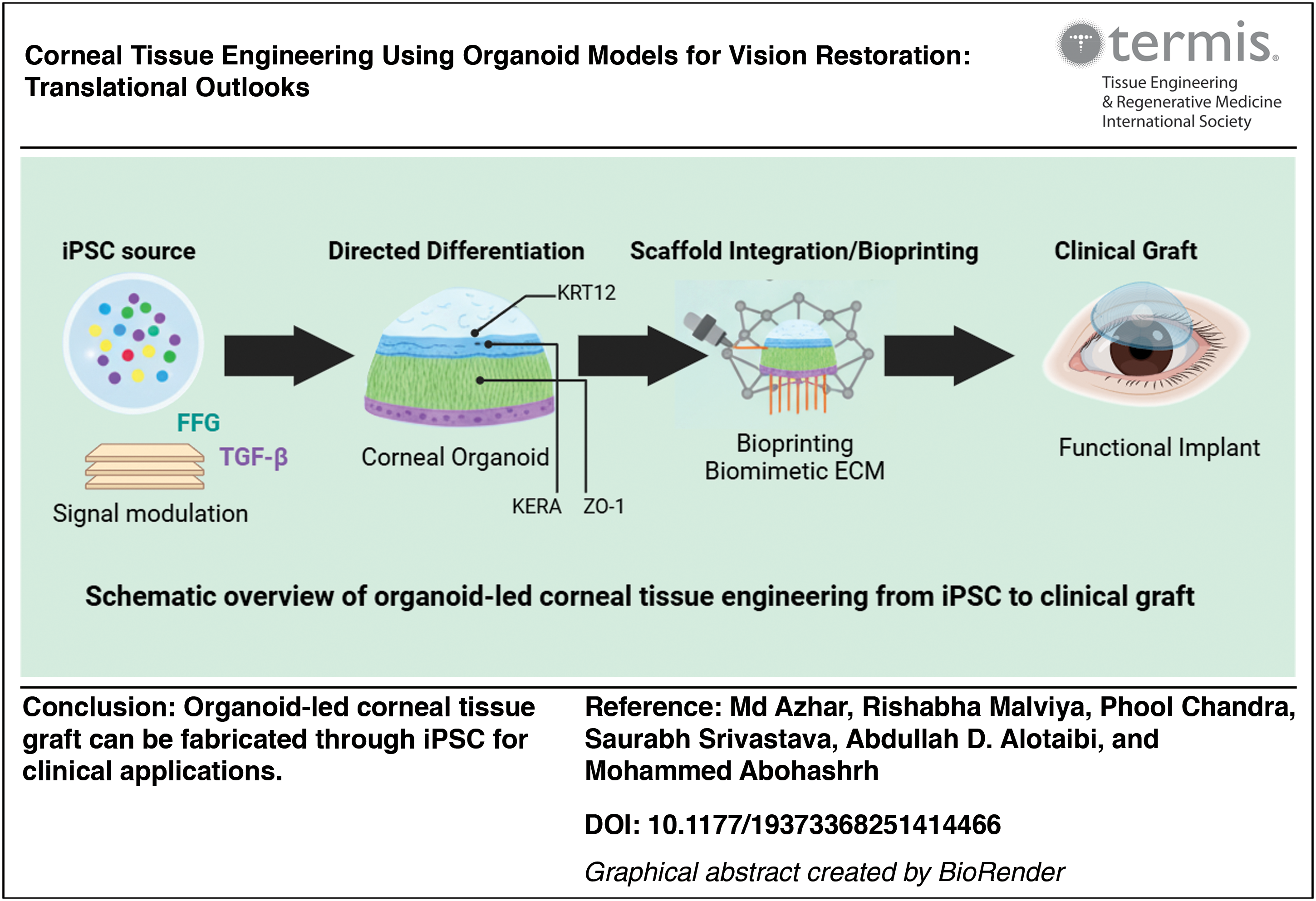
Corneal blindness has been a significant, in most cases, reversible cause of visual impairment worldwide due to donor deficiency and donor graft failure, which has encouraged the consideration of donor-independent techniques for regeneration. This review aims to discuss the advances in corneal organoid-based tissue engineering and its potential application in the translation to vision restoration. This review was conducted through an analysis of publications related to corneal organoids, biomaterials, bioprinting, preclinical models, and early human studies, published between 2005-2025 in Scopus, Web of Science, Google Scholar, PubMed, and WHO. In vitro corneal organoids from iPSCs and ESCs have a multilayered epithelium, stroma-like extracellular matrix, and intermittent endothelial phenotypes. In animal models and in vitro, they show lineage, light transmittance, and functional analysis indicators. Printing and microfabrication work with dECM gelMA bioinks. Despite batch variation, graft-scale production, endothelial pumps, and relevant aspects of translation, such as GMP-grade production, repeatability, biosafety certification, etc. It exhibited close to physiological transparency and biomechanics in quantifying with the original cornea, and demonstrates translational potential. The use of induced pluripotent stem cells and bioengineered corneal constructs has shown good first-in-human and preclinical trials. In conclusion, it is possible to say that the corneal organoid procedures are the potential solution to lessening reliance on donors and making therapeutic modalities as personalized as possible, but they demand standardized methodologies, GMP-level upscaling, solid safety data, and clinical trials before they can be adopted widely. This review presents a comprehensive overview of the progress in iPSC-derived corneal organoids, bio printing, and the development of biomaterials, and presents their respective advancements on their way to translation into the clinical setting in the field of corneal engineering and donor-independent restoration of vision.
Impact Statement
This review presents a comprehensive overview of the progress in induced pluripotent stem-cell-derived corneal organoids, bioprinting, and the development of biomaterials and presents their respective advancements on their way to translation into the clinical setting in the field of corneal engineering and donor-independent restoration of vision.
Get full access to this article
View all access options for this article.