




Abstract
This paper is concerned with the process of generating informed consent from potential participants who have limited experience of formal education (LESLLA learners) and therefore limited background knowledge of an abstract, culturally-situated concept such as research. We argue that initial efforts to inform these marginalized and vulnerable populations need sharper focus as both these prospective participants and the researchers working with them may not fully appreciate the complex dynamics of researching with each other. Hence, we propose a performative approach to generate awareness and relationships among the researcher and prospective participants. Here, we describe the new materialist performative approach to introduce LESLLA learners to research dynamics through a board game designed to familiarize potential participants with interview situations, while also creating space for considering the agencies of other entities within the research process.
Introduction
I notice a learner has a henna tattoo. I ask if it was painted for a special occasion. The conversation shifts to the celebration of relationships and the meaning of rings: which hand they should be on, and whether something should be inscribed. One group member mentions that, in their country, men can have several wives. I ask how many rings a man would wear. The discussion becomes lively and continues for a few more minutes. I sense that this prompt is humorously inappropriate.
This vignette describes a discussion with LESLLA learners, short for a learner in Literacy Education and Second Language Learning for Adults. LESLLA learners are adults, from migrant or refugee backgrounds, who learn to read and write in a second language. 1 The LESLLA learners in this vignette and others presented below have recently migrated to Norway and attempt to obtain Norwegian proficiency needed for citizenship or integration. They are participating in performative sessions, as part of the first author’s research on linguistic integration, in preparation for engagement with research processes generally, and for participation in her research specifically. The overall research project focuses on the impact of stricter language requirements for Norwegian citizenship on immigrants with little to no formal schooling (0-6 years) and limited print literacy. For this learner group, and since their dependence on the future is high, their participation in research might not reflect their interests but is rather determined by the power asymmetry between the researcher and the participant. Below, we discuss the informed consent process for research with LESLLA learners and explore if this process can be improved through a board game as a tool to introduce these learners to the dynamics of research.
Following the comprehensive argument put forward by McLaughlin and Alfaro-Velcamp (2015), we agree that “(i)mmigrant populations both share some of the commonly identified vulnerabilities associated with research participants and also present parallel and unique circumstances of concern to researchers” (p. 33). These vulnerabilities stem from structural arrangements that impede migrants’ ability to negotiate and exercise their agency and autonomy. In addition to “lack of information, dependence, and heightened risks of status” (p. 34), LESLLA learners are vulnerable due to their limited experience with the dominant forms of knowledge-making upon which Western research is based. Equally, researchers working with LESLLA learners are likely exposed to worldviews and experiences unknown to them. This process may present challenges and growth opportunities (Bigelow and Pettitt 2016), and therefore, also, a reframing of vulnerability “as a way into reimagining how our relationships could be” (p. 5).
Consequently, in this article, we call into question normalized and legitimized research practices and suggest performative, relational alternatives to some of these. First, we address the ethical and methodological considerations related to obtaining informed consent in the emerging field of Literacy Education and Second Language Learning for Adults. Next, we consider the contributions of a relational ontology to engage in research with LESLLA learners. Finally, we illustrate and discuss how a relational engagement with artifacts, such as a board game, may offer a two-way learning experience, allowing both participants and researchers to gain an understanding of the research process and of each other.
LESLLA Learners’ Participation in Research
LESLLA learners have limited experience with formal education and are likely not familiar with the assumptions, processes, and procedures that inform conventional research. Therefore, the process of securing informed consent should begin by developing a broad understanding of research situations and researcher-participant interactions. Similarly, researchers may be unaware of the assumptions, expectations, and appropriate processes that inform these learners’ views on research. Bigelow and Watson (2012), for instance, suggest that learners’ formal schooling and literacy backgrounds significantly impact their learning, yet these factors are often overlooked:
The problematics of research with adolescents or adults who have never been to school include a mismatch between how the researcher and the participants understand the research process. Some individuals may not understand the elicitation tasks because the tasks are so closely tied to culturally bound classroom practices with which they have no experience. (P. 469)
Like Rogoff (2003), the above authors imply that the amount of experience that a person has with a particular cultural activity called schooling will affect their understanding of related cultural practices such as formal, Western, institutionalized research and research processes. Similarly, VanLandingham et al. (2023) caution that research and immigrant communities operate “within separate cultural worlds that have distinct histories, goals, and expectations” (p. 325). Another concern is the frequent avoidance or underrepresentation of vulnerable and marginalized populations in research (Castañeda and Smith 2023; McLaughlin and Alfaro-Velcamp 2015) including learners with little or interrupted formal schooling and limited print literacy in Second Language Acquisition (SLA)-research (Bigelow and Tarone 2004; Young-Scholten 2015). This limited attention given to LESLLA learners within SLA stems from insufficient attention to methodological and ethical considerations (Ortega 2005).
Power Asymmetry
Aiming to rectify their underrepresentation, efforts were made to establish a specific learners’ category for these learners in SLA research. Underway, the complexities integral to research with LESLLA learners have been highlighted. Bigelow and Pettitt (2016) point out that these learners tend to unconditionally trust their teachers and persons approved by their teachers, including researchers, potentially creating “captive research participants” (Block et al. 2012:78). Being attentive to learners’ dependence on teachers for future success is a critical ethical consideration. The implication is that both participants (with limited experience of Western, institutionalized education) and the researchers who work with them, are in need of educating. In this context, Dyll (2019), in her work with indigenous communities, proposes the use of creative methodologies that allow those involved in the research to walk in each other’s worlds. These methodologies employ “sense-making,” a strategy that “urges researchers to reach out to the sense made by others in order to understand what insights they bring to their understanding of a phenomenon” (Dyll 2019:127), while also highlighting “the role of ordinary person-as-theorist” (p. 127). Learning across academic and immigrant communities may also be facilitated by cultural brokering, as advocated by VanLandingham et al. (2023). Such empathetic learning, and particularly the ability of the researcher to create relationships with research partners during research processes, while protecting their interests and dignity, are key considerations in research with LESLLA learners (Bernstein 2019; Bigelow and Pettitt 2016; Morelli and Warriner 2019; Perry 2019).
The Limitations of Language
Standard procedures to secure informed consent from adults (a macro-ethical principle) may not ensure that LESLLA learners fully understand their role or the implications of consenting to participate. In light of such vulnerability, Kubanyiova (2008) underlines that research is a relational activity that calls for a contextualized code of practice, where micro-ethical principles become important. Focusing on educational settings, Fox et al. (2020) advocate for deeper ethics-in-practice commitments to ensure socially just research in fragile contexts.
However, questions remain of how to effectively converge upon the aim of LESLLA learners gaining the necessary background knowledge to understand an abstract concept such as research (Bigelow and Pettitt 2016) and thus to exactly what they are consenting (Perry 2019). Bigelow and Pettitt (2016) observe that “even the most careful dialogue and multilingual conversation can result in coercion” (p. 68). Meanwhile Dávila (2014) questions how language as a historical enactment can be effectively translated and made relevant for participants outside of their specific cultural-historical discourses. As LESLLA researchers, we must consider participants’ lived realities, but we encounter limitations when we do not share the same epistemological or even ontological assumptions. Efforts such as technical adjustments (translating the informed consent information and giving it orally) (Gujord, Søfteland, and Emilsen 2023; Michaud, Fortier, and Amireault 2022), or innovative methods beyond standard procedures (Malessa 2023) therefore seem inadequate for bridging such knowledge divides. Moreover, these methods tend to favor an orientation of agency toward the initiatives and gains made possible by the researcher and her interpersonal skills, along with the researchers’ creative capacities, to make the informed consent process relevant for LESLLA research participants. In what follows, we propose a more deliberate engagement with the agency of materials in the process of obtaining informed consent.
The Relevance of Materials in Research Processes
In attempting to attenuate anthropocentric tendencies and engage with emerging research on more inclusive research processes, we note that few LESLLA studies incorporate ethical-methodological underpinnings that consider the contributions of materials in studying and understanding social activity. Bigelow and Watson (2012) highlight an implicit awareness of how materials may impact LESLLA learners’ participation in knowledge-making activities when they point to the alien nature of the classroom and its artifacts for individuals without formal schooling.
In SLA, there is growing recognition that engaging with different materialities can offer unexplored insights to language and language use (see Toohey 2019). The influential Douglas Fir Group (2016) calls for SLA researchers to expand their focus to “the sociocultural, educational, ideological, and socioemotional” dimensions (p. 20). Similarly, Pennycook (2018) encourages researchers to recognize that there is a world “out there” beyond human agency, challenging the idea that it is the autonomous human that solely produces and uses language.
Literacy and Research as Sociomaterial Practices
In adult literacy education, Hamilton (2011) argues that the application of a new material toolkit aligns well with the notion of literacy as being contingent upon contexts and discourses. Clarke (2002) notes that policies and practices emerge from power dynamics within networks of materialities, human and non-human, which is relevant in an adult literacy context as those with power have the means to define and valorize certain types of literacies. If it is true that LESLLA learners share “the preference of oral folk for pragmatic, operational thought as opposed to abstract categorical thinking whose relevance to life may be vague” (Bigelow and Watson 2012:466), then we see a need to consider the ways in which researchers engage with them in research. Hayes and Comber (2018) propose that viewing inequality as a doing instead of a thing in line with a non-representational ontology can deepen our understanding and expand research methodologies in education. This expansion is particularly relevant in LESLLA research. Hayes and Comber’s (2018) question: “What world of schooling is configured through our research practices?” (p. 388) prompts us to consider the limited scope often imposed by focusing solely on the human agency of teachers and learners, thereby downplaying how the non-human elements integral to a classroom create, stabilize, and change how learning and development materialize. Our study is inspired by Springgay and Truman’s (2018) contentions on the need to go beyond conventional research practices to non-procedural methods, which could help us relate with participants and data. As such, we question the normative and representationalist approach of researching the “social” as a distinct category and rather treat the “social” as “an effect of the sociomaterial practices” (Fenwick and Edwards 2013:50), therefore foregrounding literacy, and research, as sociomaterial practices.
Disentangling Legitimated Practices
A sociomaterial description gives us the opportunity “to understand how things are put together, coordinated and hooked up” (Hayes and Comber 2018:394), and has the potential to untangle the ways in which “narratives of literacy are embedded in broader narratives of the contemporary social and moral order” (Hamilton 2012:7). Awareness of these ethical and political issues depends on researchers’ willingness to understand the research context (Springgay and Truman 2018). Hamilton (2012) refers to the term social imaginary, which is “deep rooted ways of understanding and making meaning of social life” (p. 7), which can lend legitimacy to common practices (Taylor 2007:23 quoted in Hamilton 2012:7). With regards to research processes, this type of legitimacy is addressed in Lather and St. Pierre (2013) who suggest that researchers’ training in qualitative methods “normalizes our thinking and doing” (p. 630). Conventional research designs with fixed steps and protocols, assume that the “human is superior to and separate from the material” (Lather and St.Pierre 2013). There is a risk that, mechanisms that position adult literacy learners as deficient are reproduced since they become defined by and subject to “processes of privileging certain practices and rendering others invisible or devalued” (Hamilton 2012:14). Instead of relying on the texts and discourses that are designed to safeguard the ethical concerns and interests of researchers and their affiliated institutions, we should, as Hamilton (2012) suggests, understand how texts have the power to produce hierarchies. Hence, we can be attentive to the ecology of the research context, and instead engage in a thinking-making-doing (Springgay and Truman 2018) beyond binaries of literate/illiterate, subject/object, researcher/studied.
Theoretical Background
Making Connections, Making Relationships
In rethinking how we recruit participants to our research projects, and specifically, how we go about informing them during these processes, we refer to Fenwick and Edwards (2013), who contend that “sociomaterial approaches to research offer opportunities for more engaged performative and practice-focused forms of educational practices” (p. 50). These approaches to knowing depart from conventions that center the subject and trace its manipulation of materials as the objects through which human agency finds expression. Instead, we can step beyond and before the existence of distinct constructs and imagine how these may be performed into existence through the making of connections. Thus, humans, artifacts, processes, and knowledge are constituted through the enactment of relationships that give them shape and meaning (Fenwick and Edwards 2013). These authors suggest that the most radical sociomaterial approach is the performative approach which postulates that “things are performed into existence in webs of relations” (Fenwick and Edwards 2013:53). As Barad (2003) explains, performative approaches challenge representational ontologies “that grant language and other forms of representation more power in determining our ontologies than they deserve” (p. 802). With this in mind, we wish to draw attention to the key element of our performative interpretation of a sociomaterial approach to research, namely, relationality.
Relationships between human and non-human elements
Relationality is understood here as an orientation toward prioritizing the role of relationships as the primary consideration for how one understands and proceeds within the world. Relationships are more than the connections between distinct entities, they bring realities into being and the ways in which we know them. Indigenous scholars have long described relational ontology by which they and their ancestors have come to know and inhabit the world. Robin Kimmerer of the Potawatomi nation, for instance, explains how for them knowing is a gift which is neither earned nor deserved. “The essence of the gift is that it creates a set of relationships. The currency of a gift economy is, at its root, reciprocity” (Kimmerer 2014:28). This reciprocal relationship began with Skywoman, the first human, who fell to earth from a hole in the Skyworld and, together with the animals, created the land and the plants, connecting all things in matter and spirit.
It is from the same point of departure that Vanessa Watts (2013), a Haudenosaunee scholar, offers the concept of Place-Thought to describe the inseparability of place and thought in this relational ontology. “Place-Thought is based upon the premise that land is alive and thinking and that humans and non-humans derive agency through the extensions of these thoughts” (Watts 2013:21). Such an understanding of the relationship between entities is “rooted in an ontology that recognizes the spiritual realm as real and integral to knowledge making, while also guiding axiological assumptions of why and how knowledge should be made, held, and applied” (Botha, Griffiths, and Prozesky 2021:53).
LESLLA Learners and Ways of Knowing
While the LESLLA learners, and immigrants to Norway, generally, come from diverse cultural backgrounds, we believe that the elements of such a relationality resonates strongly within their worldviews. Watson (2019), for instance, contends: “Most, perhaps the vast majority, of refugee-background students in Western schools have cultural backgrounds shaped by traditional Indigenous values and practices” (p. 204). In Norway, where this research is situated, “(a)bout half of the immigrant and Norwegian-born children of immigrants have their background from Asia, Africa or Latin America” (Kyllingstad 2017:324), where relationality, though diverse in its manifestations, shapes their interactions and surroundings. Tucker (2018) suggests prioritizing relationality as “a research sensibility that emphasizes connection and interrelatedness among individuals, communities, histories, and knowledges, as well as the worlds—both past and present—in which these are rooted” (p. 227). Building on this, we draw on the relational principles of indigenous ways of knowing to enact the kind of (literacy) education envisioned by this project with LESLLA learners.
The Application of a New Material Toolkit
However, as Watson (2019) also points out, appropriately accessing indigenous knowledges and even the principles upon which they are based, is contingent upon the knowledge holders’ moral authority. Here, then, is where we, as non-indigenous researchers who are not elders steeped in the traditional knowledge, values, wisdoms, and languages of indigenous communities, fall short and acknowledge Zoe Todd’s (2016) reservations:
So there is a very real risk to Indigenous thinking being used by non-Indigenous scholars who apply it to Actor Network Theory, cosmopolitics, ontological and posthumanist threads without contending with the embodied expressions of stories, laws, and songs as bound with Indigenous-Place Thought (Watts 2013:31) or Indigenous self-determination. (P. 9)
Accepting our limitations, we invite those who are suitably qualified and so inclined, to help us to apply indigenous principles of relationality to the project of developing appropriate processes of informed consent with prospective participants with indigenous backgrounds. Meanwhile, we use the very similar but less spiritual toolkit of relationality claimed by posthumanism and new materialism while pointing out, with more suspicion than Rosiek, Snyder, and Pratt (2020), that indigenous scholars’ ideas about non-human agency predate those of contemporary philosophers by thousands of years, and with the indignation of Clary-Lemon (2019) who notes that “a holistic ontology and an emphasis on the non-rational, the embodied, the affective, or the power of things not only resonates with Indigenous knowledge but is emergent from it directly in non-attributed ways.” While it may not embrace the intuitive and spiritual dimensions of knowing and being espoused by indigenous and immigrant or refugee-background learners, we contend that the concepts from new materialist relational ontologies are sufficiently similar to those associated with indigenous worldviews to explain the workings of human and non-human interaction, or rather, intra-action.
In much the same way as these human and non-human elements are interconnected within indigenous worldviews, expressed through concepts such as Place-Thought (Watts 2013), new materialist elements intra-act rather than interact because they are already inseparably connected to and constituent of each other within relationships that create them. Rather than distinct materials, all entities exist in relation to each other, with boundaries and properties emerging from their engagements (Niemimaa 2018). As Barad (2003) explains, “. . . phenomena are ontologically primitive relations—relations without preexisting relata . . . It is through specific agential intra-actions that the boundaries and properties of the ‘components’ of phenomena become determinate and that particular embodied concepts become meaningful” (p. 815). In contrast to conventional ideas about research processes, we draw on this onto-epistemology to argue for acknowledging the agencies contributed by the research artifacts, both material and abstract, as well as the agencies of the research processes. We agree that places, attitudes, clipboards, sampling procedures all shape and direct what is considered as research, its direction and its affect.
Affective Flows Produce Capacities
Affect, as defined by Deleuze (1988), is the potential passed by one body to another, causing an accentuation or diminishing of the bodies’ capacities. This capacity to affect or be affected occurs between the human and non-human elements making up the literacy activities we mentioned earlier, animating the networks that bring the research processes with which we are concerned, into being. By shifting the focus from the agency of humans, to affect, we adapt our research processes to attend to affective flows and the capacities they produce. Instead of focusing on what bodies or things or social institutions are, we consider their capacities for action, interaction, feeling, and desire produced in bodies or groups of bodies by affective flows (Deleuze 1988 quoted in Fox and Alldred 2015:402). Connections and activities through affects enable things, “human and non-human, hybrids and parts, knowledge and systems,” to emerge (Fenwick and Edwards 2013:53). Following Barad (2003), we see agency as “a matter of intra-acting; it is an enactment, not something that someone or some thing has . . . it is ‘doing’/’being’ in its intra-activity. Agency is the enactment of iterative changes to particular practices through the dynamics of intra-activity” (p. 827).
Research as an Assemblage
In questioning the centrality of human knowledge and practice, we turn to Fox and Alldred (2015) who propose considering research as an assemblage. In a new materialist paradigm, things are not preexisting, but are immanent assemblages, which are networks of constantly changing relationships where materials relate and respond to each other. Assemblages form and dissolve based on how the affective flows of their relationships hold them together, creating territories that reassemble in emerging realities. These assemblages act as machines, connecting objects, ideas and all kinds of entities that intra-act to produce each other and outputs such as data (Fox and Alldred 2015) or, as in our case, informed consent. By focusing on relationships that may emerge from the encounters between intra-related entities rather than treating them distinct from each other, we can understand, as Fenwick and Edwards (2013) suggest, “how and when these variously distributed human and non-human materials collectively generate exercises of power, consolidate or resist it and when they cannot” (p. 58). Furthermore, the pluriversality opened up by sociomaterial performative ontologies encourages us to “pose fundamental questions about how research should be conducted within a new materialist paradigm, and what kinds of data should be collected and analysed” (Fox and Alldred 2015:400). This opens opportunities for critical, less normative and more pragmatic engagements in research. With the informed consent process in focus, we will in the next section describe our interpretation of how a performative, sociomaterial approach can be applied, and the effects it produces.
Materials and Method
Objectives
Our concern in this paper is that, in typical informed consent processes with vulnerable participants, not enough is done to ensure that both potential participants and researchers develop a thorough and appropriate understanding of what researching together might entail. We believe that, before requesting consent, LESLLA learners and researchers should engage in an informing process that allows them to develop, firstly, a familiarity with the concept of research and the interactions and tools that it may involve, and, secondly, appropriate relationships with all of these human and non-human components of the project. As Douglas and Carless (2013) point out, a performative approach offers an alternative way of coming to know that is embodied and experiential. This is appropriate for LESLLA learners because it offers another access to understanding, in this case, scientific research processes, and serves “not to replace existing forms of communication in social science, but to augment the currently limited reservoir of approaches” (Douglas and Carless 2013:56). We therefore developed a performative method for creating awareness and relationships among potential participants and those who research with them, about the research processes with which they will be engaged. Thus, while the overall research project examines how new language requirements for Norwegian citizenship impact LESLA learners, here we focus specifically on generating informed consent from these learners as potential research participants. Below, we describe the performative sessions carried out by the first author at a learning center where she teaches in Western Norway.
Site, Potential Participants, and Access
The learning center provides Norwegian and literacy classes for adult migrant learners, from various countries including Afghanistan, the Democratic Republic of Congo, Eritrea, Ethiopia, Iraq, the Philippines, Somali, Sudan, Syria, and Thailand. With the principal’s permission and support from the department head and teachers, the first author conducted the performative sessions. In one of the classrooms, language assistants in Tigrinya and Pashto aided in translating, when needed, to ensure that communication barriers were minimized. Each session lasted 1.5 hours, which is a school hour. A total of three sessions were conducted with each class. Ethical approval for the overall research project was obtained by the Norwegian Agency for Shared Services in Education and Research (Sikt). The overall project’s broader findings are discussed elsewhere, here we report specifically on how using a board game as part of a performative, sociomaterial practice, offered us the opportunity to develop understandings and relationships with future participants as part of the informed consent process.
The Board Game
As an alternative to technicist procedures for informing participants with limited literacy—such as the use of oral translations—the first author made use of a board game as a tool for performatively generating understandings between herself and the learners she wished to recruit. Since a research interview process may not be familiar to someone with limited formal schooling, the board game, printed on an A3 paper with slots filled with questions, provided LESLLA learners an opportunity to experience a similar process of “knowledge-producing conversations” (Brinkmann 2022) before deciding to participate in the research. The questions were inspired by literacy learning materials used in their classrooms, used to enhance their learning outcome (Buanes and Ringheim 2019). The board game with its questions therefore serves as a boundary object (Star and Griesemer 1989), bridging language learning and research activities. This artifact, therefore, behaves very much like VanLandingham et al.’s (2023) aforementioned cultural broker.
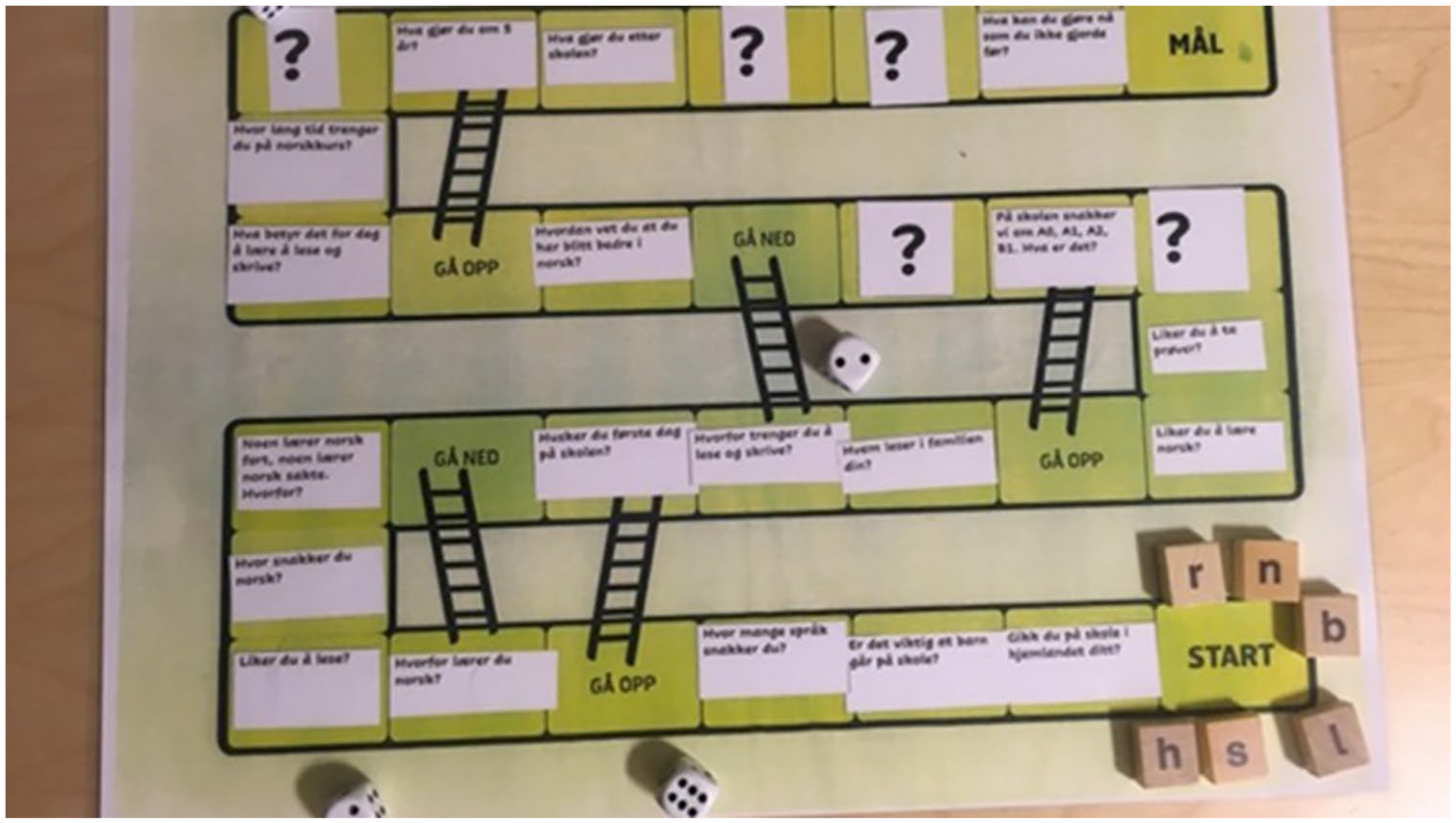
Game pieces, dice, questions, and questions marks.
Formulating Relevant Questions
Some of the intentions of these sessions were to introduce the learners and researcher to each other’s respective worlds and the artifacts and practices that they entail. To this end, the sessions began with a visual tool: images of culturally diverse lifestyles displayed through the Book Creator software. These images served as visual prompts (Block et al. 2012), encouraging learners to reflect on their own experiences and to ask relevant questions to one another. The use of these visual stimuli allowed for a natural entry into the process of formulating questions. Learners were invited to think about how they lived in their home countries, grounding the discussion in their realities. This approach not only promoted engagement but also allowed learners to practice language skills in a meaningful context.
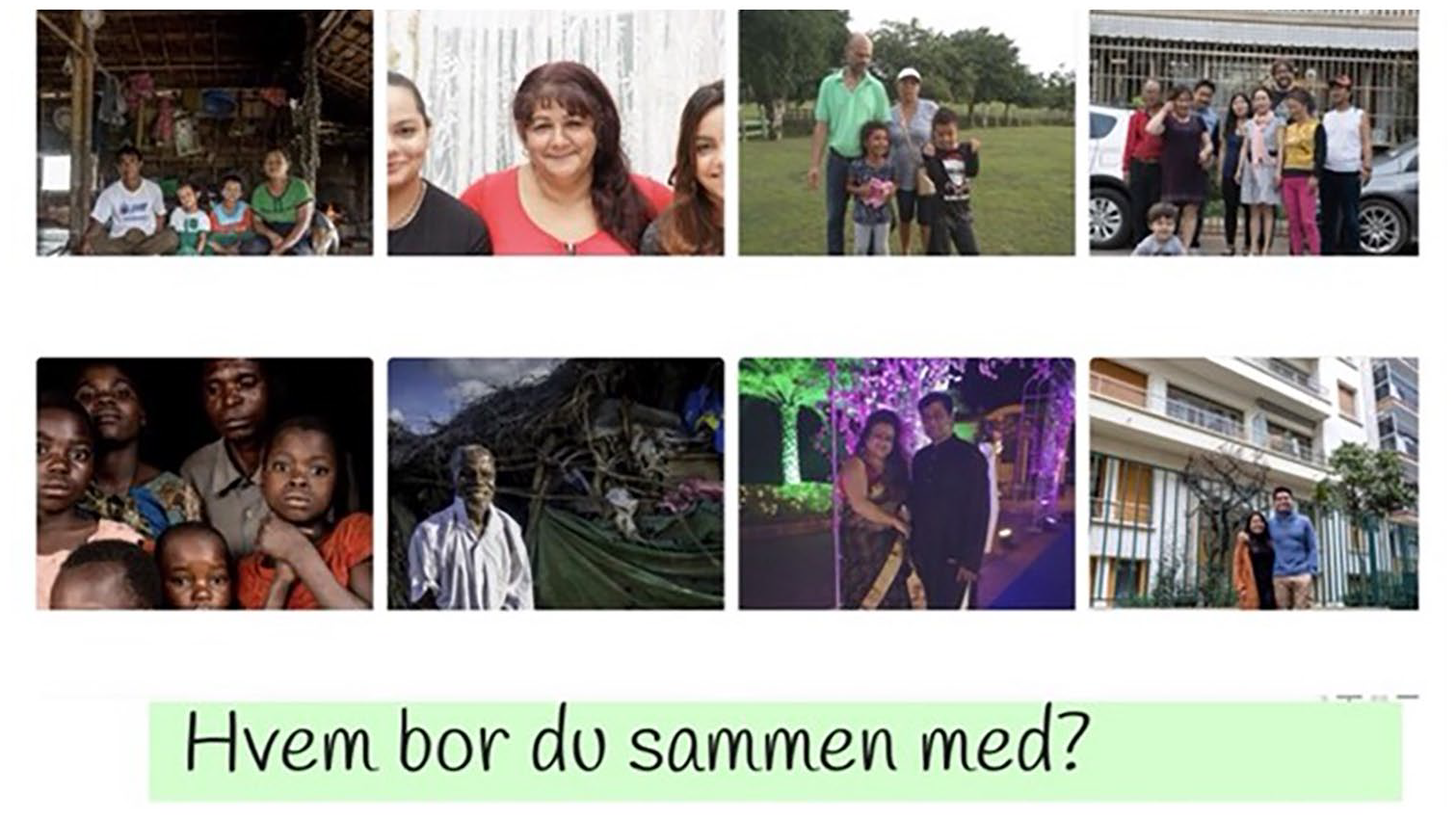
“Who do you live with?” Visual prompt, culturally diverse pictures adapted from Gapminder (n.d.).
After completing the picture series, the board game followed with questions related to the previously discussed topics. The first session covered topics like places to live and living arrangements, access to water, and transportation; the second focused on relationships, including family, friends, and community; and the third addressed formal schooling, learning a second language, and learning to read and write. In the final session, no pictures were shown before playing the game to emphasize unique, personal experiences and allow more time for the game. The conversational flows facilitated by the visual prompts and the board game prepared learners for future semi-structured interviews and provided insight into the research process.
Playing the Board Game
Each learner received a personalized game piece representing the first letter of their name and a die. The game began with everyone rolling their dice simultaneously. The player with the highest roll, threw again, and moved her game piece to the corresponding slot. Her neighbor read aloud the question which the player answered. If the response encouraged further discussion and sharing of perspectives from others, it was welcomed. Special “question mark” slots allowed learners to pose relevant questions to one another. In the next section, we will present our findings from these performative sessions in the form of vignettes.
Results and Discussion
Decentering the Researcher
I notice how the sunlight flows in from above and underneath blue window blinds. There is a constant noise from the busy road outside. Desks are clustered in the centre, and learners have stored away their textbooks and iPads for the third session. In front of us lies the board game with questions, dice and game pieces. Each of us holds a die, waiting for the moment to throw simultaneously. Now! I hear how the sound of dice hit the table with repeated clonks and notice how the learners’ glance at each other’s dice to see who can start. I observe how the two learners who rolled sixes re-roll, exchanging excited looks. The winner rolls again, and I hear how she, with the help from classmates, loudly counts the steps and walks her game piece to the correct slot. When arriving at the slot, I notice how she leans back and looks at the person to her right. The question is read by her neighbour, syllable by syllable. I become aware of how the others form their lips to make similar sounds: «What does your name mean?.” As the coherence of the question is vague, I repeat the question. The learner’s reply is unexpected and reveals a deeply personal story that, it seems, hadn’t been shared in this classroom before. Even if the story is sad, I sense that the learner is grateful for the opportunity to share it to the others. I note that a seemingly simple question such as the meaning of a name, can be relevant in an adult literacy classroom.
In the spaces afforded by the sessions and the materials, the researcher surrenders her intentions to the human and non-human agencies gathered by these webs of relations. This becomes visible when a learner rolls her die, and then executes its instruction by walking her game piece while the classmates help her count. At the correct slot, she waits for the question. It is about the meaning of her name, and there is no telling what affects this question and her response to it will elicit. Will she master the question, or will it evoke confusion and uncertainty as we see other questions do? On this occasion, it seems that the question and the player produce a narrative that empowers the speaker as she takes ownership of her name. And perhaps her narration moves her classmates and the researcher, strengthening their connection. Together these effects bring the research and its attendant processes closer to the LESLLA learner's experiences while also drawing the researcher into the learner’s world and the one created by the game and its tight circle of players. As alluded to earlier, there is myriad of things that order and govern the performative learning about researching with LESLLA learners. Yet, in the context of LESLLA research, there is little reflection on the limitations of the human researcher and consequently missed opportunities for benefiting from the “things” that could enhance our research practices. Fortunately, new materialist methodologies recognize how all human actions require the non-human, and emphasize how all these things possess agency which “flows through relational networks and is mobilized through human and non-human intra-actions” (Springgay and Truman 2018:206). As the vignette illustrates, the classroom, the desks, the chairs, the board game, the game pieces, and dice, the rules and instructions, the narratives, and the languages in which they are shared are all directing the interaction and relationships between participants. When the human researcher is decentered and the focus encompasses the agency of all of the material and non-material artifacts in assemblages, we can see that the capacities produced by their intra-actions are not simply a cognitive achievement put forward by the researcher, or a way of interacting, rather, it is also the material that is co-constituting the practices that emerge.
We have suggested that such connection resonates with indigenous perceptions of relationality, which merges human and non-human spirit and agency, as expressed in Watts’ (2013) concept of Place-Thought. Taking this further, we would claim that one is offered a deeper insight into, for instance, the powerful effects associated with the learner’s story about her name, when one understands the meaning that naming has for the learners who identify with indigenous worldviews, as Watson (2019) suggested. Olatunji et al. (2015), for example, explain that “a typical traditional African society, the name an individual bears would likely reveal his or her socio-economic and cultural characteristics, family background, family occupation, place of origin and political and economic class” (p. 75). It also holds a spiritual connection.
The ways in which naming emerges in further rhizomatic connection supports the intention that this performative initiative materializes concepts, ideas, insights, emotions, practices, and other abstract and material phenomena that could foster relationships and relational understandings between the (human and non-human) participants of the research processes. The questions and the interview format of the board game allow the learners to shift subject positions. Instead of constructing LESLLA learners as deficient, the performative sessions give space and attention to the circulating flows of different agencies that allow them to assume roles as the more knowledgeable party and to assume ownership over their own stories. As a developmental tool for recruiting and preparing LESLLA learners and researchers for learner-centered engagement, the game could therefore be said to instigate constructivist knowledge-making relationships inherent to qualitative research. However, it also offers opportunities for building deeper, empathetic relationships beyond that. Through the sharing of and listening to lived experiences that resonate across cultural contexts and with pieces of one’s own story, the performative sessions encourage a becoming with for the learners and researchers in the way that Wright (2014) proposes when she says, “we become-with life as it is manifested through the body of another, and lives are always connected to worlds” (p. 280). The above process of decentring the researcher subject and incorporating other material and abstract entities into a relational performance of research protocols in many ways emulates Francett-Hermes and Pennanen’s (2019) attempt at developing a relational ethics through a reflexive process of attempting to weave together brick and thread sensibilities. Brick sensibilities could be summarized as entailing typically modernist and positivist approaches to knowing and being. We quote Jimmy, Andreotti and Stein’s (2019) description of thread sensibilities at some length here so as to also emphasize our earlier point of how the new materialism from which we have drawn, is strikingly similar to this indigenous understanding:
Thread sense and sensibilities stand for a set of ways of being that emphasize inter-wovenness, shape-shifting flexibility and layered time; where the world is experienced through sensorial events involving movement, rhythm, sound and metaphor; where every “thing” (including humans, non-humans and the land) is a living entity; where every entity is valued for its intrinsic (insufficient and indispensable) inherent worth within an integrative and dynamic whole; and where their self-worth is grounded on their connection with something beyond the individual self, but also found within it. (P. 14)
Like Francett-Hermes and Pennanen (2019), we acknowledge our embeddedness within brick institutional practices, and propose building bridge or ally identities “to create something unpredicted and contextually relevant through the ‘braiding’ action taking place at the edges of bricks and threads that encourages generative being in both sensibilities” (p. 132). Here, we embrace and also try to extend that strategy so as to more deliberately consider the agencies of the non-human in its execution.
Unforeseen Directions
As the conversation about names progresses, it takes a turn I do not expect. A learner begins sharing details from her wedding day, describing the dowry of cows her husband gifted to her family. I notice how the conversation about becoming married engages her classmates to the point that the learner eagerly shows them pictures on her phone. However, a shift occurs when one of learner refers to the Quran and asserts that this type of arrangement is forbidden while looking at me expecting some confirmation. I choose not to comment and attempt to move the discussion forward, but I’m uncertain how well I handled the moment.
Later in the game, a question about which language is used at home prompts one to mention that she intentionally uses Norwegian with her child. I sense how this causes friction within the group, as others believe the first language is most important for the family communication. As they present their arguments, I’m impressed by how firm the learner demonstrates her perspective to the group.
As the session nears its end, a question arises about how food is prepared in each learner’s home country. One learner struggles to describe a traditional stove, unable to find the Norwegian equivalent. With gestures and suggestions classmates attempt to offer words for what the learner is describing. It is interesting to note how the learner does not accept the different suggestions, thus no proper word has surfaced, and we leave the session without a satisfactory understanding of that particular way of preparing food.
The process of taking on unfamiliar capacities and establishing relations is not a smooth one, as the vignettes illustrate. Instead, the performance is fraught with moments of tending to disagreements, negotiating contestations, being corrected, and becoming uncomfortable. We see this when a learner enthusiastically shares a story about and images of her wedding, only for her practices to be criticized by her colleague. The confrontation results in a sudden disruption of the assemblage created during the session and sets in motion a territorializing of authorizing capacities as the moralizing learner seeks confirmation from the researcher. This unmaking and remaking of relationships is described by Lury (2012) as a “mingling, bundling, and coming together” (p. 191). In the vignette, we see the first author expressing doubts about this scenario along with the responsibility to repair the situation. She ends up not taking sides but instead introduces another topic; however, it is unclear what effects the situation has generated. While some may view such uncertainty negatively, Springgay and Truman (2018) believe that such an unpredictable, provocative happening, which they consider typical of researching in the “speculative middle,” can be generative:
In the speculative middle, which is not a place, but an event, (in)tensions, concerns, and gnawings continually emerge. As the agitations take shape, it is the (in)tensions that incite further action, which elicits additional propositions, and new speculative middles to emerge. (P. 207)
The ways in which these assemblages of relations develop in unpredictable ways around actions and events, “in a kind of chaotic network of habitual and non-habitual connections, always in flux, always reassembling in different ways” (Fox and Alldred 2015:401), recalls Deleuze and Guattari’s (1988) “Principle of asignifying rupture: . . . A rhizome may be broken, shattered at a given spot, but it will start up again on one of its old lines, or on new lines” (p. 9). These old and new lines are contained within the board game since it is both planned and explorative. As a planned activity, the researcher set it up and gave instructions on how to play the game. In the explorative sense, and as highlighted above, the researcher did not know what the interactions would bring and that those involved might have discovered something new. The point, though, according to Springgay and Truman (2018) is not to hurry to stabilizing solutions, but rather to remain in the speculative middle of problematic issues kept (in)tension. We believe that the vignettes illustrate both the difficulty and the fruitfulness of this. Consider, for instance, how tricky it would have been for the first author to attempt to hold the confrontation between the learner and her colleague in tension. And if she had managed to do so, what further insights and learnings may have been achieved? On the other hand, the learner’s insistence on teaching her child Norwegian as the first language demonstrates a less challenging but nevertheless open and potentially generative problem instigated by the game. Similarly, the refusal to accept the food preparation suggestions offered by her classmates implies that they could keep looking for new ways to solve the problem, or problematize it (Springgay and Truman 2018). As an aspect of performatively informing consent, this uncertainty alerts the researcher to the unpredictable ways in which ideas or information may be taken up by potential participants who do not share the dominant assumptions about research. It also demonstrates possibilities for drawing in materials that could reposition her as less knowledgeable or less authoritative and in this way mitigate against power relations in the context of learning about researching together.
An Ethicopolitical Stance
As a learner encounters the question: “Now you read and write in Norwegian, was it important to read and write in your home country?” I notice some confusion. Another learner from the same country offers her understanding, but their experiences diverge. I sense how they both are expecting a clarification from me. It turns out, that the difference lies in the context—where rural residents relied on paid writing services, print literacy was not relevant, whereas it held importance for those in urban areas. This question and discussion remind me of the varied lived experiences within a country, and ends with the shared realization that growing up in a village differs significantly from life in a city.
On another occasion, I notice how a question about what a learner reads after school reveals the dominance of a schooled understanding of literacy. The learner replies that she mainly reads at school, not at home. I ask if she reads signs or labels during her commute, and she acknowledges that she reads signs, understands bus schedules and food labels. Her classmates affirm that this also counts as reading.
When focusing on the researchers’ responsibility to attend to the ecologies of the research context, it is the thinking-making-doing relevant within the specific context that is of importance. These examples show how, together with divergent understandings, opportunities, and capacities are nurtured to try to ensure the effects that result in a positive outcome. Together with the first author, learners are encouraged to feel secure in questioning, disagreeing, and negotiating new understandings.
These performative sessions thus have the potential to trigger “an ethics that is accountable to a material world” (Springgay and Truman 2018:206). They compel us to closely examine how these intra-active entanglements can materialize the researcher, as well as the participants, the research processes, and the artifacts and outcomes associated with them. Since there is no restriction on what may emerge (Gamble, Hanan, and Nail 2019), we should take unreserved responsibility for what we instigate. As Rosiek et al. (2020) note:
Reconceiving of inquiry as ontologically generative of agents (both human and non-human) implies that ethics moves from being an afterthought of inquiry design—be sure to do no harm and be sure to apply the knowledge you acquire in moral and just ways—to a consideration of the ethics of ontologically generating forms of being through inquiry—knowing subjects, habits of relation, material possibilities, and impossibilities. (P. 336)
Taking an ethicopolitical stance, we see these emerging concerns as essential when researching with LESLLA learners. Hamilton (2012) emphasizes that texts exert force, ingrained in institutional practices researchers bring with them. How we come to know each other and how we intra-act in circulating networks and engage in research is central to ethically accountable research. This is why, in our analyses here we try to follow the example of how classmates build up those who share our research journey.
We think that informing for consent is about the web of relations we intra-act in, and how to bring about better, more ethically appropriate relationships. Toohey (2019) reminds us that learning is about desire, stating that “Deleuze and Guattari ([1987] 2005) offered the concept ‘assemblages of desire’ to reference how desire is a force happening among and in-between assemblages and is always experienced in the body” (p. 942). In encouraging performatively learning with LESLLA learners, we hope that we have nurtured a desire to experience through and become with various materials, challenging assumed ways of doing and being in the process of informing for consent.
Conclusion
In their introduction to the Handbook on Critical Indigenous Methodologies, Denzin and Lincoln (2008) remind us that “the performative is always pedagogical, and the pedagogical is always political” (p. 5). There they also point out that indigenous methodologies are leading the way in developing critical research by bringing together pedagogy, performance, and interpretative practice. In many ways, that is what we have tried to do here. In this regard, we have applied the intention of developing socially just methodologies to the somewhat neglected dimension of appropriately recruiting and informing research participants from marginalized communities, specifically LESLLA learners. We have tried to show the need for and the advantages of rethinking informed consent as a process that first needs to ensure that the researcher and her potential research participants familiarize themselves with the dynamics of researching together. In this regard, we have illustrated possibilities for relationship building as well as of confusion and disjuncture as part of the awareness offered by a performative approach to informing consent. At the same time, we have tried to challenge conventional institutional research practices which often prioritize the cognitive achievements of human research participants and assume standard procedures. By drawing attention to the effects of both human and non-human elements in these learning performances, we demonstrate the value of recognizing diverse agencies within research assemblages. Together these (in)tensions manifest as performative learning events informed by a sociomaterial approach that attempts to build ontological and epistemological bridges to its indigenous predecessors. By decentering the researcher with her agendas and powers and acknowledging the agencies of participants and non-human elements, we hope to create space for alternative engagements with research to emerge, ones where participants may connect with the phenomena of research in ways that materialize innovative conceptualizations and practices. Further work is needed to examine how these practices can be scaled, and additionally, how relational methodologies can be expanded to other phases of research, beyond the consent process, to contribute to more ethical and inclusive research practices, particularly in studies involving vulnerable and marginalized groups.
Footnotes
Acknowledgements
Sincere thanks to the learners who shared their stories and time with us.
Data Availability Statement
Data available on request from the authors.
Declaration of Conflicting Interests
The author(s) declared no potential conflicts of interest with respect to the research, authorship, and/or publication of this article.
Funding
The author(s) received no financial support for the research, authorship, and/or publication of this article.
