




Abstract
This study qualitatively explores the understanding and need for social touch in cognitive communication. The empirical data are collected from a sample of 17 young unmarried females of 18 to 24 years through in-depth interviews. Six main themes are identified: meaning, touch need, accessibility, factors shaping touch expression, social agents of touch, and impacts of touch deprivation. The result indicates that the cultural traditions and religious narratives have significantly affected the perceptions of females in such a way that they do not realize their touch needs. This arouses concerns and points toward a prediction that it will not take much longer to see its ill effects on the general population. The findings of the study are significant to healthcare professionals and educationists to carry out focused campaigns and timely interventions. The study has resulted in both theoretical contributions to prosocial behavior literature and is a valuable addition to social touch research.
Introduction
Semantically, the word “touch” is very rich, so the Oxford English Dictionary has dedicated hundreds of lines to define this term (Reite 1990). It refers to two completely different social phenomena; first, it indicates the action of an object on the skin, and second, it refers to the sensory registration of information received from the skin (i.e., feeling). Touch is used as a means of nonverbal communication and carries much more in itself. It is visceral and paramount for emotional connection; living beings cannot live without it, especially in social settings. This study, therefore, aims to analyze the Pakistani female youth’s understanding of human touch and the impacts of touch deprivation on their overall well-being. The introduction section of the paper explains the significance of touch as a form of nonverbal communication and the function it plays in emotional communication. It further elaborates on the biological relationship between touch and the body’s hormones and emphasizes the role of established institutions of society in minimizing touch deprivation among individuals. The rest of the paper outlines the methodology, findings, description of main themes, discussion, conclusion, research limitations, recommendations, and the applications of the findings.
Touch is extremely significant to human experience and also perhaps the most susceptible to interpretation. This is why the simplest of physical gestures, a handshake might convey a meaning of peacemaking, friendship, greeting, agreement, congratulation, or a goodbye. Touch for humans is a need (Nuszbaum, Voss, and Klauer 2014) and not a choice. The human body is designed in a way that requires human touch as it activates a huge system of nerves inside the body (Kulkarni et al. 2010), regulates digestion, and helps to sleep well. Though touch is one of the most neglected modalities of communication, however, much research has been conducted to bear the important communicative function that is served by it (Hertenstein, Kerestes, and Holmes 2006), as the semantics of touch and pragmatics of touch are interdependent. This is why the importance of nonverbal communication, particularly tactile stimulation (touch) supersedes that of verbal communication; this is called ontogenetic primacy (Hertenstein et al. 2006). Thus, tactile communication is said to be done when there is a change in one’s feelings, perceptions, thoughts, or even behavior as a result of others’ touch with respect to the context in which it happens (Hertenstein 2002). This interaction is almost always bidirectional and contingent (Muir 2002). The groundwork for verbal communication during the first year of life (Field 2001) is laid by the touch alongside other modalities of nonverbal communication (Burgoon and Dunbar 2000). Hence, tactile actions are exchanged as communicative indications not only to build social bonds but also to establish power relationships.
Subsequently, this has made researchers interested in another function of touch which is emotional communication (Peláez-Nogueras et al. 1997; Stack and Muir 1990, 1992; Tronick 1995). Hedonic emotions (pleasure and displeasure) may be communicated readily by touch (Hertenstein and Campos 2001) because the skin has erogenous zones, as well as receptors (Hertenstein et al. 2006). Hedonic processes are found to be foremost in the communication of emotion, which makes touch central to the study of emotion (Campos, Kermoian, and Campos 1994). Many research studies specify this function of touch; that it communicates positive emotions and enhances positive reinforcement (e.g., Andersen and Guerrero 2008; Peláez-Nogueras, Gewirtz, et al. 1996; Pelaez-Nogueras, Field, et al. 1996; Wolff 1963).
Biologically, touch produces feel-good chemicals in the body and keeps the homeostasis of the body and overall well-being. It enhances the production of oxytocin, often referred to as the love hormone, and improves social connection (Organization for Economic Co-Operation and Development 2007). This hormone relieves stress and arouses the desire to touch or be touched. Dopamine is also released as a result of being touched and guides how to avoid punishment and pursue reward. These feel-happy chemicals stimulate the desire for touch due to the inborn need for overall well-being (Petrella and Rovers 2014). So, these hormones play a vital role in the relationship we have with others as well as our own self, assisting in the development of humans’ socially oriented brains. Resultantly touch is very significant as it stabilizes heart rate, blood pressure, and cortisol levels (Crucianelli and Filippetti 2020). Therefore, it regulates the physiological state, assists in the healthy biological development of the entire tactile system, and also becomes the very foundation of all forms of communication (Hertenstein et al. 2006). Thenceforth, touch is necessary for human functioning (Rovers, Malette, and Guirguis-Younger 2018).
Being touch-starved, also known as skin hunger or touch deprivation (Field 2002), occurs when individuals receive little to no touch from other living things. The result of this may cause a void in an individual’s thoughts, emotions, and feelings and consequently will impact society at large if left unaddressed. Maclaren (2014) calls a touch-deprived society to be a cognitively deficient society. Research also shows lack of touch slows learning skills and increases aggression specifically in teens age (Field 2002). As we see children, they have ample touch available, so they are enthusiastic to learn new things, but it slows down later, specifically in adolescent age, one of the reasons may be touch deprivation. This calls for the attention of the social scientist to investigate the causes of touch deprivation if prevailing at a larger scale and promote awareness regarding rich touch experiences through established institutions of the society without compromising ethnic values. Research has proved that touch-oriented teachers, doctors, and managers reliably receive higher ratings because they communicate warmth, care, and support. Prospects of positive social touch in established institutions and workplaces will bring positive impacts while keeping the focus on the context as every society has rules about whom we can touch, where, and when.
Few studies have assessed the cognitive role of social touch in communication in the same way as it has been done particularly for other forms of nonverbal communication (Gliga, Farroni, and Cascio 2019). There are many factors that define its meaning in the context, so it no longer remains a simple gesture after all but a complex state of happening. This and many other methodological reasons make studies on touch challenging. Also, intimate touch interaction takes place in privacy due to many socio-religious and cultural reasons, making it difficult for the researchers to observe it. Besides, the proscription against touch makes it quite obscure to study it in a laboratory context as labs are not natural environments. Some social scientists argue that lab environments are problematic for human behavior studies because people are not in their “natural” environment. Hence, experimentally designed studies on touch are quite difficult. Consequently, in a conventional society like Pakistan, talking about touch, particularly with reference to young females is considered taboo, and it is equally difficult to carry out an observational study.
Therefore, we designed this study as a self-report study, where participants would share their indigenous understanding and feelings about human touch generally. Moreover, our study is the first-ever touch-related study on young females in the social context of the capital city of Islamabad, Pakistan, and will be significant to healthcare professionals to go for timely interventions and create awareness. It will also urge education policymakers to inculcate awareness about positive social touch in course books for adolescents and will create general public awareness about the touch needs of young women in Pakistan.
Methodology
Our study is designed as a self-report exploratory study to determine the indigenous understanding and need for touch in female youth living in the capital city of Islamabad, Pakistan. So, this study is qualitative in nature and exploratory in purpose as it focuses on an in-depth analysis of a phenomenon on a comparatively limited data set. It precludes any statistical or quantitative interpretation of the data set to avoid reaching unnecessary conclusions. Therefore, the reliance on numbers is limited to the frequency of responses on subthemes and is only for better interpretation of the qualitative findings.
Thematic Analysis
Thematic analysis is considered a widely used approach to qualitative data analysis (Braun and Clarke 2006; Howitt 2010; Williams, Clarke, and Gibson 2011; Willig 2013). It is said to be a fundamental method for qualitative analysis and is identified as an adjustable and reachable approach to find, identify, and critically analyze repeated patterns of meaning and behavior within the available data (Aronson 1994; Braun and Clarke 2006; Howitt 2010; Willig 2013).
Two of the authors critically revised all the responses of the participants and framed codes after thorough familiarization with the data. All responses were coded using direct quotes from the participants’ responses. Exploratory thematic analysis was performed to the point when saturation level was achieved with no new codes or themes coming up. All the themes were reviewed and revised by the research team, titled, and finalized. Disagreements in coding or theme production were discussed within the team until a consensus was reached. After this, the frequency count of each theme was done manually in order to better interpret each theme.
Participants
The participants for this study were selected using a purposive sampling method, where participants are approached and selected according to specific criteria that are suited to the research question (Howitt 2010; Willig 2013). The specific criteria included the same age group (18–22 years), unmarried, and the same educational level, living in Islamabad, and being willing to talk on the topic, making a sample of 17 participants. Female participants were selected with the intention that females are given fewer opportunities to experience touch in a patriarchal society because patriarchal interpretations of cultural practices of modesty provide legitimacy to the existence of this inequality. Therefore, the majority of female youth is not allowed to opt for coeducation, co-curricular activities in educational institutions and to be more particular even healthy physical sports activities. All of which may provide opportunities for healthy touch. The selected female participants were coming from the middle to upper-middle class with diverse socio-cultural backgrounds. This study incorporated urban females living in Islamabad representing the liberal class of Pakistani society in terms of its socio-religious and cultural practices because this stratum of the society still agreed to talk on the topic of human touch. The conservative females completely rejected it and considered it taboo to talk about. The in-depth interviews were conducted in Urdu and English (whichever suited the participants) and the time of each interview lasted from 2 to 3 hours.
Interviews
The interview guide that was created for this study started with a few demographic questions about the participant, then some general questions followed by the main questions: (1) What do you understand by human-to-human touch? (2) What physical and social factors influence your touch need? (3) What is your perception of the implications of culture and religion on touch experiences? (4) Are there sufficient touch opportunities available to you? (5) What is the impact of human touch on routine performance? Alongside, considering that touch potentially could be seen as quite complex to talk about, the researchers decided to conduct the interview in more than one sitting in order to thoroughly probe the phenomenon in depth. Also, the researchers made sure the interviews were carried out by the two female researchers only so that the participants were comfortable sharing their understandings and lived experiences. With the participants who were still hesitant to open up, the third researcher would conduct the next sitting of the interview as she is of the same age group. This would make the participants feel comfortable and discuss the challenges they are facing with respect to human touch. All 17 interviews were recorded, transcribed, and carried out during the period of January 2022 to February 2023.
Ethical Consideration
All participants received an information sheet delineating the goal of the research and the implications of participating in the study. No rewards or inducements were offered to the participants to take part in the study. The briefing before the interview included information on researcher confidentiality and their right to pause, cancel, or withdraw from the interview at any point. To ensure anonymity, each participant has been given a pseudonym, under which all tapes and transcripts have been labeled. The research study is thus in compliance with ethical standards.
Findings
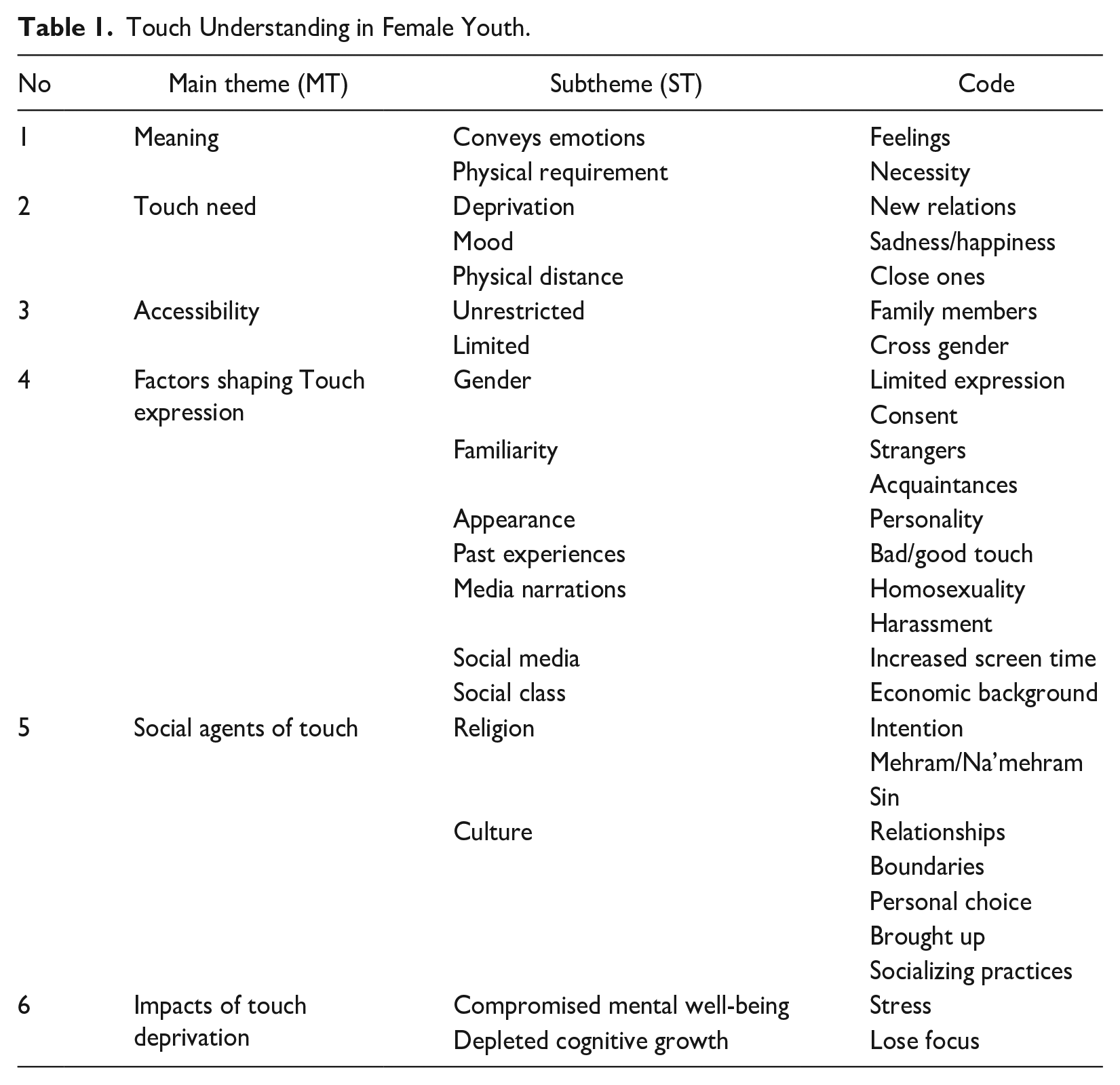
We employed thematic analysis since it best suited the objective of our research and the information gathered. As the aim was not only to understand what the participants said but why they were saying that as well, extensive discussions among all three researchers were held regarding the interpretation of the data. These discussions allowed us to elaborate on the findings and reach a consensus while finalizing the themes and codes. After reading and rereading the transcripts and thorough discussions, six MTs were identified. Each MT has STs and codes that are presented in Table 1 and the description is provided under separate headings:
Touch Understanding in Female Youth.
MT1: Meaning
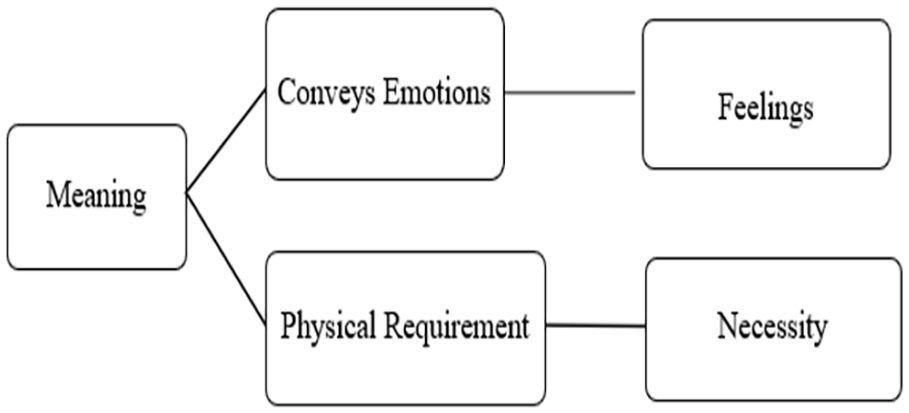
This MT encompasses the understanding and meaning of human touch by the respondents. Broadly, it includes two different STs: conveys emotions and physical requirements. The first ST covers all those responses where the respondents associated the meaning of touch as a means to communicate feelings and emotions. However, few of the respondents tried to define it as a physical requirement. Montagu (1971) also elaborates on touch to be the strongest sense as the skin receives information and messages about the surrounding environment, besides the connection with others in the shape of being loved and secure.
Though all of the participants have a different and discrete understanding of touch, most of them linked emotional connection with touch as it helps in communicating feelings that satiate their emotional needs. One of our participants Surraya defined it as “a sense of affection.” Sadia, on the contrary, shared, touch is a sense of warmth and love. When you experience it, you feel good, and so does the other person . . . human touch gives you the feeling of warmth . . . conveys a sense of trustworthiness . . . a sense of love, the way we console and counsel one another . . . it is a sweet gesture, a way to tell your feelings to other.
Moreover, it is pertinent to highlight that a few of our respondents observed touch in a binary form which would be either good or bad. Saima and Fatima, respectively, told us, touch for me is good and bad also (as I experienced both of them) and, I just want to add that not every touch is bad but not every touch is good also, one needs to decide according to them.“. . .the spectrum of touch is quite broad and should be assessed according to that spectrum. That is what I think because touch can be either good or bad.” It was also noteworthy for us to see two of the respondents alongside associating emotional meaning also defined touch as a physical need, “it is something that one wants, a bodily need” (Surrayya). Farkhanda on the other hand stated that “emotional feelings are physically connected to us, and touch is physical in the first place, so it is biological.”
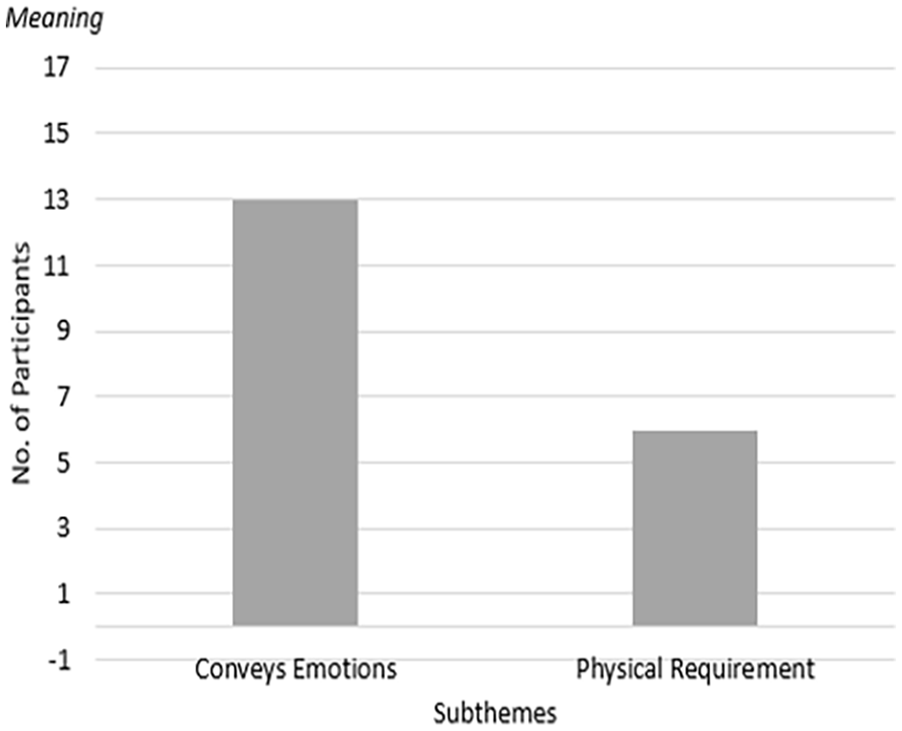
Figure 1 presents the MT 1 “Meaning” with STs and codes, and Figure 2 graphically represents the number of participants sharing their views about the MT1 “meaning.” The x-axis includes the subthemes, whereas the y-axis includes the number of participants. Notably, 13 out of 17 participants said that the human touch conveys emotions, whereas 6 out of 17 said that it is a physical requirement. This clearly depicts the participants’ focus more on the emotional aspect of social touch.
MT1: Meaning.
Frequency Count of MT1.
MT2: Touch Need
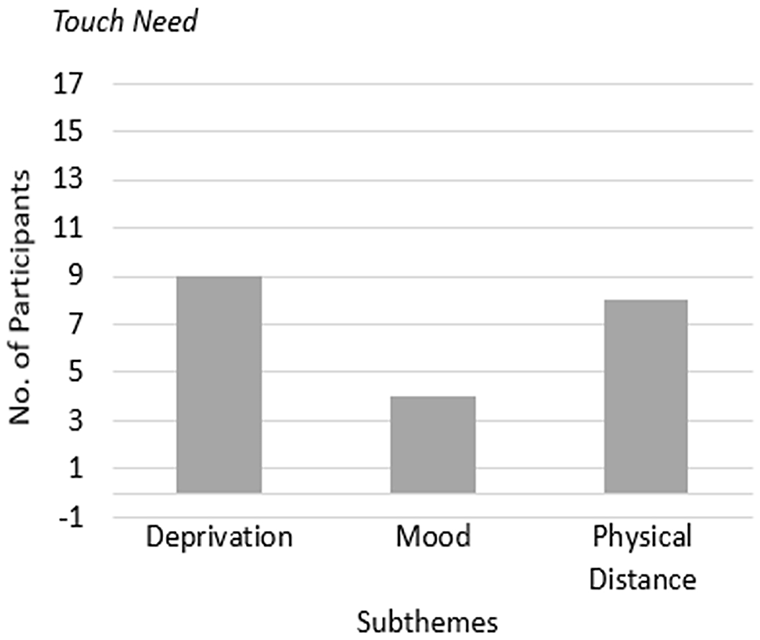
MT2 describes the elements that are responsible for arousing or generating the need for touch in young girls as mentioned by the respondents. Since all of the respondents agreed that touch is either an emotional or physical necessity, few of the respondents significantly mentioned that in case this need or requirement is not fulfilled, the females try to search for it in other relationships. However, the interesting fact was when we asked the respondents if they have unfulfilled touch needs or are touch-deprived, some of them clearly negate it. However, when asked about the touch needs of “others” (friends/ acquaintances of their age), the responses were contrary to their earlier stance. They would evidently agree that other young girls would make new relationships be with the same gender or opposite gender to get their needs fulfilled. Shabnam told us, “since it is a need of people and if find it elsewhere and if compensated by someone else, one gets attached to them.” Shabnam also agreed that, if such a basic need for touch is not fulfilled by the family, girls of her age try to compensate for it in the form of new relations. Surraya, on the contrary, categorically told “I have seen (experienced) such girls in life who need touch, they feel and want someone to pamper and hug them, that reaction is not relatable for me as I could not perceive it in that way.”
We also noticed the evidence of touch deprivation in the response shared by Farkhanda, she highlighted the times of COVID-19 and how touch deprivation in her friends developed sexual desires. She stated, I experienced it multiple times. I have spent four years in the hostel. I had a very difficult time during COVID-19 as I couldn’t go back to home. I stayed at the hostel . . . So, it was a difficult time for me. That was the time when I went through a lot and I missed my mother’s hug and my siblings . . . Sometimes, I wanted to hug a friend. Even if I could meet a male friend . . . their emotional support would have been sufficient. My friends and family used to call me daily to keep me emotionally stable, but I was deprived of physical touch . . . Let me tell you about another experience. I have some female friends who develop sexual desires when they went through this deprivation . . . They feel they should have a partner who can provide them with that touch.
About overcoming touch deprivation, a very interesting suggestion about the provision of free booths and dummies was put up by two of the respondents Humaira and Areeba, respectively, “there can be a few booths like a photo booth where free hugs (from same-gender) are available for those who want to get a hug” and “If there is a person who can provide hugs willingly (same gender), a tight hug, it would do the needful. We can even provide a dummy (like a fluffy bear).” These comments by the respondents suggest how they see touch deprivation prevailing in their surroundings which is why felt a need to suggest overcoming it. Besides, it is also noteworthy they speak about the touch in the same gender; this is derived from religious and cultural connotations.
Another very relevant factor identified by the respondents that can trigger or indicate the need for touch is a sudden burst of emotion may it be sadness or happiness. The need for human touch is evident as mentioned by R. Miller (2017) that a moment of heartfelt physical connection, particularly in a time of agony, can have a strong positive effect. Respondents Shabnam, Sadia, and Sakeena mention clearly the connection of mood with touch need, “yes, definitely, it happens [feeling touch deprived]. At times, you feel down or very happy, just a sense of somebody makes it better or a pat on the shoulder . . . it helps” (Shabnam), “I have seen that . . .. if you touch such people (dissatisfied and saddened), it makes them feel special (Sadia), if I am feeling down and someone comes and hug me, my mood will instantly change, I would feel fine after that. Similarly, if it is a friend (like I met my friend today after a long time), that touch would bring happiness and joy (Sakeena).
Surraya, on the contrary, mentions that she has observed in some of her friends that their touch need is so prodigious that they would suddenly start crying if touched when feeling down, “I do not understand what makes them cry (when receiving human touch).” Sakeena further shares her experience that recalling her deceased cousin makes her feel sad and how this feeling of sadness urges her desire to touch arises, “I was very close to my cousin, and I feel if she was around, I would have hugged her. I miss that contact with her . . . Her sudden death was a very traumatic experience.”
Furthermore, our respondents mentioned that physical distance from loved and dear ones would also trigger touch needs as Arifa said, I wanted (could be) a friend who could console me and show compassion, but no one was available. A friend visited me, and we spent a day together but still . . . as I told you I wanted it so bad as I had been far away (from home).
In another instance, she further narrated an event from her past how she realized her touch need, when she was away from her exact family for more than a month. She told that, when I was preparing for my medical exam. I was left alone in the hostel after the other three girls left. There was another girl who used to work and would come late at night therefore, I did not have any interaction or touch experience with her. I spent one and a half months untouched . . . only often did I have a handshake with girls but that was the time I needed to hug my mother . . . I connected on video calls with my mother and friends, but it did not work. Then, I felt that I do not need to talk only but wanted a touch as well.
Another participant Sundas also mentioned the same fact that physical distance results in an emotional detachment, which as a result arouses touch needs, “It often happens, that we live away from home (in the hostel) and when we miss it, we need to hug someone like friends, roommates and if no one is there, we might feel emotional detachment.” In the same perspective, Saima narrated an incident from her life that she lived away from her mother during childhood but even then, when she is grown up whenever there is a physical distance created it conjured her touch need, I avoid people touching me a lot, however, I have had a bad experience with my mother also, I used to be uncomfortable with her. I have a twin sister and I used to live with a grandparent, and because I was away from my mother, I feel this way . . . and now, when I live in a hostel, I need that touch when I go home.
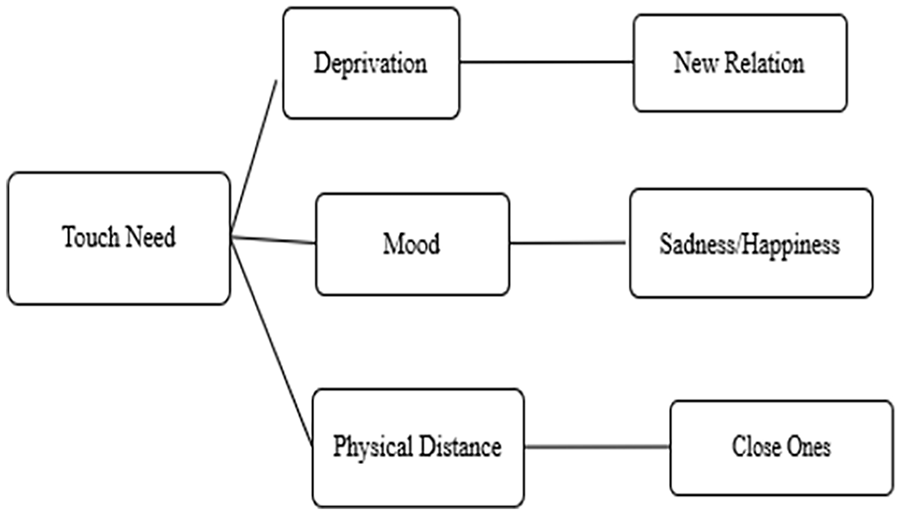
The three STs and codes that emerged for MT2 from the collected data are presented in Figure 3. Figure 4 graphically displays the number of participants’ responses against each subtheme in the main theme (MT2) which is “need.” Out of the total number of 17, 8 participants mentioned physical distance, and 9 mentioned deprivation as the reason for touch need. However, four participants also mentioned mood as a factor that increases the urge for touch.
MT2: Touch need.
Frequency Count of MT2.
MT3: Accessibility
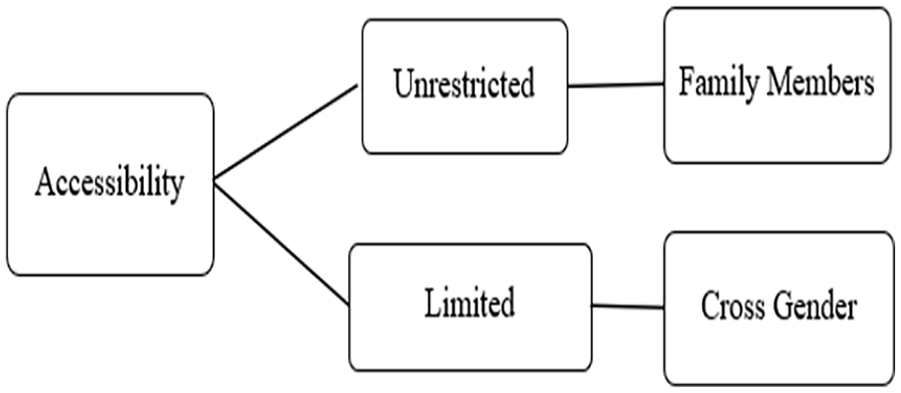
This MT includes the available conveniences for touch expression. There are varied responses about the provision of touch opportunities with family and friends as well as its limitations. All respondents agreed that they have touch opportunities available with their family and friends, but it is limited to a certain extent. Ayesha stated, “yes, it is limited. There is a limit, a set boundary that should not be crossed.” It was also interesting to see that, one of the respondents, Irum shared her view of touch with the opposite gender that she only sees in her dreams (intimate touch with a spouse), and that is why calls it sacred and she cannot imagine that with anyone else. It stays in the imagination that is enjoyed in romance novels, “If it is an intimate touch that I dream of in my romantic world, that is something else . . . and, it gets sacred in my view, a private, intimate touch. I like that kind of touch that is portrayed in romance novels.” This depicts that a limited amount of intimate touch is available in the social circle, making the participant cherish such touch experiences in her dreams only. Contrarily, Maryam shares another fact about the norms of society that youngsters are not let talk about the topic of touch, we (as a society) do not consider telling (a young girl) about appropriate touch. We avoid telling because it is believed that it is beyond their age requirement “barhon wali baat ha” (something that is related to elders only) . . . young girls face more harassment cases because they are not communicated about bad (inappropriate) touch.
This arouses concerns where simple talk for awareness is prohibited, the manifestation of healthy touch will be of course a huge challenge. Sundas takes it one step further and suggests how the conveniences of touch can be improved in society at large, there is a lot of hesitation and for that, there can be social sittings (lectures), especially with parents as it (touch) is not a negative thing and it will decrease hesitation of girls and if the mind gets changed, things (opportunities) will be a lot better.
This is why Farkhanda clearly mentioned that limited touch is available to females with respect to males in her society, “I feel in our society (not generalizing but telling from my experience) males have more touch opportunities available than females . . . Harassment cases are more common in females. . .it is a male-centered, patriarchal thing in it.”
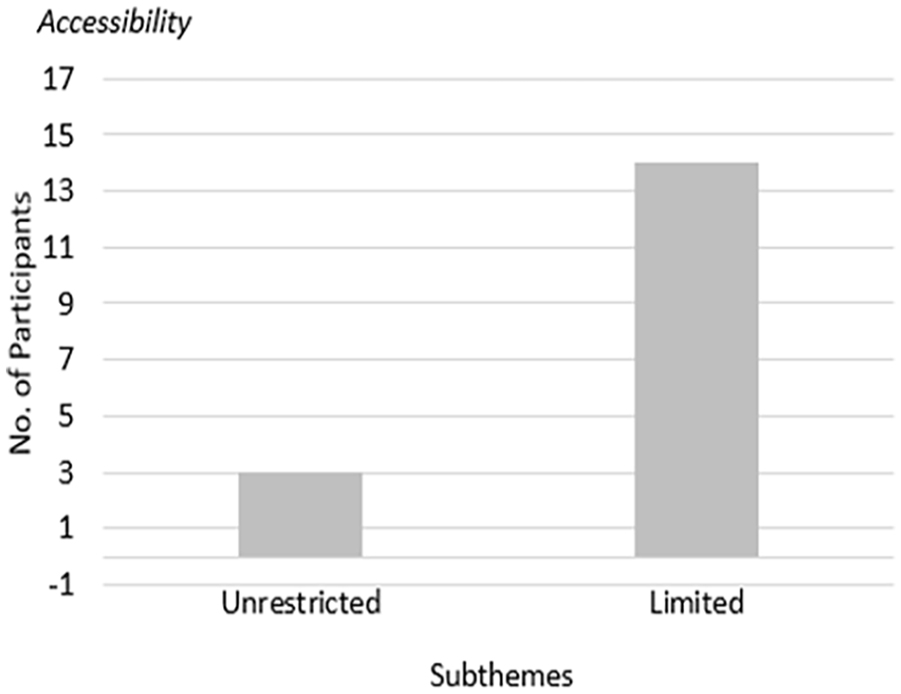
Figure 5 displays the MT3 accessibility with its two STs and codes. In Figure 6, the frequency count of each ST is displayed; 14 out of 17 participants said that their touch opportunities are limited whereas only 3 out of them said that the opportunities are unrestricted. This evidently depicts that the majority of the sample clearly see the limited opportunities of touch available to female youth in the society they are living in.
MT3: Accessibility.
Frequency Count of MT3.
MT4: Factors Shaping Touch Expression
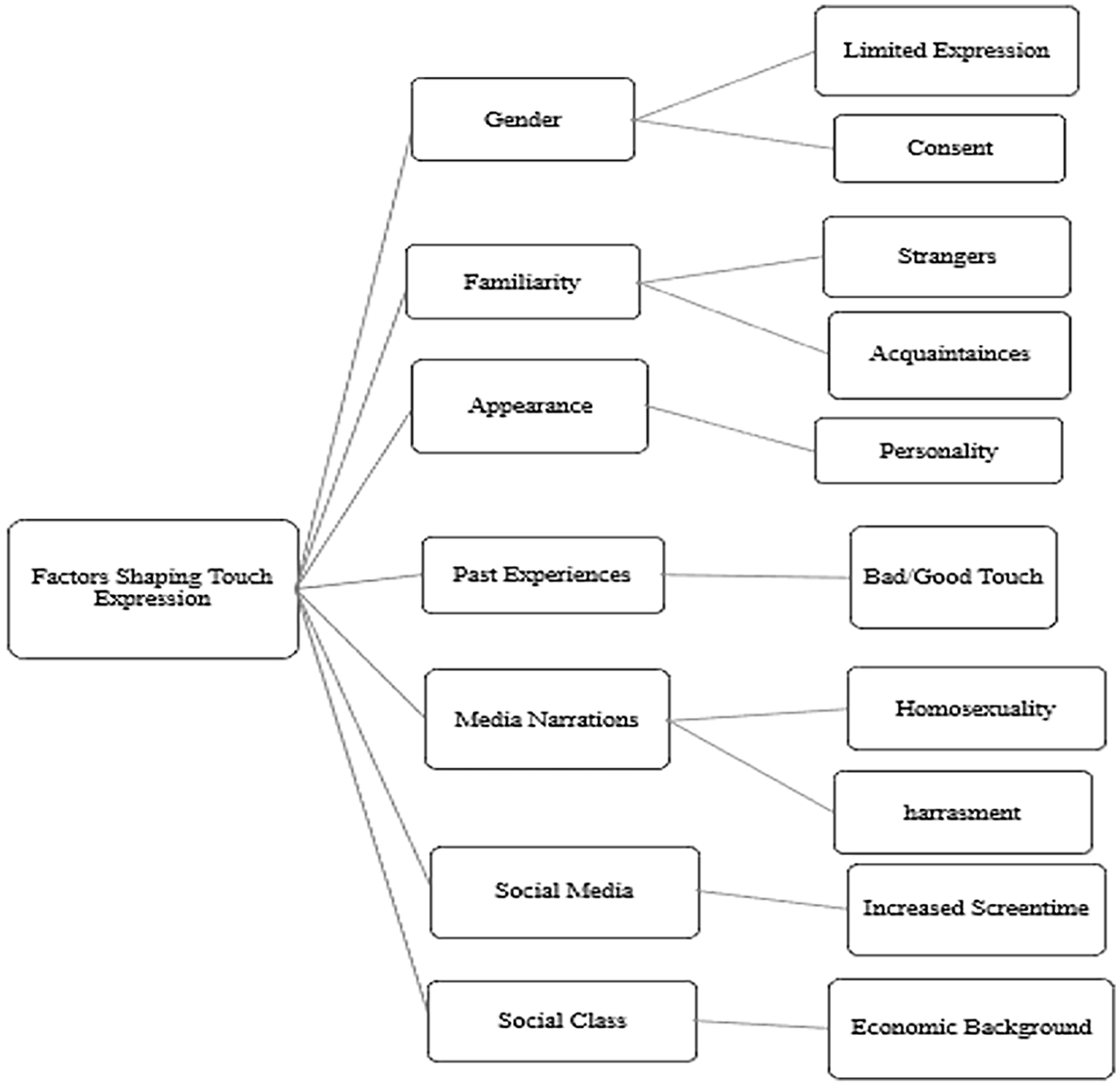
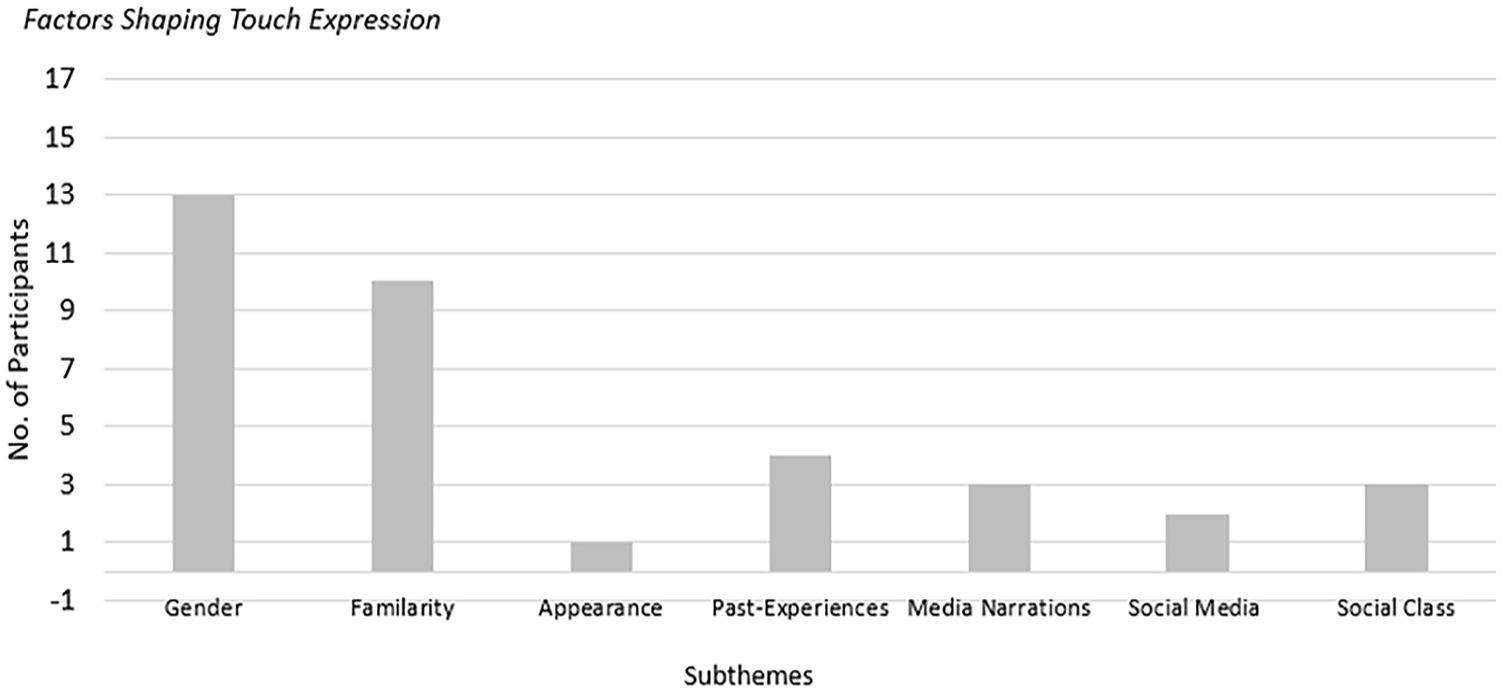
This MT includes factors that affect the expression of touch which include gender, familiarity with the person they interact with, past experiences, media narrative, social media, and social class. The studies (Henley 1973; Major, Schmidlin, and Williams 1990) show that touch is initiated more by men as compared with women, and Burgoon and Bacue (2003) state that in general women tend to give and receive touch more than men in U.S. society. This speaks of the impact of gender on touch expression. The same emerged in this study, touch within the same gender and touch with opposite genders have a different understanding. The codes identified in the data are the limited expression with the opposite gender and the role of consent. Shagufta mentions categorically that when it comes to touch with the opposite gender; consent and limitations are considered important by her; however, she does not mention any such condition when it comes to the same gender, . . . if touch is in the physical sense with someone I know or class fellow (opposite gender), I would not dissolve my boundaries at any instance . . . if I have to allow [which I would not prefer], it would be on the similar basis (consent must be there) . . . sitting together (with the opposite gender) and talking within certain limits.
On the contrary, Sadia mentions how she as an individual has no issue with touching the opposite gender, but it is the people around her and their attitude of being judgmental that limits the touch expression. She also mentions the religious connotation of sin with the opposite gender, we are a group of friends, male friends also, we sit together, play cards, and often touch hands and the [nighty percent] of people [at large] . . . do not get judgmental if I talk about university but few do so. Even, in the outside settings, it is quite frequent . . . yes, if we go to the restaurant [nearby] if you have put your hand on the other person’s (opposite gender) hand, it’s like you have committed a sin.
Fatima even firmly refrained to talk about opposite gender touch, “If I talk about cross-gender, I have not allowed anyone, simply . . . Therefore, I would refrain from talking about it more.” This comment by the respondent may help us to see what kind of socio-cultural society the participant is living in, where people’s thinking is fixed in such a way that they think even talking about touch needs to be avoided.
Saima mentions the role of culture when it comes to experiencing touch with the opposite gender, also at another point mentions her being uncomfortable with the opposite gender’s touch, “If we talk about gender . . . in our culture, it makes a difference . . . I am not very comfortable with touching males even a handshake.” Surprisingly Irum mentions how she has been able to do better in life for being able to experience touch with the opposite gender, “If I had not got interaction with males in life then my personality would have been quite different.” Another prominent factor that plays a decisive role in tactile interactions among cross-genders is consent before initiating touch. Many respondents mentioned that touching someone without consent is not appropriate; hence, it must be a norm to ask people whether they should be touched or not. As Maryam puts it, “consent in touching, matters a lot. Because some people even under stress do not prefer to be touched/hugged.”
Moreover, we also noticed that the participants’ familiarity with the subject has a big impact on how much physical touch they are willing to accept. They would avoid having any physical contact with someone they do not know, strangers unless they are personally acquainted with them. Ayesha explained, “we do not know them (that is why) otherwise in the family we know people so (touch) is allowed.” Fatima explains familiarity more clearly by mentioning particular blood relations “(Touch is allowed with) acquaintance, yes but that too with certain relations like father, brother, or elderly relatives.” Another vital factor in determining people’s willingness to have touch interactions with those who are not close family members (parents and siblings) and friends is their experience in public settings where touch is frequently inevitable or one may have a touch experience there that might put at discomfort or any bad past experience of touch.
Three participants shared how their previous experiences have impacted their choice of touch. As Saima told “I have experienced some incidents like touching by a shopkeeper while exchanging money . . . which I did not feel right . . . I have had a bad experience in that too which is why I avoid touch with males.” Sakeena told that bad past experiences of touch cause hesitation, even with a simple positive touch, “it could be due to past traumatic experiences or unpleasant experiences because some people are hesitant. I had a friend who used to get annoyed by a hug from her aunt.” Age and appearance also impact touch understanding as put up by Irum, I think young girls notice boys’ hands. I hate those people who bite their nails. If I have to judge a boy . . . I notice his hands and what is he wearing on his feet (subconsciously) and hair, . . . it is linked with a touch too.
Along with the different factors mentioned that are responsible to impact touch, a few of them mentioned that since in media, and through other sources, many cases of homosexuality have been frequently highlighted that influence the expression of touch in society, Irum said, “in my opinion, these are getting restricted because, in our society, the LGBTQ movement is taking roots, and many cases have been reported in Islamabad.” It implies that this trend has instilled a fear of judgment that ultimately impacts people’s touch experiences. Irum further told us, “I, myself know boys and girls who are part of it. . . For example, if we are sitting together, holding hands, other girls would be (judgmental) of us.” Sundas added, “rapes cases are reported, any such experience of a friend or colleague who regrets bad touch, then that restricts the need even if you want to experience it,” and Sundas clearly mentions the media role, “so many things through mainstream media that are being portrayed negatively that’s why[somehow] a negative meaning gets associated with things [an act].” One of the participants mentioned a very significant factor that has impacted human touch experiences in the present time is the role of social media and which has resulted in increased screen time for people belonging to different ages. Participants Arifa and Sundas said respectively, “moreover, the increased screen time has made people live in virtual spaces and limiting the live experiences of human touch,” and “we hesitate to talk about touch because social factors and social media portray it in a bad light.” This subtheme also corresponds with Jones’s (2018) observation that social media has been really detrimental to touch and that is why youngsters today are much more touch-deprived than they were before smartphones. Social class is also mentioned by Fatima, Farkhanda, and Sakeena as an important factor that shapes our touch expression, social factors which affect experiences of touch. . .economic background especially . . . If I talk about a family of lower-class background, the touch experiences would be very less, in middle-class it would be reserved and bound but in high-class family, I would say they expand the boundaries (to seem cool), to some extent (Fatima). economic factors indicate class status. Some are liberal as we identify them as liberals, and they have slightly different rules and boundaries (pertaining to touch) than those who belong to normal (middle-class) socioeconomic backgrounds (Sakeena).
Farkhanda also shared a story of her friend about how financial constraints have landed her in a touch deprivation state.
Figure 7 represents the MT4 with its 7 STs and 10 codes. The pattern of the number of responses per subtheme under the category of MT4 is represented graphically in Figure 8, which clearly shows gender is considered the most critical determinant. At the same point, the other subthemes, such as familiarity, appearance, past experiences media narrative, social media, and social class, are equally significant though mentioned by less number of participants.
MT4: Factors shaping touch expression.
Frequency Count of MT4.
MT5: Social Agents of Touch
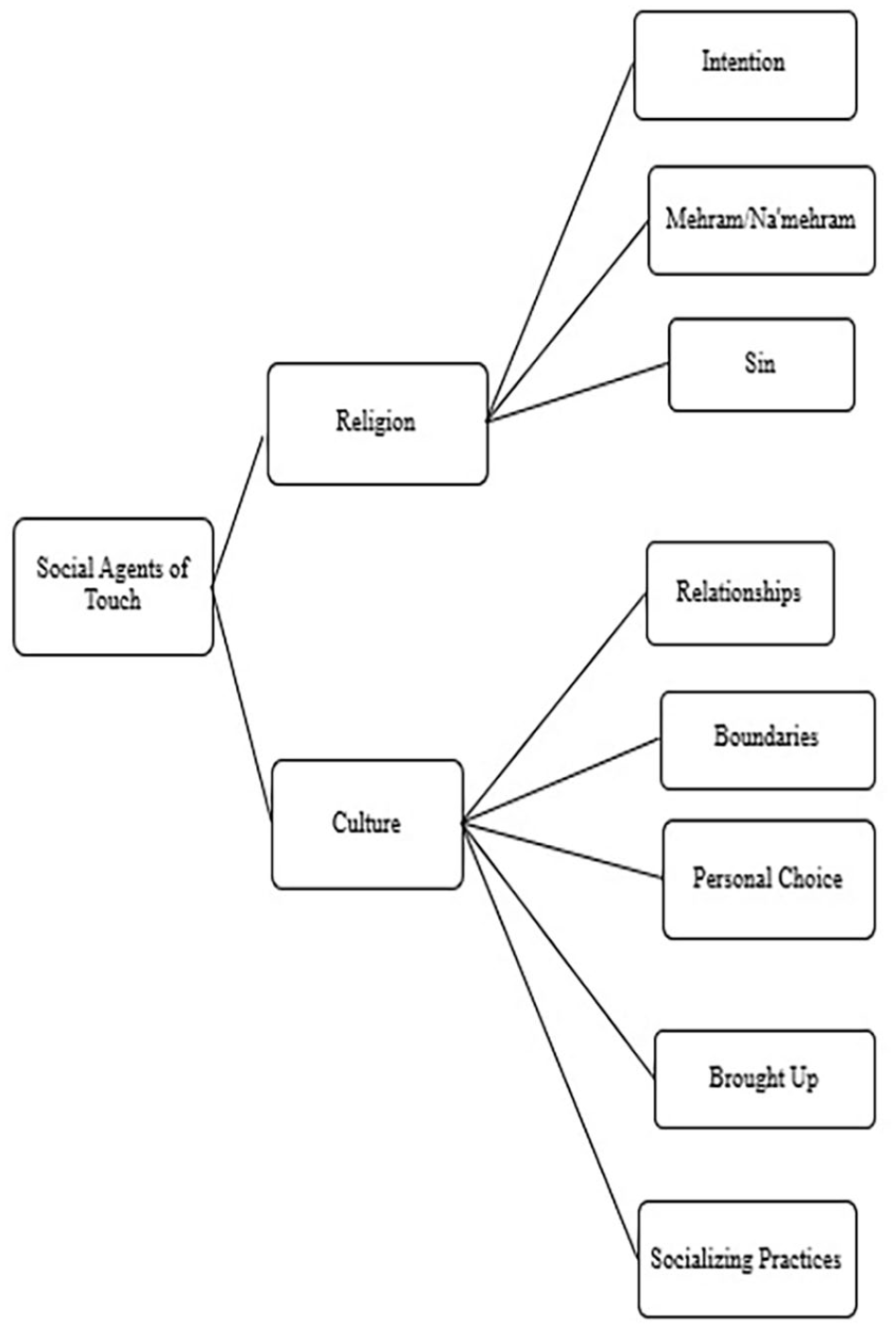
This particular MT covers the two main definers of touch: religion and culture. Overall, in the society the sample population is living in, religious ideology seems to influence significantly social practices, resultantly the touch experiences as well. According to one of the respondents of our study, it provides opportunities for touch in close relationships which are mahram (whom you cannot marry) in the religious sense but restricts it with other relationships, as said, “if parents or mahram touches, it is considered a good thing but if friends like a male friend would touch, that would not be considered a good thing” (Sadia). Amna is of the same opinion and says, “Touch is associated with the concept of mahram and na’mahram (the male counterparts one can marry) that shows whom we are allowed to touch.” Farkhanda alongside religion points out culture as the social agent that limits the touch experience, I think culture has limited our touch experiences because culture and religion, in my opinion, go hand in hand and overlap sometimes . . . we often confuse cultural and religious practices and misconceptions are also there. We live in a society where we are bound to follow certain things and I think our society or culture has limited a few things and we are not allowed to go beyond that limit. Boundaries are set both by culture . . . So, I think it exists and culture limits our touch experiences.
Since values are culture driven that is why the practices of the upbringing of an individual play a crucial role in limiting/allowing touch interactions with other people. Notably, 10 of the 17 participants from our study mentioned that their touch interaction with the opposite gender has been limited because of their cultural values. Shabnam and Sundas told us, “we are told since the beginning that one should not be physical (hugging) with the opposite sex” (Shabnam). “We cannot go and hug a male cousin, but it happens with female cousins or elder brothers (sometimes). There are some restrictions while interacting with male cousins” (Sundas).
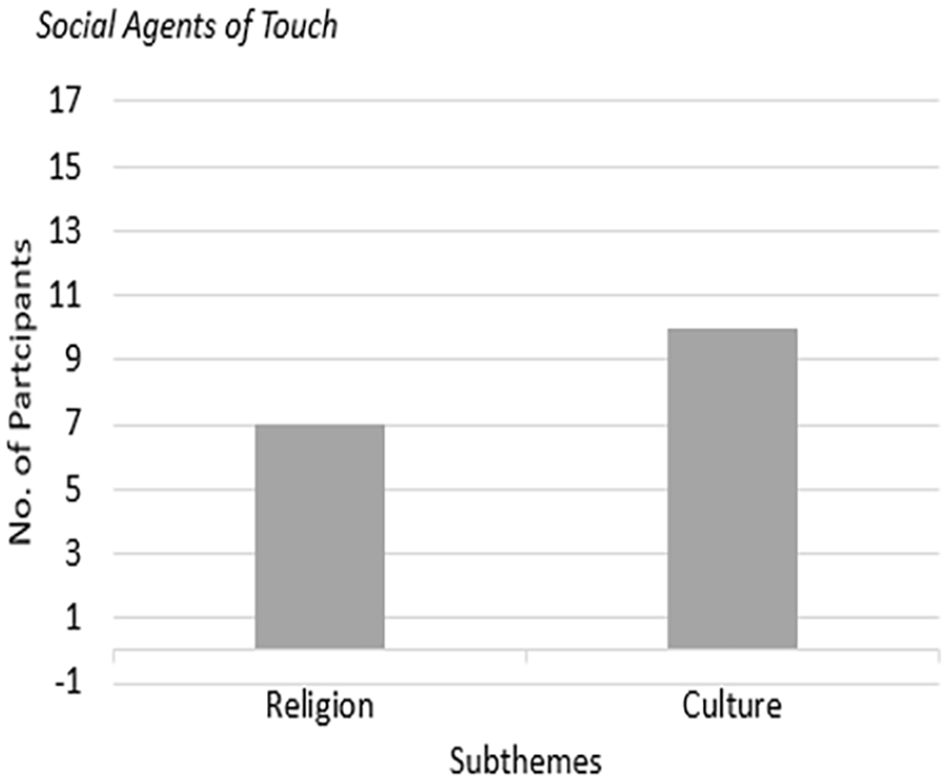
The respondent also mentioned how they are reminded of their cultural values even if they wish or try to deviate, as Sundas says, “those who talk about it are considered modern (in a sarcastic way) who ignore cultural values.” A few of them would limit their touch calling it a personal choice, this is how their touch understanding and also the choice of touch is fixed by the culture they are living in. According to their narrative, they do not like to interact physically. Sundas further mentions, “touch, in the sense to which you are referring (opposite gender), I don’t like that.” Arifa would put it, “telling openly, that I do not like a touch from the opposite gender. Another said, there are ample opportunities, but I restrict them myself as I do not like unnecessary touch by females also” (Sundas). Fatima says, “I do not like touch a lot, it’s an expression but what I have is sufficient . . . I have set certain boundaries, for example with female friends, I do hug, but I cannot express my feelings to all openly.” Touch with the opposite gender has specific limits in cultures worldwide, which are learned as the individual grows up in that setting. As put up by one of the participants, “in upbringing, culture influences the very first place” (Shagufta). Almost all the respondents agreed that touch in their culture has some restrictions and boundaries (specifically for the opposite gender), which are learned over time through socialization. Notably, 10 out of 17 participants mentioned that culture ingrains certain limitations regarding touch which are gradually learned. Hence, the concept of setting and maintaining a boundary while interacting with the opposite gender (in this particular context) is a learnt notion. Ayesha, who belongs to Gilgit-Baltistan (different cultural dynamics), but currently living in Islamabad, mentions that her culture allows her to interact with both genders, but it has to be minimal outside the family, especially with the opposite gender which she has to be obeyed as a cultural norm. Sadia told us, “we live in a culture where it is a bad thing to do, and it is the beginning of the wrong thing.” In this statement, we get an idea of a significant underlying association of touch with the moral standing of an individual. If someone happens to touch the opposite gender, one may get labeled as a wrong person in terms of moral values and expectations of society. Hence, one of the prominent reasons to avoid any physical touch by female youth in Pakistan is the fear of being judged and labeled as indecent. Saima said, “yes, it is restricted as well as gives a negative connotation to it.” Sundas also clearly stated, “it is the way we are brought up and culture obviously, plays a role to restrict touch.” Fatima further pointed out the parenting styles that are adopted from the culture with respect to abusive touch and suggested avoiding it, “in parenting styles, I would say the abusive touch must be reduced because it exists in it (culture). Figure 9 displays the MT5 with its two STs, and Figure 10 displays the frequency count of each subtheme, that is, the role of religion in defining our touch experiences is mentioned by 7 participants and 10 participants mentioned culture as the defining factor.
MT5: Social agents of touch.
Frequency Count of MT5.
MT6: Impacts of Touch Deprivation
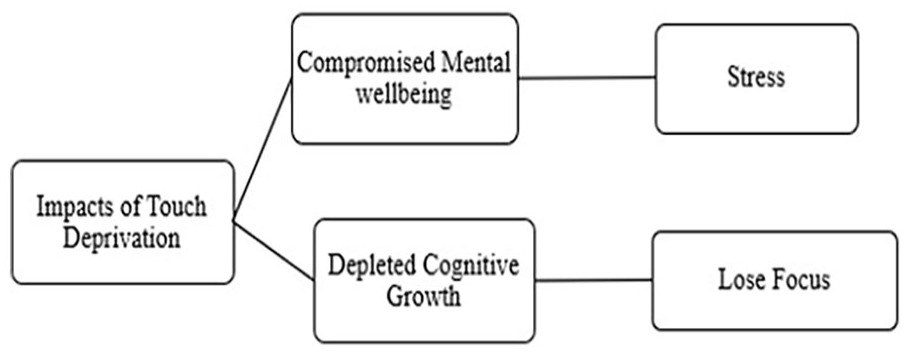
This MT encompasses the impacts of touch deprivation on individuals’ performing capabilities. Most of the respondents acknowledged that touch deprivation decreases their performance as it causes them to either get stressed or lose focus. Arifa shared her experience where a lack of physical touch led to emotional stress, definitely touch deprivation impacted my day-to-day activities. What happened was that my performance started to fall (dull), and I got worried. After a friend came and spent a day with me, it got better then I realized that I had to spend time with somebody. I connected on video calls with my mother and friends but did not work. Then, I felt that I do not only talk but wanted a touch as well . . . I figured out what went wrong . . . Moved home after a few days.
Shabnam had an experience of being pushed into social isolation by her exact family and how it affected her performance as she lost focus, “when the family did not talk, I needed someone to be around which affected my everyday performance.” Surrayya in the same context said, “besides yes if appropriate touch is not available it would impact overall wellbeing.” Saima talked about the relationship between the availability of touch and health, “those who have more of these (touch) opportunities, are healthier.” Sadia shared her opinion about what she noticed in her friends who are in need of touch, and their mental health got compromised and increased stress levels. As, “I have not seen but heard about people (my friends) who need that. And, basically due to this deficiency [touch/love], their mental health gets affected by it. They could not cope with everything and need something in life.” Contrarily, Fatima shared her own first-hand experience of not being able to perform well academically when she was touch-deprived, I feel there should be someone (could be anyone) who could hug me tight and spend time with me so I feel that there is someone available to me and I can share (feelings) with the person. When this element is missing (touch), I cannot study (lose focus), and even if I study, I cannot perform up to the mark. This was the time (semester five) in my overall academic career, I got low grades (3.5 GPA).
Furthermore, Maryam stated that anytime she is stressed, her mother’s touch helps her feel at ease, I guess a lot (impact on performance). For example, a mother’s touch is very comfortable which is a stress reliever. Normally, if I am stressing over my exams, I go to her . . . hug her or tease her. It gives relief (very typical but it happens . . . If I talk about positive touch, it is a stress reliever, touch and hugs are anxiety relievers as stress hormones get normal, yes it has a direct impact, and one feels motivated to work.
Farkhanda specifies touch deprivation in youth by mentioning they need an opportunity/forum to talk about it, (touch deprivation feels at all ages but mostly at a young age), need it more. Our mothers may also need it, but I think students (youth) if they are asked, would express their need. They perhaps wait for the opportunity to talk about it.
Figure 11 demonstrates the MT “Impacts of Touch Deprivation,” and its two subthemes and two codes. Figure 12, on the contrary, displays the number of times the STs are mentioned by the participants of the study. Though compromised mental well-being is mentioned by only six participants and depleted cognitive growth only by four participants, the emergence of this MT is a very significant finding of our study.
MT6: Impacts of touch deprivation.
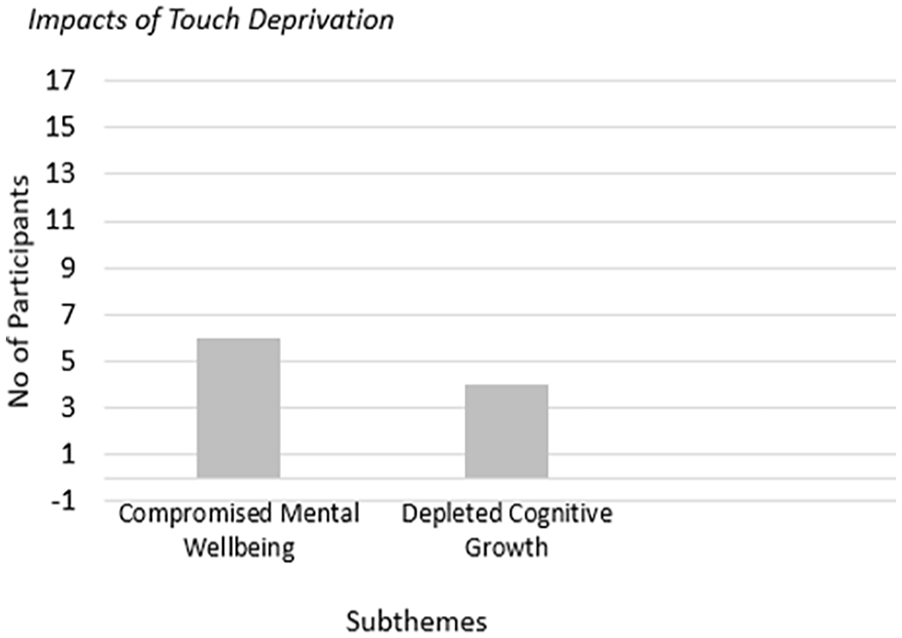
Frequency Count of MT6.
General Discussion
The inferences from the data analysis have provided us answers to some very important questions while have also raised some new ones. The analysis most importantly has revealed that female youth of the region has awareness of touch significance as well as its deprivation impacts. As Keltner (2010) has stated, touch is a language of compassion which is necessary to what it means to be human. So, if touch is to be human; it arises a debate about the catastrophic impacts of touch deprivation at the individual as well as societal level. The finding of the theme Impacts of Touch Deprivation, in this study, tells that touch deprivation results in poor performance, specifically in young females. This major finding of our study is in agreement with previous studies which state that the brains of children, who were not given the appropriate amount of touch, were approximately 20 percent smaller than the ones who received frequent touch (Honig 2005). Perry (2002) revealed the astonishing difference between the electromagnetic resonance images (EMRIs) of the brains of touch-deprived children in comparison with children who were raised in touch-inclusive environments. The same is stated by the participants of the current study that touch hunger results in compromised mental well-being and cognitive growth. This also results in aggression among adolescents as Field (2010) found out that French adolescents were found to be physically and verbally less aggressive than American adolescents because the former touched each other more than the latter who were engaged in more self-touching/self-stimulation, for example, fingering their hairs and rubbing their arms. Based on this, Field (2010) also claimed that cultures that feature more physical affection toward their infants characteristically have less adult violence. Owing to the available literature and what the participants of this study opined about this aspect of touch, it is not surprising that compromised mental well-being, low cognitive growth, and increased aggression would impact the social performance of the females. This calls for healthcare professionals and educationists to go for focused campaigns and timely interventions before it is too late and the ill impacts of touch deprivation are seen on a larger scale. The educationists can bring social awareness about the touch needs as well as may address the problem before its onset on larger population, while healthcare professionals alongside creating general public awareness may be able to rightly diagnose this condition.
The findings of the study also elaborate on the touch needs of young females. In Pakistan, there is limited to no sex education at all in the school curriculum, and talk on such social needs is considered taboo, so the question arises then what kind of understanding develops about touch needs in youth which possibly may affect their cognitive growth? In other words, when physical contact becomes limited or, in some cases eliminated, people can develop a condition called touch starvation (Pierce 2020). Mood also impacts the need for touch as a few of the participants clearly mentioned when they are extremely happy, their expression of happiness contains some kind of social touch with people around them, the same applies to when people are sad they want someone to counsel them that also need some form of social touch. The participants also evidently mentioned how the physical distance they had from their near and dear ones (in hostel life) made them mindful of their longing for touch. This poses a social responsibility on institutions and workplaces to make such policies where opportunities for healthy touch are encouraged for all especially females keeping the ethnic and religious values intact as touch has a high degree of cultural and ethnic relativity (Guindon, Packard, and Charron 2017), one cannot completely ignore the culture while making touch available for general populous. Thus, the cultural context is very significant in communicating via touch.
The selected sample is living in Islamabad, the capital city of Pakistan, which is considered quite liberal regarding its socio-cultural dynamics. The sample of our study give varied meanings to touch; relieves stress, helps in building a sense of togetherness, conveys feelings of love and sympathy, and a bodily need. This is also supported by the findings (e.g., Cascio, Moore, and McGlone 2019) which stated that social touch is a powerful force in human development and shapes communication and emotional regulation throughout the lives of individuals. Moreover, all cultures share a common understanding of it as it plays a key role in basic human exchanges including aggression, comfort, affection, and intimacy. As touch is needed for sufficient attachment development in adults, its absence causes long-lasting negative effects in terms of attachment injuries and touch wounds (Davis, Rovers, and Petrella 2017).
Earlier studies on touch in other societies have identified many factors shaping touch experiences that define the understanding and experiences of touch. These factors include gender (Cascio et al. 2019), appearance (Saarinen et al. 2021), age, and marital status (Hanzal, Segrin, and Dorros 2008); however, along with these factors, this study also shows that the selected sample has mentioned familiarity, past experience of good and bad touch, media narrative, increased screen time, and social media in present-day youth as substantial factors that shape touch phenomenon meaningfully. The participants clearly mentioned they have adequate access to touch with friends and family members but limited or no access at all with cross-gender. So, in this liberal urban setting of Islamabad, females are limitedly allowed or not allowed at all to participate in physical or social activities in comparison with males who have more space to actualize their vulnerable behaviors, the question arises what would be the understanding/realization of young females about the human touch in rural and far-flung areas. This also leads us to the prediction that young females will have more ratio of mental and physical health issues due to this unfulfilled basic social need.
Behind all these factors, the major social agents of touch that make individuals uncomfortable or fail to understand their own needs are the “religion and culture” that decide the people’s way of life. Religion is one of the most, if not the most, fundamental features of Pakistani society, which has wired the thoughts and ideologies of the people of this region the most, as stated by Azam (2010), that even the people cannot dare to call themselves secular publicly. Apropos, people’s social environment determines the touch meaning and its function according to religious and cultural ideology. This is why most of the participants would explain their views regarding touch by referring to religion, they would mention the notion of Mehram (a person who is allowed to stay with Muslim women without the need for coverings of the veil), and Na’mehram (a person who fulfills the criteria of getting married to), with respect to cross-gender touch even if not asked about it. That is why touch is said to be culture-specific (Schirmer et al. 2022).
Furthermore, touch behavior varies considerably around the world from culture to culture in the form of type of touch, amount of touch, place of touch, and whether done in public or private. Many previous studies regarding the role of culture in touch expression (Andersen and Leibowitz 1978; Davis et al. 2017; Hall 1966; McDaniel and Andersen 1998; P. M. Miller, Commons, and Gutheil 2006) found that regions in Asia that have low-touch contact are Myanmar, China, Japan, Hong Kong, Philippine, South Korea, Thailand, Taiwan, and Vietnam. However, Finland, Germany, Norway, Great Britain, and Sweden are relatively low in contact in Europe, but not as low as Asia. The cultures of the United States and Canada are also among the least interpersonally touch regions. On the contrary, the Mediterranean region that includes France, Portugal, Italy, Greece, and Spain, along with most of the Latin America region, and most of the Arab countries are the most touch-active areas of the world and Australia is moderate in touch contact level (Andersen and Guerrero 2008). The findings of these studies imply that low-touch contact cultures are located in cool climates; on the contrary, high contact cultures tend to cluster in warmer locations. It is no coincidence that touch-active countries are located near the equator where both skin and people are visible and available. Since Pakistan is located near to equator, it is not a touch-deprived society, but at the same time, socially it is a patriarchal society apropos touch opportunities are less available to females as compared with men, depriving females of their instinctive needs. Hence, the findings imply that there is limited provision of touch opportunities to females due to social, cultural, or religious implications which call for a debate if the limited expression of touch may become one of the reasons to impede the cognitive growth of society overall.
Conclusion
Looking at the concept of touch from a societal point of view, the findings of this study support social touch which can not only be a game changer in modifying social dynamics but is also likely to affect overall living standards. Becoming more tactile as a culture will increase the health benefits for society as a whole. As societies are becoming more disconnected, loneliness becomes more prevalent, and mental health issues such as stress, anxiety, and depression increase, the social institutions of the societies need to revamp and promote healthy touch experiences (Mikkola 2021). Continuity of touch deprivation in the short term may not show any significant change in people’s emotional states or behavior, but in the long term, people will likely feel a lack of social affirmation and thus start looking for other ways to fulfill these needs. Maslow (1958) describes humans have needs and desires that should be fulfilled particularly the need for love, affection, and belongingness. These special needs are in the nature of humans and if the traditions, norms, and practices keep negating them many people will lose their natural way of socializing and the result may be an imbalance in society.
This study reveals that female youth have fewer opportunities to touch due to the religio-cultural dynamics as a whole and arouses concerns about these unfulfilled social needs, which may lead them to depression mode. It points toward a prediction that it will not take much longer to see its ill effects on the general population. The urgency to address this matter might actually be larger than what we are aware of today and therefore needs more serious attention at the government level, policymaking institutions, academia, think tanks, and health bodies. Additionally, this work contributes to the broader discussion about emotional touch by suggesting that, though touch does entail cognitive cost, it would fluctuate across different social environments in which these decisions are being made.
Yet, if we are aware but not prepared to work for change, a society with rigid behavior may continue to grow. So, if we ignore the fact that the social needs of the individuals are not important to be fulfilled, a big gap between the actualization of a peaceful and tolerant society and its desire may persist.
Applications of the Findings
The findings imply that limited or no touch significantly impacts the performance of female youth. Despite that the sample of the study is limited, yet the findings are in accordance with the previous studies carried out on social touch and can be further validated on large data in the given context. The sample data have revealed there is a desire to change regarding touch opportunities for females in their social context; therefore, social engineering can be used to encourage people to make choices including healthier lifestyle choices to provide more touch opportunities. Targeted campaigns and interventions by healthcare professionals and educationists with the aim to change people’s behavior can be applied using the following strategies:
i. School/college and university counselors (psychologists) can play an active role in organizing such platforms to educate parents on the value of positive touch for youngsters and encourage the parents to employ it in their interactions with their children. Parents need to provide rich touch experiences to their children to rear touch-satisfied individuals. Alongside this, some parents might also want help/assistance in examining the psychological barriers that might cause them to feel uncomfortable with a touch once their children enter adolescence.
ii. Educational institutions may plan positive competitions including physical activities (sports and walks) and literary events (theater, dramas, panel debates, open mics, and mimes) to provide ample opportunities for close physical contact (social touch) for females. Higher Education Academia may provide forums to have academic talks and unleash such taboos and social constructs in order to fulfill the social needs of youth, particularly females.
iii. The curricula of educational institutions may also be inclusive of positive touch awareness topics educating females about their physical anatomy as well as their social and physical needs and the possible positive ways to get these needs fulfilled. This will help the female youth to better understand and express their touch needs.
iv. Healthcare professionals can bring awareness among touch-deprived people about the practice of self-massage that stimulates the vagus nerve in the neck (which reduces touch starvation). This recommendation is based on Howland’s (2006) study to treat touch-deprived people. Healthcare professionals may also suggest regular exercise, as physical activity can help improve cognitive function and well-being. It can also help reduce feelings of stress and depression and improve sleep (Mandolesi et al. 2018).
Future Research
Furthermore, it is suggested that, in future, research may be carried out on EMRIs of the brains, heartbeat responses, and correlation between perpetrators of domestic violence and touch deprivation to validate the findings of this study. Besides, we also need to see if the people who had a tendency to commit different crimes were touch-deprived in their childhood or youth age.
Footnotes
Declaration of Conflicting Interests
The author(s) declared no potential conflicts of interest with respect to the research, authorship, and/or publication of this article.
Funding
The author(s) received no financial support for the research, authorship, and/or publication of this article.
