




Abstract
Leadership matters, but even more so in the midst of a crisis, where institutional mechanisms may be unequipped to deal with fast-moving circumstances. During such times, leaders are also prone to satisficing and relying on heuristics in order to come to decisions. This paper surveys the use of political heuristics and asserts that their use is directly proportional to the abilities of institutions; where institutions have no formal mechanisms to deal with a crisis, heuristics are relied on more heavily. In such a situation, policies tend to be more extreme than otherwise. Using the COVID-19 pandemic as the background, and in particular the decision to enter into a lockdown of varying degrees, this paper examines the use of heuristics by leaders during the crisis. Combining a case study approach with an empirical exercise, I show that institutional mechanisms were important for determining the response to the coronavirus as the pandemic began. However, once the full extent of the crisis was apparent, the attributes of leaders—relying on their pre-formed heuristics and playing out according to their ideologies, background, and experience—played a much more important role in determining the lockdown policy in a particular nation.
Introduction
Leadership matters. In the specific context of decision-making under crises, political science has enjoyed somewhat of a renaissance in understanding the impact of leaders and leadership styles, with papers such as Boin et al. (2010); Dyson and t’Hart (2013); Boin, Stern, and Sundelius (2016); and Sniderman et al. (2019) shining a light on how psychological traits can inform policymaking in a crisis (or, in the case of Gottfried and Trager 2016, even precipitate a crisis). This “cognitive revolution” (Hafner-Burton, Hughes, and Victor 2013) has been especially useful in illuminating the psychological limitations of political actors under stress, focusing on the reliance on heuristics and satisficing in formulating responses (Ansell and Boin 2019; Cohen 2019; Sniderman et al. 2019; Vis 2019). In this literature, both the benefits of heuristics (in term of cognitive “short-cuts” and in bypassing formal bureaucratic procedures) and their drawbacks in a crisis situation (oversimplification, tendency to seek reinforcing evidence, relative rigidity) have been highlighted.
This move toward better understanding the human side of decision-making in a crisis has been given impetus by current events globally which have made leadership studies incredibly salient. The annus horribilis of 2020 and its continuation into 2021 has offered us a natural experiment (in the purest sense of the term, i.e., a treatment which is entirely outside the hands of politicians and is directed by nature) to examine the impact of leadership: the COVID-19 pandemic, a global phenomenon unlike any other experienced by a living politician. The ongoing coronavirus pandemic has led to a variety of responses in pursuit of fighting the spread of the disease, most of which required extraordinary policies or at least extraordinary decision-making. Indeed, the myriad of responses which have been taken globally have demonstrated the different management styles of political leaders around the world—and their own management of crisis response systems. From the “smart lockdown” approaches of Pakistani Prime Minister Imran Khan (Iqbal et al. 2020) to the oft-criticized vacillations of U.K. Prime Minister Boris Johnson (Moss and Harris 2020) and all the way to the “zero COVID” mandatory mass quarantine strategy of New Zealand Prime Minister Jacinda Ardern (Mazey and Richardson 2020), responses to COVID-19 have run the gamut and been heavily conditioned by leaders as well as institutions. 1 In such an uncertain and complex environment, with little institutional memory and a potentially existential threat, what drove specific leaders to respond in the manner they did—especially during the early months, when little was known about the disease?
This paper argues that the responses seen across the planet by various political leaders during the outbreak of COVID-19 were driven primarily by the heuristics employed by each particular leader, drawn from their own experience in crisis situations, their backgrounds, and their generational attributes. Unlike the recommendations of Ansell and Boin (2019), political leaders globally tended not to rely on pragmatism during the early days of the coronavirus, but instead reverted back to basic ideological heuristics in order to facilitate cognitive savings (Sniderman et al. 1986) and make decisions more quickly while under stress (Gigerenzer 2015).
This reality, of a reliance on heuristics in a pressure-filled situation, should be no surprise to anyone who has ever made even a cursory glance at the leadership or crisis literature. But this paper builds on this first insight to attempt to answer the challenge of Vis (2019:41), who noted that “we still know relatively little about when political elites use which heuristic and with what effect(s).” This paper makes a modest contribution to closing this gap in attempting to understand what type of heuristics might be associated with which type of leadership characteristics. Using the COVID-19 crisis as a backdrop, it is apparent that, not only are heuristics a feature of policymaking during a crisis, but that they feature most prominently in unknown situations when existing institutional mechanisms and cultural cues are inadequate and decisive measures are crucial (Al Saidi et al. 2020). That is, when institutional mechanisms have taken a leader as far as they can go in terms of crafting a response, the ultimate decisions which are made are drawn from heuristics almost exclusively.
This insight matches the assertion of Dyson and t’Hart (2013) that “heuristics should be most prevalent for low stress, System 1 decision-making, and for high-stress decision-making where deliberative System 2 resources have been overwhelmed.” However, I take this further using the perspective of the coronavirus pandemic, where institutional mechanisms were demonstrably overwhelmed by an extraordinary event, forcing a reliance on a number of heuristics by leaders. While some researchers have noted that heuristic-based decision-making leads to institutional change, especially in waves (Weyland 2008), or that cognitive processes such as heuristics can supplement formal institutions (Kropp 2010), there is little extant literature which shows how heuristics may substitute specifically for institutional memory and/or processes.
The innovation of this paper is to test this assertion—namely, that institutions have their limits and thus reliance on heuristics can drive policymaking—through two specific analyses. First, I use a case study on the pandemic responses of a municipal-level (mayoral) leader in the United States; with no institutional memory or mechanisms to rely on, the shape of policies in response were related to the pre-existing psychological traits of leaders, again colored by their own backgrounds. This hypothesis is confirmed in the second analysis, a brief econometric exercise examining new data regarding the responses taken during the pandemic (and in particular the economic lockdown) which shows that institutional mechanisms were quite important as an explanator for policies at the beginning of the pandemic, while even only 2 weeks into the lockdown, leader attributes had asserted themselves and were dominating.
The rest of the paper proceeds as follows: the next section delves into the drivers of political heuristics and the literature surrounding heuristics in a crisis, while “Leadership during COVID-19: The Limits of Institutions” section provides case studies of American political leaders and “Drivers of the Lockdown Response” section contains the empirical exercise. “Results” section offers some concluding thoughts and an agenda for future research.
Heuristics and Leadership in a Crisis
What Drives Political Heuristics?
Heuristics are commonly referred to as cognitive “short cuts,” an accurate (if imprecise) characterization which only tells part of the story on how heuristics are employed in decision-making processes. Simon (1990), the progenitor of heuristics, described them in economic terms, namely that heuristics were a way to reach an acceptable solution but with limited computation on the thinker’s part; in essence, what were the minimum inputs necessary to achieve a solution which was rational, consistent, and plausible. As Vis (2019) notes, most uses of heuristics by political personalities are driven by one of two particular types of heuristics, either the “heuristics and bias” approach of Tversky and Kahneman (1974) or the “fast and frugal” approach of Gigerenzer and Goldstein (1996), with additional work by inter alia Petersen (2015, explored below) addressing how such heuristics come to be in the political realm.
The heart of the heuristics and bias approach is the argument that cognitive biases, generally manifested as relying on any number of simplistic rules of thumb, persist even in the face of evidence to the contrary (or simply pass by unaware), leading to suboptimal decision-making. Given their pervasive nature, reliance on heuristics can be problematic if the decision that is arrived at via cognitive shortcuts (including availability bias, the representativeness heuristic, or anchoring) returns suboptimal utility compared with a decision made by not utilizing such shortcuts; as Miler (2009:868) correctly noted, “when the use of heuristics leads individuals to rely on a subset of information that is biased, the usual efficiency gains associated with using cognitive shortcuts will be outweighed by the costs of making poor decisions.” The heuristics and bias approach thus calls into question most of what we consider as standard probability theory, as our own judgments about probability distributions can be off by several factors, meaning that our decisions are also based on incorrect assumptions. Such a reality is of concern for the individual, but in the political context, where decisions are being made for others, it can result in much more dire ramifications as its errors are magnified. This is particularly important in a crisis for, as Evans (2010) noted, when problems are novel, more reflection and less reliance on intuition may result in better policies (in particular, an avoidance of a focus on short-term gains rather than long-term solutions, see Thaler et al. 1997).
While the “strong” form of the heuristics and bias approach “appears diametrically opposed to the classical rationality of the Enlightenment” (Gigerenzer and Goldstein 1996:650), the limitations it points out are still valid, if not necessarily debilitating, when discussing decision-making in a political context. On the other hand, the fast and frugal approach asserts that heuristics, in a world of bounded rationality, can remain “within the domain of rational behavior, because people are maximizing their return while minimizing their information search and processing costs” (Gowda 1999:61). This form of satisficing, by resorting to cheap rather than objectively optimal processes, may suffer some loss in terms of information availability, but the decision rules that actors are working under have arisen organically from (and thus take into account) their environment (Gigerenzer, Czerlinski, and Martignon 1999) and as such may be just as accurate as more computationally intensive methods of decision-making (Bröder and Newell 2008; Dosi et al. 2020; Hafenbrädl et al. 2016). While fast and frugal heuristics may be plagued by the same biases as those which color other types of decision-making (Hilbig 2010), there is no reason why they need necessarily be inferior (Hogarth and Karelaia 2007) and may actually lessen the complexity of an environment if enough people are relying on them (Dosi et al. 2020).
In a political context especially, heuristics may yield some specific benefits in terms of speed and cognitive savings, in particular (as Gowda 1999 noted) if they lead to results that agents (both policymakers and voters) are satisfied with. Indeed, as policymakers often face much more information than the average voter (Vis 2019), they are often well-served by using subsets of information on which to base decisions and relying on computationally lighter heuristics. Moreover, “when uncertainty does not lend itself to risk calculations, heuristics can fare better than complex, optimization-based strategies if they satisfy the criteria for being ecological rational” (Mousavi and Gigerenzer 2017:361). This description could argue explicitly for the use in a crisis situation, when information is at a premium and simpler approaches can be used to mobilize support and persuade other actors (MacGillivray 2014). However, such fast and frugal heuristics need to be “ecologically rational”—that is, actually adapted to the structure of an environment (Dyson and t’Hart 2013)—in order to be useful in a crisis situation. This reality means that a heuristic as a decision-making tool must actually be a shortcut in an uncertain environment which could plausibly lead to adequate outcomes rather than a bias that could not lead to such outcomes even in an environment of full information.
As final point, it is important to note that the use of heuristics—much like decision-making itself—can be a dynamic process, with heuristics swapped out in the middle of a situation or abandoned entirely in the face of additional information. Somewhat surprisingly, social psychologists have not made as much progress in determining why some heuristics dominate and why others are discarded, and even Gigerenzer, Hoffrage, and Goldstein (2008) admitted that “the present knowledge of heuristic selection, as opposed to models of heuristics, is rather vague.” On the other hand, such modes of heuristic switching have been explored in political science; Mintz (2004) suggested that selection might occur via poliheuristic choice, a two-stage process in which heuristics are used to narrow the available choice set and then rational decision-making is used afterward to choose among heuristics. In this manner, various common political heuristics such as intraparty rivalry or framing might jostle among each other in the first stage, with clear outliers discarded and more plausible ones chosen in the second stage.
In a similar vein, management and organization sciences have intensively examined the issue of heuristic switching, with E. J. Johnson and Payne (1985) the gold standard the first in a long line of papers. The main insight of this literature, neatly encapsulated by Bauer et al. (2013), is that decision-making is a highly adaptive process with choice of heuristics conditioned on the difficulty of the task being undertaken. As a task becomes increasingly more difficult, heuristics might switch to ones which are better suited for an increasingly complex environment, while suffering no corresponding loss of accuracy Bauer et al. (2013). Finally, economics has also focused on how a heuristic becomes replaced by another one, with economics specifically exploring heuristic switching in the context of inflationary expectations and how these expectations are formed. Papers such as Brazier et al. (2008), Massaro (2013), and Dosi et al. (2020) show how adaptive learning occurs as agents switch across monetary heuristics based on imperfect assessments of prior performance (and how their changes also endogenously influence the effectiveness of these heuristics in dampening volatility). In the economics literature, thus, heuristics are part and parcel of the outcome as well as the decision-making process, and the complexity of this feedback loop may mean that heuristics are in constant flux.
Leadership, Heuristics, and Crisis
The value of heuristics in situations where time is a luxury and information is fully available is debatable, as their use may not be “ecologically rational” and may confirm or amplify biases rather than provide necessary cognitive savings. On the other hand, fast-and-frugal heuristics such as detailed in Artinger et al. (2015) and Maitland and Sammartino (2015) can enable effective decision-making in uncertain environments and may actually be preferable to more complex decision-making procedures (the poliheuristic theory shown by Mintz 2004 argues this strongly). However, there is no reason why a crisis situation should a priori have less information for decision-makers than standard operating procedures unless there is an additional breakdown within the political institutional structure of a society, namely that the institutional matrix of a country is not able to facilitate information flows to a leader.
Institutions are properly conceived of as semi-permanent edifices which determine the incentive matrix in a society in which society operates (Hartwell 2013), commonly reduced to the “rules of the game” (North 1990). Seen from a procedural/organizational perspective, political institutions in particular are meant to provide information to decision-makers and implement policies and decisions, “simultaneously an affront to our sense of comprehensive rationality and a primary instrument for approximating it” (March and Olsen 1989:17). While political institutions are endogenous to a country and reflect the national culture and identity of dominant ethnic groups—thus leading to a bounded set of possible policy responses at any one moment—for the most part these institutions have similar functions, if not organizational forms.
However, in a crisis situation, institutional mechanisms may face the same cognitive short-circuits that may afflict a leader, in that normal political institutional mechanisms (including a bureaucracy, concerned with standard operating procedures and well planned-for contingencies) may be overwhelmed and unable to perform their usual duties (Engelen et al. 2012); alternatively, in crises which are unlike those seen before, formal institutions may be unable to contribute anything of note and are thus bypassed (Forsberg and Pursiainen 2006). In either situation, if institutions cannot facilitate the flow of information for better decision-making, decision-makers will find a need to rely on decision rules, heuristics, and their own backgrounds and experiences almost exclusively—this state of affairs then leads to institutions playing “follow the leader,” becoming instruments of heuristic-based decision-making rather than a constraint on this form of decision-making. This reality can be formalized as:
What this suggests is that heuristics are more likely to be sought after in a crisis situation if other avenues are exhausted. In this sense, heuristics are less of a shortcut and more of a rational choice while facing extreme uncertainty and where institutions cannot facilitate information flows. What this emphatically does not mean, however, is that the use of fast-and-frugal heuristics will necessarily be accurate, nor will they avoid biases—if anything, the dearth of information and unfamiliarity accompanying an institutional void may lead to even larger Type II errors. Indeed, as Kropp (2010:126) rightly noted, “while institutions do not determine individual or collective behaviour, they channel the behaviour of actors in a certain direction,” meaning they act to structure the bounds of permissible policy choices and limit policymaker’s freedom to maneuver (Lintonen 2004). If institutional boundaries are pushed aside via a crisis, and the leader is acting more on intuition or cognitive shortcuts, it is much more likely that the decisions arrived at will be outside the normal set (Keeler 1993). In terms of, for example, a pandemic, this may mean a move toward restrictions on the movement of the population, banning large gatherings, and/or closing airports, policies which would be unthinkable in normal times in a functioning democracy. We may thus conjecture that:
Leadership during COVID-19: The Limits of Institutions
Virus, Response
The previous section examined where political heuristics come from and conjectures when they are most likely to be used. This section attempts to delve deeper into these hypotheses by presenting a case study related to the experience of the COVID-19 lockdown in the United States.
The ongoing COVID-19 pandemic fits perfectly the circumstances described in our first hypothesis, namely a situation unlike one that any living politician or institution had faced before. At the same time, the spread of the pandemic was so quick and surprising (one of the very definitions of a crisis, see Hermann 1972)—and the sense of urgency for some form of response so unique—that even established institutional mechanisms had no playbook to deal with it in a policy sense; despite claims by U.S. President Trump that the outgoing Obama administration had left him “no game plan” on how to deal with such a crisis, there was in fact a playbook put together by the National Security Council in 2016 entitled “Playbook for Early Response to High-Consequence Emerging Infectious Disease Threats and Biological Incidents.” However, the document itself was in reality an inter-agency coordination plan outlining metrics for assessing the threat and detailing areas of responsibility; as such, it was very thin on specifics and even noted that a similar coronavirus threat (MERS-CoV) had “unknown” potential for a pandemic.
Despite the evolution of organizations and institutions to work with complex technologies, deal with infrastructure failures, and attempt to minimize risks and the occurrence of “accidents” (Roe and Schulman 2016), “black swan” events such as COVID-19 do occur (Boin and Lodge 2016) and can even serve to threaten the existing institutional order (Cortell and Peterson 1999). Bereft of memory or guidance, and with any institutional capabilities highly dispersed across decision units, institutions themselves had to rely on their leaders, who, without any guidance from personal experience, were only able to draw on their own specific heuristics.
As the pandemic unfolded, the unique federalist nature of the American political system—with 50 separate states and additional commonwealths, municipalities, and localities with substantial autonomy—began to come to the fore in determining the extent of the response. While the economic shock of the virus was exogenously given, creating uncertainty, the response to the coronavirus, that is, a lockdown, was entirely endogenously generated and was much more broad reaching; depending upon the jurisdiction, included blanket prohibitions on economic activity, travel restrictions, and differential responses by law enforcement to violations of the lockdown. These policies, many of which had never been imposed in the past century (if at all), also appeared to satisfy Hypothesis 2, namely that heuristic-driven policies are among the most extreme. Indeed, within a few weeks, it became apparent that the jurisdiction in which a business was located was the prime determinant of the response.
Of course, one could argue, rightly, that the distribution of infections and the disease vector has been very different spatially in the United States, and thus could have been a potential driver of the particular response in a given locality or state. However, despite each state—and municipal regions within a state—having virtually identical political institutions, it also appears that the length and severity of lockdown was related to the personal attributes of the leader of that state, that is, the governor or, in the case of America’s largest city (New York), the mayor.
New York City
New York State has been hardest hit of the states by the coronavirus, with 465,000 cases by early October 2020 and New York City (NYC) alone seeing 249,000 cases and 23,829 deaths. The response, led by both NYC Mayor William (Bill) de Blasio and Governor Andrew Cuomo (both Democrats), was both strict and confusing and, as more evidence mounts, exacerbated the effects of the illness. As Goodman (2020) noted, “the initial efforts by New York officials to stem the outbreak were hampered by their own confused guidance, unheeded warnings, delayed decisions and political infighting.” And while Governor Cuomo has had his own disastrous decisions related to COVID-19—most notably the order of elderly patients who tested positive for coronavirus back into nursing homes—the use of successive heuristics appears clearest in the case of the New York City Mayor.
Beginning in late January 2020, when faced with the uncertainty of the disease but no concrete data regarding its spread in New York City, Mayor de Blasio relied on a tried-and-true approach, namely arguing that New Yorkers should “go about their lives.” De Blasio had used this framing before during previous crises his administration had faced, including during the shooting of a police officer in 2014 and as part of the reassurance offered after signing an executive order mandating transgender access to bathrooms (Richardson 2016). This initial judgment, first communicated in a press conference on January 24, was repeated in the coming weeks, with the subsequent responses emanating from the Mayor merely variants on a theme; indeed, there was very little belief updating (Hogarth and Einhorn 1992) through the months of January, February, and March. The approach that was taken was in fact akin to Mussweiler and Strack’s (1999) “selective accessibility” model, a form of anchor bias where an initial judgment taken on a comparative basis—that is, how similar is this pandemic to other crises faced—is used as a priming agent for subsequent actions, trending toward anchor-consistent evidence.
This supposition can be supported by the actions of Mayor as the pandemic unfolded: in February, Mayor de Blasio’s administration (in the visage of Health Commissioner Oxiris Barbot) was encouraging attendance at the Lunar New Year celebrations in Chinatown in New York City as a rejoinder to “misinformation spreading about coronavirus,” while de Blasio himself attended the celebrations and urged New Yorkers the very next day (February 9) to not let the virus “stop you from going to Chinatown and going out to eat” (de Blasio 2020). This theme continued through early March, as, even though the danger of coronavirus had become apparent in the United States, Mayor de Blasio was urging New Yorkers to continue life as normal and “get out on the town.” As late as March 12, while being pushed to close restaurants in a meeting of business executives, Mayor de Blasio said he opposed this as “I’m really concerned about restaurateurs; I’m really concerned about jobs” (quoted in Goodman 2020).
De Blasio was only forced off of this path by another familiar aspect of his political career, his rivalry with Governor Andrew Cuomo (Barkan 2020). From March 12 to March 16, Governor Cuomo instituted a piecemeal series of closing (bars and restaurants) and limits on public gatherings (first to no more than 500 people and then, four days later, to 50 people or more). De Blasio’s response appeared to be one predicted by Mintz (1995, 2004), as the heuristic path he was on (reliance on anchor assessments) was pushed aside in favor of a much more dominant heuristic, namely that of intraparty rivalry. Once Governor Cuomo entered the fray and was able to use his authority to push the entire state of New York in a different direction, the heuristic of social proof, a key component in rivalry (Thies 2001), took over, as de Blasio attempted to “out-Cuomo” Cuomo in being pro-lockdown and especially consistent with his own ideological predispositions.
In the first instance, de Blasio ordered the closing of the city’s school system on March 16 (in notoriously bad optics, the Mayor was seen going to the gym that morning), and the decisions became much more stringent from that point on, and with far less prevarication. For example, de Blasio pushed for a stay-at-home order ahead of Governor Cuomo in an apparent attempt to demonstrate his seriousness (Goodman 2020); as a further example of resolve, de Blasio spoke repeatedly (and controversially) in public about any possible breaches of the lockdown, singling out religious services in particular as those who would be targeted for going against public health orders: So, the NYPD, Fire Department, Buildings Department, everyone has been instructed that if they see worship services going on, they will go to the officials of that congregation, they’ll inform them they need to stop the services and disperse. If that does not happen, they will take additional action up to the point of fines and potentially closing the building permanently. (Office of Mayor de Blasio 2020c, March 27)
The dramatic shift from blasé to hyper-stringent measures—ones which had never before been seen in New York City—likely exacerbated both the effects of the virus in New York (Pei, Kandula, and Shaman 2020) and the economic consequences, but in neither situation were the decisions driven by the institutional mechanism of the executive nor the checks and balance of NYC governance. In reality, the decisions emanated directly from Gracie Mansion, and appeared to shift as the Mayor’s own read of the situation—again, rather than the institutional levers of government—switched decision rules.
In perhaps a perfect encapsulation of this reality, the importance of de Blasio’s own beliefs was shown most starkly in the end of May and beginning of June 2020, as massive protests against police brutality (sparked by the death of George Floyd in Minneapolis) were accompanied by incidents of rioting and looting; when confronted with the fact that these mass gatherings (even when peaceful) were technically prohibited by lockdown regulations and could contribute to further spread of the coronavirus, Mayor de Blasio defended both the ongoing regulations against non-protestors and a relaxation for protestors with recourse to his own pre-existing ideology: . . . I appreciate how painful it’s been for people to be missing religious observance, but I’ll tell you the religious leaders of this city have stood as one and said we are not going to do things prematurely, that will endanger lives. . .. But this is other piece of the equation: When you see a nation, an entire nation, simultaneously grappling with an extraordinary crisis seeded in 400 years of American racism, I’m sorry, that is not the same question as the understandably aggrieved store owner or the devout religious person who wants to go back to services. (Office of Mayor de Blasio 2020a, June 2)
Pressured from above and below to do something about the unrest, the Mayor instituted a week-long curfew on June 1, 2020, but this had a minor effect at best on gatherings (and gave rise to accusations of more police brutality in attempting to enforce it). With some diminution of the violence accompanying the protests, De Blasio ended the curfew one day early on the night of June 7 as NYC prepared for the beginning of Phase One of reopening on June 8 (where retail, construction, and select other industries could resume normal functioning).
However, the Mayor’s heuristic-based decision-making persisted, as, noting that the protests were “special” but other large events were potentially problematic for the spread of the disease, the Mayor canceled and/or pulled permits for the normal panoply of New York City summertime festivals just two days later (Hicks and Campanile 2020). In addition, throughout June and July 2020, the Mayor remained adamant that the protests were in no way associated with a rise in coronavirus cases among 20- to 29-year-olds, stating that any number of causes could be found for the increase (see Office of Mayor de Blasio 2020b, July 15). Perhaps seeking to avoid any cognitive dissonance between these two stances, the Mayor actually overrode the public health institutions of the city, as City Hall confirmed that the city’s contact tracers were instructed not to ask anyone who tested positive if they attended a demonstration (Smith 2020). In this sense, if no contradictory information was available, there would be no need to update one’s heuristics.
Drivers of the Lockdown Response
In the example of New York (along with other jurisdictions not examined here), the uncertainty associated with the course of the crisis and its possible severity in a particular locale joined with the pre-existing beliefs of the leader in charge and the political rivalries and factions attached to the personalities involved to generate a number of decision-making heuristics. However, this case study, done from the outside and based on secondary sources, may fall prey to the sin that Vis (2019:61) noted, namely that we “assume instead of showing empirically that political elites use heuristics.” While we cannot—at the moment—derive a survey of all actors involved in the COVID-19 pandemic response, we can use a simple empirical exercise to further illuminate the role of a leader’s background in heuristic formation, and thus also in driving policies in response.
There are few models in the literature crafted from a psychological, political, or even economic standpoint on what drive the particulars of an economic lockdown in response to a pandemic. However, there is a small literature in political science and public health which examines the drivers of either health policy or health efficiency (e.g., Correa and Namkoong 1992), acknowledging the prominent role for politics in driving various health outcomes (Muntaner et al. 2011; Patterson and Veenstra 2016) or in fashioning crisis management and responses (Haeffele and Storr 2020). Based on this work, we could conjecture that the stringency of a lockdown in response to COVID-19 was a response to the number of cases a country or region saw, how able it was to absorb possible economic effects (i.e., the cost/benefit analysis of undertaking a more severe lockdown), its institutional attributes, and, as shown above, the possible use of heuristics by its leaders related to their personality and/or background. Expressed as an equation, this simple model would be:

The Y variable in Equation 1 is the Oxford University “Stringency Index,” which measures the extensiveness of lockdown provisions in a particular country across nine policy dimensions (Hale et al. 2020). The Stringency Index here is taken at two separate dates, first at March 15, 2020, the point at which nearly every country worldwide had begun to institute some form of lockdown policy, but at a point where policies still differed wildly across countries (see Figure 1 for the distribution of the Index on that date). The second date is March 30, 2020, at which point the extent of the pandemic had become evident and where, theoretically, the leader’s own personality would be taking center stage beyond merely institutional mechanisms.
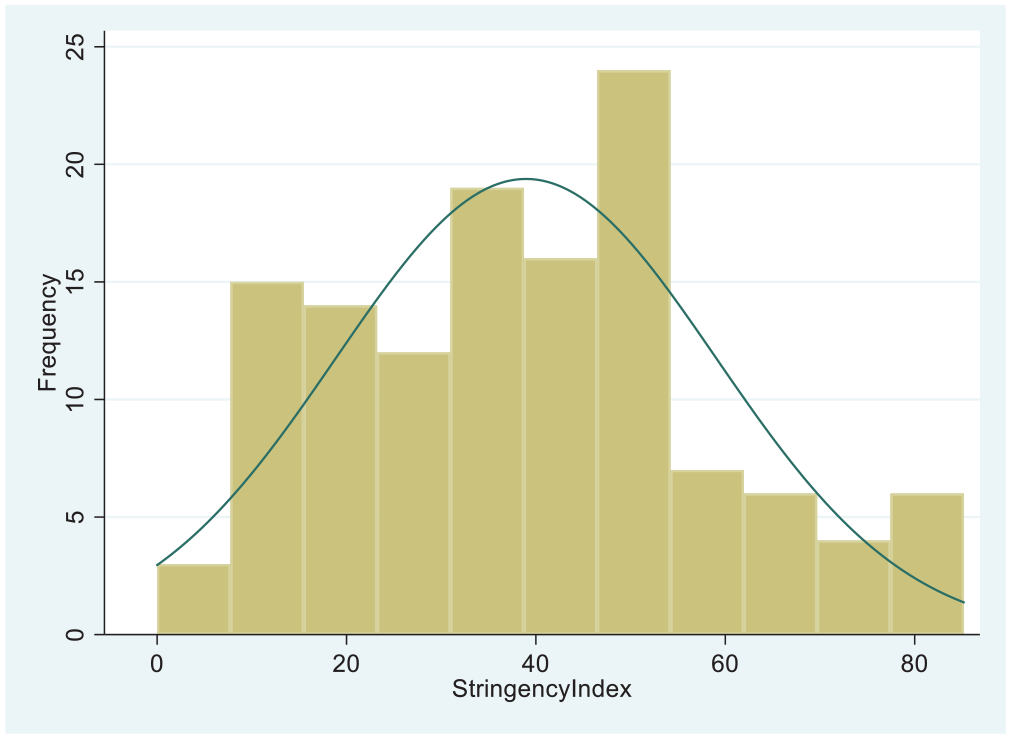
Distribution of the stringency index on March 15, 2020.
For the right-hand side control variables, they can be plausibly thought to determine why the lockdown was the way it was in that particular country. Most important would seem to be the actual extent of impact that COVID-19 had had on a country by March 15 (or March 30) and the prospect of how the shape of the curve was beginning to look; to account for this, I use both the number of confirmed cases of coronavirus and the number of deaths attributed to the virus as of March 15 or March 30. The information contained in these variables may not only capture the extent of COVID’s effect on that particular country, but also may capture additional institutional and cultural attributes which could be determining both popular and political responses (Huynh 2020; van Bavel et al. 2020).
As our hypothesis is that heuristics pick up where institutions leave off, in addition to the public health indicators, the institutions variable shown in Equation 1 comprises a salient attribute of the political system which could have an impact on the response to a pandemic: executive constraints, which represent how institutionalized political limitations are on the chief executive, with the assumption that a highly constrained national executive would not be able to unilaterally introduce wide-ranging lockdown measures (alternatively, a weak executive may be pressured by legislative bodies to have a more expansive lockdown). Additional institutional measures may be explored in future research (and indeed are attempted in robustness tests below), but executive constraints is the most omnibus variable that can be used, in the sense of encompassing check and balances, legislative influence, and regime type.
Complementing these public health and institutional indicators are a vector of macroeconomic and country specific indicators plausibly correlated with the stringency of the lockdown, a complete list of which is given in Appendix A. Given that much of the data used here is available solely on an annual basis, the macroeconomic/country variables show values current as of the last available annual datapoint, either 2019 or 2018 (or in a very few instances, 2017).
However, the most important trait for the purposes of this examination is the “Leader” variable in Equation 1, a vector of specific heuristics—proxied by various personality attributes —which might determine how a particular political leader would act in a given situation. As the difficulties with quantifying the personality or decision rules of a large group of leaders are legion, I take a page from Hartwell (2013) and use the background of a leader as a way to classify the likelihood of use of a specific heuristic. This vector thus includes:
Ideology: A highly prevalent heuristics in political decision-making must be the reliance on one’s own ideology in the face of uncertainty; when confronted by a shifting, uncertain, or incomplete scenario (or even disputed facts, see Kahan 2013), it is logical that a leader would rely first on their principles to decide a course of action. Whether or not a leader is left-wing or right-wing may make a great difference on their approach to the lockdown, with left-wing leaders more likely to default to stringent, government-ordered measures, and right-wing leaders preferring less intervention and more liberty. To capture this effect, I include a dummy taking the value of 1 if a leader is left-wing, 0 otherwise.
Representativeness: The representativeness heuristic—when a leader judges probabilities “by the degree to which A is representative of B, that is, by the degree to which A resembles B” (Tversky and Kahneman 1974:1124)—may be one of the most highly used heuristics by a policymaker (Stolwijk and Vis 2021). It can be conjectured that, the longer one has been in a job, the more they have seen and thus the more they are likely to frame the next crisis in terms of previous ones and act accordingly. In the COVID-19 context, this would mean a reluctance to impose highly stringent lockdowns, as such measures would not have been needed before. In order to capture this likelihood, I use three separate measures: first, the number of months a leader has been in power to proxy for likelihood of using the heuristics (Luan, Reb, and Gigerenzer 2019:1747 note that “more experienced decision makers tend to adopt heuristics more frequently”). Second, the age of a leader may determine generational and/or cohort effects in dealing with stress (as older people tend to rely more on decision rules, see Besedeš et al. 2012), an effect which can be seen from the dispersion of ages in the database (Figure 2). Third, I also include a dummy variable capturing if the leader was in power during the H1N1 pandemic in 2009 (to assess the closest living experience to COVID-19).
Gender: There is a broad literature in political science and psychology on how voters use heuristics related to gender (Pétry and Duval 2017), while there are many popular canards (especially related to COVD-19) regarding the role of gender in leadership styles and decisions (Stevens 2012; Vecchio 2002). With reference to the use of heuristics, however, there is evidence that different genders use different heuristics: in particular, men may be prone to overconfidence and escalation of commitment heuristics—in addition to relying on heuristics more overall (Gotlieb et al. 2019)—while women would be less likely to rely on these (Croson and Gneezy 2009) but more likely to use an affect heuristics, that is, relying on emotion at the moment as a guide to decision-making (Nouri and AhmadiKafeshani 2019 provide evidence for this in a study of entrepreneurs). To capture these effects, a dummy is included for sex, with 1 for a male leader and 0 for a female leader.
Illusion of control: In a pandemic, with an unseen foe spreading before accurate information about its nature is available, there is a need to be seen to be maintaining some form of control; by exercising lockdowns and other emergency policies, politicians may believe that actually do have some control over the situation. However, given the role of chance in such a situation, politicians may instead be relying on a common heuristic, the illusion of control (Langer 1975), which implies expectancy of a high probability of success unwarranted by the actual probabilities (Stefan and David 2013; Thompson et al. 2007). A crude measure of assessing this illusion may be the military background of a particular leaders, as the training given to military personnel, whether enlisted or in the officer class, may assist in decision-making under pressure by revealing that control is actually an illusion; alternatively, it could also bias a person toward a certain type of certitude in decision-making in order to stymie the foe.
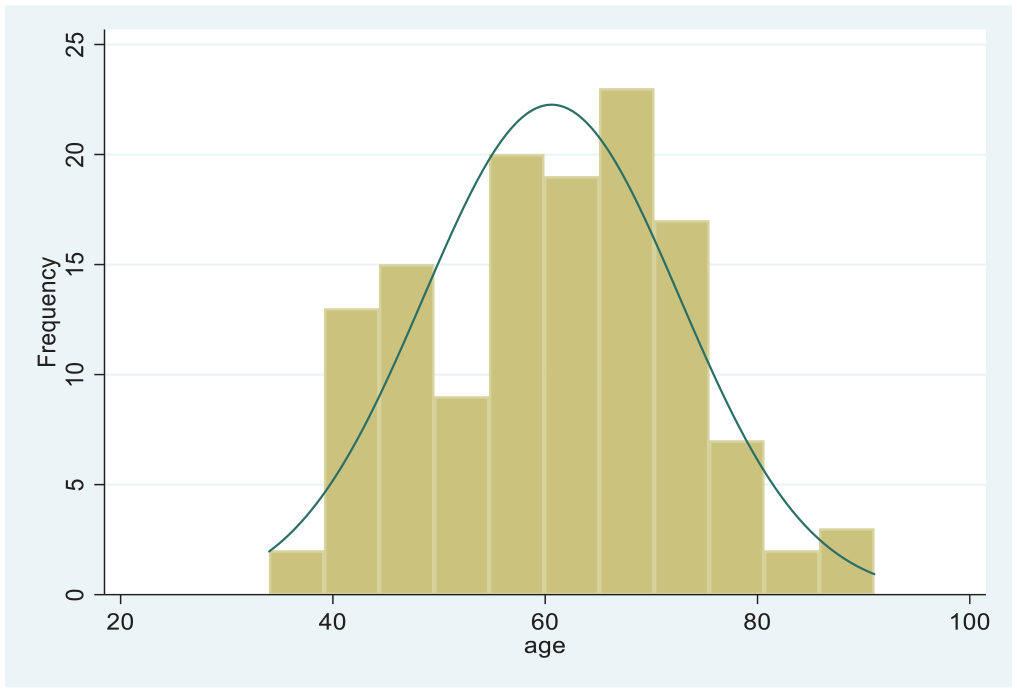
Dispersion of leader ages in the database.
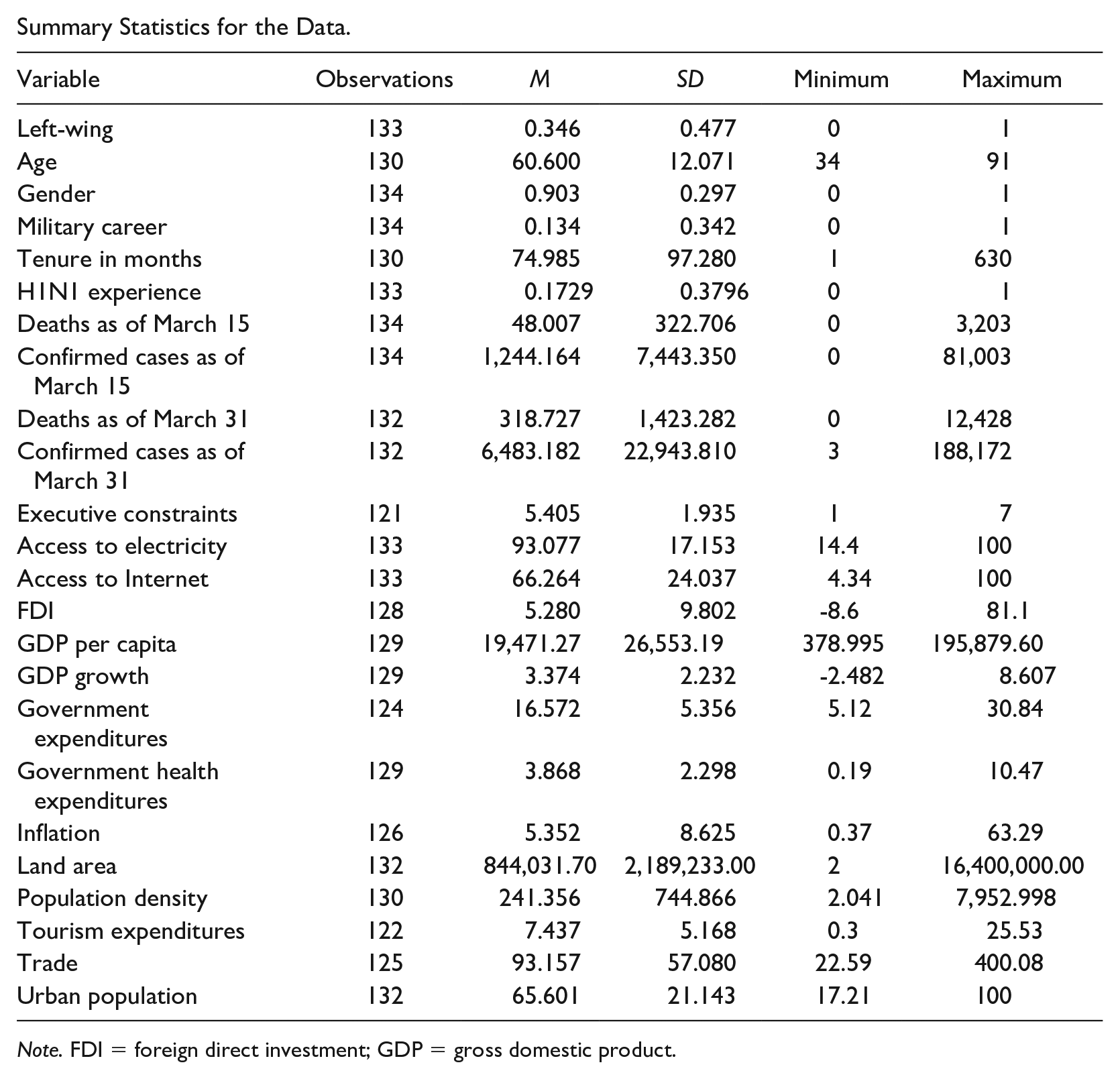
This list of personality and background traits used to proxy for heuristics is by no means exhaustive and indeed shows the difficulties of creating a broad-based, cross-country analysis which may absorb leadership traits—and the corresponding use of heuristics—across countries. But based on availability at this moment, and in the absence of the grand post-COVID history that is yet to be written, these traits may at least be plausibly correlated with the response to the pandemic and informed how a leader would approach the question of a lockdown (summary statistics of all variables are shown in Appendix B).
To test this model econometrically, I have put together a database of 135 countries for a cross-sectional regression on the two days, with the estimator used for Equation 1 a standard ordinary least squares regression with standard errors clustered on the country variable; given the large number of plausible covariates, a stepwise general-to-specific (GETS) method in the manner of Hendry (1995) is used to narrow down the specification to only significant variables other than those variables of interest. Given the patchy availability of some institutional data, this yields in reality a number of observations between 103 and 119 for the regressions shown below.
Results
The results of this brief examination are shown in Tables 1 (for March 15) and 2 (for March 30). Most interestingly, the leadership variables shown here are highly insignificant on March 15 in explaining the strength of the lockdown; indeed, when including all leadership variables (columns 13 and 14), the level of the Stringency Index at this date apparently has no correlation with any specific leadership characteristics apart from the left-wing measure, which has a negative and significant (at the 10 percent level) correlation with the strength of the lockdown. Instead, it appears that the biggest significant driver of the stringency of the lockdown globally was the number of deaths in a particular country to that point, perhaps suggesting how severe the pandemic was going to be in a particular country and how massive a response was envisioned. However, particularly interesting for our hypothesis is that it appears that institutional measures played far more of a role than leadership traits, with the constraints on the executive being correlated with higher stringency, perhaps in response to clamoring from the public and the legislative branch for action, and each increase in executive constraints appears to be correlated with an increase in the Stringency Index of approximately 3 points.
Drivers of the Stringency Index as of March 15, 2020.
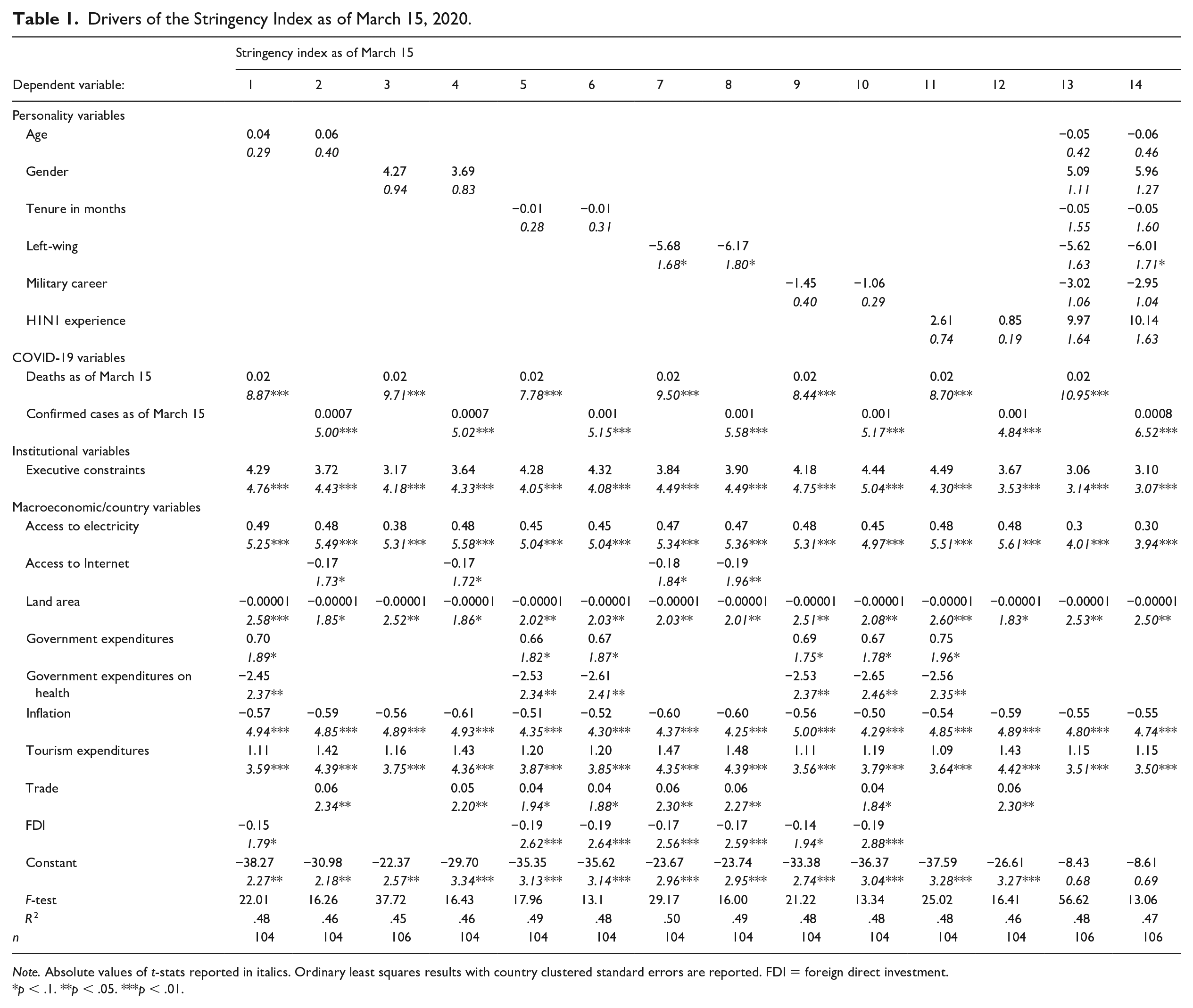
Note. Absolute values of t-stats reported in italics. Ordinary least squares results with country clustered standard errors are reported. FDI = foreign direct investment.
p < .1. **p < .05. ***p < .01.
Shifting to March 30, however, the story is much different. Considering each personality trait in isolation, in the first instance, institutional metrics have mostly fallen away in significance, and the incidence of both deaths and confirmed cases has dropped in significance to almost zero. While some controls, especially tourism and inflation, remain significant, the main drivers of the stringency index as of this date appear to be the leaders themselves: in particular, the length of time that a leader has been in office and whether or not a leader is left-wing, both of which are correlated with less stringent lockdowns at the outset of the pandemic. As in the earlier regressions, the leader’s gender has no impact on average on the stringency of the lockdown, a result consistent with the findings of Ferreira and Gyourko (2014) but directly contradicts the arguments of C. Johnson and Williams (2020).
These results are even stronger in the columns 13 and 14 of Table 2, where we include all personality characteristics together in order to provide a more holistic picture; the statistical significance of tenure and ideological orientation increase, while whether or not a leader served in the military and/or experience the H1N1 pandemic also appears to be a moderating influence on the stringency of a lockdown. Taken together, either the left-wing or military career variables have a much more significant impact on stringency (of multiple orders of magnitude) than health expenditures, previously the key driver of the index. Most importantly, in line with our hypothesis, the executive constraint variable drops out entirely. Robustness tests—not shown because they lead to the same result—utilizing various institutional metrics such as polity2, level of democracy, political competition (all from the Polity IV database) or an overall political risk rating, corruption, and a composite risk rating (from the International Country Risk Guide, ICRG) in place of executive constraints also showed no significance for institutions and in each case the institutional variable was dropped as part of the GETS process. 2 An additional robustness test, shown here as column 15 in Table 2, included both dummies for European Union (EU) membership and whether a country was located in Asia (including South, Central, Southeast, and East Asia); as can be seen, the results remain the same in terms of leadership attributes but Asian countries also are marginally correlated with a slightly lower lockdown stringency at the outbreak of the pandemic, perhaps attributable to cultural precepts (although this is not tested for explicitly). 3 In sum, by March 30, the attributes of leaders—which would have been ignored in a purely institutional analysis—were the main determinants of the key policy decisions of 2020.
Drivers of the Stringency Index as of March 31, 2020.
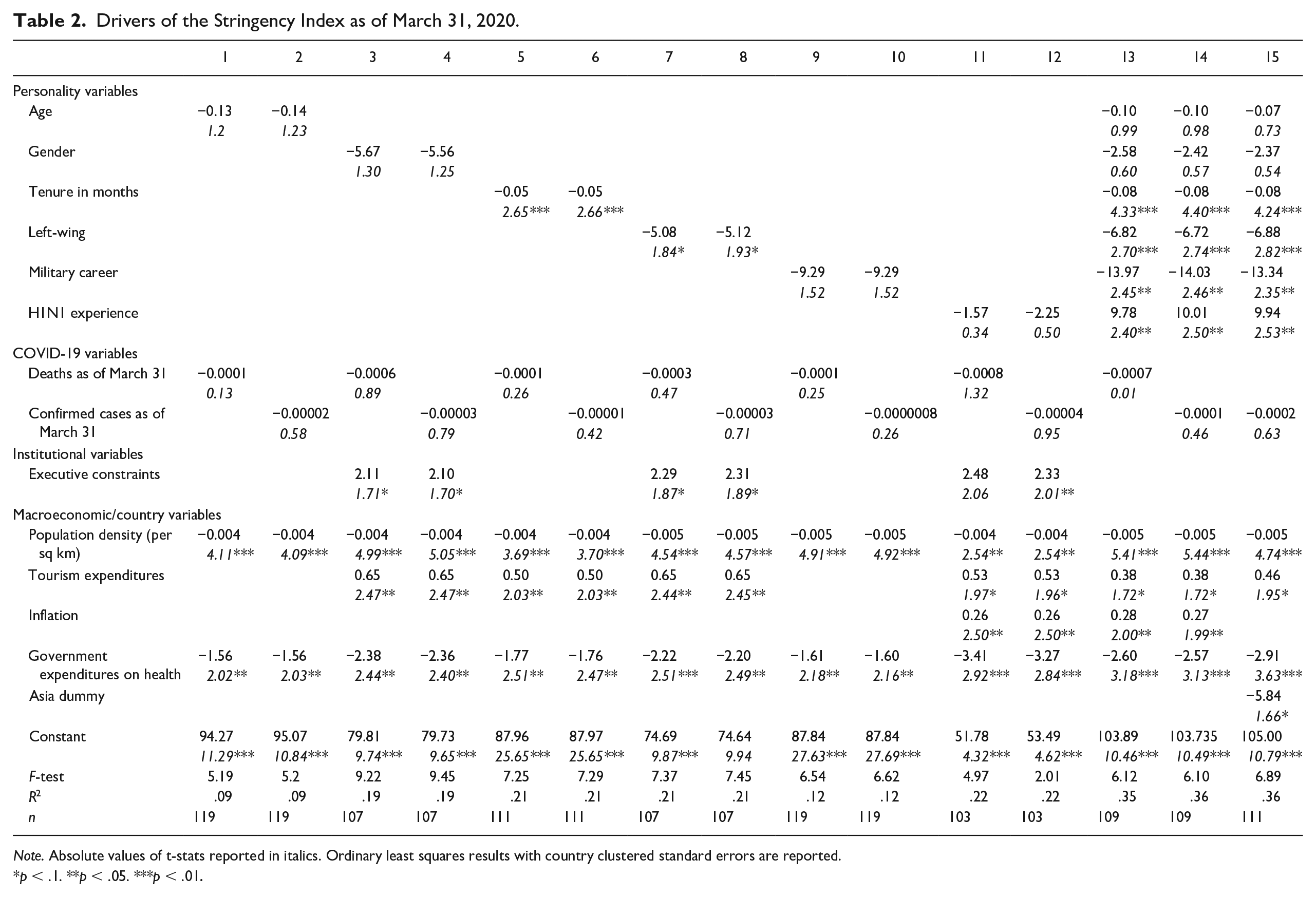
Note. Absolute values of t-stats reported in italics. Ordinary least squares results with country clustered standard errors are reported.
p < .1. **p < .05. ***p < .01.
Conclusions
The fact that leadership matters should not be surprising to even casual readers of the crisis literature. The fact that political leadership relies on heuristics should also not be surprising for readers of any form of psychological or sociological journals. However, when heuristics are employed—and when they switch—is an area which is relatively less explored with regard to political leaders, and this paper has charged into this area with a novel data set and theoretical construct. Using a case study with the COVID-19 pandemic as the backdrop, and supplemented by an empirical exercise, we found that political leaders at the outset of the pandemic tended to rely on heuristics most strongly when institutions were least effective in dealing with such an extraordinary crisis. In a vacuum of institutional expertise, politicians are thus more likely to push for extreme policies which comport with their own views of the world. This does not necessarily mean that reliance on heuristics is incorrect or if this reliance led to policies which were a failure (even though there may be obvious instances where this is the case); rather, what we have explored here is the actual recourse to heuristics as a decision-making tool under extreme stress and where institutions are inadequate to provide guidance.
This paper provides early evidence of the reliance on heuristics but has some notable shortcomings. In the first instance, in tribute to Vis (2019), we have no interviews or up close and personal information from policymakers during COVID-19, meaning that we are left to make educated guesses about the use of heuristics based solely on the background of the particular leader. Second, as noted in the previous section, our knowledge of the influence of political heuristics in a cross-country context is limited by the data available on “leadership” and “personality” of political leaders. Both of these shortcomings suggest avenues for future research, including application of much more rigorous attributes taken from cognitive theory and applied to leaders during the pandemic. Indeed, with the pandemic ongoing, it is likely that the definitive work on political responses is yet to be written, as such research is a function of time, but is an area that will keep cognitive psychologists, sociologists, and political scientists busy for decades.
Perhaps more attainable is the second limitation, which calls for amassing a database of world leaders during the pandemic and performing a more thorough econometric examination than done here. One of the main difficulties in cross-country leadership studies is the lack of comparable data, relying oftentimes on comparative case studies; at the same time, any large data sets which capture leader attributes are often outdated by the time they are amassed. For COVID-19, a data set of leaders would be a snapshot rather than a dynamic beast, and thus is more feasible in the short run. Such a data set could also be much more psychologically specific, including expanding our knowledge of traits such as the Big Five or the Dark Triad and how they would have explained subsequent policies during the pandemic.
As a final note, this paper also suggests that there is much work to be done in wrangling psychological and political insights into a more complete picture of the institutional environment in a country. How do institutions cope with political heuristics? Do they reassert their abilities in more information-rich environments? How does institutional development interact with heuristics? The persistence of the pandemic and the divergence of responses, even nearly two years into the spread of COVID, can also provide fertile evidence on cognitive biases in the face of crises. Moreover, these biases can be aided and abetted by 21st-century phenomena, such as misinformation, social media, and the restriction of information based on whether or not it confirms the priors of the ruling elite. All of these issues remain on the table and require further study to understand not just how policymaking in a crisis is reliant on leadership traits, but on how repeated interactions and complex systems surrounding cognitive biases either dispel or reinforce these heuristics.
Footnotes
Appendix A
Appendix B
Summary Statistics for the Data.
| Variable | Observations | M | SD | Minimum | Maximum |
|---|---|---|---|---|---|
| Left-wing | 133 | 0.346 | 0.477 | 0 | 1 |
| Age | 130 | 60.600 | 12.071 | 34 | 91 |
| Gender | 134 | 0.903 | 0.297 | 0 | 1 |
| Military career | 134 | 0.134 | 0.342 | 0 | 1 |
| Tenure in months | 130 | 74.985 | 97.280 | 1 | 630 |
| H1N1 experience | 133 | 0.1729 | 0.3796 | 0 | 1 |
| Deaths as of March 15 | 134 | 48.007 | 322.706 | 0 | 3,203 |
| Confirmed cases as of March 15 | 134 | 1,244.164 | 7,443.350 | 0 | 81,003 |
| Deaths as of March 31 | 132 | 318.727 | 1,423.282 | 0 | 12,428 |
| Confirmed cases as of March 31 | 132 | 6,483.182 | 22,943.810 | 3 | 188,172 |
| Executive constraints | 121 | 5.405 | 1.935 | 1 | 7 |
| Access to electricity | 133 | 93.077 | 17.153 | 14.4 | 100 |
| Access to Internet | 133 | 66.264 | 24.037 | 4.34 | 100 |
| FDI | 128 | 5.280 | 9.802 | -8.6 | 81.1 |
| GDP per capita | 129 | 19,471.27 | 26,553.19 | 378.995 | 195,879.60 |
| GDP growth | 129 | 3.374 | 2.232 | -2.482 | 8.607 |
| Government expenditures | 124 | 16.572 | 5.356 | 5.12 | 30.84 |
| Government health expenditures | 129 | 3.868 | 2.298 | 0.19 | 10.47 |
| Inflation | 126 | 5.352 | 8.625 | 0.37 | 63.29 |
| Land area | 132 | 844,031.70 | 2,189,233.00 | 2 | 16,400,000.00 |
| Population density | 130 | 241.356 | 744.866 | 2.041 | 7,952.998 |
| Tourism expenditures | 122 | 7.437 | 5.168 | 0.3 | 25.53 |
| Trade | 125 | 93.157 | 57.080 | 22.59 | 400.08 |
| Urban population | 132 | 65.601 | 21.143 | 17.21 | 100 |
Note. FDI = foreign direct investment; GDP = gross domestic product.
Acknowledgements
The author thanks Bernard Steunenberg, Geoffrey Layman, and Timothy Devinney for their comments and help.
Declaration of Conflicting Interests
The author(s) declared no potential conflicts of interest with respect to the research, authorship, and/or publication of this article.
Funding
The author(s) received no financial support for the research, authorship, and/or publication of this article.
