



Abstract
Objectives
The increasing awareness of health has led to a significant increase in the consumption of plant-based milk (PBM) alternatives and probiotics. Probiotics are live microorganisms that are beneficial to gut health. This study aims to assess the antibacterial activity of Limosilactobacillus fermentum in different types of PBM, particularly oat (OM), almond (AM), soy (SM), hazelnut (HM), and coconut (CM) milk against pathogenic bacterial strains (Escherichia coli, Bacillus subtilis, and Klebsiella oxytoca), and to examine the sensitivity of these pathogenic bacterial strains to different antibiotics.
Methods
Each PBM was divided into two samples: one inoculated with L. fermentum and one control without. All were fermented anaerobically at 37 °C for 48 hours. The antibacterial activity against E. coli, B. subtilis, and K. oxytoca was assessed using the agar well diffusion method by measuring inhibition zones. Additionally, pathogen susceptibility to seven antibiotics (AMP, OXC, KAN, E, CXT, CAZ, and AMX) was determined using the Kirby-Bauer disk diffusion assay on Mueller-Hinton agar.
Results
Coconut and oat milk fermented with L. fermentum showed significantly (p < 0.05) enhanced inhibition (10 ± 1.87 mm and 6.75 ± 1.59 mm, respectively) against B. subtilis compared to their controls. In contrast, almond milk exhibited strong activity in the control group (12.00 ± 0.25 mm), which decreased notably after fermentation (2.91 ± 1.63 mm; p < 0.05). Moderate inhibition (p < 0.05) of K. oxytoca was observed in treated soy and hazelnut milk, while E. coli showed no inhibition in any treated samples. The antibiotic susceptibility assay revealed that B. subtilis exhibited the largest inhibition zone (22 ± 11.31 mm) in response to E. Additionally, K. oxytoca and E. coli were more susceptible to KAN, with inhibition zones of 14.75 ± 0.35 mm and 14.25 ± 1.06 mm, respectively.
Conclusion
In conclusion, these findings suggest that fermented PBMs may serve as natural antibacterial alternatives with potential functional food applications.
Introduction
Pathogenic bacteria such as Escherichia coli, Bacillus subtilis, and Klebsiella oxytoca are known to cause a wide range of gastrointestinal and systemic infections, particularly in immunocompromised individuals. 1 However, although E. coli is a common gut commensal, certain pathogenic strains (eg, EHEC, ETEC, EPEC) can lead to severe illnesses such as diarrhea, urinary tract infections, and hemolytic uremic syndrome. 2 B. subtilis, generally considered non-pathogenic, has also been associated with opportunistic infections and foodborne outbreaks. 3 K. oxytoca, an opportunistic Gram-negative bacterium, is implicated in hospital-acquired infections, including antibiotic-associated colitis and urinary or respiratory tract infections. 4
In recent years, plant-based milk (PBM) alternatives have gained significant popularity due to increasing consumer interest in health-conscious, sustainable, and dairy-free diets. 5 These PBMs derived from nuts, grains, legumes, and seeds not only serve as functional alternatives to cow's milk but also offer unique bioactive compounds with potential antimicrobial properties. 5 For instance, oat milk contains avenanthramides, 6 soy milk is rich in isoflavones and saponins, 7 and coconut milk offers lauric acid, 8 all of which have demonstrated antibacterial effects, especially when fermented.6‐8
Fermentation plays a pivotal role in enhancing the antibacterial properties of plant-based milk through the metabolic activity of probiotic bacteria such as Lactobacillus spp. 9 During fermentation, lactic acid bacteria (LAB) produce organic acids, primarily lactic acid, which reduces the pH of the medium, creating an inhospitable environment for many pathogenic microorganisms.10‐15 This acidification not only extends shelf life and improves microbial safety but also contributes directly to antibacterial activity by inhibiting the growth of both Gram-positive and Gram-negative bacteria. 16 The extent of this antibacterial enhancement, however, is influenced by the composition of the plant matrix, the probiotic strain used, and the nature of the target pathogen.17‐19
Incorporating probiotics into plant-based milks (PBMs) represents a strategic approach to enhance their functionality by combining nutritional benefits with natural antimicrobial properties.18,19 The interaction between probiotic strains and various PBM substrates during fermentation can influence the production of bioactive compounds,12‐14 particularly those with antibacterial activity. 5 Understanding these dynamics is essential for optimizing the formulation of probiotic-enriched PBMs as effective vehicles for health promotion and microbial inhibition. In this study, almond, soy, oat, hazelnut, and coconut milks were selected because they are among the most widely consumed plant-based milk alternatives globally. These variations offer diverse nutrient profiles and bioactive compounds, enabling a comprehensive evaluation of how different substrates impact the antibacterial activity of probiotic fermentation. Therefore, this study aims to assess the antibacterial activity of Limosilactobacillus fermentum in different types of PBM (almond, soy, oat, hazelnut, and coconut milk) against pathogenic bacterial strains (Escherichia coli, Bacillus subtilis, and Klebsiella oxytoca), and to compare their effects with standard antibiotics by determining the antibiotic susceptibility profiles of these pathogens. The bacterial strains used in this work, including the probiotic L. fermentum and the pathogenic strains E. coli, B. subtilis, and K. oxytoca, were previously isolated, and their species-level identification was confirmed by 16S rRNA gene sequencing in our laboratory. 4 To the best of our knowledge, this is the first study to evaluate the antibacterial activity of multiple plant-based milks fermented with L. fermentum against three strains of pathogens, as well as to examine the antibiotic susceptibility profiles of these pathogens.
Materials and Methods
Bacterial Strains
Escherichia coli (PV875700), Klebsiella oxytoca (PV875705), Bacillus subtilis (PV875767), and Limosilactobacillus fermentum 3152 (0804) were isolated and purified from cheese samples in our laboratory. Species-level identification was confirmed by 16S rRNA gene sequencing, and all isolates were cryopreserved at −80 °C for future experiments. 5
Antibacterial Potential of L. fermentum in PBM Against Pathogenic Bacterial Strains in Plant-Based Milk
Sample Preparation
A pure culture of Lactobacillus fermentum was cultivated and adjusted to a concentration of 108 CFU/mL using spectrophotometric turbidity measurements and serial dilutions. 20 Five experimental tubes were inoculated with the prepared suspension of L. Fermentum (1 mL), while five control tubes contained no bacterial inoculum. Each tube was supplemented with 10 mL of PBM substrates, including coconut, soy, almond, oat, and hazelnut milk) ALPRO™, Alpro, Ghent, Belgium(, sourced from the local market. The tubes were sealed and incubated at 37 °C for 48 h under anaerobic conditions to simulate fermentation. Pathogenic bacterial strains, including E. coli, K. oxytoca, and B. subtilis were cultivated in nutrient-rich broth (HiMedia, India) and incubated aerobically at 37 °C for 24–48 h to ensure optimal growth.
Agar Well Diffusion Assay
Mueller-Hinton Agar (MHA; HiMedia, India) plates were prepared under sterile conditions. 5 A total of 60 plates, all of which were inoculated with the target pathogenic strains. Thirty plates served as controls, which had plant milk alone, while the remaining 30 plates had the L. fermentum-treated PBM. All plates were inoculated with pathogenic strains. Each condition included two replicates for accuracy. Wells were created in the agar using a sterile punch tool, which was sterilized by submersion in ethanol and flame-drying before use. 21 The respective milk samples (200 μL per well) were aseptically transferred into the wells using sterilized pipettes. All plates were incubated anaerobically at 37 °C for 48 h. After incubation, the diameters of inhibition zones surrounding each well were measured in millimeters using a calibrated ruler. The mean inhibition zone sizes were calculated to assess the antibacterial efficacy of L. fermentum PBM against the tested pathogenic strains.
Antibiotics Susceptibility Assay of Pathogenic Bacterial Strains
The Kirby-Bauer disk diffusion method was employed to evaluate the susceptibility of bacterial isolates to a range of antibiotics, including Ampicillin (AMP), Oxacillin (OXC), Kanamycin (KAN), Erythromycin (E), Cefotaxime (CXT), Ceftazidime (CAZ), and Amoxicillin (AMX) from HiMedia, India. Mueller-Hinton Agar plates were prepared and inoculated with a standardized bacterial suspension (adjusted to 0.5 McFarland standard) of each pathogenic strain (ie Escherichia coli, Klebsiella oxytoca, and Bacillus subtilis). 22 Sterile multi-disc dispensers and forceps were used to aseptically place seven antibiotic discs onto the surface of the agar plates, ensuring even spacing between discs. The plates were incubated at 37 °C for 24–48 h, allowing bacterial growth and the diffusion of antibiotics to classify the bacterial strains as susceptible, intermediate, or resistant to each antibiotic. 5
Statistical Analysis
Data are expressed as mean values ± standard error of the mean (SEM). Statistical comparisons among groups were performed using one-way analysis of variance (ANOVA), followed by Tukey's post hoc test. All statistical analyses were carried out using SPSS software, version 20.0 (SPSS Inc., Chicago, IL, USA). A p-value of less than 0.05 was considered statistically significant.
Results
Antibacterial Potential of L. fermentum in PBM Against Pathogenic Bacterial Strains
Among the tested combinations, B. subtilis exhibited the greatest sensitivity to untreated almond milk, producing an inhibition zone (IZ) of 12.00 ± 0.25 mm (Figure 1). However, this antibacterial effect was significantly reduced following L. fermentum treatment, with the IZ decreasing to 2.91 ± 1.63 mm. E. coli showed moderate inhibition with untreated almond milk (7.08 ± 3.81 mm), but no inhibition was observed after the treatment. K. oxytoca displayed no inhibition under either condition (Figure 1). Hazelnut milk, whether treated or untreated, showed no inhibition against E. coli, B. subtilis, or K. oxytoca. However, a slight inhibition of K. oxytoca was observed in the treated sample (3.58 ± 4.39 mm). Oat milk demonstrated selective antibacterial activity only against B. subtilis, with a clear zone of 6.75 ± 1.59 mm observed after treatment with L. fermentum (Figure 1). However, no inhibition was recorded for E. coli or K. oxytoca. Control oat milk showed no antibacterial activity against any of the strains. In the case of soy milk, L. fermentum treatment resulted in no inhibition of B. subtilis and E. coli, whereas K. oxytoca displayed a modest inhibition zone of 3.58 ± 4.47 mm. The control group showed no inhibition against any of the tested strains. In coconut milk, B. subtilis exhibited limited inhibition in the control group (4.08 ± 5.02 mm) but showed significantly increased inhibition in the treated group (10 ± 1.87 mm). In contrast, E. coli and K. oxytoca showed no inhibition in either treated or untreated conditions (Figure 1).

Antibacterial Activity of Limosilactobacillus fermentum Fermented Different Plant-Based Milks Against B. subtilis (Bs), K. oxytoca (Ko), and E. coli (Eo) Pathogens as Compared to the Control (Con; Without L. fermentum). Data are Presented as Mean ± SEM. *A = Almond, H = Hazelnut, O = oat, S = Soy, C = Coconut, and M = Milk.
Antibacterial Susceptibility of Pathogenic Bacterial Strains
The antibacterial susceptibility test revealed significant differences in inhibition zones among the bacterial strains (Table 1 & see Supplementary Figure 2). B. subtilis exhibited the largest inhibition zone (22 ± 11.31 mm) in response to antibiotic E, while other antibiotics demonstrated lower efficacy, with OXC showing no inhibitory effect. K. oxytoca and E. coli were more susceptible to KAN, with inhibition zones of 14.75 ± 0.35 mm and 14.25 ± 1.06 mm, respectively. K. oxytoca also exhibited susceptibility to CAZ (15 ± 1.00 mm) but showed no response to the remaining antibiotics. Similarly, E. coli demonstrated moderate inhibition with CAZ (8.65 ± 11.80 mm), while displaying minimal or no inhibition with other antibiotics (Table 1).
The Effects of Antibiotics on the Inhibition Zone (mm) of B. subtilis, K. oxytoca, and E. coli.
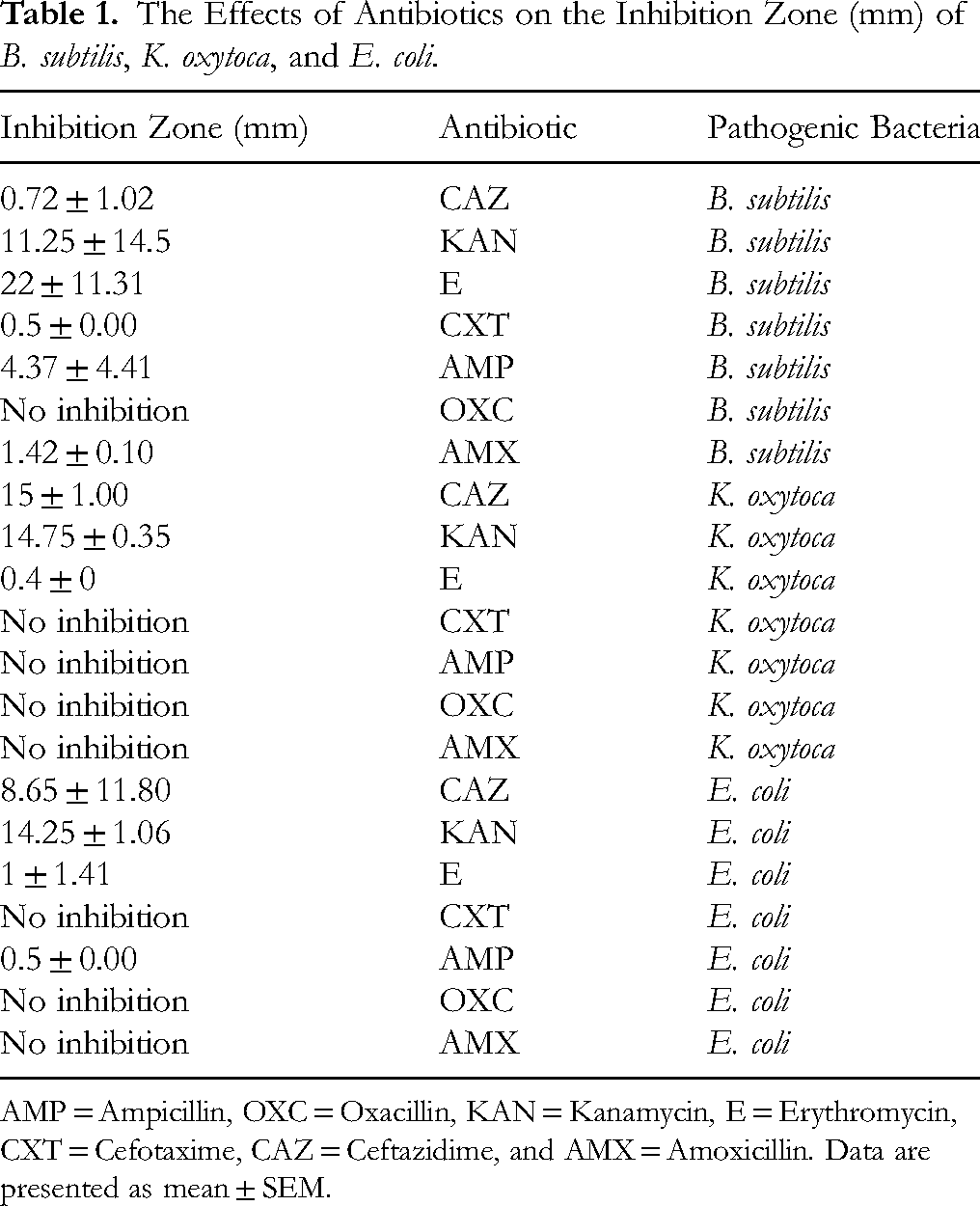
AMP = Ampicillin, OXC = Oxacillin, KAN = Kanamycin, E = Erythromycin, CXT = Cefotaxime, CAZ = Ceftazidime, and AMX = Amoxicillin. Data are presented as mean ± SEM.
Discussion
In the present study, B. subtilis was the most sensitive bacterium to almond milk, including in the control group. These findings suggest that almond milk may inhibit the growth of B. subtilis, indicating a potential antimicrobial effect. 23 Almond milk (control) showed an inhibitory effect on E. coli, whereas treated almond milk did not exhibit the same effect. This difference suggests that the treatment process may alter the bioactive components responsible for antimicrobial activity. 23 Further studies are needed to investigate this potential relationship. In addition, treated hazelnut milk exhibited antibacterial activity against K. oxytoca, but did not affect B. subtilis or E. coli. These findings are consistent with those of a previous study, 24 which also reported that hazelnut oil lacked antibacterial properties, as no inhibitory effects were observed.
Overall, soy milk exhibited minimal antibacterial activity. While fermented soy milk showed some inhibitory effect against K. oxytoca, it remained ineffective against B. subtilis and E. coli, highlighting its limited antibacterial potential in unmodified form. Similar trends have been observed in studies involving soy-based products. 25 Gutiérrez et al 26 reported that soy-derived compounds demonstrated variable antibacterial activity, with Klebsiella species showing greater susceptibility than Bacillus. Further findings by Kim et al 27 emphasized that antimicrobial efficacy depended on several factors, including the bacterial species, concentration of the compounds, and the specific soy-derived constituents involved. These differences in susceptibility are likely linked to structural variations between bacterial types. Gram-positive bacteria, such as B. subtilis, have a thick peptidoglycan layer but lack an outer membrane. 28 This structural composition allows easier penetration of certain antibiotics, particularly those targeting cell wall synthesis.
In contrast, Gram-negative bacteria like K. oxytoca possess an outer membrane composed of lipopolysaccharides and proteins, which acts as a selective barrier, impeding the entry of many antimicrobial compounds. 28 This outer membrane contains porins that permit the passage of specific small molecules; however, it contributes to the intrinsic resistance of Gram-negative bacteria to various antibiotics. 28 Similarly, the absence of inhibitory activity against E. coli and K. oxytoca in both treated and untreated oat and coconut milk could suggest that oat and coconut derivatives generally have limited effectiveness against gram-negative bacteria because of their outer membrane barrier, which restricts the penetration of antimicrobial agents. 29 The observed increase in inhibition of B. subtilis in treated coconut milk compared to the control suggested that treatment enhances the antimicrobial properties of coconut milk, potentially due to the activation or release of bioactive compounds. Dabesor et al, 30 reported that ethanol coconut extracts exhibited notable antibacterial activity against gram-positive bacteria like B. subtilis.
The fundamental principles regarding the antibacterial properties of antibiotics can be further categorized. 31 Notably, antibiotic E exhibited the strongest bactericidal action against B. subtilis, while KAN demonstrated the second most effective action. KAN emerged as the most effective antibiotic in this study, proving effective across nearly all bacterial strains tested. The findings suggested that E. coli employs various strategies to develop resistance against antibiotics. 5 Specifically, KAN treatment appears to enhance mechanisms within E. coli that mitigate oxidative stress. 32 Ultimately, while antibiotics are valuable in medical treatments, bacterial organisms can develop effective resistance mechanisms that amplify stress responses, allowing them to evade the intended effects of these drugs. 32 This adaptability may enable pathogenic bacteria to better withstand antibiotic pressures in the future. Further studies are needed to explore the mechanisms underlying catalase resistance to improve treatment outcomes.
A key limitation of this study is that antibacterial activity was assessed only by agar well diffusion, without employing more precise assays such as MIC determination, time–kill studies, or in vivo models, which could have provided deeper insights into the inhibitory mechanisms. Another limitation is the lack of chemical profiling of fermented PBMs to identify the specific bioactive compounds responsible for their antibacterial effects. Addressing these aspects in future work would strengthen the interpretation and applicability of the findings.
Conclusion
The objective of this research was to examine the sensitivity of B. subtilis, K. oxytoca, and E. coli to different antibiotics. Additionally, to evaluate the antibacterial activity of L. fermentum in various plant-based milk alternatives and to assess their inhibitory effects against these pathogenic strains. In terms of antibiotic susceptibility, the most potent bactericidal effect against B. subtilis was observed with antibiotic E, followed by KAN. Among the antibiotics tested, KAN emerged as the most consistently effective agent, demonstrating broad-spectrum activity across nearly all bacterial strains evaluated. Experimental results revealed that none of the plant-based milk samples with L. fermentum exhibited antibacterial activity against E. coli. However, almond milk demonstrated inhibitory effects against B. subtilis, while soy and hazelnut milk showed moderate activity against K. oxytoca. These findings highlight the selective antibacterial properties of plant-based milks, which appear to be further influenced by fermentation. Future research should focus on optimizing fermentation protocols, fine-tuning the concentrations of bioactive compounds, and investigating synergistic combinations of plant-based milks with other natural or synthetic antimicrobial agents to enhance their antibacterial efficacy. At the same time, the growing concern over bacterial resistance underscores the need for deeper investigation. Understanding these resistance mechanisms will be crucial for enhancing the therapeutic potential of plant-based milk alternatives and informing the development of more effective, targeted antimicrobial strategies.
Supplemental Material
sj-docx-1-npx-10.1177_1934578X251394618 - Supplemental material for Antibacterial Activity of Plant-Based Milk Containing Limosilactobacillus fermentum and Antibiotic Susceptibility of Pathogenic Bacterial Strains
Supplemental material, sj-docx-1-npx-10.1177_1934578X251394618 for Antibacterial Activity of Plant-Based Milk Containing Limosilactobacillus fermentum and Antibiotic Susceptibility of Pathogenic Bacterial Strains by Dema Alghamdi, Shahad Alaslani, Reem Almutairi, Ruwaydah Alqahtani, Haneen Yajzi, Aeshah Aljohani and Amal Bakr Shori in Natural Product Communications
Footnotes
Acknowledgements
This project was funded by the Deanship of Scientific Research (DSR), King Abdulaziz University, Jeddah, under grant No. (IPP: 76-247-2025). The authors, therefore, gratefully acknowledge the DSR technical and financial support.

Ethics Approval,Animal Welfare and Consent to Participate (for Human Samples)
There are no human subjects in this article and informed consent is not applicable.
Consent for Publication
All authors have read and approved the final manuscript and consent to its publication.
Author Contribution(s)
Funding
The authors disclosed receipt of the following financial support for the research, authorship, and/or publication of this article: This work was supported by the King Abdulaziz University, (grant number IPP: 76-247-2025).
Declaration of Conflicting Interests
The authors declared no potential conflicts of interest with respect to the research, authorship, and/or publication of this article.
Availability of Data and Materials
The datasets used and/or analyzed during the current study are available from the corresponding author on reasonable request.
Supplemental Material
Supplemental material for this article is available online.
References
Supplementary Material
Please find the following supplemental material available below.
For Open Access articles published under a Creative Commons License, all supplemental material carries the same license as the article it is associated with.
For non-Open Access articles published, all supplemental material carries a non-exclusive license, and permission requests for re-use of supplemental material or any part of supplemental material shall be sent directly to the copyright owner as specified in the copyright notice associated with the article.
