



Abstract
Keywords
Introduction
Aedes aegypti (Diptera: Culicidae) and Aedes albopictus (Diptera: Culicidae) are major vectors of diseases caused by arboviruses such as dengue, yellow fever, chikungunya, and Zika.1,2 Dengue fever is a leading health problem, with an estimated 400 million new cases globally every year, of which Asia accounts for 75%, followed by Latin America and Africa. 3 Vietnam is a hyperendemic country for dengue, with all four serotypes circulating year-round and a median annual incidence of 232 cases per 100 000 people. 4 Chikungunya is also projected to become a significant health threat in the near future.4,5 For decades, synthetic pesticides have played an important role in mosquito control programs. However, the increasing global disease burden6,7 and the expanding distribution of mosquito species 8 demonstrate that traditional synthetic pesticides are gradually becoming less effective. Furthermore, traditional pesticides have been reported to have negative impacts on the environment and human health. Recently, essential oils are being considered as a source of biopesticides due to their many advantages, such as broad-spectrum effectiveness, low toxicity to non-target organisms, difficulty for target organisms to develop resistance, and rapid decomposition.9–11
Alpinia breviligulata (Gagnep.) Gagnep. (Zingiberaceae) is a native species of Vietnam, commonly found growing along streams in secondary forests and plain areas. In Vietnamese folklore, the rhizome of A. breviligulata is often used to treat stomachaches by decocting water to drink. 12 Several previous studies have demonstrated that all different parts of this plant contain essential oils.13–16 The abundance and availability of A. breviligulata as a raw material for biopesticides prompted us to carry out research on the chemical composition and larvicidal activities of essential oils from different parts of this plant. To our knowledge, this is the first report of the examination of A. breviligulata essential oil as a mosquito larvicidal agent.
Materials and Methods
Plant Material
Leaves, stems, rhizomes, and roots of Alpinia breviligulata were collected from Khanh Hoa Province, Vietnam, in February, 2024, and identified by Dr Dinh Quang Diep (Table 1).
Collection and Hydrodistillation Details of Alpinia breviligulata from Vietnam.

Extraction of Essential Oils
To determine the yield of essential oils, fresh materials were used. Each extraction process utilized 50 grams of fresh material, and the procedure was repeated three times. The essential oil was extracted through hydrodistillation using a Clevenger apparatus from Witeg Labortechnik, located in Wertheim, Germany. The distillation process lasted for 6 h.
Gas Chromatographic – Mass Spectral Analysis
Gas chromatography–mass spectral analyses (GC/MS) of essential oils were carried out using a Shimadzu GCMS-QP2010 Ultra (Shimadzu Scientific Instruments, Columbia, MD, USA): with a ZB-5 ms fuzed silica capillary column (60 m length, 0.25 mm diameter, and 0.25 μm film thickness) (Phenomenex, Torrance, CA, USA), He carrier gas, 2.0 mL/min flow rate, injection and ion source temperatures of 260 °C, and a GC oven program of 50 to 260 °C at 2.0 °C/min was used. A 0.1 μL amount of a 5% (w/v) sample of essential oil in CH2Cl2 was injected in split mode with a 24.5:1 split ratio. Only one injection for each essential oil was carried out. Retention indices (RI) were determined by the method of Van den Dool and Kratz, calibrating the instrument with a homologous series of n-alkanes (C8-C28) acquired on the same day using the same instrument under the same conditions. 17 Identification of the essential oil components was carried out with a comparison of MS fragmentation and RI with those available in the databases.18–21
Larvicidal Biassays
Aedes aegypti and Ae. albopictus mosquitoes are continuously maintained at Duy Tan University. Mosquito eggs were allowed to hatch in tap water overnight. The larvae were then fed a mixture of cat food and yeast in a ratio of 3:1 (w/w). All developmental stages of mosquito species were kept under laboratory conditions with a temperature of 25 °C, relative humidity of 75%, and a 12-h light/12-h dark cycle.
Larvicidal activities were conducted following the guidelines outlined by the World Health Organization with modifications. 22 Third instar and early fourth instar larvae were selected for the larvicidal activity assays. Twenty-five larvae were transferred into 250-mL beakers containing 150 mL of distilled water. Essential oils were dissolved in ethanol (Sigma-Aldrich) to prepare 1% stock solutions. Various volumes of the stock solutions were added to the test beakers containing mosquito larvae to achieve desired concentrations of 100, 50, 25, 12.5, 6.25, and 3.125 µg/mL (n = 100), respectively. Ethanol served as the negative control (0.5 mL ethanol/150 mL H2O), while permethrin (Sigma-Aldrich) was used as the positive control. Each concentration of agents was tested in quadruplicate. The number of dead larvae was recorded after 24 and 48 h of exposure. Larvicidal activity assays were conducted under the same mosquito rearing conditions. There were no mortalities in the negative (ethanol) controls.
Statistical Analysis
The mortality data were analyzed using log-probit analysis 23 to obtain LC50 and LC90 values, along with 95% confidence limits, utilizing Minitab® version 19.2020.1 (Minitab, LLC, State College, PA, USA).
Results
Chemical Profiles of Essential Oils
The leaves showed the highest essential oil yield compared to other parts (0.31%) (Table 1). Details of the chemical composition of essential oils from different parts (leaves, root, stem, and rhizome) of A. breviligulata are presented in Table 2. The main components of leaf essential oil were α-pinene (19.4%), caryophyllene oxide (15.1%), and α-copaene (8.5%). Essential oil from the roots included the main components α-humulene (12.3%), camphene (10.3%), endo-fenchyl acetate (9.4%), (E)-β-caryophyllene (7.0%), and α-pinene (5.5%). The essential oil of the stem is characterized by the main components caryophyllene oxide (27.7%), humulene epoxide II (6.4%), and α-copaene (5.4%). The main components of rhizome essential oil are characterized by monoterpenes such as β-pinene (18.1%), α-pinene (10.4%), camphene (6.7%), and in addition, there is a sesquiterpenoid content of 5.0%, which is atractylone.
Essential oil Compositions of Alpinia breviligulata.

RIcalc = Retention index calculated with respect to a homologous series of n-alkanes on a ZB-5 ms column. RIdb = Reference retention index from the databases. tr = trace (<0.05%), - = not detected. Major components are highlighted in blue bold font. Unidentified components > 1% are highlighted in red font.
a MS(EI): 220(6%), 205(14%), 202(11%), 192(14%), 191(70%), 187(20%), 177(42%), 159(91%), 149(42%), 135(84%), 121(100%), 108(66%), 107(68%), 105(60%), 93(91%), 91(60%), 81(63%), 55(45%), 41(40%).
b MS(EI): 238(27%), 223(11%), 205(13%), 195(20%), 181(31%), 177(20%), 162(58%), 155(25%), 147(17%), 137(28%), 128(47%), 123(30%), 110(40%), 109(54%), 95(99%), 85(27%), 81(32%), 71(54%), 69(53%), 55(51%), 43(100%), 41(41%).
c MS(EI): 300(32%), 163(23%), 162(29%), 133 (16%), 123(15%), 117(18%), 107(20%), 95(28%), 94(100%), 81(35%), 69(20%), 55(18%), 41(16%).
d MS(EI): 300(27%), 218(22%), 204(100%), 189(47%), 161(37%), 147(25%), 133(46%), 122(31%), 119(45%), 109(39%), 108(44%), 107(43%), 105(45%), 81(51%), 69(35%), 55(33%), 41(32%).
e MS(EI): 300(10%), 282(35%), 189(10%), 176(10%), 162(13%), 147(15%), 133(16%), 124(20%), 119(22%), 109(97%), 95(100%), 94(37%), 81(35%), 69(22%), 55(21%), 41(20%).
Larvicidal Activities
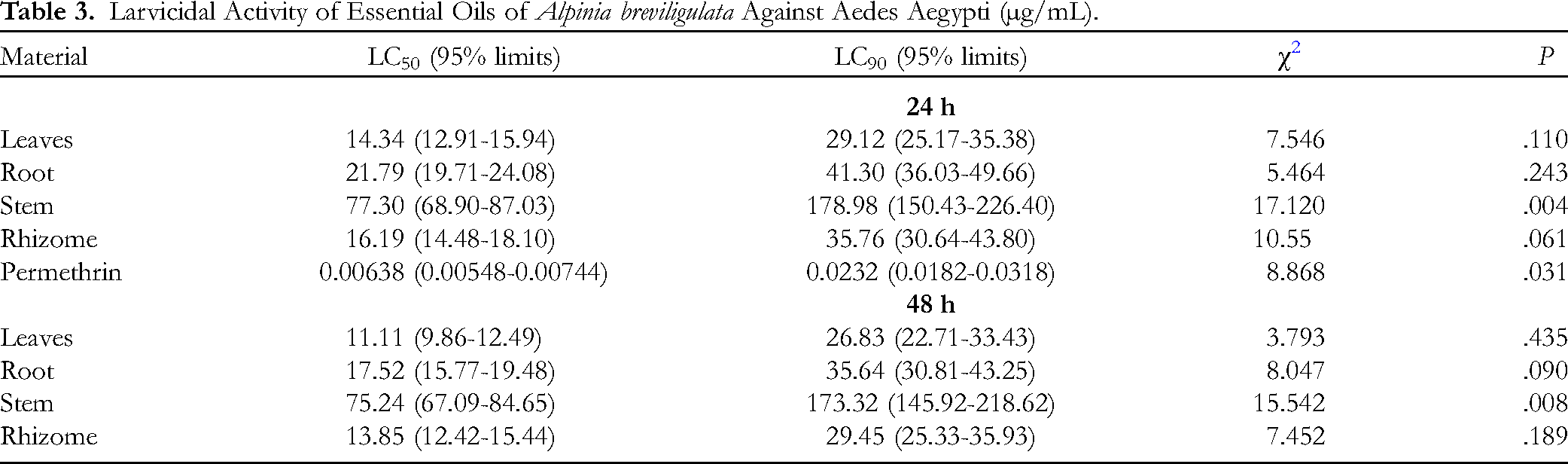
Leaf, root, and rhizome essential oils demonstrated larvicidal activities against Aedes mosquitoes with 24h-LC50 values in the range of 14.34-21.79 µg/mL, while the stem essential oil showed with 24-h LC50 values greater than 77.30 µg/mL (Tables 3, 4).
Larvicidal Activity of Essential Oils of Alpinia breviligulata Against Aedes Aegypti (µg/mL).
Larvicidal Activity of Essential Oils of Alpinia breviligulata Against Aedes Albopictus (µg/mL).

Nt: not test; Nd: not determined.
Discussion
Comparisons of the chemical composition of A. breviligulata essential oil in this study and previous studies are presented in Figure 1. The leaf essential oils in this study have high similarities with the study of Dũng et al. 16

For the root essential oil, major differences between the present study and the previous study were observed in the components α-pinene (5.5/2.4%), camphene (10.3/3.2%), limonene (4.5/2.0%), 1,8-cineole (1.1/6.0%), borneol (1.2/5.5%), and caryophyllene oxide (3.3/13.0%). 15 Rhizome essential oil in this study showed a greater content of the main component monoterpene and lower content of the main components sesquiterpene compared to the previous study. 15 The chemical composition of stem essential oil showed the dominance of sesquiterpenoids, of which sesquiterpene hydrocarbons accounted for 26.3% and oxygenated sesquiterpenoids accounted for 62.4%.
Our previous study and several other studies, have reported that (E)-β-caryophyllene and caryophyllene oxide exhibits larvicidal activities against Aedes mosquitoes, with 24-h LC50 values greater than 50 µg/mL.24–26 The α-pinene and β-pinene have demonstrated larvicidal activity against Aedes mosquito species, with 24-h LC50 values ranging from 12.94 to 23.63 µg/mL.26,27 The α-humulene has shown larvicidal activity, with 24-h LC50 values ranging from 37.89 to 53.05 µg/mL.26,27 The α-copaene demonstrated weaker larvicidal activity against Bradysia procera compared to α-pinene, caryophyllene oxide, and α-humulene. 28
Thus, the additive activity of the main components α-pinene, α-copaene, and caryophyllene oxide in the leaf essential oil may have been responsible for the observed larvicidal activity. Camphene demonstrated larvicidal activity against Ae. aegypti, with 24-h LC50 values ranging from 50 to 100 µg/mL.29,30
The endo-fenchyl acetate demonstrated larvicidal activity against Ae. albopictus, with 24-h LC50 values greater than 300 µg/mL. 31 Although limonene showed strong larvicidal activity against Aedes mosquitoes, 27 its content in the root essential oil was only 4.5%. Thus, the strong activity of the root essential oil may be due to the synergistic effects between its main components. The observed larvicidal activity of stem essential oil is consistent with the content and larvicidal activity of its main components, caryophyllene oxide (27.7%) and α-copaene (5.4%). The two compounds, α-pinene and β-pinene, may be primarily responsible for the larvicidal activity of rhizome essential oil. Piper arboricola stem essential oil has been characterized by two main components, α-pinene (19.3%) and β-pinene (26.9%), which have shown larvicidal activity against Ae. aegypti with a 24-h LC50 value of 28.45 µg/mL. 32 Huong et al showed that β-pinene and α-pinene are the two major components responsible for the larvicidal activity of essential oils of Zingiber species against Ae. aegypti and Ae. albopictus with 24h-LC50 values ranging from 12.72 to 45.58 µg/mL. 33
According to Pavela, 9 a plant species holds great promise for the development of botanical larvicides if it satisfies the following factors: it can be cultivated and its essential oil has larvicidal activity with a 24-h-LC50 value < 50 µg/mL. In addition, the LC90 value is also an important parameter to consider, because a low LC50 value does not always necessarily mean that a low dose is sufficient to achieve maximum mortality. The essential oils of leaves, roots and rhizomes of A. breviligulata all exhibited LC50 and LC90 values less than 50 µg/mL. Yield is one of the important factors when considering an essential oil as a biopesticide. In this study, the yield of essential oil of A. breviligulata leaves was 0.31% based on the weight of fresh material. Many aromatic plant species have been proposed as sources of essential oils for biopesticide development, with their reported yields equivalent to 0.31% such as Ocimum tenuiflorum L., 34 Coriandrum sativum L., 35 Blumea densiflora DC. 36 Alpinia zerumbet (Pers.) B.L.Burtt & R.M.Sm. 37 and Alpinia calcarata (Andrews) Roscoe. 38
Conclusion
Essential oils from different parts of A. breviligulata (leaves, roots, stems and rhizome) demonstrated different chemical composition profiles. The concentrations of monoterpenes and sesquiterpenes increased gradually in the order of stem, leaf, root, and rhizome essential oils, respectively. Leaf, root, and rhizome essential oils have shown larvicidal activity against Ae. aegypti and Ae. albopictus, considered very active with 24-h LC50 values ranging from 14.34 to 21.79 µg/mL. These oils can be considered as sources of botanical pesticides for Aedes mosquito control due to their potent larvicidal activities. Further studies should include toxicity assessments on non-target organisms of these essential oils. A limitation of this work is that plat materials were only collected at one point of the year and only from one location. The concentrations of bioactive components can vary due to phenology, geographical location, edaphic or climate conditions so the larvicidal activities of the essential oils are likely to be affected.
Footnotes
Acknowledgements

Declaration of Conflicting Interests
The authors declared no potential conflicts of interest with respect to the research, authorship, and/or publication of this article.
Funding
This research was funded by University of Khanh Hoa, grant number KHTN-23.01.
Ethical Approval
This study was approved by the Duy Tan University Medical–Biological Research Ethics Council, Number DTU/REC2020/NHH02.
Statement of Human and Animal Rights
All of the experimental procedures involving animals were conducted in accordance with the Duy Tan University Medical–Biological Research Ethics Council, Number DTU/REC2020/NHH02.
Statement of Informed Consent
There are no human subjects in this article and informed consent is not applicable.