



Abstract
Background
Genus Achillea L., one of the largest and the most taxonomically complicated genera of the Asteraceae family, has a complex phyletic structure due to excessive hybridization and polyploidy, which especially occurs among species from the Achillea section. Although the genus has been investigated in detail, a hybrid Achillea ×vandasii Velen has not been studied for volatile profiles. Thus, this study aimed to analyze and compare headspace volatiles (HSVs) from rosette leaf, stem leaf, stem, and inflorescence as well as essential oil (EO) of plant aerial parts.
Methods
The chemical composition of the headspace volatiles and essential oil of a hybrid Achillea ×vandasii Velen. were analyzed by gas chromatography with a flame ionization detector (GC-FID) and gas chromatography-mass spectrometry (GC-MS).
Results
The distribution among HSVs depends on the plant organ investigated. Generally, monoterpene hydrocarbons and oxygenated monoterpenes were dominant in all headspace samples, primarily 1,8-cineole followed by α-pinene and β-pinene. Sesquiterpenoids were absent or presented in a low percentage. Unlike HSVs, the EO was abundant in sesquiterpene hydrocarbons and their oxygenated derivates. Among all, caryophyllene oxide, α-cadinol, and germacrene D were dominant in the studied essential oil.
Conclusions
The results showed that the qualitative and quantitative composition of studied headspace volatiles and essential oil differ significantly in terms of terpene content. Considering the hybrid origin of the studied taxon and obtained volatile profiles, the tested hybrid shows no or very weak agreement with the parental species.
Introduction
Genus Achillea L. is one of the largest and the most taxonomically complicated genera of the Asteraceae family, including more than 100 species, widely distributed in Europe, Asia, and North Africa, with centers of diversity in Southeast Europe and Southwest Asia.1,2 The genus has a complex phyletic structure due to excessive hybridization and polyploidy, which especially occurs among species from the Achillea section.1,3 Earlier studies have demonstrated numerous cases of polyploidy (2x-4x-6x-8x), transition zones between species, hybridization, and excessive polymorphism.1,4–6 The presence of spontaneous hybrids, allo- and autopolyploids, aneuploids and phenocopies results in great cytological, morphological, and phytochemical variability both at inter- and intraspecific levels. Therefore, taxonomic evaluation, identification of species, and classification have been a very difficult task for decades. 7 In the flora of Bulgaria, A. clypeolata Sm. is one of the species for which there is evidence of hybridization with other closely related species such as A. coarctata Poir., A. crithmifolia Waldst & Kit. and A. nobilis L.1,8 However, hybrid combinations are still hypothetical and need further careful field before they can be regarded as sufficiently proven. 1
A. ×vandasii Velen. is a Balkan endemic taxon, native distributed in Bulgaria, Romania, and Serbia, whose taxonomic status was insufficiently resolved until today.9,10 Namely, this plant was originally described from Bulgaria as an independent species, 11 but was later treated as an infraspecies taxon from Balkan-Pontic A. coarctata Poir. 12 or from endemic A. clypeolata Sm. 13 It is morphologically similar to A. clypeolata, from which it differs in lower growth, lemon yellow ligules (vs golden yellow), less whitish indumentum and much more deeply pinnate leaf segments. Unlike A. coarctata it has a grayish tomentose indumentum (vs shiny-silky) 11 Richardson 14 suspected a possible hybrid origin of this taxon, while Thornton-Wood 15 considered it an independent species. Further, Nedelcheva16,17 who studied the populations from the Rhodopi Mts in Bulgaria, indicated diploidy (2n = 18) and possible hybrid origin of A. ×vandasii with presumed parental species A. clypeolata and A. crithmifolia. According to current floristic databases, A. ×vandasii is recognized as a hybrid between A. clypeolata and A. crithmifolia.18–20
Since there is no data on A. ×vandasii volatiles, this study aimed to determine the chemical profiles of the essential oil of the plant aerial parts (in the flowering phase), and headspace volatiles originating from different plant organs: rosette leaf, stem leaf, stem, and inflorescence. According to Nikolić et al. 21 this nothotaxon is distribuded in central (vicinity of Prokuplje) and eastern Serbia (Mt Basara near Pirot). We also found A. ×vandasii in 2008. at the foothill of Mt Svrljiške Planine in eastern Serbia together with parental species (BEO 100339).
Materials and Methods
Plant Material
The plant material of A. ×vandasii was collected in June 2020, in the flowering phase, in Serbia, Vrandol (43° 16′ 16″ N; 22° 14′ 33″ E), Figure 1. The voucher specimen is deposited in the Herbarium of the Natural History Museum, Belgrade (BEO), under the number 100329.
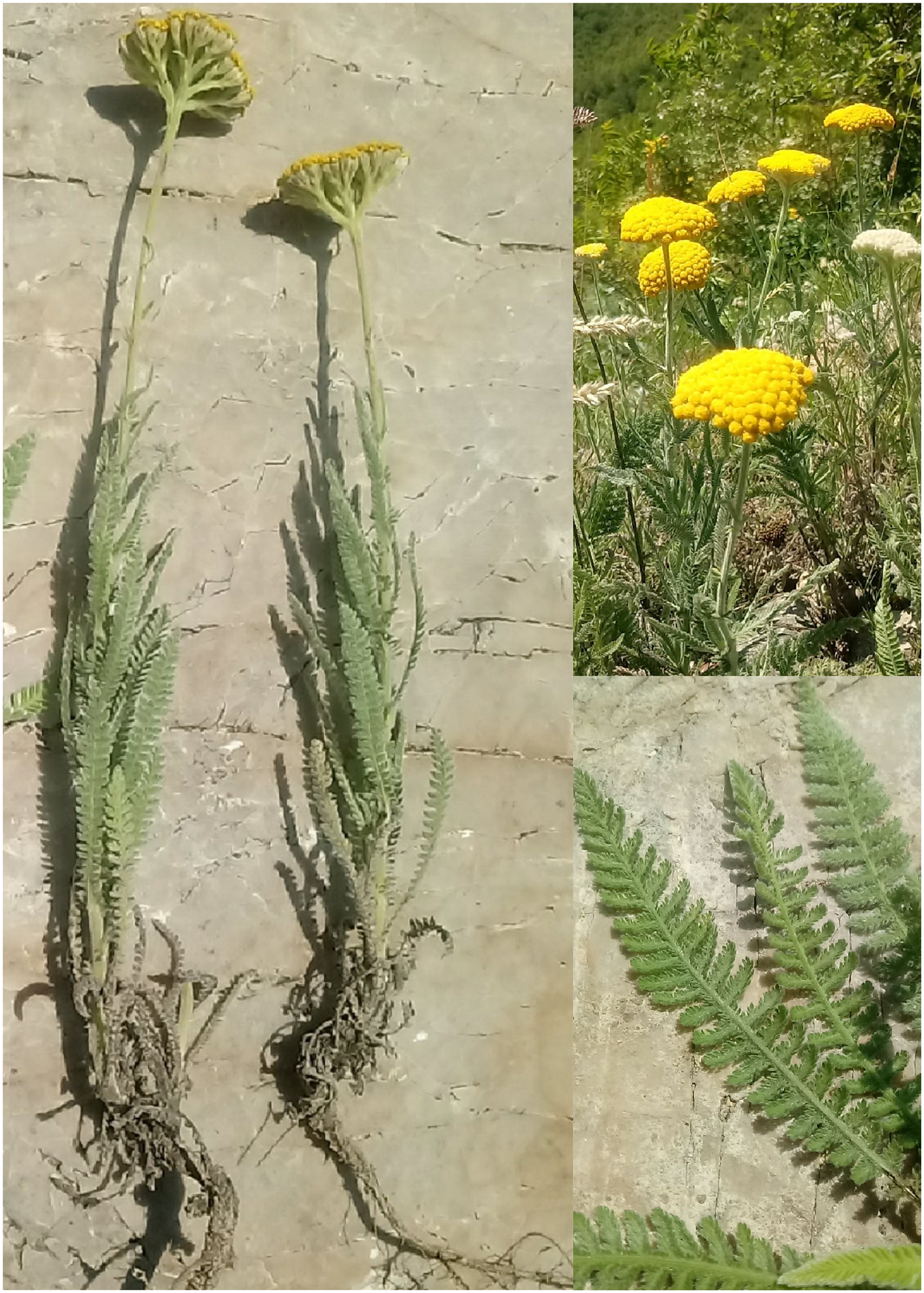
Achillea ×vandasii Velen. (June 2020, Serbia, Vrandol; photographed by Dr Bojan Zlatković).
Volatiles Isolation
Headspace volatiles (HSVs) were isolated from different plant organs (fresh plant material): rosette leaf, stem leaf, stem, and inflorescence. Before the isolation, each sample was cut into small pieces, weighed (≈0.2 g), and then placed into 20 mL vials. The automated HS isolation was conducted in triplicate following the previously reported procedure. 22 After the GC-MS and GC-FID analyses, the obtained HS volatile contents were recalculated in the Microsoft Excel software to obtain the mean values with the corresponding standard deviation (Table 1).
Chemical Composition of Headspace Volatiles of Different Plant Organs of A. ×vandasii.

RI: Experimental linear retention indices relative to C8-C40 alkanes. bLI: Literature indices-Adams’ retention indices. cMonoterpene hydrocarbons (MH), oxygenated monoterpenes (MO), sesquiterpene hydrocarbons (SH). Not detected compounds are marked as (-).dHS-GC-MS/FID analyses were done in triplicate, mean value (x̄)±standard deviation (σ).
The fresh plant aerial parts were cut into small pieces and subjected to hydrodistillation using a Clevenger-type apparatus for a period of 2 h. Subsequently, liquid/liquid extraction with diethyl ether was done; the obtained extract was dried over anhydrous magnesium sulfate, filtered and finally, the solvent removed. The mass of essential oil (EO) was measured to calculate yield (0.03%), and to prepare a solution of 20 mg mL−1 for GC-FID and GC-MS analyses.
Analyses of the Essential Oil and Headspace Volatiles
The analyses of HSVs and EO were performed using an Agilent Technologies apparatus as previously described.22,23 The sample of essential oil was injected three times, and the results obtained were recalculated in the Microsoft Excel software to obtain the mean values with the corresponding standard deviation (Table 2). Briefly, the GC conditions: injector temperature 250 °C; GC-MS interface temperature 300 °C; oven temperature programmed from 50 °C for 2.25 min, then to 200 °C (for HSVs), and to 290 °C (for EO) at 4 °C min−1 (carrier gas He, 1.0 mL min−1, constant flow mode). MS conditions: ionization voltage of 70 eV; acquisition mass range 40–440; scan time 0.32 s. The injected volume of a diluted solution of EO in diethyl ether was 1 μL, split ratio 40:1; and 500 μL of HSVs, split ratio 10:1. Identification of both HSVs and EO was performed from TIC (Total Ion Chromatogram) by comparison of their linear retention indices relative to C8-C40 n-alkanes recorded on the same column/temperature program with literature values (NIST MS Search 2.0; NIST Chemistry WebBook SRD69; Adams, 2007) and their mass spectra with those of standards from databases (Wiley 6, NIST02, Adams) by the application of the AMDIS software (the Automated Mass Spectral Deconvolution and Identification System, Ver. 2.7, distributed within the software package for 7890-7000 BGC-MS/MS triple quadrupole system). The percentage composition of the volatiles was computed from the GC-FID peak areas without any corrections.
Chemical Composition of the A. ×vandasii Essential Oil.

RI: Experimental linear retention indices relative to C8-C40 alkanes. bLI: Literature indices-Adams’ retention indices, and cNIST Chemistry WebBook. dOxygenated monoterpenes (MO), sesquiterpene hydrocarbons (SH), oxygenated sesquiterpene (SO), and others (O). eGC-MS/FID analyses were done in triplicate, mean value (x̄)±standard deviation (σ).
Results and Discussion
The HS profiles of the A. ×vandasii are summarized in Table 1. Generally, monoterpenes present a dominant class of HSVs among all plant organs. The distribution between monoterpene hydrocarbons and oxygenated monoterpenes depends on the plant organ. Monoterpene hydrocarbons dominate in rosette leaf, while oxygenated monoterpenes make up 90% of inflorescence HSVs, and 70% in stem leaf HSVs. These two classes are almost equally present in the stem HSVs. In both, α-pinene, β-pinene, and 1,8-cineole are leading volatiles. Germacrene D represents sesquiterpene present in a very small percentage or absent in stem and inflorescence samples. On the contrary, essential oil, with 31 identified compounds (97.3% in total), is abundant in sesquiterpenes (≈90%), Table 2. Monoterpene hydrocarbons are absent, while oxygenated monoterpenes make up 7.2% of EO. Among all sesquiterpenes, caryophyllene oxide, germacrene D, and α-cadinol are dominant compounds in the studied A. ×vandasii EO.
Since there is no data on the volatiles A. ×vandasii, the obtained profiles of HSVs and EO could not be compared with published data. However, according to the floristic database 18 A. ×vandasii is recognized as a hybrid species. Furthermore, as presumed parental species A. clypeolata and A. crithmifolia are listed. In light of that fact, previously reported volatile profiles of parental species could be compared with the obtained HSVs and EO of A. ×vandasii. Considering previous studies on essential oils of A. clypeolata and A. crithmifolia, no similarity can be observed in terms of qualitative and quantitative composition with A. ×vandasii. A recent study on A. clypeolata suggested that location (geographical origin) affects the variability of EO chemical composition.10,24 A. clypeolata of Serbian origin contained 1,8-cineole as the main constituent, while Bulgarian samples contained borneol, β-eudesmol, elemol, and camphor in significant percent. Stojković et al 25 showed a similar distribution of dominant compounds; 1,8-cineole followed by camphor, α-thujone, and borneol, respectively. Respecting these literature sources, the studied EO of A. ×vandasii shows no similarity in composition, until the study of Radulović et al 10 in which one of the studied samples contained caryophyllene oxide in high percent. Even the EOs of presumed parental species A. crithmifolia show no or very low similarity with the studied A. ×vandasii EO.10,25 The HSVs of the aerial parts of A. crithmifolia 26 do not match the average content of dominant HSVs of A. ×vandasii, except for β-pinene.
Limitations of the Study
Undeniably, the results obtained are valuable as an incentive for further investigations of the studied A. ×vandasii due to the terpenoid distribution patterns proved to be a good standpoint for understanding taxonomic relationships between hybrid and presumed parental species. However, some limitations of the research should be stated. One of the limitations of the study refers to the generally known variability of the EO chemical composition of the Achillea taxa. Further studies should investigate the chemical composition of the essential oils of parent species and hybrids from the same locality simultaneously, to minimize the influence of certain factors of variation. In that case, the research topic itself would gain considerable validity, because such an approach would be a unique opportunity to compare all three taxa from the same habitat: (dis)similarities between them as well as the future taxonomic treatment of hybrid. Finally, the uncertain taxonomic status of A. ×vandasii would be overcome by the inclusion of structurally different chemical markers, morphological and molecular features.
Conclusion
Although representatives of the genus Achillea have been studied from several aspects, such as chemotaxonomic profiling, data on the volatile compounds of some taxa are still missing. Balkan endemic taxon A. ×vandasii was studied to bring out data on the chemical composition of essential oil of plant aerial parts, and headspace volatiles of rosette leaf, stem leaf, stem, and inflorescence. The results showed that the qualitative and quantitative composition of these two types of volatiles differ significantly in terms of terpene content. Although headspace volatiles of all studied plant organs abound in monoterpenes, the essential oil of plant aerial parts contains sesquiterpenes dominantly. Considering the hybrid origin of the studied taxon, one part of the work included a comparison of literature data on volatiles of the parental species with those studied. Overall, based on the volatile profiles, the studied hybrid shows no or very weak agreement with the parental species.
Footnotes
Acknowledgment
The authors would like to thank Dr Bojan K. Zlatković for his help in collecting plant material.
Author Contributions
S.Č.J.: conceptualization, methodology, investigation, analysis, data curation, writing - original draft. J.P.S.: investigation, writing - original draft. Z.S.M.: investigation, methodology, resources, writing - review & editing. M.S.N.: investigation, writing – review & editing. G.S.S.: methodology, project administration, resources, supervision, writing – review & editing.
Declaration of Conflicting Interests
The authors declared no potential conflicts of interest with respect to the research, authorship, and/or publication of this article.
Funding
This work was supported by the Ministry of Science, Technological Development and Innovations of the Republic of Serbia [Grant number: 451-03-65/2024-03/200124 and grant number: 451-03-66/2024-03/200124].
