



Abstract
Fluorescent natural products have been a source of fascination for centuries. In this review, we highlight natural products and natural product derivatives as optical logic-based molecules. The early beginnings of the field of molecular logic-based computation are introduced and followed with literature examples of logic gates from fluorescent natural products. The intention is to arouse the curiosity of readers to go out and discover more fluorescent natural products with intrinsic logic properties.
Introduction
The field of molecular logic celebrated its 30th birthday at the beginning of July 2023. 1 The story goes that the roots of molecularlogic-based computation began in Colombo, Sri Lanka and flowered in Belfast, Northern Ireland, and then spread across the globe.2–5 Supported by detailed world maps, over 1260 laboratories worldwide are documented to have contributed to the development of molecular logic concepts and examples.2–12 A Web of Science search using the topic keyword molecular logic gates reveals over 2800 papers dating back from 1994. Considering the volume of published papers, it is rather surprising that of all the reported examples of molecular logic gates, relatively few are derived from natural products. It was mentioned en passant that the anti-malarial quinine, and its cinchona relatives, have the hallmarks of fluorescent pH indicators, recognizable by a fluorophore-spacer-receptor modular system consistent with the photoinduced electron transfer (PET) paradigm.2,7,13,14 A few laboratories have independently come to the realization, for various reasons, that natural products are a valuable source of fluorescent probes.15–22 By one estimate, it is believed that Nature has engineered more than 300 intrinsically fluorescent molecules. 19 An obvious advantage of tapping into this natural reserve is the time saved from reducing or eliminating synthetic effort. Forthcoming in this review, we will highlight fluorescent natural products and related semi-synthetic derivatives with logic-based computational capabilities.23–32
An Introduction to Molecular Logic Gate Operators
Chemical sensors are devices with an equilibrium measured as a continuous sigmoidal response curve. However, the 2 extremes of the sigmoidal curve have a plateau, which can be analyzed in an off-on or on-off fashion. By setting a defined threshold, the chemical sensors are converted to logic gates able to encode data in binary code as either high (binary 1) or low (binary 0). 27 Hence, the 2 plateaux of the sigmoidal curve cater to the 2 binary digital states.
The off-on and on-off chemical sensors then become YES and NOT logic gates. Generally, the equilibria examined by chemical sensors involve a binding interaction; however, non-binding and physical inputs, such as temperature and pressure, are also useful for specific applications. 12 Within the field of molecular logic, fluorescence, or some other related form of luminescence, has customarily been the output signal.23,24,27
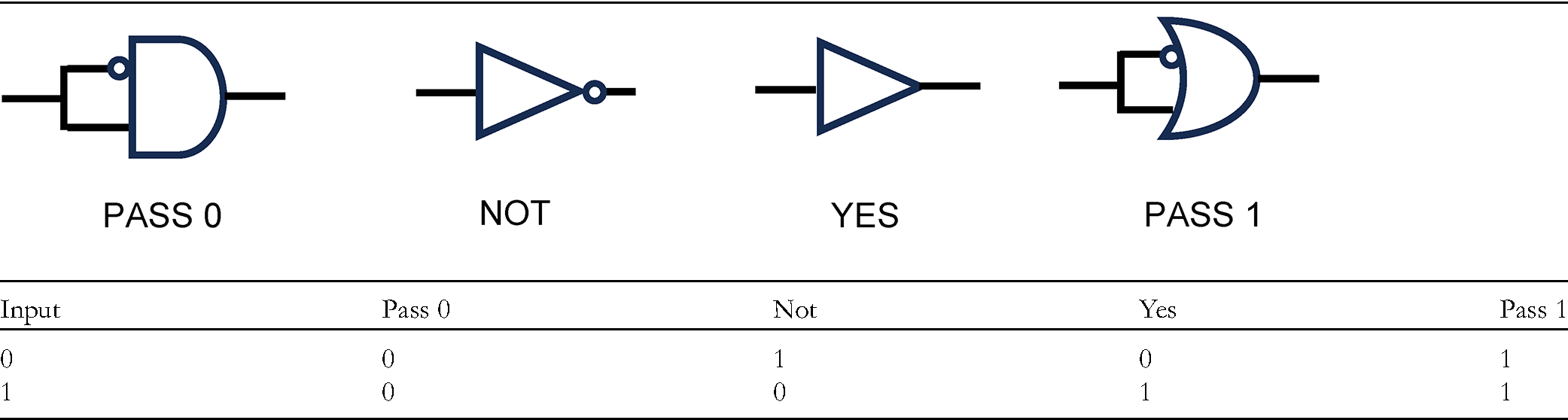
Tables 1 and 2 present the truth tables for single-input and many 2-input logic gates, respectively. A YES gate, the basis for a switch, is pictorially presented by a triangle. A NOT gate is represented as a triangle with an open circle at the right tip (or as a solid white dot). PASS 0 and PASS 1 logic functions are trivial from the point of view that the output is independent of the input. However, representing PASS 0 and PASS 1 symbolically requires the integration of 2 logic gate types. PASS 0 is an integration of a NOT (white dot) and an AND gate. PASS 1 is an integration of a NOT (white dot) and an OR gate.
The Truth Tables for Single-Input Single-Output Logic Gates and the Representative Logic Gate Symbols.
The Truth Tables for 8 Double-Input Single-Output Logic Gates and the Representative Logic Gate Symbols.
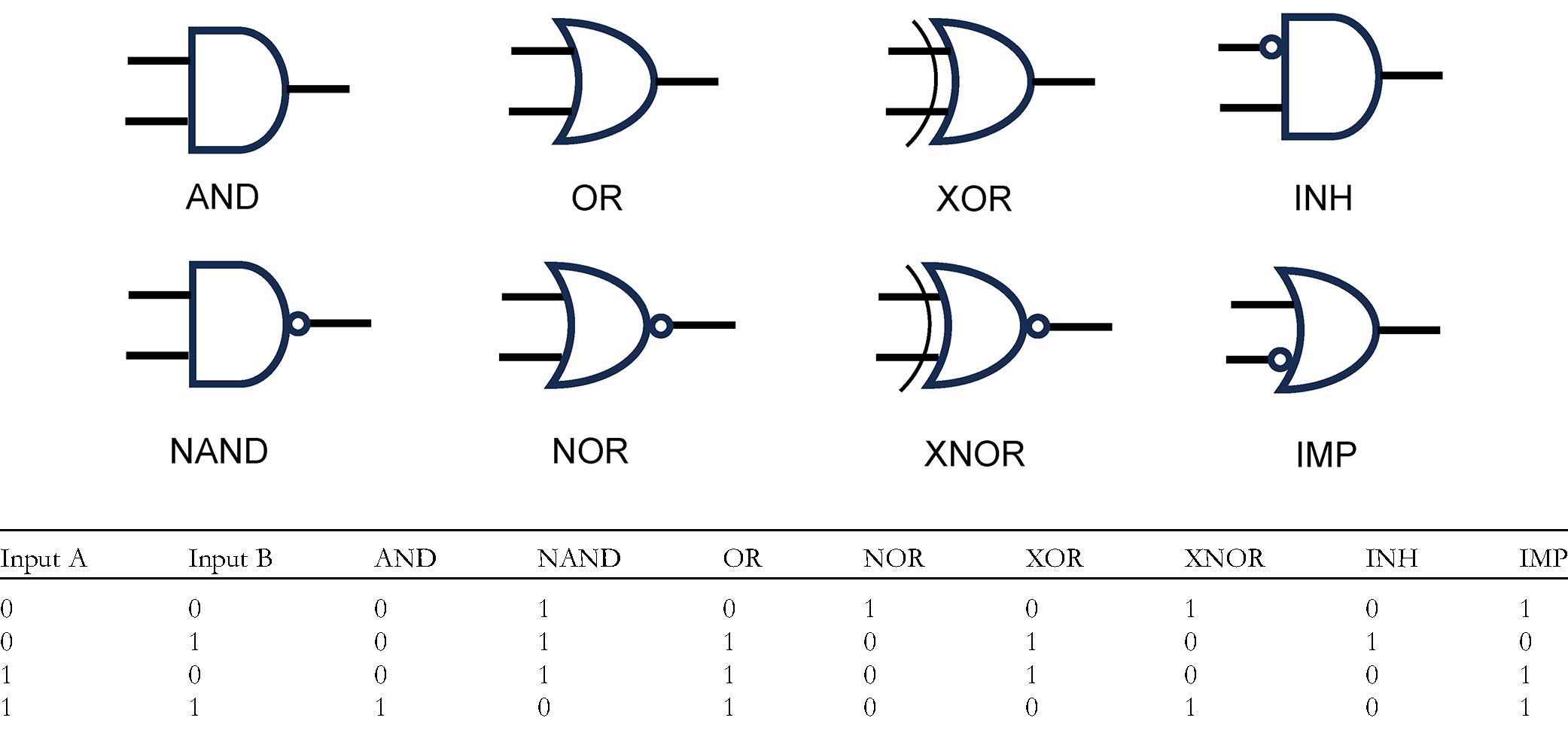
There are 16 two-input logic gates of which, arguably, the most common 8 are shown in Table 2. The AND logic function is selective and representative of cooperativity. An output of 1 only occurs when both inputs are 1. The NAND gate has the opposite output pattern of 0 only when both inputs A and B are 1. The reader will notice that the NAND gate is an integration of an AND gate plus a NOT gate. The OR logic function represents non-selectivity. An OR gate gives an output of 0 only when both inputs are 0, otherwise the output is 1. The inverse of the OR gate is the NOR gate, which only gives an output of 1 when both inputs are 0. Once again, the NOR logic gate is an integration of an OR gate plus a NOT gate. The (exclusive OR) XOR gate is specific for giving an output of 1 in the case when only 1 of the 2 inputs are present. The XNOR gate is the inverse of XOR with an additional NOT gate giving an output of 1 in the case when both two inputs are the same value. The INH (INHIBIT) logic function is a non-cooperative type of gate that combines the integration of AND and NOT functions, but in an arrangement different from a NAND gate. Only an input of 1 from input B (Table 2) results in an output of 1. However, unlike previous examples, the NOT function operates on just 1 input (in Table 2, input A). The IMP (IMPLICATION) logic function, as the inverse of the INH gate, gives an output of 0 only in the case of a 1 from input B. The IMP gate can be considered an INH gate with an additional NOT gate, like the comparison between an AND gate versus a NAND gate. However, according to De Morgan's theorem a more simplified yet equivalent logic symbol is shown (Table 2) based on an OR gate and only 1 NOT gate at input B rather than an AND gate with 2 NOT gates, 1 at input A, and the other at the output (not shown). From these basic logic gate functions, more complex logic operations consisting of 3 or more inputs can be designed.
In the forthcoming discussion, Boolean logic systems are demonstrated with fluorescent natural products where chemicals are the inputs and emission the output. The reader is encouraged to refer frequently to Tables 1 and 2 as they make their way through the review.
Examples of Fluorescent Natural Product Logic Gates
The macrocyclic diphthalate ester
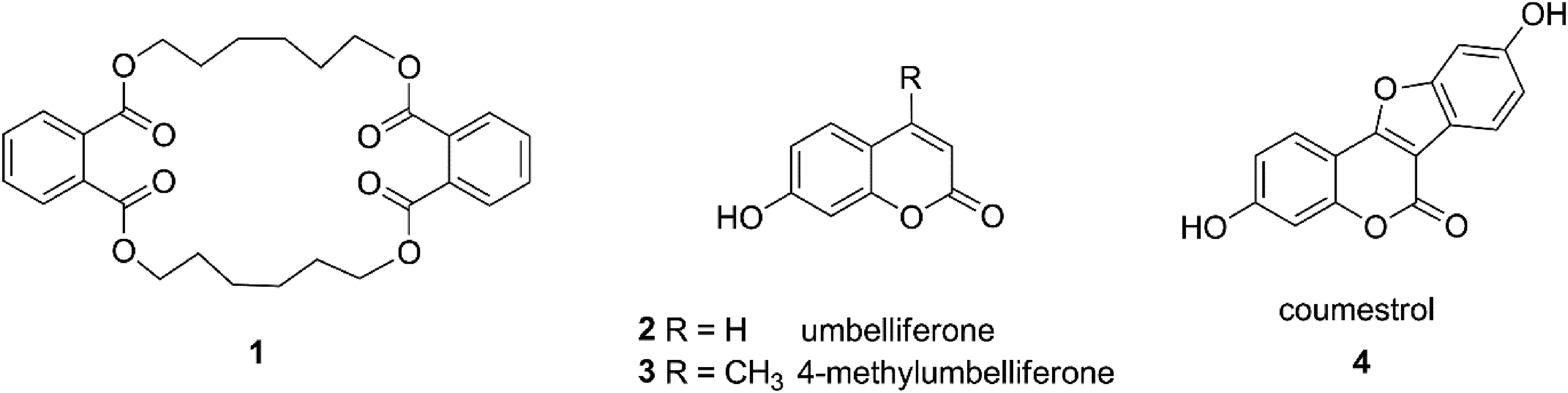
Molecules present in scorpions and plants.
Coumarins (benzopyran-2-one) have a broad utility in biological and pharmaceutical applications.
36
The scorpion Mesobuthus martensii is strongly fluorescent under UV light due to the presence of umbelliferone
Coumestrol
Reconfigurable logic gates by Pérez-Inestrosa are based on the benzylisoquinoline alkaloid, papaverine

Isoquinoline-N-oxide-methylene-arene logic gates
The sister molecule
Berberine

Examples of natural products used as components in logic systems.
Curcumin
Molecule
Calcimycin
Anabasine is a natural product from the tree tobacco plant consisting of pyridine attached to piperidine. Molecules

Off-on-off logic gates based on natural product components.
Canthin-5,6-dione is a shared feature within the fluorescent natural products amarastelline

Off-on-off logic gates based on canthin-5,6-dione.
The natural product andrographolide was used as a platform for the synthesis

Natural products as a platform for fluorescent logic gates.
The fascinating blue emission of quinine

The cinchona alkaloids.
The cinchona alkaloids have a vinyl moiety, which can be exploited for polymerization. Quinidine was polymerized with methoxypolyethylene glycol, and quinine and cinchonine with chitosan for use as heterogenous catalysts.72,73 We prepared a quinidine copolymer by free radical polymerization using an acrylamide subunit. Both the monomer
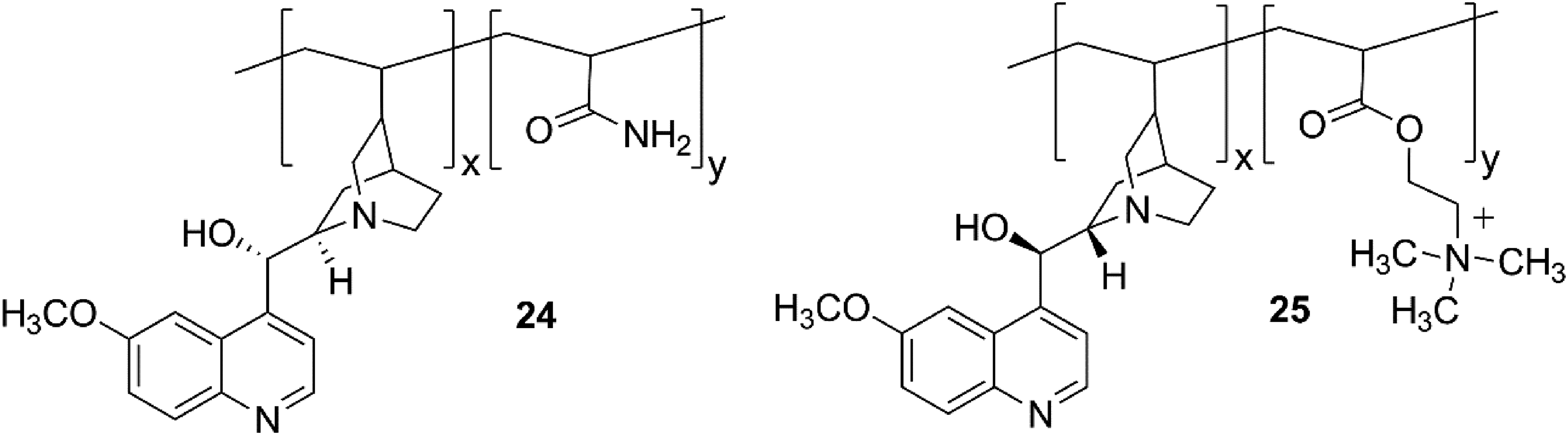
Copolymers of quinidine
Similarly, copolymers of quinine and quinidine were recently proposed as circularly polarized organic afterglow materials and applied as components to encryption and anti-counterfeiting devices. 75 The green afterglow of the films lasts on the order of seconds. The different phosphorescent color, lifetime, and light was used to demonstrate an excitation-dependent encryption application with 254 nm and 365 nm light. The study brings to mind the triple emissive carbon dots prepared from m-phenylenediamine and poly(vinyl alcohol) that are used as an advanced anti-counterfeiting measure in 100 Renminbi banknotes. 76
Quinine
Cytochrome c

The heme subunit of cytochrome c
Gentili proposed logic gates from the intermolecular association of flindersine
Porphyrin-based logic gates
Conclusions and Perspectives
Molecular logic as a field has required researchers to “[think] outside the box,” and to consider the adage “old molecules, new concepts.”93,94 Fluorescent natural products are old molecules, which we believe are an untapped sources for new concepts in the field of molecular-logic based computation. The first molecular logic gate was designed and engineered in an organic laboratory, and ever since, so have many thousands of molecular logic gates.1,8–11,27 However, we hint that many more examples of molecular logic gates derived from Nature are waiting to be discovered. The cinchona alkaloids and quinine were readily available as INHIBIT logic gates before the first molecular proof of an INHIBIT gate.70,95 The antibiotic calcimycin, a medicinal natural product repurposed for fluorescent imaging and quantification of the alkaline earth metals Ca2+ and Mg2+ in cells, was demonstrated as a 2-input NOR logic gate before the molecular proof of a NOR gate. 50 These fluorescent natural products were known to chemists before the birth of molecular logic, and even before the introduction of mathematical logic by George Boole.1,96
We conclude by suggesting some strategies for the development of natural product-derived fluorescent logic gates:
The synthetically convenient option is to find fluorescent natural products that can be studied directly by recognizing an architectural design built into the molecule. With the cinchona alkaloids we recognized a receptor1–fluorophore–spacer–receptor2 format. A semi-synthetic approach is to use the fluorescent core of a natural product and perform additional chemical transformations. The isoquinoline-N-oxide-methylene-arene logic gates based on papaverine are an example. Synthesize molecular logic gates from readily available natural product components. The coupling of a coumarin derivative with anabasine provided a ternary off-on-off logic gate.
We envision that the screening of natural products from a molecular logic viewpoint should result in the discovery of other unnoticed fluorescent switches and logic gates.
Footnotes
Acknowledgement
The authors are grateful to the University of Malta for financial and technical support.