



Abstract
Background
In recent years, the focus of traditional Chinese medicine (TCM) research has gradually shifted from pure chemical research to looking at the combination of chemistry with the life sciences. However, due to the complexity of the chemical composition of Chinese medicinal plants, understanding material structure through in vivo and in vitro studies is a bottleneck in biological analysis. Nuclear magnetic resonance (NMR) spectroscopy has numerous unique advantages over other analytical techniques, and has developed into a crucial tool in Chinese medicine research. This review aims to analyze and summarize the application of NMR under the multiple fields of TCM.
Methods
The online databases PubMed, Web of Science, Embase, Cochrane Library, and CNKI were using the search terms “Nuclear magnetic resonance spectrometry,” “NMR,”“Chinese medicine,” “TCM,” “Herbal medicine,” were from January 1, 2010 to June 1, 2023
Results
The research scopes were 375 after being selected. The latest applications of NMR to TCM including its application to metabolomics, structural identification and efficacy exploration, and authentication and quality control. There were 116 articles on metabolism, 196 articles on compound structure identification and 63 articles on quality control. The metabolomic study of NMR is in line with the multicomponent, multitarget, and overall comprehensive effect of TCM. The structural identification of the chemical components of TCM is more helpful for the discovery of other biologically active substances with high efficacy and few side effects. NMR provides support in quality control and planting site selection of TCM.
Conclusion
NMR has become an essential tool and makes great contributions to the field of TCM research, the innovation in the application of NMR technology will aid with the research on the material basis of TCM.
Introduction
In recent years, due to its unique theoretical system and treatment methods, traditional Chinese medicine (TCM) has shown exceptional ability in the prevention and treatment of diseases and has gradually gained recognition worldwide. 1 Due to the complexity and difficult-to-identify constituents of Chinese medicine products, the qualitative and quantitative analysis of Chinese medicine has always been one of the focuses of the modernization of TCM. The use of new research methods and high-tech instruments to study the complex constituents of Chinese medicine products and the chemical changes in Chinese medicine products in vivo and in vitro for the elucidation of the relevant theories of TCM will be the focus of researchers for some time.
Nuclear magnetic resonance (NMR) spectroscopy is a spectroscopic technique that allows the determination of molecular structure and chemical identification. Since the 1980s, NMR has been widely used in structural biology. 2 As one of the major tools for the study of biomolecular structure and molecular dynamics, the quantitative property of NMR is rarely mentioned in analyzing a mixture. In the past 20 years, because the experimental parameters related to quantitative methods have been largely optimized, NMR has become a versatile tool for analyzing mixtures. 3 New Applications of NMR in Drug Discovery and Development, edited by L. Garrido and N. Beckmann, and New Developments in NMR, edited by H. Keun, are 2 quality books that introduce the principles, developments, and applications of NMR which will help us better understand NMR. The universal presence of NMR active nuclei, such as 1H, 13C, and 31P, in organisms, makes NMR-based techniques superior to conventional absolute quantification methods, including infrared spectroscopy, ultraviolet spectroscopy, and liquid chromatography (LC) in the following ways: (1) Since the signal intensity (the area under the resonance) may be proportional to the number of nuclei in the mixture that give rise to that resonance, no quantitative reference is needed for the simultaneous quantitative detection of multiple constituents. (2) The smaller number of pretreatment steps required for NMR samples results in a lower sample preparation cost and lower risk of sample contamination and loss. (3) High purity is not required for the tested compounds because the NMR spectra are highly sensitive to the structural differences of the compounds. In particular, the ability of NMR to recognize isomers is unmatched by other technologies. (4) The operation of the NMR spectrometer is simple, and the speed of analysis is high. (5) NMR is nondestructive and so the samples are recoverable. 4 This technique is currently widely used in organic chemistry, 5 agriculture, 6 biomedical services, 7 and other fields.
NMR is an important tool for the study of metabolomics in Chinese medicine, it can observe the dynamic changes of metabolism in the body within a specific time period, and analyze the essence of Chinese medicine through the combination of evidence and symptoms. It better reflects the changes in the integrity of the organism compared to other methods, and is more in line with TCM's requirement of the integrity of the study object. With further research and development of analytical techniques, however, the application fields of NMR are no longer limited to this. Structural identification and efficacy exploration, in turn, provide new directions for future therapeutics. Authentication and quality control, on the other hand, control the source of TCM treatments, the TCM The combination of NMR with other techniques provides a convenient way for the visualization and standardization of TCM. Eventually, this will form a complete application chain. This review summarizes the application of NMR under the multiple fields of TCM.
Methodology
Search Strategy
The online databases PubMed, Web of Science, Embase, Cochrane Library, and CNKI were searched to find related papers from January 1, 2010 to June 1, 2023. The following medical subject heading terms or free text words were used: “(Nuclear magnetic resonance spectrometry OR NMR) AND (Chinese medicine OR TCM OR Herbal medicine)).”
Inclusion Criteria and Exclusion Criteria
The inclusion criteria for an article were: (1) Reviews, Abstracts, Case reports, and Editorials were excluded, (2) a novel and clear viewpoint and combined NMR by itself or in conjunction with other techniques. (3) The subject must be closely related to the application of these techniques in TCM-related research fields. (4) The article must provide guidance for the future modernization of TCM and the qualitative and quantitative analysis of Chinese medicine products. (5) Articles that were in essence a repeat of an already included article were excluded.
Quality Assessment
A total of 618 articles were retrieved from the online databases. After applying the above inclusion and exclusion criteria 375 articles were included in the review. The relevant process is illustrated in Figure 1.
Results
Metabolomics of TCM
Metabolomics can dynamically reflect changes in endogenous metabolites in organisms and can reflect systemic and integrative responses to external stimuli and interventions. 8 With a history of only 20 years, metabolomics has become an important research field in systems biology, following genomics and proteomics. NMR and LC/mass spectrometry (MS) can be used to reveal pharmacodynamic and toxicological mechanisms, TCM syndromes, and the mechanism of acupuncture. The details of applications of NMR in bioanalysis TCM metabolomics are summarized in Table 1.

Flow diagram of obtaining target literature.
Applications of NMR in Bioanalysis TCM Metabolomics.
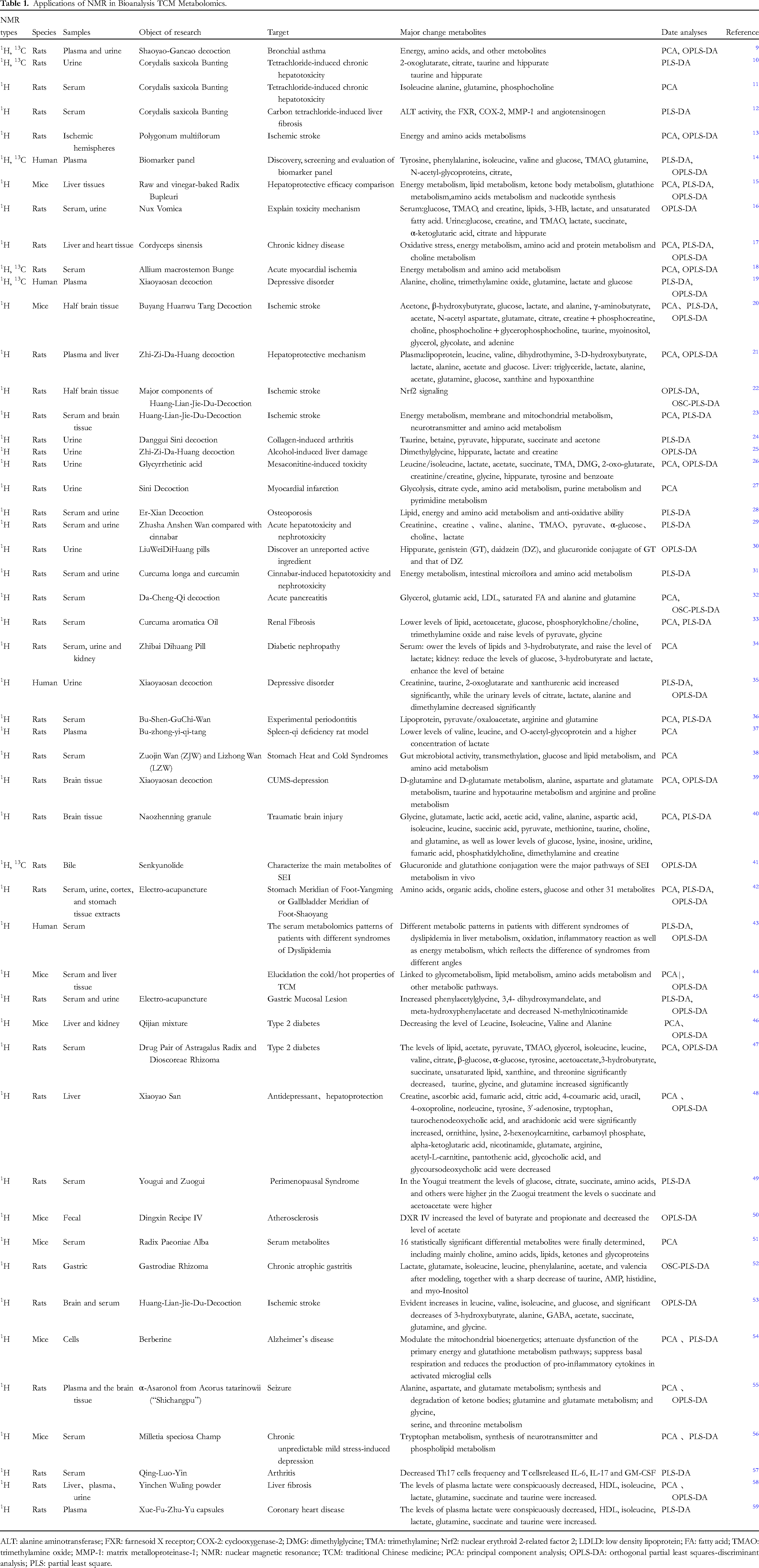
ALT: alanine aminotransferase; FXR: farnesoid X receptor; COX-2: cyclooxygenase-2; DMG: dimethylglycine; TMA: trimethylamine; Nrf2: nuclear erythroid 2-related factor 2; LDLD: low density lipoprotein; FA: fatty acid; TMAO: trimethylamine oxide; MMP-1: matrix metalloproteinase-1; NMR: nuclear magnetic resonance; TCM: traditional Chinese medicine; PCA: principal component analysis; OPLS-DA: orthogonal partial least squares-discriminant analysis; PLS: partial least square.
Pharmacodynamic and Toxicological Mechanisms of TCM
Chinese medicine products have complex constituents and many targets for drug efficacy, and their toxicological mechanisms are often unclear which impedes studies into their efficacy and toxicity. Metabolomic studies can reflect the entire process of the overall metabolic changes in Chinese medicine products after they enter the human body, which is consistent with the holistic view of TCM; thus, such studies have unique advantages in revealing pharmacodynamic and toxicological mechanisms.
In terms of pharmacodynamic efficacy, Li et al 13 used proton NMR (1H NMR) metabolic profiling to analyze the brain tissue of rats after intervention with Polygonum multiflorum (Heshouwu). It was found that the Heshouwu-induced changes in brain metabolites were mostly related to energy metabolism and amino acid metabolism and that Heshouwu could mitigate stroke-induced oxidative stress and inflammatory responses by reducing interleukin-1 (IL)-1 and related inflammatory cytokines through the Nrf2 signaling pathway. Liang et al10,11 used NMR-based metabolomics to determine the protective effects of Rhizoma Corydalis (Yanhusuo) on CCL4-induced chronic liver damage and observed the changes in serum and urine metabolites. The results suggest that Yanhusuo can coordinate multiple metabolic pathways, including the citric acid cycle, gut microbial metabolism, taurine metabolic pathway, and hypotaurine metabolic pathway, to jointly protect the liver. Ease Powder (Xiaoyao San), a commonly used TCM prescription for ameliorating emotional disorders, has received attention for the clinical treatment of depression. NMR metabolomic analysis of the changes in metabolites in human urine showed that the changes in 15 metabolites, including glutamine, glutamic acid, alanine, and aspartic acid, were consistent with the improvement of depressive symptoms, suggesting that these metabolites could be used as biomarkers for diagnosis and drug evaluation. 39 In recent years, Danggui Sini decoction, an aqueous extract of Angelica sinensis, Ramulus Cinnamomi, and Radix Puerariae, has been widely used in the treatment of rheumatoid arthritis. The 1H NMR-based metabolomics study of Cheng et al 24 found that Danggui Sini decoction could improve the symptoms of a collagen-induced arthritis rat model through the regulation of taurine and hypotaurine pathways, enteric microbial metabolism pathways, glycolysis/gluconeogenesis pathways, the citric acid cycle, and lipid metabolism pathways. At present, the majority of metabolomics studies on the efficacy of Chinese medicine products focus on the analysis of Chinese herbal compounds.
Strychnos nux-vomica (Maqianzi), a traditional medicine in China, has been widely used in analgesics, dispersing blood stasis, clearing heat, and reducing swelling. 60 However, because of its severe toxicity, Maqianzi can cause dizziness, muscle fibrillation, and liver and kidney damage, and its clinical application is limited. By combining a 1H NMR-based metabolomics approach with histopathological analysis and clinical biochemical analysis, the dose-time relationship in the metabolites in the body fluids of rats was examined using the orthogonal partial least squares (OPLS)-discriminant analysis (DA) method. From the results it was suggested that Maqianzi may cause disorders of energy metabolism and disorders of the gut microbiome, further causing liver and kidney injury. 16 The lateral root of Aconitum carmichaelii Debeaux (Fuzi) is an essential medicine for restoring Yang from collapsing. Due to its rapid and intense effect, improper use of Fuzi can easily lead to severe toxic side effects. Licorice can be added to Fuzi-containing prescriptions to reduce its toxicity. Sun et al 26 found that glycyrrhetinic acid could significantly improve Fuzi-induced amino acid biosynthesis and metabolism in rats and reduce the biological toxicity of Fuzi at the metabolic level. In addition, combined with other tools, NMR can provide the basis for future innovation in drug development while understanding toxicological mechanisms. Andrographolide is a TCM monomer with a variety of pharmacological activities, but it has a certain degree of nephrotoxicity. Gu et al 61 accurately confirmed the structure, activity and the degree of nephrotoxicity of the 23 andrographolide derivatives with 1H-NMR, HRMS, and MTT assay. Among them, compounds III, V, and IXc showed a significant reduction in nephrotoxicity and, ultimately, 5 new compounds were designed and their biological activities were predicted. Thus, NMR-based metabolomics may be an effective means of clarifying the mechanisms of toxicity and toxicity attenuation of Chinese medicine products, as well as to develop novel drugs.
Syndromes of TCM
In addition to the holistic concept, TCM also emphasizes syndrome differentiation in diagnosis and treatment. ‘Syndrome’ refers to the common name for a group of associated symptoms. Over the years, there have been numerous studies of syndromes. However, well-recognized, clear interpretations of syndromes have not yet been achieved. Chen et al 43 analyzed the characteristics of metabolites in the serum of patients with abnormal lipid metabolism in a control group, a kidney-yang deficiency syndrome group, and a phlegm-dampness obstruction group using NMR-based metabolomics. They established a serum metabolomics model based on the different patterns of liver metabolism, oxidation, inflammatory response, and energy metabolism in different patients to assist TCM diagnosis. Yin deficiency with yang hyperactivity syndrome and yin and yang deficiency syndrome are the 2 most common TCM syndrome types of primary hypertension. Analysis of the plasma of patients using NMR and gas chromatography-MS revealed that abnormal glucose metabolism might be the common mechanism of the 2 syndromes: activation of the sympathetic nervous system may play an important role in the pathogenesis of yin deficiency with yang hyperactivity syndrome, and the metabolic rate in yin and yang deficiency syndrome is low, thus explaining the specific physiological mechanisms of the 2 syndrome types from different angles. 62 By determining information about metabolites in the human body and the metabolite markers of various syndromes using metabolite databases of NMR-based metabolomics combined with principal component analysis (PCA) and OPLS-DA, 63 the essence of syndromes is expected to be gradually revealed at the metabolomics level.
Metabolomics of the Acupuncture Mechanism
Currently, acupuncture is still the most recognized aspect of TCM in the Western world and is considered a safe technique for both health maintenance and therapeutic purposes. 64 However, the biological mechanism underlying acupuncture remains unclear. The meridian theory is the theoretical basis of acupuncture treatment. More than 400 acupoints are systematically described in terms of the 12 meridians throughout the body, and acupuncture of a specific acupoint has a specific therapeutic effect on a specific part of the human body.
Researchers performed 1H NMR-based multivariate statistical analysis of the metabolites in the serum, urine, cortex and stomach tissue extracts from rats to observe the effects of electroacupuncture at acupoints of the gallbladder meridian (Zushaoyang Danjing) and stomach meridian (Zuyangming Weijing) on the rats’ metabolism. The results showed that electroacupuncture treatment resulted in significant changes in 31 metabolites, including amino acids, organic acids, cholinesterases, and glucose, verifying the specific metabolic changes due to acupuncture at acupoints on the 2 meridians 42 and proving the feasibility and effectiveness of the metabolomics approach in elucidating the mechanism of acupuncture. Xu et al 45 used 1H NMR-based metabolomics to study metabolic disorders caused by gastric mucosal injury and the efficacy of electroacupuncture at acupoints on the stomach meridian. They found that gastric mucosal injury indeed caused metabolic disorders, while the analysis of metabolites in urine confirmed that the metabolites of phenylacetylglycine, 3, 4-dihydroxymandelic acid, and N-methylnicotinamide were improved by electroacupuncture at acupoints on the stomach meridian. NMR is also instructive for moxibustion in acupuncture therapy. Moxibustion has been proven to be effective in treating skin lesions of psoriasis. By performing (1H-13C, 1H-1H) NMR-based metabolomic analysis on the skin tissues revealed that Moxibustion treatment can improve the metabolic disorders of skin lesions in psoriatic mice to some extent by reducing valine, glucose, asparagine, aspartate and alanine-mediated cell proliferation and scaffold protein synthesis, attenuating histidine-mediated vasoproliferation and promoting triglyceride decomposition. 65 The results all suggested that the use of NMR-based metabolomics has potential for the further interpretation of the molecular mechanism of acupuncture.
Structural Identification and Efficacy Exploration of TCM
Structural Identification of TCM
To date, the spectral analysis of natural substances, such as Chinese medicine products, has been developed into an independent course. The combination of one-dimensional (1D) and 2-dimensional (2D) NMR with infrared spectroscopy, ultraviolet spectroscopy, and MS will become an indispensable analytical tool for analyzing and determining the structures of substances.
Shi et al 66 used 1H NMR techniques and UHPLC-QE HRMS in combination with a polarity partitioning strategy to characterize a wide range of chemical compositions in GuiLingJi. A total of 163 compounds were identified, including amino acids, fatty acids, sugars, phenolic acids, flavones, triterpenoids, and triterpenoid saponins, coumarins, and others. Yu et al 67 identified the phytochemical compounds in Shuxuening injection (SXNI) by using (UHPLC-Q-Orbitrap HRMS) and NMR techniques, combining with the solvent partition. Direct UPLC-Q-orbitrap HRMS analysis identified only 72 compounds, while with the addition of NMR techniques, the identification ended up with 133 compounds, which included 73 flavonoids, 5 biflavone, 6 proanthocyanidin, 14 terpene trilactones, 6 fatty acids, 5 fatty amides, 12 organic acids, 1 amino acid, 3 excipients, 2 saccharides, and 6 other components. Apart from TCM compounding, Wu et al66,68 phytochemical study of 95% EtOH extract of the TCM Euphorbia royleana resulted in the isolation of 11 diterpenoids, 2 triterpenoids, and the successful discovery of new ingenane and ingol diterpenoids, whose structures were elucidated using spectroscopic analyses (1D and 2D NMR, HRMS, ECD, UV, and IR data) in conjunction with chemical methods. Similarly, NMR was involved in the structural identification of 2 novel alkaloids isolated from Binglang, 69 9 novel compounds isolated from the roots of J. sambac, 70 3 undescribed indole alkaloid derivatives isolated from this preparation of Qing Dai, 71 and other. Regardless of whether it is a TCM compound or a single Chinese medicine, conventional analytical methods coupled with NMR technology allow for more comprehensive structural identification of substances.
Efficacy Exploration of TCM
The role of NMR in the structural identification of TCM is mainly in 2 aspects: firstly, to find out the key compounds that exert efficacy (no matter toxicology or pharmacodynamics) from the known TCM; secondly, to analyze the compound compositions of different TCM, and to screen for the compounds that have the same or similar efficacy with the known specific efficacy.
Chen et al 72 isolated 6 compounds from the ethanol extracts of the Chinese medicine Periploca forrestii Schltr. using high-performance LC and found that one of the compounds, E, had significant antioxidant activity and inhibited hyaluronidase and acetylcholinesterase activity. This compound also had a potential therapeutic effect on secondary immune arthritis in rats. After purification, E was identified as chlorogenic acid by NMR spectroscopy. Mei et al 73 found that the active ingredient in Ephedra sinica stapf disrupted the interaction between ACE2 and SARS-CoV-2 RBD. The structures of the active compounds were characterized by NMR and HPLC-Q-TOF-MS/MS, in which 3 active components were identified to inhibit the ACE2-RBD interaction. EV-A71 infection can cause diarrhea, skin rash, hand-foot-mouth disease, and even infectious diseases of the nervous system. Currently, no specific antiviral drug for EV-A71. Ma et al 74 selected 75 kinds of commonly used antiviral Chinese medicinal plants from the Chinese Pharmacopoeia and used the extracts from them to test their activity against EV-A71. They found 2 active anti-EV-A71 compounds, which were caffeic acid derivatives, in the aqueous extract of the rhizome of Cimicifuga heracleifolia (Sheng Ma) and Arnebia euchroma (Zi Cao) using NMR and MS.
In studies of natural substances, the combined use of chromatography and spectroscopy in the early stage provides a good complement to the conventional biological activity-oriented methods. This combination not only avoids unnecessary isolation, purification, and identification of known compounds but also helps the researchers focus on compounds with interesting structural characteristics. The details of applications of NMR in the identification and characterization of compounds of TCM are summarized in Table 2.
Applications of NMR in Identification and Characterization of Compounds of TCM.
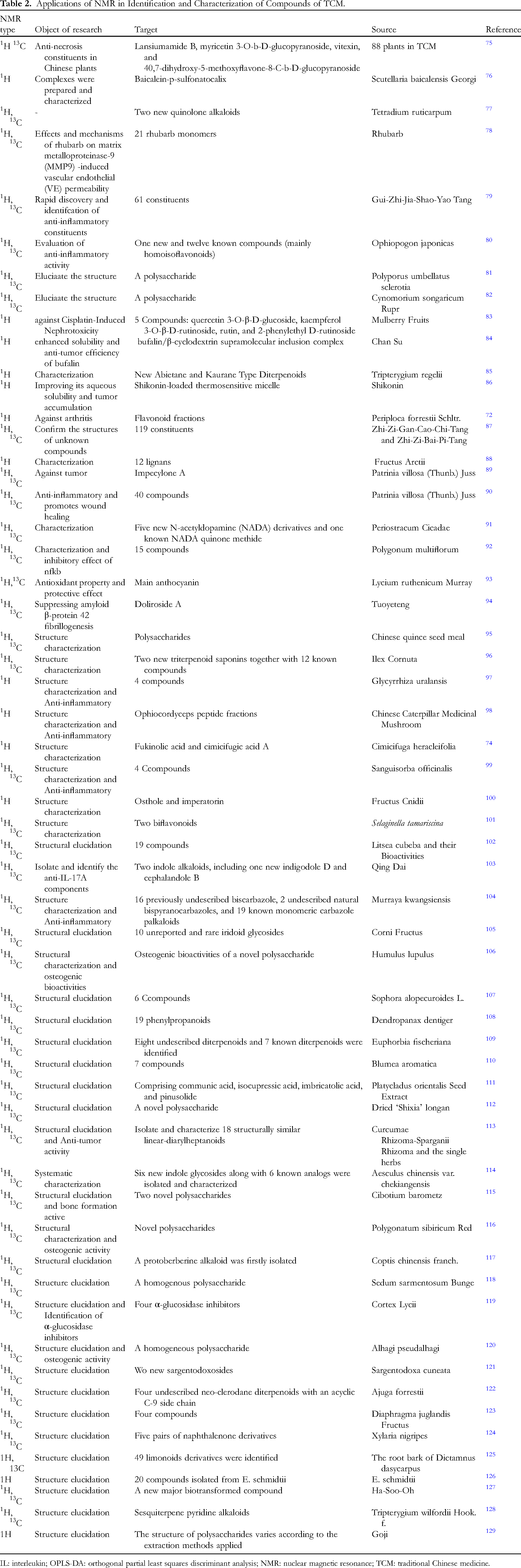
IL: interleukin; OPLS-DA: orthogonal partial least squares discriminant analysis; NMR: nuclear magnetic resonance; TCM: traditional Chinese medicine.
Authentication and the Quality Control of TCM
The chemical constituents of Chinese medicine products differ with varieties, production areas, and treatment methods. NMR is a comprehensive and quantitative method for identifying Chinese medicine products, which can be used to authenticate the varieties and origins, evaluate the quality and stability of medicinal materials, and control the processing of chinese medicine. The details of applications of NMR in identification and quality control of TCM are summarized in Table 3.
Applications of NMR in Authentication and Quality Control of TCM.

Identification of Genuine Regional Drug
Researchers conducted NMR and a multivariate analysis of Astragalus membranaceus (Huangqi) with different cultivation patterns and growing years. They found that the sucrose/glucose ratio could be used as a simple index to distinguish between wild-type and cultivated A. membranaceus and found changes in correlation patterns among the different metabolites of the 2 varieties. 145 Fan et al 139 used quantitative NMR to determine the concentrations of protoberberine alkaloids, such as berberine, jatrorrhizine, epiberberine, coptisine, palmatine, and columbamine, in different species of Coptis (Huanglian), thus meeting the goal of identifying different species based on differences in their alkaloid contents. NMR fingerprints and related statistical methods are combined to obtain the unique chemical group information of the corresponding plants after simple extraction of the fingerprints of Chinese medicine. Statistical methods can be used to classify and extract complex signals for identification and analysis.
Quality Control of Chinese Medicine
The evaluation of the quality of Chinese medicine products with NMR is a new technique that determines the content of the active ingredients and the purity of Chinese medicine products. The high medicinal value of Calculus bovis, but with the huge gap between supply and demand also brings a lot of adulteration in the market. It is still a major difficulty to accurately distinguish between superior and inferior Calculus bovis. NMR data mining enabled the near-holistic chemical characterization of Calculus bovis while identifying species-specific markers for quality assessment and species classification. Sucrose and glucose were found to be the main additives in the adulterated samples. The qHNMR was able to analyze and quantify the sugar content of each sample in order to further classify the marketed Calculus bovis as adulterated, substandard, and counterfeit Calculus bovis. 153 Moreover, the evaluation results are typically verified using traditional high-performance LC (HPLC), linear relationships, precision, and stability. For example, Hsieh et al 133 combined a strong cation exchange solid-phase extraction procedure with 1H NMR and successfully established the simultaneous detection of betaine, citric acid, threonine, alanine, and proline in lycii fructus (Goji), thus providing a powerful tool for the quality control of lycii fructus from different sources. Salvianolate Lyophilized Injection (SLI) is a TCM preparation commonly used in the treatment of stroke. However, because of the highly similar structures of the 3 pairs of diastereomers of its main constituent, salvianolic acid, and the lack of commercial resources to serve as standards for most of the constituents, quantitative quality control of SLI is difficult. Fortunately, the active constituents in SLI have been simultaneously determined using the1H NMR technique by optimizing the solvent system and acquisition parameters, and the results were verified by HPLC. 135
Optimization of Production Processes
Xing et al 15 compared the hepatoprotective effects of Radix Bupleuri (RB) and 2 types of vinegar-baked Radix Bupleuri (VBRBs) using an NMR-based metabolomics approach. The results showed that VBRBs in comparison with RB had better hepatoprotective effects, especially in liver energy metabolism, lipid metabolism, ketone body metabolism, glutathione metabolism, amino acid metabolism, and nucleotide synthesis. This proves that the greatness of Chinese medicine treatment lies not only in the efficacy of the herbs themselves, but also in the complexity of their processing. The typical unit operations of manufacturing Chinese medicine include extraction, concentration, purification, and so on. Manufacturing processes often result in chemical changes in herbal products. Therefore, a thorough understanding of the effects of processing on chemical changes is essential to ensure product quality. NMR can be used as an analytical tool in the pharmaceutical process to track the dynamic changes of substances during the processing of TCM, and to identify the key process parameters by combining with chemometrics to realize the modularization of processing, thus improving the stability of product quality.
As one of the oldest and most commonly used Chinese medicines, Scrophulariae Radix (SR) usually needs to be processed by different methods before clinical use. An untargeted metabolomics approach based on (2D) 1H-13C HSQC was successfully applied to extensively characterize the chemical composition differences of SR processed with different steaming times and different processing methods. A total of 20 compounds changed significantly with steaming time, while 7 compounds changed significantly with the means of processing. 155 Ethanol precipitation has been widely used in the purification of food and herbal products as a simple and effective method to remove impurities. Zhao et al 156 used 1H-NMR coupled with chemometrics to study the changes in the chemical composition during the ethanol precipitation process of Danshen, and identified 16 metabolites, including several small molecular amino acids, organic acids, phenolic acids, and saccharides, as potential chemical markers in the process by 1H-NMR coupled with OPLS-DA. Furthermore, Zhao et al 157 clustered the Danshen samples by 1H NMR-based Hierarchical classification analysis (HCA) to identify critical control points and used PCA and OPLS-DA to distinguish the major metabolites of the intermediates before and after the critical control points. The results demonstrated that alkali isolation and acid dissolution are the most critical processes in the multistep chain of Danshen extract manufacturing, and that critical changes in the 3 main components such as sugars, phenolic acids, and amino acids were recognized as potential critical quality markers for assessing process efficiency. In contrast to most studies conducted by LC-ELSD, LC-UV, and LC-MS or their combinations, 1H NMR combined with Chemometrics is a very effective process quality control tool without the need for time-consuming analyses and complex preseparations, providing comprehensive information about chemical changes during herbal processing and helping to identify critical control points and potential critical quality markers.
With the advancement of science and technology, the identification of the degree of processing of TCM is no longer confined to the judgment of the color, aroma, taste, and properties of the product. The presence of NMR combined with Metabolomics and Chemometrics, provides data support for the enhancement and reduction of toxicity in the process of herbal processing, making it possible to standardize and modularize the processing of TCM.
Other Applications
NMR can also be applied to the development, preparation, and functional exploration of novel antimicrobial nanomaterials. Self-assembled nanoparticles of natural phytochemicals (berberine and 34,5-methoxycinnamic acid) derived from TCM showed inhibitory effects against multidrug-resistant Staphylococcus aureus involving 1H-NMR, powder x-ray diffraction, FT-IR and UV-vis. 158 Phenolic compounds in Chinese medicine have the potential to reduce silver ions to prepare AgNPs for antibacterial studies. 1H-NMR combined with HPLC enables the monitoring of the synthesis reaction of decocted AgNPs. 159
Moreover, based on the mastery of the above basic application methods, some scholars also have combined NMR technology with other research methods and derived some innovative research ideas. Salvia miltiorrhiza Bunge (Danshen) is a widely used Chinese medicine, and its active ingredients, water-soluble phenolic acids, have important medicinal value. However, the biosynthetic pathways of these active ingredients remain unclear. To resolve this problem, Liu et al 160 detected 54 metabolites through multivariate statistics using NMR-based metabolomics and transcriptomics. They combined the results with the differentially expressed genes found by transcriptome sequencing and speculated that the synthesis of rosmarinic acid after methyl jasmonate treatment was mostly through caffeic acid and 4-hydroxyphenyllactic acid. This finding provided valuable information for the synthesis of salvianolic acids. Network pharmacology has certain advantages in clarifying the complex mechanism of Chinese herbal medicines, and a disease-target network was constructed by network pharmacology analysis at the molecular level for predicting therapeutic targets based on the relationships between the active ingredients and the targets. 161 A study combined 1H NMR-based metabolomics and network pharmacology to elucidate the antifibrosis mechanism of Flastem milkvetch seeds (Shayuanzi) and discovered 5 potential target proteins (the intersection of the target proteins of Shayuanzi and the target proteins of liver fibrosis) based on the analysis results, suggesting that Shayuanzi has potential antifibrosis effects by regulating ALT, FXR, COX-2 and MMP-1. 12 A chemical constituent-target-pathway-disease network can be constructed by combining metabolomics with network pharmacology to elucidate the molecular mechanisms of Chinese medicine.
In addition, given the relative maturity of NMR technology, people have achieved great success in realizing quantum computation (QM) on NMR platforms, and it has become one of the preferred platforms for testing various quantum algorithms. Quantum computers are capable of high-dimensional data processing and complex analysis and solve molecular structure prediction problems with special algorithms, ultimately providing more accurate structure identification. Jin et al 162 conducted the structural identification of Kopsia officinalis compounds using extensive spectroscopic analyses and quantum computational techniques. Similarly, Xu et al 163 identified novel compounds in Elephantopus scaber L. by 1D and 2D NMR spectroscopic data analysis combined with quantum chemical electronic circular dichroism calculations. QM involves quantum algorithms and quantum simulations that can also optimize the experimental parameters of NMR. A quantum mechanics approach to simulating the signaling behavior of these “specific” spin systems is essential to optimize the presence of many metabolites in the brain at a stage where many brain metabolites (glutamine, glutamate, inositol, etc. 164 ) behave as strongly coupled spin systems at the field strengths of a clinical MRI system. For example, the density matrix simulation of MR spectra to find the optimal sequence and sequence parameters for the metabolite of interest yields convenient line shapes thus optimizing the metabolite detection.165,166 Such advances in methods and techniques are important tools for depicting the microscopic world of TCM, helping us to explore deeper pharmacological mechanisms and providing a realistic basis for achieving the concretization of TCM theories.
Conclusion
NMR has become a common research tool in the field of TCM. NMR-based metabolomics studies are in line with the multiconstituent, multitarget, and holistic and integrative effects of TCM, thus helping to explain the microscopic mechanisms in vivo to achieve modernization of TCM. NMR, as an analytical technique that can provide the most structural information about compounds, will aid in the discovery of additional bioactive substances with novel structures, high efficacy, and few side effects through the structural identification of the chemical constituents of Chinese medicine products. The identification and quality evaluation of Chinese medicine products based on NMR is also an important supplement to the application of NMR in the field of TCM. Such research will provide support for the standardization of Chinese medicine products and the cultivation of TCM herbs on a global scale. The integration of NMR with transcriptomics, network pharmacology, and even exosomes and electron microscopy will generate more meaningful research directions in the field of TCM.
However, as a technical method, it has some unavoidable limitations: (1) Due to the complex constituents of TCM, signal overlapping may occur in the detection of the mixtures with complex structures. (2) The low sensitivity of NMR (lower than that of MS by several orders of magnitude) makes it unsuitable for trace detection, (3) The acquisition of 13C-NMR spectra and multidimensional NMR spectra requires more time and more samples than the acquisition of mass spectra and infrared spectra. (4) NMR is only suitable for the detection of known substances; it is not suitable for the detection of unknown substances. (5) The purchase and maintenance costs of an NMR spectrometer are high, which leads to an increase in the cost of testing. 4 However, with the continuous development of NMR technology, some limitations of NMR are expected to be improved. Peak overlap problems due to the complex composition of Chinese medicines can be improved at the data acquisition or processing stage. For example, designing clever pulse sequences increases the resolution of the data acquisition phase, 167 or processing methods such as deconvolution can fit the peaks with a template peak shape.168,169 In addition, the frequency of the NMR spectrometer is increasing yearly, and ultra-high field NMR spectrometers operating at frequencies above 1 GHz are now commercially available. The improvement of probe frequency and performance has significantly enhanced detection sensitivity and greatly reduced detection times. It is worth noting that although multidimensional NMR methods help to address the complexity of mixture spectra by spreading the signal over additional dimensions, this information comes at the cost of greater experimental duration. This is because the process requires the acquisition of a large number of increments (typically several hundreds) to sample the indirect dimension in order to record a 2D spectrum with sufficient resolution. 169 Together with this, the incompatibility of 2D spectroscopic methods with short-time experiments (such as on-flow NMR, reaction monitoring, or dissolution dynamic nuclear polarization) and the limitation of available time of the spectrometer preclude the acquisition of high-throughput 2D data by conventional methods for a large number of samples. Therefore, most of the applications of NMR in the field of Chinese medicine are still based on 1D spectroscopy.
The combined application of multiple techniques, such as LC-NMR and LC-MS-NMR, must be the main trend of future development in this field. Through the automated combination of relevant technologies, the shortcomings of each individual technique can be compensated for, and retrieval of the adequate structural information of the detected substances from online databases can help medicinal chemists quickly identify the major constituents of the natural substances under study. On this basis, interesting compounds with new structures can be further isolated so that sufficient amounts of pure compounds can be obtained for structural and biological activity studies. The main problem to be solved in the next step will be how to make full use of the results of comparisons between the obtained structural data and the standard compound data in the databases to quickly determine the structures of multiple complex constituents. The wide range of applications of NMR technology in TCM metabolomics, identification of chemical structure, authentication, and quality control of TCM convince us that NMR technology is an important tool to allow further understanding of the essence of TCM and the objective material basis of TCM development.
Footnotes
Authors’ Contributions
Conceptualization was carried out by YM and XZ. Formal investigation was done by YM, XZ, and LW. Data analysis was done by LW, YZ, LY, and YG. Writing original draft was done by LW, YZ, LY, and YG. Writing, review and editing were handled by LW, YZ, LY, YP, and WSP. All authors read and approved the final version of this manuscript.
Availability of Data and Materials
This review used published literature as sources and the data are included in this article.
Declaration of Conflicting Interests
The author(s) declared no potential conflicts of interest with respect to the research, authorship, and/or publication of this article.
Funding
The author(s) disclosed receipt of the following financial support for the research, authorship, and/or publication of this article: This work was supported by the Priority Academic Program Development of Jiangsu Higher Education Institutions (Integration of Chinese and Western Medicine) (grant number [2018] No.87).
