



Abstract
Introduction
The genus Elsholtzia Willd. (Lamiaceae) contains 44 species, which are widely distributed in East Asia, in Vietnam, China, and Korea.1,2 In Vietnam, there are 7 species: Elsholtzia winitiana Craib., Elsholtzia ciliata (Thunb.) Hyl., Elsholtzia blanda Benth., Elsholtzia rugulosa Hemsl., Elsholtzia pilosa Benth., Elsholtziacommunis (Collett & Hemsl.) Diels, and Elsholtzia penduliflora W.W.Sm.
3
Acording to The World Flora Online, E. blanda has 2 synonyms, Aphanochilus blandus Benth. and Perilla elata D.Don.
3
In folk medicines, E. blanda has been used for treating nephritis, and has antiseptic and pain-relieving effects.1,2 Previous papers reported that phenolics are the main chemical constituents of E. blanda and some of these exhibited significantly NO inhibition effects.3–7 This article reports 10 phenolics (
Results and Discussion
The methanol extract of dried E. blanda aerial parts was fractionated by successive chromatographic steps to yield 1 previously undescribed phenolic derivative (
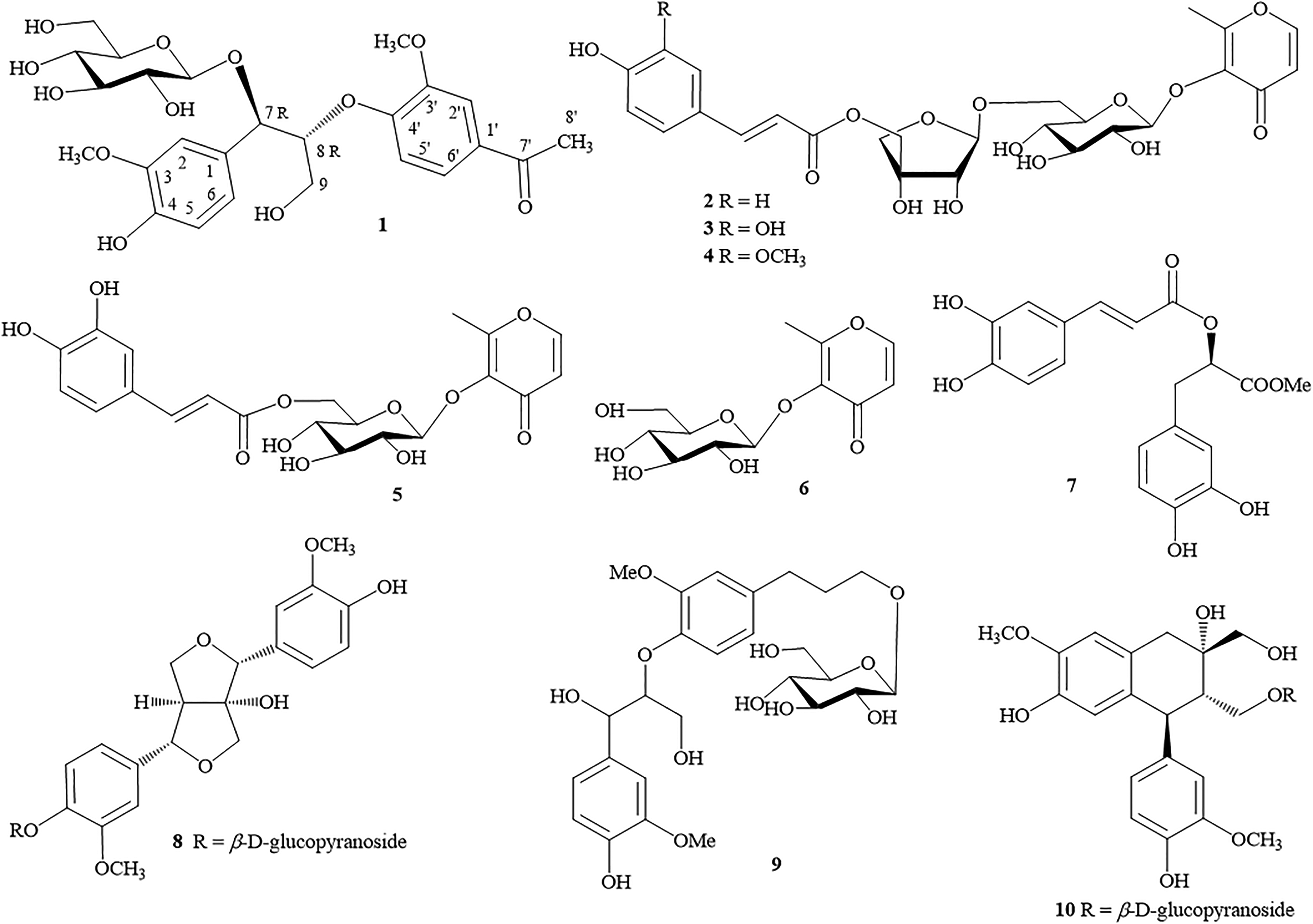
Structures of the isolates from Elsholtzia blanda.

Key HMBC and COSY interactions of

Cd spectrum of
1H and 13C NMR Spectroscopic Data for

CD3OD.
(mult., J in Hz).
Abbreviation: NMR, nuclear magnetic resonance; Pos, position; s, singlet; d, doublet; m, multiplet.
The other isolates were identified as maltol-6′-O-(5-O-p-coumaroyl)-(1→6)-β-D-apiofuranosyl-β-D-glucopyranoside (
As shown in previous studies, some plant phenolic secondary metabolites show significant NO production inhibition.2,21 The leaves of E. blanda are used in folk medicine to cure some inflammatory diseases.
1
Therefore, the isolates were screened for their NO production effects in LPS-activated RAW264.7 cells. All the isolates showed noncytotoxic activity (at a concentration of 100 µM, MTT (3-[4,5-dimethylthiazol-2-yl]-2,5 diphenyl tetrazolium bromide) assay). Their inhibition effects were then evaluated (concentrations of 0.8, 4.0, 20, and 100 µM). Compounds
Material and Methods
General
The equipment and experimental procedures are shown in Supplemental materials.
The Plant Materials
E. blanda Benth. (aerial parts) was obtained in Melinh-Vinhphuc Province (1.2021), and identified by Dr Le Tuan Anh at Vietnam National Museum of Nature. The specimen (NCCT-P175) was kept at IMBC, VAST.
Extraction and Purification
This section is shown in Supplemental materials.
(7R,8R)-7-O-β-D-Glucopyranosyllycocernuaside D (1 )
Colorless amorphous powder;
For the NMR data of
Conclusions
Ten phenolic compounds (
Supplemental Material
sj-docx-1-npx-10.1177_1934578X231192213 - Supplemental material for Phenolic Constituents of Elsholtzia blanda Benth
Supplemental material, sj-docx-1-npx-10.1177_1934578X231192213 for Phenolic Constituents of Elsholtzia blanda Benth by Duong Thi Dung, Pham Hai Yen, Do Thi Trang, Bui Huu Tai and Phan Van Kiem in Natural Product Communications
Footnotes
Acknowledgement
We would like to thank Dr Le Tuan Anh for identification of the plant.
Declaration of Conflicting Interests
The authors declared no potential conflicts of interest with respect to the research, authorship, and/or publication of this article.
Funding
The authors disclosed receipt of the following financial support for the research, authorship, and/or publication of this article: This work is financial supported by National Foundation for Science and Technology Development (NAFOSTED; No 104.01-2020.03).

Supplemental Material
Supplemental material for this article is available online.
References
Supplementary Material
Please find the following supplemental material available below.
For Open Access articles published under a Creative Commons License, all supplemental material carries the same license as the article it is associated with.
For non-Open Access articles published, all supplemental material carries a non-exclusive license, and permission requests for re-use of supplemental material or any part of supplemental material shall be sent directly to the copyright owner as specified in the copyright notice associated with the article.
