



Abstract
Objective
Acanthus ebracteatus Vahl. (family Acanthaceae) is distributed in the mangrove areas of northern Vietnam. The whole plant has the effect of dissolving blood stasis, reducing swelling, relieving pain, dissolving phlegm, and is often used to treat back pain, numbness, cough, and asthma. In our screening program for seeking cytotoxic active compounds, the methanol extract of this plant significantly showed activity and was selected for further study. In this paper we report the chemical constituents of A. ebracteatus and their cytotoxic activity towards two cancer cell lines, HepG2 and SK-LU1 in vitro.
Methods
The dried and powdered aerial parts of A. ebracteatus were ultrasonically extracted with methanol. This extract was suspended in water and successively partitioned with n-hexane, dichloromethane, and ethyl acetate to give n-hexane, dichloromethane, ethyl acetate, and water-soluble extracts. These extracts were fractionated and purified by column and HPLC chromatographic methods. The chemical structures of the isolates were determined by analysis of HRESIMS, and 1D and 2D NMR, and CD spectra. The isolates were screened for their in vitro cytotoxic activity by SRB assay.
Results
One new flavone glycoside (
Conclusion
One new (
Introduction
Acanthus ebracteatus Vahl. (family Acanthaceae) is a small tree about 1–1.5 m tall, with rounded, hairless stems, opposite leaves, hairless leaf blades, and sharp serrated margins.1,2 This plant is distributed along the beaches in Vietnam, India, China, Thailand, Malaysia, and Indonesia. A. ebracteatus flowers all year round. The whole plant is used by decoction in drinking water to treat intestinal diseases, diarrhea, and infections. Leaves are used to treat snake bites, and seeds to treat worms.1,2 Previous studies suggested that the ethanol extract of this plant enhances the efficacy of the collagen scaffold in wound closure, 3 showing potential for skin infection treatment, 4 effects on human dermal papilla and murine macrophages. 5 Phytochemical study of this plant led to the isolation of verbascoside, 5 megastigmane, an aliphatic alcohol and benzoxazinoid. 6 In our screening to seek bioactive components from Vietnamese plants, A. ebracteatus methanol extract showed cytotoxic activity on the KB cell line with an IC50 value of 54.6 µg/mL and, therefore, was selected for further study. In this paper, we report the isolation and structural determination of eleven compounds, including a new flavone glycoside, and their cytotoxic activity on two cancer cell lines, HepG2 and KB.
Results and Discussion
Compound
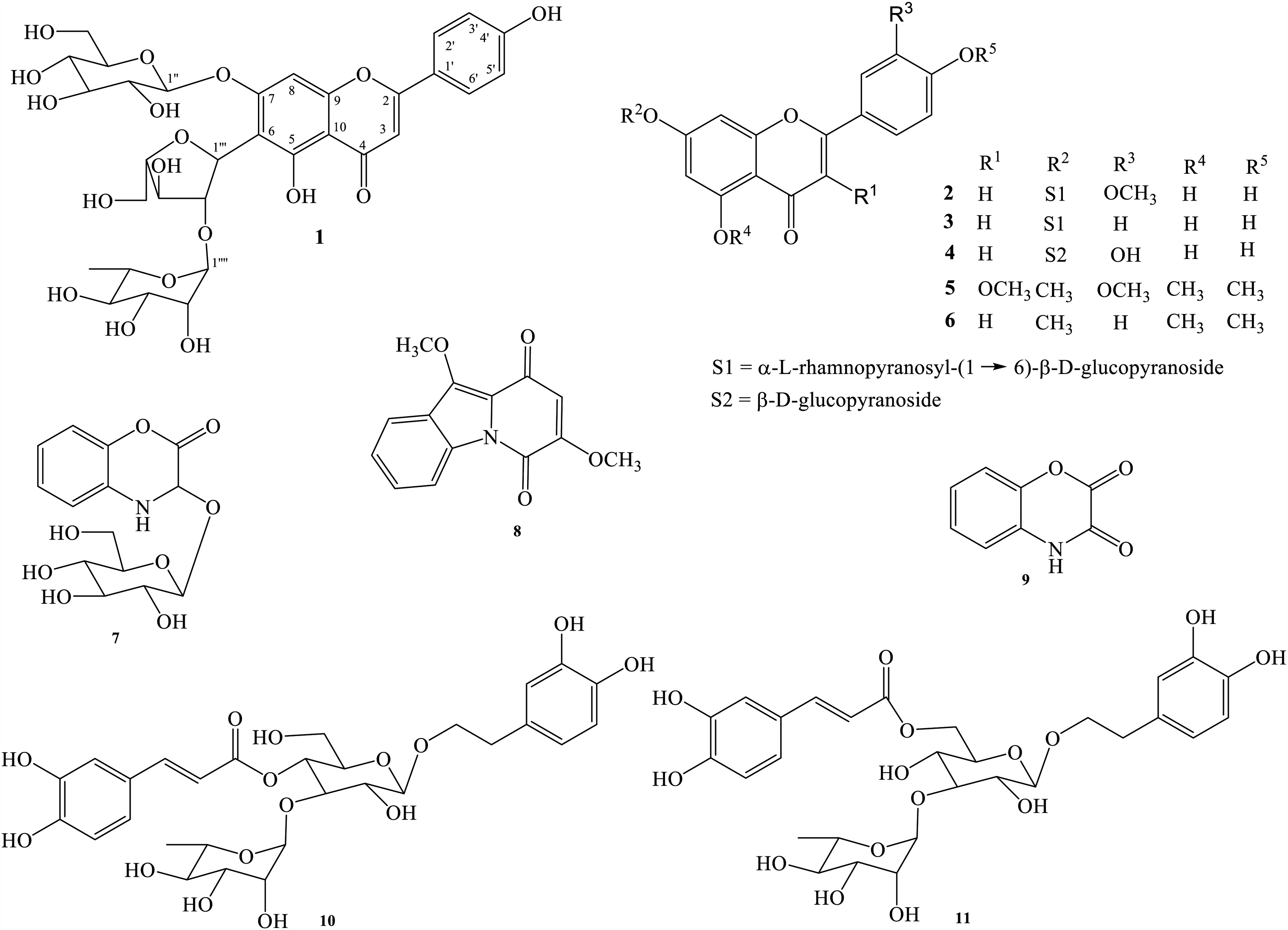
Chemical structures of

Key 1H-1H COSY, HMBC, and NOESY correlations of
1H NMR and 13C NMR Spectroscopic Data for

Measured in CD3OD.
150 MHz, c600 MHz.
All the NMR data assignments were made from 1H NMR, 13C NMR, HSQC, HMBC, COSY, and NOESY spectra.
The known compounds were identified as chrysoeriol 7-O-rutinoside (
Compounds
Materials and Methods
General experimental procedures
The used characterization equipment is the same as that described in our previous work.20,21
Refer to Supplemental Material.
Plant materials
The aerial parts of Acanthus ebracteatus Vahl. (Acanthaceae) were collected from Xuan Thuy National Park, Nam Dinh Province, Vietnam, and identified by Dr Nguyen The Cuong, Institute of Ecology and Biological Resources, VAST. The voucher specimen (NCCT-P172) has been deposited at IMBC, VAST.
Extraction and isolation
Refer to Supplemental Material.
7-O-β-D-Glucopyranosyl-5,4′-Dihydroxyflavone 6-C-α-L-Rhamnofranosyl-(1→2)-α-L-Arabinofuranoside (1 )
A yellow powder,
Cytotoxic assay
The cytotoxic assay is the same as that described in our previous work.21, 22
Refer to Supplemental Material.
Acid Hydrolysis
See Supplemental Material.9,10
Conclusions
In this study, a new flavonoid, 7-O-β-D-glucopyranosylapigenin 6-C-α-L-rhamnopyranosyl-(1→2)-α-L-arabinofuranoside (named acanebranoside A) and ten known compounds (
Supplemental Material
sj-docx-1-npx-10.1177_1934578X231166547 - Supplemental material for Phytochemical Constituents from the Aerial Parts of Acanthus ebracteatus Vahl. and Their Cytotoxic Activity
Supplemental material, sj-docx-1-npx-10.1177_1934578X231166547 for Phytochemical Constituents from the Aerial Parts of Acanthus ebracteatus Vahl. and Their Cytotoxic Activity by Bui Thi Mai Anh, Tran Thi Thuy Nga, Hoang Thi Tuyet Lan and Nguyen Thi Mai, Phan Thi Thanh Huong, Bui Huu Tai, Nguyen Xuan Nhiem, Phan Van Kiem in Natural Product Communications
Footnotes
List of abbreviations:
Acknowledgements
The authors would like to thank Dr Nguyen The Cuong at the Institute of Ecology and Biological Resources, VAST for the plant identification.
Author Contribution
Research idea, NT Mai, PV Kiem, NX Nhiem; Isolation, cytotoxic assay, PTT Huong, BTM Anh, TTT Nga, NT Mai; Structure elucidation and writing, NT Mai, PV Kiem, BH Tai.
Ethical Approval
Our institution does not require ethical approval for reporting individual cases or case series.

Declaration of Conflicting Interests
The author(s) declared no potential conflicts of interest with respect to the research, authorship, and/or publication of this article.
Funding
This research has been financially supported by Ministry of Education and Training (Code B2022-GHA-562-05).”
Statement of Human and Animal Rights
This article does not contain any studies with human or animal subjects.
Statement of Informed Consent
There are no human subjects in this article and informed consent is not applicable.
Supplemental Material
Supplemental material for this article is available online.
References
Supplementary Material
Please find the following supplemental material available below.
For Open Access articles published under a Creative Commons License, all supplemental material carries the same license as the article it is associated with.
For non-Open Access articles published, all supplemental material carries a non-exclusive license, and permission requests for re-use of supplemental material or any part of supplemental material shall be sent directly to the copyright owner as specified in the copyright notice associated with the article.
