Seven phenolic compounds, including a new phenylethanoid, named passifoside (1), and 6 previously described compounds, syringaresinol (2), berchemol (3), threo-guaiacylglycerol (4), p-hydroxybenzaldehyde (5), 3,4,5-trimethoxyphenyl-O-β-D-glucopyranoside (6), and trans-p-coumaric acid (7), were identified from the aerial parts of Passiflora foetida. Their chemical structures were elucidated from HR-ESI-MS and NMR spectral data, and comparison with the literature. Compound 2 inhibited nitric oxide production in lipopolysaccharide-activated RAW264.7 cells, showing an IC50 value of 9.45 ± 0.33 µM. The other compounds showed either weak or no significant activity compared to L-NMMA, which was used as a positive control.
The genus Passiflora (Passifloraceae family) comprises up to 500 species, growing in tropical and warm temperate regions. They are shrubs or herbs, and almost all are climbing plants. Some species are cultivated for their edible fruits (mostly known as passion fruits).1 Various Passiflora plants have been used in folk medicinal remedies. Particularly, the blue passion flower (P cearulea), native to Brazil, is used as a diuretic, analgesic, and mild antimicrobial agent in South American countries.2 Water extract of P edulis leaves is used to treat hypertension in India.3 The leaves of P foetida are applied to cure insomnia and hysteria in Nigeria.4 Numerous phytochemical studies on Passiflora species have been reported and mostly focused on P incarnata and P edulis. Flavonoids, β-carboline alkaloids, and cyanogenic compounds are identified to be major chemical constituents of these plants.1,5,6 In recent years, the methanol extract of P foetida has been shown to exhibit anti-inflammatory activities such as suppression of NO, IL-6, IL-1β, PGE2, and TNF-α or reduced expression of COX-2 and iNOS by activation of NF-κB p65 in RAW264.7 cells.7 Additionally, a phytochemical study of the stem bark of P foetida revealed 10 flavonoids, in which luteolin and chrysoeriol exhibited the most potential nitric oxide inhibitory activity.8 To find nitric oxide inhibitors from P foetida, herein, we report the isolation of a new phenylethanoid glycoside and 6 other known phenolic compounds from aerial parts of this plant. The in vitro nitric oxide inhibitory activity of the isolated compounds was evaluated in a model of lipopolysaccharide-induced nitric oxide production in RAW264.7 cells.
Results and Discussion
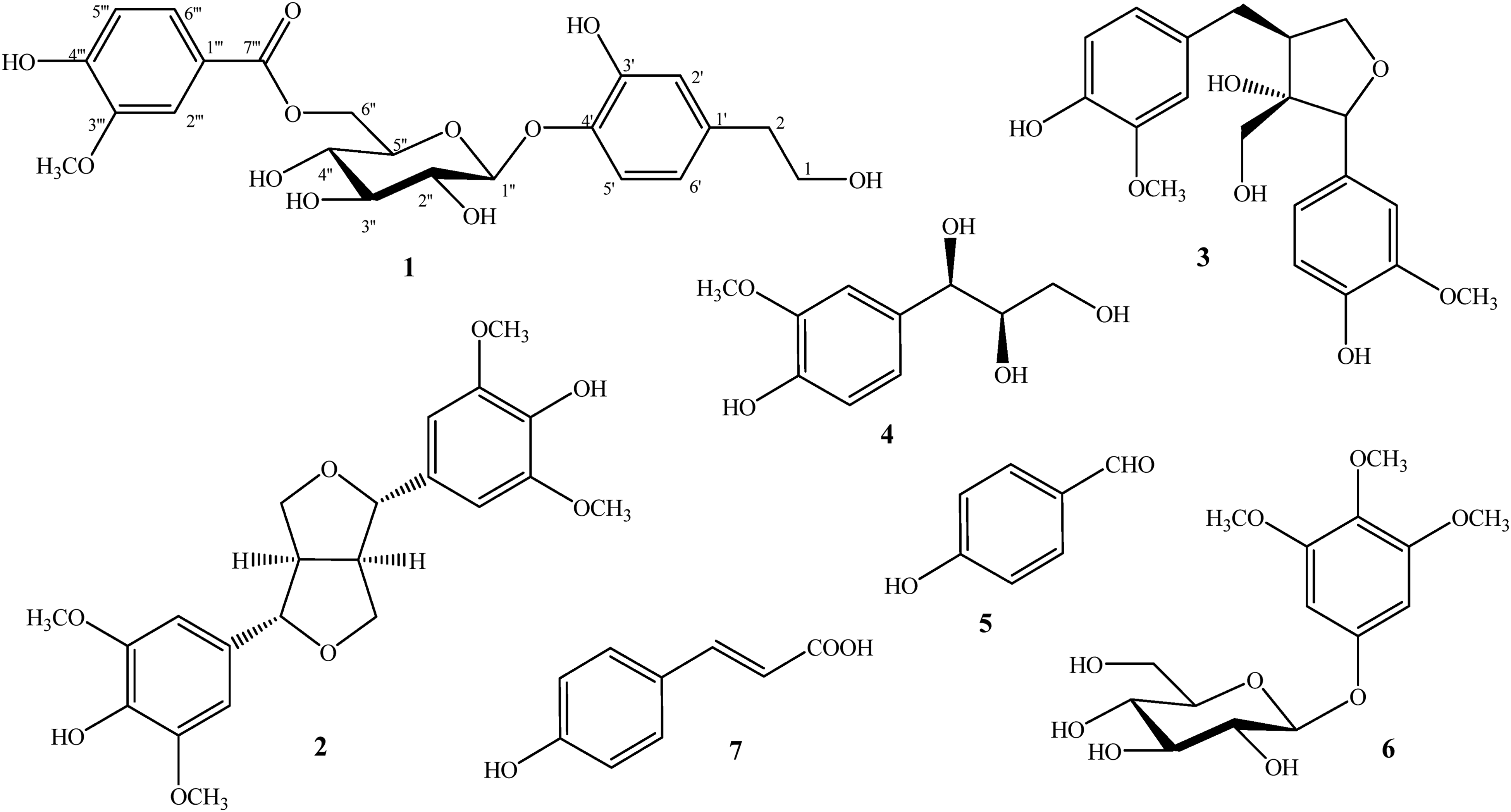
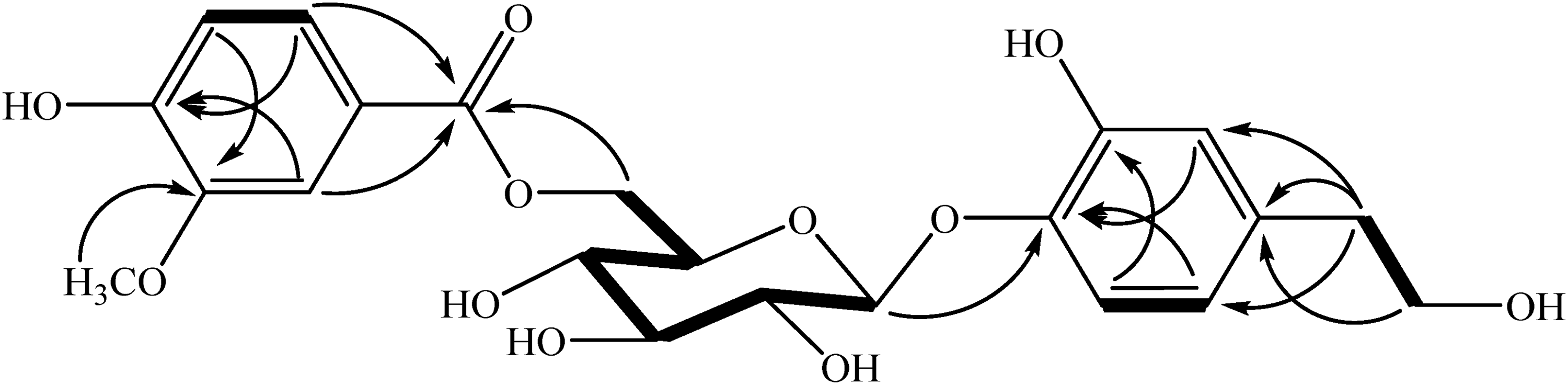
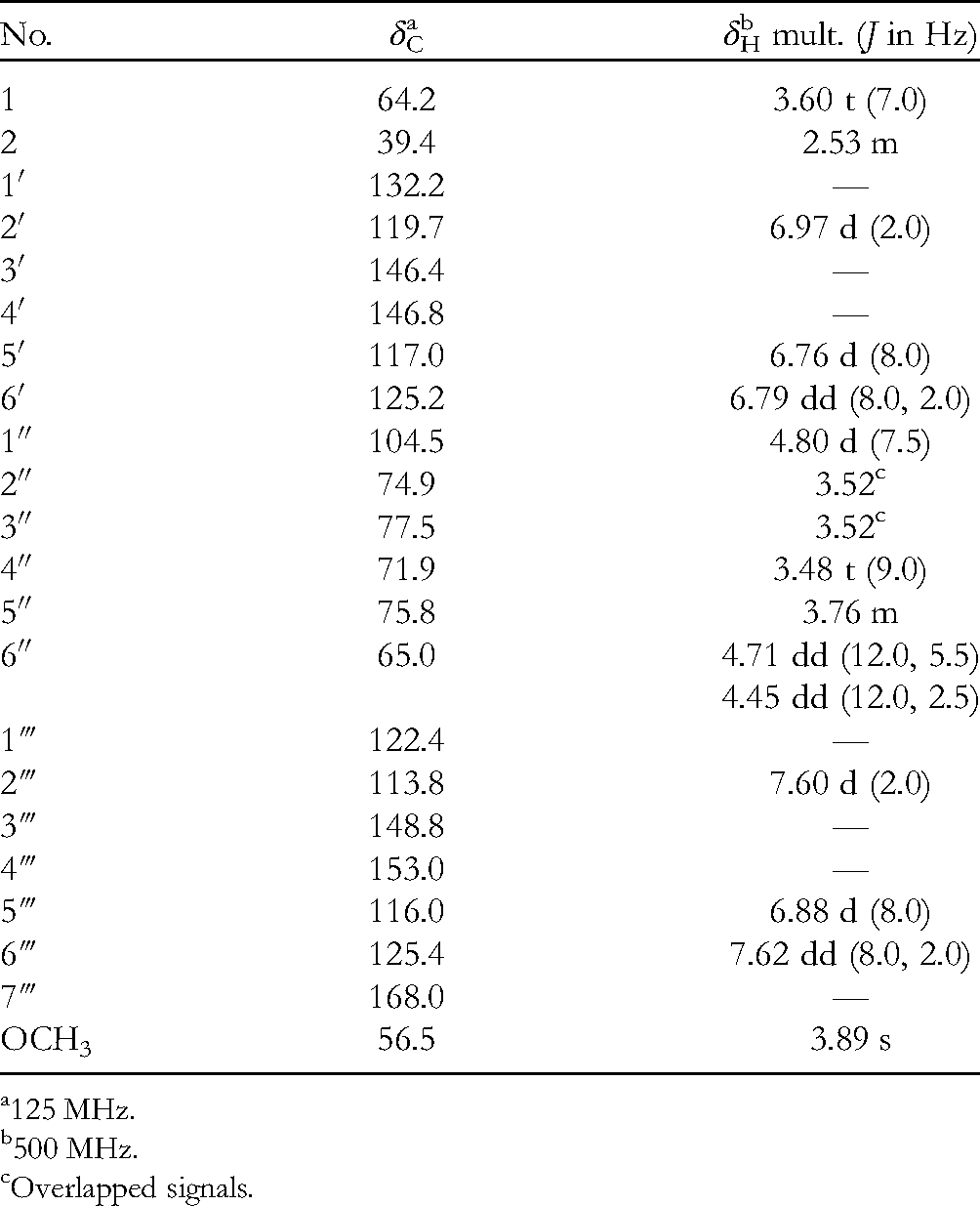
Compound 1 (Figure 1) was obtained as a white amorphous solid. The molecular formula of 1, C22H26O12, was deduced by a cluster of additive molecular ions at m/z 467.1532 [M + H]+ (calculated for [C22H27O12]+, 467.1548), at m/z 484.1802 [M + NH4]+ (calculated for [C22H26O12NH4]+, 484.1813), and at m/z 489.1366 [M + Na]+ (calculated for [C22H26O12Na]+, 489.1367) in the HR-ESI-MS. The 1H NMR spectrum of compound 1 showed signals of 6 olefinic protons belonging to a pair of ABX coupled systems [δH 6.76 (d, J = 8.0 Hz), 6.79 (dd, J = 2.0, 8.0 Hz), 6.97 (d, J = 2.0 Hz), 6.88 (d, J = 8.0 Hz), 7.62 (dd, J = 2.0, 8.0 Hz), 7.60 (d, J = 2.0 Hz)], one anomeric proton signal at δH 4.80 (d, J = 7.5 Hz), and one methoxy group at δH 3.89 (s). The 13C NMR spectrum of compound 1 revealed 22 carbons including 7 non-protonated carbons (1 carbonyl and 6 olefinic carbons), 11 methines (6 olefinic and 5 carbinol carbons), 3 sp3 hybridized methylenes, and 1 methoxy group. Of these, 13 de-shielded carbon signals were assigned to the 2 benzene rings and a carbonyl group. The COSY correlations of H2-1 (δH 3.60)/H2-2 (δH 2.53) and the chemical shift value of C-1 (δC 64.2) revealed the structural fragment of 2-substituted ethanol. Furthermore, the HMBC correlations between H2-2 (δH 2.53) and C-6′ (δC 125.2)/ C-2′ (δC 119.7)/ C-1′ (δC 132.2), H-5′ (δH 6.76) and C-3′ (δC 146.4), H-6′ (δH 6.79)/ H-2′ (δH 6.97) and C-4′ (δC 146.8) indicated 1 to be a 2-(3′,4′-disubstituted phenyl)ethanol, a phenylethanoid backbone (Figure 2). The carbon chemical shift values of C-4′ (δC 146.8) and C-3′ (δC 146.4) suggested oxygen-bearing carbons. On the other hand, the HMBC correlations between H-6‴ (δH 7.62)/ H-2‴ (δH 7.60) and C-4‴ (δC 153.0)/ C-1‴ (δC 122.4), H-5‴ (δH 6.88)/ methoxy proton (δH 3.89) and C-3‴ (δC 148.8), and carbon chemical shift values of C-7‴ (δC 168.0)/ C-4‴ (δC 153.0)/ C-3‴ (δC 148.8) indicated the presence of a 4‴-hydroxy-3‴-methoxybenzoyl group. Another 6 carbinol carbons (δC 104.5, 74.9, 77.5, 71.9, 75.8, and 65.0) were assigned to a glucopyranosyl group. Later, the connection of the above 3 moieties was elucidated by analysis of the HMBC spectrum. The HMBC interaction between H2-6″ (δH 4.71, 4.45) and carbonyl carbon C-7‴ (δC 168.0) confirmed the presence of an ester functional group, which was connected between the 4‴-hydroxy-3‴-methoxybenzoyl moiety and C-6″ of the glucopyranosyl moiety. The HMBC interaction between Glc H-1″ (δH 4.80) and C-4′ (δC 146.8) proved that the O- glucopyranosyl group was bound at C-4′ of the phenylethanoid moiety. Additionally, the J coupling constant value of the anomeric proton (δH−1″ 4.80, J = 7.5 Hz) confirmed a β-form of the glucopyranosyl linkage. Finally, acid hydrolysis of compound 1 produced D-glucose, which was deduced by co-TLC analysis, the positive sign of optical rotation and comparison with authentic D-glucose (Supplemental Material). Consequently, compound 1 was determined to be 2-(3′,4′-dihydroxyphenyl)ethanol 4′-O-β-D-[6″-O-(4‴-hydroxy-3‴-methoxybenzoyl)]gluco pyranoside, and named as passifoside (Supplemental Figures S1-S10).
Structure of phenolics 1-7 isolated from Passiflora foetida.
Important COSY (H⁃H) and HMBC (H→C) correlations of 1.
The other isolated compounds were known (Figure 1) and determined to be syringaresinol (2),9 berchemol (3),10threo-guaiacylglycerol (4),11p-hydroxybenzaldehyde (5),12 34,5-trimethoxyphenyl-O-β-D-glucopyranoside (6),13 and trans-p-coumaric acid (7)14 by their identical NMR spectral data with literature (Supplemental Tables S1-S6).
The nitric oxide inhibitory activity of compounds 1-7 was assayed by the evaluation of nitrite levels producing in RAW264.7 cells via the Griess reaction (Supplemental Material). The compounds were tested at serial concentrations from 0.8 to 100 µg/mL. At the highest concentration of 100 µg/mL, none of the tested compounds showed any significant effect on the viability of RAW264.7 cells, monitoring by MTT assay (cell viability in the range from 80.6% to 95.6%). Therefore, the NO inhibitory activity of the compound was not affected by cytotoxicity at the diluted concentrations. Compound 2 (Table 1) exhibited potential NO inhibitory activity with an IC50 value of 3.95 ± 0.14 µg/mL (9.45 ± 0.33 µM), which is smaller than that of the positive control L-NMMA (IC50 31.37 ± 1.33 µM). The other compounds are considered to be either weak or inactive in comparison with L-NMMA. Recently, the lignans syringaresinol, isolariciresinol, balanophonin, and pinoresinol were identified to be anti-inflammatory constituents of the Tibetan medicinal plant Saussurea obvallata, showing COX-2 inhibitory activity with IC50 values of 23.1, 36.4, 12.1, and 3.6 µM, respectively.15 These compounds were also reported to significantly inhibit NO production in a dose-dependent manner.15 However, their IC50 values were not reported. Our results again confirmed the NO inhibitory activity of syringaresinol and indicate that syringaresinol could be an active constituent for the anti-inflammatory activity of P foetida.
NO Inhibitory Activity of 1-7 in LPS-Activated RAW264.7 Cells.
Optical rotation was taken on a P-2000 instrument (JASCO). NMR spectra were measured on a 500 MHz NMR spectrometer (Bruker BioSpin), and HR-ESI-MS on a 6530 Accurate Mass Q-TOF (Agilent Technology). For column chromatography, either reversed-phase C18 resin (RP-18) or silica gel was used as a stationary phase. Semipreparative HPLC was performed on an Agilent 1260 using an ODS-H80 semipreparative HPLC column (YMC J′sphere, 20 × 250 mm, 4 µm). Thin layer chromatography was performed on silica gel 60 F254 and/or RP-18 F254S precoated plates).
Plant Samples
The aerial parts of Passiflora foetida L. were collected in February 2020 at Hoa Binh, Vietnam. It was taxonomically determined by Dr Nguyen The Cuong (Institute of Ecology and Biological Resources, VAST). A voucher specimen (number: NCCT-P90) is kept at the Institute of Marine Biochemistry, VAST.
Extraction and Purification of Compounds
The dried powdered aerial parts of P foetida (6.0 kg) were ultrasonically extracted with methanol for 3 times (15L of methanol, 30 min, and at room temperature for each time). After filtration, the solvent was evaporated in vacuo to give a dark residue. This residue (105 g) was mixed with distilled water and partitioned with n-hexane, methylene chloride, and ethyl acetate (EtOAc) to give n-hexane (PF1, 12 g), methylene chloride (PF2, 9 g), ethyl acetate (PF3, 4 g), and water extracts (PF4). The n-hexane and methylene chloride extracts were combined and separated on a silica gel column, eluting with a gradient solvent system of acetone/n-hexane (0%-100% in volume) to give 5 fractions, PF1A-PF1E. Fraction PF1C was further separated on an RP-18 column, eluting with an isocratic mobile phase of acetone/water (1/1, vol/vol) to give 6 fractions, PF1C1-PF1C6. Fraction PF1C2 was injected into a semipreparative HPLC and eluted with an isocratic mobile phase of 35% acetonitrile (ACN) in water to give compound 2 (6.7 mg). Fraction PF1C2 was also separated by semipreparative HPLC with an isocratic mobile phase of 35% ACN in water to give compound 4 (3.0 mg). The EtOAC extract was loaded onto an RP-18 column and eluted with an isocratic mobile phase of acetone/water (1/2, vol/vol) to give 3 fractions, PF2A-PF2C. Fraction PF2A was firstly separated on a silica gel column, eluting with n-hexane/acetone (3/1, vol/vol), and then further purified by semipreparative HPLC using an isocratic mobile phase of 24% ACN in water to give compound 3 (2.0 mg). Fraction PF2C was fractionated on a silica gel column, eluting with n-hexane/acetone (3/1, vol/vol), to give 3 smaller fractions, PF2C1-PF2C3. Fractions FC2C1 and FC2C3 were purified by semipreparative HPLC using an isocratic eluent of 24% ACN in water to give compounds 5 (2.5 mg) and 7 (27.0 mg). The water potion was loaded onto a diaion HP-20 column and eluted with a gradient solvent system of methanol/water (0%-100% methanol in volume) to give 2 fractions PF4A and PF4B. Fraction PF4B was fractionated on a silica gel column with dichloromethane/methanol (0%-100% methanol) to give 5 fractions, PF4B1-PF4B5. Fraction PF4B2 was continuously separated on an RP-18 column, eluting with acetone/water (1/2, vol/vol) to yield 6 fractions, PF4B2A-PF4BF. Fraction PF4B2A was injected into a semipreparative HPLC and eluted with an isocratic mobile phase of 14% ACN in water to furnish compound 6 (8.0 mg). Fraction PF4B2C was also treated by semipreparative HPLC with an isocratic mobile phase of 18% ACN in water to yield compound 1 (22.0 mg).
Passifoside (1)
White amorphous solid; m.p. 236–238 °C; : + 39.4 (c 0.1, MeOH); HR-ESI-MS: m/z 467.1532 [M + H]+ (calculated for [C22H27O12]+, 467.1548), m/z 484.1802 [M + NH4]+ (calculated for [C22H26O12NH4]+, 484.1813), and m/z 489.1366 [M + Na]+ (calculated for [C22H26O12Na]+, 489.1367); 1H and 13C NMR: see Table 2.
Seven compounds, passifoside A (1), syringaresinol (2), berchemol (3), threo-guaiacylglycerol (4), p-hydroxybenzaldehyde (5), 3,4,5-trimethoxyphenyl-O-β-D-glucopyranoside (6), and trans-p-coumaric acid (7), were isolated from the aerial parts of Passiflora foetida. Compound 1 was identified to be a new phenylethanoid glycoside. Syringaresinol (2) exhibited NO inhibitory activity (IC50 9.45 ± 0.33 µM) better than that of the control sample, L-NMMA (IC50 31.37 ± 1.33 µM). This result is a confirmation of the NO inhibitory activity of syringaresinol and indicates that it is an active anti-inflammatory ingredient of P foetida.
Supplemental Material
sj-docx-1-npx-10.1177_1934578X221141163 - Supplemental material for New Phenylethanoid and Other Compounds From Passiflora foetida L., With Their Nitric Oxide Inhibitory Activities
Supplemental material, sj-docx-1-npx-10.1177_1934578X221141163 for New Phenylethanoid and Other Compounds From Passiflora foetida L., With Their Nitric Oxide Inhibitory Activities by Nguyen Van Linh, Nguyen Trung Tuong, Pham Xuan Phong and
Do Thi Trang, Nguyen Xuan Nhiem, Do Hoai An, Bui Huu Tai in Natural Product Communications
Footnotes
Acknowledgements
This research is funded by the Project (Code: 2020...) from the Ministry of National Defence.
Declaration of Conflicting Interests
The author(s) declared no potential conflicts of interest with respect to the research, authorship, and/or publication of this article.
Funding
The author(s) received no financial support for the research, authorship, and/or publication of this article.
ORCID iDs
Nguyen Xuan Nhiem
Bui Huu Tai
Supplemental Material
Supplemental material for this article is available online.
References
1.
DhawanKDhawanSSharmaA. Passiflora: a review update. J Ethnopharmacol.2004;94(1):1‐23. doi:10.1016/j.jep.2004.02.023
2.
AnesiniCPerezC. Screening of plants used in Argentine folk medicine for antimicrobial activity. J Ethnopharmacol. 1993;39(2):119‐128. doi:10.1016/0378-8741(93)90027-3
3.
JamirTTSharmaHKDoluiAK. Folklore medicinal plants of Nagaland, India. Fitoterapia. 1999;70(4):395‐401. doi:10.1016/S0367-326X(99)00063-5
SaekiDYamadaTKajimotoTMuraokaOTanakaR. A set of two diastereomers of cyanogenic glycosides from Passiflora quadrangularis. Nat Prod Commun. 2011;6(8):1934578X1100600810. doi:10.1177/1934578X1100600810
6.
AvulaBWangY-HRumallaCSSmillieTJKhanIA. Simultaneous determination of alkaloids and flavonoids from aerial parts of Passiflora species and dietary supplements using UPLC-UV-MS and HPTLC. Nat Prod Commun. 2012;7(9):1934578X1200700918. doi:10.1177/1934578X1200700918
7.
ParkJWKwonOKRyuHW, et al. Anti-inflammatory effects of Passiflora foetida L. in LPS-stimulated RAW264.7 macrophages. Int J Mol Med. 2018;41(6):3709‐3716. doi:10.3892/ijmm.2018.3559
8.
NguyenTYToDCTranMH, et al. Anti-inflammatory flavonoids isolated from Passiflora foetida. Nat Prod Commun. 2015;10(6):1934578X1501000634. doi:10.1177/1934578X1501000634
9.
MinYDChoiSULeeKR. Aporphine alkaloids and their reversal activity of multidrug resistance (MDR) from the stems and rhizomes of Sinomenium acutum. Arch Pharm Res. 2006;29(8):627‐632. doi:10.1007/bf02968246
10.
ShoebMJasparsMMacManusSMajindaRSarkerS. Epoxylignans from the seeds of Centaurea cyanus (Asteraceae). Biochem Syst Ecol. 2004;32(12):1201‐1204. doi:10.1016/j.bse.2004.03.011
11.
IshikawaTFujimatuEKitajimaJ. Water-soluble constituents of anise: new glucosides of anethole glycol and its related compounds. Chem Pharm Bull. 2002;50(11):1460‐1466. doi:10.1248/cpb.50.1460
12.
LiuXQBaekWSKyunADChoiHYYookCS. The constituents of the aerial part of Gastrodia elata Blume. Nat Prod Sci. 2002;8(4):137‐140.
13.
JinHGKimARKoHJWooER. A new megastigmane glycoside from Akebia quinata. Arch Pharm Res. 2015;38(5):591‐597. doi:10.1007/s12272-014-0357-x
14.
GallandSMoraNAbert-VianMRakotomanomanaNDanglesO. Chemical synthesis of hydroxycinnamic acid glucosides and evaluation of their ability to stabilize natural colors via anthocyanin copigmentation. J Agric Food Chem. 2007;55(18):7573‐7579. doi:10.1021/jf071205v
15.
WangWJiangLZhuYMeiLTaoYLiuZ. Bioactivity-guided isolation of cyclooxygenase-2 inhibitors from Saussurea obvallata (DC.) Edgew. Using affinity solid phase extraction assay. J Ethnopharmacol. 2022;284:114785. doi:10.1016/j.jep.2021.114785
Supplementary Material
Please find the following supplemental material available below.
For Open Access articles published under a Creative Commons License, all supplemental material carries the same license as the article it is associated with.
For non-Open Access articles published, all supplemental material carries a non-exclusive license, and permission requests for re-use of supplemental material or any part of supplemental material shall be sent directly to the copyright owner as specified in the copyright notice associated with the article.