Although demonstrated in 1975, vibrational circular dichroism (VCD) finally started to popularize during this century as a reliable tool to determine the absolute configuration (AC) of organic molecules. This research field continues to be a very dynamic one, in particular for the study of natural products which are a unlimited source of chiral molecules. It therefore turns of interest to summarize the accomplishments published in recent years and to comment on some eventual difficulties that emerged in rare cases to complete the AC determination task. Therefore the aim of this review is to update VCD results for the AC assignment of natural products published from 2015 to 2019, a period in which VCD was reported in some 126 publications involving almost 300 molecules. They are organized according the type of studied metabolite allowing an easily search. The molecules correspond to 28 monoterpenes concerning 17 papers, to 42 sesquiterpenes in 14 papers, to 51 diterpenes in 19 publications, to 5 other terpenoids in three papers, to 48 aromatic molecules in 15 reports, to 20 polyketides in 10 publications, to 27 miscellaneous formulas also in 10 papers, and to 76 nitrogen containing compounds, which include alkaloids and their synthetic analogs, in 38 articles. The landscape of reviewed molecules is quite wide as it goes from simple monoterpenes, like borneol or camphor, to very relevant biological molecules like the alkaloid cocaine or tadalafil samples to distinguish genuine and counterfeit Cialis®. In addition, 5 natural products and a simple derivative published outside the reviewed period, were used to illustrate some aspects of density functional theory calculations.
The absolute configuration (AC) determination of molecules containing one or more stereogenic centers has been a topic of major concern for around 100 years, both in natural products and in medicinal chemistry. This is consequent to the isolation of many secondary metabolites from Nature which have been used as starting model compounds to develop drugs that became widely used in clinics.1,2
The earliest approach to distinguish some enantiomers, although without the capability of AC assignment is the human nose,3,4 while the oldest approach to ascertain the AC of a molecule is by chemical correlation. This methodology frequently is a long time consuming and expensive procedure that, at the end, makes the comparison by optical rotation measurements using a molecule of known AC. This fact, among others, induced scientists to develop spectroscopic methodologies which are quicker and less expensive in producing results. Thus, in addition to optical rotation measurements, optical rotatory dispersion (ORD) and electronic circular dichroism (ECD), in which the Cotton effect can be contrasted with that of a molecule of known AC, simply based on partial structure analogy, was developed and widely used.5 In fact, useful empirical rules were developed for ORD and ECD AC proposals, although time has shown that not necessarily these rules always hold, since erroneous conclusions were eventually reached. Although highly sensitive, the disadvantage of ECD is that it requires the presence of a chromophore in the molecule under study since it uses circularly polarized light in the UV region of the electromagnetic spectrum, and therefore only those stereogenic centers located in the neighborhood of the chromophore can be assigned.
A more general approach for the correlation of optical activity and AC is vibrational circular dichroism (VCD) which is an extension of ECD from the UV region to the IR region of the electromagnetic spectrum. The great advantage of this change is that in the IR region one is observing the vibration modes of atoms and therefore in principle the method is quite general for organic molecules. In most cases the VCD methodology is not using model compounds since the AC follows from comparison of the experimental spectrum and a spectrum generated from quantum mechanical calculations.
After the undoubted confirmation6 of the existence of VCD in 1975, another quarter of a century had to elapse to allow time for the development of 2 essential tools required for the successful use of VCD. They are Fourier transform IR spectrophotometers, since VCD provides some 104-105 times smaller signals than IR, and quantum chemical calculations on sufficiently fast computer systems.
Herein we document the uses of VCD for the AC determination of natural occurring secondary metabolites and some simple derivatives during the 2015-2019 period by grouping the studied molecules according to their pertinence to specific natural product groups, thereby facilitating the reader to quickly search the studied examples. Although there are several reviews on the use of VCD to study natural products,7-14 the present approach is in line with the reviews we published on the subject,15,16 which also include methodological information that will therefore not be covered herein again. Please note that for reference16 2 bibliography sets of data are given. The original review paper appeared in 2015 and, since it was recognized with the Gerald Blunden Award; it was printed again in 2017, although both publications contain exactly the same information.
Results and Discussion
An introduction to the principles, instrumentation, and theoretical quantum chemistry calculations for vibrational circular dichroism (VCD) spectra and the VCD methodology applied to chiral natural products prior to 2015 were detailed in a couple of reviews.15,16 Since VCD continues to be a very dynamic field, the aim of this review is to summarize VCD results for the absolute configuration (AC) assignment of terpenoids, aromatic compounds, alkaloids, and other natural products from 2015 to 2019. As a general strategy, most reviewed articles provide results based on comparison of experimental and calculated VCD spectra, although in some cases vibrational circular dichroism exciton coupling (VCDEC) was employed, thereby avoiding the need of long and tedious calculations required for VCD comparisons, but it is relevant to note that computational conformational analysis is needed to be sure of the relative orientations of the 2 coupled vibrational excitons. This methodology,17 based on the earlier VCD coupled oscillator model, has been briefly explained in one of our previous reviews.16
Before summarizing the literature in this review, there are a couple of relevant considerations to be stressed. One, a very general one, is related to chemical nomenclature of chiral natural products, and in general to chiral organic molecules. In the literature one finds 2 ways to designate a molecule, for instance either as (+)-(R)-limonene or as (R)-(+)-limonene. Please note that the first designation is the correct one, since the (+) sign is a property of the molecule, while the (R) stereochemical descriptor is part of the name of the molecule and one does not want to split the name by putting in between a property of the molecule. The other point is specifically of concern for VCD measurements, which in general are done in the liquid phase. Due to the already mentioned low sensitivity of VCD, as compared to IR, high sample concentrations are required thereby causing intermolecular associations of functional groups possessing labile hydrogen atoms. Therefore carboxylic acids must always be converted into their methyl esters, a task that is easily accomplished using diazomethane. In the case of primary and secondary alcohols, as well as phenols, it is recommended they should be converted into a simple ester, like an acetate, or into an ether. Exceptions are intramolecular hydrogen bonded hydroxy groups which will not undergo intermolecular associations. Therefore it will be frequent in this review that instead a natural product, a simple derivative thereof was evaluated by VCD.
This review deals with chiral molecules, many of them possessing several stereogenic centers and the formula of each of them requires an undoubted pictorial representation. It therefore turns of relevance to mention that for each tetravalent carbon atom only 1 bond should be drawn with a full black wedge, for a beta substituent, or with 1 dashed wedge for an alpha substituent, the remaining 3 bonds being drawn with normal lines. In cases where individual methyl groups of a gem-dimethyl arrangement have to be distinguished, this can be done by drawing both of them with a normal line and designate them as the pro-R or the pro-S methyl group.
Terpenoids
During this review period 17 papers concern 28 monoterpenoids, 14 papers account on 42 sesquiterpenoids, 19 on 51 diterpenoids, and 3 papers on 5 other terpenoids. They are individually grouped to facilitate the localization of specific molecules within a subgroup of terpenoids.
Monoterpenoids
The formulas of the 28 monoterpenoids included in this subsection can be seen in Figures 1-6.
Formulas of compounds 1-5.
Formulas of compounds 6-12.
Formulas of compounds 13-17.
Formulas of compounds 18-20.
Formulas of compounds 21-25.
Formulas of compounds 26-28.
Monoterpenoids appear in higher plants, algae, fungi, and eventually in insects and mammals. Most monoterpenes show characteristic odor and taste, have been used as cosmetic materials, food additives, insecticides, as well as insect repellent and attractant drugs.18
As already mentioned, since intermolecular associations of secondary alcohols in solution complicate the comparison of experimental and calculated VCD spectra, the AC determination of the 2 ocimenes (−)-(3S,5Z)-2,6-dimethyl-2,3-epoxyocta-5,7-diene (1) and (−)-(3S,5Z)-2,6-dimethylocta-5,7-dien-2,3-diol (2), isolated from the essential oils of domesticated specimens of Artemisia absinthium, followed from VCD19 studies of 1, monoacetate 3, and acetonide 4 (Figure 1).
Although commercial samples of (+)-limonene (5) (Figure 1) are widely used for chiroptical studies,15 the monoterpene was now used to evaluate the success and limitations of ORD, ECD, and VCD. Calculations at several levels of theory provided consistency for the specific optical rotation sign, ORD, ECD, and VCD data.20
The structures of new natural menthenes 6, 8-11 (Figure 2), isolated from Ageratina glabrata, were defined by NMR experiments and the AC of the series followed from VCD studies of the 1,6-acetonide 5-acetate derived from 9 and the 1,6-acetonide derived from 12, as well as by the Flack and Hooft X-ray parameters of 10.21 Likewise, this study permitted the reassignment of the AC of 10 isolated from several species22-26 and of 11 from Cacalia tangutica27 as ent-11.
A review of widely distributed epoxythymols28 revealed that 136 contain a stereogenic center at C-8, of which 21 showed [α]D = 0, 16 were levorotatory, 15 were dextrorotatory, and no value was reported for the rest. In addition, many [α]D values were quite small and only in some cases a reasonable [α]D value was reported. To clarify this chaotic looking situation, a detailed study of epoxythymols from Ageratina glabrata29 was undertaken, which included specific rotation measurement, enantiomeric purity determination using BINOL as a chiral NMR solvating agent, and VCD. The conformational analysis of these molecules, for the calculation of VCD spectra by DFT, required considering 4 initial conformational models for the MMFF searches using the Monte Carlo protocol since the rotational barriers of the bulky ester residues must be identified. Enantiomeric pure 13, 15, and 16, (Figure 3) as well as a 3:1 (8S)/(8R) scalemic mixture of 14 were isolated, the later (ee 50%) still displaying intensity usable VCD bands. Comparison of the calculated and experimental VCD spectra showed in all cases good correspondence for the (8S) AC.
The exceptional case of the epoxythymol areolal (17), (Figure 3) showing drastic AC variations within its source species,30Piptothrix areolare, was examined. Sequential samples showed dextrorotatory (ee 32%), then almost racemic (ee 4%), followed by levorotatory (ee 82%), and finally again dextrorotatory (ee 10%) values. The AC of (−)-(8S)−17 followed from VCD data of the third sample (ee 82%). Please note that formulas 13-16 do not show the C-8 stereogenic center since they refer to either enantiomer.
Both isoborneol enantiomers were separated by semipreparative chiral HPLC from a commercial racemate. The solution VCD spectrum of the first eluate was consistent with that calculated for (+)-(1S,2S,4S)-18 (Figure 4). The results allowed establishing a method for the analysis, preparative separation, and AC determination of chiral compounds without typical chromophore groups. Since isoborneol is quite rigid, the IR and VCD spectra of both enantiomers were also recorded in KBr pellets. The VCD spectra compared well with the calculated spectra of the 2 enantiomers.31
VCD studies of 2 isolates32 from Bubonium graveolens provided their AC as (−)-(1S,5R,6S)-2,7,7-trimethylbicyclo[3.1.1]hept-2-en-6-yl acetate (19) and its acetyl derivative 20 (Figure 4). The compounds were already known in the species, although this is the first report on the AC of (−)-20. The also recorded chiral VCD signatures of the crude oils suggest these 2 major constituents deserve further characterization.
Bicamphors 21-25 (Figure 5) were prepared from commercially available (+)-(1R)-camphor. The dimeric samples with well-defined symmetry and limited conformational mobility, earlier studied by ECD, have bornane units, most with a C2 symmetry axis. They allowed to do optimal informative VCDEC studies.33
Essential oils of Artemisia herba-alba gave large amount of (–)-α-thujone (26), (+)-β-thujone (27), and (+)-camphor (28) (Figure 6). The optical rotation sign of these molecules followed from chiral HPLC with polarimetric detection. A validation method was developed by combining IR, VCD, and least square estimation. VCD spectra confirmed the AC of (–)-(1S,4R,5R)-α-thujone and (+)-(1S,4S,5R)-β-thujone.34
Sesquiterpenoids
The formulas of the 42 sesquiterpenoids included in this subsection can be seen in Figures 7-17.
Formulas of compounds 29-31.
Formulas of compounds 32-33.
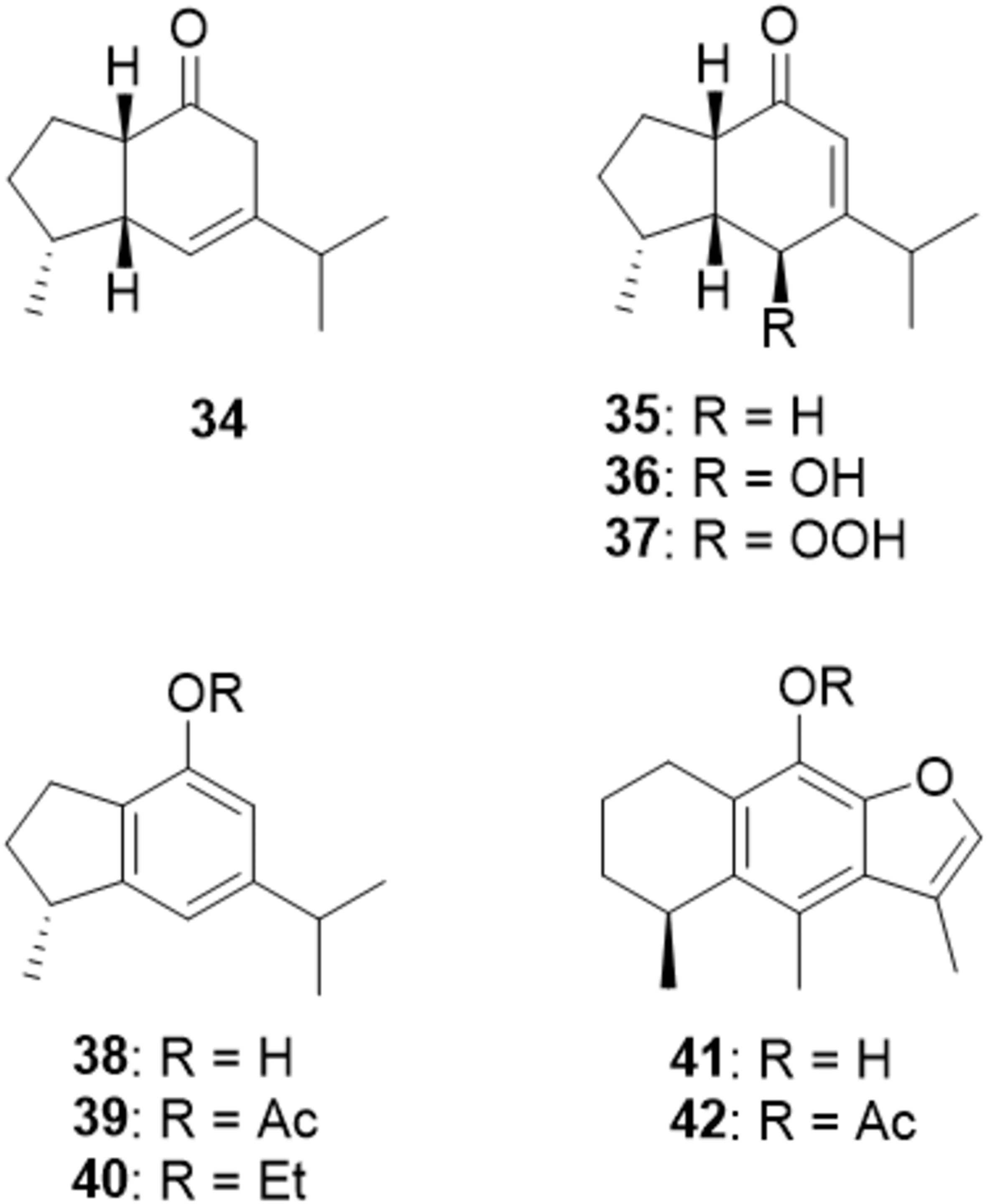
Formulas of compounds 34-42.
Formulas of compounds 43-46.
Formulas of compounds 47-50.
Formulas of compounds 51-53.
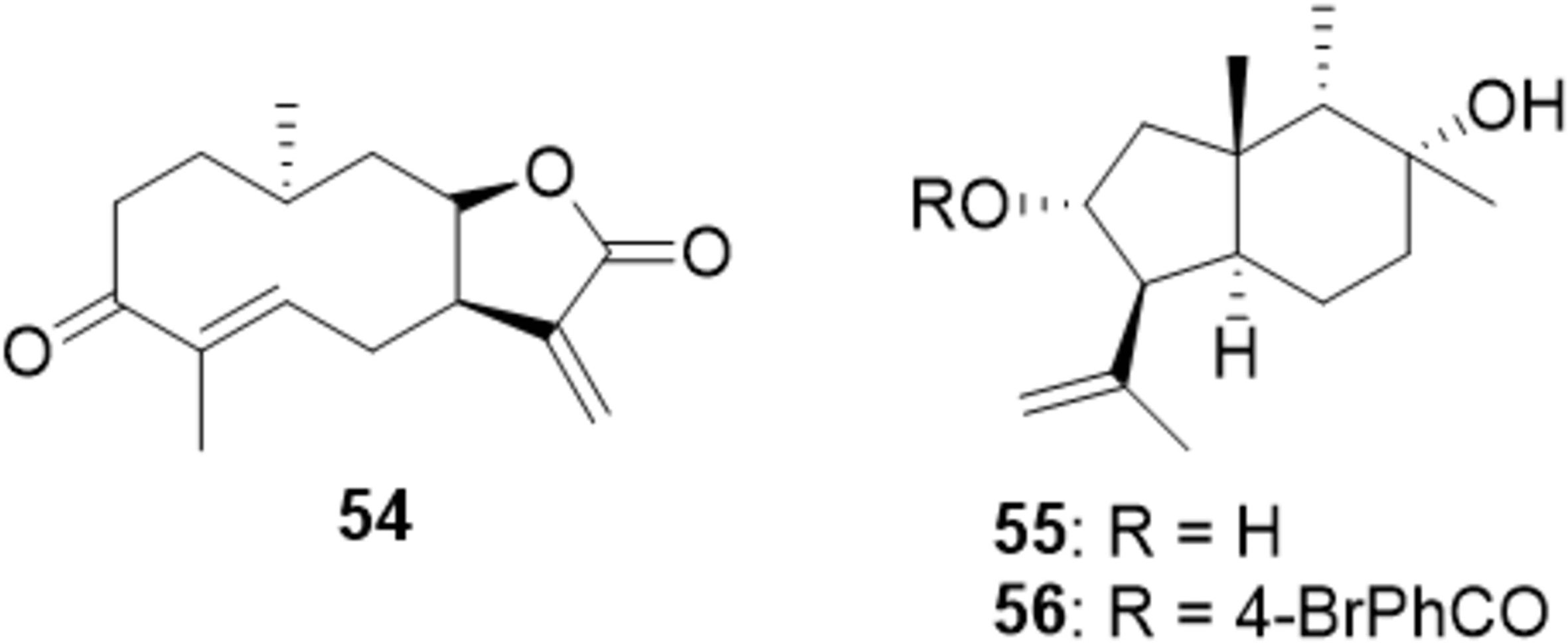
Formulas of compounds 54-56.
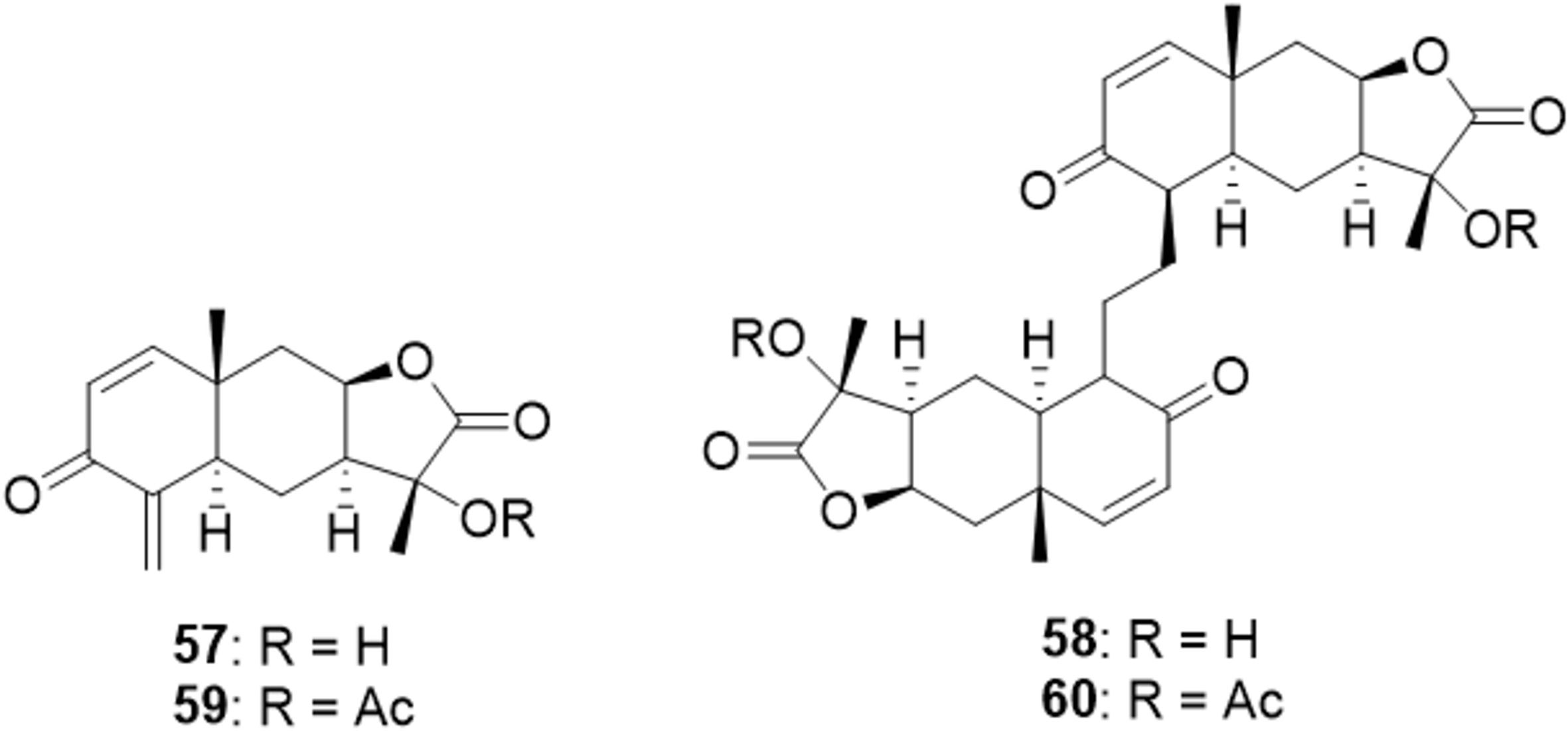
Formulas of compounds 57-60.
Formulas of compounds 61-66.
Formulas of compounds 67-69.
Formula of compounds 70.
Monoterpenoids 19 and 20 (Figure 4), and dextrorotatory oxocycloneroledol (29) (Figure 7), a main constituent of the leaf oil (49.4 to 55.6%) of Bubonium graveolens, was separated on a chiral HPLC column. The VCD spectrum provided its AC as (+)-(2R,6R)−29 after solvation model density (in CCl4) B3LYP/6-31G(d,p) DFT calculations.32
The isolation of (+)-(7R)-podocephalol (30) from Lasianthaea aurea and the preparation of its derived (−)-(7R)-podocephalyl acetate (31) (Figure 7) permitted the first conformational, VCD configurational and supramolecular studies of an ar-himachalene.35
A study of the endophytic fungus Nemania bipapillata (AT-05), isolated from the marine red alga Asparagopsis taxiformis, provided new botryane sesquiterpenoid (+)-(2R,4S,5R,8S)−4-deacetyl-5-hydroxybotryenalol (32) and the bisnorsesqiterpene (+)-(2R,4S,8S)-nemenonediol B (33) (Figure 8) whose AC followed from VCD studies.36
The AC of natural esquelanes 34 and 35 (Figure 9), the main components of a commercial fragrance, as well as their derivatives 36-40 (Figure 9) were revised by VCD spectroscopy of 35 and 39 in combination with DFT calculations at the B3LYP/DGDZVP level of theory. The VCD method was also applied to cacalol acetate 42 to verify its AC, since cacalol 41 (Figure 9) was previously used as a comparative motif to determine the AC of esquelanes.37
The (−)-T-muurolols 43-46 (Figure 10), isolated from marine-derived Streptomyces sp. M491, were studied by optimization of their molecular geometries and calculation of their OR, IR, VCD, ECD, and UV-vis spectra and molecular orbital energies using DFT and TDDFT methods. Their calculated IR spectra were in good agreement with experimental data, the OR values show the same sign but larger values, the VCD and ECD spectra can be interpreted as the response from deformation vibrations on the molecular skeleton and from transitions lacking asymmetry, respectively.38 Their AC was earlier established by NMR and X-ray crystallography of 3-oxo-T-muurolol and assuming that all these sesquiterpenes from Streptomyces sp. M491 belong to the same stereochemical series.39
The AC of germacranolide sesquiterpenlactone 47, isolated from Montanoa grandiflora and Laurus nobilis, was deduced by VCD together with the evaluation of the Flack and Hooft X-ray parameters. In addition, VCDEC was applied to α,β-unsaturated germacranolide 6-epi-laurenobiolide (48) while its reduced diastereomers 49 and 50 (Figure 11) were studied by VCD and VCDEC.40
The AC of vetiverianines 51, 52, and 53, (Figure 12), isolated from the roots of Vetiveria zizanioides, were determined by NMR, X-ray crystallography, and VCD studies as (4S,5S,6S,7S,10S)−51, (4R,5S,7R)−52, and (4R,5S,7R,11R)−53.41
The AC of (+)-(7R,8R,10S)-inuloxin A (54) (Figure 13), isolated from Inula viscosa, and of seiricardine A (55), obtained from Seiridium cardinale, fungi, followed from the combined analysis of their ORD, ECD, and VCD properties and by chemical introduction of a suitable chromophore. Thus, (−)−55 was converted into the p-Br-benzoyl ester (−)-(1S,2R,3aS,4S,5R,7aS)−56 (Figure 13). This study shows that when dealing with structurally complex and flexible molecules, a concerted application of more than one chiroptical methodology should be considered.42
The eudesmanolide farinosin (57) (Figure 14), isolated from the aerial parts of Encelia fariginosa, was fully characterized for the first time despite its original isolation half a century ago. The early assumed relative stereochemistry and AC were confirmed by VCD together with evaluation of the Hooft X-ray parameters.43 In addition, the structure of hydroxy-bis-dihydrofarinosin (58), from the same plant, was verified by single crystal X-ray diffraction. The AC of derived diacetates 59 and 60 (Figure 14) followed from the corresponding VCD studies.44
The EtOAc extract from the aerial parts of Artemisia argyi was submitted to HPLC-based activity profiling to track the active compounds. The AC of 61-66 (Figure 15) were determined by VCD studies at the B3LYP/6-31 + G(d,p level of theory). Automatic comparison using SimVCD software was useful for 61, 63, 64, and dimer 66.45
A bioassay-guided isolation from a Trichoderma albolutescens culture medium led to the isolation of trichodermin (67) and trichoderminol (68) (Figure 16). Their structures and (2R,4R,5S,6R,11R,12S) AC followed from spectroscopic techniques including VCD.46
Unusually complex (−)-centratherin (69) (Figure 16), isolated from the leaves of Eremanthus crotonoides, has 3 carbonyl groups, one of them conjugated with a diene, an α,β-unsaturated-γ-lactone, and an angelate group. Its AC was determined by the combined use of ECD, electronic dissymmetry factor (EDF), ORD, VCD, and vibrational dissymmetry factor (VDF). The combined EDF and VDF spectra analysis are a helpful diastereomer discrimination tool. All analyses confirmed the AC as (6R,7R,8S,10R,2'Z)−69.47
Artemether, a methyl ether derivative of artemisinin was isolated from Artemisia annua. Among α- and β-artemether, the β-isomer shows the main antimalarial activity. Therefore, a full understanding of the structure of β-artemether (70) (Figure 17) is essential. The consistency of VCD spectra with calculations at the B3WP91/6-311G+ (2d,p) and B3LYP/6-311G+(2d,p) levels confirmed the AC.48
Diterpenoids
The formulas of the 51 diterpenoids included in this subsection can be seen in Figures 18-30.
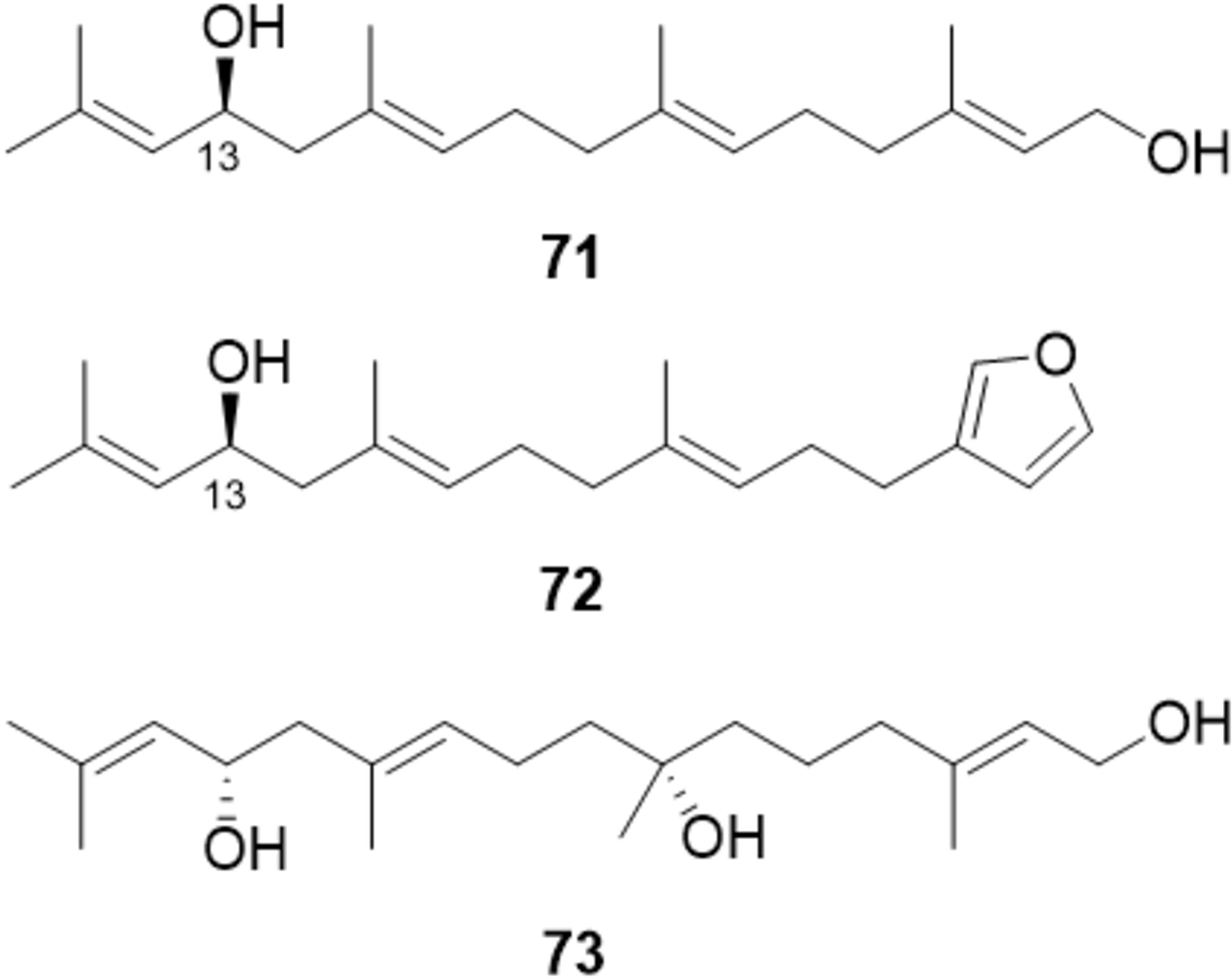
Formulas of compounds 71-73.
Formula of compounds 74.
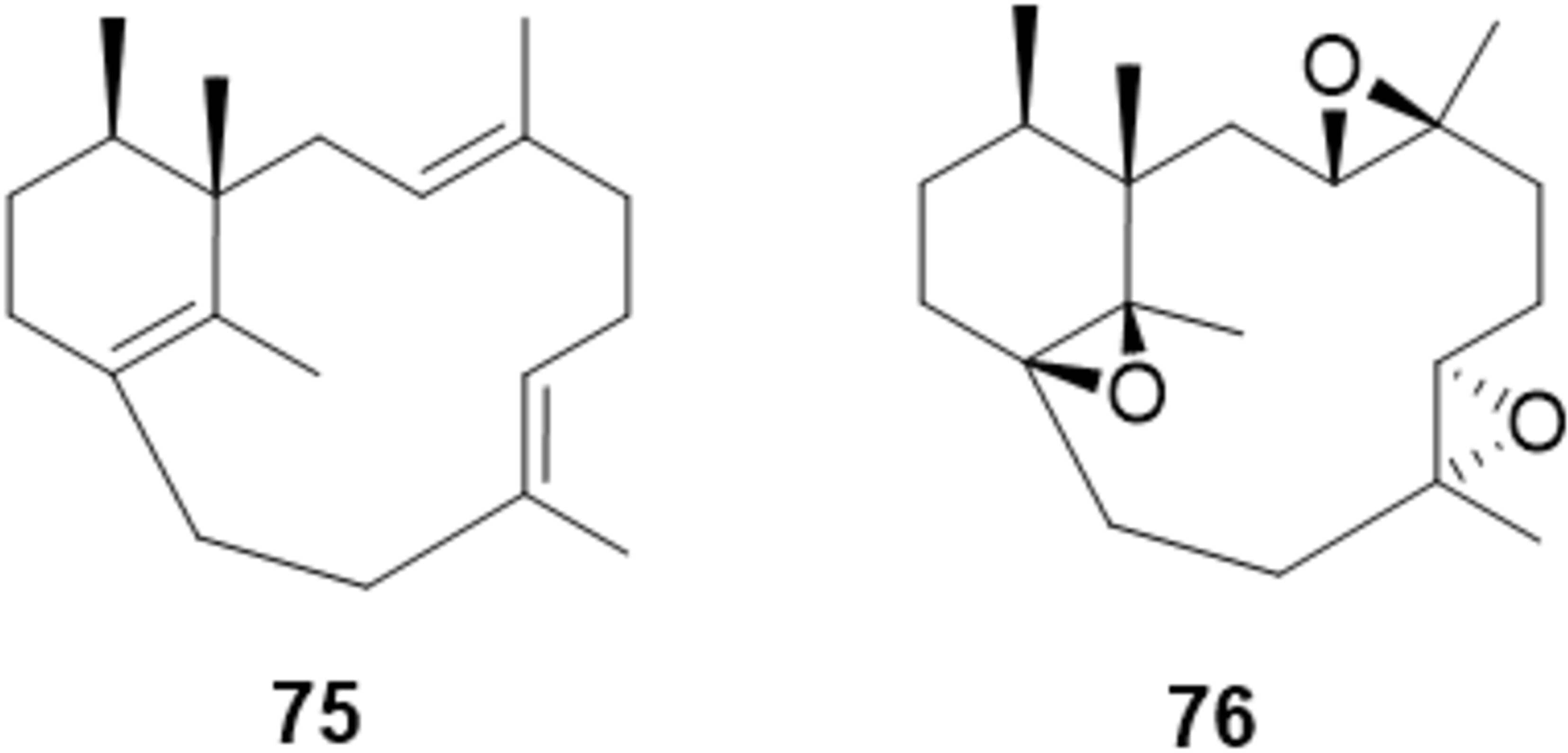
Formulas of compounds 75-76.
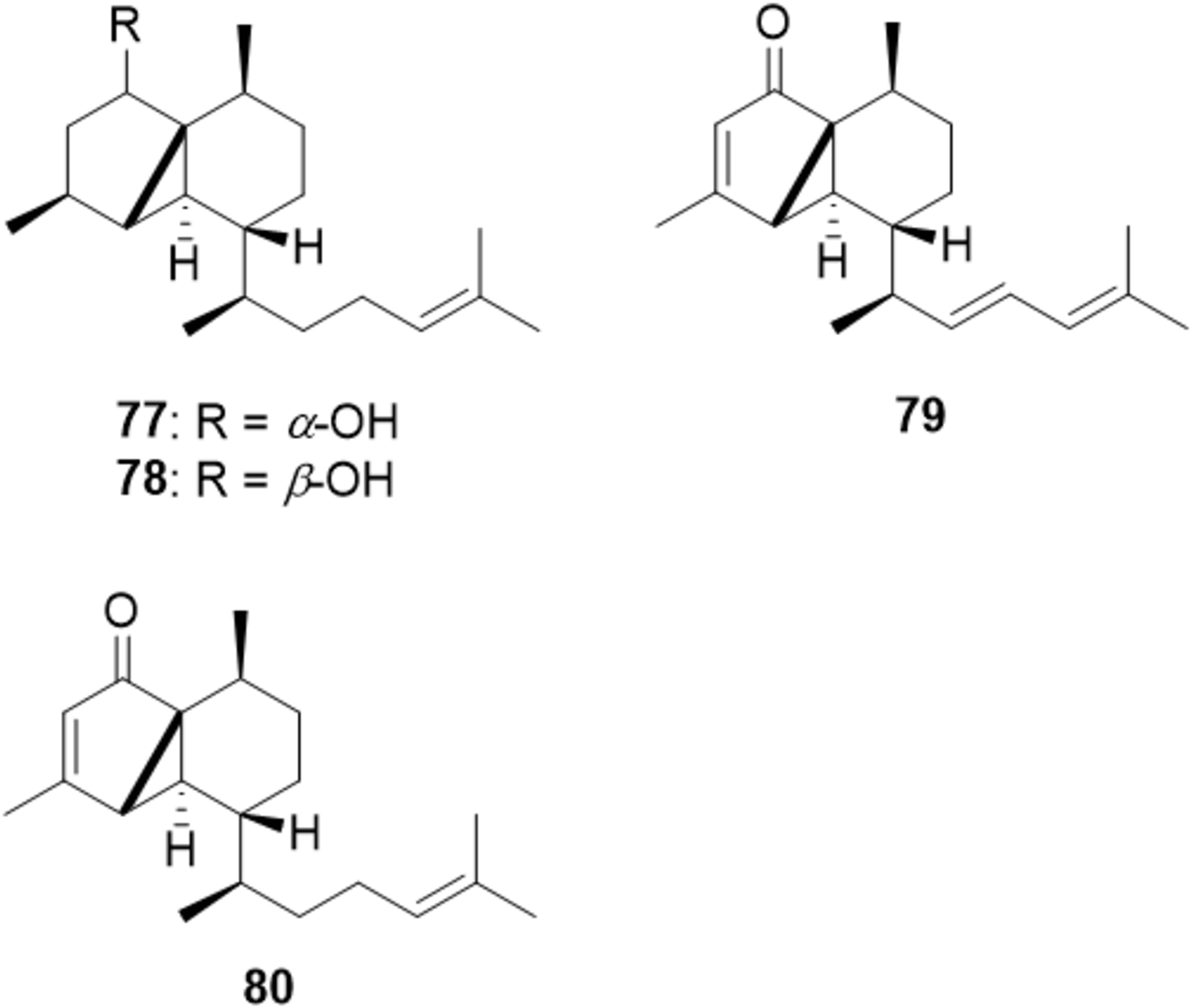
Formulas of compounds 77-80.
Formulas of compounds 81-82.
Formulas of compounds 83-88.
Formulas of compounds 89-90.
Formula of compound 91.
Formulas of compounds 92-97.
Formulas of compounds 98-105.
Formulas of compounds 106-112.
Formulas of compounds 113-118.
Formulas of compounds 119-121.
The AC of linear diterpenoids elegandiol (71) and bifurcane (72) (Figure 18), isolated from Bifurcaria bifurcata, was initially established as 13-(R) by chemical derivatization.49 Calculated spectra of suitable structure fragments facilitated the use of VCD allowing the unambiguous assignment of the 13-(S) AC of 71 and 72.50
The AC of bifurcatriol (73) (Figure 18), a linear diterpenoid with 2 stereogenic centers isolated from the Irish brown alga Bifurcaria bifurcata, was assigned by VCD and DP451 probability analyses of the calculated 13C-NMR chemical shifts.52
The structure of incensfuran (74) (Figure 19), isolated from Boswellia papyrifera, was elucidated by NMR, while its AC was determined by single crystal X-ray diffraction analysis, ECD, and VCD as (1S,4R,5R)−74.53
Treatment of a verticillane from Bursera species with Et2O:BF3 gave 75 (Figure 20). The calculated and experimental VCD curves provided its (1E,4Z,8Z,11S,12R) AC. In turn, preparation of (+)-76 assigned the AC as (1R,4R,5R,8S,9S,11S,12R,15R) and provided the preferred conformation of the 12-member ring which showed a specific spatial orientation of the 3 oxiranes.54
The gorgonian Euplexaura sp. GXWZ-05 attracted attention due to the cytotoxic activity of its EtOAc extract. Thus, 4 serrulatane-type diterpenoids, including new euplexaurenes 77-79 (Figure 21) and known anthogorgiene P (80) were isolated. The AC followed from a VCD study of 80.55
The relative stereochemistry of FCdiene 81 (Figure 22), isolated from fermentation of Saccharomyces cerevisiae, was confirmed by comparison of experimental and predicted 13C–NMR chemical shifts and the AC followed from its IR and VCD spectra as (6S,7S,11R)-fusicocca-2,10(14)-diene (81).56
The stereochemistry of a new isopimarane-type diterpenoid, isolated from Callicarpa macrophylla Vahl, was studied by ECD and VCD with the aid of TDDFT calculations confirming the AC as (4S,5S,9S,10S,13S,14S)−14α-hydroxy-7,15-isopimaradien-18-oic acid (82) (Figure 22).57
The known mixture of horminone (83) and taxoquinone (84) (Figure 23) was isolated from the aerial parts of Salvia concolor Lamb. The derived peracetates mixture showed partial hydrolysis upon silica gel chromatography yielding monoacetates 85 and 86, which upon reacetylation gave 87 and 88. The AC of abietane-type epimeric pairs of monoacetates 85 and 86, and of diacetates 87 and 88 was confirmed by VCD. The 1H and 13C NMR chemical shift of 85 to 88 were also fully assigned.58
Anacolosins A (89) and B (90) (Figure 24) were obtained from Anacolosa clarkia. Their relative and AC were assessed using a combination of 1H NMR coupling constant data, ROESY experiments, ECD, and VCD spectroscopy.59
A sample of 9,12-cyclomulin-13-ol (91) (Figure 25), a constituent of Azorella and Laretia species, becomes available from Laretia acaulis. Its AC has been established by VCD in combination with DFT calculations.60
The aqueous extract of the leaves of Ageratina cylindrica afforded ent-kaurenoic acid glycosides 92-95 (Figure 26). Their structures were elucidated mainly by NMR and MS, while the AC were established by VCD spectroscopy of 96 prepared either from 92 or 95, and of its C-15 epimer 97 prepared from grandifloric acid.61
The AC of 98-101 (Figure 27), isolated from Jatropha dioica, was assigned by VCD and confirmed by single-crystal X-ray diffraction of 101 and 103. The (M,2S,9S,11R) and (M,2R,9S,11R) AC assignments of 102 and 103, respectively, show the capacity of VCD to differentiate epimers in the presence of an inherently dissymmetric chromophore. In addition, the (2R,9R,13S,15S) and (2R,3S,4R,9R,13S,15S) AC of jatrophatrione 100 and citlalitrione 101, respectively, became evident.62 The roots of the plant afforded riolozatrione (104) and 6-epi-riolozatrione (105), 102, and 103 (Figure 27). The AC of the compounds was established by VCD and X-ray diffraction.63
Although icetexone (106) and conacytone (108) were originally isolated from Salvia ballotiflora in 1976, no detailed NMR assignment and AC determination were available. This was achieved by single-crystal X-ray studies of 106 and 108 (Figure 28) whose Flack and Hooft parameters provided the AC. The AC was also tested by VCD of the derived acetates 107 and 109.64 Of relevance is to note that in the case of icetexone acetate (107) DFT VCD calculations require to start from both a “bowl” and a “dome” shaped 7-member ring model. Further studies of the aerial parts of the plant gave additional icetexanes. Their structures were established by spectroscopic means, mainly 1H- and 13C-NMR, while the AC of 110, 111, and 112 (Figure 28) was determined by X-ray diffraction analysis and VCD.65
The aerial parts of Salvia clinopodioides gave abietanes 113, 115, and 117, together with icetexane 118 (Figure 29). The AC of 113 and 115 was verified by VCD of their acetates 114 and 116. Considering that natural occurring 115, 117, and 118 share a common biosynthetic origin with 113, it could be assumed they have the same AC.66
Three biogenetically interesting ent-kauranes (−)-alboatisins 119-121 (Figure 30), isolated from the aerial parts of Isodon albopilosus, have been studied calculating OR values, IR, VCD, ECD, UV-Vis, and molecular orbital energies by DFT. The studies provided a detailed structural characterization and the AC followed from the VCD and ECD results.67
Other terpenoids
The formulas of the 5 terpenoids included in this small subsection can be seen in Figures 31-33.
Formula of compound 122.
Formulas of compounds 123-124.
Formulas of compounds 125-126.
There are 3 additional reports regarding a meroterpenoid, a couple of nor-triterpenoids, and a couple of tetraterpenoid carotenes that were studied during the reviewed period, while there appeared no study on a sesterterpenoid (C25) or a sesquaterpenoid (C35) within the period.
Conversion of (+)-daurichromenic acid, isolated from the leaves of Rhododendron dauricum, into its methyl ester was followed by Lewis acid (FeCl3) catalyzed cyclization of rings A and B. This derivatization strategy reduced the molecular flexibility and allowed the AC assignment of meroterpenoid (–)−122 (Figure 31) by ECD and VCD as (5R,8S,10R).68
Two hoursighly oxygenated nor-triterpenoids, picraviane A (123) and B (124) (Figure 32) were isolated from Picramnia glazioviana Engl and their structures determined by NMR. Single-crystal X-ray diffraction data were also obtained for picraviane B. The AC of both compounds was ascertained by VCD spectroscopy.69
ECD, Raman optical activity, and VCD methodologies were used to characterize (3R,3'R)-astaxanthin (125) and (3S,3′S)-astaxanthin (126) (Figure 33). Commercially available racemic astaxanthin was separated into the enantiomers by column chromatography after bis-[(−)-camphanic] ester derivatization. The conformational sensitivity of the used chiroptical methods makes them promising tools for the study of carotenoids in the natural environment and may make them very attractive for future studies of chiral carotenoids in biological systems.70
Aromatic Compounds
The formulas of the 48 aromatic compounds included in this section can be seen in Figures 34-46.
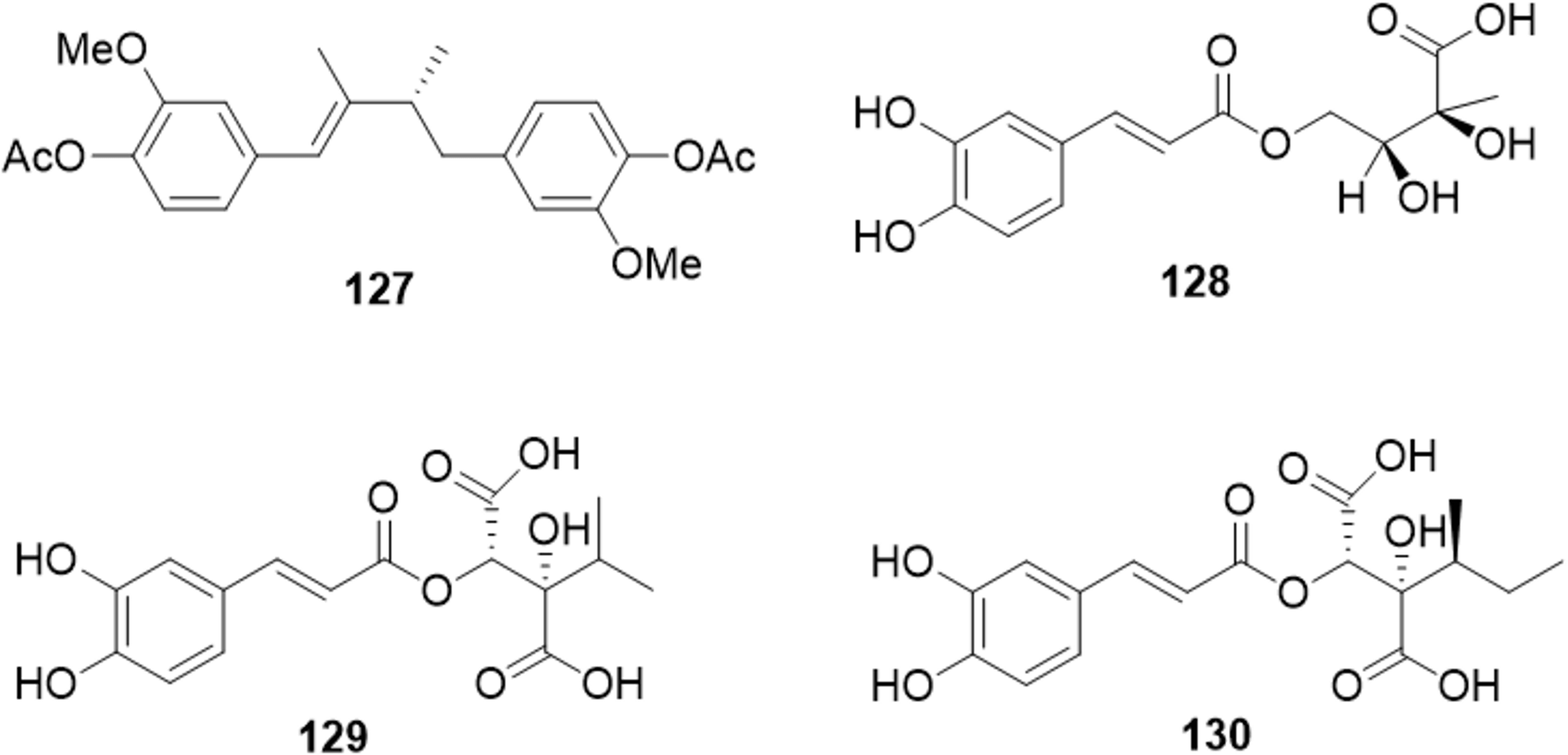
Formulas of compounds 127-130.
Formulas of compounds 131-134.
Formulas of compounds 135-136.
Formulas of compounds 137-140.
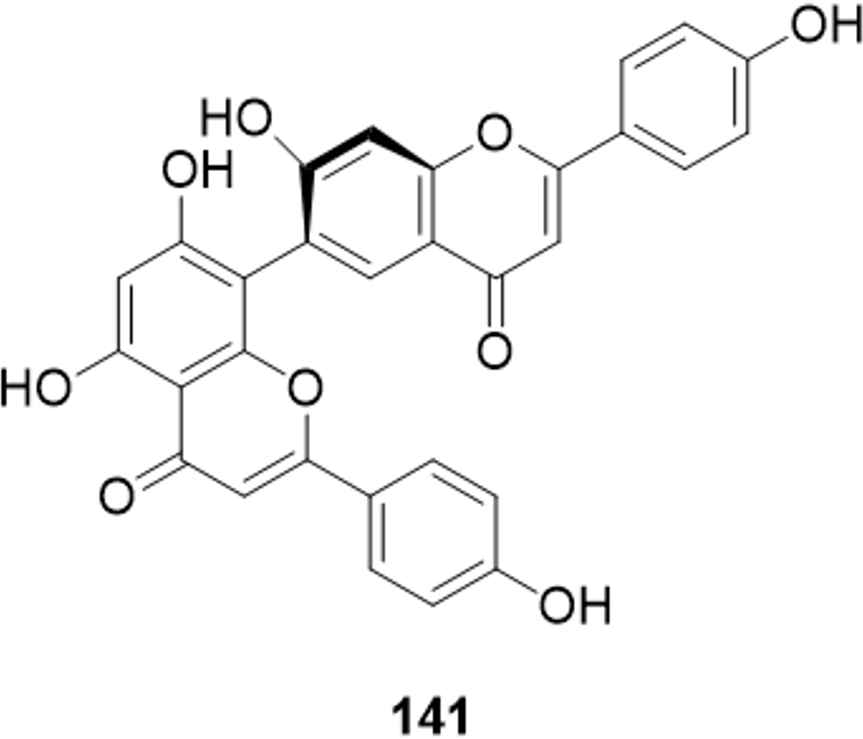
Formula of compound 141.
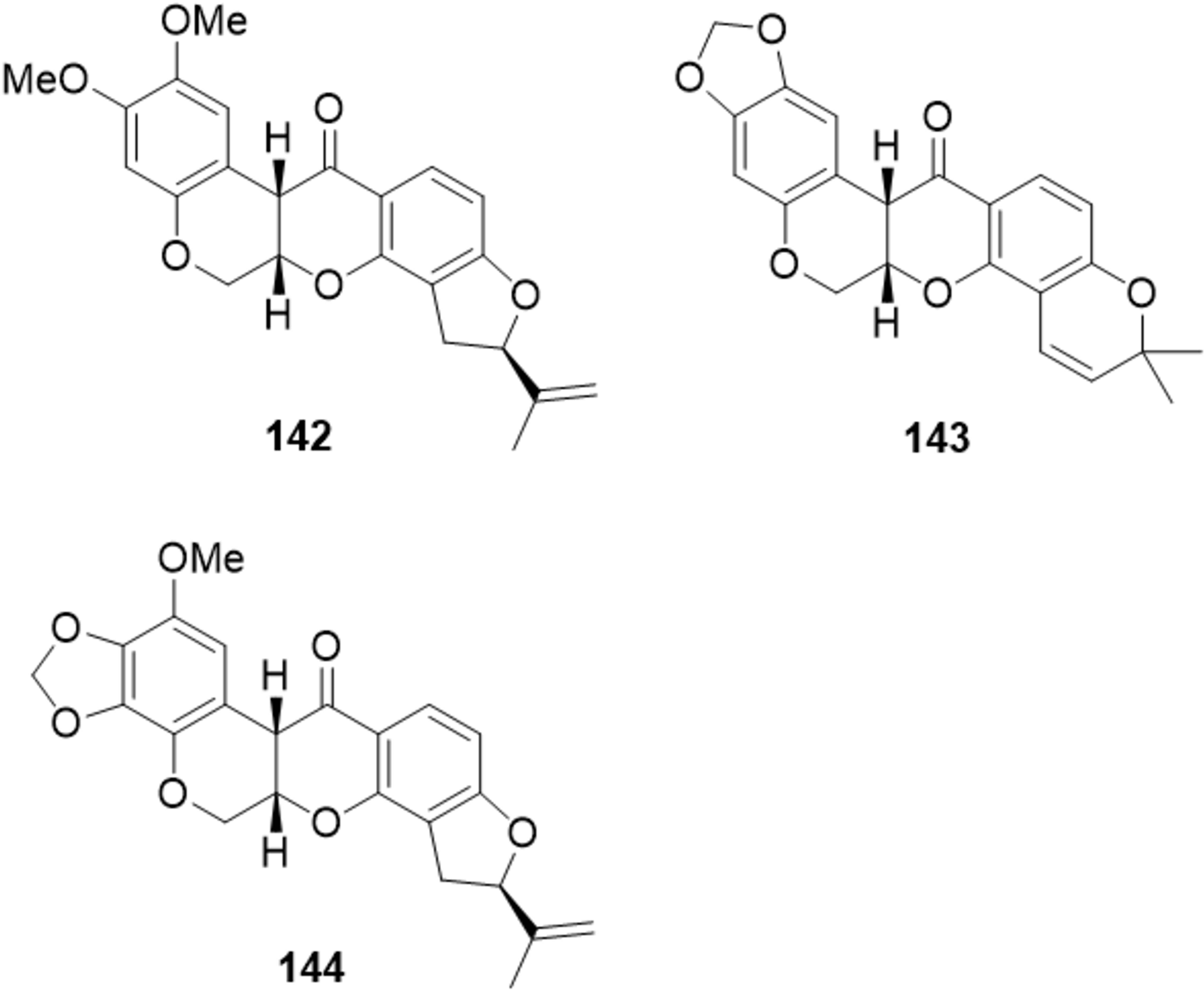
Formulas of compounds 142-144.
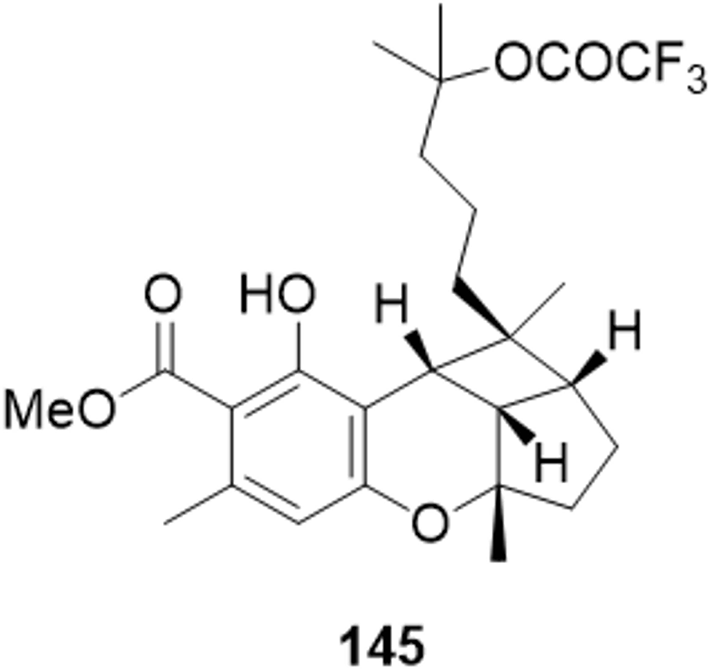
Formula of compound 145.
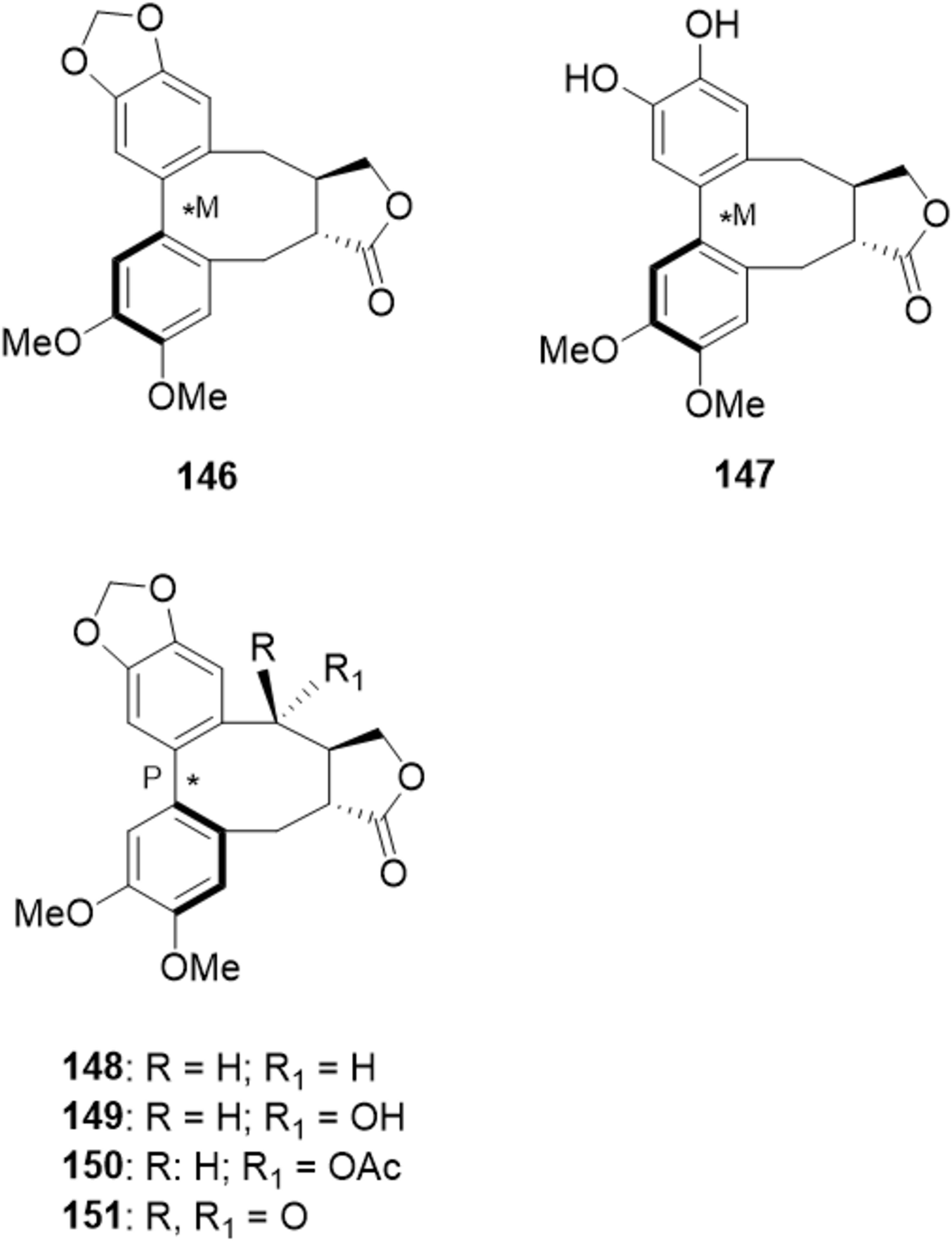
Formulas of compounds 146-151.
Formulas of compounds 152-157.
Formulas of compounds 158-159.
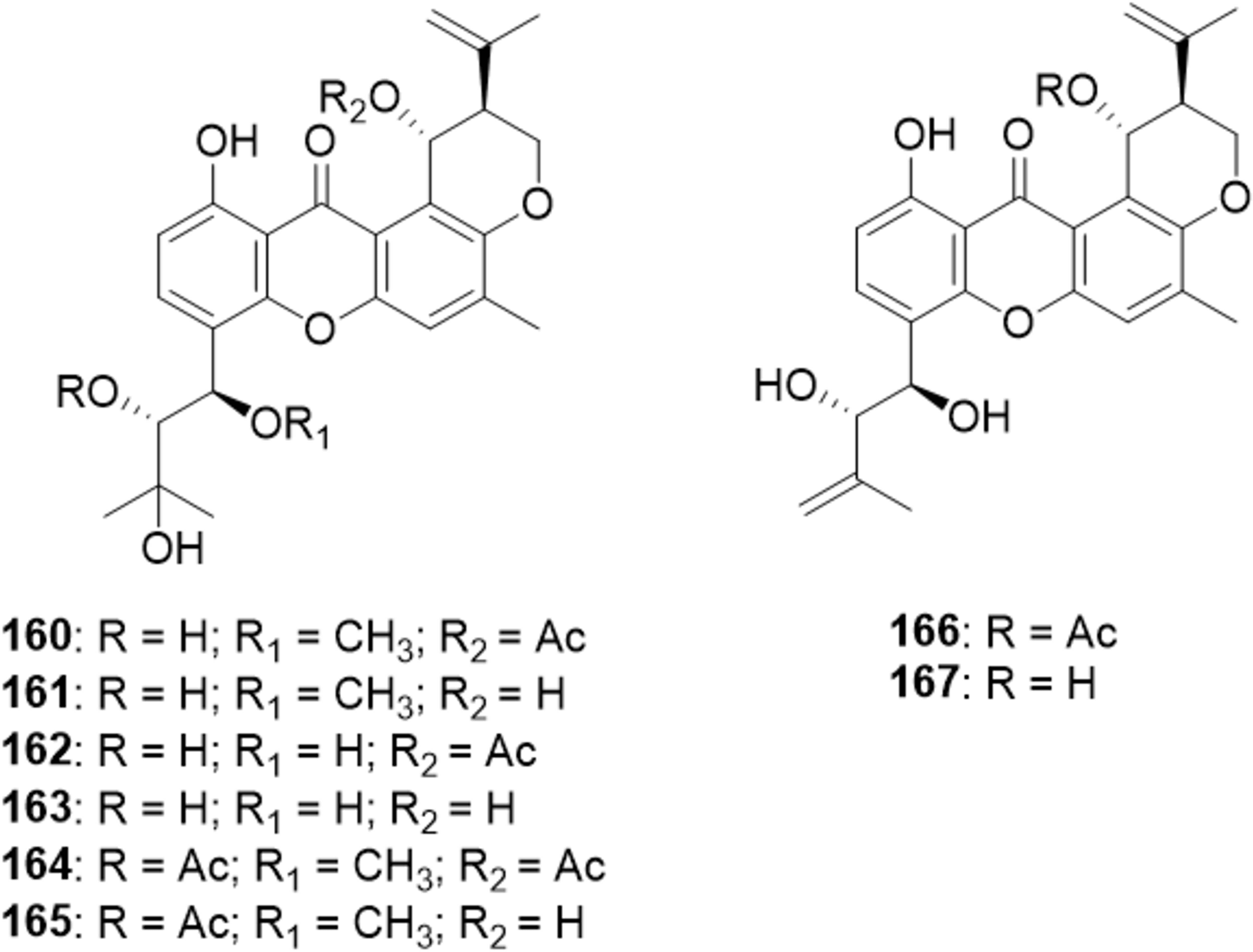
Formulas of compounds 160-167.
Formulas of compounds 168-172.
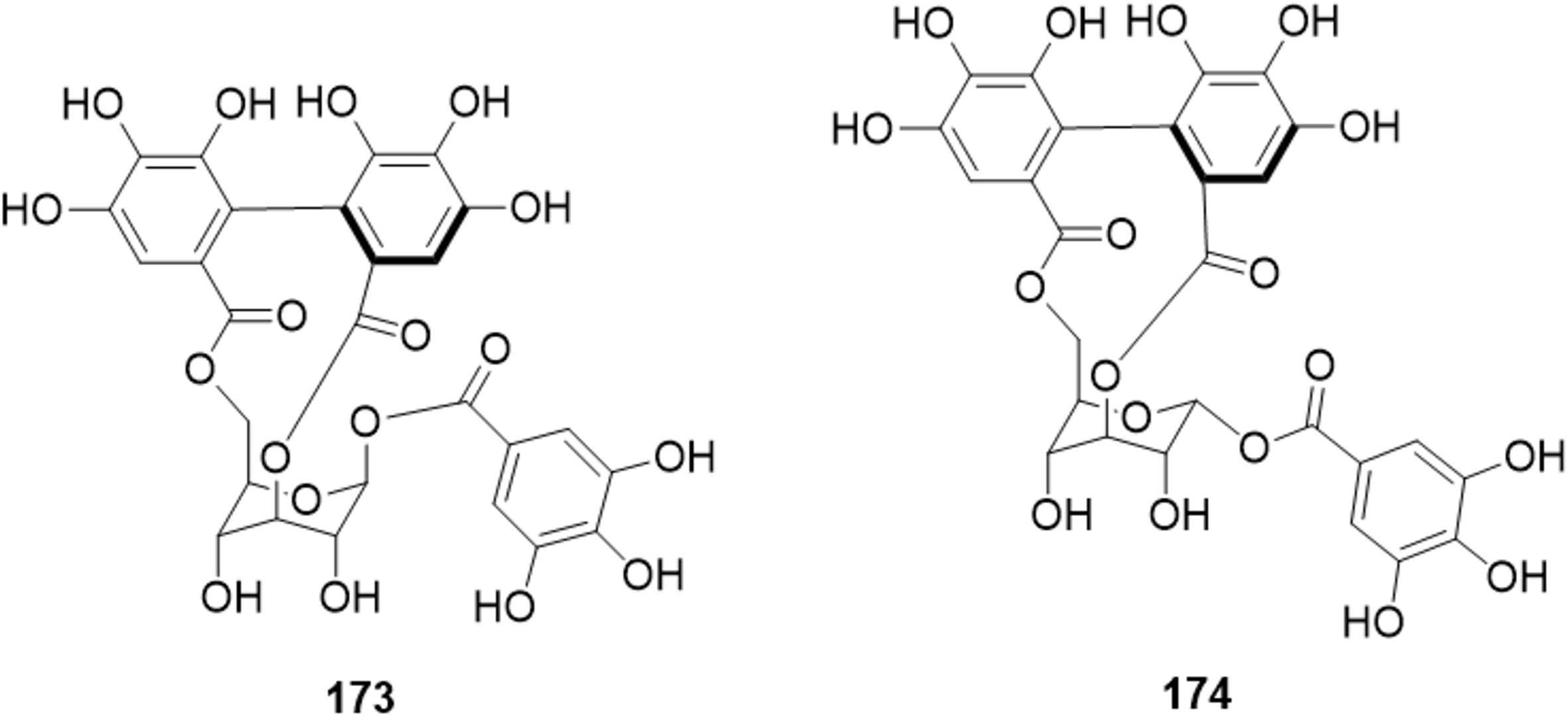
Formulas of compounds 173-174.
Guaiaretic acid, isolated from Guaiacum sanctum, presented some difficulty in determining its AC since the sole stereogenic center is located on a chain. Calculated VCD spectra of guaiaretic acid diacetate [(−)−127] (Figure 34), when compared with the experimental spectrum allowed to complete the task, finally showing the AC is 8'R.71
The relative and AC of caffeic acid ester derivatives 128-130 (Figure 34), isolated from Tithonia diversifolia, was established by a combined use of experimental and calculated 13C NMR chemical shifts, as well as by ECD and VCD spectroscopies.72
The (3'R,4'R) AC of angular-type pyranocoumarins (–)−3',4'-di-O-acetylkhellactone (131), (–)−4'-O-acetyl-3'-O-angeloylkhellactone (132), (+)−3'-O-acetyl-4'-O-isobutyroylkhellactone (133), and (–)−3'-O-angeloyl-4'-O-senecioylkhellactone (134) (Figure 35), isolated from Prionosciadium thapsoides, was assigned by VCDEC and verified by VCD.73
Application of the VCDEC methodology in combination with calculated IR/VCD spectra analysis allowed the unambiguous assignment of the AC of C-8 substituted furandibenzoylmethane 135 (Figure 36). The AC of the natural product, isolated from the roots of Dahlstedtia glaziovii, was determined as (+)-(8S).74
The AC of the homoisoflavanone 5,7-dihydroxy-6-methoxy-3-(9-hydroxyphenylmethyl)-chroman-4-one (136) (Figure 36), found in Polygonum ferrugineum, was determined as (3R,9R) using a combination of electronic and vibrational chiroptical spectroscopic methods.75
The AC assignment of commercially available samples of epimeric (+)-catechin (137) and (–)-epicatechin (138) (Figure 37) was determined by contrasting the experimental and calculated VCD curves of their respective peracetate derivatives 139 and 140.76
Optically active agathisflavone (141) (Figure 38), a biflavone-type dimeric flavonoid isolated from Schinus terebinthifolius, was studied by measuring ECD, EDF, ORD, VCD, and VDF spectra thereby allowing to assign the axial chirality of (−)-agathisflavone as (aS) or (M).77
The bark of the roots of Piscidia carthagenensis afforded known rotenone (142) and millettone (143), as well as new piscicartone (144) (Figure 39). The structure of 144 followed from NMR studies while the AC of 142-144 was determined by VCD.78
Esterification and trifluoroacetic acid treatment of (+)-(S)-daurichromenic acid, isolated from Rhododendron dauricum, gave (+)−145 (Figure 40). Its conformational analysis, VCD, and ECD calculations allowed determining the (2S,3S,4S,11R,12S)-(145) AC.79
Steganes 148-151 were synthesized starting from natural (–)-bursehernin isolated from the resin of Bursera fagaroides and analyzed through 1D and 2D NMR spectroscopy. Their AC was established by VCD as (+)-(M,8R,8'R)−146, (+)-(M,8R,8'R)−147, (–)-(P,8R,8'R)−148, (–)-(P,7R,8R,8'R)−149, (–)-(P,7R,8R,8'R)−150, and (–)-(P,8R,8'R)−151 (Figure 41). Steganes 146 and 147 have the biaryl axis (M) configuration while 148-151 possess the (aR) or (P) configuration.80
The prenylated phloroglucinol α-pyrones 152-154, the dibenzofuran 155, the 23-methyl-6-O-demethylauricepyrone (156), and achyrofuran (157) (Figure 42) were isolated from the aerial parts of Achyrocline satureioides. Their structures were determined by 1D and 2D NMR spectroscopic studies while the AC of the sole stereogenic center of 152 was established by VCD. The same (S) AC of the α-methylbutyryl chain attached to the phloroglucinol nucleus was assumed for compounds 153-157 based on biogenetic considerations.81
The structures of 2 aryltetralin lactone lignans, petasitesins A (158) and B (159) (Figure 43), isolates from butterbur (Petasites japonicus), were elucidated by 1D and 2D NMR spectroscopy. ECD and VCD spectra suggested the AC as (7'R)−158 and (8S,7'R,8'R)−159.82
Prenylated xanthones aspergixanthones A–H (160–167) (Figure 44) were obtained from an Aspergillus sp fungus. It was hard to assign the AC due to free rotation of stereogenic centers on chains. By combined analysis of ECD, ORD, VCD, and the Snatzke method, the AC could be defined as (14R,15R,20S,25R)−160. The AC for 161-167 was assigned on the basis of a shared biogenesis and ECD spectra.83
The cascarosides 168-172 (Figure 45) were extracted from the bark of Rhamnus purshiana. Their structures were confirmed by NMR and MS, while the stereochemistry at C-10 and the AC were confirmed by ECD and VCD.84
Corilagin (173) (Figure 46), isolated from Phyllanthus stipulatus, was studied in both MeOH and DMSO by NMR, ECD, VCD, DFT, and molecular dynamics calculations revealing the conformational preferences. Experimental results show the axial preference of the gallate residue at the anomeric position in MeOH solutions, while the equatorial conformation dominates in DMSO as follows from 1H NMR coupling constant values. Conformational analyses of both corilagin conformers and statistical comparisons using the CompareVOA software supported the conformational phenomenon, concluding that the equatorial gallate conformer was wrongly described as isocorilagin (174) (Figure 46) which is yet non-existent. The axial chirality at the biphenyl moiety was confirmed as (aR) or (P).85
Polyketides
The formulas of the 20 polyketide compounds included in this section can be seen in Figures 47-53.
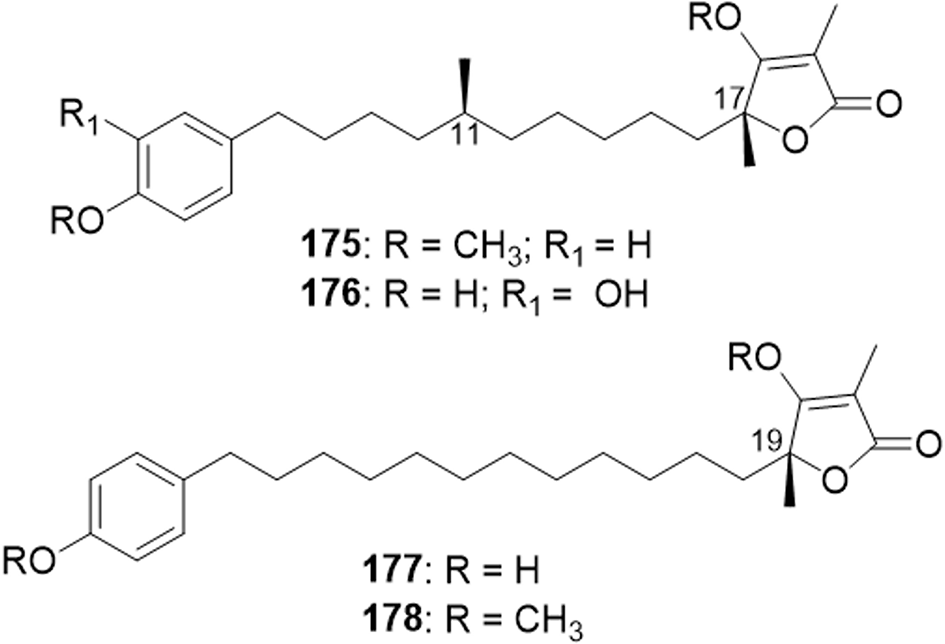
Formulas of compounds 175-178.
Formulas of compounds 179-180.
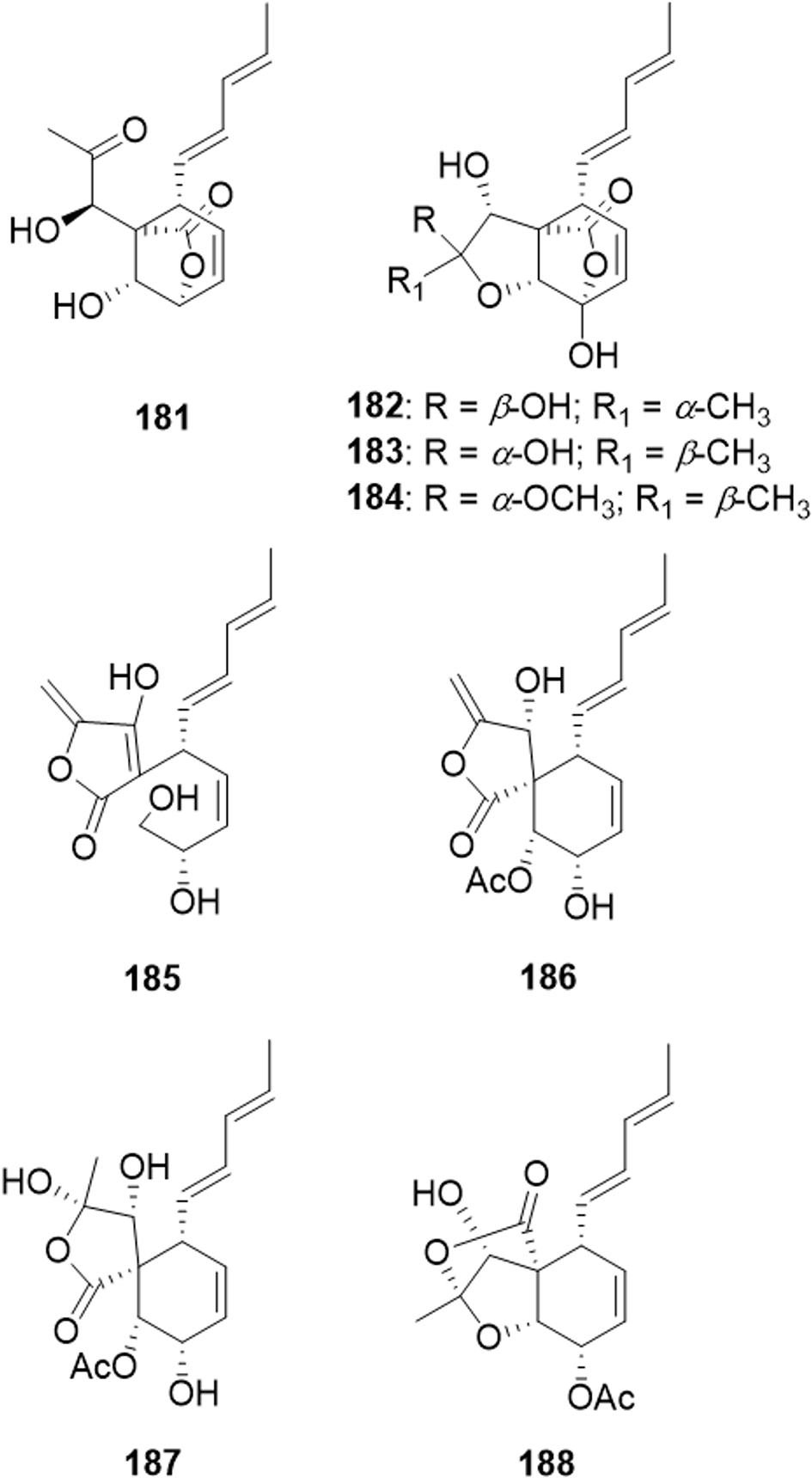
Formulas of compounds 181-188.
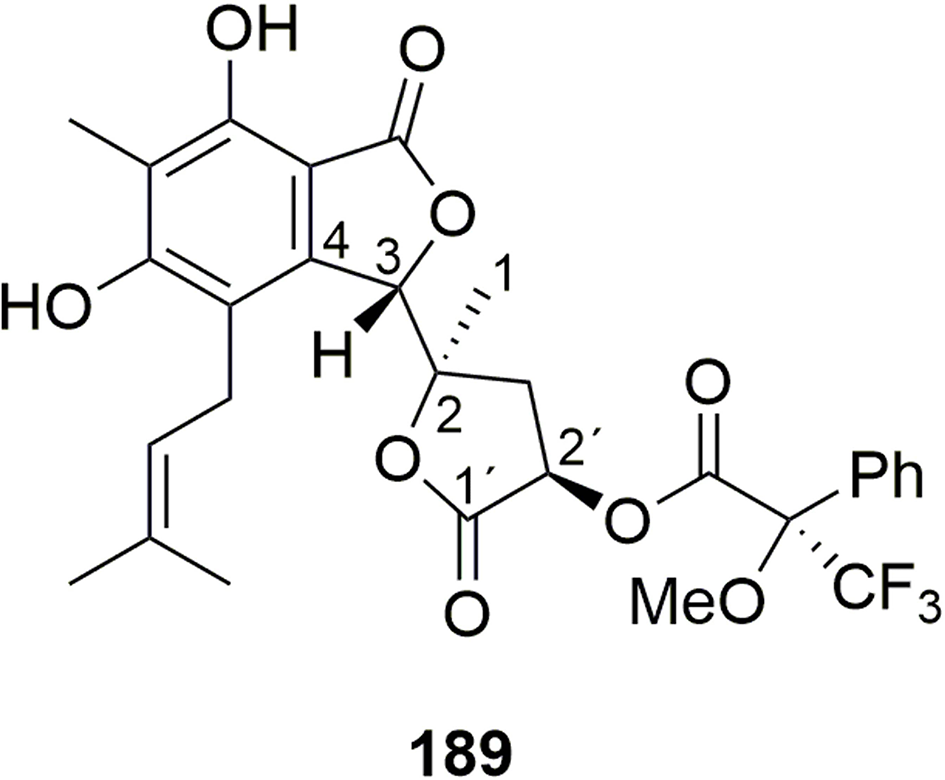
Formula of compound 189.
Formulas of compounds 190-191.
Formulas of compounds 192-193.
Formula of compound 194.
Polyketides are comprised by a structurally diverse group of compounds that contain carbonyls and hydroxy groups. They are synthesized through a series of decarboxylative condensation reactions between small carboxylic acids and malonate using enzyme complexes homologous to fatty acid syntheses.
A plakinidone, isolated from the sponge Plakortis halichondrioides, was treated with diazomethane to furnish 175 (Figure 47) whose AC was established as (11S,17R). For the configuration assignment at C-17 both VCD and ECD, were usefull.86 The AC of plakinidones 176 and 177 (Figure 47), isolate from the same sponge, was established through chemical correlation. To determine the (19R) AC of 178, the VCD and ECD spectra measured in MeCN were compared with calculated spectra. Since aromatic rings are rigid and aliphatic saturated chains adopt rather not-bent zig-zag conformations, most of the dihedrals were frozen simplifying the conformational search. The DFT calculations were performed at the B3LYP/aug-cc-pVDZ and B3LYP/TZVP levels of theory and the polarizable continuum model simulated the solvent effect.87
The polyketide cancrolide A, isolate from the fungus Chaetomium cancroideum, was treated with acetic anhydride to afford acetyl derivative 179 (Figure 48). NOE correlations and VCDEC indicated the (13R) AC.88
The AC of (+)-colomitide C, isolated from Cadophora luteo-olivacea, was established as (2S,2'S,3'R,4'S,5'R)−180 (Figure 48) by VCD spectroscopy.89
The structures of polyketides 181-188 (Figure 49), isolated from Fusarium avenaceu, were elucidated by 1D and 2D NMR spectroscopy. The relative stereochemistry was assigned using 1H NMR coupling constants, NOESY, and ROESY experiments, while the AC was established as (6R,9S,10R,11R,12R,13S)−188 by VCD.90
VCDEC was used to determine the (2R,2'R,3S) absolute stereochemistry at C-2' in 189 (Figure 50) using the mono (S)-MTPA ester of chaetophenol G isolated from Chaetomium cancroideum.91
The structure of (–)-aloesaponol III 8-methyl ether (190) (Figure 51), isolated from the roots of Eremurus persicus, was elucidated by IR and NMR experiments and the AC was assigned through VCD and ECD spectroscopies as (R).92
The fungus Rutstroemia capillus-albis provided 9-O-methylfusarubin (191) (Figure 51), whose (R) AC was assigned by applying ECD and VCD.93
Griseorhodin A (192) and griseorhodin C (193) (Figure 52) were produced in solid culture by Streptomyces puniceus AB10. Their AC was established as (6S,6aS,7S,8S)−192 and (6R,6aS,7S,8R)−193 using VCD and DFT calculations.94
Dextrorotatory pennicitrinone A (194) (Figure 53) is a citrinin dimeric derivative isolated from the marine-derived fungus Penicillium janthinellum. Due to the large distance between the stereogenic centers of the 2 monomer units, it was difficult to determine the AC, a task that was accomplished as (3R,4S,2'R,3'S)−194 by VCD combined with accurate quantum mechanical calculations.95
Miscellaneous C,H,O Compounds
The formulas of the 27 miscellaneous compounds included in this section can be seen in Figures 54-61.
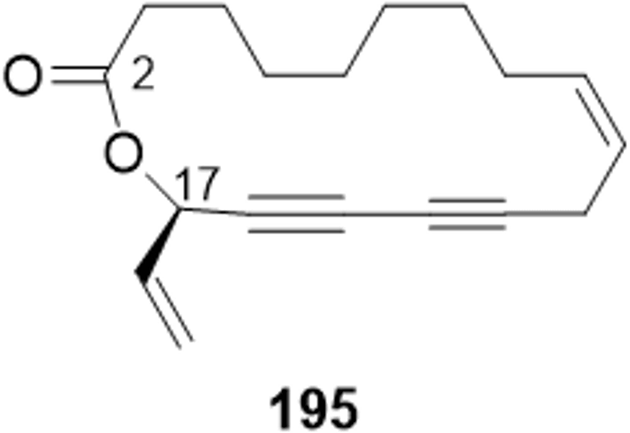
Formula of compound 195.
Formulas of compounds 196-199.
Formulas of compounds 200-206.
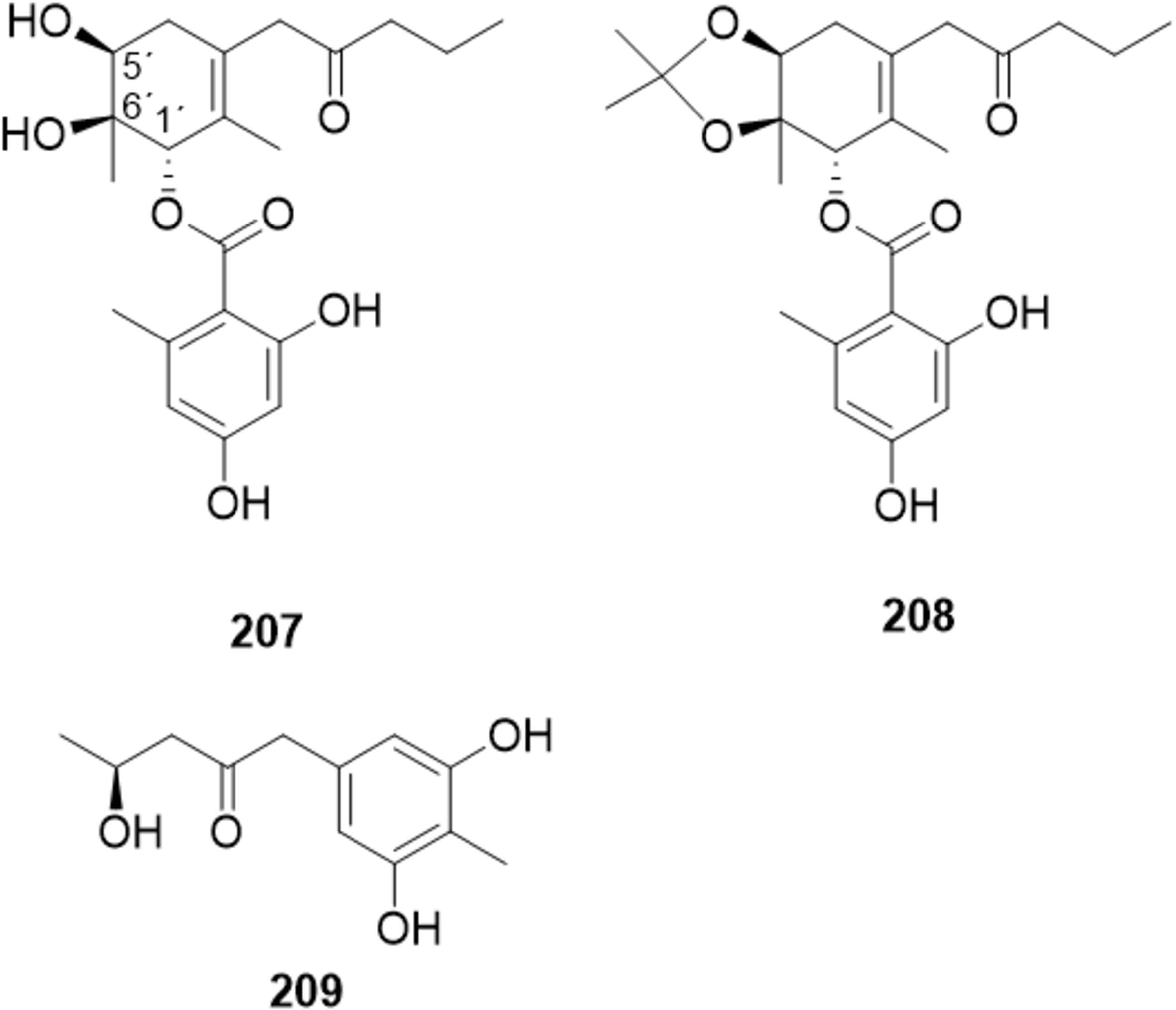
Formulas of compounds 207-209.
Formulas of compounds 210-215.
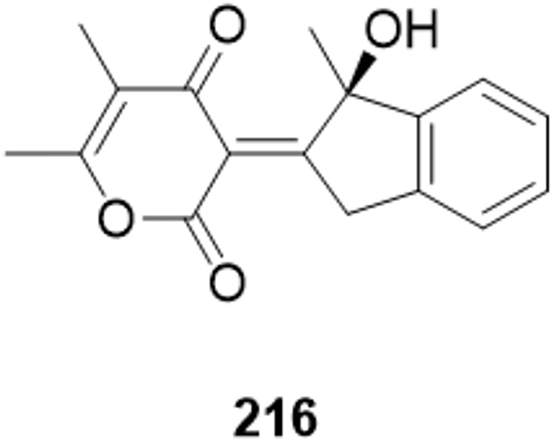
Formula of compound 216.
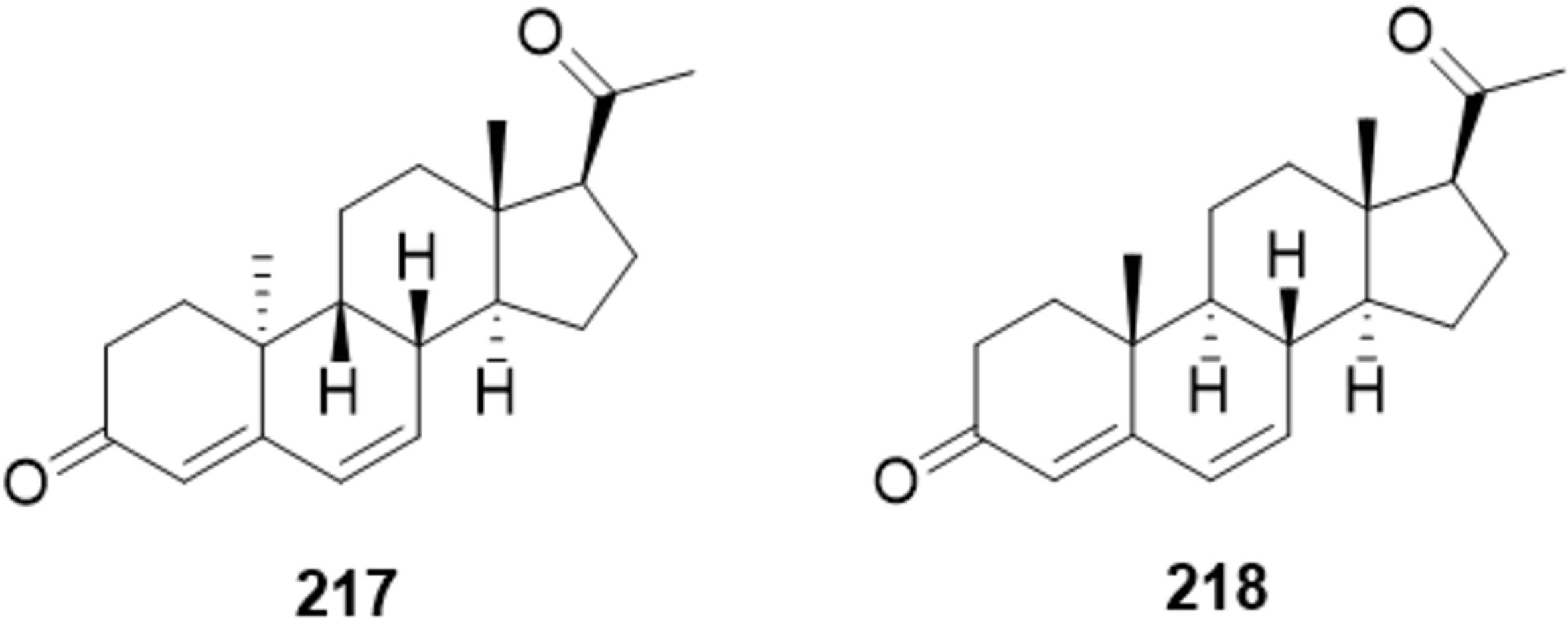
Formulas of compounds 217-218.
Formulas of compounds 219-221.
The hexanes extract of Eryngium campestre afforded the macrocyclic conjugated diyne campestrolide (195) (Figure 54) whose (Z,17R) AC was determined by VCD. For this purpose, B3PLYP/6-311G(d,p) calculations provided the starting geometry optimized model. Only the dihedral angles of this geometry were allowed to relax during the annealing, while bond lengths and valence angles were kept constant.96
The AC of omoxanthocidin B (196) (Figure 55) isolated from the endophytic Streptomyces sp. AcE210, was determined using an experimental VCD plot that was compared with a spectrum calculated for the (S) enantiomer.97
Commercial samples of (–)−197 and (+)−198 were used to assign their (R) AC using a combined approach of chiroptical methods. Experimental and computationally predicted OR, TDDFT ECD, and DFT VCD spectra of sotolon (197) and maple furonone (198) (Figure 55), combined with a computational study of the enol/keto tautomerization of 197 demonstrated that sotolon was present as its H-bonded dimer 199 (Figure 55) in chloroform solution, while maple furanone 198 was not evidenced as its dimer.98 The calculated energies for monomers 197 and 198, and those of their respective double hydrogen bonded ten-member cyclic dimers showed similar thermodynamic values, and therefore the authors invoked dynamic properties that could influence the stability preferences in chloroform solutions.
The combined use of VCD, ECD, and ORD allowed the AC assignment of diplobifuranylone A (200) as (2S,2'S,5'S,6'S), diplobifuranylone B (201) as (2S,2'R,5'S,6'R), diplobifuranylone C (202) as (2S,2'S,5'R,6'R), and diplofuranone A (203) as (4S,9R). Regarding sapinofuranones B (204) and C (205) (Figure 56), isolated from the fungus Diplodia corticola, the assignment of the (4S,5S) configuration using the current chiroptical data is more problematic, probably due to the conformational mobility of the systems and to the mismatching results of VCD and ECD. and was therefore confirmed after preparation and study of heavy di-(p-bromobenzoate) 206 (Figure 56).99
The (1'S,5'S,6'S) AC of 207, isolated from the fungus Talaromyces aculeatus (DS-62013), was assigned by preparing its derived acetonide 208 (Figure 57) which was studied by OR, ECD, and VCD. The conformational search required for the DFT calculations was simplified by hydrogen bond formation between the ester carbonyl group and the ortho phenol. Assignment of the AC of (+)-(S)−209 (Figure 57) isolated from the same fungus, was achieved using a matrix method, the positive OR values suggesting it should have the (S) AC.100
Diplopyrone (210) (Figure 58), is a phytotoxic metabolite of Diplodia corticola and D. mutila whose AC was confirmed by virtual multifrequency spectrometer software calculations of VCD and ECD data as (9R,6S,8aS, 4aS).101
VCD, ECD, and ORD, in combination with DFT calculations, allowed the AC assignment of (2S,3S)-radicinin (211), (2S,3R)-epi-3-radicinin (212), (2S,3R,4S)-radicinol (213), and (2S,3S,4S)-epi-3-radicinol (214), and to assign the (9S,10R) AC for cochliotoxin (215) (Figure 58) isolates from the fungus Cochliobolus australiensis (LJ-4B).102
Colletopyrandione (216) (Figure 59) was isolated as a scalemic mixture from Colletotrichum higginsianum. Its relative configuration was assigned by X-ray diffraction analysis and the (S) AC of the most abundant enantiomer was assigned by ECD and VCD spectra.103
A commercial sample of dydrogesterone (217) containing 6-dehydroprogesterone (218) (Figure 60), one of the diastereomers of dydrogesterone and generally its dominant impurity, was studied by VCD. The study allowed identifying the presence of both compounds.104
The azaphilone derivatives 219-221 (Figure 61) were cultured in a modified PDB medium using marine-derived fungus Pleosporales sp. CF09. The (7S,2'S,3'R) AC of (−)−221 was established by VCD analysis. Based on a shared biogenesis, the (7S,2'S,3'R) AC for (−)−219 and the (7S,2'S,3'R) AC for (+)−220 were proposed.105
Nitrogenated Compounds
The formulas of the 76 nitrogenated compounds included in this section can be seen in Figures 62-85.
Formulas of compounds 222-227.
Formulas of compounds 228-231.
Formulas of compounds 232-234.
Formulas of compounds 235-238.
Formulas of compounds 239-242.
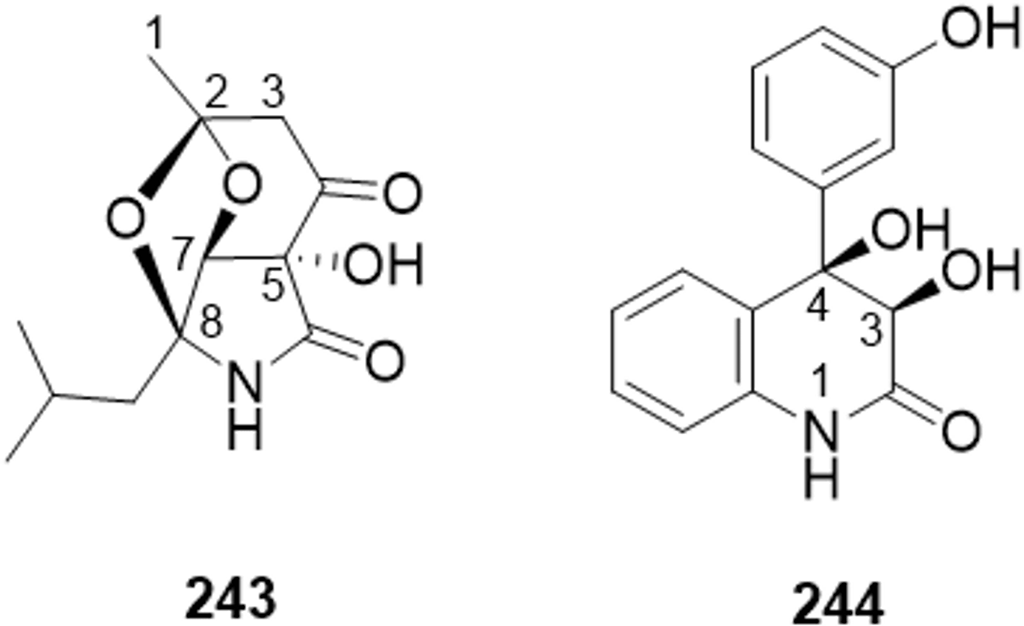
Formulas of compounds 243-244.
Formulas of compounds 245-246.
Formulas of compounds 247-251.
Formulas of compounds 252-253.
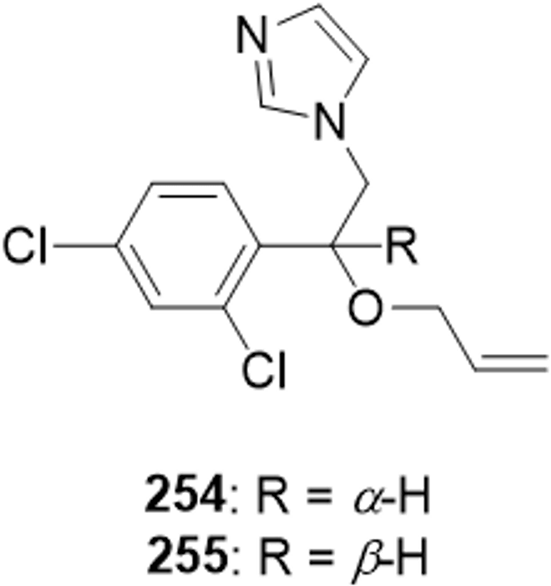
Formulas of compounds 254-255.
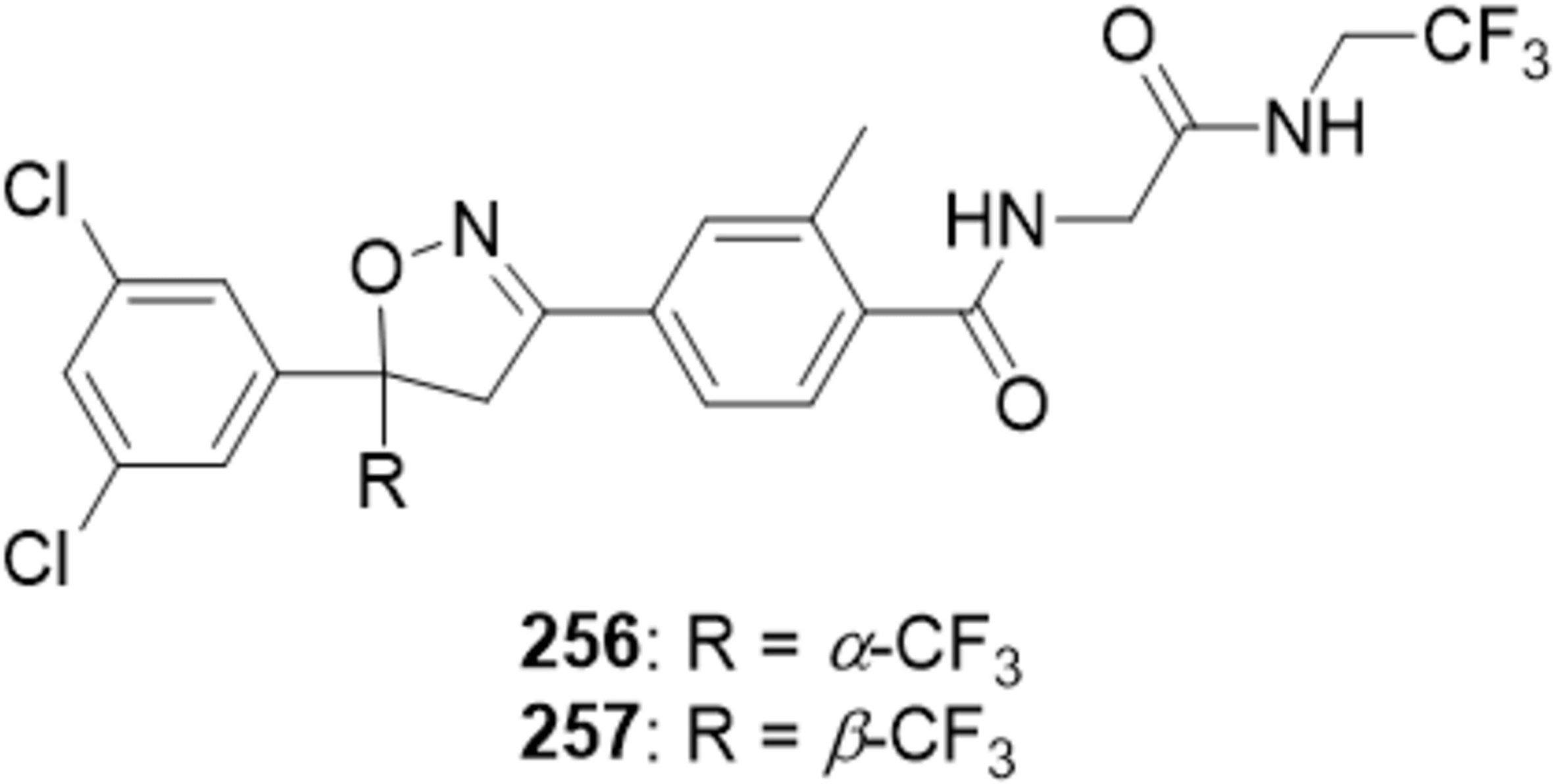
Formulas of compounds 256-257.
Formulas of compounds 258-259.
Formulas of compounds 260-261.
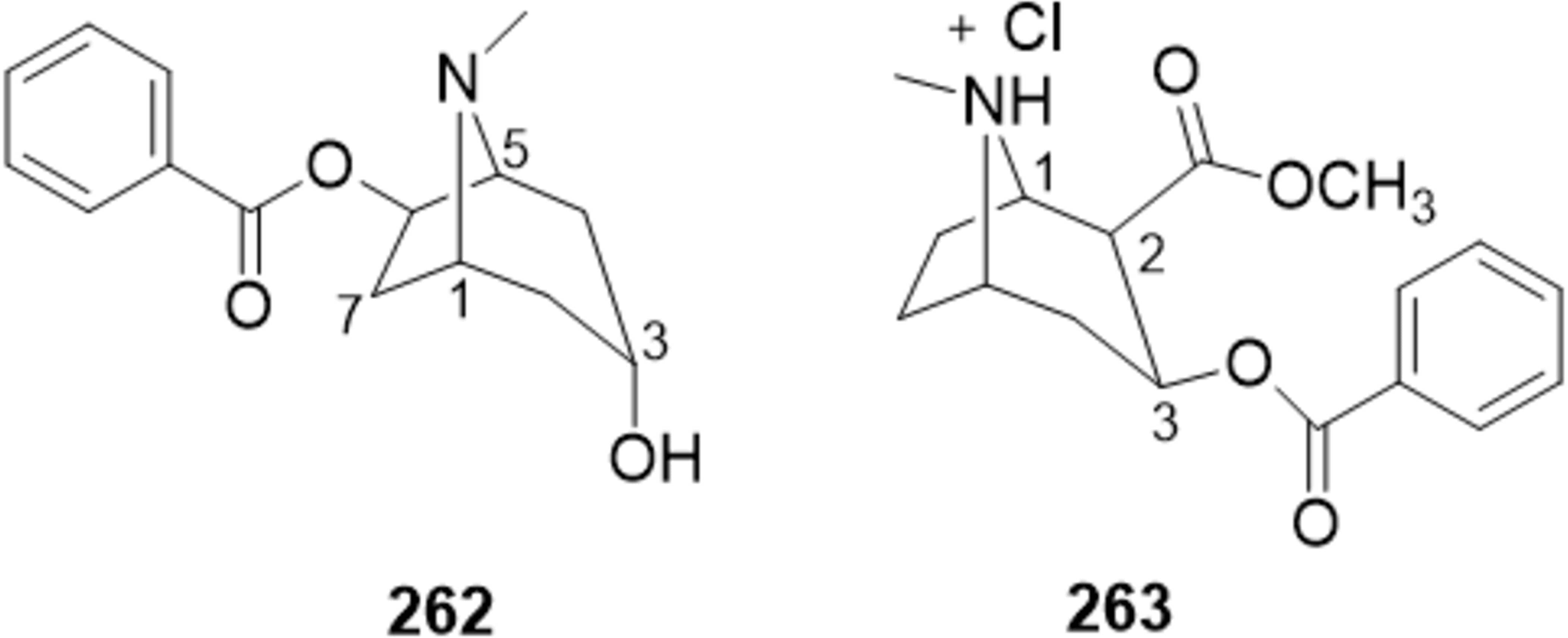
Formulas of compounds 262-263.
Formulas of compounds 264-268.
Formulas of compounds 269-272.
Formulas of compounds 273-274.
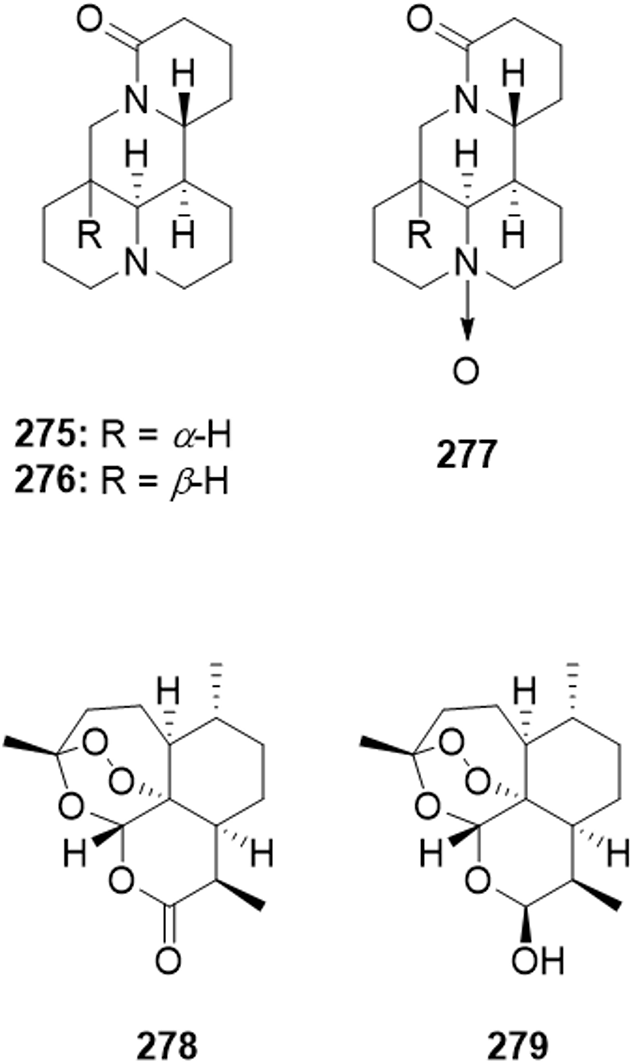
Formulas of compounds 275-279.
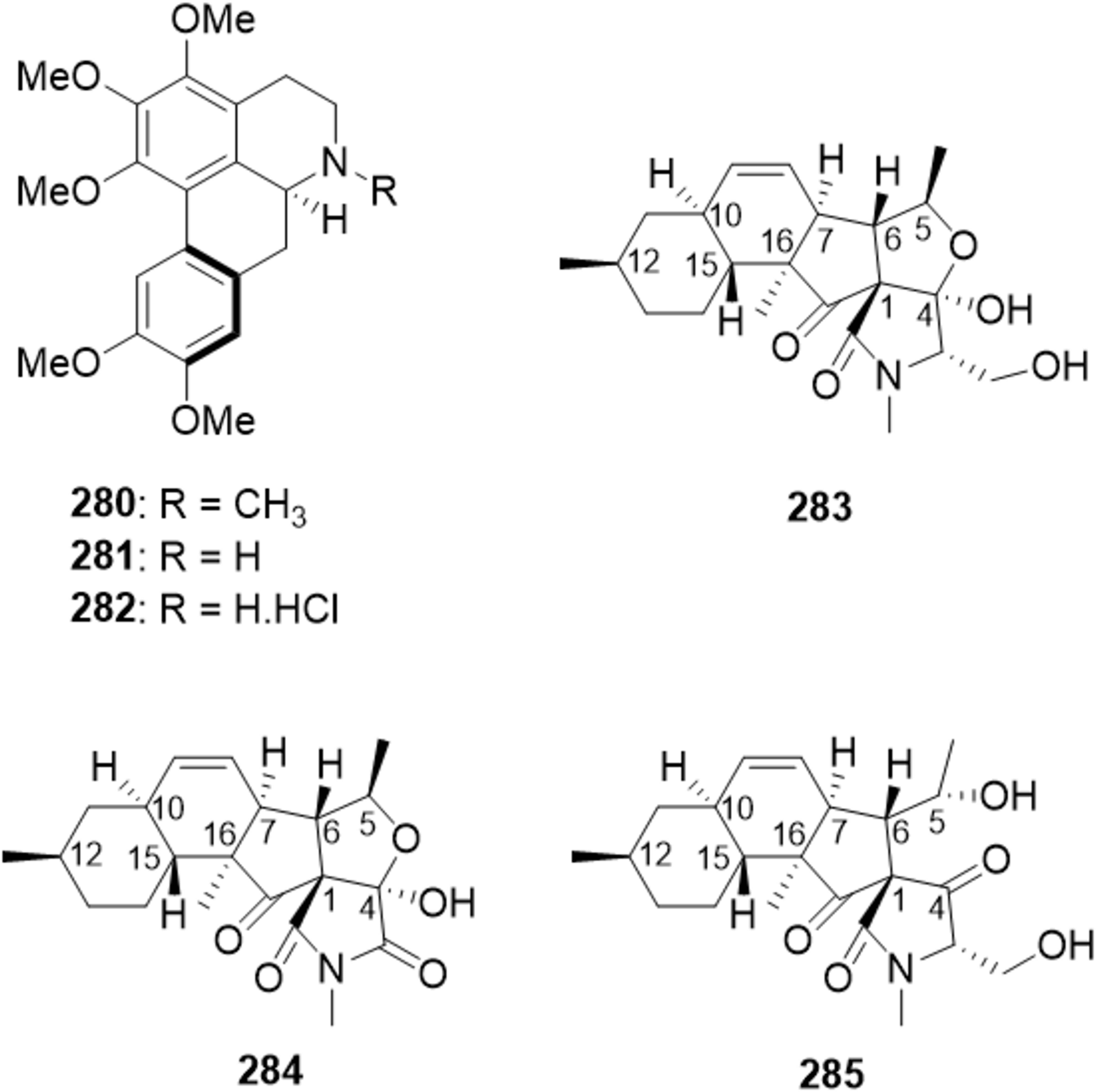
Formulas of compounds 280-285.
Formulas of compounds 286-291.
Formulas of compounds 292-293.
Formulas of compounds 294-295.
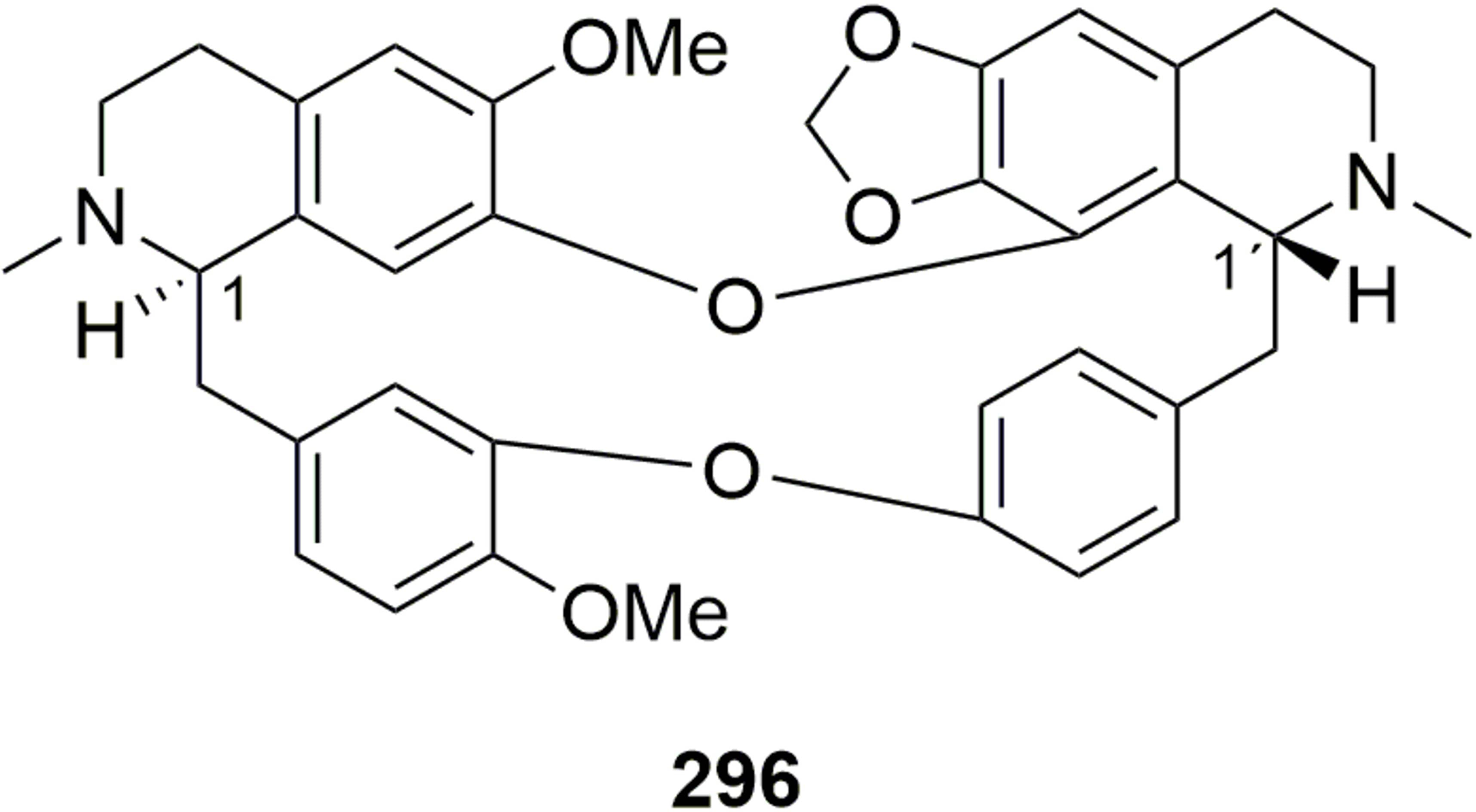
Formula of compound 296.
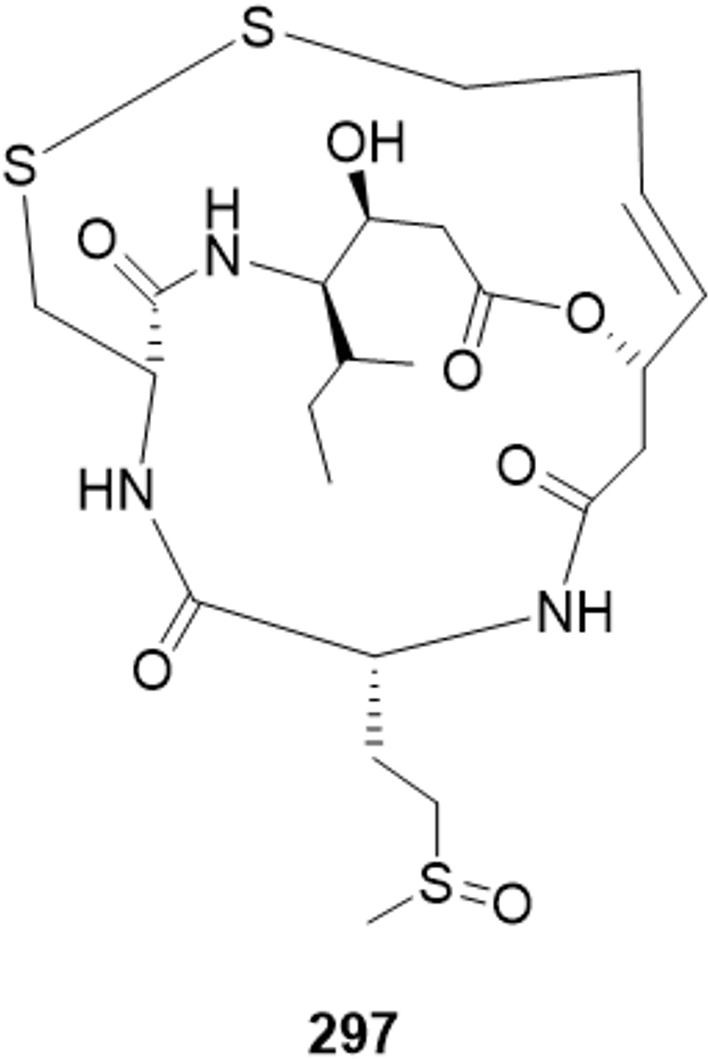
Formula of compound 297.
This section includes many alkaloids, a group of interesting natural products, although it is not limited to them. In addition, a major reason for selecting the title of this section is to use an accurate designation. The classical definition of alkaloid refers to a nitrogen containing natural product with biological activity, and therefore a simple derivative, as a methyl ester or acetate is not complying with the definition.
The IR and VCD spectra of commercially available (R)-(222) and (S)-carnitinenitrile (223), of (R)- (224) and (S)-propionylcarnitine (225), and of (R)-(226) and (S)-acetylcarnitine (227) (Figure 62), measured in deuterated methanol, allowed to establish the AC of the molecules and provided conformational aspects of the N,N,N-trimethyl moiety.106
Natural rhizopine (228) of unknown stereochemistry, obtained after inoculation of alfalfa roots by Sinorhizobium meliloti, and its racemic synthetic analog were peracetylated. The synthetic peracetate was fractionated into its enantiomers by semi-preparative supercritical fluid chromatography and the enantiomers were subjected to AC analysis by VCD. It followed that natural rhizopine is (1R,2S,3R,4R,5S,6R)−228 and its enantiomer is (1S,2R,3S,4S,5R,6S)−230, (Figure 63) while the peracetates are 229 and 231, respectively.107
Commercial racemic butylone hydrochloride was separated into its enantiomers by chiral chromatographic. ECD and VCD, combined with DFT calculations provided the AC of both enantiomers as (S)-(232) and (R)-butylone (233) (Figure 64).108
A commercial sample of (−)-(3R,4R,5S)-oseltamivir (234) (Figure 64) was stable for studies in chloroform, acetonitrile, and water solutions. ECD, ORD, VCD, and ROA, assisted by quantum chemical calculations pointed out different conformers, establishing thereby the most probable models responsible for structure–activity relationships (SAR).109
Commercial metolachlor is a herbicide consisting of 4 stereoisomers generated by 1 stereogenic center and atropisomerism. A combination of ECD and VCD was used to assign the AC of the 4 separated stereoisomers which were eluted from n-hexane/EtOH (24/1) in the sequence: (M,S)−235, (P,S)−236, (M,R)−237, and (P,R)−238 (Figure 65). The individual isomers remain unchanged upon storage in solution at 4 °C, C-chirality owing to tetrahedral nitrogen inversion was in thermal equilibrium, and atropisomerism depends on rotation about the phenyl-nitrogen bond whose energy barrier is relatively high, around 37 kcal/mol.110
VCD was used to assign the stereochemistry of the 4 stereoisomers of a commercial sample of brivaracetam. The AC was confidently assigned as (2S,4'R)−239, (2S,4'S)−240, (2R,4'R)−241, and (2R,4'S)−242 (Figure 66) without prior knowledge of their relative stereochemistry.111
Both enantiomers of rubrobramide were separated by optical resolution of a sample obtained by total synthesis. The AC of natural (+)-rubrobramide (243) (Figure 67), isolated from the fungis Cladobotryum rubrobrunnescens, was determined as (2S,5R,7S,8S) by VCDEC.112
The dihydroquinolone 244 (Figure 67) was isolated from a marine-derived strain of the fungus Metarhizium marquandii. The AC was determined by OR, ECD, and VCD as (3R,4R)-aflaquinolone I (244).113
The AC of a synthetic sample of (+)-(R)-tolterodine (245) (Figure 68) was evaluated by ECD and VCD. The ECD spectra, measured in different solvents and at various temperatures, provided excellent agreements with TDDFT-calculated ECD spectra. In contrast, experimental VCD spectra could not be reproduced by DFT calculation.114
Experimental IR, VCD, and UV spectra of a commercial sample of colchicine (246) (Figure 68) were compared with spectra calculated at the B3LYP/6-311G++(d,p) level of theory using the Gaussian 09 software. In addition, natural bonding orbitals, non-linear optical properties, and HOMO-LUMO calculations were done at the same level of theory using the same software. This knowledge was then employed for molecular docking analysis with cancer target proteins using the Maestro-Schrodinger suite 8.115
Streptomyces chartreusis ICBG377 produced (−)-strepchazolins A (247), and B (248) (Figure 69) whose AC was unambiguously confirmed as (5S,6S,9R)−247 and (5S,6S,9S)−248 by VCD and DFT calculations, in agreement with X-ray crystallography data and Mosher measurements.116
The ethanol extract of Pandanus amaryllifolius gave 3 dextrorotatory indolizinones. The AC was determined by VCD and ECD as (8aR)-pandalizine C (249), (8R,8aS)-pandalizine D (250), and (7R,8aR)-pandalizine E (251) (Figure 69).117
The synthesis of trans-pyridine-N-oxide gave 2 diastereoisomers whose resolution succeeded by chiral HPLC, providing enantiopure samples of (+)−252 and (–)−253 (Figure 70). The experimental VCD and ECD studies combined with DFT and TDDFT calculations revealed the (+)-trans-(M,M)−252 and (–)-trans-(P,P)−253 AC.118
Commercial racemic imazalil was separated into its enantiomers with 99% enantiomeric purity using chiral HPLC. The AC of the enantiomers was assigned using OR, VCD, and ECD as (+)-(S)−254 and (−)-(R)−255 (Figure 71).119
Commercial fluralaner is dosed as a racemic mixture. The AC of (+)-(S)-(256) and (−)-(R)-fluralaner (257) (Figure 72) was assigned by VCD. thereby confirming that the active (+)-enantiomer has the (S) AC as earlier determined by single-crystal X-ray diffraction.120
VCD studies of a commercial sample of (−)-(S)-nicotine (258) (Figure 73), confirmed the presence of 2 main conformers at room temperature. Experimental and calculated results indicated that hyperconjugative interactions play a dominant role in the conformational equilibrium. The conformers differ only in the relative orientation of the pyridine ring.121
A thorough DFT and MM study of the conformational landscape, molecular, and electronic structures of a commercial sample of (−)-(S)-anabasine (259) (Figure 73), revealed the mechanism controlling its conformational preference, thereby indicating that both steric and electrostatic factors are determinant in the conformational distribution of the molecule in the gas phase.122
The VCD technique was used for determining the solution-state conformational distribution of slightly structural constrained (−)-(S)-cotinine (260) (Figure 74). A commercial sample was used to demonstrate that VCD offers unique molecular fingerprints derived from smooth skeletal motions that may not be observed in the parent IR spectrum.123
The synthetic cannabinoid was extracted from commercially available ‘‘Spice-like’’ herbal MDMB-CHMICA. It was studied by VCD and ECD and found to have the (S)−261 (Figure 74) configuration by comparison of the experimental spectra with DFT calculations.124
Preparation of (±)−262 and chiral resolution allowed determining the AC of the natural occurring isomer as (+)-(1S,3R,5S,6R)−6β-benzoyloxy-3α-tropanol (262) (Figure 75), present in Knightia strobilina and Erythroxylum zambesiacum, by a combined use of chiral HPLC with ECD, OR, and VCD.125
A commercial sample of tropane (−)-(1R,2R,3S,5S)-cocaine hydrochloride (263) (Figure 75) was analyzed by ECD, VCD, and ROA spectroscopies. The results showed that the solution structure was different from the crystal geometry.126
The diketopiperazine alkaloids 264-267 (Figure 76) were isolated from Penicillium chrysogenum. The relative and AC of 264 and 265, and that at C-3 and C-14 of 267 were established by NOE modified Marfey’s analysis, and ECD calculations. Their AC were successfully determined by VCD as (−)-(3R,15R,19S)-chrysopiperazine A (264), (−)-(3R,15R,19S)-chrysopiperazine B (265), (−)-(3R,15R,19S)-versicoloid B (266), and (−)-(3R,15R,19S)-chrysopiperazine C (267).127
The AC of a synthetic isoquinolinone was established as the (1R,10bR,1'R)−268 analog of crispin A (Figure 76), using any one of the 3 chiroptical methods ORD, ECD, and VCD. Incorrect diastereomers were eliminated by the combined use of electronic dissymmetry and vibrational dissymmetry factors spectra analysis.128
Reactions of glutaraldehyde with the 4 stereoisomers of commercial sphingosine generated the respective tricyclic products 269-272 (Figure 77) with more rigid structures. Their VCD spectra are completely dissimilar reflecting their AC as (−)-(D)-erithro-269, (+)-(L)-threo-270, (+)-(L)-erithro-271, and (−)-(D)-threo-272.129
Levorotatory flustramine B, occurring in the bryozoa Flustra foliacea (L.), was synthesized and its AC was determined by VCD and VCDEC as (3aS,8aR)-(273) (Figure 78) through the AC of oxazolidinone and amide intermediates.130 Similar studies of indolyl derivatives were developed for the AC assignment of secondary alcohols in the ester series131 and primary amines in the amide series.132
The AC of a levorotatory alkaloid, found in Galanthus woronowii and G. nivalis, was established using several solution-state techniques like NMR, VCD, and ROA as (−)-(4aS,6R,8aS)-galantamine (274) (Figure 78).133
The IR and VCD spectra of matrine (275), sophoridine (276), oxymatrine (277), artemisinin (278), and dihydroartemisinin (279) (Figure 79) were measured in CDCl3 and DMSO-d6 solutions to get their stereochemical information, including AC and conformational behavior. The studies showed that effectively accounting for solvent effects is critical to using IR and VCD spectroscopy which provide unique spectroscopic features to differentiate the potential stereoisomers.134 Compounds 275-277 are present in the roots of Sophora flavescens, while 278 appears in Artemisia annua, although for the accounted study 275-279 were commercially available.
The leaves of Annona purpurea provided (+)-(S)-purpureine (280), (+)-(S)-norpurpureine (281), and (+)-(S)−3-hydroxyglaucine (282) (Figure 80). A VCD study for the AC determination of 280 provided evidence for the mutually dependent atropisomerism and absoluye configuration. The AC of the compounds has been assumed as owing to the P,S series.135
The marine-derived fungus Fusarium equiseti D39 provided (+)-fusarisetins B (283), (+)-C (284), and (−)-D (285) (Figure 80). Their structures were determined by spectroscopic data, VCD calculations, and X-ray crystallography providing the assignment of the AC as (1R,3S,4R,5R,6S,7S,10S,12R,15R,16S)−283 and (1R,4R,5R,6S,7S,10S,12R,15R,16S)−284. From biogenetic considerations the AC of 285 should be (1R,3S,5S,6S,7S,10S,12R,15R,16S).136
Jonquailine (286) was isolated from Narcissus jonquilla quail. DFT calculations of ECD, VCD, and ORD data were employed to assign the (3S,4aS,6aR,8R,12bS) AC, and then by extension the (3S,4aS,6aR,8R,12bS)-pretazettine (287) (Figure 81) and (3S,4aS,6aR,8S,12bS)−8-O-methylpretazettine (288) analogs were also assigned.137
The dioxomorpholines 289-291 (Figure 81) were isolated from a marine-facultative Aspergillus sp. MEXU 27854 collected from an Acapulco beach. The relative configuration of 289 and 290 was established by NOE correlations which was consistent with the AC reported for 291. Each AC was confirmed by VCD as (+)-(2S,4S,12R,2'S)−9-deoxy-PF1233 B (289), (+)-(2S,4S,12R,2'S)−9-deoxy-PF1233 A (290), and (+)-(2S,4S,12R,2'S)-PF1233 B (291).138
The alkaloid stemona-amine 292 (Figure 82), was isolated from the roots of Stemona tuberosa, its structure was determined by X-ray crystallography while the AC was established by VCD spectroscopy as (3S,8S,9R,9aS,10S,11S,12S,13R,18S,20S)-stemona-amine F (292).139
ECD, VCD, and IR spectroscopies were used to analyze genuine and counterfeit Cialis®, the samples were compared to the corresponding spectra of a tadalafil (293) (Figure 82) standard measured in the same solvent. The results revealed that the counterfeit drugs contained a lower amount of tadalafil than that declared by the producer.140
ECD and VCD were used to study (−)-brevianamide B (294) (Figure 83) prepared by reduction and stereoselective oxidation from (+)-brevianamide A, isolated from Penicillium brevicompactum. The ECD bands are due to the (S) spiroindoxyl quaternary center which allowed confirming the AC. Spectral and crystallographic evidence in favor or against the formation of a dimeric aggregate are discussed. The VCD spectra strongly suggest that only monomeric species are present in solution.141
Studies of a commercial sample of brucine (295) (Figure 83) were undertaken. For this purpose optimized molecular geometries, electronic and vibrational spectra analysis, frontier molecular orbital analysis, natural bonding orbitals, and non linear optical properties were studied by DFT. This allowed generating molecular electrostatic potential surfaces to find the reactive molecular sites115
ORD, ECD, and VCD measurements of bioactive (+)-cepharanthine (296) (Figure 84), isolated from commercial Epigeal Srephaia (roots of Stephania epigae), allowed its (1R,1'R) AC reassignment using TDDFT and DFT simulations at the B3LYP/6-31 + G(d,p) level of theory. The 7 most stable conformers revealed no particularly dominant shape for the 18-member macrolide.142
A theoretical conformational search for the determination of the most abundant conformers of burkholdac C (297) (Figure 85), isolated from the bacterium Burkholderia thailandensis, was done using the B3LYP and CAM-B3LYP functionals. The study included molecular mechanics modeling, DFT, and TDDFT calculations which provided the 4 lowest energy conformers in agreement with experimental ECD and VCD spectra.143
DFT Calculations
Along this review it was almost always mentioned that the experimental VCD spectra of the studied molecules were compared with spectra obtained after DFT calculations. Exceptions to such calculations are those limited cases for which VCDEC was employed.33,40,73,74,88,91,112,130-132 A relevant aspect of the calculation task is the selection of the level of theory that has to be used to provide a good spectra comparison and consequently a confident AC assignment, which implies balancing spectra similarity and invested computer resources for the calculations. This situation is not very relevant when a single stereogenic center is present in the molecule under study since the AC is correctly defined in most cases, although with different levels of confidence. The situation can turn critical when several stereogenic centers have to be ascertained on the scrutinized molecule since then a confidence level as close to 100% as possible is required. Our experience, gained over the last 15 years during which more than 80 papers using VCD were generated, dictates that no single level of theory, or a few of them, could yet be invoked to act as the universal solution. Just 3 quite recent papers will illustrate this point.
Perezone (298), the first secondary metabolite isolated in the New Word, occurs in the roots of many Perezia species. This fascinating monocyclic quinone sesquiterpenoid (Figure 86), possessing a sole (R) stereogenic center, has been subjected to chemical and spectroscopic studied for almost 170 years, since its discovery in Mexico City in 1852. It was recently studied extensively144 by VCD, at several levels of theory, using combinations of B3LYP, M06-2X, ωB97XD, and B97D functionals with the 6-311 ++ G(2d,2p) and DGDZVP basis sets to determine the minimum energy points of the potential energy surface. The study evidenced the inability of the calculations to predict a consistent conformational order since each employed level of theory generated a significantly different conformational scenario, ranging from 75 to less than 5% of folded conformers. The confidence for comparing the experimental and calculated spectra ranged from 86% to 99%.
Formulas of compounds 298-299.
In contrast to perezone (298), the bicyclic diterpenoid leubethanol (299) (Figure 86), isolated from Leucophyllum frutescens, which possess the same hydrocarbon chain than 298, can be modeled easily at the B3LYP/DGDZVP level of theory to provide a 100% confidence when comparing calculated and experimental spectra. In fact, VCD was used in this case to determine the configuration of the secondary methyl group at C-11, a task that could not be accomplished using 900 MHz NMR measuements.145
Although cacalolides 300-303 (Figure 87) have a quite rigid scaffold, it was necessary to resort to different approaches to gain satisfactory calculated VCD spectra. Metabolites 300, 302, and 303 were isolated from the roots of Psacalium aff. sinuatum. Cacalone (300) gave a confidence (C) of only 71% when calculated at the B3PW91/DGDZVP2 level of theory and it was necessary to prepare O-acetylcacalone (301) to reach C = 100%. In the case of epi-cacalone (302), no acetylation reaction was required for modeling with C = 97% at the same level of theory. In contrast, the 3 low energy conformers of cacalohastine (303), which possess the same scaffold geometry but differ by the geometrical distribution of the methoxy group and rotation of the methyl group at C-4 gave only C = 89% at this level of theory and required calculations at the PBEPBE/DGDZVP level to provide C = 100%. It thus follows that VCD spectra are quite sensitive to conformational differences and therefore it is necessary to determine a precise conformational distribution that includes all relevant contributing conformers and from there calculate the VCD absorption bands.146
Formulas of compounds 300-303.
Conclusions
VCD has consolidated as a robust technique for the AC determination of many types of organic molecules, as just shown. As a relative new methodology, it turns of interest to briefly mention how it compares with other chiroptical alternatives like ORD and ECD. Both ORD and ECD provide similar information derived from Cotton effects in the visible and mainly the UV region. ORD instrumentation, measuring optical activity form the visible to the ultraviolet in search for a Cotton effect, was widely used some 50-70 years ago and currently appropriate instrumentation is hard to find. So, the chiropical alternative of VCD is ECD which also requires, as VCD, a photoelastic modulator to generate the required circularly polarized radiation. ECD is highly sensitive, thus demanding very small amounts of sample, requires the presence of appropriate chromophores, and provides a very limited number of broad absorption bands. In contrast, any chiral compound will provide a narrow multiband VCD spectrum whose assignment, in most cases, requires DFT calculations. Since VCD spectra show many bands and ECD only 1 or 2 bands, the former seems to be a better AC assignment tool. It further follows that VCD continues to be a very relevant methodology for the absolute configuration determination of natural products and their simple derivatives.
This review summarizes a total of 297 molecules for which AC studies using VCD and in many cases other chiroptical methods, which were published during the 2015 to 2019 period. They are grouped according to the type of molecule thereby facilitating a search for specific cases. Molecular formulas are always provided and the pertinent stereogenic center are explicitly drawn. They include a vast range of molecules going from rigid bicyclic monoterpenes, like borneol or camphor, to highly popular molecules like the alkaloid cocaine or tadalafil samples to distinguish genuine and counterfeit Cialis®.
Regarding DFT calculations, there is a need to find a single or just a few combinations of functionals and basis sets to predict accurate conformational profiles and from there calculate the VCD bands. When that goal is reached, VCD will transform into a routine technique, but currently each VCD project of unprecedented structures could be an adventure of uncertain results. In fact, we are in possession of a few yet VCD unsolved molecules.
In a more general organic chemistry scenario, 2 simple suggestions are made for formula drawing and for compound naming:
For drawing 2 dimensional projections of molecules containing stereogenic centers, simple rules are given. The idea is to avoid inconsistencies and at the same time provide the simplest way of depicting potentially complex cases.
For naming a molecule having known optical activity and stereogenic centers, please indicate the optical activity sign first, the stereochemical descriptors next, and then indicate the systematic or trivial compound name.
For atropisomers please always use the (P) and (M) nomenclature. Cases where confusion could arise occur for 249-251 (Figure 69) and for 273 and 274 (Figure 78) where for instance C-8a is a stereogenic center whose AC is correctly given as (8aR) albeit there is no atropisomerism.
Footnotes
Declaration of Conflicting Interests
The author(s) declared no potential conflicts of interest with respect to the research, authorship, and/or publication of this article.
Funding
The author(s) disclosed receipt of the following financial support for the research, authorship, and/or publication of this article: Partial financial support from CONACYT-Mexico grant 284194 is acknowledged.
ORCID iD
Pedro Joseph-Nathan
References
1.
CampD.GaravelasA.CampitelliM. Analysis of physicochemical properties for drugs of natural origin. J Nat Prod. 2015;78(6):1370-1382.doi:10.1021/acs.jnatprod.5b0025526039921
2.
NewmanDJ.CraggGM. Natural products as sources of new drugs over the nearly four decades from 01/1981 to 09/2019. J Nat Prod. 2020;83(3):770-803.doi:10.1021/acs.jnatprod.9b0128532162523
3.
BrennaE.FugantiC.SerraS. Enantioselective perception of chiral odorants. Tetrahedron. 2003;14(1):1-42.doi:10.1016/S0957-4166(02)00713-9
4.
BentleyR. The nose as a stereochemist. enantiomers and odor. Chem Rev. 2006;106(9):4099-4112.doi:10.1021/cr050049t16967929
5.
CrabbéP. Optical Rotatory Dispersion and Circular Dichroism in Organic Chemistry. Holden-Day; 1965.
6.
NafieLA.ChengJC.StephensPJ. Vibrational circular dichroism of 2,2,2-trifluoro-1-phenylethanol. J Am Chem Soc. 1975;97(13):3842-3843.doi:10.1021/ja00846a061
7.
NafieLA. Vibrational circular dichroism: a new tool for the solution-state determination of the structure and absolute configuration of chiral natural product molecules. Nat Prod Comm. 2008;3(3):451-466.doi:10.1177/1934578X0800300322
8.
PolavarapuPL. Determination of the structure of chiral natural products using vibrational circular dichroism. In: BerovaN.PolavarapuPL.NakanishiK.WoodyRW., eds.Comprehensive Chiroptical Spectroscopy. Applications in Stereochemical Analysis of Synthetic Compounds, Natural Products, and Biomolecules. Wiley; 2012:387-420.
9.
BatistaJM. Determination of absolute configuration using chiroptical methods. In: AndrushkoV.AndrushkoN., eds.Stereoselective Synthesis of Drugs and Natural Products. vol. 2. Wiley; 2013:1571-1599.
10.
Batista JrJM.da SilvaBV. Determination of the absolute configuration of natural product molecules using vibrational circular dichroism. In: Atta-ur-Rahman, ed. Studies in Natural Products Chemistry. vol. 41. Elsevier; 2014:311-451.
11.
BatistaJM.BlanchEW.BolzaniVdaS. Recent advances in the use of vibrational chiroptical spectroscopic methods for stereochemical characterization of natural products. Nat Prod Rep. 2015;32(9):1280-1302.doi:10.1039/C5NP00027K26140548
12.
PolavarapuPL. Determination of the absolute configurations of chiral drugs using chiroptical spectroscopy. Molecules. 2016;21(8):1056.doi:10.3390/molecules2108105627529201
13.
MándiA.KurtánT. Applications of OR/ECD/VCD to the structure elucidation of natural products. Nat Prod Rep. 2019;36(6):889-918.doi:10.1039/C9NP00002J31139804
14.
PolavarapuPL.SantoroE. Vibrational optical activity for structural characterization of natural products. Nat Prod Rep. 2020;37(12):1-39.doi:10.1039/d0np00025f32608433
15.
Joseph-NathanP.Gordillo-RománB. Vibrational circular dichroism absolute configuration determination of natural products. In: KinghornAD.FalkH.KobayashiJ., eds.Progress in the Chemistry of Organic Natural Products. vol. 100. Springer International Publishing; 2015:311-451.
16.
Burgueño-TapiaE.Joseph-NathanP. Vibrational circular dichroism: recent advances for the assignment of the absolute configuration of natural products. Nat Prod Commun. 2015;10(10):1785-1795. doi:10.1177/1934578X1501001036; 2017;12(5):641-651. doi:10.1177/1934578X170120050130496660
17.
HolzwarthG.ChabayI. Optical activity of vibrational transitions: a coupled oscillator model. J Chem Phys. 1972;57(4):1632-1635.doi:10.1063/1.1678447
18.
NomaY.AsakawaY. Biotransformation of monoterpenoids. Comprehensive Natural Products II. 2010;3:669-801.
19.
JulioLF.Burgueño-TapiaE.DíazCE.Pérez-HernándezN.González-ColomaA.Joseph-NathanP. Absolute configuration of the ocimene monoterpenoids from Artemisia absinthium. Chirality. 2017;29(11):716-725.doi:10.1002/chir.2274128840973
20.
ReinscheidF.ReinscheidUM. Stereochemical analysis of (+)-limonene using theoretical and experimental NMR and chiroptical data. J Mol Struct. 2016;1106:141-153.doi:10.1016/j.molstruc.2015.10.061
21.
Pardo-NovoaJC.Arreaga-GonzálezHM.Gómez-HurtadoMAet al. Absolute configuration of menthene derivatives by vibrational circular dichroism. J Nat Prod. 2016;79(10):2570-2579.
22.
CaoY.WeiX.XuH.TangW. Antifungal properties of methanol extract and its active compounds from Brickellia rosmarinifolia Vent. Fitoterapia. 2010;81(8):1176-1179.doi:10.1016/j.fitote.2010.07.02120678558
23.
CuencaMDR.CatalanCAN.DíazJG.HerzW. Monoterpenes and lignans from Mikania saltensis. J Nat Prod. 1991;54(4):1162-1164.doi:10.1021/np50076a047
24.
Qiu-HongW.LiuC-M.ChenY-J.GaoK. Terpenoids from the roots of Ligularia muliensis. Helv Chim Acta. 2006;89(5):915-922.
25.
LiX-Q.GaoK.JiaZ-J. Eremophilenolides and other constituents from the roots of Ligularia sagitta. Planta Med. 2003;69(4):356-360.doi:10.1055/s-2003-3887212709904
26.
SumiokaH.HarinantenainaL.MatsunamiK.OtsukaH.KawahataM.YamaguchiK. Linderolides A-F, eudesmane-type sesquiterpene lactones and linderoline, a germacrane-type sesquiterpene from the roots of Lindera strychnifolia and their inhibitory activity on NO production in RAW 264.7 cells in vitro. Phytochemistry. 2011;72(17):2165-2171.doi:10.1016/j.phytochem.2011.08.00421872894
27.
LiuX.WuQ-X.ShiY-P. Terpenoids from the flower of Cacalia tangutica. J Chin Chem Soc. 2005;52(2):369-374.doi:10.1002/jccs.200500055
28.
Talavera-AlemánA.Rodríguez-GarcíaG.LópezYet al. Systematic evaluation of thymol derivatives possessing stereogenic or prostereogenic centers. Phytochem Rev. 2016;15(2):251-277.doi:10.1007/s11101-015-9412-6
29.
Arreaga-GonzálezHM.Pardo-NovoaJC.Del RíoREet al. Methodology for the absolute configuration determination of epoxythymols using the constituents of Ageratina glabrata. J Nat Prod. 2018;81(1):63-71.doi:10.1021/acs.jnatprod.7b0063729278331
30.
Arreaga-GonzálezHM.Rodríguez-GarcíaG.Del RíoREet al. Configurational variation of a natural compound within its source species. The unprecedented case of areolal in Piptothrix areolare. J Nat Prod. 2019;82(12):3394-3400.doi:10.1021/acs.jnatprod.9b0073431751133
31.
GaoR-Q.FanJ.TanQet al. Reliable HPLC separation, vibrational circular dichroism spectra, and absolute configurations of isoborneol enantiomers. Chirality. 2017;29(9):550-557.doi:10.1002/chir.2272828710844
32.
SaidME-A.BombardaI.NaubronJ-Vet al. Isolation of the major chiral compounds from Bubonium graveolens essential oil by HPLC and absolute configuration determination by VCD. Chirality. 2017;29(2):70-79.doi:10.1002/chir.2267228019704
33.
AbbateS.MazzeoG.MeneghiniS.LonghiG.BoiadjievSE.LightnerDA. Bicamphor: a prototypic molecular system to investigate vibrational excitons. J Phys Chem A. 2015;119(18):4261-4267.doi:10.1021/acs.jpca.5b0233225871493
34.
SaidME-A.VanlootP.BombardaIet al. Analysis of the major chiral compounds of Artemisia herba-alba essential oils (EOs) using reconstructed vibrational circular dichroism (VCD) spectra: En route to a VCD chiral signature of EOs. Anal Chim Acta. 2016;903:121-130.doi:10.1016/j.aca.2015.11.01026709305
35.
Rodríguez-GarcíaG.Villagómez-GuzmánAK.Talavera-AlemánAet al. Conformational, configurational, and supramolecular studies of podocephalol acetate from Lasianthaea aurea. Chirality. 2019;31(11):923-933.doi:10.1002/chir.2304231454433
36.
MedinaRP.AraujoAR.BatistaJMet al. Botryane terpenoids produced by Nemania bipapillata, an endophytic fungus isolated from red alga Asparagopsis taxiformis - Falkenbergia stage. Sci Rep. 2019;9(1):12318.doi:10.1038/s41598-019-48655-731444403
37.
Cerda-García-RojasCM.BucioMA.GonzálezSB.García-GutiérrezHA.Joseph-NathanP. Absolute configuration of esquelane derivatives from Adesmia boronioides by vibrational circular dichroism. Tetrahedron. 2015;26(2-3):136-140.doi:10.1016/j.tetasy.2014.12.003
38.
GouG-Z.BoZ.ShiLet al. Chiroptical spectroscopic properties of natural T-muurolols: a DFT and TD-DFT study. Indian J Chem A. 2015;54A(8):1017-1025. http://hdl.handle.net/123456789/32001
39.
DingL.PfohR.RühlS.QinS.LaatschH. T-muurolol sesquiterpenes from the marine Streptomyces sp. M491 and revision of the configuration of previously reported amorphanes. J Nat Prod. 2009;72(1):99-101.doi:10.1021/np800684319072130
40.
Sánchez-CastellanosM.BucioMA.Hernández-BarragánA.Joseph-NathanP.CuevasG.QuijanoL. Vibrational circular dichroism (VCD), VCD exciton coupling, and X-ray determination of the absolute configuration of an α,β-unsaturated germacranolide. Chirality. 2015;27(3):247-252.doi:10.1002/chir.2242025640191
41.
MatsuoY.MaedaS.OhbaC.FukayaH.MimakiY. Vetiverianines A, B, and C: sesquiterpenoids from Vetiveria zizanioides roots. J Nat Prod. 2016;79(9):2175-2180.doi:10.1021/acs.jnatprod.6b0014027598828
42.
SantoroE.MazzeoG.PetrovicAGet al. Absolute configurations of phytotoxins seiricardine A and inuloxin a obtained by chiroptical studies. Phytochemistry. 2015;116:359-366.doi:10.1016/j.phytochem.2015.03.00125817835
43.
OrtegaAR.Sánchez-CastellanosM.Pérez-HernándezN.Robles-ZepedaRE.Joseph-NathanP.QuijanoL. Relative stereochemistry and absolute configuration of farinosin, an eudesmanolide from Encelia farinose. Chirality. 2016;28(5):415-419.doi:10.1002/chir.2259527027742
44.
OrtegaAR.Ortiz-PastranaN.QuijanoL.Becerra-MartínezE.Olmedo-AguirreJO.Joseph-NathanP. Structure and absolute configuration of hydroxy-bis-dihydrofarinosin from Encelia farinose. Magn Reson Chem. 2017;55(6):530-539.doi:10.1002/mrc.455427859567
45.
ReinhardtJK.KlemdAM.DantonOet al. Sesquiterpene lactones from Artemisia argyi: absolute configuration and immunosuppressant activity. J Nat Prod. 2019;82(6):1424-1433.doi:10.1021/acs.jnatprod.8b00791
46.
RyuSM.LeeHM.SongEGet al. Antiviral activities of trichothecenes isolated from Trichoderma albolutescens against pepper mottle virus. J Agric Food Chem. 2017;65(21):4273-4279.doi:10.1021/acs.jafc.7b0102828490172
47.
JuniorFMS.CovingtonCL.de AlbuquerqueACFet al. Absolute configuration of (-)-Centratherin, a sesquiterpenoid lactone, defined by means of chiroptical spectroscopy. J Nat Prod. 2015;78(11):2617-2623.doi:10.1021/acs.jnatprod.5b0054626565920
48.
WangZ.ChenJ.LiL.ZhouZ.GengY.SunT. Detailed structural study of β-artemether: density functional theory (DFT) calculations of infrared, Raman spectroscopy, and vibrational circular dichroism. J Mol Struct. 2015;1097:61-68.doi:10.1016/j.molstruc.2015.04.039
49.
VallsR.PiovettiL.BanaigsB.ArchavlisA.PellegriniM. (S)-13-hydroxygeranylgeraniol-derived furanoditerpenes from Bifurcaria bifurcata. Phytochemistry. 1995;39(1):145-149.doi:10.1016/0031-9422(94)00849-O7786483
50.
MertenC.SmyrniotopoulosV.TasdemirD. Assignment of absolute configurations of highly flexible linear diterpenes from the brown alga Bifurcaria bifurcata by VCD spectroscopy. Chem Commun. 2015;51(90):16217-16220.doi:10.1039/C5CC05659D26399505
51.
SmithSG.GoodmanJM. Assigning stereochemistry to single diastereoisomers by GIAO NMR calculation: the DP4 probability. J Am Chem Soc. 2010;132(37):12946-12959.doi:10.1021/ja105035r20795713
52.
SmyrniotopoulosV.MertenC.KaiserM.TasdemirD. Bifurcatriol, a new antiprotozoal acyclic diterpene from the brown alga Bifurcaria bifurcata. Mar Drugs. 2017;15(8):245.doi:10.3390/md15080245
53.
RehmanNU.HussainH.Al-ShidhaniSet al. Incensfuran: isolation, X-ray crystal structure and absolute configuration by means of chiroptical studies in solution and solid state. RSC Adv. 2017;7(67):42357-42362.doi:10.1039/C7RA07351H
54.
Del Río-ChávezÁngel A.García-GutiérrezHA.Román-MarínLUet al. Absolute configuration of phomactatriene diterpenoids obtained by Wagner-Meerwein rearrangement of epimeric verticillols. Chirality. 2019;31(11):934-946.doi:10.1002/chir.2306131436870
55.
CaoF.ShaoC-L.LiuY-F.ZhuH-J.WangC-Y. Cytotoxic serrulatane-type diterpenoids from the Gorgonian Euplexaura sp. and their absolute configurations by vibrational circular dichroism. Sci Rep. 2017;7(1):1-8.doi:10.1038/s41598-017-12841-2
56.
MertenC.DirkmannM.SchulzF. Stereochemical assignment of fusiccocadiene from NMR shielding constants and vibrational circular dichroism spectroscopy. Chirality. 2017;29(8):409-414.doi:10.1002/chir.2270828560831
57.
WangZ-Q.WuC-J.WangZ-Het al. Determination of absolute configuration of an isopimarane-type diterpenoid by experimental and theoretical electronic circular dichroism and vibrational circular dichroism. J Mol Struct. 2017;1146:484-489.doi:10.1016/j.molstruc.2017.06.040
58.
Díaz-FernándezM.SalazarMI.Joseph-NathanP.Burgueño-TapiaE. Configurational study of diastereoisomeric royleanone ditepenoids from Salvia concolor. Nat Prod Commun. 2019;14(7):1-8.doi:10.1177/1934578X19862650
59.
CaiS.RisingerAL.PetersenCLet al. Anacolosins A-F and corymbulosins X and Y, clerodane diterpenes from Anacolosa clarkii exhibiting cytotoxicity toward pediatric cancer cell lines. J Nat Prod. 2019;82(4):928-936.doi:10.1021/acs.jnatprod.8b0101530830773
60.
MuñozMA.San-MartínA.Joseph-NathanP. Vibrational circular dichroism absolute configuration of 9,12-cyclomulin-13-ol, a diterpene from Azorella and Laretia species. Nat Prod Commun. 2015;10(8):1343-1344.doi:10.1177/1934578X150100080526434110
Burgueño-TapiaE.Chávez-CastellanosK.Cedillo-PortugalE.Joseph-NathanP. Absolute configuration of diterpenoids from Jatropha dioica by vibrational circular dichroism. Tetrahedron. 2017;28(1):166-174.doi:10.1016/j.tetasy.2016.11.006
63.
Melchor-MartínezEM.Silva-MaresDA.Torres-LópezEet al. Stereochemistry of a second riolozane and other diterpenoids from Jatropha dioica. J Nat Prod. 2017;80(8):2252-2262.doi:10.1021/acs.jnatprod.7b0019328771358
64.
EsquivelB.Burgueño-TapiaE.Bustos-BritoC.Pérez-HernándezN.QuijanoL.Joseph-NathanP. Absolute configuration of the diterpenoids icetexone and conacytone from Salvia ballotaeflora. Chirality. 2018;30(2):177-188.doi:10.1002/chir.2278129110401
65.
EsquivelB.Bustos-BritoC.Sánchez-CastellanosMet al. Structure, absolute configuration, and antiproliferative activity of abietane and icetexane diterpenoids from Salvia ballotiflora. Molecules. 2017;22(10):1690-1711.doi:10.3390/molecules2210169029057832
66.
Bustos-BritoC.Joseph-NathanP.Burgueño-TapiaEet al. Structure and absolute configuration of abietane diterpenoids from Salvia clinopodioides: Antioxidant, antiprotozoal, and antipropulsive activities. J Nat Prod. 2019;82(5):1207-1216.doi:10.1021/acs.jnatprod.8b0095231063376
67.
GouG-zhang.ZhouB.ShiLet al. Electronic structure and circular dichroism of natural alboatisins isolated from aerial parts of Isodon Albopilosus : DFT and TDDFT study. Chin J Chem Phys. 2015;28(6):695-702.doi:10.1063/1674-0068/28/cjcp1503045
68.
MándiA.SwamyMMM.TaniguchiT.AnetaiM.MondeK. Reducing molecular flexibility by cyclization for elucidation of absolute configuration by CD calculations: Daurichromenic acid. Chirality. 2016;28(6):453-459.doi:10.1002/chir.2260627172768
69.
GimenesL.Batista JuniorJM.Martins Dos Santos JuniorFet al. Picraviane A and B: Nortriterpenes with limonoid-like skeletons containing a heptanolide E-ring system from Picramnia glazioviana. Phytochemistry. 2019;163:38-45.doi:10.1016/j.phytochem.2019.03.02431003042
70.
ZajacG.KaczorA.BudaSet al. Prediction of ROA and ECD related to conformational changes of astaxanthin enantiomers. J Phys Chem B. 2015;119(37):12193-12201.doi:10.1021/acs.jpcb.5b0719326305416
71.
OrtegaAR.Burgueño-TapiaE.Joseph-NathanP. Difficulties to determine the absolute configuration of guaiaretic acid. Nat Prod Commun. 2018;13(8):981-986.doi:10.1177/1934578X1801300815
72.
Ccana-CcapatintaGV.SampaioBL.dos SantosFM.BatistaJM.Da CostaFB. Absolute configuration assignment of caffeic acid ester derivatives from Tithonia diversifolia by vibrational circular dichroism: the pitfalls of deuteration. Tetrahedron. 2017;28(12):1823-1828.doi:10.1016/j.tetasy.2017.10.025
73.
Buendía-TrujilloAI.Torrres-ValenciaJM.Joseph-NathanP.Burgueño-TapiaE. Absolute configuration assignment of 3',4'-di-O-acylkhellactones using vibrational circular dichroism exciton chirality. Nat Prod Commun. 2015;10(6):1027-1032.doi:10.1177/1934578X150100065826197543
74.
CanziEF.dos SantosFM.MeneghettiEK.Sales MaiaBHLN.BatistaJM. Absolute configuration of a rare dibenzoylmethane derivative from Dahlstedtia glaziovii (Fabaceae). Tetrahedron Lett. 2018;59(2):135-137.doi:10.1016/j.tetlet.2017.12.002
75.
BatistaJM.WangB.CastelliMV.BlanchEW.LópezSN. Absolute configuration assignment of an unusual homoisoflavanone from Polygonum ferrugineum using a combination of chiroptical methods. Tetrahedron Lett. 2015;56(44):6142-6144.doi:10.1016/j.tetlet.2015.09.102
76.
Burgueño-TapiaE.Joseph-NathanP. Optimization of the number of considered conformers for the absolute configuration determination of catechin and epicatechin Peracetates by VCD. Nat Prod Commun. 2017;12(5):683-686.doi:10.1177/1934578X170120051030496675
77.
CovingtonCL.JuniorFMS.SilvaJHS.KusterRM.de AmorimMB.PolavarapuPL. Atropoisomerism in biflavones: The absolute configuration of (-)-Agathisflavone via chiroptical spectroscopy. J Nat Prod. 2016;79(10):2530-2537.doi:10.1021/acs.jnatprod.6b0039527723329
78.
OrtegaAR.Pérez-HernándezN.Joseph-NathanP. Piscicartone, a rotenoid from Piscidia carthagenensis. Nat Prod Commun. 2019;14(5):1-7.doi:10.1177/1934578X19849799
79.
SwamyMMM.MandiA.AnetaiM.MondeK. Stereochemistry of a rhododaurichromanic acid derivative. Nat Prod Commun. 2016;11(2):193-195.doi:10.1177/1934578X160110021527032199
80.
Velázquez-JiménezR.Torres-ValenciaJM.Valdez-CalderónAet al. Absolute configuration of stegane lignans by vibrational circular dichroism. Tetrahedron. 2016;27(4-5):193-200.doi:10.1016/j.tetasy.2016.01.010
81.
CaseroC.MachínF.Méndez-ÁlvarezSet al. Structure and antimicrobial activity of phloroglucinol derivatives from Achyrocline satureioides. J Nat Prod. 2015;78(1):93-102.doi:10.1021/np500735f25517209
82.
LeeJS.JeongM.ParkSet al. Chemical constituents of the leaves of butterbur (Petasites japonicus) and their anti-inflammatory effects. Biomolecules. 2019;9(12):806.doi:10.3390/biom912080631795455
83.
ZhuA.YangM-Y.ZhangY-Het al. Absolute configurations of 14,15-hydroxylated prenylxanthones from a marine-derived Aspergillus sp. fungus by chiroptical methods. Sci Rep. 2018;8(1):10621.doi:10.1038/s41598-018-28996-530006520
84.
DemarqueDP.PinhoDR.LopesNP.MertenC. Revisiting empirical rules for the determination of the absolute configuration of cascarosides and other (ox-)anthrones. Chirality. 2018;30(4):432-438.doi:10.1002/chir.2280329323431
85.
SprengerRF.ThomasiSS.FerreiraAG.CassQB.Batista JuniorJM. Solution-state conformations of natural products from chiroptical spectroscopy: the case of isocorilagin. Org Biomol Chem. 2016;14(13):3369-3375.doi:10.1039/C6OB00049E26946940
86.
Jiménez-RomeroC.RodeJE.RodríguezAD. Reassignment of the absolute configuration of plakinidone from the sponge consortium Plakortis halichondrioides-Xestospongia deweerdtae using a combination of synthesis and a chiroptical approach. Tetrahedron Asymmetry. 2016;27(9-10):410-419.doi:10.1016/j.tetasy.2016.03.01128190935
87.
Jiménez-RomeroC.RodeJE.PérezYM.FranzblauSG.RodríguezAD. Exploring the sponge consortium Plakortis symbiotica-Xestospongia deweerdtae as a potential source of antimicrobial compounds and probing the pharmacophore for antituberculosis activity of smenothiazole A by diverted total synthesis. J Nat Prod. 2017;80(8):2295-2303.doi:10.1021/acs.jnatprod.7b0030028742349
88.
AsaiT.MoritaS.TaniguchiT.MondeK.OshimaY. Epigenetic stimulation of polyketide production in Chaetomium cancroideum by an NAD(+)-dependent HDAC inhibitor. Org Biomol Chem. 2016;14(2):646-651.doi:10.1039/C5OB01595B26549741
89.
RusmanY.HeldBW.BlanchetteRA.HeY.SalomonCE. Cadopherone and colomitide polyketides from Cadophora wood-rot fungi associated with historic expedition huts in Antarctica. Phytochemistry. 2018;148:1-10.doi:10.1016/j.phytochem.2017.12.01929366851
90.
WestphalKR.WernerMIH.NielsenKAHet al. Characterization of eight novel spiroleptosphols from Fusarium avenaceum. Molecules. 2019;24(19):3498.doi:10.3390/molecules2419349831561557
91.
AsaiT.MoritaS.TaniguchiT.MondeK.OshimaY. Epigenetic stimulation of polyketide production in Chaetomium cancroideum by an NAD(+)-dependent HDAC inhibitor. Org Biomol Chem. 2016;14(2):646-651.doi:10.1039/C5OB01595B26549741
92.
RossiD.AhmedK.GaggeriRet al. (R)-(−)-Aloesaponol III 8-methyl ether from Eremurus persicus: a novel compound against leishmaniosis. Molecules. 2017;22(4):519.doi:10.3390/molecules22040519
93.
MasiM.MeyerS.GóreckiMet al. Phytotoxic activity of metabolites isolated from Rutstroemia sp.n., the causal agent of bleach blonde syndrome on cheatgrass (Bromus tectorum). Molecules. 2018;23(7):1734.doi:10.3390/molecules23071734
94.
OrtegaHE.BatistaJM.MeloWGP.ClardyJ.PupoMT. Corrigendum to “Absolute configurations of griseorhodins A and C” [Tetrahedron Lett. 58 (50) (2017) 4721–4723]. Tetrahedron Lett. 2018;59(13):1239.doi:10.1016/j.tetlet.2018.02.042
95.
CaoF.SunT-T.YangJ-Ket al. The absolute configuration of anti-Vibrio citrinin dimeric derivative by VCD, ECD and NMR methods. Nat Prod Res. 2019;33(15):2192-2199.doi:10.1080/14786419.2018.149359030445830
96.
MedbouhiA.TintaruA.BeaufayCet al. Structural elucidation and cytotoxicity of a new 17-membered ring lactone from Algerian Eryngium campestre. Molecules. 2018;23(12):3250.doi:10.3390/molecules2312325030544816
97.
OrtliebN.BretzelK.KulikAet al. Xanthocidin derivatives from the endophytic Streptomyces sp. AcE210 provide insight into xanthocidin biosynthesis. ChemBioChem. 2018;19(23):2472-2480.doi:10.1002/cbic.20180046730300957
98.
YangQ.LiangM-M.WangH-Jet al. Investigating cyclic sotolon, maple furanone and their dimers in solution using optical rotation, electronic circular dichroism and vibrational circular dichroism. Tetrahedron. 2017;73(17):2432-2438.doi:10.1016/j.tet.2017.03.025
99.
MazzeoG.CimminoA.MasiMet al. Importance and difficulties in the use of chiroptical methods to assign the absolute configuration of natural products: The case of phytotoxic pyrones and furanones produced by Diplodia corticola. J Nat Prod. 2017;80(9):2406-2415.doi:10.1021/acs.jnatprod.7b00119
100.
DingS-S.ZhangC-C.ShiW-Set al. Absolute configuration of two novel compounds from the Talaromyces aculeatus using optical rotation, electronic circular dichroism and vibrational circular dichroism. Tetrahedron Lett. 2016;57(1):75-79.doi:10.1016/j.tetlet.2015.11.066
101.
FusèM.MazzeoG.LonghiGet al. Unbiased determination of absolute configurations by vis-à-vis comparison of experimental and simulated spectra: the challenging case of diplopyrone. J Phys Chem B. 2019;123(43):9230-9237.doi:10.1021/acs.jpcb.9b0837531580674
102.
SantoroE.MazzeoG.MarsicoGet al. Assignment through chiroptical methods of the absolute configuration of fungal dihydropyranpyran-4-5-diones phytotoxins, potential herbicides for Buffelgrass (Cenchrus ciliaris) biocontrol. Molecules. 2019;24(17):3022.doi:10.3390/molecules24173022
103.
MasiM.CimminoA.BoariAet al. Colletopyrandione, a new phytotoxic tetrasubstituted indolylidenepyra N -2,4-dione, and colletochlorins G and H, new tetrasubstituted chroman- and isochroman-3,5-diols isolated from Colletotrichum higginsianum. Tetrahedron. 2017;73(47):6644-6650.doi:10.1016/j.tet.2017.10.018
104.
KoenisMAJ.TiekinkEH.van RaamsdonkDMEet al. Analytical chemistry on many-center chiral compounds based on vibrational circular dichroism: absolute configuration assignments and determination of contaminant levels. Anal Chim Acta. 2019;1090:100-105.doi:10.1016/j.aca.2019.09.02131655634
105.
CaoF.MengZ-H.MuX.YueY-F.ZhuH-J. Absolute configuration of bioactive azaphilones from the marine-derived fungus Pleosporales sp. CF09-1. J Nat Prod. 2019;82(2):386-392.doi:10.1021/acs.jnatprod.8b0103030724084
106.
MazzeoG.AbbateS.LonghiG.CastiglioniE.VillaniC. Vibrational circular dichroism (VCD) reveals subtle conformational aspects and intermolecular interactions in the carnitine family. Chirality. 2015;27(12):907-913.doi:10.1002/chir.2253226447810
107.
KriefA.DunkleM.BaharM.BultinckP.HerreboutW.SandraP. Elucidation of the absolute configuration of rhizopine by chiral supercritical fluid chromatography and vibrational circular dichroism. J Sep Sci. 2015;38(14):2545-2550.doi:10.1002/jssc.20150013825931280
108.
SpálovskáD.KrálíkF.KohoutMet al. Structure determination of butylone as a new psychoactive substance using chiroptical and vibrational spectroscopies. Chirality. 2018;30(5):548-559.doi:10.1002/chir.2282529424468
109.
GóreckiM. A configurational and conformational study of (-)-Oseltamivir using a multi-chiroptical approach. Org Biomol Chem. 2015;13(10):2999-3010.doi:10.1039/C4OB02369B25620446
110.
XieJ.ZhangL.ZhaoL.TangQ.LiuK.LiuW. Metolachlor stereoisomers: enantioseparation, identification and chiral stability. J Chromatogr A. 2016;1463:42-48.doi:10.1016/j.chroma.2016.07.04527544750
111.
QiuS.TehraniKA.SergeyevS.BultinckP.HerreboutW.MathieuB. Stereochemistry of the brivaracetam diastereoisomers. Chirality. 2016;28(3):215-225.doi:10.1002/chir.2255826740317
112.
MizutaniS.KomoriK.TaniguchiT.MondeK.KuramochiK.TsubakiK. A Bioinspired Synthesis of (±)-Rubrobramide, (±)-Flavipucine, and (±)-Isoflavipucine. Angew Chem Int. 2016;55(33):9553-9556.doi:10.1002/anie.201602910
113.
El-KashefDH.DaletosG.PlenkerMet al. Polyketides and a dihydroquinolone alkaloid from a marine-derived strain of the fungus Metarhizium marquandii. J Nat Prod. 2019;82(9):2460-2469.doi:10.1021/acs.jnatprod.9b0012531432669
114.
GóreckiM.ZulloV.IulianoA.PescitelliG. On the absolute stereochemistry of tolterodine: a circular dichroism study. Pharmaceuticals. 2019;12(1):21.doi:10.3390/ph1201002130691175
115.
AfzalA.ThayyilMS.ShariqMet al. Anti-cancerous brucine and colchicine: experimental and theoretical characterization. Chemistry Select. 2019;4(39):11441-11454.doi:10.1002/slct.201902698
116.
OrtegaHE.BatistaM.MeloWGP.de PaulaGT.PupoMT. Structure and absolute configuration of secondary metabolites from two strains of Streptomyces chartreusis associated with attine ants. J Brazil Chem Soc. 2019;30(12):2672-2680.doi:10.21577/0103-5053.20190194
117.
ChengY-B.HuH-C.TsaiY-Cet al. Isolation and absolute configuration determination of alkaloids from Pandanus amaryllifolius. Tetrahedron. 2017;73(25):3423-3429.doi:10.1016/j.tet.2017.05.002
118.
TeodorescuF.NicaS.UncutaCet al. Vibrational and electronic circular dichroism studies on the axially chiral pyridine-N-oxide: trans-2,6-di-ortho-tolyl-3,4,5-trimethylpyridine-N-oxide. Tetrahedron. 2015;26(18-19):1043-1049.doi:10.1016/j.tetasy.2015.08.006
119.
CasasME.KretschmannAC.AndernachL.OpatzT.BesterK. Separation, isolation and stereochemical assignment of imazalil enantiomers and their quantitation in an in vitro toxicity test. J Chromatogr A. 2016;1452:116-120.doi:10.1016/j.chroma.2016.05.00827234843
120.
KongJ.JoyceLA.LiuJ.JarrellTM.CulbersonJC.ShererEC. Absolute configuration assignment of (+)-fluralaner using vibrational circular dichroism. Chirality. 2017;29(12):854-864.doi:10.1002/chir.2277028981965
121.
OrtegaPGR.MontejoM.GonzálezJJL. Vibrational circular dichroism and theoretical study of the conformational equilibrium in (-)-S-nicotine. Chem Phys Chem. 2015;16(2):342-352.doi:10.1002/cphc.20140265225421493
122.
Rodríguez OrtegaPG.MontejoM.MárquezF.López GonzálezJJ. Conformational properties of chiral tobacco alkaloids by DFT calculations and vibrational circular dichroism: (-)-S-anabasine. J Mol Graph Model. 2015;60(305):169-179.doi:10.1016/j.jmgm.2015.05.01126059478
123.
Rodríguez OrtegaPG.MontejoM.MárquezF.López GonzálezJJ. DFT-Aided Vibrational Circular Dichroism Spectroscopy Study of (-)-S-cotinine. Chemphyschem. 2015;16(7):1416-1427.doi:10.1002/cphc.20150001825802067
124.
AndernachL.PuschS.WeberCet al. Absolute configuration of the synthetic cannabinoid MDMB-CHMICA with its chemical characteristics in illegal products. Forensic Toxicol. 2016;34(2):344-352.doi:10.1007/s11419-016-0321-1
125.
MuñozMA.GonzálezN.Joseph-NathanP. Enantiomeric HPLC resolution and absolute configuration of 6β-benzoyloxy-3α-tropanol. J Sep Sci. 2016;39(14):2720-2727.doi:10.1002/jssc.201600061
126.
FaganP.KocourkováL.TatarkovičMet al. Cocaine hydrochloride structure in solution revealed by three chiroptical methods. Chem Phys Chem. 2017;18(16):2258-2265.doi:10.1002/cphc.20170045228685956
127.
XuW-F.MaoN.XueX-Jet al. Structures and absolute configurations of diketopiperazine alkaloids chrysopiperazines A–C from the gorgonian-derived fungus Penicillium chrysogenum. Mar Drugs. 2019;17(5):250.doi:10.3390/md17050250
128.
JohnsonJL.NairDS.PillaiSMet al. Dissymmetry factor spectral analysis can provide useful diastereomer discrimination: Chiral molecular structure of an analogue of (-)-crispine a. ACS Omega. 2019;4(4):6154-6164.doi:10.1021/acsomega.8b0367831459760
129.
NakahashiA.C SiddegowdaAK.HammamMAS.GowdaSGB.MuraiY.MondeK. Stereochemical study of sphingosine by vibrational circular dichroism. Org Lett. 2016;18(10):2327-2330.doi:10.1021/acs.orglett.6b0047727135615
130.
Cordero-RiveraRE.Meléndez-RodríguezM.Suárez-CastilloORet al. Formal synthesis of (−)-flustramine B and its absolute configuration assignment by vibrational circular dichroism exciton chirality. Tetrahedron. 2015;26(14):710-720.doi:10.1016/j.tetasy.2015.05.009
131.
Bautista-HernándezCI.Trejo-CarbajalN.Zúñiga-EstradaEAet al. 2-Cyano-2-indolylpropanoic acid as a chiral derivatizing agent for the absolute configuration assignment of secondary alcohols and primary amines by 1 H NMR and VCD. Tetrahedron. 2017;28(6):762-782.doi:10.1016/j.tetasy.2017.04.011
132.
Bautista-HernándezCI.Cordero-RiveraRE.Zúñiga-EstradaEAet al. Absolute configuration assignment of oxindole derivatives by vibrational circular dichroism exciton coupling. Tetrahedron. 2016;27(14-15):623-638.doi:10.1016/j.tetasy.2016.06.004
133.
De GussemE.TehraniKA.HerreboutWA.BultinckP.JohannessenC. Comparative study of the vibrational optical activity techniques in structure elucidation: the case of galantamine. ACS Omega. 2019;4(9):14133-14139.doi:10.1021/acsomega.9b0210831497733
134.
ZhangY.PoopariMR.CaiXet al. IR and vibrational circular dichroism spectroscopy of matrine- and artemisinin-type herbal products: stereochemical characterization and solvent effects. J Nat Prod. 2016;79(4):1012-1023.doi:10.1021/acs.jnatprod.5b0108227070079
135.
Ontiveros-RodríguezJC.Burgueño-TapiaE.Porras-RamírezJ.Joseph-NathanP.ZepedaLG. Configurational study of an aporphine alkaloid from Annona purpurea. Nat Prod Commun. 2018;13(7):836-836.doi:10.1177/1934578X1801300711
136.
ZhaoD.HanX.WangDet al. Bioactive 3-decalinoyltetramic acids derivatives from a marine-derived strain of the fungus Fusarium equiseti D39. Front Microbiol. 2019;10:101285doi:10.3389/fmicb.2019.0128531231352
Aparicio-CuevasMA.Rivero-CruzI.Sánchez-CastellanosMet al. Dioxomorpholines and derivatives from a Marine-Facultative Aspergillus species. J Nat Prod. 2017;80(8):2311-2318.doi:10.1021/acs.jnatprod.7b0033128796494
139.
HitotsuyanagiY.SekiyaY.FukayaH.ParkHS.ZhuS.KomatsuK. Stemona-amines F and G, new alkaloids from Stemona tuberosa. Tetrahedron Lett. 2016;57(51):5746-5749.doi:10.1016/j.tetlet.2016.10.096
140.
KrálíkF.JirmásekP.KuchařM.SetničkaV. Chiroptical and vibrational spectroscopic study of genuine and counterfeit medicines containing tadalafil. Chirality. 2018;30(5):560-567.doi:10.1002/chir.2282829419887
141.
BultinckP.CherblancFL.FuchterMJet al. Chiroptical studies on brevianamide B: vibrational and electronic circular dichroism confronted. J Org Chem. 2015;80(7):3359-3367.doi:10.1021/jo502264725734916
142.
RenJ.ZhaoD.WuS-Jet al. Reassigning the stereochemistry of bioactive cepharanthine using calculated versus experimental chiroptical spectroscopies. Tetrahedron. 2019;75(9):1194-1202.doi:10.1016/j.tet.2019.01.028
143.
MangC-Y.LiuC-P.WuK-Cet al. Density functional study of conformational states for burkholdac C, a biologically active bicyclic depsipeptide from the bacterium Burkholderia Thailandensis. Mol Phys. 2016;114(5):681-694.doi:10.1080/00268976.2015.1112924
144.
Rojo-PortilloT.Reyes-LópezE.Hernández-HuertaEet al. Is the VCD spectrum a fingerprint of the conformational population? the conformation of perezone in the spotlight. J Mol Struct. 2020;1202:127273.doi:10.1016/j.molstruc.2019.127273
145.
Molina-SalinasGM.Rivas-GalindoVM.Said-FernándezSet al. Stereochemical analysis of leubethanol, an anti-TB-active serrulatane, from Leucophyllum frutescens. J Nat Prod. 2011;74(9):1842-1850.doi:10.1021/np200066721859082
146.
del RíoRE.Pardo-NovoaJC.Cerda-García-RojasCM.Joseph-NathanP. Vibrational circular dichroism behavior of quinol cacalolides from Psacalium aff. sinuatum. J Mol Struct. 2021;1224:128987.doi:10.1016/j.molstruc.2020.128987