



Abstract
Cordycepin is one of the substantial components of the parasitic fungus Cordyceps sinensis as well as other Cordyceps species. It exerts various effects such as antimetastatic, antiinflammatory, antioxidant, and neuroprotective activities. Assorted studies revealed in vitro and in vivo anticancer influence of cordycepin and put forward its potential for cancer therapy. However, the role of multidrug resistance-associated mechanisms for the antitumor effect of cordycepin has not been investigated in great detail thus far. Therefore, we searched cordycepin’s cytotoxicity with regard to well-known anticancer drug resistance mechanisms, including ABCB1, ABCB5, ABCC1, ABCG2, EGFR, and TP53, and identified putative molecular determinants related to the cellular responsiveness of cordycepin. Bioinformatic analyses of NCI microarray data and gene promoter transcription factor binding motif analyses were performed to specify the mechanisms of cordycepin towards cancer cells. COMPARE and hierarchical analyses led to the detection of the genes involved in cordycepin’s cytotoxicity and sensitivity and resistance of cell lines towards cordycepin. Tumor-type dependent response and cross-resistance profiles were further unravelled. We found transcription factors potentially involved in the common transcriptional regulation of the genes identified by COMPARE analyses. Cordycepin bypassed resistance mediated by the expression of ATP-binding cassete (ABC) transporters (P-gp, ABCB5, ABCC1 and BCRP) and mutant epidermal growth factor receptor (EGFR). The drug sensitivity profiles of several DNA Topo I and II inhibitors were significantly correlated with those of cordycepin’s activity. Among eight different tumor types, prostate cancer was the most sensitive, whereas renal carcinoma was the most resistant to cordycepin. NF-κB was discovered as a common transcription factor. The potential of cordycepin is set forth as a potential new drug lead by bioinformatic evaluations. Further experimental studies are warranted for better understanding of cordycepin’s activity against cancer.
Cordycepin, also known as 3’-deoxyadenosine (9-(3-deoxy- β-

Tumor type and drug class profiling. (A) Chemical structure of cordycepin. (B) Mean log10IC50 values for cordycepin of the National Cancer Institute (NCI) cell lines, and SD log10IC50 values were grouped according to the tumor type of the cell lines. (C) Percentage of classes of established anticancer drugs, whose log10IC50 values correlate with those for cordycepin. (D) Oncobiogram for the correlation of cordycepin to DNA topoisomerase I and II inhibitors.
As a nucleoside analog, cordycepin differs from adenosine in that it lacks a 3’-hydroxyl group, enhancing its potency. 3 It interferes with various biochemical and molecular processes through inhibiting mRNA polyadenylation 4 and regulating a number of targets assigned in numerous cellular processes. Thus, it may present diverse properties such as anticancer, antimetastatic, antiinflammatory, antioxidant, and neuroprotective activities. 2,3,5,6
Anticancer and antimetastatic activities of cordycepin have been previously demonstrated in cell lines of many tumor types in vitro. 7,8 Importantly, cordycepin was proven to exert anticancer activity in diverse in vivo tumor models in mice. 9 -16 In vivo activity of a cytotoxic compound is important in view of further consideration as a drug in the clinical setting for cancer patients. Cordycepin exerted an anticancer function through stimulating the adenosine A3 receptor followed by GSK-3β activation and cyclin D1 repression. Furthermore, cordycepin displayed an antimetastatic property through inhibiting platelet aggregation initiated by ADP liberated from cancer cells and easing invasiveness of cancer cells via suppressing matrix metalloproteinase (MMP-2, MMP-9) activities, as well as enhancing tissue inhibitor of matrix metalloproteinase (TIMP-1, TIMP-2) secretions from those cells. 2,9,17 -20
Multidrug resistance (MDR) is a phenomenon in which cancer cells display cross-resistance to structurally and functionally diverse drugs at the same time, and it constitutes a substantial obstacle in cancer therapy. 21 Investigations about the underlying mechanisms of MDR still continue. Among the well-known mechanisms are the overexpression of transmembrane efflux pumps such as ATP-binding cassette (ABC) transporters, for example, P-glycoprotein (P-gp), breast cancer resistance protein (BCRP), ABCB5, and mutations in tumor suppressor genes or oncogenes (eg, TP53, EGFR). 21 -24 Due to tumor heterogeneity, these mechanisms may also jointly function. Thus, MDR is a multifactorial process. 23,25 -28
Novel therapeutic approaches have high priority to tackle this phenomenon. At this point, nature may present an undeniable source offering a great number of natural products with high diversity and rich potential, which may provide promising drug candidates to tackle drug resistance and re-sensitize refractory cancer cells to medications. Cordycepin may be an encouraging drug candidate for cancer treatment. Yet, it has not been affirmed whether the MDR phenotype may impact the tumor cellular responsiveness towards cordycepin.
In the present paper, we focused on its putative anticancer activity against tumor cells on the basis of gene expression and drug profiling in the NCI tumor cell line panel. For this purpose, we examined the role of well-known MDR mechanisms (ie, P-gp, ABCB5, BCRP, EGFR and p53) for the cytotoxic activity of cordycepin. Then, we assesssed cordycepin’s anticancer activity (log10IC50) in a serial cell line panel of the National Cancer Institute (NCI, USA) by COMPARE and hierarchical cluster analyses. Furthermore, we executed motif analysis of the genes identified by COMPARE analysis to see whether these genes may be regulated by common transcription factors. Thus, the activity of cordycepin on tumor cells was unraveled based on gene expression and drug profiling.
Results and Discussion
Classical Mechanisms of Drug Resistance
We correlated the log10IC50 values of cordycepin for the NCI cell line panel with assorted parameters such as ATP-binding cassette (ABC) efflux transporters (P-gp/ABCB1/MDR1, ABCB5, ABCC1/MRP/MRP1, ABCG2/BCRP/BCRP1/MXR), an oncogene (EGFR/HER1/ERBB/ERBB1), and a tumor suppressor (TP53/p53). We examined microarray-, RT-PCR- or Western blot-based mRNA expressions of these genes as well as gain of DNA at the chromosomal locus 7q21 (where the ABCB1 gene is located) and the intracellular rhodamine-123 (Rh123) accumulation rates. Rh123, a fluorescent dye and well known substrate for P-gp, can be used in order to assess the inhibitory effect of compounds on P-gp transporter. 29,30 Pearson’s correlation coefficient test was performed to associate the log10IC50 values of cordycepin with these gene expression and mutation data. Well-known anticancer drugs representing particular resistance mechanisms were considered as positive controls (Table 1). Remarkably, unlike the positive control drugs, no statistically significant outcomes of ABC transporters and the epidermal growth factor receptor (EGFR) were obtained, implying that the cellular sensitivity towards cordycepin is neither affected by the ABC transporters nor by EGFR. Thus, the cytotoxic activity of cordycepin is not hindered by these classical mechansims of drug resistance.
Correlation of log10IC50 Values for Cordycepin to Drug Resistance Mechanisms (ABCB1, ABCB5, ABCC1, ABCG2, EGFR, TP53) in 51 Tumor Cell Lines of the NCI Panel.

Significance is less than 0.05 for bold values (P < 0.05).
a P < 0.05 and R > 0.3 (R < −0.3)
MDR is a complex process comprising assorted and multi-functional mechanisms. MDR transporters, inadequacies in the cell cycle and apoptosis, changes in drug metabolism or DNA repair, and autophagy initiation are among the substantial underlying mechanisms. 31 The impact of cordycepin on apoptosis induction, cell cycle arrest and autophagy induction has been reported in various cancer cells. 7,32,33 Still, it is not well-known yet whether or not cordycepin’s cytotoxic activity is hampered by MDR mechanisms.
ABC efflux transporters have long been studied as one of the main multi-drug resistant-associated mechanisms since P-gp was discovered as the first ABC efflux transporter accounting for the sensitivity of cells to chemotherapeutic agents. 21,34 -36 Forty-nine ABC transporters, subdivided into 7 separate families (A-G) based on sequence homology, have been described in humans, 37,38 among which particularly P-gp, multidrug resistance-related protein (MRP1) and breast cancer resistance protein (BCRP) have been widely studied. 39,40 As a newer ABC transporter, ABCB5 was also found to be expressed in stem-like cancer cells and other types of tumors conferring MDR, and it was shown to be related to clinical treatment response of tumors in cancer patients. 41 -45 Although great attempts are being made to either discover or design efficient and selective ABC transporter modulators, clinical trials have not yet been successful due to unpredictable side effects, and MDR modulators have not entered clinical routine oncology. Unfortunately, no authority-approved inhibitor of ABC transporters exists. 46 At this point, the conception of the discovery of potential drugs from natural origin has come into prominence in the last years due to their multiple modes of action and low toxicity profiles. Our findings revealed that cordycepin may bypass MDR mediated by ABCB1-, ABCB5-, ABCC1-, as well as ABCG2-overexpressing cell lines. Moreover, cordycepin re-sensitized multidrug resistant cancer cells to chemotherapeutics via the modulation of P-gp expression. 47
EGFR is a member of the ErbB family of receptor tyrosine kinases with crucial functions in epithelial cell physiology. 48 EGFR is usually either mutated or overexpressed in various tumor types. 49 Interestingly, EGFR is also correlated with resistance to a broad spectrum of established anticancer drugs. 50 However, the efficient targeting of EGFR to attain sufficient clinical benefit is not a straightforward matter due to the acquisition of primary or secondary resistance in tumors despite being one of the important targets in cancer therapy. Small molecules with drug resistance-bypassing capability may represent potential drug leads and hold importance for the elucidation of mechanisms of resistance to EGFR-targeted therapies. In this context, cordycepin may be a model compound, whose activity does not rely on such a classical mechanism as resistance to EGFR inhibition. Cordycepin may not only bypass resistance to established drugs, but also inhibit phosphorylation and signaling of EGFR. 51,52 This may contribute to further beneficial effects such as inhibition of proliferation, induction of cell differentiation and cell death, and inhibition of metastasis.
On the other hand, the log10IC50 values for cordycepin significantly correlated with all TP53 mutation parameters, suggesting that TP53 may be a related mechanism involved in cordycepin activity. TP53 is a tumor suppressor gene, in which genetic variations lead to human cancers in various ways. 53 Importantly, TP53 is not only causatively related to carcinogenesis, but is also a factor of resistance to a variety of established anticancer drugs. 54 Enhanced p53 expression was observed if NB-4 and U937 leukemia cells were treated with cordycepin, inducing cytochrome c release, caspase-9 activation, and apoptosis. 55 In another study, cordycepin accounted for p53-mediated apoptosis inducing radiosensitization in ME180 and HeLa human uterine cervical cancer cells. 56 An inhibitory effect of cordycepin on cell proliferation and migration through increased p53 and p21 expressions in endothelial cells were further reported by Lin et al., 13 all supporting our findings.
Microarray-based mRNA expressions of these ABC transporters and EGFR correlated with RT-PCR-, Western blot- and RNAse protection-based mRNA expression values, confirming the accuracy of microarray hybridizations. Likewise, yeast functional assay presenting TP53 function validated DNA sequencing of TP53 mutations.
Although the role of cordycepin on ABC transporters to treat multidrug-resistant tumors has not been investigated in much detail, there are several studies emphasizing that cordycepin can re-sensitize tumors to DNA-damaging chemotherapeutics such as cisplatin, temozolomide, doxorubicin and also radiotherapy. 56 -66 Still, limited number of investigations mentioned cordycepin’s effects on ABC transporters. To exemplify, a notable P-gp inhibitory property of cordycepin has been uncovered through the stimulation of P-gp ATPase activity, 47 which may form a rationale basis for our assumptions.
Tumor-Type Dependent Response Toward Cordycepin
The NCI cell line panel is comprised of tumors from different origins including lung, colon, brain, ovary, breast, prostate, kidney, leukemia, and melanoma. We assessed the response (sensitivity or resistance) of tumor types for cordycepin. For this purpose, we generated tumor-type response profiles based on the mean log10IC50 values of cordycepin for each tumor type. Prostate cancer was the most cordycepin-sensitive tumor type, whereas renal carcinoma was the most resistant one (Figure 1B).
Cross-Resistance of Cordycepin to Established Anticancer Drugs
We compared the log10IC50 values of the NCI cell lines for cordycepin with those of 86 standard drugs to obtain an insight into the possible mechanisms associated with cordycepin activity. Six out of eleven DNA Topo I and II inhibitors (54.5%) remarkably correlated with those of cordycepin (R > 0.3 and P < 0.05). Intermediate correlation rates were observed for alkylating agents (4/13 drugs = 30.7%), antimetabolites (4/15 drugs = 26.6%), antibiotics (1/4 drugs = 25%), as well as other drugs (1/5 drugs = 20%). On the other hand, no significant correlations were monitored for tyrosine kinase inhibitors, platin derivatives, mTOR inhibitors, mitotic spindle poisons, epigenetic inhibitors and antihormones (Figure 1(C)). An oncobiogram for the correlation of cordycepin to DNA topoisomerase I and II inhibitors is shown in Figure 1(D). These findings may point out that cordycepin represents various modes of action, which is a frequent characteristic behavior of many phytochemicals. 67
COMPARE Analyses to Predict Sensitivity and Resistance to Cordycepin
A rank index of correlation coefficients (R-values) was generated from log10IC50 (M) values of test compounds and microarray-based mRNA expression values to obtain COMPARE rankings. R > 0.4 and R < 0.4 were considered to rank the genes. Positive correlation coefficients represent genes concerning cellular resistance, and negative correlation coefficients represent those referring to sensitivity. The top 20 genes with either positive or negative correlation coefficients are shown in Table 2, together with those regarding biological fuctions. We categorized genes from various functional groups that were related to the response of tumor cells toward cordycepin. Cellular cordycepin responsiveness was associated in the COMPARE analysis with genes associated with apoptosis, autophagy, DNA repair, signal transduction, and angiogenesis. Though the influences of these genes for cellular responsiveness to cordycepin are not known, we can suggest some explanations. To exemplify, GRPEL1, NFRKB, and BCAS2 were among the upregulated genes. A member of the Zrt/Irt-like protein family of zinc transporters, LIV-1, and its downstream target GRPEL1 promoted cell death by simultaneous regulation of cell-death signaling and mitotic arrest. 68 Nuclear factor related to κB binding protein (NFRKB), a probable therapeutic target for cancer, has a role in DNA double-strand break resection and repair. 69 Breast carcinoma-amplified sequence 2 (BCAS2) takes part in DNA repair, cell cycle control, apoptosis and tissue homoeostasis. 70 On the other hand, GRB14, ARG1 and BRE appeared as downregulated genes. A possible role of GRB14 for the proliferation of human breast and prostate cancers, 71 as well as functions of ARG1 in tumor immunity, tumor proliferation and metastasis, were previously reported. 72 BRE enhanced tumor growth in vivo. 73
Correlation of mRNA Expression Identified by COMPARE Analysis With log10IC50 Values for Cordycepin of the NCI Tumor Cell Lines.

We further performed hierarchical cluster analysis to assess whether the mRNA expression profiles of genes indicated in Table 3 could be sorted into clusters of the dendrogram depending on their specific gene expressions. Short distances between the branches of the dendrogram demonstrated the degree of close association. We used clustered image map software (CIMminer) for hierarchical clustering and heat map analysis to picture the genes mediating sensitivity or resistance of various tumors to cordycepin. The dendrogram revealed two clusters with entirely sensitive, one cluster with predominantly resistant, and one cluster of a mixed type (Figure 2). The estimation of sensitivity or resistance to cytotoxic agents by mRNA expression profiles is a major focus in precision medicine, since it may decide whether or not a tumor responds to a particular drug. Our findings show that gene expression profiling combined with COMPARE and hierarchical cluster analyses prepresent an approach to predict the responsiveness of tumor cells to cordycepin. Principally, this approach is not only applicable to established anticancer drugs, but to any cytotoxic natural product. This enlarges the perspective that tumors resistant to standard chemotherapy may still be sensitive to cytotoxic natural products and that such products may be identified by our approach.

Heat map of cordycepin obtained from National Cancer Institute (NCI) cell line panels by cluster analysis of the mRNA expression of genes, which directly or indirectly correlated with the log10IC50 values for cordycepin. The top of the dendrogram represents the clustering of genes and the left side represents the clustering of cell lines.
Separation of Clusters of NCI Cell Lines Obtained by Hierarchical Cluster Analysis for Cordycepin.
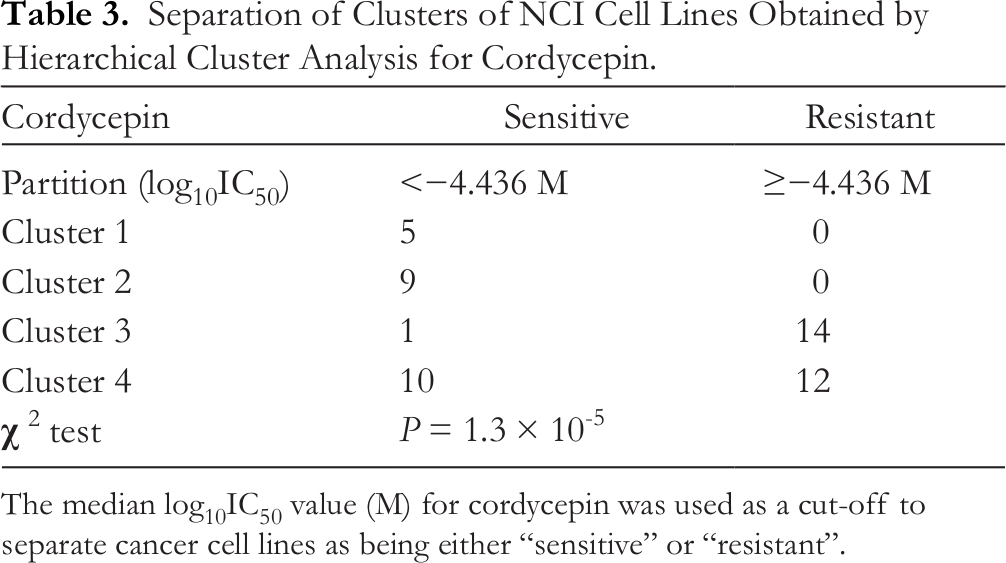
The median log10IC50 value (M) for cordycepin was used as a cut-off to separate cancer cell lines as being either “sensitive” or “resistant”.
Analysis of Binding of Transcription Factor Gene Promoters
The question arises why such a broad diversity of functionally different genes appeared to be associated with either sensitivity or resistance to cordycepin. One possible explanation might be that these genes underly common regulatory transcriptional mechanisms. Therefore, we performed motif searches in the promoter regions of the 40 genes that have been identifed by COMPARE analyses, in order to address the question whether single transcription factors might bind to specific binding motifs in the promoter regions of these, thereby implying a common transcriptional regulation. Interestingly, nuclear factor kappa B (NF-κB) DNA binding motifs extensively appeared in the promoter sequences 50 kb upstream of the genes with 87 hits and a Z score of −3.788 (Figure 3), which pointed out that NF-κB might have a substantial role in the regulation of genes involved in the cellular response to cordycepin. When the PSSM (position-specific scoring matrix) file of NF-κB motif was screened on each gene separately, binding locations were identified in all 40 genes (Table 4). This result implies that NF-κB may be a common transcription factor involved in the regulation of these genes, despite their functional diversity. This result is reasonable in light of previous investigations, pointing to the fact that cordycepin suppresses NF-κB activity. 74 -77

Motif analysis of 50 kb upstream regions of the genes identified by COMPARE analysis disclosing the significant presence of NF-κB binding motif.
NF-κB Binding Locations in the Promoter Regions of the Genes Identified by COMPARE Analysis.

Conclusion
To conclude, in this paper we investigated the role of classical mechanisms for drug resistance towards cordycepin. We disclosed the capacity of cordycepin to bypass resistance mediated by the expression of ABC transporters (P-gp, ABCB5, ABCC1, and BCRP) or mutant EGFR. Cordycepin may target refractory tumors and effectively act jointly with established chemotherapeutic agents as a potential new drug lead. By using bioinformatic approaches, we determined putative molecular determinants to cordycepin activity. Further studies are needed to interpret biological relevance and the probable implications of cordycepin in the treatment of cancer.
Materials and Methods
Bioinformatic Analyses of National Cancer Institute Microarray Data
The database of the Developmental and Therapeutics Program (DTP) of the National Cancer Institute (NCI) (https://dtp.nci.nih.gov) deposits messenger RNA (mRNA) profiles of 60 human cancer cell lines, including a series of breast cancer, colon cancer, non-small cell lung cancer, leukemia, melanoma, renal cancer, ovarian cancer cells, prostate carcinoma and tumor cells of the central nervous system. The cytotoxicity of cordycepin and standard anticancer drugs on these cell lines that had been previously tested by sulforhodamine B assay, and log10IC50 values (M) were calculated based on the 50% inhibition concentration values measured via dose-response curves (http://dtp.cancer.gov/databases_tools/default.htm). COMPARE analysis was used to generate rank ordered lists of genes expressed in the NCI cell lines through the correlation of IC50 values for cordycepin. The methodology has been previously defined as a tool to distinguish candidate genes involved in drug resistance and sensitivity by using standard and reverse COMPARE. 78,79 Pearson’s rank correlation test (WINSTAT program, Kalmia) was used to determine significance values (p-values) and ranking correlation coefficients. Subsequently, we performed hierarchical cluster analysis to group the mRNA expressions of the genes identified by COMPARE analysis. The CIMMINER program (https://discover.nci.nih.gov/cimminer/) was performed to get a dendrogram via the WARD method. A short distance between branches in the dendrogram demonstrates the degree of close association. Prior to the calculation of the median of log10IC50 value of cordycepin as a cut-off value, we performed χ2 test to confirm the association between clustered genes and cellular response.
Gene Promoter Transcription Factor Binding Motif Analysis
We used the UCSC Genome Browser Gene Sorter (http://genome.ucsc.edu) to gain the gene promoter sequences following the analysis of a set of genes obtained from COMPARE analysis. The search was set up 50 kb upstream of the transcription start site. Browser Extensible Data (BED) files were produced to screen for the probable binding motifs for each gene and then, uploaded to the Galaxy Cistrome software. Promoter sequences were screened using the “SeqPos motif tool” executed in Galaxy Cistrome software. 80,81 Subsequently, another tool called “screen motif” within Cistrome was performed to search a set of genomic locations for all occurrences of a particular motif by using PSSM file. 80
Footnotes
Declaration of Conflicting Interests
The author(s) declared no potential conflicts of interest with respect to the research, authorship, and/or publication of this article.
Funding
The author(s) received no financial support for the research, authorship, and/or publication of this article.
