




Abstract
There are reports documenting the volatile oils of several durian cultivars in Malaysia. However, there is limited information on the rapid discrimination of the durian cultivars based on the composition of the total volatiles and individual volatile compounds. Thus, the present work aims to discriminate 11 Malaysian durian cultivars based on their volatile compositions using multivariate data analysis. Sulfur-containing volatiles are the major volatiles in D175 (Udang Merah), D88 (Darling), D13 (Golden Bun), DXO (D24 Special), D17 (Green Bamboo), D2 (Dato Nina), and D168 (Hajah Hasmah) durian cultivars, while esters are predominant in D99 (Kop Kecil), D24 (Bukit Merah), and D160 (Musang Queen) durian cultivars. D197 (Musang King) cultivar has an almost equal composition of sulfur-containing volatiles and esters. In the ester predominated volatile durian oil, ethyl 2-methylbutanoate and propyl 2-methylbutanoate are the major volatile compounds, while the durian cultivars with predominant sulfur-containing volatiles mainly contain diethyl disulfide, diethyl trisulfide, and 3,5-dimethyl-1,2,4-trithiolane. The durian cultivars were clustered into 8 clusters using principal component analysis, with 3 clusters consisting of 2 cultivars, and with the remaining cultivars clustered individually. The highly sought-after durian cultivars, D160 and D197, were clustered into one. Hierarchal clustering analysis identified the distinct compounds which discriminate every durian cultivar.
Introduction
Durian (Durio zibethinus Murr.), popularly dubbed as King of Fruit, belongs to the family of Malvaceae. Its local name, durian, is derived from the word “duri,” the sharp-pointed hexagonal thorn on the thick husk surface, covering the aril inside.1,2 D. zibethinus is native to Southeast Asia and is widely distributed in Malaysia, Thailand, and Indonesia. The genus Durio consists of 28 species, 6 of which produce edible fruits. 3 Nineteen species are native to Borneo, and 5 species are endemic to Peninsular Malaysia. 2 The fruit typically contains 5 locular units with between 1 and 5 pulps per unit. 4 The durian tree grows in warm, wet conditions of the equatorial tropics and is cultivated in Southeast Asia, particularly Malaysia, Indonesia, Thailand, and the Philippines. 2 In Malaysia, durian fruiting seasons are in March and April and in September and October. Thailand, Malaysia, and Indonesia are the top 3 producers and exporters of durian in the world. Malaysia exported a total of 23 381 metric tonnes of durian worth RM118.2 million in 2018. 5 Durian is widely used in Malaysian local dishes such as cakes, sweets, pastries, and ice cream and traditional delicacies such as “dodol” (durian cakes), “tempoyak” (fermented durian), and “lempuk” (preserved durian). 6 It is marketed as a whole fruit or prepacked in plastic containers. The pulp is rich in carbohydrates, proteins, vitamins (thiamine, riboflavin, vitamins A, C, and E), and minerals, such as calcium, phosphorus, potassium, iron, magnesium, and sodium. 7
Different cultivars have different fruit shapes, sizes, smells, colors, texture, taste, and tree characteristics. The cultivation of durian cultivars varies depending on the market demand. The fruits range from pendulous, round to oblong, olive-green to yellow, covered with broadly pyramidal, coarse, hard, and sharp spikes. The edible aril varies in color, texture, and thickness, representing 20% to 35% of the fruit weight. 1 The sensory properties of the fruit arils are pleasantly sour, sweet, and fruity, and the odor is attributed to several compounds that promote a strong and penetrating odor. The sulfur-containing volatiles such as thiols, disulfides, and trisulfides have distinct onion-like odors, while esters give a fruity odor. 4 The index of flavor quality of fruits is correlated with their acid and sugar contents. Lipids are also known to contribute to the mouthfeel and modify the taste and flavor of other compounds in foods.
Even though durian is generally characterized by its bitter taste and sweet and creamy texture, different cultivars have unique flavors and tastes. There are over 20 different cultivars in the Malaysian market, but only a few are highly prized and preferred due to their distinct flavor and aroma. Various factors affect the volatile composition of fruits, such as variety, geography, season, and maturity. The 6 popular cultivars are D24, D160 (Musang Queen), D168 (Hajah Hasmah), D197 (Musang King), D200 (Black thorn), and D99 (Kop Kecil). 8
The solid-phase microextraction (SPME) method is widely used in analyzing the durian headspace volatiles.4,6,9,10 SPME is a solvent-free technique that integrates analyte extraction from sample matrices analyte concentration and analyte desorption in gas chromatography. 11 The method is based on the partition equilibrium of analytes between sample matrices and the extraction phase. 12 The analytes are not affected by the temperature or solvents. The analytes in sample matrices are extracted onto an outer fiber coating by absorption or adsorption, and the analytes can be desorbed directly onto the GC injection port. The SPME conditions must be optimized to ensure reproducibility and enhance the sensitivity and accuracy of the analysis. 10
Previous studies on the volatile aroma of durian showed that Malaysian durian cultivars, Chuk, D101, D24, MDUR78, D28, mainly contained sulfur-containing volatiles,4,13,14 whereas esters predominated in D2. 4 However, there is limited information on the discrimination and clustering of the Malaysian durian cultivars based on their volatile compound composition. Thus, this study aimed to discriminate 11 Malaysian durian cultivars based on the total composition of volatiles compounds and the distinctive volatile compounds profile using multivariate data analysis. The 11 durian cultivars investigated in this study were D24 (Bukit Merah), DX0 (D24 Special), D99 (Kop Kecil), D160 (Musang Queen), D197 (Musang King), D2 (Dato Nina), D13 (Golden Bun), D17 (Green Bamboo), D88 (Darling), D168 (Hajah Hasmah/IOI), and D175 (Red Prawn) from Malaysia.
Experimental
Reagents and Standards
Sodium chloride (Merck, Germany) and hydrocarbon standard C7-C20 (04070, Supelco, Sigma Aldrich) were purchased from Sigma Aldrich.
Durian Samples
Eleven durian cultivars, D24, D99, DXO, D160, D197, D2, D13, D17, D88, D168, and D175, were obtained from Selayang wet market during fruiting seasons in August 2016. The durian fruits that dropped during the fruit season were transported on the same day and sold in the market. The durian fruits are usually allowed to reach full maturity on the trees, and when ripe, the abscission layer at the peduncle weakens, which leads to the durian fruits falling off the trees naturally. 14 Fully ripened durian and durian without any visible defect were selected. The ripened durian was characterized by a strong smell, tender, dry pulp, yellowish husk, and the fruit’s rind can be easily dehusked. The durian samples were dehusked in the laboratory for sample preparation on the same day before the analysis. The pulps with no external injuries or intact epidermis were then chosen. The pulps were placed in a commercially available low-density polyethylene-wrapped plastic container.
SPME Extraction
The method used for extraction was adopted from Chin et al. 10 The fresh durian pulp (50 g) and distilled water (100 mL) were blended for 1 min to produce a homogenous mixture. Next, 15 g of the blended homogenous durian and 5 g of sodium chloride (Merck, Germany) were transferred quickly into a 30 mL vial containing a magnetic stirrer bar (8 × 25 mm) and sealed with a 20 mm diameter aluminum seal and a Teflon septum. Then, the homogenous durian pulp was kept under constant vigorous stirring at 30˚C within 25 min. A SPME syringe was then manually inserted into the vial headspace with 75 μm carboxen-polydimethylsiloxane fiber coating (Supelco Co.) and exposed for 25 min. Desorption of the analytes from the fiber coating was made at the GC injection port at 250 ˚C for 5 min.
GC-MS Conditions
The headspace of volatile durian oil was analyzed using an Agilent 6890N gas chromatography system (Agilent Technologies, Inc.) equipped with an Agilent 5973 inert mass selective detector (electron ionization mass spectrometer). The SPME fiber coating was introduced into the GC injection port at 250 °C at 10:1 split mode with 99.99% purified helium as the carrier gas at 0.4 mL/min with a constant flow rate. The volatile compounds were separated using an HP5-ms (Agilent) capillary column (10 m × 0.10 mm, 0.10 µm film thickness) with the injector and detector maintained at 250 °C. The oven temperature program was set at 40 °C for 1.5 min, ramped to 240 °C at 50 °C/min, and then held at this temperature for 2 min. 4 The mass spectrometer was operated in scan mode with 70 eV electron ionization. Identification of aroma compounds was initially accomplished by matching mass spectra with library values (US National Institute of Standards and Technology [NIST]). The hydrocarbon standard C7-C20 (04070, Supelco, Sigma Aldrich) was run under the same conditions. Volatile components were identified by comparing the retention index (RI), molecular weights, and mass fragmentation patterns with the public database (PubChem database, NIST Database). Kovats indices were calculated as reported previously. 15
Multivariate Analysis
A multivariate approach was applied to decrease the complexity of hundreds of variables obtained from the GC-MS dataset using SIMCA-P version 13.0 software (Umetrics). The software was used for the hierarchal clustering analysis (HCA) and principal component analysis (PCA). The data table for the multivariate analysis consisted of 32 durian samples from 11 cultivars arranged in rows, and the peak intensity area of 21 volatile compounds for GC-MS at a given retention time was arranged in columns. HCA was calculated according to Ward’s method and standardized data.
Results and Discussion
SPME Optimization
SPME optimization is crucial in qualitative analysis to determine the optimum conditions for volatile compounds extraction from durian pulps. SPME with headspace sampling was used to avoid interference from contaminants such as fruit sugars (fructose and sucrose), or the presence of protein in the durian homogenate that would lead to disintegration of the fiber coating efficiency. 10 The sampling duration, sampling temperature, sampling size, and headspace volume were optimized by monitoring the detector response of 4 major volatiles: diethyl disulfide, diethyl trisulfide, ethyl 2-methylbutanoate, and propyl-2-methyl butanoate. The parameter which gave the highest detector response and reproducibility was selected, while the remaining parameters were constant. Each parameter was evaluated, and the optimum parameters were 15 g sampling size, 30 °C sampling temperature, 25 min extraction time, and 30 mL sampling size. In addition, sodium chloride and water were used during durian pulp homogenization to saturate the sample matrix and elute the polar compounds from the durian pulp. Sodium salt enhances the partition coefficient of an analyte between the headspace and sample phase of polar compounds. 10
Volatile Compounds from the Headspace Durian Volatiles
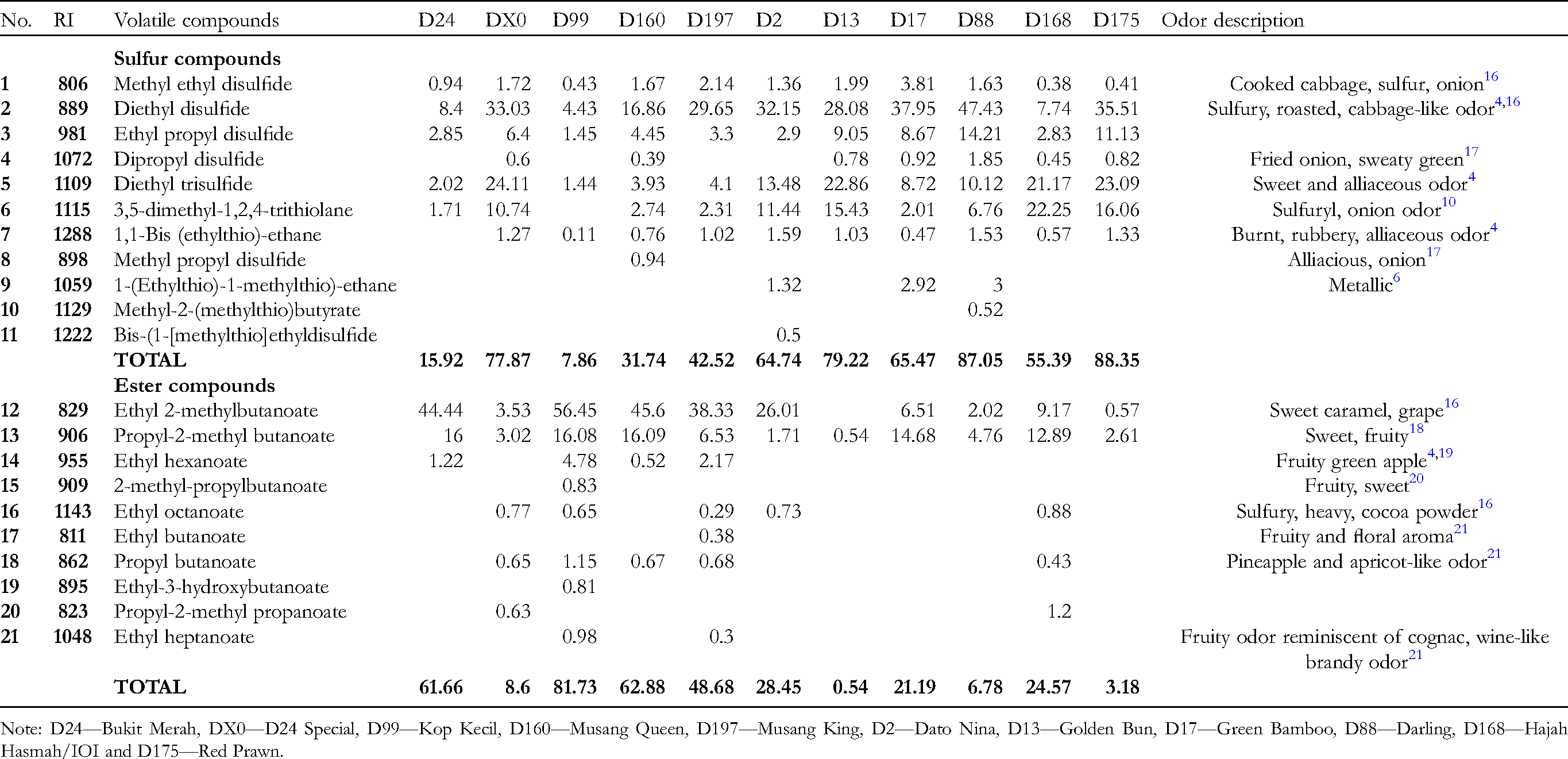
Twenty-one major volatile compounds were identified from the headspace durian volatile oils of 11 durian cultivars (Table 1). The identification of the compounds was based on the NIST library and RIs. The volatile compounds are recorded as relative compositions based on the area under the peaks. All compounds detected were identical to those reported previously from several Malaysian,4,10,13 Indonesian, 9 and Thailand cultivars. 6 DXO, D2, D13, D17, D88, D168, and D175 cultivars mainly contain sulfur-containing volatiles (64%-88%), whereas in D24, D160, D197, and D99 cultivars esters predominate (49%-82%). On the contrary, previous studies on Malaysian durian reported that D24 and D101 mainly contain sulfur-containing volatiles,4,13 while esters mainly predominated in D2. 4 Interestingly, a highly sought-after durian cultivar in Malaysia, D197 (Musang King), has an almost equal relative composition of ester and sulfur-containing volatiles. Figure 1 illustrates the ester and sulfur-containing volatiles composition of 11 durian cultivars.

The composition of ester and sulfur-containing volatile of 11 durian cultivars. Note: D24—Bukit Merah, DX0—D24 Special, D99—Kop Kecil, D160—Musang Queen, D197—Musang King, D2—Dato Nina, D13—Golden Bun, D17—Green Bamboo, D88—Darling, D168—Hajah Hasmah/IOI and D175—Red Prawn.
Durian Volatiles of 11 Durian Cultivars.
Note: D24—Bukit Merah, DX0—D24 Special, D99—Kop Kecil, D160—Musang Queen, D197—Musang King, D2—Dato Nina, D13—Golden Bun, D17—Green Bamboo, D88—Darling, D168—Hajah Hasmah/IOI and D175—Red Prawn.
The strong and penetrative odor of durian is a synergy of various compounds. The durian odor is mainly characterized by sulfury, onion, and garlic odor of sulfur-containing volatiles and sweet fruity odor of esters. 10 A notable difference in the composition of sulfur-containing volatiles and esters is observed in the 11 cultivars. However, the main volatile compounds are similar across cultivars, but with variations. Thus, the discrimination of durian cultivars is achieved by multivariate data analysis. PCA analysis is helpful in the rapid identification of cultivars.
In the durian in which the sulfur-containing volatiles predominated, diethyl disulfide, diethyl trisulfide, and 3,5-dimethyl-1,2,4-trithiolane were the major compounds with a relative composition of 28% to 88%, 8% to 24%, and 10% to 22%, respectively, similar to previous reports.4,22 Diethyl disulfide has a sulfury, roast, and cabbage-like odor, while diethyl trisulfide has a sweet and alliaceous odor. Meanwhile, 3,5-dimethyl-1,2,4-trithiolane has a sulfury and onion-like odor. 4 Dialkyl sulfides were suggested as the main contributors to the sulfury note of durian volatiles.23,24 However, a later aroma extract dilution analysis showed that the low dilution factors of these compounds did not support those suggestions. 6 In several studies, thiols, the most odorous aroma compounds, were present in several durian varieties, including D2, D101, and D24, in relatively high amounts. 10 However, thiols including ethanethiol, propanethiol, 1-(methylthio)propane, S-ethyl ethenethionate, and S-propylethenethionate were absent in the present study, which could be due to their rapid oxidation into disulfides and trisulfides, even in the absence of oxygen. 10
Meanwhile, ethyl-2-methylbutanoate and propyl-2-methylbutanoate are the most abundant compounds in the ester predominant durian cultivars, accounting for 26% to 57% and 6% to 16%, respectively. A similar observation was reported by Wong and Tie and Voon et al.4,13 Ethyl-2-methylbutanoate has the highest odor impact in durian volatiles among the nonsulfurous compounds.4,6 An aroma extract dilution analysis showed that these compounds have a high flavor dilution factor. 6 Ethyl 2-methylbutanoate has powerful green, fruity apple-like odor, while propyl 2-methylbutanoate has a fruity odor. 6
Irrespective of whether the durian cultivar is one in which either sulfur-containing volatiles or esters predominate, methyl ethyl disulfide, diethyl disulfide, ethyl propyl disulfide, diethyl trisulfide, 3,5-dimethyl-1,2,4-trithiolane, 1,1-bis(ethylthio)ethane, ethyl-2-methylbutanoate, and propyl-2-methylbutanoate are present in almost all 11 varieties. The durian volatiles were similar to those reported previously.4,10,13 D88 cultivar has the highest diethyl trisulfide and ethyl propyl disulfide compositions, whereas DXO and D168 cultivars have the highest contents of diethyl trisulfide and 5-dimethyl-1,2,4-trithiolane, respectively. Meanwhile, the D99 cultivar has the highest composition of ethyl-2-methylbutanoate. Propyl-2-methylbutanoate is found in the highest compositions in the D24, D99, and D160 cultivars. Figure 2 shows the compositions of major volatile compounds in 11 durian cultivars.

Distribution of major volatile compounds in 11 durian cultivars. Note: D24—Bukit Merah, DX0—D24 Special, D99—Kop Kecil, D160—Musang Queen, D197—Musang King, D2—Dato Nina, D13—Golden Bun, D17—Green Bamboo, D88—Darling, D168—Hajah Hasmah/IOI, and D175—Red Prawn.
The variation in volatile organic compounds could be attributed to geographical differences for each durian clone. For example, D197 and D24 cultivars were cultivated in the lowland of Pahang, the D175 cultivar was planted in the lowland of Penang, D168 in Selangor, and DXO in the hilly area in Pahang. 14 This finding is in agreement with a previous study that suggested there was a significant difference in the sulfur-containing compounds for different durian cultivars in Malaysia. 10 Genetics, cultural practice, climate, and agrichemicals during the fruit development stage affect the durian volatile profile. 25
In addition to the total composition of sulfur-containing volatiles and esters, the cultivars can be distinguished based on the major compounds observed. Even though the main compounds were present in all cultivars, their compositions differed in different cultivars. For instance, D2 and D17 durian cultivars have similar total compositions of sulfur-containing volatiles. However, they can still be differentiated based on the main compounds present in their volatile oils. D2 cultivars mainly contain diethyl trisulfide and ethyl-2-methylbutanoate, while the volatile oil of D17 is predominated by diethyl trisulfide and propyl-2-methylbutanoate. DXO and D13 cultivars have similar total compositions of sulfur-containing volatiles, and both cultivars have similar composition of major compounds, except for the D13 cultivar, which has a smaller ester composition than DXO.
Multivariate Analysis
Multivariate data analysis of the cultivars was carried out to investigate the similarity of the cultivars based on the composition of their volatile compounds. Thus, the marker compounds for different cultivars can also be identified. For this purpose, the PCA and HCA (Unit variance scaling) of 32 samples × 21 volatiles compounds (11 sulfur-containing volatiles and 10 ester compounds) datasets were constructed. The visualizations are presented in a PCA biplot, which consists of a score and loading plot. The score plot indicates the map of sample clusters, and the loading plot shows the map of variables that contributed to the sample variation. 26 The PCA biplot (Figure 3) of the GC-MS data of 11 durian cultivars showed consistency within-sample groupings. The model produced 8 clusters by first and second principal components (PC1 39.3% and PC2 16.8%) and supported by HCA clustering (Figure 4). The PCA is for projecting the raw data based on aspects to assess the sample variation efficiently. From the observation, 3 clusters consist of 2 cultivars each, meaning that they share a similar composition of volatile compounds. The 3 clusters are D160 (Musang Queen) and D197 (Musang King), DXO and D2 (Dato Nina), and D175 (Red Prawn) and D13 (Golden Bun), while the rest of the cultivars were clustered individually.

PCA biplot of 11 durian cultivars and their marker compounds. Note: D24—Bukit Merah, DX0—D24 Special, D99—Kop Kecil, D160—Musang Queen, D197—Musang King, D2—Dato Nina, D13—Golden Bun, D17—Green Bamboo, D88—Darling, D168—Hajah Hasmah/IOI and D175—Red Prawn.

HCA of the 11 durian cultivars. Note: D24—Bukit Merah, DX0—D24 Special, D99—Kop Kecil, D160—Musang Queen, D197—Musang King, D2—Dato Nina, D13—Golden Bun, D17—Green Bamboo, D88—Darling, D168—Hajah Hasmah/IOI and D175—Red Prawn.
D160 and D197 have similar volatile compositions, in which diethyl disulfide and ethyl 2-methylbutanoate are the major volatiles in both cultivars. Diethyl disulfide is characterized by a sulfurous, roast, and cabbage-like odor, 4 while ethyl 2-methylbutanoate has a powerful green and fruity odor. Both compounds have a strong odor impact in D197 and D160 cultivars. According to Voon et al, sweet notes of durian are highly correlated with sulfur-containing volatiles and esters. The presence of volatiles in similar composition could contribute to the consumer acceptance of D197 and D160 cultivars. 27 DXO and D2 cultivars contain diethyl disulfide as major volatiles. Ethyl 2-methylbutanoate is also present in a considerable amount in the DXO cultivar. However, ethyl-2-methylbutanoate is not strongly correlated with the sweet note of durian.4,28 It can be deduced that DXO has a stronger sulfury durian odor note than D2, which has a considerable amount of ester in its headspace volatiles. Diethyl trisulfide is the major volatile in the D175 and D13 cultivars. The headspace volatiles of the cultivars mainly consisted of sulfur-containing compounds. It is postulated that D13 and D175 cultivars have a stronger durian sulfury odor compared to other cultivars. Durian with a stronger pleasant sweet and fruity aroma are more favored by consumers. 9 D99, D175, D160, and D24 cultivars are highly sought in Malaysia, and they are sold with a higher price tag due to high demand. 27
The sample variations were contributed to by the variable positions at the same positions in the biplot. All the ester compounds were located at the negative axis of PC1, while most of the sulfur-containing volatiles were positioned at the positive axis of the PC1, except for 2 compounds, methyl propyl disulfide and 1-(ethylthio)-1-methylthio)-ethane. Propyl-2-methyl butanoate, propyl butanoate, ethyl-2-methylbutanoate, ethyl hexanoate, and ethyl heptanoate contribute to the variation of D99, propyl-2-methyl propanoate, and ethyl octanoate to D168 and ethyl-3-hydroxybutanoate to D24. These compounds are volatile esters. The highly sought-after durian in Malaysia, D160 and D197, positioned at the center of the plot, contain both sulfur (methyl propyl disulfide and 1-(ethylthio)-1-methylthio)-ethane) and ester compounds (ethyl butanoate). While at the positive axis of PC 1, methyl ethyl disulfide contributed to the D17 variation, and 1,1-bis (ethylthio)-ethane and bis-(1-(methylthio)ethyldisulfide to D175 and D13 clusters. Meanwhile, dipropyl disulfide, methyl-2-(methylthio)butyrate, diethyl disulfide, and ethyl propyl disulfide contributed to the D88 variation.
In conclusion, the abundance of sulfur-containing volatiles and esters contributes to the strong durian odor. The 11 durian cultivars have distinct sulfur-containing volatiles and ester compositions. However, the total volatiles compositions of several cultivars are comparable. Nonetheless, the cultivars may be differentiated based on individual compositions of main compounds. The durian cultivars were grouped into 8 clusters using PCA, and the variations between cultivars were examined using HCA. The present data are valuable for the rapid discrimination of durian cultivars, and the finding is useful in monitoring the quality of durian fruit.
Footnotes
Acknowledgments
The authors thank Universiti Teknologi MARA for the facilities provided and financial assistance.
Declaration of Conflicting Interests
The authors declared no potential conflicts of interest with respect to the research, authorship, and/or publication of this article.
Funding
The research was funded by Universiti Teknologi MARA through Research Grant MyRA Road to HiCOE (600-RMC/GPM COE 5/3(052/2021).
