



Abstract
A phytochemical investigation of an aqueous ethyl alcohol (EtOH) extract of the flowers of Nicotiana tabacum L. led to the identification of one new eudesmane-type sesquiterpenoid (
Keywords
Introduction
Nicotiana tabacum L. (family Solanaceae), also known as tobacco, was first introduced from the tropical Americas.
1
As one of the most commercially valued agricultural crops worldwide, it is widely grown in China, especially the southwest provinces of Yunnan, Guizhou, and Sichuan. In addition to providing the raw materials for cigarette production, the aerial part of N tabacum is also used as an insecticide, sedative, diaphoretic, anesthetic, and emetic agent in traditional Chinese medicine.2–5 Previous phytochemical studies on Nicotiana plants led to the discovery of more than 2500 compounds, including sesquiterpenoids, diterpenoids, alkaloids, and flavonoids.6-9 Our research team previously found that a 95% ethanol extract of tobacco leaves possessed significant phytopathogenic fungal activities against Valsa mali and 10 other plant pathogens.10,11 In our search for antifungal agents from N tabacum, one new eudesmane-type sesquiterpenoid (
Results and Discussion
Compound

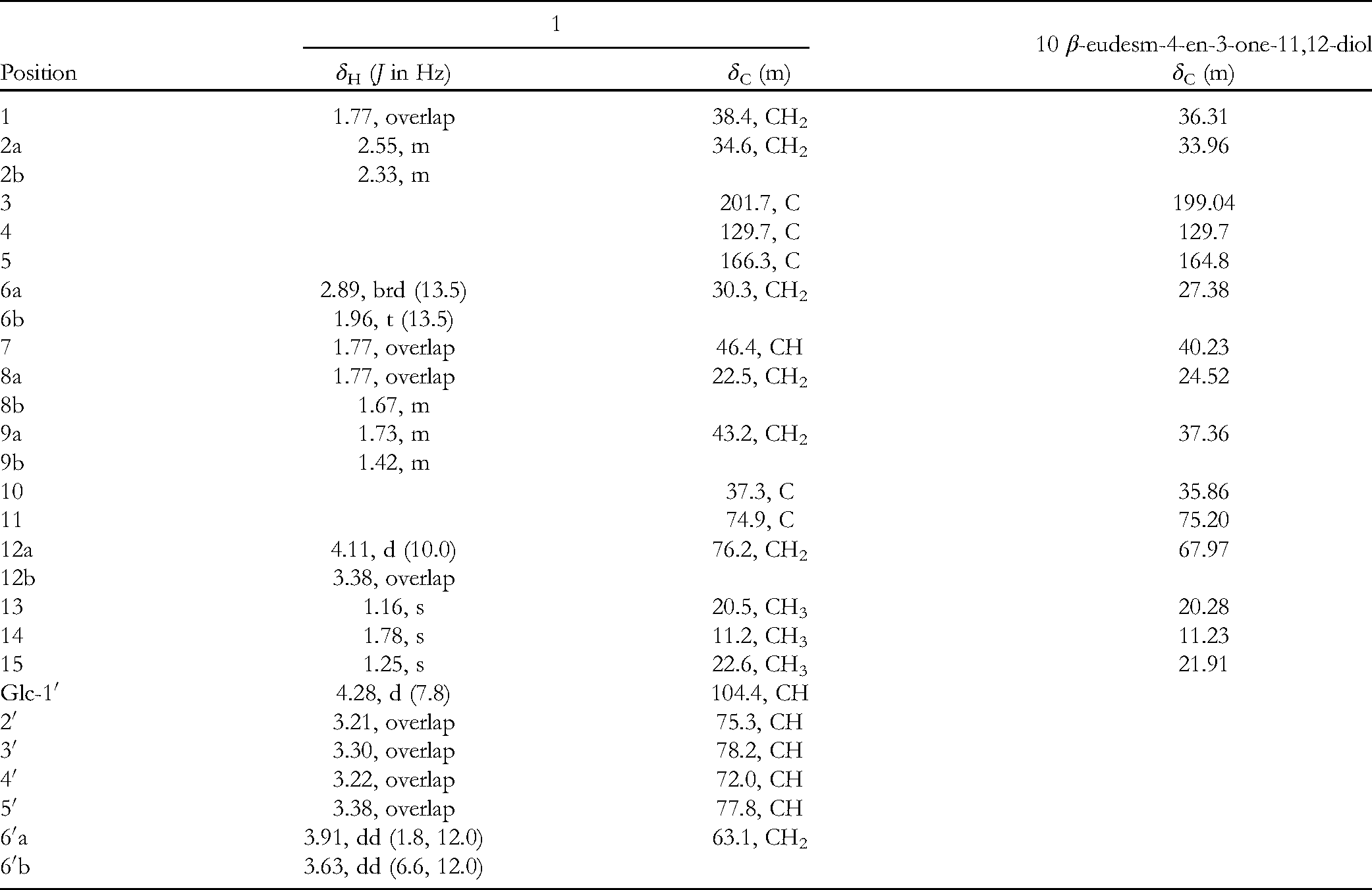
The chemical structures of compounds
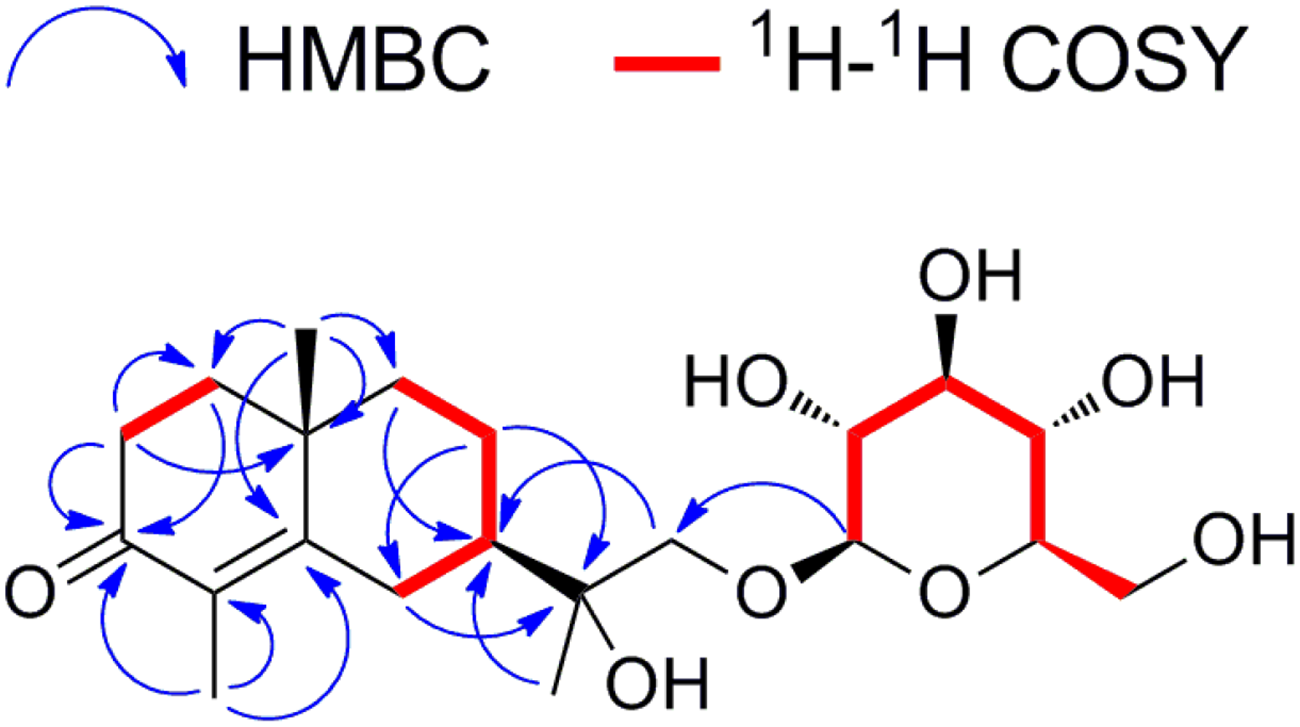
Important HMBC and 1H–1HCOSY correlations of compound

Important NOESY correlations (relative configuration) of compound
1H and 13C NMR Spectroscopic Data of
In addition, another fourteen known compounds were isolated in this study. They were identified as luteolin (
All these compounds were evaluated for antifungal activity against the phytopathogenic fungal strains Valsa mali var. mali, Alternaria porri, and Botrytis cinerea at a concentration of 10 µg/mL (Table 2). Compared with the control group (CG), compound
Antifungal Activities of Compounds
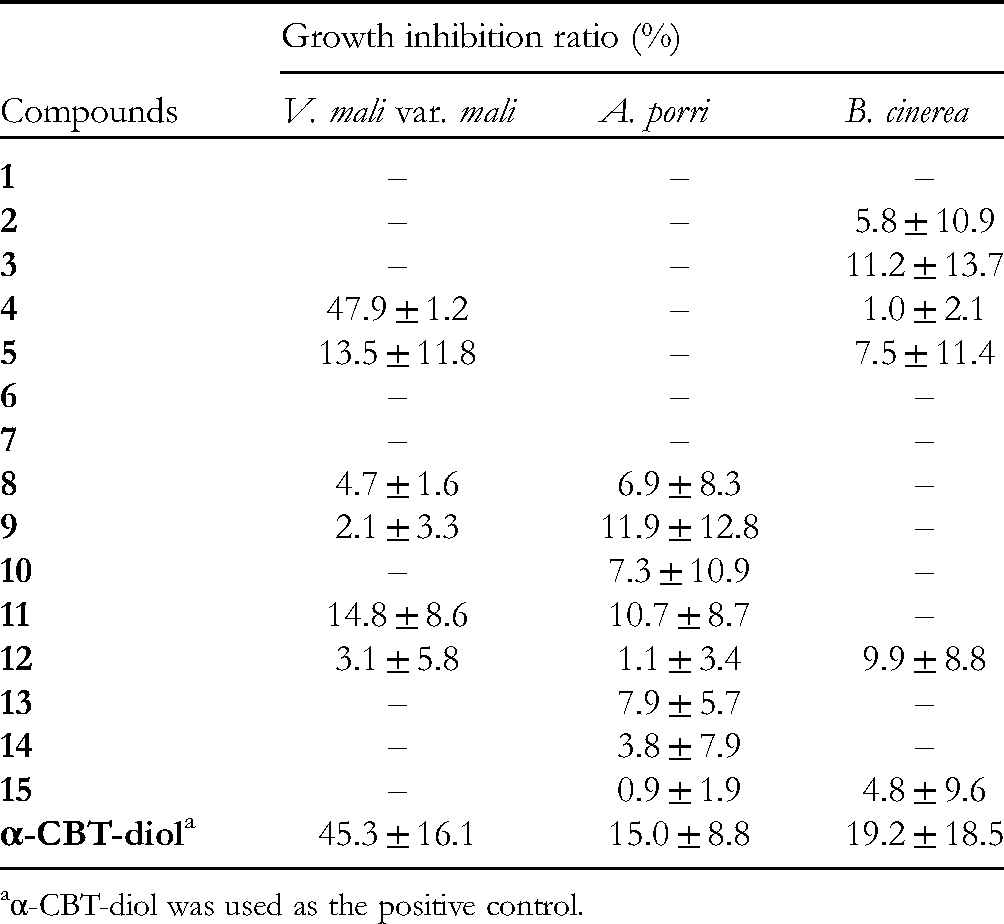
α-CBT-diol was used as the positive control.
Material and Methods
General Experimental Procedures
Specific rotation was measured on an Autopol IV-T spectrometer (Rudolph Technologies). NMR spectra were obtained on a Bruker Advance III-600 MHz spectrometer (Bruker Biospin); chemical shifts are given in δ (ppm) with the known residual solvent proton peak as the reference. High-resolution electrospray ionization (HRESIMS) was performed on a Thermo Orbitrap Fusion Lumos instrument (Thermo Fisher Scientific), while the LC–MS data were measured on a Shimadzu LCMS-8050 mass spectrometer (Shimadzu Corp.). Semipreparative HPLC was performed on a C18 (SunFire®, 10 μm, 19 × 250 mm) column using a Waters e2695 separation module equipped with a 2998 detector (Waters Corp.). Commercially available silica gel of 200 to 300 mesh (Qingdao Marine Chemical Co.), Diaion HP-20 macroporous resin (Mitsubishi Chemical Corp.), and Sephadex LH-20 (Pharmacia Fine Chemicals) were used for open column chromatography.
Plant Materials
The flowers of N tabacum L. were cultivated in Zhucheng City, Shandong Province, China, in July 2020 and identified by Yong-Mei Du (Tobacco Research Institute). A voucher specimen (NT-S-2020-07) was deposited in the laboratory of Tobacco Research Institute of Chinese Academy of Agricultural Sciences, Qingdao 266101, China.
Extraction and Isolation
Fresh flowers were collected from a total of 15 acres (about 1000 kg) of N tabacum. At normal temperatures and pressures, these materials were rinsed in 95% ethanol (solid–liquid ratio of 1:7), three times. The treated flowers were dried in the sun, while the solution was concentrated under reduced pressure to obtain the glandular trichome secretions (this work is reported in another study). The air-dried flowers (100 kg) were crushed and refluxed three times with 95% EtOH for 2 h. The extract (8.0 kg) was suspended in 20 L of dilute HCl solution (pH 1
Compound 1
White amorphous powder,
Antifungal Activity Assay
The antifungal activity against three phytopathogenic fungi (eg, Valsa mali var. mali, Alternaria porri, and Botrytis cinerea) were tested using a modified method previously described in the literature.10,11 All plant pathogens were purchased from Qingdao Agricultural University (Qingdao, China). The isolated compounds were separately dissolved in 95% ethanol at a concentration of 1 mg/mL. After steam sterilization, culture dishes (90 mm) filled with liquid potato dextrose agar (PDA) medium were immediately added to 1 mL of the aforementioned solution and mixed thoroughly; these samples constituted the experimental group (EG). The final concentration of each compound was 10 μg/mL (the dilution ratio was 1:100). PDA medium containing 1 mL of 95% ethanol was used as the CG. After the medium was naturally cooled and solidified, the fungal strains cultured in another PDA culture dish (φ = 9 mm) were inoculated in the center of each dish and repeated three times. The treated fungus was fermented under static conditions at 25°C for 7 days. The final growth inhibition ratio of the samples was calculated by the cross-patch method using the formula [(φCG
Conclusions
One new eudesmane-type sesquiterpenoid glycoside (
Supplemental Material
sj-doc-1-npx-10.1177_1934578X211059578 - Supplemental material for Chemical Constituents from Nicotiana tabacum L. and Their Antifungal Activity
Supplemental material, sj-doc-1-npx-10.1177_1934578X211059578 for Chemical Constituents from Nicotiana tabacum L. and Their Antifungal Activity by Chen Yang, Sheng-Nan Xie, Lin Ni, Yong-Mei Du, Su Liu, Mao-Ye Li and Kuo Xu in Natural Product Communications
Footnotes
Declaration of Conflicting Interests
The authors declare no potential conflicts of interest with respect to the research, authorship, and/or publication of this article.
Funding
This research was supported by the Foundation of the Key Laboratory of Biopesticides and Chemical Biology, Ministry of Education, Fujian Agriculture and Forestry University (No. Keylab 2019-05), the Foundation of Key Laboratory of Plant Resources Conservation and Sustainable Utilization, South China Botanical Garden, Chinese Academy of Sciences (No. PCU202001), the Science Foundation for Young Scholars of Tobacco Research Institute of Chinese Academy of Agricultural Sciences (No. 2020B02), and the Agricultural Science and Technology Innovation Program (No. ASTIP-TRIC05).

Trial Registration
Not applicable because this article does not contain any clinical trials.
Ethical Approval
Ethical approval is not applicable for this article.
Statement of Human and Animal Rights
This article does not contain any studies with human or animal subjects.
Statement of Informed Consent
There are no human subjects in this article and informed consent is not applicable.
Supplemental Material
Supplemental material for this article is available online.
References
Supplementary Material
Please find the following supplemental material available below.
For Open Access articles published under a Creative Commons License, all supplemental material carries the same license as the article it is associated with.
For non-Open Access articles published, all supplemental material carries a non-exclusive license, and permission requests for re-use of supplemental material or any part of supplemental material shall be sent directly to the copyright owner as specified in the copyright notice associated with the article.
