



Abstract

The World Health Organization (WHO) now sees the COVID-19 pandemic as a global emergency event. Since there is no particular treatment for SARS-CoV-2 infection at present and also since it takes a long time to find a new medicine, there is an immediate need for an urgent solution to this pandemic infection.1,2
Efficient care is encouraged, but caution should be practiced when mixing multiple medications and even complementary medicines.2,3 Among COVID-19 patients, a high incidence of extreme QTc interval prolongation and also cardiac adverse drug reaction were observed in triple combination therapy with hydroxychloroquine, azithromycin and lopinavir/ritonavir. 4
Previous study has shown that medications are widely used in the management of COVID-19 associated with QT prolongation, and may increase the risk of cardiac diseases. 5 In particular, in the treatment of COVID-19, special attention is given to antimalarial drugs such as chloroquine and hydroxychloroquine as antiviral agents. 6 These drugs are multichannel blockers and have specific effects on the human ether-a-go-go-related-gene (hERG) and Kir2.1. 3 At the effective concentrations, especially in combination with either antibiotics (such as macrolides and fluoroquinolones) or antivirals agents (such as lopinavir/ritonavir), chloroquine and hydroxychloroquine cause significant QT-prolongation against SARS-CoV-2.3,6 In addition, remdesivir produces sinus bradycardia and prolonged QT interval in some patients with SARS-CoV-2. 7 Similarly, another study reported that ECG recordings of COVID-19 patients treated with hydroxychloroquine revealed a significant prolongation in the QTc interval, while there was no significant change with favipiravir therapy. 8
To the best of our knowledge, inhibition of hERG by pharmacological channel blocking and/or disrupted trafficking of hERG channels are the most important mechanisms of certain medicines known for drug-induced QT prolongation. The prolongation of the corrected QT (QTc) interval is also the most frequent drug side effect when hERG channels are usually blocked. The blockage is a key factor in provoking arrhythmia or torsades de pointes in using the drugs. 3
Awareness of this danger enables physicians to ensure adequate QT distance monitoring and arrhythmia risk management and maximize patient safety during this emergency. 9 Furthermore, there is a growing trend in the consumption of natural products and medicinal plants, which is also encouraged by their over-the-counter (OTC) status and accessibility without the need for a prescription of a specialist. It should be mentioned that medicinal plants and natural products as COVID-19 therapeutic candidates are no exception to this rule. Little is known about the cardiac toxicity of many herb preparations.10,11 In this perspective, there is an urgent need to critically notice the potential hERG channel-related off-target effects of natural products. 10 Based on the search criteria mentioned in Figure 1, our study lists some medicinal plants and natural compounds associated with QT prolongation that can be frequently used in the treatment of COVID-19, which is clearly not exhaustive (See in Table 1).
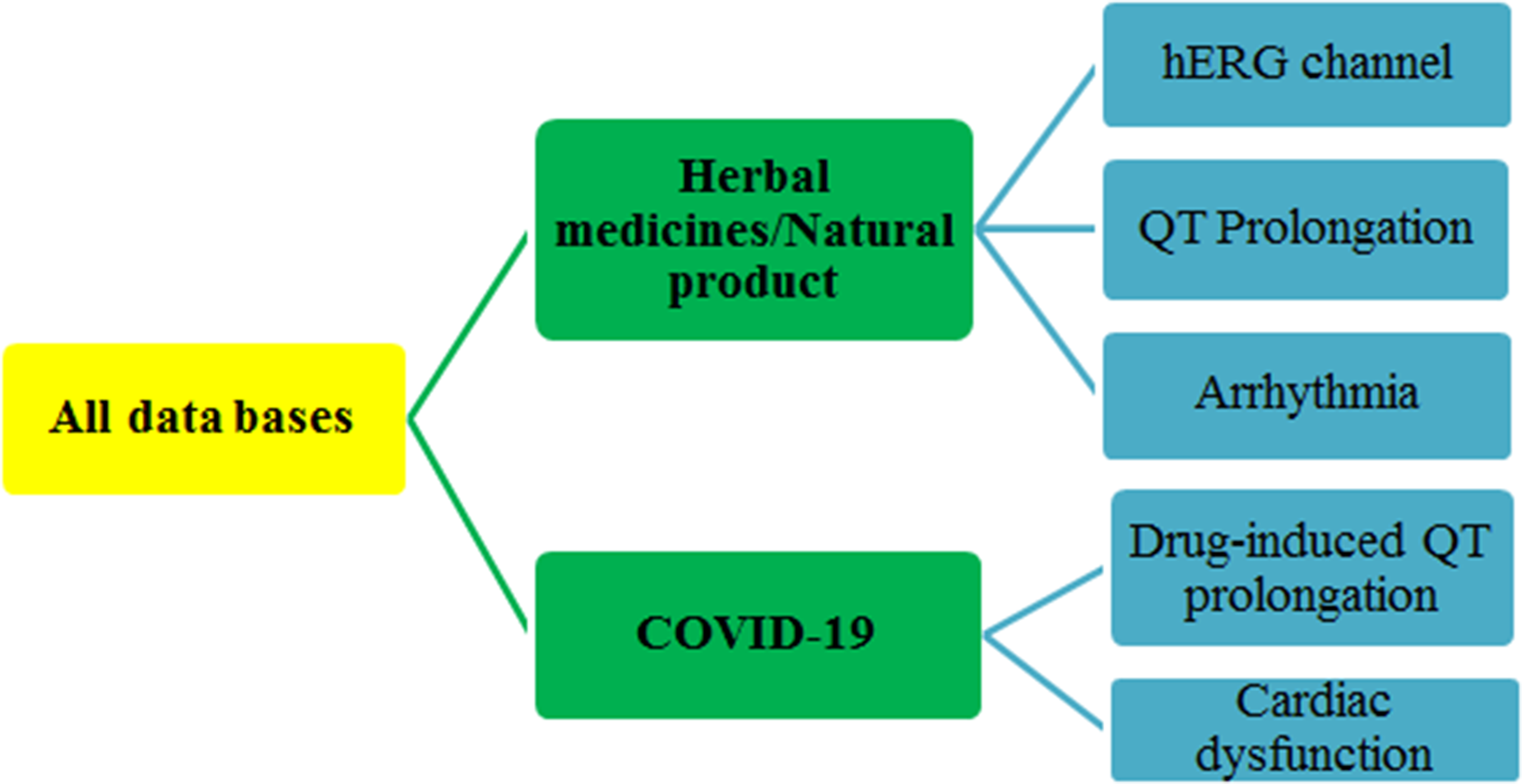
Search criteria used to select articles.
QT Prolongation Effect of Natural Products/Herbal Medicines.

Careful electrocardiographic monitoring is needed to evaluate plausible malignant arrhythmias of herbal drugs, especially in combination with conventional medicine, in spite of the fact that herbal medicines and natural products can be applied as a complementary remedy in the treatment of COVID-19 due to their various beneficial pharmacological effects. Also, more information should be sought about agents applied in COVID-19 treatment in the clinical trial surveys.
Footnotes
Declaration of Conflicting Interests
The author(s) declared no potential conflicts of interest with respect to the research, authorship, and/or publication of this article.
Funding
The author(s) received no financial support for the research, authorship and/or publication of this article.
Ethical Approval
Not applicable, because this article does not contain any studies with human or animal subjects.
Informed Consent
Not applicable, because this article does not contain any studies with human or animal subjects.
