




Abstract
Two iridoid glycosides (
The genus Verbena belongs to Verbenaceae, and is mainly found in the subtropical regions of North America and South America and partially distributed in Europe and Asia. 1 Although most of the Verbena species have been cultivated for horticulture, a few Verbena species have been used for medicinal purposes. For instance, Verbena officinalis L., also known as ‘Vervain,’ is used as a diuretic, an astringent for poorly healing wounds, a galactagogue, an expectorant, and an antirheumatic. 2 Iridoids, triterpenes, and flavonoids are the characteristic components isolated from V. officinalis. 3 Verbena hastata L., the species of interest in this study, is native to North America. V. hastata, also known as ‘Blue Vervain,’ is used as a folk medicine for the treatment of headaches, externally wounds, ulcers, and acne. Although a few iridoid glucosides such as verbenalin and hastatoside were isolated from V. hastata, 4,5 there has been no systematic study of its chemical components. As a part of our ongoing study on traditional medicinal plants, a phytochemical examination was carried out on the whole plant of V. hastata. This study involves the structural identification of the isolated compounds and their inhibitory activity against the production of advanced glycation end products (AGEs).
Results and Discussion
The whole plant of V. hastata was extracted with MeOH. After removing the solvent, the concentrated MeOH extract was passed through a column packed with porous polymer polystyrene resin (Diaion HP-20). The samples were eluted with 30% MeOH, 50% MeOH, MeOH, EtOH, and EtOAc. The eluates with 50% MeOH and MeOH were subjected to silica gel (Si) column chromatography (CC) and octadecylsilanized (ODS) Si CC to yield compounds
Based on the physicochemical and spectroscopic data, compounds
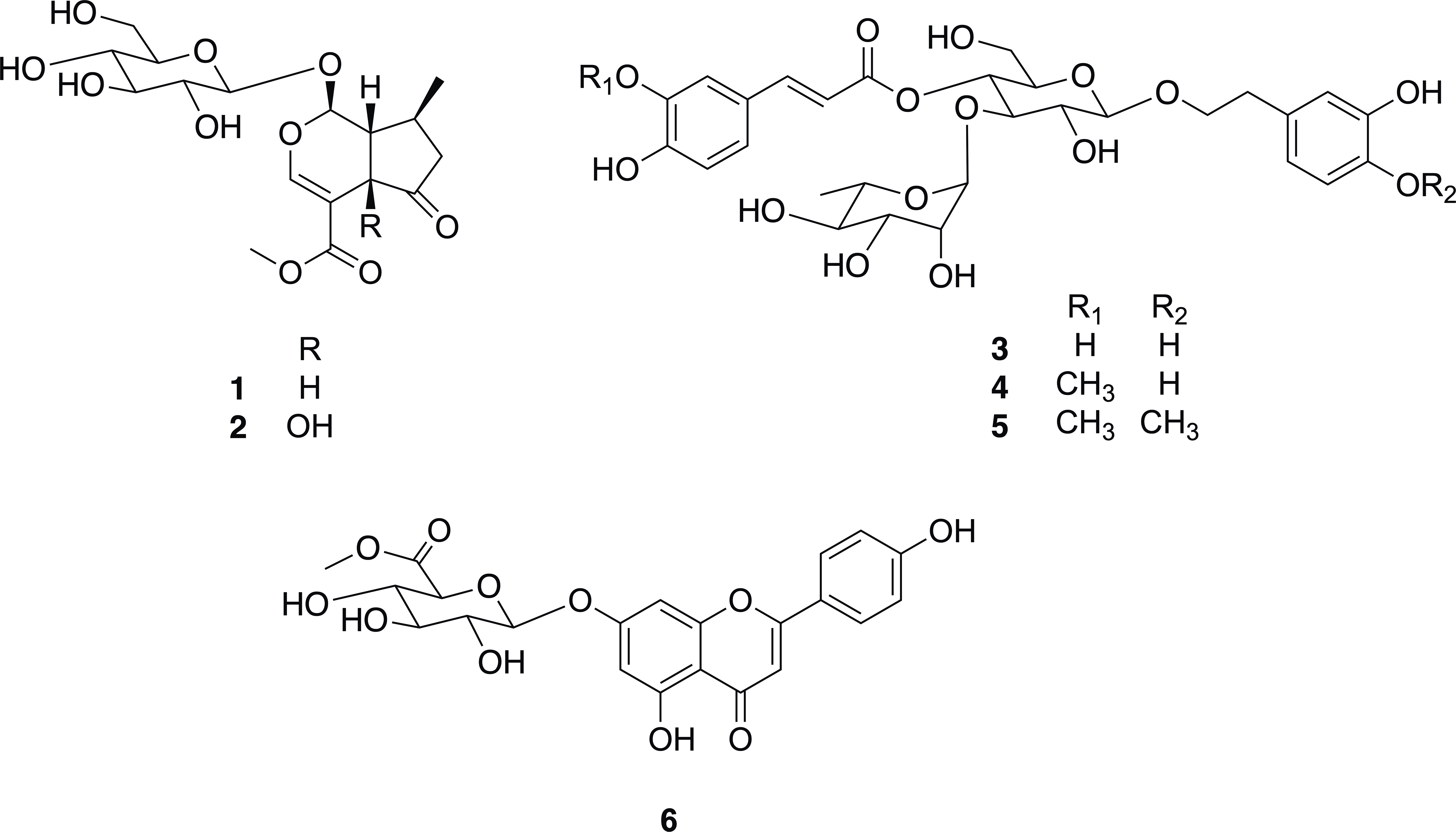
Structures of

Structures of
Compound
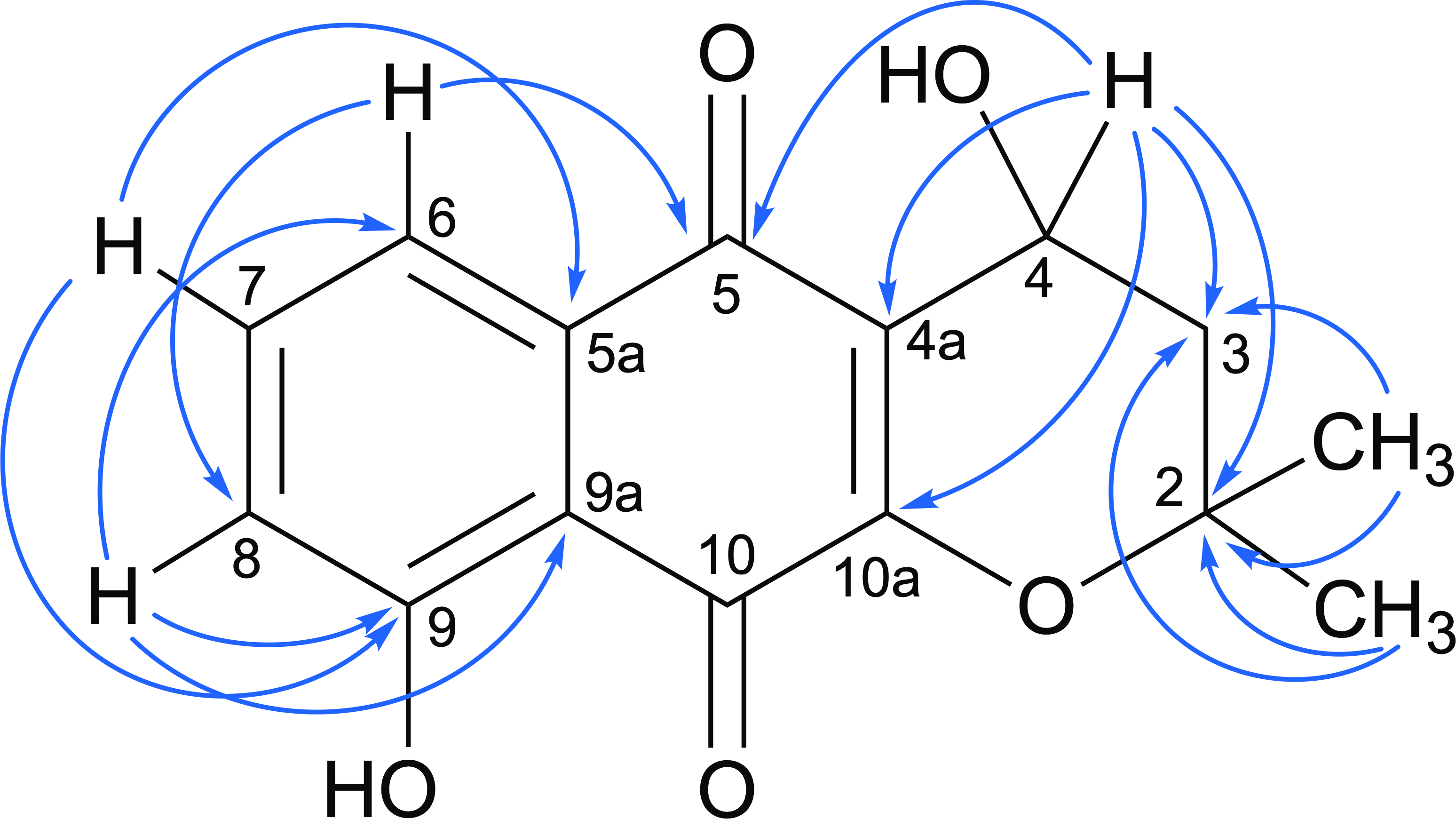
Key HMBC correlations of 14.
AGEs are either produced by the nonenzymatic glycation and oxidation of proteins and reducing sugars or as sugar metabolism intermediates. The formation of AGEs in the skin, blood vessel walls, and bones is closely related to their aging.
21
Moreover, the accumulation of AGEs has implications in the pathology of diabetes, chronic inflammation, Alzheimer’s disease, and cancer.
22
Therefore, the inhibitory activities of the isolated compounds (
In summary, 14 compounds were isolated from the whole plant of V. hastata. Compounds
Experimental
General Experimental Procedures
Optical rotations were measured using a JASCO P-1030 (Tokyo, Japan) automatic digital polarimeter. IR spectra were recorded on a JASCO FT-IR 620 spectrophotometer. UV spectra were recorded on a JASCO V-630 spectrophotometer. NMR spectra were recorded on a Bruker DRX-500 (500 MHz for 1H NMR, Karlsruhe, Germany) spectrometer using standard Bruker pulse programs. Chemical shifts are given as δ values in reference to tetramethylsilane (TMS) as an internal standard. MS-ESITOF data were recorded on a Waters-Micromass LCT mass spectrometer (Manchester, UK). Diaion HP-20 (Mitsubishi Chemical, Tokyo, Japan), silica gel (Fuji Silysia Chemical, Aichi, Japan), and ODS silica gel (Nacalai Tesque, Kyoto, Japan) were used for column chromatography. TLC was carried out on silica gel 60 F254 (thickness: 0.25 mm, Merck, Darmstadt, Germany) and RP18 F254S (thickness: 0.25 mm, Merck) plates, and spots were visualized by spraying the plates with 10% H2SO4 aqueous solution, followed by heating. HPLC was performed using a system composed of a DP-8020 pump (Tosoh, Tokyo, Japan), a Shodex OR-2 (Showa-Denko, Tokyo, Japan) detector, and a Rheodyne injection port. All other chemicals used were of biochemical reagent grade.
Plant Material
Verbena hastata L. was purchased from a wholesale firm in Lichters (Ontario Canada) in November 2013. A voucher specimen has been deposited in our laboratory (voucher no. KS-2013‐004, Department of Medicinal Pharmacognosy).
Extraction and Isolation
The whole plants of V. hastata (dry weight, 2.0 kg) were extracted with MeOH. The MeOH extract was concentrated under reduced pressure, and the viscous concentrate (235 g) was passed through a porous-polymer polystyrene resin (Diaion HP-20), successively eluted with 30% MeOH, 50% MeOH, MeOH, EtOH, and EtOAc. The 50%MeOH-eluate portion (25 g) was subjected to Si CC and eluted with stepwise gradient mixtures of EtOAc-MeOH-H2O (190:10:1; 90:10:1; 40:10:1; 20:10:1), and finally with MeOH alone, to give 12 fractions (A–L). Fraction C was purified by ODS Si CC eluted with MeOH-H2O (1:1; 6:4; 7:3) to give
(4R)-4,9-Dihydroxy-α-lapachone (14 )
Red amorphous powder.
Assay for Determining the Inhibitory Activity Against the Production of AGEs
The inhibitory activity of the compounds against the production of AGEs upon the incubation of glyceraldehyde and collagen was measured using a commercially available kit (Collagen Glycation Assay Kit, Glyceraldehyde, CosmoBio, Tokyo, Japan). Briefly, collagen solution was stored in ice, and 50 µL of this solution was placed in each well of a 96-well black plate (Greiner Bio-one, Frickenhausen, Germany). The solution was incubated for 24 hours at 37 °C under the high humidity conditions. After incubation, 40 µL of sample dilution buffer containing the sample or positive control was added to obtain a final concentration of 2‐20 mM. Then, 10 µL of 500 mM glyceraldehyde solution was added to each well. The plate was mixed on a microplate shaker and read on Varioskan flash fluorescence microplate reader (Thermo Fisher Scientific, Waltham, MA, USA) at Ex/Em = 360/475 nm (Fluorescent intensity A). The solution was further incubated for 24 hours at 37 °C. After termination of the reaction, the fluorescence intensity was measured using a fluorescence microplate reader at Ex/Em = 360/475 nm (Fluorescent intensity B). Inhibitory ratio of the samples was calculated using the following formula:

Data of the inhibition against the production of AGEs were present as the mean ± SE. The concentration resulting in 50% inhibition (IC50) was calculated from a dose-response curve.
Statistical Analysis
The results are present as the mean ± SE. The significance of the differences was examined by one-way ANOVA followed by Dunnett’s test. Differences of P < 0.05 were considered significant.
Supplemental Material
Online supplementary file 1 - Supplemental material for Chemical Constituents of the Whole Plant of Verbena hastata and Their Inhibitory Activity Against the Production of AGEs
Supplemental material, Online supplementary file 1, for Chemical Constituents of the Whole Plant of Verbena hastata and Their Inhibitory Activity Against the Production of AGEs by Akihito Yokosuka, Misaki Honda, Hitoshi Kondo and Yoshihiro Mimaki in Natural Product Communications
Supplemental Material
Online supplementary file 2 - Supplemental material for Chemical Constituents of the Whole Plant of Verbena hastata and Their Inhibitory Activity Against the Production of AGEs
Supplemental material, Online supplementary file 2, for Chemical Constituents of the Whole Plant of Verbena hastata and Their Inhibitory Activity Against the Production of AGEs by Akihito Yokosuka, Misaki Honda, Hitoshi Kondo and Yoshihiro Mimaki in Natural Product Communications
Supplemental Material
Online supplementary file 3 - Supplemental material for Chemical Constituents of the Whole Plant of Verbena hastata and Their Inhibitory Activity Against the Production of AGEs
Supplemental material, Online supplementary file 3, for Chemical Constituents of the Whole Plant of Verbena hastata and Their Inhibitory Activity Against the Production of AGEs by Akihito Yokosuka, Misaki Honda, Hitoshi Kondo and Yoshihiro Mimaki in Natural Product Communications
Supplemental Material
Online supplementary file 4 - Supplemental material for Chemical Constituents of the Whole Plant of Verbena hastata and Their Inhibitory Activity Against the Production of AGEs
Supplemental material, Online supplementary file 4, for Chemical Constituents of the Whole Plant of Verbena hastata and Their Inhibitory Activity Against the Production of AGEs by Akihito Yokosuka, Misaki Honda, Hitoshi Kondo and Yoshihiro Mimaki in Natural Product Communications
Supplemental Material
Online supplementary file 5 - Supplemental material for Chemical Constituents of the Whole Plant of Verbena hastata and Their Inhibitory Activity Against the Production of AGEs
Supplemental material, Online supplementary file 5, for Chemical Constituents of the Whole Plant of Verbena hastata and Their Inhibitory Activity Against the Production of AGEs by Akihito Yokosuka, Misaki Honda, Hitoshi Kondo and Yoshihiro Mimaki in Natural Product Communications
Supplemental Material
Online supplementary file 6 - Supplemental material for Chemical Constituents of the Whole Plant of Verbena hastata and Their Inhibitory Activity Against the Production of AGEs
Supplemental material, Online supplementary file 6, for Chemical Constituents of the Whole Plant of Verbena hastata and Their Inhibitory Activity Against the Production of AGEs by Akihito Yokosuka, Misaki Honda, Hitoshi Kondo and Yoshihiro Mimaki in Natural Product Communications
Supplemental Material
Online supplementary file 7 - Supplemental material for Chemical Constituents of the Whole Plant of Verbena hastata and Their Inhibitory Activity Against the Production of AGEs
Supplemental material, Online supplementary file 7, for Chemical Constituents of the Whole Plant of Verbena hastata and Their Inhibitory Activity Against the Production of AGEs by Akihito Yokosuka, Misaki Honda, Hitoshi Kondo and Yoshihiro Mimaki in Natural Product Communications
Supplemental Material
Online supplementary file 8 - Supplemental material for Chemical Constituents of the Whole Plant of Verbena hastata and Their Inhibitory Activity Against the Production of AGEs
Supplemental material, Online supplementary file 8, for Chemical Constituents of the Whole Plant of Verbena hastata and Their Inhibitory Activity Against the Production of AGEs by Akihito Yokosuka, Misaki Honda, Hitoshi Kondo and Yoshihiro Mimaki in Natural Product Communications
Supplemental Material
Online supplementary file 9 - Supplemental material for Chemical Constituents of the Whole Plant of Verbena hastata and Their Inhibitory Activity Against the Production of AGEs
Supplemental material, Online supplementary file 9, for Chemical Constituents of the Whole Plant of Verbena hastata and Their Inhibitory Activity Against the Production of AGEs by Akihito Yokosuka, Misaki Honda, Hitoshi Kondo and Yoshihiro Mimaki in Natural Product Communications
Footnotes
Declaration of Conflicting Interests
The author(s) declared no potential conflicts of interest with respect to the research, authorship, and/or publication of this article.
Funding
The author(s) received no financial support for the research, authorship, and/or publication of this article.

Supplemental Material
Supplemental material for this article is available online.
References
Supplementary Material
Please find the following supplemental material available below.
For Open Access articles published under a Creative Commons License, all supplemental material carries the same license as the article it is associated with.
For non-Open Access articles published, all supplemental material carries a non-exclusive license, and permission requests for re-use of supplemental material or any part of supplemental material shall be sent directly to the copyright owner as specified in the copyright notice associated with the article.


