



Abstract
The bicyclic sesquiterpene β-caryophyllene (BCP) has diverse biological activities, including antioxidant, anti-inflammatory, antidiabetic, and analgesic effects. This study evaluates anxiolytic, toxicity, and antioxidant effects of BCP using in vitro and in vivo test models. The anxiolytic effects were tested in Swiss albino mice (Mus musculus) by applying the elevated plus-maze, rota-rod, light and dark, and hiding sphere models, while the toxicity was evaluated by brine shrimp (Artemia salina) lethality bioassay. Additionally, the antioxidant capacity was tested by using 2,2-diphenyl-1-picrylhydrazyl radical, 2,2′-azinobis-3-ethylbenzothiazoline-6-sulfonic acid hydroxyl radical scavenging, and the Saccharomyces cerevisiae test model. The results suggest that BCP exerted a dose-dependent anxiolytic-like effect on the experimental animals. It did not show toxicity in A. salina at 24 hours. BCP showed a concentration-dependent free-radical-scavenging capacity, similar to the standard antioxidant Trolox. It also showed protective and repair capacities against hydrogen peroxide-induced damaging effects in isogenic and wild-type S. cerevisiae strains. Taken together, BCP exerted antioxidant and protective effects, which can be targeted to treat neurological diseases and disorders such as anxiety.
Essential oils (EOs) are derived from the secondary metabolism of several plants and have complex chemical compositions, including the presence of terpenes such as monoterpenes, sesquiterpenes, and diterpenes. Terpenes are biologically active elements found in many plants and have gained much attention in the context of drug discovery and development due to their diverse biological applications. 1 -6
β-Caryophyllene (BCP, BCF) is a bicyclic sesquiterpene that includes alpha (α), beta (β), and gamma (γ) isomers. BCP plays an important role in sesquiterpenoid chemistry since it is frequently found in many EOs of plant foods such as oregano (Origanum vulgare L.), 7 black pepper (Piper nigrum L.), 8 and clove (Syzygium aromaticum (L.) Merr. & L.M. Perry). 9 In addition, this sesquiterpene is among the main active principles of Cannabis sativa L., Ocimum gratissimum L., Cordia curassavica (Jacq.) Roem. & Schult. (syn. Cordia verbenacea A.DC.), Spiranthera odoratissima A. St.-Hil., and several species of Copaifera L. 10 -12 BCP has been approved as a food additive by the United States Food and Drug Administration (FDA, No. 21CFR172.515).
Cumulative scientific reports suggest that BCP has many important biological activities, including anti-inflammatory, antidiabetic, antitumor, and neuropharmacological effects. 13 -18 However, the BCP’s mechanisms of activity behind these effects have yet to be disclosed. Some in vitro and in vivo assays report that BCP has an antioxidant capacity as it can act against oxidative damage caused by reactive oxygen species (ROS). 15,19 The increase in ROS levels that induces oxidative stress results in the development of several diseases, mainly in the central nervous system (CNS), such as epilepsy, 20 depression, 21 Parkinson’s disease, 22 anxiety, and Alzheimer’s disease. 23,24
ROS are not only produced as sub-products of the mitochondrial respiratory chain but also can be produced from exogenous sources such as smoke, radiation, and pollution. 25 ROS overproduction can be highly toxic, causing damage to cellular macromolecules, including deoxyribonucleic acid (DNA), proteins, and lipids. 26 In this study, we have evaluated the anxiolytic effect of BCP along with its toxicity and antioxidant capacity by applying a number of in vitro and in vivo test models.
Results
Behavioral and Toxic Effects
In the groups treated with BCP (intraperitoneal [i.p.]), there was no change in motor coordination under the parameters evaluated, including the time spent in the rotating bar when compared with the negative control (NC) group at the doses tested, 10 (167.2 ± 6.25), 25 (173.3 ± 4.77), and 50 (172.3 ± 4.85) mg/kg (Figure 1(A)). However, the animals treated with diazepam (DZP) (110 ± 2.14) spent 38.3% less time on the rotating bar when compared with the NC group (178.3 ± 1.16) (P < 0.05), thus demonstrating its muscle relaxant capacity. Similar results were also observed in relation to the number of falls in the BCP-treated groups in comparison to the NC group. The animals treated with DZP 2 mg/kg (i.p.) significantly (P < 0.05) increased the number of falls (2.50 ± 0.22) when compared with the NC group (1.16 ± 0.16) (Figure 1(B)).

Effects of β-caryophyllene (BCP, BCF) on the locomotor activity of mice. (A) Length of stay and (B) number of falls. Values are mean ± SEM (n = 6); P < 0.05 when compared to the avehicle and bdiazepam (DZP) groups; analysis of variance followed by the Neuman-Keuls post hoc test.
In the Artemia salina test, BCP did not show significant toxic effects even at the highest concentration tested (3 mM). The nauplii exposed to BCP at 0.3, 0.7, 1.5, and 3 mM, showed survival by 100 ± 0.0; 90.00 ± 5.77; 83.33 ± 3.33; 73.30 ± 6.66% in the first 24 hours, and 86.67 ± 3.33; 76.67 ± 3.33; 73.33 ± 2.8; 63.00 ± 3.00% after 48 hours of exposure, respectively. However, at 48 hours, the percentage of survival of the shrimp nauplii was reduced by more than 10% for each concentration (Figure 2).

Toxic effects of BCP (BCF) on Artemia salina. Values are means ± SEM (n = 3, triplicate, 10 nauplii/tube); P < 0.05 when compared with the avehicle; bK2Cr2O7, and cBCP at 0.3 mM in the same exposure time; analysis of variance followed by Tukey’s (multiple comparisons) one-way post-test. BCP, BCF, β-caryophyllene; K2Cr2O7, potassium dichromate (0.3 mM); LC50, concentration indicating 50% lethality; R 2, coefficient of determination.
Anxiolytic Effects
In the Elevated Plus-Maze (EPM) test, the parameters of total distance moved, distance moved in the open arms versus total distance, number of open arms entries, and anxiety index were evaluated to understand the anxiety levels. There were no significant differences in the total distance moved at doses of 10 (3944 ± 348 cm), 25 (4546 ± 266 cm), and 50 mg/kg (4920 ± 353 cm) of BCP as compared with the NC group. The locomotor activity was also evaluated in the EPM test, where the DZP at 2 mg/kg exhibited a reduced distance moved (2113 ± 219 cm) in the apparatus when compared with the NC group (3714 ± 398 cm). DZP group presented an increase (P < 0.05) in the distance covered in the open arms versus total distance (34.43 ± 1.47) and the number of open arm entries (13.86 ± 1) compared with the NC group (9.00 ± 3.32, 3.42 ± 0.89, respectively) (Figure 3(A)). The anxiolytic effects of BCP were also observed in the distance moved in the open arms versus total distance (Figure 3(B)) and number of open arm entries (Figure 3(C)), when compared with the NC group, especially at doses of 25 (24.99 ± 1.55, 15 ± 0.97) and 50 mg/kg (30 ± 1.04, 16.68 ± 0.69), respectively. BCP at 25 (0.57 ± 0.03) and 50 mg/kg (0.49 ± 0.02), similar to DZP 2 mg/kg (0.45 ± 0.06), significantly lowered the anxiety index as compared with the NC group (0.90 ± 0.03) (Figure 3(D)).

Anxiolytic-like effect of BCP (BCF) on mice. (A-D) Elevated-plus maze test; (E and F) light-dark test; and (G) hidden glass spheres. Values are mean ± SEM (n = 6); a P <0.05 when compared with the vehicle group; analysis of variance followed by the Neuman-Keuls post hoc test. BCP, BCF, β-caryophyllene; DZP, diazepam.
In the light-dark test, the number of crosses and the time spent in the light portion of the box were evaluated. In this case, the animals treated with DZP at 2 mg/kg (256.4 ± 12.00) spent much longer time in the light box than the BCP at 10 (161 ± 10.64) and 25 mg/kg (198.4 ± 9.48) doses. However, BCP at 50 mg/kg exhibited better activity than the DZP group as it increased the light box spent time by 6.90% (274.1 ± 8.04) as compared with the DZP group (Figure 3(E)). When analyzing the number of crosses for the light box, all tested groups, BCP 10 (4.16 ± 0.35), 25 (5.12 ± 0.51), and 50 mg/kg (6.75 ± 0.36), and DZP (6.37 ± 0.46) showed significantly (P < 0.05) higher number of crosses when compared with the NC group (2.62 ± 0.41) (Figure 3(F)).
In order to confirm the possible anxiolytic effect of BCP, the test of hiding spheres was also performed. There was a reduction of 45.4% of hidden spheres in relation to the NC group (12 ± 0.57) for animals treated with the DZP group (6.55 ± 0.5), while the reduction of hidden spheres was 47.3%, 66.0%, and 79.0% for animals treated with BCP at doses of 10 (6.33 ± 0.42), 25 (4 ± 0.42), and 50 (2.50 ± 0.61) mg/kg, respectively. It was also observed that BCP at 25 and 50 mg/kg showed a reduction of 38.9% and 61% compared with the DZP group, respectively (Figure 3(G)).
Antioxidant Effects (In Vitro)
Percentage of 2,2-diphenyl-1-picrylhydrazyl radical (DPPH•) scavenging capacity of BCP at 0.3, 0.7, 1.5, and 3 mM were 39.87 ± 0.43%, 55.23 ± 0.08%, 61.70 ± 0.11%, and 77.37 ± 0.14% radical reduction, respectively. All concentrations significantly (P < 0.05) reduced the DPPH• in comparison to the NC group. The standard antioxidant trolox (6-hydroxy-2,5,7,8-tetramethylchroman-2-carboxylic acid) at the same concentrations scavenged DPPH• by 46.33 ± 0.88%, 59.67 ± 1.45%, 62.97 ± 1.96%, and 79.55 ± 0.33%, respectively. The half-maximal effective concentration (EC50) value of BCP was 0.55 nM with a 95% CI (CI 0.50-0.60 mM) (Figure 4(A)).

Antioxidant capacity of BCP (BCF). (A) DPPH assay; (B) ABTS assay; and (C) H2O2 assay. Values are mean ± SEM (n = 3); P < 0.05 when compared with the *system (DPPH/ABTS/H2O2 solution) and avehicle (Tween 80 0.05% dissolved in 0.9% saline); analysis of variance and t-Student-Neuman-Keuls post hoc test. ABTS, 2,2′-azinobis-3-ethylbenzothiazoline-6-sulfonic acid; BCP, BCF, β-caryophyllene; DPPH, 2,2-diphenyl-1-picrylhydrazyl; H2O2, hydrogen peroxide.
2,2′-azinobis-3-ethylbenzothiazoline-6-sulfonic acid radical (ABTS•+) scavenging capacity of BCP at different concentrations has been shown in Figure 4(B). BCP at 0.3, 0.7, 1.5, and 3 mM scavenged ABTS•+ by 45.93 ± 1.18%, 60.50 ± 0.68%, 69.20 ± 0.05%, and 85.02 ± 0.16%, respectively. Trolox, in the same concentrations, showed radical scavenging capacity by 50.88 ± 0.58%, 64.04 ± 0.91%, 71.72 ± 0.44%, and 83.53 ± 0.31%, respectively. The EC50 value of BCP was 0.39 nM (CI: 0.33-0.45 mM) at 95% CIs.
In hydroxyl radical (•OH) scavenging assay, the radicals were generated from the Fenton reaction. In this case, an antioxidant is able to inhibit the degradation of 2-deoxyribose by the elimination of •OH in relation to the NC group. BCP at 0.3, 0.7, 1.5, and 3 mM reduced the degradation of 2-deoxyribose by 22.63 ± 0.14%, 38.10 ± 0.11%, 44.77 ± 0.08%, and 60.13 ± 0.43%, respectively, while at the same concentration, the standard Trolox between 20.45 ± 0.33% and 53.67 ± 0.88%. The EC50 value of BCP was 0.67 mM (CI 0.59-0.76 mM) at 95% CIs (Figure 4(C)).
Oxidant/Antioxidant Effect on Saccharomyces cerevisiae (In Vivo)
BCP exerted preventive effects on hydrogen peroxide (H2O2)-induced oxidative damage in proficient and mutated S. cerevisiae strains during pretreatment (Figure 5). It was seen that BCP at the lowest concentration inhibited zones between 7.25 ± 0.47 and 22.25 ± 1.03 mm in all strains, whereas the positive control group by 30.75 ± 2.52 and 36.25 ± 1.37 mm, demonstrating BCP-mediated possible modulatory effects on this test system. Similar response at the highest concentration (3 mM) was observed, even though larger inhibition zones were observed, between 12.5 ± 0.64 and 28.50 ± 0.64 mm. A reduction in H2O2-promoted oxidation was observed, indicating that BCP pretreatment presented possible antioxidant activity.

Effects of pretreatment of BCP on H2O2-induced damage in Saccharomyces cerevisiae strains. Values are mean ± SEM (n = 4, readings/concentration); P < 0.05 in the same time period when compared with the asaline, bH2O2, c0.1 mM, d0.3 mM, e0.7 mM, f1.5 mM, g3.0 mM; one-way analysis of variance followed by Tukey’s post-test (multiple comparisons). BCP, β-caryophyllene; H2O2, hydrogen peroxide.
In post-treatment, BCP demonstrated effects on DNA damage repair against H2O2 oxidative damage, indicated by decreased zones of inhibition. It was observed that the lower BCP concentration had zones of inhibition between 10.75 ± 0.85 and 29.35 ± 0.47 mm in the evaluated strains, whereas BCP at higher concentrations presented values between 26.44 ± 1.54 and 40.25 ± 0.62 mm, suggesting a repairing capacity of BCP. Similar results were also found for the highest concentration (3 mM), with inhibition zones between 11.50 ± 0.62 and 29.25 ± 0.47 mm (Figure 6). BCP co-treated with H2O2 significantly (P < 0.05) modulated the oxidative damage in the test strains. The lowest BCP concentration (0.1 M) indicated the best antioxidant effect in all S. cerevisiae strains, suggesting the ability to reverse H2O2-induced damaging effects in this test system (Figure 7).

Effects of post-treatment of BCP on H2O2-induced damage in Saccharomyces cerevisiae strains. Values are mean ± SEM (n = 4, readings/concentration); P < 0.05 in the same time period when compared to the asaline; bH2O2, c0.1 mM, d0.3 mM, e0.7 mM, f1.5 mM, g3.0 mM; one-way analysis of variance followed by Tukey’s post-test (multiple comparisons). BCP, β-caryophyllene; H2O2, hydrogen peroxide.

Effects of co-treatment of BCP on H2O2-induced damage in Saccharomyces cerevisiae strains. Values are mean ± SEM (n = 4, readings/concentration); P < 0.05 in the same time period when compared to the asaline, bH2O2, c0.1 mM, d0.3 mM, e0.7 mM, f1.5 mM, g3.0 mM; one-way analysis of variance followed by Tukey’s post-test (multiple comparisons). BCP, β-caryophyllene; H2O2, hydrogen peroxide.
Pearson’s Statistical Correlations Between Anxiolytic and Antioxidant Tests
The anxiolytic effects of BCP were statistically correlated with the antioxidant activities observed in vitro and in vivo antioxidant assays. Positive statistical correlations were found between anxiety index and ABTS•+, DPPH•, and •OH tests. A positive correlation was found for the cytoplasmic superoxide dismutase (Sod1Δ) mutant strain, mitochondrial superoxide dismutase (Sod 2Δ) mutant, as well as for the double mutant Sod1Sod2. The hiding sphere test was positively correlated with antioxidant activity in vitro and in vivo (S. cerevisiae), as well as between the time of distance moved with antioxidant activity of BCP in SOWT and Sod1. However, for in vitro tests, correlations of radical capture and antioxidant effects of ABTS•+, DPPH•, and •OH radical capture were negative (Table 1).
Pearson’s Statistical Correlations Between the Anxiolytic and Antioxidant Activity of β-Caryophyllene.

Abbreviations: ABTS•, 2,2′-azinobis-3-ethylbenzothiazoline-6-sulfonic acid radical; DPPH•, 2,2-diphenyl-1-picrylhydrazyl radical; NS, nonsignificant statistical correlation; OH•, hydroxyl radical.
** P <0.01; * P < 0.05.
Discussion
Studies on compounds of plant origin have shown several therapeutic properties and low toxicity. 27,28 Anxiolytic activities have been reported for BCP in animal models and in the toxicological/behavioral evaluation of this study. BCP did not induce behavioral changes (locomotor) but presented anxiolytic effects at doses of 10, 25, and 50 mg/kg, as observed in the rota-rod, EPM, light-dark, and hiding sphere tests. These tests are widely used in the screening of substances that may have an influence on the CNS. 29 -32
The importance of anxiolytic activity in the doses tested is noteworthy since there are reports that BCP has anxiolytic activity at higher doses (100, 150, and 200 mg/kg). 16,33,34 BCP anxiolytic effects were also observed in the 2 highest doses tested (25 and 50 mg/kg), due to increased number of open arm entries in relation to the positive control. Similarly, diazepam also increased the number of entries in the open arms, which demonstrates that BCP has anxiolytic effects analogous to benzodiazepine compounds.
The frequency of mice in the open arms is the highest anxiety index in the EPM test since the open area is extremely aversive to rodents. 35,36 The anxiety is created by the conflict between the desire to explore and the preference for remaining in the enclosed spaces. 37,38 As observed in the study, the anxiolytic effects of BCP were also observed in the 2 higher doses tested by increased residence time in the light compartment. However, only at the dose of 75 mg/kg were these effects higher than diazepam.
BCP anxiolytic effects, at all doses tested, were evidenced by reducing the number of hidden spheres in a dose-dependent manner, corroborating with the anxiolytic behaviors observed in other tests. The hiding spheres test was also used to confirm the anxiolytic effect observed in the EPM and the light-dark test, 39 since this model is used to infer compulsive and anxious behavior, being widely used as a model of obsessive-compulsive disorder. 40,41
Toxicity analysis is of great importance for the selectivity of pharmaceutical activities. 42 As discussed, BCP has anxiolytic effects in several behavioral tests since it did not present toxicological effects due to behavioral changes. In the A. salina test, BCP presented toxic effects only at high concentrations (3 mM), corroborating with the previous study, which did not find BCP toxicity extracted from the essential oil of Croton argyrophylloides, which contains 10% of BCP in its composition. 43
The BCP has several pharmacological activities including anti-inflammatory and antianxiety, but its neuroprotective mechanisms of action are not conclusive. 16,33 Studies have shown that at the dose of 50 mg/kg BCP has shown the endocannabinoid receptor (CB2R) agonist activity. 16 Cell death by necrosis is a marker of ischemia and inflammation and BCP at 0.2, 1, 5, and 2.5 µM, by mechanisms still unknown, is neuroprotective due to its anti-inflammatory activities. Neuroprotective effects were also observed in mice at doses of 8, 24, and 72 mg/kg by mechanisms associated with mixed lineage kinase domain-like protein expression, interaction with protein kinases 1 and kinases 3, and by decreasing levels of toll-like receptor 4, interleukin-1beta, and tumor necrosis factor-alpha. 44
There are reports that anxiety is associated with oxidative stress, 35,45 due to the high metabolic demand in the brain related to the amount of oxygen required and reactive species formation. 46 Thus, antioxidant compounds may contribute to the reduction of oxidative stress that is involved in the pathogenesis of various diseases such as epilepsy, 47 Alzheimer’s, 48 depression, 49 and anxiety. 35 Oxidative stress affects cellular functions essential for brain functioning, causing mitochondrial dysfunction, DNA damage, modification of neuronal signaling, and inhibition of neurogenesis. 50,51
Regarding BCP antioxidant effects, in vitro tests indicate that BCP exhibits antioxidant effects similar to Trolox. 52,53 Antioxidant effects were attributed to BCP by free radical capture as well as interference in GSH expression. 54 These effects have also been reported for BCP as the major component of the Marrubium parviflorum subsp. oligodon at concentrations of 0.4, 1.0, and 2.0 mg/mL. 55 As shown, the anxiolytic effects were positively correlated (Pearson’s statistical correlation) with the antioxidant test data.
Plant secondary metabolites, as well as carotenoids and ascorbic acid, have been shown to exhibit antioxidant activities. 56 Studies on protective effects, antioxidant and DNA repair of oxidative damage induced in S. cerevisiae strains indicated that BCP, in concentrations of 0.3; 0.7; 1.5 and 3 mM, showed inhibitory effects of H2O2-induced oxidative damage on proficient and mutated yeast strains. There are reports that BCP at doses of 25 and 50 mg/kg/day inhibits H2O2-induced damage to mouse cells, decreasing the cytokine levels, and, thus, decreasing the oxidative process in cells in the CNS. 57 In addition, BCP exhibits anti-inflammatory, as well as protective effects against chemical-induced damage, protecting cellular brain damage. 58,59
Natural substances with antioxidant and anxiolytic activity can be an alternative for the treatment of anxiety disorders. 60 Through our results, it was possible to verify that BCP leads to a reduction of oxidative stress in vitro, avoiding the production of free radicals that damage all cellular components, including proteins, lipids, and the DNA that is related to the development of several diseases, such as atherosclerosis, Parkinson’s disease, Alzheimer’s disease, and anxiety. 61
BCP has antioxidant and antianxiety effects via activation of nuclear factor erythroid 2-related factor 2, which in turn is dependent on the activation of endocannabinoid receptors. 62 It reduces the activity of inducible nitric oxide synthase (iNOS), restoring antioxidant enzymes and inhibits lipid peroxidation and glutathione depletion in Wistar rats 63 and the production of nitric oxide in BV2 microglial cells. 64 Excessive free radical production is known to induce neuronal toxicity in cortical and striatum neurons. 65 Moreover, iNOS increases the effect of cyclooxygenase, leading to the formation of arachidonic acid and prostaglandins, which in turn can trigger inflammation 66 and anxiety. 67
Thus, the function of antioxidants is to neutralize excessive free radical formation, protecting cells against toxic effects, and consequently, preventing pathologies, especially those related to the CNS. 68,69 The study indicates BCP to be a promising compound for anxiety therapy, as observed in the animal model, as well as for its correlations with antioxidant activities as observed in S. cerevisiae and in vitro antioxidant tests.
Conclusions
BCP showed an anxiolytic-like effect in mice in a dose-dependent manner. No behavioral changes were observed in mice. BCP did not show toxic effects on A. salina. BCP showed antioxidant effects in a concentration-dependent way in in vitro studies. The free radical-scavenging capacity of BCP may prevent oxidative damage in S. cerevisiae. BCP-mediated anxiolytic-like effects were statistically correlated with its antioxidant effects, suggesting that this compound may act by minimizing the oxidative stress involved in anxiety. However, although BCP is a promising compound for anxiety therapy, additional studies are needed before the use of BCP in pharmaceutical formulations can be recommended.
Materials and Methods
Reagents
The isolated BCP compound (C15H24), purity ≥80%, was purchased from Sigma-Aldrich (St. Louis, MO, USA) (Figure 1). For the in vitro antioxidant tests, Trolox, thiobarbituric acid (TBA), trichloroacetic acid (TCA), sodium nitroprusside, 2,2′-azobis-2-amidinopropane dihydrochloride, and 2-deoxyribose were purchased from Sigma-Aldrich Co. (St. Louis, MO, USA). In the S. cerevisiae assay, YEL (yeast extract 1%, bactopeptone 2%, dextrose 2%) and YED (yeast extract 1%, bactopeptone 2%, dextrose 2%, agar 2%) were purchased from Microbac (São Paulo, Brazil) for cultivation and sowing, respectively. H2O2 was purchased from Dynamics Química Contemporânea LTDA (São Paulo, Brazil).
Experimental animals
Swiss mice (Mus musculus), male, weighing between 25 and 30 g, aged 6‐8 weeks, were obtained from the animal house of the Federal University of Piauí. The animals received water and food (Purina) ad libitum and were kept under controlled lighting (12 hours light/dark cycle) and temperature (26 ± 1 °C). Behavioral experiments were performed between 8:00 am to 12:00 am. The animals were monitored for more than 1 hour after behavioral tests. The experimental protocols and procedures were approved by the Committee of Ethics in Animal Experimentation of the Federal University of Piauí (No. 008/2015).
Treatments
BCP was emulsified with 0.05% Tween 80 (Sigma-USA) and dissolved in 0.9% saline. The animals were treated with the BCP at doses of 10, 25, and 50 mg/kg, intraperitoneally, 30 minutes before the experiments, with 6 animals per group. The NC group received vehicle (0.05% Tween 80 with 0.9% saline) at a constant volume of 10 mL/kg (i.p.). DZP, 2 mg/kg (Sigma Chem Co., St. Louis, MO, USA), used as a positive control, was administered i.p. after being dissolved in 0.9% saline solution.
Behavioral and Toxicity Studies
Rota-Rod Test
The rota-rod test measures the effect of muscle relaxation and motor coordination after drug administration on animals. 70 For this test, 8 animals per group were treated according to the experimental protocols. Thirty minutes after treatment, the animals were placed with all 4 legs on a 2.5-cm diameter bar raised 25 cm from the floor in a rotation of 12 rpm for a period of up to 3 minutes to check the residence time in the apparatus and the number of falls.
Artemia salina Test
For general toxicity evaluation, the lethality bioassay with A. salina was used. For that, cysts were incubated in artificial saline water (39.35 mM NaCl, 18.66 mM MgCl2·6 H2O, 28.16 mM Na2SO4, 8.84 mM CaCl2·2H2O, and 9.38 mM of KCl in 1000 mL of water) at 25-30 °C, with pH adjusted (9.0) using sodium bicarbonate. After 48 hours of incubation, 10 live and active nauplii were transferred to test tubes containing BCP at the concentrations of 0.3, 0.7, 1.5, and 3 mM.
The final volume of each sample was adjusted to 5 mL with artificial saline and chlorine-free water (1:1, v/v). Samples were maintained under the same incubation condition for an additional 24-48 hours. Live nauplii were counted macroscopically to determine the number of deaths per concentration. Saltwater and potassium dichromate (5 µg/mL) were used as NC and positive control, respectively. The treatments were performed in triplicate, and the results were expressed as a percentage of mortality. We have also determined the median lethal concentration (LC50) values of the BCP at 24 and 48 hours of exposure time.
Evaluation of Anxiolytic Effect
EPM test
The EPM for mice consists of 2 opposing open arms (50 × 10 cm) and 2 closed (50 × 10 × 50 cm), likewise opposing cross-shaped arms. The open and closed arms are connected by a central platform (10 × 10 cm) and 50 cm from the floor. The animals were placed in the center of the apparatus with the head turned toward one of the closed arms, and their behavior was observed for 5 minutes. The behavioral measures were recorded: total distance moved, distance moved in the open arms versus total distance moved, number of entries in the open arms, and length of stay in the open arms. 71
Light-Dark Test
The apparatus used is made of acrylic divided into 2 compartments (light and dark) that communicate through a small door. The dark field (black acrylic, 27 × 18 × 29 cm) is weakly lit. The light box (acrylic, 27 × 18 × 29 cm) is illuminated by ambient light. Thirty minutes after the administration of treatments, the activities of each animal were recorded for 5 minutes. The parameter used was the time spent in the light box in seconds. A compartment entry was considered valid when the animal’s 4 paws were inside that chamber. After each test, the equipment was washed with soap and water, cleaned with ethanol 70%, and dried.
Hiding Spheres Test
The procedure of hiding spheres has been proposed since rodents exhibit the behavior of hiding (burying) aversive objects, including sources of shock, harmful foods, or inanimate objects such as glass spheres. 72,73 Administration of substances with a possible anxiolytic effect in rodents tends to reduce the number of hidden spheres (NHSs) in this test. The groups were divided into the vehicle (0.05% Tween 80 dissolved in 0.9% saline, i.p.), DZP (2 mg/kg, i.p.), and the other groups were treated with different doses of BCP (10, 25, and 50 mg/kg, i.p.). After 30 minutes of treatment, the animals were individually placed in polycarbonate boxes (27 × 16 × 13 cm), which were lined with a 5-cm layer of shavings, which were uniformly distributed 25 glass spheres with 1.5 cm in diameter. The NHSs were recorded. The spheres that were completely covered by the shavings were considered hidden. After each individual test, the beads were cleaned with 70% alcohol, and the shavings were removed to leave no traces of the previous animal.
In Vitro Antioxidant Tests
DPPH radical scavenging assay
This method is based on the elimination of the stable free radical DPPH•. The evaluation of the antioxidant capacity against the radical DPPH• was performed according to Silva and Eleutherio. 74 For that, the association of BCP at various concentrations (0.3, 0.7, 1.5, and 3.0 mM) with the DPPH radical was vigorously agitated and incubated at room temperature in the absence of light for 30 minutes. The antioxidant evaluation was performed in triplicate and the absorbance values (517 nm) were expressed as percent inhibition of the DPPH radical in relation to the System (100% DPPH• radical). The standard antioxidant Trolox was tested at 0.1-3 mM, and the EC50 values for BCP and Trolox were also determined.
ABTS+ Radical-Scavenging Assay
To evaluate the antioxidant capacity with the ABTS•+ radical, the radical cation ABTS•+ was initially formed according to the procedure described by Re et al. 75 The initial solution was then diluted in ethanol to reach a solution with the absorbance of 1.00 (±0.05) at 734 nm. In the dark environment and at room temperature, a reaction mixture of BCP (0.1-3 mM) was made with the ABTS•+ solution. The experiment was performed in triplicate, and the absorbance readings were performed after 6 minutes in a spectrophotometer (734 nm). The results were expressed as percent inhibition of the ABTS•+ radical relative to the System (100% ABTS•+ radical). Trolox was tested at the same concentration as described in the DPPH• assay, and the EC50 values for BCP and Trolox were also determined.
Hydroxyl Radical Scavenging Assay
To evaluate the antioxidant capacity of the hydroxyl radical generated by the Fenton system, 76 aliquots of BCP (0.1-3 mM) were added to the reaction medium containing 2-deoxyribose, 3.2 mM ferric chloride (50 mM), H2O2 (100 mM), and phosphate buffer (20 mM, pH 7.4). The reaction mixture was incubated at 50 °C for 40 minutes. After this procedure, 10% TCA and 1% TAB (50 mM sodium hydroxide) were added. The mixture was then heated for 15 minutes at 95 °C, cooled, and the absorbances were measured at 532 nm. The results were expressed as percent inhibition of 2-deoxyribose degradation relative to the System (100% hydroxyl radical). Trolox was tested at the same concentration as described above, and the EC50 values for BCP and Trolox were also determined.
Oxidant/Antioxidant Assay
S. cerevisiae test
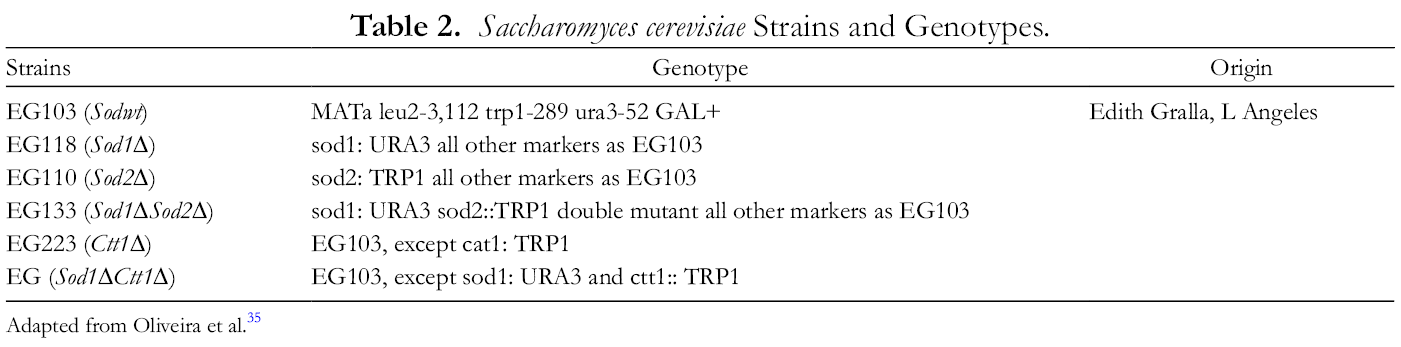
Saccharomyces cerevisiae is 1 of the major eukaryotic model organisms used in emerging studies to understand the cellular response to oxidative stress and antioxidant defense systems in natural products. 77 Six yeast strains of S. cerevisiae species proficient and mutated in their antioxidant defenses were used for this study. The EG118 line is defective in the enzymatic system involving the enzyme cytoplasmic superoxide dismutase (CuZnSOD-Sod1Δ gene product), EG110 have a mutation in the mitochondrial Sod (MnSOD-Sod2Δ gene product), EG133 is the double mutant defective for Sod1Δ and Sod2Δ, the EG223 strain is defective in the enzyme catalase (Cat1Δ), EG is the double mutant defective for Sod1Δ and Cat1Δ, and EG103 corresponds to the wild strain (Table 2). 78
Saccharomyces cerevisiae Strains and Genotypes.
Adapted from Oliveira et al. 35
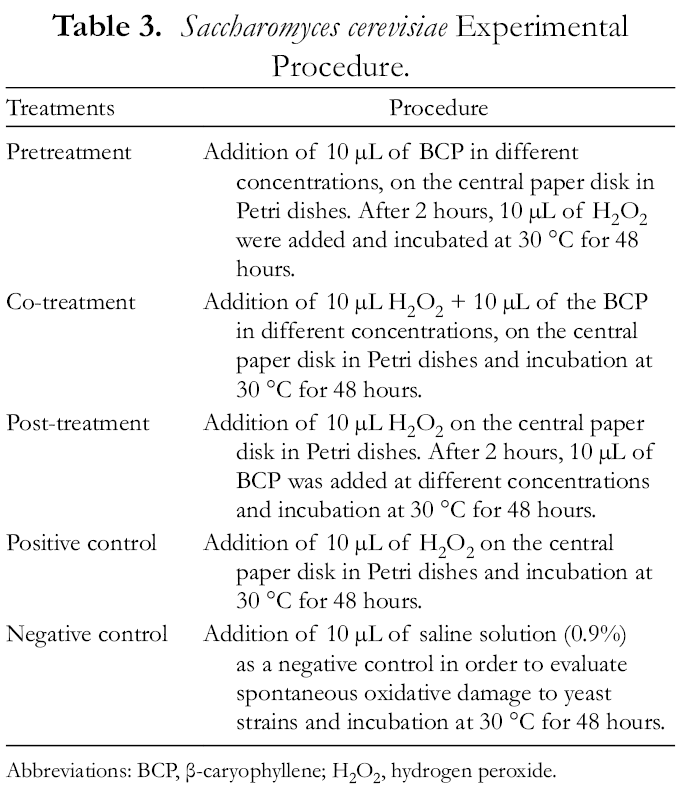
The strains were cultured in YEL medium (0.5% yeast extract, 2% bacto-peptone, 2% glucose) at 28 °C on an orbital shaker until they reached a stationary growth stage. 76 Suspension cells were seeded from the center to the margin of Petri dishes in a continuous movement on both sides of the dish containing a sterile filter paper disc in the center of the plate, in which 10 µL of the BCP concentrations (0.3, 0.7, 1.5, and 3 mM) was added. H2O2 was used as a positive control (10 mM) and the saline solution (0.9%) as a negative control. After 48 hours of incubation at 30 °C, inhibition halos (in mm) were measured from the filter paper disc margin to the yeast growth (Table 3).
Saccharomyces cerevisiae Experimental Procedure.
Abbreviations: BCP, β-caryophyllene; H2O2, hydrogen peroxide.
The percentage values of BCP-modulation on oxidative damage caused by H2O2 were calculated based on the absence of yeast growth from the central paper disc to the margin of the Petri dish (40 mm). After obtaining the oxidation values, the percentage of modulation was calculated using the following formula: % M = [PC − ([BCP + PC)]/PC × 100, where “% M” represents the percentage of BCP modulation; PC is the percentage of oxidative damage induced by H2O2. BCP + PC is the percentage of oxidative damage induced by BCP associated with H2O2.
Statistical Analysis
The results were presented as mean ± SD. The data were analyzed using ANOVA, followed by Tukey’s and Dunnett’s Bonferroni tests using GraphPad Prism (version 6.0), considering P < 0.05 with a confidence level of 95%. Pearson’s statistical correlations were made to evaluate associations of the anxiolytic effects of BCP with antioxidant activities.
Footnotes
Statement of Human and Animal Rights
All of the experimental procedures involving animals were conducted in accordance with the Guide for the Care and Use of Laboratory Animals, Eighth Edition, which was approved by the Committee of Ethics in Animal Experimentation of the Federal University of Piauí (nº 008/2015).
Declaration of Conflicting Interests
The author(s) declared no potential conflicts of interest with respect to the research, authorship, and/or publication of this article.
Funding
The author(s) disclosed receipt of the following financial support for the research, authorship, and/or publication of this article: We are grateful to the National Council for Scientific and Technological Development (CNPq) and UFPI for funding and hosting of this project, respectively.
