



Abstract
Volatiles of diethyl ether extract (DE), ethyl acetate extract (EE), and hexane extract (HE) of Artemisia scoparia Waldst. et Kit. were analyzed by gas chromatography with flame ionization detector and gas chromatography-mass spectrometry. In both DE and EE, the main compound was scoparone (24.0% and 86.1%, respectively) while in the HE, alkanes were dominant with nonacosane as the most represented (19.4%). Antimicrobial activity was tested against 4 bacterial strains and 1 fungal strain using disc-diffusion method. Tested samples were inactive against Gram-negative bacteria and they exhibited activity against Gram-positive bacteria and yeast Candida albicans. This is the first report on the chemical composition of volatile components and antimicrobial activity of DE, EE, and HE of A. scoparia Waldst. et Kit.
Genus Artemisia, commonly known as wormwood or sagebrush, is the most widely distributed genera of the tribe Anthemideae, Asteraceae family, which consists of around 800 species of herbs and shrubs. 1 They are well known for their volatile oil that is frequently used in pharmaceutical and food industry. 2 Artemisia scoparia Waldst. et Kit. (redstem wormwood) is a perennial and slightly aromatic herb which grows in the summer season, along road sides and on low hills, stony ground, waste or rural lands, from 400 to 2200 m altitude. 3 The plant is well known in traditional medicine as a febrifuge, diuretic, antispasmodic, 4 purgative, and a cure for earache, while the smoke is known to be good for burns. 5 This species also has anticholesterolemic, antibacterial, antiseptic, and cholagogue properties. 2 Moreover, infusions made from the whole plant have been traditionally used to treat jaundice and other liver disorders. 6 Hydromethanolic extract of A. scoparia possesses antinociceptive and anti-inflammatory activities. 7 Essential oil obtained from the aerial parts of this plant showed strong radical scavenging capacity and antioxidant activity against hydroxyl radical and hydrogen peroxide. 8 Furthermore, the essential oil displays strong insecticidal activity against stored-product insects. 9 Methanolic extract from aerial parts of A. scoparia showed activity toward Bacillus subtilis, Staphylococcus aureus, and Candida albicans while it was inactive against Escherichia coli and Pseudomonas aeruginosa. 10 Khan et al evaluated that A. scoparia ethyl acetate extract (EE) demonstrated significant activity against Salmonella typhimurium and S. aureus while aqueous extracts were active only toward S. typhimurium. Acetone, ethanol, and n-hexane extracts showed weak activity against P. aeruginosa. 11 The results of the antibacterial activity assays performed by Cha et al showed that the essential oil of A. scoparia exhibited moderate activities against Streptococcus pyogenes, Streptococcus sanguinis, Streptococcus sobrinus, and Streptococcus gordonii and strong activity against Fusobacterium nucleatum, Prevotella intermedia, and Porphyromonas gingivalis. 12
Geng et al examined the ethanol extract of A. scoparia and isolated 3 new glucosides: scoparamide A, 3S,8S-dihydroxydec-9-en-4,6-yne 1-O-(6′-O-caffeoyl)-β-
Тo the best of our knowledge there are no data on the chemical composition and antimicrobial activity of A. scoparia diethyl ether extract (DE), hexane extract (HE), and EE extracts. Therefore, the aim of this paper was GC/FID and GC/MS analysis of these extracts and preliminary screening of their antimicrobial activity.
Qualitative composition and relative abundance of the volatile compounds of A. scoparia DE, HE, and EE are given in Table 1. The number of identified components from DE was 96 (representing 92.0% of the total GC peak areas), among which 53 components represented less than 0.1%. For HE that number was 83 (96.3% of total), among which 46 components represented less than 0.1%, while for EE the number of identified components was 10 (89.9% of total), among which 5 components represented less than 0.1%, as shown in Table 1. In both DE and EE, the main compound was scoparone (DE 24.0%; EE 86.1%). Scoparone was previously isolated from A. scoparia 16 -21 but was also found in some other species of this genus. Among others scoparone was found in A. capillaris, 22 -24 A. annua, 25,26 and A. dracunculus. 27
Chemical Composition (%) of Artemisia scoparia Extracts.

Compounds are listed in order of elution from a HP-5MS column. RI, experimental linear retention indices relative to C8-C40 alkanes; RL, literature retention indices; t, trace amount (<0.1%); (
Other abounded components in DE were nonacosane (5.9%), stigmasterol (4.9%), and tritriacontane (3.9%), while in EE scopoletin (1.2%) and vanillin derivatives (2.6%) were above threshold. The major classes of compounds identified in DE were n-alkanes with a share of 42.1% and coumarins with a share of 24.4% of the total extract. As well as for DE, in HE the dominant class of compounds was n-alkanes with a share of 60.3% of the total HE. The most abundant component in HE was nonacosane (19.4%). Other compounds present in HE in significant amounts were hentriacontane, heptacosane, capillene, and eugenol (11.0%, 9.0%, 5.8%, and 4.8%, respectively). For EE coumarins were the predominant class of compounds with a share of 87.3% of the total extract.
There was similarity in qualitative chemical composition of DE and HE, while composition of EE is notably different which is consistent with solvent polarity. In both DE and HE, hydrocarbon sesquiterpenoids were present in more than 10 times smaller amounts than oxygenated sesquiterpenoids. In the case of EE, monoterpenoids, sesquiterpenoids, and diterpenoids were not detected at all. Percentage of sterols in DE and HE was about the same (7.5%, 8.0%, respectively), while they were absent from EE. The components present only in EE in trace amount were maltol, 1,2-benzenediol, (Z)-3-hexenyl valerate, and eugenol.
No literature data about volatiles of A. scoparia extracts are available, while there are reports about the chemical composition of essential oil of this plant. A previous analysis of the essential oil of A. scoparia showed that there are highly significant differences in chemical composition of the oil. Kapoor et al determined that the major components of A. scoparia oil from India were β-myrcene, γ-terpinene, p-cymene, and neral. 28 Hydrocarbon monoterpenoids were the predominant class of compounds. In A. scoparia volatiles from India monoterpenoids amounted to about half of the total oil content and γ-terpinene and eugenol were the most abundant constituents. 29 Kaur et al found that the major class of compounds in A. scoparia oil from India was hydrocarbon monoterpenoids, while dominant components were β-myrcene, p-cymene, and limonene. 30 Singh et al reported that the major compounds in the essential oil obtained from young leaves of A. scoparia from India were β-myrcene and p-cymene, while in oil obtained from mature leaves were p-cymene and acenaphthalene. 8 The essential oil of A. scoparia from South Korea was rich in 1,8-cineole (21.5%), camphor (11.0%), and β-caryophyllene (6.8%). 12 The dominant class of compounds was oxygenated monoterpenoids. Safaei-Ghomi et al discovered that the oil from Iran contained high level of 1-phenyl-penta-2,4-diyne (capillene), β-pinene, limonene, and (E)-β-ocimene. 31 The essential oil of A. scoparia from Tajikistan was dominated by the phenyldiacetylenes (2,4-pentadiynyl-benzene and capillene). 32 Capillene was the major component (57.2%) of the essential oil obtained from a portion of the same plant material that was used to obtain the extracts examined in this paper. 33 The compositions of essential oils and volatiles of extracts in question differ substantially in terms of major components. Namely, the main component of the oil was phenyldiacetylenes while the dominant component of DE and EE was coumarins. However, there are common monoterpenes, sesquiterpenes, and phenylpropanoids between EO, DE, and HE. Even, the content of capillene (5.8%) and capillin (4.6%) of HE is higher than the content of scoparone (1.8%).
The results of antimicrobial activity of the extracts against 4 bacteria and 1 yeast species are summarized in Table 2. Tested extracts were inactive against both Gram-negative strains, but they exhibited some activity against Gram-positive bacteria: S. aureus and B. subtilis. The antifungal activity against C. albicans of DE and EE was high, while HE exhibited low activity.
Antimicrobial Activity of Artemisia scoparia Diethyl Ether (DE), Hexane (HE), and Ethyl Acetate (EE) Extracts.
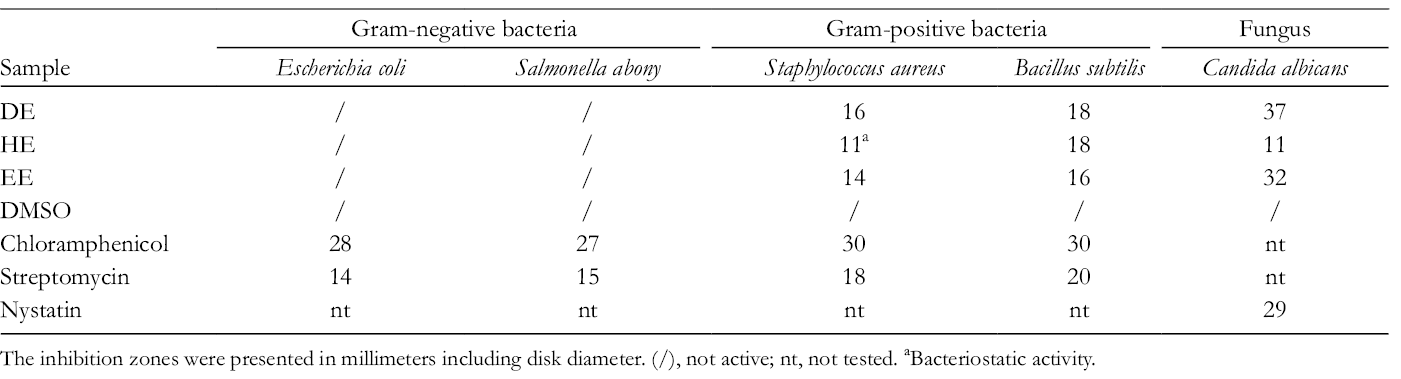
The inhibition zones were presented in millimeters including disk diameter. (/), not active; nt, not tested. aBacteriostatic activity.
Differences in extract antimicrobial activity do not follow the difference in extract scoparone content (1.8% for HE, 24.0% for DE to 86.1% for EE). Given the content of scoparone in EE extracts (86.1%), it could be expected that the activity of the EE would be similar to that of scoparone, but these results do not confirm this expectation. Namely, Yang et al found that scoparone was active against E. coli and B. subtilis and inactive against S. aureus and Aspergillus niger. 34 Devendar et al found that scoparone showed a moderate reduction in the growth of C. albicans and A. niger. 35
Based on the above, it could be concluded that the dominant group of compounds in DE and HE are alkanes while in EE coumarins are predominant, mostly scoparone. Further, only Gram-positive bacteria S. aureus and B. subtilis and yeast C. albicans were sensitive to the examined extracts. The mentioned microorganisms were most sensitive to DE.
Experimental
Plant Material and Isolation of Solvent Extracts
The aerial parts of A. scoparia were collected in Niška Banja, near Niš, Serbia, in 2017 in the full-blooming stage. A voucher specimen No. 13814 has been deposited in the Herbarium Moesiacum Niš (HMN), Department of Biology and Ecology, Faculty of Science and Mathematics, University of Niš. The plant material was dried at room temperature, milled, macerated with diethyl ether, ethyl acetate, or hexane (10 g of plant material in 100 mL of solvent) and then kept for 72 hours in the dark, at room temperature, with occasional shaking. The resulting extracts were filtered and concentrated on a rotary vacuum evaporator to dryness. Dry extracts were then diluted with the adequate solvent (DE with diethyl ether, EE with ethyl acetate, and HE with hexane) and analyzed by GC/FID and GC/MS.
GC/FID and GC/MS Analysis
The GC/MS analysis was performed using an Agilent Technologies 7890A gas chromatograph equipped with a fused silica capillary column HP-5MS (5% phenyl methyl siloxane, 250 µm × 25 m, film thickness 0.25 µm, Agilent Technologies, Santa Clara, CA, USA) and coupled with a 7000 MS/MS triple quadrupole system, operating in MS1 scan mode, of the same company. GC/MS was operated under the following conditions: injector and interface temperatures were 250°C and 300°C, respectively; oven temperature programmed from isothermal at 70°C for 2.25 minutes, then 70°C to 300°C at a heating rate of 5°C/min, and then isothermally held for 10 minutes; carrier gas was helium with a flow of 1.0 mL/min, constant flow mode, vacuum outlet (23.39 cm/s average velocity); injected volume was 5 µL of 1/100 diluted solution, split ratio 20:1. MS conditions were as follows: ionization voltage of 70 eV, acquisition mass range 35 to 500, scan time 0.32 seconds. GC/FID analysis was carried out under the same experimental conditions using the same column as described for the GC/MS. The percentage composition of the extracts (Table 1) was computed from the GC peak areas without the use of any correction factors.
Identification of Volatile Compounds
Extract constituents were identified by comparison of their linear retention indices (relative to C8-C40 alkanes on the HP-5MS column) with literature values and their MS with those from Wiley 6, NIST 11, Agilent Mass Hunter Workstation B.06.00 software by the application of the AMDIS software (Automated Mass Spectral Deconvolution and Identification System, ver. 2.1, DTRA/NIST, 2011).
Antimicrobial Activity
The antimicrobial activity of A. scoparia extracts was evaluated against 2 Gram-positive bacteria: B. subtilis (ATCC 6633) and S. aureus (ATCC 6538) and 2 Gram-negative bacteria: E. coli (ATCC 8739) and Salmonella abony (NCTC 6017). The antifungal activity was tested against C. albicans (ATCC 10231). Microbial strains belonged to the American Type Culture Collection (ATCC; Gaithersburg, MD, USA) except S. abony, belonging to National Collection of Type Cultures (NCTC, Public Health England, London, UK). A disc-diffusion method was used for the determination of the antimicrobial activity of the extracts, according to the National Committee for Clinical Laboratory Standards. 36 Inoculates of the bacterial and fungal strains were prepared from overnight broth cultures and suspensions were adjusted to 0.5 McFarland standard turbidity. A volume of 100 µL of the suspension containing 1.0 × 10⁸ CFU/mL of bacteria or 1.0 × 10⁴ CFU/mL of fungal spores was spread on Mueller-Hinton agar (Torlak, Serbia) or sabouraud dextrose agar (Torlak), respectively, in sterilized Petri dishes (90 mm in diameter) making the 4-mm thick layer. The discs (9 mm in diameter, “Antibiotica Test Blattchen”-Schleicher and Schull, Dassel, Germany) were impregnated with 30 µL of extracts solutions (concentration 50 mg/mL in DMSO) for bacterial and for fungal strains and placed on the inoculated agar. Negative controls were prepared using DMSO. The standard discs (6 mm in diameter) of chloramphenicol (30 µg, Torlak), streptomycin (10 µg, Torlak), and nystatin (30 µg, Torlak) were used as positive control. The inoculated plates were kept at 4°C for 2 hours and incubated at 37°C (24 hours) for bacterial strains and at 28°C (48 hours) for fungal strains. The antimicrobial activity was evaluated by measuring the zone (in millimeters) of inhibition against the test microorganisms using appliance “Fisher-Lilly Antibiotic Zone Reder” (Fisher Scientific Co., USA). All microorganisms were completely insusceptible to the control discs imbued with DMSO. Antimicrobial assay was performed in triplicate and the mean values are reported.
Footnotes
Acknowledgments
We are grateful to the Ministry of Education, Science and Technological Development and the Science Fund of the Republic of Serbia for scientific research support.
Declaration of Conflicting Interests
The author(s) declared no potential conflicts of interest with respect to the research, authorship, and/or publication of this article.
Funding
The author(s) received no financial support for the research, authorship, and/or publication of this article.
