



Abstract
Two new compounds, rel-(3S,4aR,10bR)-3-(4′-methoxyphenyl)-8-hydroxy-9-methoxy-4a,5,6,10b-tetrahydro-3H-naphtho[2,1-b]pyran (
The rhizomes of Musa basjoo are native to the East Asian tropics, which is mainly distributed in the south of the HuaiHe River in the QinLing Mountains in China. Previously, the isolation of triterpenes, alkaloids, polysaccharides, acenaphthenes, acenaphtylenes, phenylphenalenones, and bicyclic diarylheptanoids has been reported from phytochemical studies of this genus. 1 -4 The rhizomes of Musa basjoo have been demonstrated to exhibit diverse pharmacological activities like antibacterial, antiinflammatory, and anticancer. 5 -8 This paper describes the isolation and structural elucidation of 2 new compounds (Figure 1) from the 70% ethanol extract of the rhizomes of Musa basjoo.

The structure of compounds 1 -
Compound
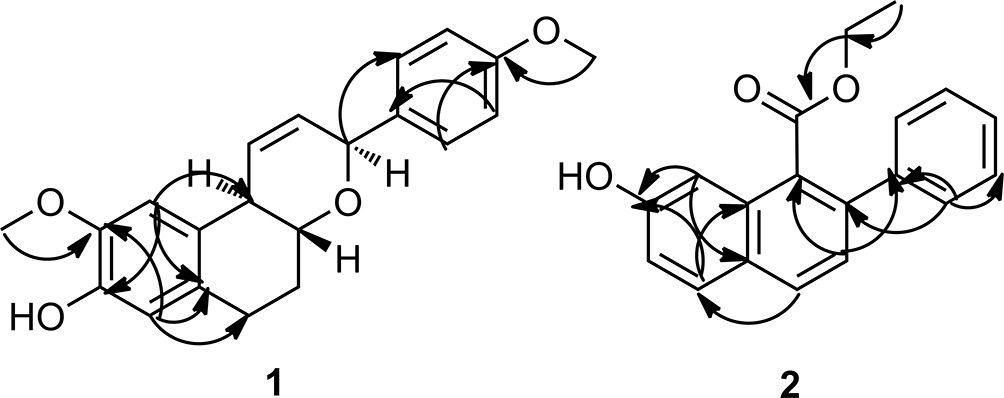
Key heteronuclear multiple bond (H→C) correlations of 1 and 2.
1H (400 MHz, CDCl3) and 13C (100 MHz, CDCl3) Nuclear Magnetic Resonance Data for 1 and 2.

Compound
Experimental
General
HR-ESI-MS was measured on a Bruker Daltonics micro TOF-Q II mass spectrometer (Bruker Daltoniks GmbH, Germany). NMR was recorded on a JEOL ECS 400 NMR spectrometer (at 400 MHz for 1H and 100 MHz for 13C) (JEOL, Japan). Column chromatography was performed with silica gel (200-300 mesh and 300-400 mesh, Qingdao Haiyang chemical co., Ltd, China), Toyopearl HW-40F (Tocho corporation, Japan), and Sephadex LH-20 (Pharmacia Biotech, Switzerland).
Plant Material
Rhizomes of Musa basjoo (16040803) were purchased from Yunnan of China in 2016, which were identified as the dried rootstock of Musaceae Musa basjoo Sied.et Zu cc. by associate professor Qing de Long from Department of Medicinal Botany and Pharmacognosy, and the specimens (No. BJ001) were preserved in the Guizhou Provincial Key Laboratory of Pharmaceutical Preparations, Guizhou Medical University.
Extraction and Isolation
The dried rhizomes of Musa basjoo (20 kg) were extracted with 70% ethanol (3 times). After evaporation of the solvent under reduced pressure, the crude extract (1129.2 g) was dissolved in water and separated through a D101 macroporous resin, following elution in proper order by water, 50% ethanol, and 95% ethanol. The 50% ethanol extract (42 g) was chromatographed on silica gel column chromatography eluted gradiently with a gradient of dichloromethane–methanol (15:1, 10:1, 8:1, 6:1, 4:1, 2:1, 1:1, v/v) to give 10 fractions (Fr.1~10). The Fr.2 (1.51 g) was subjected to silica gel column chromatography eluted with petroleum ether–chloroform (5:1 v/v) to obtain 6 subfractions (Fr.2.1~2.6). Fr.2.2 was separated by silica gel column chromatography, eluted with petroleum ether–acetone (4:1 v/v) and further purified by Sephadex LH-20 column (chloroform–methanol, 1:1) and Toyopearl HW-40F column (methanol) to give
Rel-(3S,4aR,10bR)-3-(4′-Methoxyphenyl)-8-Hydroxy-9-Methoxy-4a,5,6,10b-Tetrahydro-3H-Naphtho[2,1b]pyran (1)
White, amorphous powder.
1H and 13C NMR (CDCl3): Table 1.
HR-ESI-MS m/z: 361.1415 [M + Na]+ calculated for C21H22O4Na, 361.1410.
7-Hydroxy-2-Phenylnaphthalene-1-Carboxylic Acid Ethyl Ester (2)
Yellowish solid.
1H and 13C NMR (CDCl3): Table 1.
HR-ESI-MS m/z: 291.1053 [M-H]− calculated for C19H15O3, 291.1027.
Supplemental Material
Supplementary material - Supplemental material for Two New Compounds from Rhizomes of Musa basjoo
Supplemental material, Supplementary material, for Two New Compounds from Rhizomes of Musa basjoo by Li Jiang, Yang Wang, Min-Hui Zhu, Lin Zheng, Lin-Zhen Li, Ai-Min Wang, Chang-Hu Lin, Ting Liu and Yong-Jun Li in Natural Product Communications
Footnotes
Declaration of Conflicting Interests
The author(s) declared no potential conflicts of interest with respect to the research, authorship, and/or publication of this article.
Funding
The author(s) disclosed receipt of the following financial support for the research, authorship, and/or publication of this article: This work was supported by the National Natural Science Foundation of China (U1812403), the Central Government Guides Local Science and Technology Special Projects (No. 20184006), Science and Technology Projects of Guizhou Province (No. 20152002), Guizhou Province Project for Excellent Young Scholars (No. 201511), Science and Technology Projects of Guiyang City (No. 201505), and Innovation Talent Team Project of Guizhou Province (Nos. 20165613 and 20165677).

References
Supplementary Material
Please find the following supplemental material available below.
For Open Access articles published under a Creative Commons License, all supplemental material carries the same license as the article it is associated with.
For non-Open Access articles published, all supplemental material carries a non-exclusive license, and permission requests for re-use of supplemental material or any part of supplemental material shall be sent directly to the copyright owner as specified in the copyright notice associated with the article.
