A brief up-to-date overview on the isolation, and chemical and biological characterization of new and known alkaloids from different Amaryllidaceae species, including Brunsvigia, Crinum, Cyrtanthus, Narcissus, and Nerine genera, was reported. Furthermore, the isolation and chemical characterization of alkaloids extracted from bulbs of Narcissus tazetta subsp. tazetta L. collected from Muğla, Turkey were described.
The plants belonging to the Amaryllidaceae family are known all over the world for their use in folk medicine and as decorations in public gardens and parks due to their beautiful flowers. About 1600 species are grouped in this family and divided into about 75 genera, which are distributed throughout both tropical and subtropical regions of the world.1 The majority of these species are common to the Mediterranean basin, Andean South America, and southern Africa. The Amaryllidaceae plants are well-known producers of numerous alkaloids that are divided into 12 structural families2 with a wide range of biological effects, including antitumor, antiviral, antibacterial, antifungal, antimalarial, analgesic, and cytotoxic activities.3-6 Galanthamine is the first example of their practical application in medicine. It is a potent and selective inhibitor of the enzyme acetylcholinesterase and is used to treat the Alzheimer's disease.6
The most abundant Amaryllidaceae alkaloid is lycorine (1, Figure 1), which belongs to the pyrrolo[de]phenanthridine subgroup. Although its biological effects have been known for many years, it is still being investigated for a variety of medicinal applications, in particular as an anticancer agent showing promising activity against tumors with dismal prognoses.7,8 Its anticancer activity prompted extensive structure-activity relationship studies.9 The Amarylidaceae alkaloids belonging to the 5,10-ethanophenanthridine subgroup (crinine-type), such as haemanthamine (2, Figure 1), also exhibited potent in vitro anticancer activities, regardless of cancer cell sensitivity to the apoptotic cell death.10 Bulbispermine (3, Figure 1), a crinine-type Amaryllidaceae alkaloid, was first isolated from Zephyranthes robustus and later from Crinum bulbispermum.11 Bulbispermine was used to synthesize a small group of analogs, which were tested in vitro against a panel of cancer cell lines with various levels of resistance to apoptotic cell death. It was found that the C1,C2-dicarbamate derivative of bulbispermine exhibited notable growth inhibitory properties. Bulbispermine inhibits the proliferation of glioblastoma cells through cytostatic effects, possibly arising from rigidification of the actin cytoskeleton. These results suggested that crinine-type alkaloids have a potential to be used as drug leads for the treatment of apoptosis-resistant cancers and, in particular, glioblastoma.11 Also, the multicyclic framework of haemanthamine was transformed into a novel natural product-like skeleton12 as well as to compounds that contain the montanine ring system. These derivatives inhibited proliferation of cancer cells resistant to apoptosis at micromolar concentrations and some of them were also active against patient-derived glioblastoma cells expressing stem-cell markers.13 Furthermore, studies on haemanthamine’s mode of action involving the ribosome receptor were also recently reported.14
Amaryllidaceae alkaloids belonging to different subgroups isolated from Brunsvigia, Crinum, Cyrtanthus, Narcissus, and Nerine species.
A new alkaloid, jonquailine (4, Figure 1), belonging to the pretazettine group of Amaryllidaceae alkaloids, was isolated from dried bulbs of Narcissus jonquilla (quail) collected in Middlesex county of southeast England.15 The main alkaloids of N. jonquilla quail were galanthamine and haemanthamine.16 Jonquailine revealed significant antiproliferative effects against glioblastoma, melanoma, uterine sarcoma, and non-small-cell lung cancer cells displaying various forms of drug resistance. When used in combination with paclitaxel, jonquailine showed a synergic antiproliferative action against drug-resistant lung cancer cells.15 Jonquailine belongs to the2 benzopyrano[3,4 c]indole subgroup and it is the C-8 epimer of 8-O-methylpretazettine (7, Figure 1) isolated from Eucharis amazonica.16 Noteworthily, in this subgroup, tazettine (5, Figure 1), the most abundant alkaloid, was devoid of anticancer activity.17-19 However, a structurally related pretazettine (6, Figure 1)20 has shown promising activity in numerous models of murine cancer.21 It undergoes an easy conversion under mild basic conditions to the inactive tazettine.22,23 As recently reported, the absolute stereochemistry is important for the bioactivity of Amaryllidaceae alkaloids6 and the presence of an oxygenated chiral carbon at C-8 is crucial for anticancer activity of pretazettine and jonquailine, while tazettine lacking this stereocenter is inactive. The absolute configuration of tazettine was determined by X-ray analysis of its N-methyl iodide24 and confirmed by chemical correlation25 and its total synthesis.26,27 As mentioned above, under mild basic conditions pretazettine was converted into tazettine,21 which allowed to assign the stereochemistry at C-3, C-4a, and C-6a in pretazettine (i.e., the junction of the B, C, D tricyclic system). This was also confirmed by its total synthesis.28,29 Later, the relative and absolute stereochemistry at the junction between rings B and D, and C and D, as well as that at C-3 in jonquailne (4) and 8-O-methyl-pretazettine (7), were assigned by comparing their nuclear magnetic resonance and electronic circular dichroism (ECD) spectra with those of pretazettine (6). Finally, the R absolute configuration at C-8 of jonquailine was only recently assigned by chiroptical (optical rotatory dispersion, ECD, and vibrational circular dichroism) and computational methods and thus also the S one at C-8 of pretazettine and its 8-O-methyl analog.30
As the search for new alkaloids often leads to new bioactive natural products, a recent screening was carried out by some of the authors, on the alkaloids produced by indigenous South African Amaryllidaceae plants, which are largely unexplored. The studies, performed on Nerine sarniesis, Crinum buphanoides, Crinum graminicola, Cyrtanthus mackenii, and Brunsvigia grandiflora, led to the isolation of lycorine as one metabolite produced by all the species studied. Furthermore, 2 mesembrine-type alkaloids, named sarniensine and sarniensinol (8 and 9, Figure 1), and a new crinine-type alkaloid, named crinsarnine (10, Figure 1), were isolated together with lycorine (1), tazettine (5), bowdensine, hippadine, and 1-O-acetyl-lycorine (11, 12 and 14, Figure 1) from the dried bulbs of N. sarniensis.31,32 The alkaloids isolated were evaluated against the Aedes aegypti, which is the major vector for dengue, yellow fever, and the Zika viruses. None of the compounds showed mortality against first instar A. aegypti larvae at the concentrations tested. In adult topical bioassays, only crinsarnine (10) displayed adulticidal activity with an LD50 = 2.29 ± 0.05 mg/mosquito. As regards the structure–activity relationship, the pretazettine- and crinine-type compounds had produced different results. Among the pretazettine group compounds, opening of the B ring or the presence of a B ring lactone as well as the trans-stereochemistry of the A/B ring junction appear to be important for activity, while in crinine-type alkaloids, the substituent at C-2 seems to play a role.31,32
C. graminicola produced lycorine in the best yield (2.1 g/kg). Moreover, 1-O-acetyl-(14) and 2-O-acetyl-lycorine (15, Figure 1), pratorimine (16, Figure 1), hippadine (12), and tazettine (5) were isolated from C.buphanoide. Haemanthamine (2), haemanthidine, and criwelline (17 and 18, Figure 1) were isolated from C. graminicola, while tazettine and 11-hydroxyvittatine (19, Figure 1) were produced by C. mackenii. Finally, crinamine (20, Figure 1) and 11-hydroxyvittatine were isolated from B. grandiflora. This is the first report on the alkaloids from these 4 South African Amaryllidaceae.28
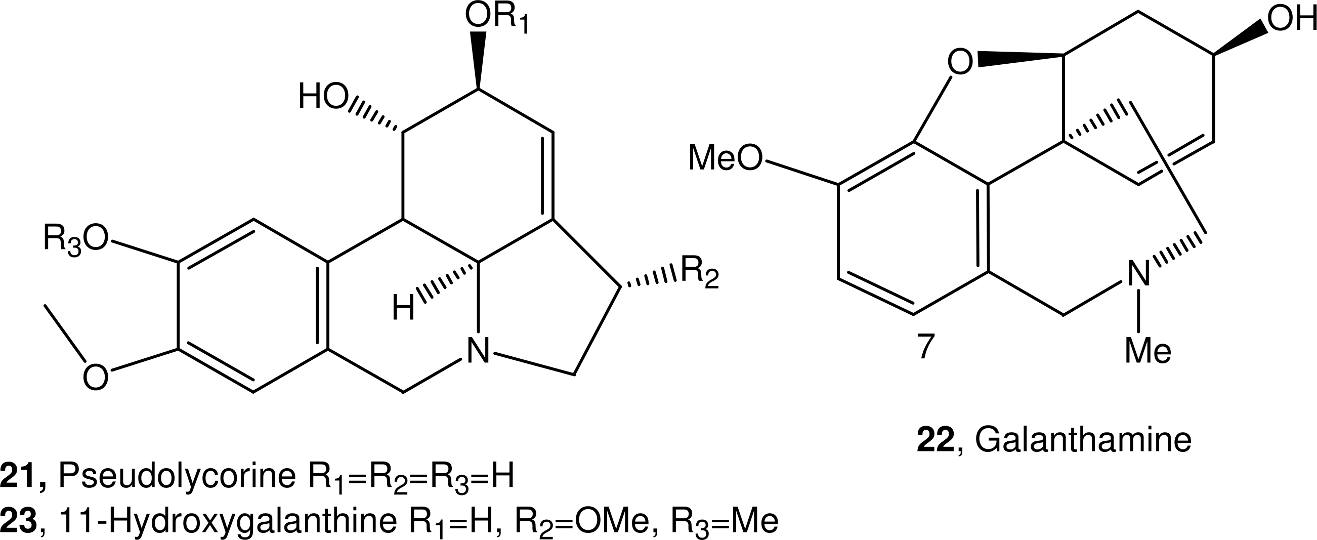
Among the Narcissus genus, Narcissus tazetta subsp. tazetta is a widely distributed bulbous plant known for its biologically active alkaloids.29 The isolation and chemical characterization of alkaloids extracted from bulbs of this Amaryllidaceae species collected from Muğla/Turkey have been reported in this article for the first time. Phytochemical studies on N. tazetta subsp. tazetta resulted in the isolation of 4 Amaryllidaceae alkaloids including lycorine (1, Figure 1), pseudolycorine, galanthamine, and 11-hydroxygalanthine (21-23, Figure 2). The isolated compounds, excluding galanthamine, belong to lycorine subgroup of the Amaryllidaceae alkaloids.33 Galanthamine is an Amaryllidaceae alkaloid with acetylcholinesterase inhibitory activity used in the treatment of mild-to-moderate Alzheimer’s disease as mentioned earlier.34 In particular, the ethanolic extract of N. tazetta subsp. tazetta L. was acidified using 2% HCl and then basified using ammonia. This aqueous solution was extracted with CHCl3 yielding 4 alkaloids, identified as lycorine, pseudolycorine, galanthamine, and 11-hydroxygalanthine, by comparing their spectroscopic and optical rotation data with those reported in the literature.35-41
Pseudolycorine, galanthamine, and 11-hydroxygalanthine isolated from Narcissus tazetta subsp. tazetta.
Previously, a limited number of alkaloids including lycorine have been isolated from a different specimen of N. tazetta subsp. tazetta L. collected from South Turkey.29 According to that report, haemanthamine, tazettine, lycorine, N-norgalanthamine, and 3-epi-hydroxybulbispermine were isolated from the subspecies growing in Antalya province, which has more humidity and higher air temperature comparing to Mugla. Additionally another isolation study was carried out on the subspecies provided from an export firm.42 Buphanisine, 9-O-demethylhomolycorine, haemanthamine, galanthamine, tazettine, and 3-epihydroxy-bulbispermine were reported from this plant. Also, previous reports point to isolation of plenty of alkaloids with various skeleton types from N. tazetta L.43,44 Apart from Turkey, alkaloidal profile of N. tazetta from different Mediterranean countries such as Egypt and Iran have been previously investigated.45-48 Lycorine, pseudolycorine, tazettine, pretazettine, galanthamine, haemanthamine, 9-O-demethyl-2-α-hydroxyhomolycorine, homo-lycorine, and ismine were isolated from the plant grown in those countries. To the best of our knowledge, this is the first report of pseudolycorine, 11-hydroxygalanthine, and galanthamine from this Amaryllidaceae subspecies naturally growing in Turkey. A report on the Amarylladaceae species growing in Turkey has been provided by Baytop and Mathew.49 In addition, to the biological activities already reported for lycorine and galanthamine, for the other 2 alkaloids isolated from N. tazetta subsp. tazetta, only for pseudolycorine (21) have been reported some interesting activities while for 11-hydroxygalanthine (23) no biological activity was described during its first isolation from Narcissus serotinus.36 In particular, 21 exhibited cytotoxic activity when tested on 5 human cancer cell lines and 1 murine mouse cancer cell together with other 22 Amaryllidaceae alkaloids belonging to different subgroups.10 Previously it was also reported that pseudolycorine inhibited protein synthesis and manifested activity against murine Rauscher leukemia virus and neurotropic RNA viruses,50 including herpes simplex virus.51
Experimental
Plant Material
The bulbs of Narcissus tazetta subsp. tazetta were collected from Akçapınar/Muğla during flowering period and voucher specimens of the plant (No:1596) have been deposited in the Herbarium of the Ege University, Faculty of Pharmacy, Department of Pharmacognosy, Izmir, Turkey.
Extraction and Isolation
The organic extract of N. tazetta subsp. tazetta L. dried bulbs was obtained following the procedure described previously.52 Briefly, fresh leaves and bulbs (~60 kg) were minced, air-dried, and pulverized. This powdered plant material (10.5 kg) was macerated with 95% EtOH for 48 hours and the solvent was evaporated in vacuo. The residue was macerated with 2% HCl (9 × 350 mL per liter) overnight at 20°C, filtered through filter paper and basified to pH 8 with NH4OH. The aqueous solution was extracted with CHCl3 (8 × 500 mL per liter ), the organic extracts were combined, dried (Na2SO4), and evaporated under vacuum to afford a crude alkaloid extract (26.45 g). The latter was fractionated by column chromatography (110 cm × 7 cm) using silica gel 60 (70-230 mesh) eluted with a gradient system of CHCl3 and MeOH (0-100% MeOH). Fractions were collected, checked by thin-layer chromatography (TLC), exposed to iodine vapor, and the homogeneous fractions were combined. The residue of fractions 51 to 53 (275.1 mg) was further purified by 2 sequential column chromatography (CC) using EtOAc:CHCl3:Me2O:MeOH:NH4OH (6:2:1.5:0.5:0.1) and EtOAc:CHCl3:MeOH:MeCN (5:2.5:2:0.5) as solvent systems, respectively, to afford an homogeneous compound, identified as galanthamine (22, 7 mg). The residue of 58 to 61 (607 mg) was purified by CC, using C6H6:CHCl3:MeOH:NH4OH (7:2:1:1) and EtOAc:CHCl3:MeOH:NH4OH (6:2:2:2) as eluent, yielding a fraction that was crystallized from Et2O. The crystallized compound was identified as lycorine (1, 38 mg). The residue of fractions 81 to 83 (618 mg) of the original column was further purified by CC, eluted with C6H6:CHCl3:MeOH:NH4OH (6.25:3:0.75:0.1), and then by preparative TLC, eluted with EtOAc:CHCl3:MeOH:NH4OH (6:2:2:2), to afford another homogeneous compound identified as 11-hydroxygalanthine (23, 10 mg). Finally, from the residue (5.36 g) of 84 to 99 a homogeneous compound (12.5 mg) was obtained by precipitation in CHCl3 and was identified as pseudolycorine (21).
Supplemental Material
Supplementary data - Supplemental material for A Brief Up-to-Date Overview of Amaryllidaceae Alkaloids: Phytochemical Studies of Narcissus tazetta subsp. tazetta L., Collected in Turkey
Supplemental material, Supplementary data, for A Brief Up-to-Date Overview of Amaryllidaceae Alkaloids: Phytochemical Studies of Narcissus tazetta subsp. tazetta L., Collected in Turkey by Çiğdem Karakoyun, Marco Masi, Alessio Cimmino, Mustafa Ali Önür, Nehir Unver Somer, Alexander Kornienko, and Antonio Evidente in Natural Product Communications
Footnotes
Acknowledgments
This study was realized within the framework of Erasmus Plus Programme. Prof. Evidente is associated with Istituto di Chimica Biomolecolare del CNR, Pozzuoli, Italy.
Declaration of Conflicting Interests
The author(s) declared no potential conflicts of interest with respect to the research, authorship, and/or publication of this article.
Funding
The author(s) disclosed receipt of the following financial support for the research, authorship, and/or publication of this article: This study was supported by the academic grant from the Department of Chemical Sciences of University of Naples Federico II.
References
1.
ChristenhuszMJM.ByngJW. The number of known plants species in the world and its annual increase. Phytotaxa. 2016;261(3):201-217.doi:10.11646/phytotaxa.261.3.1
2.
KornienkoA.EvidenteA. Chemistry, biology, and medicinal potential of narciclasine and its congeners. Chem Rev. 2008;108(6):1982-2014.doi:10.1021/cr078198u
3.
NairJJ.BastidaJ.CodinaC.ViladomatF.van StadenJ. Alkaloids of the South African Amaryllidaceae: a review. Nat Prod Commun. 2013;8(9):1335-1350.doi:10.1177/1934578X1300800938
4.
NairJJ.van StadenJ. Pharmacological and toxicological insights to the South African Amaryllidaceae. Food Chem Toxicol. 2013;62:262-275.doi:10.1016/j.fct.2013.08.042
5.
NairJJ.van StadenJ. Traditional usage, phytochemistry and pharmacology of the South African medicinal plant Boophone disticha (L.f.) herb. (Amaryllidaceae). J Ethnopharmacol. 2014;151(1):12-26.doi:10.1016/j.jep.2013.10.053
6.
CimminoA.MasiM.EvidenteM.SuperchiS.EvidenteA. Amaryllidaceae alkaloids: absolute configuration and biological activity. Chirality. 2017;29(9):486-499.doi:10.1002/chir.22719
7.
Lamoral-TheysD.AndolfiA.Van GoietsenovenGet al. Lycorine, the main phenanthridine Amaryllidaceae alkaloid, exhibits significant antitumor activity in cancer cells that display resistance to proapoptotic stimuli: an investigation of structure-activity relationship and mechanistic insight. J Med Chem. 2009;52(20):6244-6256.doi:10.1021/jm901031h
8.
Lamoral-TheysD.DecaesteckerC.MathieuVet al. Lycorine and its derivatives for anticancer drug design. Mini Rev Med Chem. 2010;10(1):41-50.doi:10.2174/138955710791112604
9.
DasariR.BanulsLMY.MasiMet al. C1,C2-ether derivatives of the Amaryllidaceae alkaloid lycorine: retention of activity of highly lipophilic analogues against cancer cells. Bioorg Med Chem Lett. 2014;24(3):923-927.doi:10.1016/j.bmcl.2013.12.073
10.
Van GoietsenovenG.AndolfiA.LallemandBet al. Amaryllidaceae alkaloids belonging to different structural subgroups display activity against apoptosis-resistant cancer cells. J Nat Prod. 2010;73(7):1223-1227.doi:10.1021/np9008255
GovindarajuK.IngelsA.HasanMNet al. Synthetic analogues of the montanine-type alkaloids with activity against apoptosis-resistant cancer cells. Bioorg Med Chem Lett. 2018;28(4):589-593.doi:10.1016/j.bmcl.2018.01.041
14.
PellegrinoS.MeyerM.ZorbasCet al. The Amaryllidaceae alkaloid haemanthamine binds the eukaryotic ribosome to repress cancer cell growth. Structure. 2018;26(3):416-425.doi:10.1016/j.str.2018.01.009
15.
MasiM.FrolovaLV.YuXet al. Jonquailine, a new pretazettine-type alkaloid isolated from Narcissus jonquilla quail, with activity against drug-resistant cancer. Fitoterapia. 2015;102:41-48.doi:10.1016/j.fitote.2015.01.009
16.
CabezasF.RamírezA.ViladomatF.CodinaC.BastidaJ. Alkaloids from Eucharis amazonica (Amaryllidaceae). Chem Pharm Bull. 2003;51(3):315-317.doi:10.1248/cpb.51.315
17.
GottiR.FioriJ.BartoliniM.CavriniV. Analysis of Amaryllidaceae alkaloids from Narcissus by GC-MS and capillary electrophoresis. J Pharm Biomed Anal. 2006;42(1):17-24.doi:10.1016/j.jpba.2006.01.003
18.
Van GoietsenovenG.HuttonJ.BeckerJ-Pet al. Targeting of eEF1A with Amaryllidaceae isocarbostyrils as a strategy to combat melanomas. FASEB J. 2010;24(11):4575-4584.doi:10.1096/fj.10-162263
19.
Van GoietsenovenG.MathieuV.LefrancF.KornienkoA.EvidenteA.KissR. Narciclasine as well as other Amaryllidaceae isocarbostyrils are promising GTP-ase targeting agents against brain cancers. Med Res Rev. 2013;33(2):439-455.doi:10.1002/med.21253
20.
WildmanWC.BaileyDT. Pretazettine. J Am Chem Soc. 1967;89(21):5514-5515.doi:10.1021/ja00997a074
21.
FurusawaE.FurusawaS. Effect of pretazettine and viva-natural, a dietary seaweed extract, on spontaneous AKR leukemia in comparison with standard drugs. Oncology. 1988;45(3):180-186.doi:10.1159/000226558
WildmanWC.BaileyDT. Amaryllidaceae interconversions. Partial syntheses of [2]benzopyrano[3,4-c]indoles. J Am Chem Soc. 1969;91(1):150-157.doi:10.1021/ja01029a030
24.
SatoT.KoyamaH. Amaryllidaceae alkaloids. Part II. crystal structure of tazettine methiodide. J Chem Soc, B: Physical Organic. 1971:1070-1073.doi:10.1039/j29710001070
25.
HighetRJ.HighetPF. The absolute configuration of tazettine. Tetrahedron Lett. 1966;7(34):4099-4101.doi:10.1016/S0040-4039(00)90294-6
26.
BaldwinSW.DebenhamJS. Total syntheses of (-)-haemanthidine, (+)-pretazettine, and (+)-tazettine. Org Lett. 2000;2(2):99-102.doi:10.1021/ol9911472
27.
NishimataT.MoriM. First asymmetric total syntheses of (+)-crinamine, (−)-haemanthidine, and (+)-pretazettine. J Org Chem. 1998;63(22):7586-7587.doi:10.1021/jo9815249
28.
MasiM.MubaiwaB.MabankTet al. Alkaloids isolated from indigenous South African Amaryllidaceae: Crinum buphanoides, Crinum graminicola, Cyrthantus mackenii and Brunsvigia grandiflora. S Afr J Bot. 2018;118:188-191.doi:10.1016/j.sajb.2018.07.021
29.
OrhanI.SenerB. Bioactivity-directed fractionation of alkaloids from some Amaryllidaceae plants and their anticholinesterase activity. Chem Nat Compd. 2003;39(4):383-386.doi:10.1023/B:CONC.0000003421.65467.9c
MasiM.CalaA.TabancaNet al. Alkaloids with activity against the Zika virus vector Aedes aegypti (L.) - Crinsarnine and sarniensinol, two new crinine and mesembrine type alkaloids isolated from the South African plant Nerine sarniensis. Molecules. 2016;21(11):1432.doi:10.3390/molecules21111432
32.
MasiM.van der WesthuyzenAE.TabancaNet al. Sarniensine, a mesembrine-type alkaloid isolated from Nerine sarniensis, an indigenous South African Amaryllidaceae, with larvicidal and adulticidal activities against Aedes aegypti. Fitoterapia. 2017;116:34-38.doi:10.1016/j.fitote.2016.11.007
33.
JinZ.ZhongJ. Amaryllidaceae and Sceletium alkaloids. Nat Prod Rep. 2016;33(11):1318-1343.doi:10.1039/c6np00068a
34.
RaskindMA.PeskindER.WesselT.YuanW;. Galantamine in AD: a 6-month randomized, placebo-controlled trial with a 6-month extension. Neurology. 2000;54(12):2261-2268.doi:10.1212/WNL.54.12.2261
35.
BastidaJ.LavillaR.ViladomatF. Chemical and biological aspects of Narcissus alkaloids. Alkaloids Chem Biol. 2006;63:87-179.
36.
PigniNB.Ríos-RuizS.Martínez-FrancésVet al. Alkaloids from Narcissus serotinus. J Nat Prod. 2012;75(9):1643-1647.doi:10.1021/np3003595
37.
LlabresJM.ViladomatF.BastidJet al. Two alkaloids from Narcissus requienii. Phytochemistry. 1986;25(6):1453-1459.doi:10.1016/S0031-9422(00)81308-4
38.
LatvalaA.OnurMA.GozlerT.LindenA.KivcakB.HesseM. Alkaloids of Galanthus elwesii. Phytochemistry. 1995;39(5):1229-1240.doi:10.1016/0031-9422(95)00187-C
FalesHM.GiuffridaLD.WildmanWC. Alkaloids of the Amaryllidaceae. VIII. The structures of narcissamine, pseudolycorine and methylpseudolycorine. J Am Chem Soc. 1956;78(16):4145-4150.doi:10.1021/ja01597a078
SenerB.KoyuncuM.BingölF.MuhtarF. Production of Bioactive Alkaloids from Turkish Geophytes. Paper presented at the International Conference on Biodiversity and Bioresources: Conservation and Utilization; 1997; Phuket, Thailand.
43.
BerkovS.Martínez-FrancésV.BastidaJ.CodinaC.RíosS. Evolution of alkaloid biosynthesis in the genus Narcissus. Phytochemistry. 2014;99:95-106.doi:10.1016/j.phytochem.2013.11.002
44.
BoitHG.DöpkeW. Alkaloide von Narcissus tazetta und N. poeticus (XIII. über Amaryllidaceen-Alkaloide). Chem Ber. 1956;89(10):2462-2465.doi:10.1002/cber.19560891042
45.
AbdallahOM. Narcisine, an alkaloid from Narcissus tazetta. Phytochemistry. 1993;34(5):1447-1448.doi:10.1016/0031-9422(91)80051-2
46.
EvidenteA.LanzettaR.AboudoniaAH.AmerME.KassemFF.HarrazFM. 9-O-Demethylhomolycorine from Egyptian Narcissus tazetta. Archiv Der Pharmazie. 1994;327:595-596.
47.
JinZ. Amaryllidaceae and Sceletium alkaloids. Nat Prod Rep. 2009;26(3):363-381.doi:10.1039/b718044f
48.
KhonakdariMR.MirjaliliMH.GholipourA.RezadoostH.FarimaniMM. Quantification of galantamine in Narcissus tazetta and Galanthus nivalis (Amaryllidaceae) populations growing wild in Iran– corrigendum. Plant Genet. Resour.. 2018;16(3):288-288.doi:10.1017/S1479262117000223
49.
BaytopT.MathewB. The Bulbous Plants of Turkey: An Illustrated Guide to the Bulbous Petaloid Monocotyledons of Turkey: Amaryllidaceae-Iridaceae-Liliaceae. First ed. London, UK: B T Batsford Ltd; 1985.
50.
GabrielsenB.MonathTP.HugginsJWet al. Antiviral (RNA) activity of selected Amaryllidaceae isoquinoline constituents and synthesis of related substances. J Nat Prod. 1992;55(11):1569-1581.doi:10.1021/np50089a003
51.
Renard-NozakiKT.KimT.ImakuraY.KiharaM.KobayashiS. Effect of alkaloids isolated from Amaryllidaceae on herpes simples virus. Res Virol. 1989;140:115-128.doi:10.1016/S0923-2516(89)80089-5
52.
UnverN. New skeletons and new concepts in Amaryllidaceae alkaloids. Phytochem Rev. 2007;6(1):125-135.doi:10.1007/s11101-006-9019-z
Supplementary Material
Please find the following supplemental material available below.
For Open Access articles published under a Creative Commons License, all supplemental material carries the same license as the article it is associated with.
For non-Open Access articles published, all supplemental material carries a non-exclusive license, and permission requests for re-use of supplemental material or any part of supplemental material shall be sent directly to the copyright owner as specified in the copyright notice associated with the article.