



Abstract
Ginseng saponins, also called ginsenosides, are the main active ingredients of Panax ginseng and Panax quinquefolius and are often used as qualitative and quantitative markers in the regulation of ginseng products. Various methods have been used to extract the major ginsenosides, such as ginsenosides Rb1, Rb2, Rc, Rd, and Rf from P. ginseng and P. quinquefolius. The objective of this paper is to review the studies regarding the influence of different extraction systems on ginsenoside amount and pattern in P. ginseng and P. quinquefolius roots. Although traditional extraction methods, Soxhlet and heat reflux extractions, have many disadvantages, including long extraction times and low extraction efficiency, they are the most widely used methods for ginseng saponin extraction. The amount and pattern of ginsenosides found in P. ginseng and P. quinquefolius roots differ depending on the method of extraction. In particular, the total ginsenoside amount and extraction efficiency can be significantly increased with the use of advanced extraction techniques that apply the conditions of high temperature and/or high pressure, such as pressurized liquid extraction, high-pressure microwave-assisted extraction, supercritical fluid extraction, and pulsed electric field extraction. Among several advanced extraction procedures, ultrahigh-pressure extraction is thought to offer the most advanced and efficient technology in that it requires only a few minutes for ginseng saponin extraction.
The herb, ginseng, has been used for medicinal purposes for over 5000 years. 1 The 2 most recognized ginseng botanicals are Panax ginseng C. A. Meyer (Araliaceae), commonly known as Asian, Chinese, or Korean ginseng, and Panax quinquefolius L., commonly known as American or North American ginseng. 2,3 The genus name Panax is derived from a Greek word “panakos,” meaning “all-healing” or “cure-all.” 4 The term “ginseng” stands for the “man-like” shape of the root and generally refers to products prepared from Panax species. 5 Dried roots of ginseng are used for their positive biological effects in the treatment of hyperglycemia, cardiovascular disease, cancer, and insomnia. 6 -8 In addition, ginseng is used as a tonic or adaptogenic that normalizes body functions, enhances physical performance, and promotes resistance against a variety of stresses. 1 -4
Ginseng contains a series of tetracyclic triterpenoid saponins (ginsenosides) as major bioactive constituents. 1,4 Ginsenosides are divided into 3 groups according to their chemical structure: the Rb group (protopanaxadiols), the Rg group (protopanaxatriols), and the Ro group (oleanolic acid). 9 The Rb group includes ginsenosides Rb1, Rb2, Rc, and Rd, whereas ginsenosides Rg1, Rg2, Re, and Rf belong to the Rg group (Figure 1). From a biological point of view, ginsenosides have been reported to exert antihypertensive, antineoplastic, and anti-atherosclerotic effects. 10 Different types and amounts of ginsenosides can be obtained by different extraction procedures, which may be used to differentiate between Panax species. 11,12 This paper reviews previous and current studies regarding the applications of diverse techniques to extract the main ginsenosides from P. ginseng and P. quinquefolius roots.

Chemical structures of common Panax ginseng and Panax quinquefolius ginsenosides.
Conventional Extraction Techniques for the Determination of Ginsenosides in Panax ginseng and Panax quinquefolius
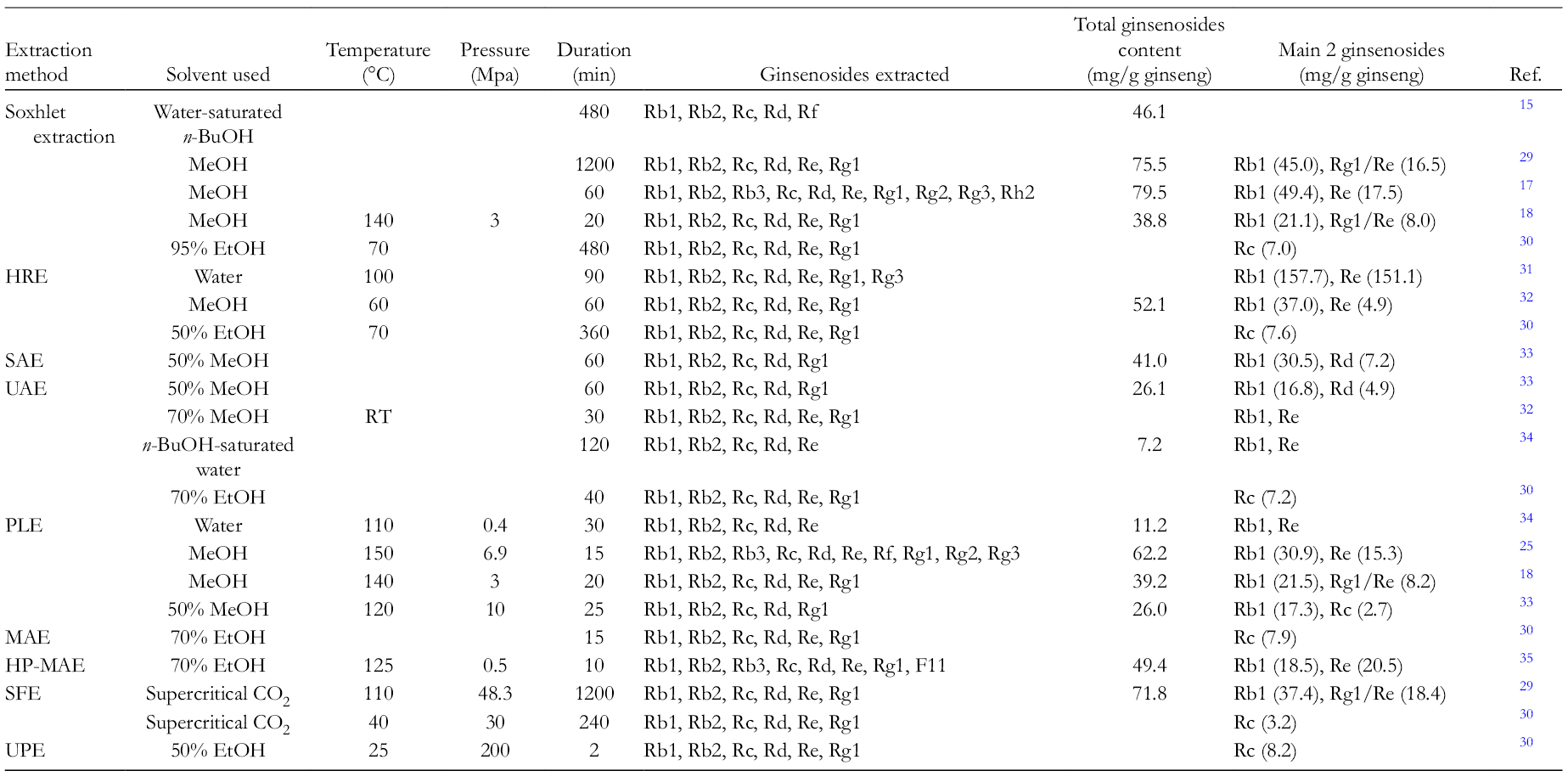
Ginseng saponins have been extracted from P. ginseng (Table 1) and P. quinquefolius (Table 2) using a variety of conventional extraction methods with different solvents. The traditional solvent techniques for the extraction and determination of ginsenosides are the Soxhlet, heat-reflux, shaking, and ultrasound-assisted methods (Figure 2). 11,12 Each extraction method has advantages and disadvantages.

Various extraction methods used to separate ginsenosides from Panax ginseng and Panax quinquefolius. Conventional extraction techniques, such as Soxhlet extraction, SAE, and UAE, have been widely used in ginseng saponin extraction, although they have the disadvantage of being both time- and solvent-consuming. Various novel techniques, including MAE, SFE, and PLE, have been developed for the extraction of ginsenosides from Korean and American ginseng in order to shorten extraction duration, decrease solvent consumption, and increase extraction yield. HRE, heat reflux extraction; MAE, microwave-assisted extraction; PLE, pressurized liquid extraction; SFE, supercritical fluid extraction; UAE, ultrasound-assisted extraction (adapted from Wang and Weller 13 ; Danlami et al 14 ).
Changes in Ginsenoside Pattern in Panax ginseng Roots Depending on the Method of Extraction.

B.P., boiling point; BuOH, butanol; CO2, carbon dioxide; EtOH, ethanol; HP-MAE, high-pressure microwave-assisted extraction;HRE, heat reflux extraction; MAE, microwave-assisted extraction; MeOH, methanol; PLE, pressurized liquid extraction; RT, room temperature; SAE, shaking-assisted extraction; SFE, supercritical fluid extraction; UAE, ultrasound-assisted extraction; UPE, ultrahigh-pressure extraction.
Effects of Different Extraction Methods on Ginsenoside Patterns in Panax quinquefolius Roots.
Soxhlet Extraction
In 1879, Franz von Soxhlet developed a new extraction system that allows the extraction of compounds from solid materials by repeated percolation with an organic solvent under reflux. 36 Soxhlet extraction became a well-known technique for extracting ginsenosides from ginseng materials, although it has the disadvantage of being both time- and solvent-consuming. 13 This method produces a wide variation in ginsenoside content of P. ginseng and P. quinquefolius depending on the solvent, extraction times, and sample preprocessing. Wu et al investigated the effect of different solvents (MeOH, water-saturated n-BuOH, and water with 10% MeOH) on ginsenoside contents of fresh P. ginseng. 15 The highest yields of individual ginsenosides (Rb1, Rb2, Rc, Rd, and Rf) were obtained with water-saturated n-BuOH. A comparison of ginsenoside contents in fresh P. ginseng was also performed by Wu et al using different extraction times with the conventional Soxhlet method. 15 The total amount of ginseng saponin increased proportionally with increasing extraction time (1, 2, and 8 hours). Differences in sample preprocessing contribute to different saponin contents between the raw and preprocessed P. quinquefolius. Wang et al compared the yields of 12 ginsenoside components (Rb1, Rb2, Rb3, Rc, Rd, Re, Rg1, Rg2, 20R-Rg2, Rg3, Rh1, and Rh2) in fresh and steamed American ginseng roots using a Soxhlet extractor. 17 After heat processing at 120°C for 1 hour, the total ginsenoside content in American ginseng obtained from fresh material (8.0%) was higher than that obtained from steamed material (5.9%). The amounts of 7 main ginsenosides (Rb1, Rb2, Rb3, Rc, Rd, Re, and Rg1) were also higher in fresh American ginseng than they were in steamed American ginseng.
Heat Reflux Extraction
Heat reflux extraction (HRE), a solid-liquid extraction, is considered to be a feasible approach for saponin extraction by using hot solvent. 37 During the heat reflux process, the extraction of ginseng saponins is performed at an elevated temperature and the solvent is recovered by evaporation.
The extraction solvent, time, and temperature are important factors in this method for the recovery of bioactive compounds from raw ginseng materials. 13 The effect of solvent, duration, and temperature of HRE on the contents of ginsenosides was investigated by Kim et al. 37 In that study, different solvents (0%, 10%, 30%, 50%, 70%, and 100% EtOH), temperatures (40°C, 60°C, and 80°C), and durations (2, 4, 6, and 8 hours) were investigated for ginseng saponin extraction. The results indicated that 70% EtOH was the optimal solvent for extraction of ginsenosides from ginseng powder. In addition, the amount of ginsenoside in the extract noticeably increased after 6 hours when the temperature was 80°C. HRE can be used for quantitative comparison of saponin contents in different parts of ginseng. The amount of ginsenosides in American ginseng roots was compared with that of leaf extracts using HRE. 31 Samples were refluxed for 1.5 hours at 100°C with water according to the hot water reflux extraction procedure. American ginseng roots extracted by the heat reflux method contained greater amounts of 7 ginsenosides (Rb1, Rb2, Rc, Rd, Re, Rg1, and Rg3) than leaf samples. In addition, ginsenoside Rh2 was detected in the leaf, but not the root, of P. quinquefolius after hot water reflux extraction.
Shaking-Assisted Extraction
In the shaking-assisted method, sample slurry in solvent is usually shaken for 24 hours at room temperature using horizontal shaking equipment. The traditional flask-shaking extraction technique has been used to extract ginsenosides from both P. ginseng and P. quinquefolius roots. 23,33 Shin et al used conventional shaking-assisted extraction (SAE) to quantify 6 ginsenosides (Rb1, Rb2, Rc, Rd, Re, and Rg1) in P. ginseng and the total ginsenoside content in the SAE extract was 9.2 mg/g ginseng. 23 In comparison with the ultrasound-assisted extraction (UAE) method, SAE allowed markedly higher extraction yields of ginsenosides. According to Ligor et al, the total amount of saponins from P. quinquefolius after SAE was 41.0 mg/g ginseng, whereas the amount of ginsenosides (Rb1, Rb2, Rc, Rd, and Rg1) obtained from UAE was 26.1 mg/g ginseng. 33
Ultrasound-Assisted Extraction
UAE is based on the mechanical action of ultrasound on the cell walls of plant materials. UAE is usually performed at a lower temperature and, therefore, may prevent the thermal degradation of unstable phytochemicals. 38 According to Wu et al, UAE can be an effective alternative to the traditional extraction methods using refluxing boiling solvents for the isolation of ginseng saponins from P. ginseng. 15 UAE produced a higher yield of individual ginsenosides (Rb1, Rb2, Rc, Rd, and Rf) than Soxhlet extraction after 2 hours of extraction. In addition, the time required for ginseng saponin extraction by UAE was 3 times less than that of the thermal extraction method.
Both extraction solvent and extraction duration are critical factors for UAE as well as HRE. Kim et al determined that the recovery of ginsenosides from P. ginseng by UAE was increased with increasing extraction time (11.2 mg/g ginseng after 30 minutes, 13.0 mg/g ginseng after 1 hour, 13.7 mg/g ginseng after 2 hours, and 14.5 mg/g after 3 hours). 37 Corbit et al and Engelberth et al determined the effects of different solvents on ginseng saponin content extracted from American ginseng using the UAE method. Corbit et al showed that sonication of American ginseng in 70% MeOH at room temperature for 30 minutes resulted in a higher concentration of ginsenosides than that obtained from 100% MeOH. 32 Engelberth et al tested the recovery of 5 ginsenosides (Rb1, Rb2, Rc, Rd, and Re) from P. quinquefolius in 3 different extraction solvents (n-BuOH-saturated water, water-saturated n-BuOH, and water only) using UAE. 34 The amount of ginsenosides recovered by the n-BuOH-saturated water UAE was higher than that of the water alone and the water-saturated n-BuOH.
Advanced Extraction Methods for the Determination of Ginsenosides in Panax ginseng and Panax quinquefolius
Extraction technologies must be relatively simple, highly selective, versatile, solvent-free, ecological, and economical. 12 Compared with conventional extraction techniques (heat, refluxing, and Soxhlet), modern ultra-pressure and ultra-temperature extraction methods are less time-consuming, require relatively less solvent, are easily automated, and are more efficient. 39 Newer extraction methods, including pressurized liquid extraction (PLE), microwave-assisted extraction (MAE), supercritical fluid extraction (SFE), and pulsed electric field extraction (PEFE) (Figure 2), have been used for the identification and quantification of ginsenosides in P. ginseng (Table 1) and P. quinquefolius (Table 2).
Pressurized Liquid Extraction
PLE, also known as accelerated solvent extraction and pressurized fluid extraction, is a static extraction method using superheated liquids at elevated pressures. It significantly improves the speed of the extraction process. 18,40 The usefulness of PLE in the quantitative analysis of diverse chemicals in plants is obvious. 40 When the extraction efficiency of PLE was compared with Soxhlet extraction, the total amount of ginsenosides (Rb1, Rb2, Rc, Rd, Re, and Rg1) in P. ginseng (17.5 mg/g ginseng) and P. quinquefolius (39.2 mg/g ginseng) obtained using PLE was higher than that obtained from Soxhlet extraction (17.2 mg/g ginseng in P. ginseng and 38.8 mg/g ginseng in P. quinquefolius). 18 Furthermore, under the same extraction conditions (solvent, MeOH; temperature, 140°C; time, 20 minutes; pressure 3 MPa), the time and volume of solvent required for PLE were lower than those for Soxhlet extraction. Taken together, the results of PLE provided comparable or higher extraction efficiency than the Soxhlet method for ginsenosides in both P. ginseng and P. quinquefolius.
Ginseng saponins extracted by PLE were quantitatively compared between P. ginseng and P. quinquefolius by Wan et al and between roots and leaves of P. ginseng by Qian et al. Compared with P. ginseng (10.0-21.1 mg/g ginseng), there was a better recovery of ginsenosides (Rb1, Rb2, Rb3, Rc, Rd, Re, Rf, Rg1, Rg2, and Rg3) from P. quinquefolius (37.7-62.2 mg/g ginseng) according to Wan et al. 25 Qian et al found that higher amounts of leaf ginsenosides corresponded to lower amounts of root ginsenosides. 24 The extraction cell, consisting of either ginseng root (2 g) or ginseng leaf (0.5 g), mixed with diatomaceous earth, was extracted under optimal PLE conditions (solvent, MeOH; temperature, 150°C; static extraction time, 15 minutes; pressure, 1500 psi). The total amount of 9 ginsenosides (Rb1, Rb2, Rb3, Rc, Rd, Re, Rf, Rg1, and Rg2) ranged from 59.1 to 111.6 mg/g ginseng in leaves and 12.7 to 18.6 mg/g ginseng in roots.
Microwave-Assisted Extraction
MAE uses extraction solvents that are transparent to microwaves compared with the materials to be extracted, thereby serving as coolants as well as solvents. 41 Compared with the conventional extraction techniques, such as Soxhlet, reflux extraction, and sonication, extraction time and solvent volume can be reduced by microwave heating in MAE. Shi et al revealed that the extraction time by MAE was shorter and the extraction yield of 7 major ginsenosides (Rg1, Re, Rb1, Rc, Rb2, Rb3, and Rd) from P. ginseng was higher compared with Soxhlet extraction. 16 Shu et al reported that microwave power and extraction time affected the extraction efficiency of ginsenosides Rb1 and Rg1 from P. ginseng. 26 The extraction yields of ginsenosides Rb1 and Rg1 significantly improved by increasing microwave power from 30 to 150 W. Furthermore, increasing the irradiation time (1-15 minutes) in MAE resulted in a higher percentage of ginsenosides Rg1 and Rb1 extracted from ginseng root. Effects of both the microwave power and the irradiation time on total saponin content in ginseng powder from MAE were also investigated by Kwon et al. 21 Similar to the result of Shu et al, the contents of the main ginsenosides (Rb1, Rb2, Rc, Rd, Re, and Rg1) in Korean ginseng increased proportionally with increasing irradiation time (20-40 seconds) and power output (75-300 W).
Recently, high-pressure microwave-assisted extraction (HPMAE) was developed for fast isolation of phytochemicals from various solid plant materials. In the closed-vessel system of HPMAE, the extraction process is accelerated with increasing temperature owing to increased pressure inside the vessel. 42 HPMAE was used to isolate ginsenosides Rg1, Re, Rb1, Rc, Rb2, and Rd from P. ginseng by Wang et al. 27 Powdered P. ginseng root was extracted under the most favorable HPMAE conditions (70% EtOH for 10 minutes at 400 kPa). The extraction yield of ginsenosides by HPMAE (43.3 ± 1.5 mg/g ginseng) was much higher than that obtained by other traditional extraction methods, including Soxhlet extraction (37.1 ± 2.0 mg/g ginseng), UAE (35.9 ± 1.6 mg/g ginseng), and HRE (37.9 ± 1.3 mg/g ginseng). Qu et al also performed HPMAE to extract 12 ginsenosides (Rb1, Rb2, Rb3, Rc, Rd, Re, Rf, Rg1, Rg2, Rh1, Rh2, and F11) from American ginseng. 35 The optimal conditions of HPMAE for ginsenoside extraction from P. quinquefolius roots consisted of a 70% EtOH-water solution, extraction pressure of 450 kPa, and extraction time of 10 minutes. Eight ginsenosides (Rb1, Rb2, Rb3, Rc, Rd, Re, Rg1, and F11) were detected in the main roots and the total amount extracted was 49.37 ± 2.79 mg/g ginseng.
Supercritical Fluid Extraction
A new method called SFE has been used to extract ginsenosides from Korean and American ginseng. 28,29,43 SFE is the process separating chemical compounds from natural sources using supercritical fluids instead of organic solvents. The main advantages of SFE over traditional extraction methods are associated with the drastic reduction in extraction time and organic solvent consumption and more selective extractions. 44 Among several supercritical fluids, supercritical carbon dioxide is an attractive solvent because it is nontoxic and nonflammable and has a relatively low critical pressure and temperature. However, supercritical carbon dioxide has disadvantages for polar natural materials with higher polarity such as saponins, flavones, and alkaloids. 45 Using supercritical carbon dioxide with small amounts of polar modifiers can overcome this disadvantage by increasing the polarity of the fluid phase during extraction. 44 The effect of modifiers on ginsenoside extraction from the roots of American ginseng using SFE was determined by Wood et al. 29 Total ginsenoside content obtained using MeOH (71.8 ± 1.8 mg/g ginseng) was higher than that obtained using DMSO (50.8 ± 2.1 mg/g ginseng). Luo et al compared ultrasound-assisted supercritical CO2 reverse microemulsion extraction (USCRME) with traditional SFE to analyze ginsenosides in P. ginseng. 28 The results indicated that the ginsenoside extraction yield using USCRME after 4 hours of extraction time was 3.2 times higher than that using SFE without ultrasound.
Pulsed Electric Field Extraction
Pulsed electric field processing utilizes a high voltage field (∼20-50 kV/cm) created across a liquid for killing microorganisms in foods. 46 The food industry is highly interested in the PEFE method as a nonthermal alternative to pasteurization. 47 In addition, PEFE is an attractive technique for extracting active components from botanical samples. In order to optimize a PEFE method for the extraction of ginsenosides from P. ginseng, Hou et al investigated various experimental conditions, including electric field intensity (12.5-20 kV/cm), pulse duration (2-6 μs), and concentration of solvent (0–70% EtOH). 22 The PEFE parameters that obtained the highest amount of ginsenoside were 20 kV/cm electric field intensity, 6 μs pulse duration, 70% EtOH, and 150 L/h velocity. Under these optimal conditions, PEFE provided a higher total quantity of ginsenoside (12.7 ± 0.1 mg/g ginseng) compared with conventional extraction methods, including HRE (7.2 ± 0.1 mg/g ginseng), UAE (6.8 ± 0.1 mg/g ginseng), and MAE (7.2 ± 0.1 mg/g ginseng).
Extraction Methods Using High Pressure for the Determination of Ginsenosides in Panax ginseng and Panax quinquefolius
Ultrahigh pressure processing, also described as high pressure, high hydrostatic pressure, and cold isostatic pressure processing, is a novel extraction method utilizing pressures above 100 MPa. 48 Ultrahigh-pressure extraction (UPE) has been widely used in food treatment and preservation as a nonthermal technique. 49 An important application of the UPE method is the extraction of phytochemicals, such as saponins 19,20,30 and polyphenols, 50 from various parts of plants at room temperature. These techniques provide the possibility of working at elevated pressures, remarkably diminishing extraction time and power consumption. 13 The higher the electric pressure used, the higher the extraction efficiency owing to an increase in solvent strength and density. 51 High-pressure extraction methods for P. ginseng and P. quinquefolius have been reported in a number of publications and most have focused on P. ginseng.
The extraction efficiency of the UPE method has been compared with various conventional extraction techniques. In a recent study, Chen et al showed that the use of UPE produced the highest ginsenoside yield (4.4%) from P. ginseng compared with other conventional extraction techniques, such as Soxhlet extraction (4.3%), UAE (3.9%), and HRE (4.3%). 19 The optimal conditions of UPE were pressure, 200 MPa; temperature, 60°C; duration, 5 minutes; and solvent, 70% EtOH. 19 Shouqin et al also found that UPE resulted in a higher ginsenoside extraction yield (7.3%) using less extraction time (2 minutes) compared with UAE (5.9% after 30 minutes) and HRE (5.8% after 4 hours) when 50% EtOH and 500 MPa pressure were used with P. ginseng. 20 The results of Zhang et al also correlated with previous studies of UPE. 30 According to Zhang et al, UPE had the highest extraction yield of ginsenoside Rc (8.2 mg/g ginseng) from P. quinquefolius roots in the shortest time (2 minutes) compared with other methods, including Soxhlet (7.0 mg/g ginseng after 8 hours), HRE (7.6 mg/g ginseng after 6 hours), UAE (7.2 mg/g ginseng after 40 minutes), MAE (7.9 mg/g ginseng after 15 minutes), and SFE (3.2 mg/g ginseng after 4 hours). 30
Direct proportional relationships between ginsenoside extraction yield and extraction parameters (solvent concentration, extraction pressure, and extraction time) were not consistently detected. Total ginsenoside contents using UPE increased with increasing pressure (878.6 ± 90.2 µg/mL at 30 MPa, 971.1 ± 70.2 at 50 MPa, and 1193.0 ± 98.9 at 80 MPa) according to Lee et al. 12 However, Shin et al found that various pressure levels (150, 300, 450, and 600 MPa) and pressing times (5, 10, and 15 minutes) did not proportionally increase the amount of ginsenoside extracted. 23 Shouqin et al also found that the ginsenoside extraction yield increased with solvent concentration and extraction pressure when EtOH concentration was in the range of 10% to 70% and pressure was 100 to 500 MPa. 20 However, when the EtOH concentration reached 90% and the pressure reached 600 MPa, the yield decreased significantly.
Conclusion
Extraction is the first essential step during the chemical analysis and purification of components from plant materials. Many techniques have been developed to extract ginsenosides, the main active components of P. ginseng and P. quinquefolius, from the roots of ginseng. This review aimed to provide detailed information on various significant differences in extraction techniques for a variety of extraction skills for raw P. ginseng and P. quinquefolius. The conventional reflux methods, including Soxhlet extraction and HRE, are the most widely used methods for ginseng saponin extraction, but were limited by long extraction periods. A method to overcome this disadvantage was the application of either ultrasound- or shaking-assisted equipment. In comparison with conventional methods, the use of modern ultra-pressure or ultra-temperature extraction methods, such as PLE, HPMAE, and UPE, usually increased the amount of total ginsenoside obtained in a shorter extraction time, resulting in higher extraction efficiency. The proper selection of extraction method and conditions are important to improve the extraction yield of particular ginsenosides from ginseng thereby increasing the effectiveness of the following experimental steps.
Footnotes
Declaration of Conflicting Interests
The author(s) declared no potential conflicts of interest with respect to the research, authorship, and/or publication of this article.
Funding
The author(s) disclosed receipt of the following financial support for the research, authorship, and/or publication of this article: This work was supported by a 2-Year Research Grant of Pusan National University.