



Abstract
Frankincense is an aromatic oleogum resin that has been traded for thousands of years for medicine and incense and is today frequently distilled into essential oils for aromatherapy and perfume. A new species of frankincense, Boswellia occulta Thulin, DeCarlo, & S.P. Johnson, was recently described from Somaliland (northern Somalia), but pure essential oils from this species have not yet been described. Samples of resin were collected directly from 12 individual B. occulta trees, hydrodistilled, and analyzed via GC-MS, GC-FID, and agglomerative hierarchical clustering. This revealed a significant level of methyl ethers in all samples (34.5%-62.6%), especially 1-methoxydecane (26.6%-47.9%) and 1-methoxyoctane (3.6%-8.6%). All samples were similar, but 3 groups were defined: (
The Boswellia genus is made up of around 20 species; however, this number is in dispute. 1 Boswellia species are well known for producing frankincense, an aromatic oleogum resin. Frankincense has been used in traditional medicine and cultural and religious ceremonies for thousands of years. More recently, essential oils derived from frankincense resins have become popular in complementary and alternative medicine and in aromatherapy and have shown notable biological activities. 1
Boswellia sacra Flueck., native to southern Oman, Yemen, Somaliland, and Somalia, yields an oleogum resin essential oil made up largely of α-pinene, α-thujene, limonene, sabinene, myrcene, β-caryophyllene, and p-cymene. 1 Although generally considered botanically synonymous, the African populations of B. sacra have often in the literature been considered a separate species, B. carteri Birdw., and essential oils from these resins are also rich in α-pinene, limonene, myrcene, α-thujene, p-cymene, and β-caryophyllene. 1 Boswellia frereana Birdw., endemic to Somalia, also yields an oleogum resin essential oil dominated by α-pinene with lesser amounts of p-cymene, α-thujene, sabinene, and β-caryophyllene. Boswellia papyrifera Hochst, which grows primarily in Ethiopia, Eritrea, and Sudan, has a very different volatile chemical profile of oleogum resin essential oil. The essential oil is composed largely of octyl acetate with smaller amounts of octanol. 1
Recently, a new species of Boswellia, B. occulta Thulin, DeCarlo & S. P. Johnson, has been described 2 and identified as the source of a methoxyalkane-rich oleogum resin essential oil which has been contaminating commercial B. carteri essential oils; as the Somali harvesters consider B. occulta and B. carteri to be the same tree, they frequently mix the resins of the 2 species. 3 Methoxyalkanes in the frankincense resin coming from Somaliland are of considerable interest to the aromatics industry, which initially suspected them to be synthetic contaminants 4 (pers. comm. with industry). Several analytical investigations have been conducted on methoxyalkane-containing resins, but all on commercial samples. 4,5 In this work, we present a characterization of pure B. occulta oleogum resin essential oils collected from individual trees located in the Sanaag region of Somaliland.
Results
The B. occulta oleogum resin essential oils from 12 different individual trees were obtained by hydrodistillation in yields of 2.68% to 5.45% (w/v) as colorless to pale yellow oils. The chemical compositions of the essential oils are compiled in Table 1. All of the essential oils were dominated by methyl ethers (34.5%-62.6%), in particular 1-methoxydecane (26.6%-47.9%) and 1-methoxyoctane (3.6%-8.6%). Other major components included the diterpene alcohol serratol (2.7%-31.8%) and the sesquiterpene alcohol 4,10-di-epi-guaiol (up to 15.1%). Monoterpene hydrocarbons and oxygenated monoterpenoids made up a very small portion of the essential oil compositions (0.3%-11.6% and 0.1%-1.0%, respectively). Sesquiterpenoids were slightly higher in concentration with 1.2% to 23.0% sesquiterpene hydrocarbons and 1.9% to 28.6% oxygenated sesquiterpenoids.
Chemical Composition of the Oleogum Resin Essential Oils of Boswellia occulta.

RI, retention index determined with respect to a homologous series of n-alkanes on a ZB-5 column.
tr, trace (<0.05%).
Ayubova et al. 4
Correct isomer not determined.
A hierarchical cluster analysis has been carried out and reveals the B. occulta essential oil chemical profiles to be very similar. There are, however, 3 clearly defined groups (Figure 1): (

Dendrogram obtained from the agglomerative hierarchical cluster analysis of 12 Boswellia occulta oleogum resin essential oil compositions collected from Somaliland.
Discussion
The chemical compositions of B. occulta oleogum resin essential oils are markedly different from those derived from other Boswellia species (Table 2). Methoxyalkanes are exceedingly rare as natural products; they have never been reported as a plant product, to our knowledge, but have been isolated from spider silk, 6,7 millipedes, 8 and potentially microbes. 9,10 Previous work confirmed that the methoxyalkanes come from the resin itself, suggesting that the tree itself is producing these compounds, a botanical first. 4,5 The methoxyalkane Boswellia was originally believed to be a chemotype of B. carteri based on oleogum resins collected from Somaliland and Puntland, 5,11 but has since been shown to be a separate species, B. occulta, based on oleogum resins collected from specific trees. 3 Boswellia carteri oleogum resin essential oils by contrast are generally rich in α-pinene, 11 –13 with 3 α-pinene-rich subgroups thus far defined: Group 1 (an α-pinene/myrcene/limonene group), Group 2 (an α-pinene/limonene group), and Group 3 (a limonene/α-pinene group). There is another distinct chemotype of B. carteri, a chemotype rich in α-thujene and p-cymene. 11,13 Very recently, Ayubova et al reported the chemical compositions of essential oils derived from oleogum resins purchased in the Sanaag region of Somaliland and reported by harvesters to be B. occulta; their compositions are qualitatively similar to the compositions of B. occulta found in this present study. 4 The oleogum resin essential oils reported by Ayubova et al showed 1-methoxydecane (23.1%-30.0%), 1-methoxyoctane (6.0%-8.2%), 4,10-di-epi-guaiol (2.5%-6.6%), and serratol as the major components. Thus, the oleogum resins obtained by this group are indeed most likely derived from B. occulta.
Comparison of the Monoterpenoid Concentrations (Average % and Range) of Boswellia carteri (From Somalia), Boswellia sacra (From Oman), and Boswellia frereana (From Somalia).
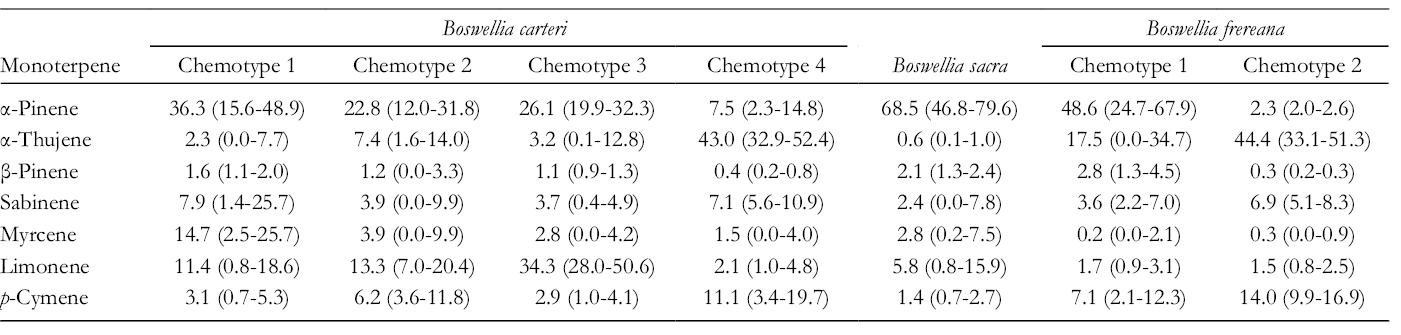
Boswellia sacra oleogum resin essential oils from Oman are dominated by α-pinene with an average content of 68.5% 14 -16 (unpublished results from our laboratories). Van Vuuren et al have reported commercial B. sacra essential oils with lower concentrations of α-pinene (18.3% and 22.5%) along with larger concentrations of limonene (13.1% and 11.2%). 13 However, these essential oils were obtained from “herbal shops or pharmacies” so the geographical origin was unknown. Furthermore, there is some debate regarding the taxonomy of B. carteri and B. sacra. Although both are generally considered by botanical taxonomists to be conspecific (B. sacra), others have considered the African populations to be B. carteri and the Arabian populations to be B. sacra. 1,11
There seem to be 2 chemotypes of B. frereana from Somaliland (unpublished results from our laboratory). One chemotype is rich in α-pinene and α-thujene, and the other chemotype is dominated by α-thujene and p-cymene. These compositions are consistent with those reported by Van Vuuren et al for commercial B. frereana essential oil. 13
Boswellia occulta oleogum resin essential oils are thus highly unique both for their unusual chemical composition and for their distinct scent profiles. Although it has thus far largely reached the market as a contaminant of B. carteri essential oils, 3 this species individually has value by enriching the range of materials used in the fragrance and complementary medicine industries.
Materials and Methods
Collection of Oleogum Resins
Oleogum resins from individual B. occulta trees were collected by Ahmed Mohamed Dhunkaal from the Sanaag region of Somaliland, near the town of Ceel Dibir, during October 2018 (summer) (Table 3 and Figure 2). The resins were sealed in plastic bags and shipped to the Aromatic Plant Research Center (Lehi, UT, USA) for analysis. The trees were photographed and a voucher specimen was collected and deposited in the University of Hargeisa Herbarium (HARG No. 000189). The voucher specimen was identified by Dr Mats Thulin and described as B. occulta. 2
Boswellia occulta Collection Sites, Sanaag Region of Somaliland, Near the Town of Ceel Dibir.


Boswellia occulta collection sites. (a) Somaliland. (b) Enlarged map showing collection sites.
Hydrodistillation of Oleogum Resins
Hydrodistillations of the oleogum resin samples of B. occulta were carried out using an all-glass Clevenger apparatus as previously described. 11
Gas Chromatography-Mass Spectrometry
The B. occulta oleogum resins were analyzed by GC-MS with a Shimadzu GCMS-QP2010 Ultra with ZB-5 capillary column as previously described. 11 Identification of the chemical components was carried out by comparison of the retention indices determined with respect to a homologous series of normal alkanes and our comparison of their mass spectra with those reported in the literature 17 and our own in-house library. 18
Gas Chromatography-Flame Ionization Detection
Quantitative analysis of the B. occulta oleogum resin essential oils by GC-FID was carried out using a Shimadzu GC 2010 equipped with flame ionization detector, a split/splitless injector, and Shimadzu autosampler AOC-20i, with a ZB-5 capillary column as previously described. 19
Footnotes
Acknowledgments

Declaration of Conflicting Interests
The author(s) declared no potential conflicts of interest with respect to the research, authorship, and/or publication of this article.
Funding
The author(s) received no financial support for the research, authorship, and/or publication of this article.