



Abstract
This method allowed for the metabolic profiling and the subsequent evaluation of the content of bioactive compounds and antioxidant activity of coffee samples, depending on the 4 species of coffee (Colombia, Guatemala, Kenya, and Vietnam) and extraction procedure (focused high ultrasound [INEFU]) and (ultrasound extraction [UE] )and (water extraction [WE]). The goal was to provide cosmeceutical activity data about the extraction yield and total polyphenol of the 4 species of coffee by optimizing the INEFU, UE, and WE conditions. Under optimal extraction conditions, which consisted of 1800W for 45 minutes (INEFU) and 500 W for 45 minutes (UE), 10.4-19.5% and 8.2-16.2% (w/w) of the highest extractions yield and total polyphenol content was obtained. For the skin whitening activity, tyrosinase inhibitory activity was observed at 65.5% in the INEFU extracts, which was 26.5% higher than that of the UE extracts (51.8%) in Vietnam coffees. To reduce melanin production in Clone M-3 cells, 88.4% melanin production was observed following the addition of control, WE relative to the control without a sample, and 85.4% and 80.5% were found in the UE and INEFU conditions. The highest total phenol secretion was conclusively obtained under the optimal conditions and resulted in a significant improvement of the coffee-based cosmeceutical ingredient.
Currently, ultrasound-assisted extraction has been applied to effectively extract natural components from different materials. 1,2 Compared with the conventional hot water extraction method, ultrasound-assisted extraction can enhance the yield, save operation time, and streamline the process. 3 With rapid industrialization, environmental pollution is destroying the ozone layer and UV light exposure is increasing. In addition, people are becoming increasingly interested in living quality life with longevity. Accordingly, the functional cosmetics market is expanding. 4 Studying the impact of coffee extracts on human health is of great interest, since coffee is one of the most commonly consumed beverages in the world. 5 The metabolome of green coffee bean is rich in compounds with well-known health-giving effects, such as chlorogenic acid, trigonelline, and choline. Chlorogenic acid is the most important class of coffee polyphenols (12% to 18% dry weight in green coffee), and can be clustered into 3 main groups: caffeoylquinic acid, with 5-O-caffeoylquinic acid being the most abundant, feruloylquinic acid, and di-caffeoylquinic acid. 6,7 Experimental and epidemiological studies have demonstrated that coffee (and some molecules contained in coffee extracts) can provide beneficial effects against several pathogens, such as neurological Parkinson’s diseases, breast cancer, colon cancer, metabolic type 2 diabetes disorders, and liver cirrhosis. 8 Recent information about coffee’s phytochemical and biological properties has progressively led to consider green coffee bean as a potential cosmeceutical ingredient, as its benefits on human skin health seem to outdo its negative effects. 9,10 Therefore, it is expected that healthy and eco-friendly products can be developed by applying natural cosmetic resources that has diverse bio-functions for the production of make-up. This study was conducted to provide relatively new cosmeceutical information about 4 green coffee beans, which has been widely used as natural active components, and to increase its applicability by optimizing the focused high ultrasound (INEFU) extraction conditions. Table 1 shows the extraction yields and phenol content of the extracts under WE, INEFU, and UE conditions. With respect to INEFU, the yield increased when the ultrasound watts treatment increased, and it was the highest at 1800 W. Therefore, it appears that a 45 minutes process time at 1800 W would be considered the most efficient extraction condition. The extract from the INEFU procedure had the highest yield ratio at 1.203- 1.352% at the UE procedure extraction.
Comparison of the Extraction Yields of the 4 Species Green Bean Coffees in Relation to the Different Extraction Processes.

A: ultrasound power (W); B: extraction time (min); C: extraction temperature (°C).
An ultrasonic wave energy of 120 kHz (1800 W) or higher could also increase the diffusion and solubility of the solvent, which resulted in an increase in the polyphenol content of the extracts. A similar UE extracts result was also reported elsewhere. 11 The amount of total polyphenols in the WE, INEFU, and UE extracts. INEFU extract showed that significantly higher phenolic content than the WE and UE extracts (Figure 1). Melanin is produced from the biosynthesis of tyrosinase in skin cells, and it improves skin resistance to ultraviolet rays, dryness, and extreme temperatures; however, too much melanin production leads to pigmentation, such as freckles and liver spots, and to skin damage. Therefore, the reduction of melanin biosynthesis by tyrosinase has been used as an indicator of the whitening activities of natural products. 12 As shown in Table 2, Vietnam from the 4 species of coffee extracts had inhibition effects of 59.5 ± 0.8% (WE), 61.8 ± 0.4% (UE), and the INEFU extract inhibited. 63.5 ± 0.8% of the tyrosinase activity. The inhibition activity increased with the increase in the concentration.
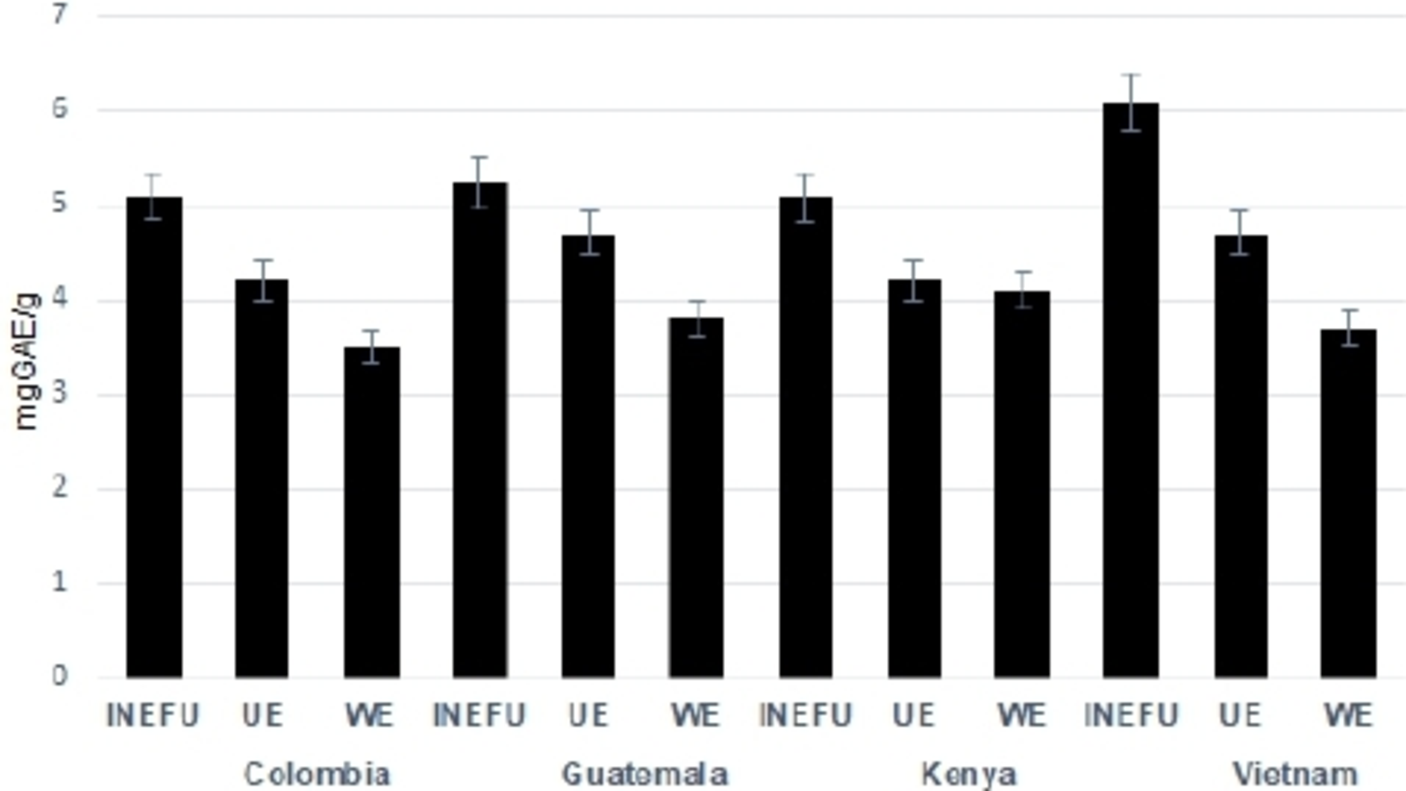
Total phenolic content of 4 species green bean coffees is means of 3 replicates ± standard deviation.
Comparison of Cosmetic Activities of the 4 Species Green Bean Coffees in Relation to the Different Extraction Processes.

aWE water extraction for 45 minutes at the 40°C with water.
bUE ultrasonication extraction for 45 minutes at 500 W at the 40°C with water.
cINEFU focused high ultrasonication extraction for 45 minutes at 1800 W at the 40°C with water.
This result also indicates that the INEFU extract has a greater whitening effect by effectively reducing tyrosinase activity. In addition to the tyrosinase inhibition activity observation, the reduction in Clone M-3 cell melanin production after sample treatment has also been employed to measure the whitening activities of natural products. 13
Therefore, to examine melanin synthesis in Clone M-3 cells, the extracts were treated for 3 days at concentrations of 0.2, 0.4, 0.6, 0.8, and 1.0 mg/mL. However, the Vietnam INEFU extract had 81.5% inhibition ratio of melanin production compared to the production of melanin without any treatment as a control relative to the 1.0 mg/mL concentrations. Vietnam extract from the INEFU has a potential whitening activity than 3 species of coffee (Colombia, Guatemala,,, and Kenya). To inhibit melanin production (Table 2), 88.4% melanin production was observed following the addition of WE relative to the control without a sample, and 85.4% and 81.5% were found in the UE and INEFU conditions, respectively. Thus, it can be concluded that the highest extraction yield from the INEFU process results in the highest cosmetic activities relative to those from other processes by eluting the highest amount of the polyphenols bioactive compound from 4 species of coffee. It appears that the treatment at INEFU, the focused high ultrasound for this INEFU process, effectively destroyed the hard cell walls, which resulted in increased solvent penetrability and the elution of its useful components. The focused 1800 W treatment, which was also determined to be the optimal focused high ultrasonic wave intensity, increased the diffusion and solubility of the solvent and accelerated the elution of useful components from green coffee beans. This study was the first report to indicate that the various cosmetic activities of 4 species of coffee relating to the extraction yield and polyphenols content can be enhanced by optimizing the extraction conditions, such as the ultrasonic wave intensity, temperature, and treatment time. A treatment employing INEFU at 1800 W for 45 minutes, produced the highest yield and polyphenol content as well as the highest whitening activity and lowest melanin production. This finding indicates that focused high ultrasounds (INEFU) effectively destroyed the tissues and cell walls of the hard-surfaced plant 4 species of coffee, which resulted in an improved elution of the active cell components. It appears that the higher ultrasounds of the INEFU process especially loosened the hard tissues that prevent the elution of active components and increased the area of contact with the solvent to accelerate active component diffusion and elution. 11 In addition, the high input energy produced by the cavitation from the ultrasonic device destroyed the inner tissues of the cells, which shortened the travel distance of the extracts, facilitated solvent diffusion, and increased solubility. The resulting cleavage of bonds between the atoms in the high molecular polymer might have contributed to the elution of substances that were not easily eluted using the existing methods. Therefore, the INEFU process can maintain the synergistic effect that improves both the extraction yield and the elution of polyphenols, which resulted in an increase of its cosmetic activities, such as whitening, and also expands the use of this natural polyphenols for multifunctional cosmetics.
Experimental
Sample Preparation
Green coffee beans were received from CAFFEMUSO, Seoul, South Korea. We analyzed coffee beans from 4 specie (Colombia, Guatemala, Kenya, and Vietnam). Each sample was analyzed in triplicate. For the WE (water extraction), INEFU (focused high ultrasound extraction) and UE(ultrasound extraction) dried and ground. green coffee bean powder was mixed with water at a ratio of 1:10. A UE extractor (Ilshin Lab, Daejeon, Korea) was used at 45 minutes at 500 W/vol. For the INEFU, 4 species were placed in a high ultrasound extractor (working volume of 1 L, Classys, Seoul, South Korea) and processed at frequencies of 1800 W/vol input energy at 45 minutes. Subsequently, all of the extracts were filtered by vacuum filtration and evaporated using a rotary evaporator (N–N series, Evela, Tokyo, Japan). The concentrates were freeze-dried and stored at −20°C before use.
Cell Lines and Culture Media
Melanin production was also tested using a mouse melanocyte, which is known as Clone M-3 (KCLB, Seoul, Korea). Melanocytes were cultured with 10% heat-inactivated fetal bovine serum (FBS) and Dulbecco's modified eagle medium (GIBCO, Grand Island, NY, USA) or RPMI 1640 (GIBCO), respectively. All other nutrients, including HEPES (4-(2-hydroxyethyl)-1-piperazineethanesulfonic acid) buffer, gentamycin sulfate and trypsin–EDTA, were purchased from Sigma (St. Louis, MO, USA) as analyzed guaranteed or reagent grade.
Measurements of Extraction Yields and Polyphenol Content From Several Extraction Processes
The phenol concentration was quantified following the method previously described. 14 In brief, the Folin Ciocalteau method was utilized to determine the content of polyphenols in the green coffee bean extracts. A test sample (50 µL) was mixed with 2 mL of 2% sodium carbonate and allowed to stand at room temperature (RT) for 2 minutes. During this time,100 μL of 50% Folin Ciocalteau reagent was added; the reaction mixture was kept undisturbed at RT for 30 minutes and readings were taken at 720 nm. Gallic acid was used as a standard for the calibration curve. The quantity of phenol present in the extract was expressed as gallic acid equivalents.
Measuring Tyrosinase Activity Inhibition
The inhibition of tyrosinase activity has been shown to indicate skin whitening effects by the dopachrome method 15 : 150 µL of mushroom tyrosinase was mixed with 225 µL of 2.5 mM L-tyrosine, 225 µL of 0.4 M HEPES buffer (pH 6.8), and 300 µL of ethanol solution or 1 mg/mL green coffee bean extracts and incubated for 15 minutes at RT. Then, the absorbance was measured at 475 nm, and the tyrosinase inhibition rates were calculated as follows:

where A is the absorbance of the sample solution after the reaction, B is the solution with the sample before the reaction, C is the solution without the sample before the reaction, and D is the solution without the sample after the reaction, and 100% inhibition means that the enzyme activities were completely inhibited after addition of the green coffee bean extract samples.
Measurement of Melanin Production in Clone M-3 Cells
The amounts of melanin produced in Clone M-3 cells were measured using the following procedures 13 : 1 × 10⁵ viable cells/well of Clone M-3 cells (KCLB 10053.1, Korean Cell Line Bank, Seoul, Korea) were inoculated into 96-well plates and then cultured in a CO2 incubator (5%, 37°C) until 80% of the cells were attached to the wells. After 24 hours, each well was treated with green coffee bean extracts at 0.2, 0.4, 0.6, 0.8, and 1.0 mg/mL or with ascorbic acid as a positive control for 24 hours. Then, the wells were washed with phosphate buffered saline and treated with trypsin–EDTA to detach and collect the cells by centrifugation at 5000 rpm for 10 minutes. The supernatant was removed, and the pellets were dried at 60°C. The melanin in the cells was obtained by placing the samples in a 60°C thermostatic bath and adding 100 µL of 1 M NaOH with 10% dimethyl sulfoxide. The melanin quantity produced by the cells was calculated by measuring the absorbance at 490 nm in a microplate reader. Then the relative concentration of melanin production from the cells was expressed as the ratio of the amounts of melanin after addition of the extract samples to the amounts without addition as a control by the following equation:

where A is the amount of melanin (μg/mL) after addition of the extract sample and B is the amount of melanin produced without addition as a control (μg/mL).
Statistical Analysis
All data were expressed as mean ± standard deviation of 3 separate experiments. Design-Expert software (8.6 Statease Inc., Minneapolis, USA) was used for the experimental design and statistical analysis. Statistical significance was set at P < 0.05.
Footnotes
Declaration of Conflicting Interests
The author(s) declared no potential conflicts of interest with respect to the research, authorship, and/or publication of this article.
Funding
The author(s) disclosed receipt of the following financial support for the research, authorship, and/or publication of this article: This work was carried out with the support of Classys INC. (Project title: Construction of high purity, concentration extracts techniques from natural materials).