



Abstract
Fatty acids (FAs), sterols, and triterpenes of dichloromethane extracts of the fruits of 8 Heracleum L. taxa (Apiaceae) from southeastern Europe were investigated by gas chromatography with flame ionization detector and gas chromatography with mass spectrometry. In order to analyze the FAs, their volatile methyl esters were obtained by saponification and subsequent esterification of oily supernatants of the fruit extracts. Dominant was petroselinic acid (42.8%-56.5%), followed by linoleic (20.3%-33.3%) and oleic acids (12.3%-13.7%). Sterols and triterpenes were analyzed as volatile derivatives obtained by the silanization of residual unsaponifiable fractions. Among them, the most abundant was β-sitosterol (44.9%-56.9%), followed by stigmasterol (15.7%-25.0%), Δ7-stigmastenol (6.6%-12.5%), and campesterol (5.2%-8.1%). The quantity of petroselinic acid was also determined by the external standard method (298.8-433.4 mg/g of oily supernatant). The obtained results show that the investigated plants are potential valuable sources of the compounds utilized in different industries.
Plants belonging to the Apiaceae family are widely distributed in temperate climate regions, and the fruits of some of these species (eg, Coriandrum L. and Carum L. spp.) are valued as sources for the extraction of many important oleochemicals, which can be used in the chemical, pharmaceutical, cosmetic, food, and other industries. 1,2 In this regard, plants from the genus Heracleum L. (cow parsnips, hogweeds) are insufficiently investigated. The previous investigations were mainly focused on the composition of their essential oils, some of which exhibited significant bioactivities (eg, antibacterial, antifungal, cytostatic, anticonvulsive, anti-inflammatory, and analgesic, in some cases comparable with or even better than the effects of the reference drugs). 3 -8
In the focus of the present study are 8 Heracleum taxa collected in southeastern Europe: Heracleum sphondylium L. (HSPH), Heracleum sibiricum L. (HSIB), Heracleum montanum Schleich. ex Gaudin (HMON), Heracleum ternatum Velen. (HTER), Heracleum pyrenaicum subsp. pollinianum (Bertol.) F.Pedrotti & Pignatti (HPOL), H. pyrenaicum subsp. orsinii (Guss.) F. Pedrotti & Pignatti (HORS), and Heracleum verticillatum Pančić (HVER), all belonging to the H. sphondylium group, 9 as well as Heracleum orphanidis Boiss. (HORP). Taxa of the H. sphondylium group can grow up to 3.5 m high, with umbels circa 20 cm wide, producing an abundance of fruits. Heracleum orphanidis has a stem up to 50 cm high and umbels circa 5 cm in diameter. 10 Recently, we reported on the furanocoumarins of crystalline precipitates from dichloromethane extracts of the fruits of these plants. 11 In this study, we investigated the fatty acids (FAs), sterols, and triterpenes of oily supernatants of these Heracleum fruit dichloromethane extracts.
Oily supernatants of dichloromethane extracts of the fruits of the investigated Heracleum taxa were subjected to saponification and subsequent esterification to obtain volatile fatty acid methyl esters (FAME). The identified FAs, including their quantities determined by the peak area normalization method, are presented in Table 1. The investigated oily supernatants had both qualitatively and quantitatively very similar FA compositions. The dominant were monounsaturated (57.8%-70.3%). Each supernatant contained significant (P < 0.05) quantities of petroselinic (42.8%-56.5%) and oleic (12.3%-13.7%) acids, as well as of polyunsaturated linoleic acid (LA) (20.3%-33.3%). The amount of petroselinic acid was also determined by the external standard method and was 348.1 ± 0.5 mg/g of HSPH, 298.8 ± 0.7 mg/g of HSIB, 340.1 ± 1.7 mg/g of HMON, 374.2 ± 10.0 mg/g of HTER, 355.4 ± 12.2 mg/g of HPOL, 375.8 ± 7.1 mg/g of HORS, 433.4 ± 1.1 mg/g of HVER, and 420.0 ± 10.6 mg/g of HORP oily supernatant. Our study is in agreement with the one of Kleiman and Spencer, 12 where petroselinic (47.4%-56.3%), linoleic (24.6%-31.7%), and oleic (12.2%-14.4%) acids were the dominant ones in the fruit fatty oils of several Heracleum taxa, including H. sphondylium, H. sibiricum, H. montanum, and H. pyrenaicum subsp. orsinii collected in either southeastern Europe or Turkey. In addition, in the present research, 12 more FAs were identified, providing a more comprehensive insight into their FA compositions. A similar qualitative and quantitative FA composition was determined of the fatty oils and/or heptane extracts of the fruits of Heracleum candicans Wall. ex DC., Heracleum lanatum Michx., Heracleuem pinnatum C.B. Clarke, Heracleuem platytaenium Boiss., Heracleuem trachyloma Fisch. & C.A. Mey., and Heracleum crenatifolium Boiss. 12,13
Fatty Acid Composition of Oily Supernatants of Dichloromethane Extracts of Investigated Heracleum Fruits (%).
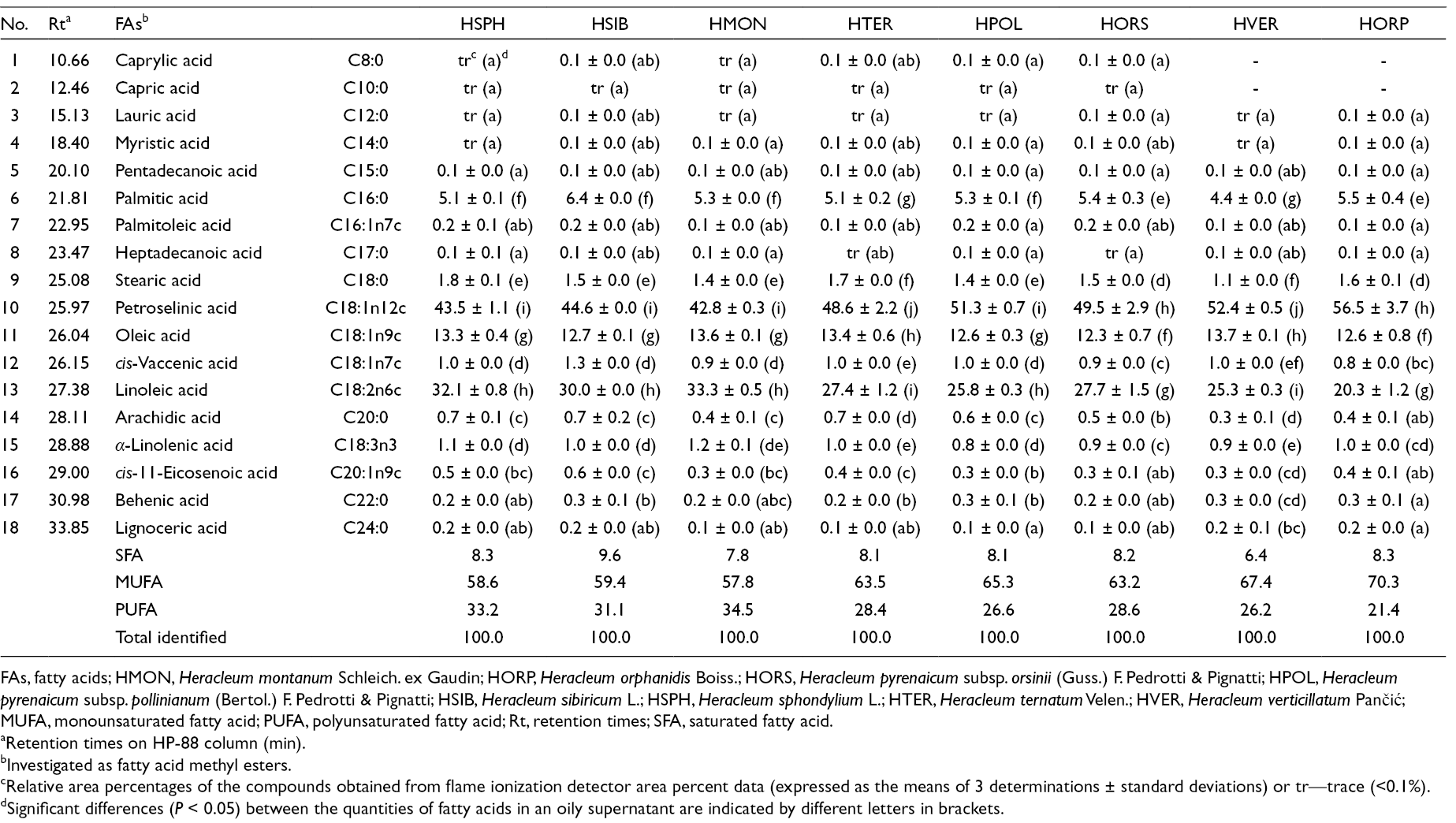
FAs, fatty acids; HMON, Heracleum montanum Schleich. ex Gaudin; HORP, Heracleum orphanidis Boiss.; HORS, Heracleum pyrenaicum subsp. orsinii (Guss.) F. Pedrotti & Pignatti; HPOL, Heracleum pyrenaicum subsp. pollinianum (Bertol.) F. Pedrotti & Pignatti; HSIB, Heracleum sibiricum L.; HSPH, Heracleum sphondylium L.; HTER, Heracleum ternatum Velen.; HVER, Heracleum verticillatum Pančić; MUFA, monounsaturated fatty acid; PUFA, polyunsaturated fatty acid; Rt, retention times; SFA, saturated fatty acid.
Retention times on HP-88 column (min).
Investigated as fatty acid methyl esters.
Relative area percentages of the compounds obtained from flame ionization detector area percent data (expressed as the means of 3 determinations ± standard deviations) or tr—trace (<0.1%).
Significant differences (P < 0.05) between the quantities of fatty acids in an oily supernatant are indicated by different letters in brackets.
The chemosystematic significance of petroselinic acid is well known. 13 Namely, it is the dominant FA in the fruits of most genera of Apiaceae. 12,13 For example, this FA was the most abundant in the total lipid extracts of the fruits of caraway, Carum carvi L. (29.46%-31.12%), 2 and coriander, Coriandrum sativum L. (76.65%). 14 Petroselinic acid is utilized in different industries. In the chemical industry, it is subjected to oxidative cleavage in order to obtain a mixture of adipic and lauric acids. Adipic acid can be used for a nylon polymer synthesis, whereas lauric acid is utilized as a raw material for softeners, emulsifiers, detergents, and soaps. 2 Petroselinic acid also synthesizes new sophorolipids, environmentally friendly biosurfacants. 15 In cosmetic formulations, this FA acts as a moisturizing and anti-aging agent, and in those containing α-hydroxy acids, it is added as a skin-irritation reducing agent. 15 -18 Petroselinic acid is also a potentially valuable raw material for the pharmaceutical and food industries. Namely, it was previously revealed that this FA possesses anti-inflammatory properties, since it inhibits the production of arachidonic acid metabolites and/or reduces the formation of intracellular adhesion molecules. 19 Additionally, the lysis of triglycerides with the incorporated petroselinic acid by pancreatic lipases occurs at much lower efficacy than the lipolysis of oleic acid rich triglycerides. Thus, it could be possibly used in low-fat diets. 15,20 Among the polyunsaturated FAs in the investigated Heracleum extracts, diunsaturated LA and triunsaturated α-linolenic acid (ALA) were identified. LA and ALA are the only known essential FAs, ie, they cannot be synthesized in the human body. Because of their effects on lipoprotein concentration, membrane fluidity, function of membrane enzymes and receptors, modulation of eicosanoid production, regulation of blood pressure, and metabolism of minerals, essential FAs have antiatherogenic and antithrombotic properties. 21
Sterols and triterpenes of the oily supernatants of the investigated Heracleum fruit dichloromethane extracts were analyzed as their volatile trimethylsilyl derivatives obtained by the silanization of unsaponifiable fractions. The proportion of total sterols and triterpenes in the unsaponifiable fraction was 73.3% ± 1.0% in HSPH, 71.9% ± 0.5% in HSIB, 65.3% ± 1.8% in HMON, 57.4% ± 0.8% in HTER, 62.5% ± 0.9% in HPOL, 62.0% ± 1.0% in HORS, 66.6% ± 1.1% in HVER, and 66.4% ± 0.7% in HORP. The investigated unsaponifiable fractions had identical qualitative and very similar quantitative sterol and triterpene compositions (Table 2). Among them, the dominant were phytosterols (87.2%-92.5%). Namely, significant (P < 0.05) quantities of β-sitosterol (44.9%-56.9%), stigmasterol (15.7%-25.0%), Δ7-stigmastenol (6.6%-12.5%), and campesterol (5.2%-8.1%) were determined. The health promoting benefits of phytosterols are well known. They can reduce the total and LDL cholesterol, decrease the risk of certain forms of cancer, and improve the treatment of prostate disorders. Furthermore, some phytosterols are important raw materials for the semisynthesis of various drugs with steroid structure. 14,22 Previously, β-sitosterol was isolated from the light-petroleum extract of H. sphondylium fruits 23 and from the ethanol extract of H. pyrenaicum Lam. aerial parts, 24 as well as from different extracts of various plant parts of some other Heracleum species, such as the petroleum fraction of the ethanol extract of H. canescens Lindl. roots. 25 On the other hand, stigmasterol was not identified in the investigated taxa previously, but was isolated from several other Heracleum species, eg, from the petroleum ether extract of H. platytaenium aerial parts. 26 The presence of other sterols, as well as the only identified triterpene, α-amyrin (0.8%-6.0%), was reported for the first time in Heracleum taxa in this work. Triterpene alcohols are regularly identified as the constituents of unsaponifiable fractions of fatty oils, and α-amyrin was previously detected, for example, in olive oil, Oleae oleum and in corn oil, Maydis oleum. 27,28
Sterol and Triterpene Composition of Unsaponifiable Fractions of Oily Supernatants of Dichloromethane Extracts of Investigated Heracleum Fruits (%).

HMON, Heracleum montanum Schleich. ex Gaudin; HORP, Heracleum orphanidis Boiss.; HORS, Hercleum pyrenaicum subsp. orsinii (Guss.) F. Pedrotti & Pignatti; HPOL, Heracleum pyrenaicum subsp. pollinianum (Bertol.) F. Pedrotti & Pignatti; HSIB, Heracleum sibiricum L.; HSPH, Heracleum sphondylium L.; HTER, Heracleum ternatum Velen.; HVER, Heracleum verticillatum Pančić; RI, retention indices; Rt, retention times.
Retention times on HP-5MS column (min).
Retention indices on HP-5MS column relative to C8-C40 n-alkanes.
Investigated as trimethylsilyl derivatives.
Relative area percentages of the compounds obtained from flame ionization detector area percent data (expressed as the means of 3 determinations ± standard deviations) or tr— trace (<0.1%).
Significant differences (P < 0.05) between the quantities of sterols/triterpene in an unsaponifiable fraction are indicated by different letters in brackets.
In this research, FAs, sterols, and triterpenes of the fruits of H. ternatum, H. pyrenaicum subsp. pollinianum, H. verticillatum, and H. orphanidis were investigated for the first time, while in the case of H. sphondylium, H. sibiricum, H. montanum, and H. pyrenaicum subsp. orsinii, the data for the composition of these metabolites were significantly complemented. Additionally, our results indicate that the fruits of the investigated 8 Heracleum taxa represent valuable natural sources for the extraction of certain oleochemicals, eg, petroselinic acid, preserving resources of other Apiaceae fruits, such as those of Carum and Coriandrum spp., for their utilization in the pharmaceutical and food industries, and for cookery.
Experimental
Chemicals
Bis-(trimethylsilyl)-trifluoroacetamide (BSTFA), cis-6-octadecenoic acid methyl ester (petroselinic acid methyl ester) (10 mg/mL in heptane), cis-11-vaccenic acid methyl ester (10 mg/mL in heptane), Supelco 37 component FAME mix (in dichloromethane), ergosterol (10 mg/mL in chloroform), and methanol (HPLC grade, ≥99.9%) were purchased from Sigma-Aldrich (St. Louis, MO, United States), β-sitosterol, stigmasterol, and dichloromethane (HPLC grade) from Carlo Erba (Val-de-Reuil, France), and a homolog series of n-alkanes (C8-C40) from Fluka (Buchs, Switzerland). All other reagents were of p.a. quality.
Plant Material
The fruits of the investigated Heracleum taxa were collected from the wild in southeastern Europe. The plants were identified by curator/botanist of the Natural History Museum (Belgrade), Dr Marjan Niketić. Voucher specimens have been deposited in the Herbarium of the Natural History Museum, Belgrade (BEO). Collection localities and dates, as well as voucher numbers, are shown in Table 3.
Collection Localities and Dates, and Voucher Numbers of Investigated Heracleum Taxa.

HMON, Heracleum montanum Schleich. ex Gaudin; HORP, Heracleum orphanidis Boiss.; HORS, Heracleum pyrenaicum subsp. orsinii (Guss.) F. Pedrotti & Pignatti; HPOL, Heracleum pyrenaicum subsp. pollinianum (Bertol.) F.Pedrotti & Pignatti; HSIB, Heracleum sibiricum L.; HSPH, Heracleum sphondylium L.; HTER, Heracleum ternatum Velen.; HVER, Heracleum verticillatum Pančić.
Extraction and Sample Preparation
The fruits were air-dried, powdered, and extracted twice with dichloromethane at room temperature (maceration for 3 and 2 days, drug/solvent 1:10 w/v). The solvent was evaporated under reduced pressure, and after standing at 4°C for 24 hours, the extracts were filtered to separate oily supernatants from furanocoumarin-rich crystalline precipitates (this procedure was repeated twice). Saponification of the oily supernatants (1 g) was achieved by 50% potassium hydroxide (5 mL)/ethanol (30 mL) at 90°C for 60 minutes. Unsaponifiable residues were removed using light petroleum, and the soap-rich polar fractions were treated with hydrochloric acid to obtain free FAs, which were then collected using diethyl ether. After evaporation of the solvent, FAs were esterified by 98% sulfuric acid (1 mL)/methanol (150 mL, purity ≥99.9%) at 80°C for 60 minutes to obtain volatile FAME, which were collected using light petroleum. In order to analyze sterols and triterpenes, residual unsaponifiable fractions (500 µL of 10 mg/ml solution in dichloromethane) were treated with BSTFA (50 µL) and held at 60°C for 45 minutes to obtain volatile trimethylsilyl derivatives. The samples were analyzed within 6 hours after derivatization. The content of oily supernatants in the fruits of the investigated Heracleum taxa, as well as of FAME and unsaponifiable fractions in the oily supernatants, is presented in Table 4.
The Content of Oily Supernatants in the Fruits of Investigated Heracleum Taxa, as well as of Fatty Acid Methyl Ester and Unsaponifiable Fractions in the Oily Supernatants, % (w/w).

HMON, Heracleum montanum Schleich. ex Gaudin; HORP, Heracleum orphanidis Boiss.; HORS, Heracleum pyrenaicum subsp. orsinii (Guss.) F. Pedrotti & Pignatti; HPOL, Heracleum pyrenaicum subsp. pollinianum (Bertol.) F.Pedrotti & Pignatti; HSIB, Heracleum sibiricum L.; HSPH, Heracleum sphondylium L.; HTER, Heracleum ternatum Velen.; HVER, Heracleum verticillatum Pančić.
Gas Chromatography with Flame Ionization Detector and Gas Chromatography with Mass Spectrometry Analysis
The analysis of FAME was performed on an Agilent 6890N Gas chromatograph (GC, Agilent Technologies, Palo Alto, CA, United States) equipped with a split/splitless injector (260°C), a flame ionization detector (FID), and a capillary column (Agilent J&W HP-88, 100 m × 0.25 mm, 0.20 µm film thickness), and coupled with an Agilent 5975C mass selective detector (MSD) operating in the electron ionization (EI) mode at 70 eV. The carrier gas was He at a flow rate of 1.2 mL/min. The oven temperature was initially held at 140°C for 5 minutes, then increased linearly from 140 to 240°C at 4°C/min, and finally held at 240°C for 10 minutes. The FID and MSD transfer line temperatures were 260°C and 250°C, respectively. The split ratio was 1:25 and the injected volume 1 µL of 1% solution of FAME in dichloromethane. The identification of the FAME was based on the comparison of their retention times (Rt) and mass spectra with those of representative standards ran under the same chromatographic conditions, ie, Supelco 37 Component FAME Mix, petroselinic acid methyl ester, and cis-11-vaccenic acid methyl ester. Relative percentages of the compounds were calculated based on the peak areas from the FID data. Additionally, the quantity of the most abundant FA, petroselinic acid, was determined by the external standard method, ie, by the construction of a calibration curve of petroselinic acid methyl ester (concentration range 0.08-10.00 mg/mL; y = 15 288 881 008.70x + 736 572.53; r 2 = 0.9990). Gas chromatography with flame ionization detector (GC-FID) and gas chromatography with mass spectrometry (GC-MS) analysis of the unsaponifiable fractions was performed on an Agilent 7890A GC equipped with 5975C (inert XL EI/CI) MSD and a FID detector connected by a capillary flow technology two-way splitter with make-up (250 °C). A HP-5MS capillary column (Agilent, 30 m × 0.25 mm, 0.25 μm film thickness) was used. The temperature of the GC oven was programmed from 60°C to 315°C at 3°C/min and held at 315°C for 15 minutes. He was used as carrier gas at 1.3 mL/min. The split ratio was 1:10 and the injection volume was 1 µL of a previously prepared solution of trimethylsilyl derivatives. The FID and MSD transfer line temperatures were 300°C and 315°C, respectively. The MS data were acquired in EI mode at 70 eV. The identification of the compounds was based on the comparison of their retention indices (RI), Rt, and mass spectra with those of commercially available standards (β-sitosterol, stigmasterol, and ergosterol), as well as to NIST/NBS 05, Wiley libraries 8th edition and NIST Chemistry WebBook. 29 The linear RIs were determined in relation to a homolog series of n-alkanes (C8-C40) run under the same operating conditions. Relative percentages of the compounds were calculated based on the peak areas from the FID data.
Statistical Analysis
Determinations were carried out in triplicate. The results are expressed as mean values ± standard deviation and analyzed by one-way analysis of variance, followed by Tukey’s post hoc test. Values of P below 0.05 were considered to indicate significant differences. The analysis was carried out by Statistical Package for the Social Sciences (SPSS) version 23.0.
Footnotes
The author(s) declared no potential conflicts of interest with respect to the research, authorship, and/or publication of this article.
Declaration of Conflicting Interests
The author(s) declared no potential conflicts of interest with respect to the research, authorship, and/or publication of this article.
Funding
The author(s) disclosed receipt of the following financial support for the research, authorship, and/or publication of this article: This work was supported by the Ministry of Education, Science, and Technological Development of the Republic of Serbia (Grant nos. 173021 and 172053).