Isodesmosine is a pyridinium amino acid that contributes to elastin’s crosslinking structure. It is known to form by condensation and aromatization of 3 allysines and 1 lysine, preceded by previous formation of allysine residues from lysine through enzymatic oxidation. In this work, utilizing Pr(OTf)3-promoted Chichibabin pyridinium synthesis, 4 types of protected 13C-labeled isodesmosines were prepared from different amounts of protected 13C-labeled and nonlabeled aldehydes, together with protected lysine hydrochlorides. Comparisons of peak intensities of 13C nuclear magnetic resonance of the obtained isodesmosine-13Cn suggested that the formation of crosslinkers occurs instantaneously in one of the proposed mechanistic pathways, or via an entirely different route.
Elastin crosslinkers isodesmosine (1, Figure 1) and desmosine (2) are unusual amino acids, featuring, respectively, 1,2,3,5- and 1,3,4,5-tetrasubstituted pyridinium cores.1,2 Elastin is the main component of the elastic fibers, which contribute to the elasticity in organs such as skin, blood vessels, lungs, and heart.3,4 Although this extracellular matrix protein is highly insoluble, it consists of soluble tropoelastin precursor. This monomer protein is connected 3-dimensionally to form fully functional elastin through the crosslinkers 1 and 2,3-5 which are biosynthetically created by condensations of 1 lysine and 3 allysines that arise from lysine by enzyme lysyl oxidase.6,7
Structures of isodesmosine (1) and desmosine (2).
Elastin degradation occurs in several prevalent diseases including chronic obstructive pulmonary disease (COPD)8,9 and has been associated with increased metabolites of peptides containing desmosines 1 and 2 in clinical samples, which can be identified by liquid chromatography tandem mass spectrometry (LC-MS/MS).10,11 Consequently, amino acids 1 and 2 have been considered as useful biomarkers for both the rapid diagnosis of COPD and drug discovery. To achieve the precise LC-MS/MS analysis of 1 and 2, [13C3,15N1]-labeled isodesmosine (3, Figure 2) was previously designed as one of the candidates of internal standard for isotope-dilution method and successfully prepared in our laboratory.12 The compound 3 has a gap of m/z 4 with natural 1 and 2 so that peak area of 3 enables utilization of this compound as a standard to conduct the quantitation of 1 and 2 in clinical samples.
Structure of isodesmosine-13C3,15N1 (3).
The synthesis of 3 relied on the biomimetic Chichibabin pyridinium synthesis using 50 mol% praseodymium trifluoromethanesulfonate [Pr(OTf)3] in H2O, starting from 13C-labeled allysine and 15N-labeled lysine hydrochloride.12 As a result, 3 13C atoms were incorporated into C2, C4, and C6 positions of the pyridinium ring. Although the reaction mechanism of formation of the pyridinium scaffold in this key reaction was previously proposed by several research groups,6,7 the detailed explanation and elucidation have not been achieved to full extent. In this work, the Pr(OTf)3-promoted Chichibabin pyridinium synthesis was carried out in several conditions utilizing different ratios of non- and 13C-labeled allysine aldehydes and nonlabeled lysine hydrochloride. Comparison of peak intensities of 13C nuclear magnetic resonance (NMR) given by obtained products was expected to lead to the new insight of isodesmosine’s formation mechanism through the incorporation of 13C into the C2, C4, and C6 positions on the pyridinium ring.
We commenced with the preparation of allysine derivative 4 starting from commercially available t-butyloxycarbonyl-L-glutamic acid γ-benzyl ester (N-Boc-Glu-OBn, 5) according to our previous report, with slight modification of the tert-butylation and hydroboration-oxidation reactions (Scheme 1).13 Previously, carboxylic acid 5 was protected with tert-butyl group using di-tert-butyl carbonate ((Boc)2O) and N,N-dimethyl-4-aminopyridine to give 6 in 75% yield.13 In this work, treatment of 5 with t-butyl-2,2,2-trichloroacetoimidate afforded 6 in 94%, which was a much better result than previous conditions. Hydroboration-oxidation of terminal olefin 7, which was converted from 6 in 3 steps,13 was previously conducted using NaBH4 in the presence of BF3· OEt2 to obtain the desired primary alcohol 8 in 82% yield along with a small amount of secondary alcohol. When 9-borabicyclo[3.3.1]nonane was used for hydroboration, only 8 was obtained in 95% yield. Dess-Martin periodinane oxidation of alcohol 8 gave the target aldehyde 4 in 93% yield. The preparation of protected 13C-labeled allysine aldehyde 912 and protected lysine hydrochloride 10 was conducted according to literature procedures.13
Preparation of allysine derivative 4.
Pr(OTf)3-protmoted Chichibabin pyridinium synthesis13-18 was then carried out to obtain the 13Cn-labeled isodesmosines with protecting groups on amino acids as shown in Scheme 2. Four equivalents of 4/9 (with different ratios) and 1 equivalent of 10 were used in this reaction under the conditions of 50 mol% Pr(OTf)3 in H2O at room temperature for 24 hours. Four types of protected 13Cn-labeled (0 ≦ n≦ 3) isodesmosines were successfully prepared with 4:0, 3:1, 2:2, and 1:3 ratios of 9/4 and 10, in 5% to 21% yield.
Chichibabin pyridinium synthesis of 4, 9, and 10 to afford protected 4 types of isodesmosine-13Cn. Ratio of 9 and 4 was 4:0, 3:1, 2:2, and 1:3.
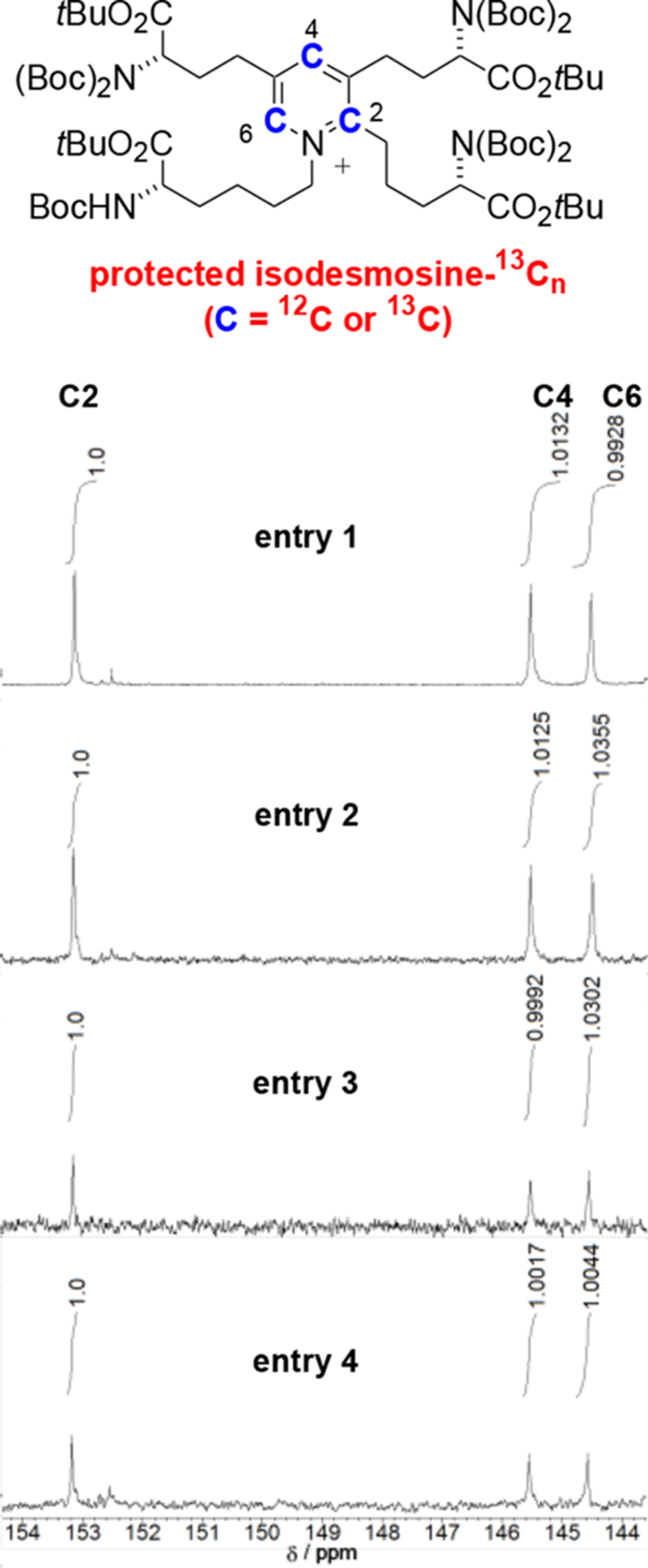
13C NMR (125 MHz) experiments were then conducted on 4 types of protected 13Cn-labeled (0 ≦ n≦ 3) isodesmosines (Table 1). Ratios of intensities of C4 and C6 against C2 (standardized as 1) were estimated to be 1.01332 (C4/C2) and 0.9928 (C6/C2) for 4:0 ratio of 4/9 (entry 1), 1.0125 (C4/C2) and 1.0355 (C6/C2) for 3:1 ratio of 4/9 (entry 2), 0.9992 (C4/C2) and 1.0302 (C6/C2) for 2:2 ratio of 4/9 (entry 3), and 1.0017 (C4/C2) and 1.0044 (C6/C2) for 1:3 ratio for 4/9 (entry 4), respectively. The obtained values are approximately the same, which means that there are no significant differences of composition of 13C atom on C2, C4, and C6. The results show that 13C was equally incorporated into C2, C4, and C6 on pyridinium ring without preference, indicating that isotope effect in the formation reaction of pyridinium was not observed. Conversely, isotope effect could be seen if the formation of the pyridinium proceeded stepwise, as theory suggests.19
13C Nuclear Magnetic Resonance Spectra of Protected 13Cn-Labeled (0 ≦ n≦ 3) Isodesmosines and Comparison of Each Peak Intensities.20
Entry
Ratio (9:4)
Intensity (C4/C2)
Intensity (C6/C2)
1
4:0
1.0132
0.9928
2
3:1
1.0125
1.0355
3
2:2
0.9992
1.0302
4
1:3
1.0017
1.0044
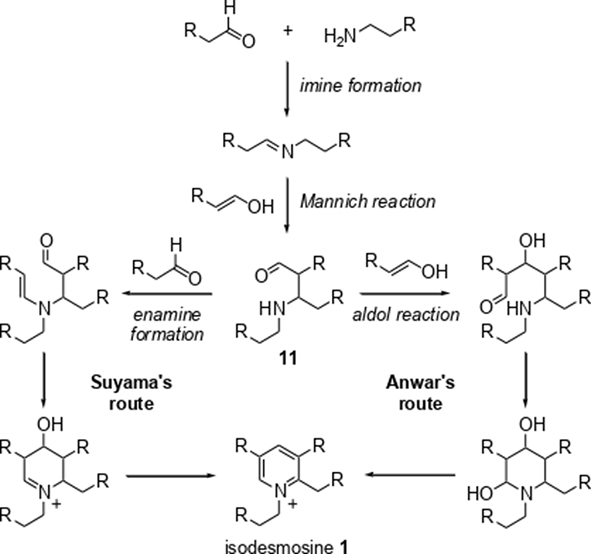
Although several reaction pathways can be considered, the most plausible mechanism of formation of elastin crosslinkers was proposed by Suyama and Anwar6,7 based on experimental results; imine formation occurs first, followed by Mannich reaction with allysine enol to afford intermediate aldehyde 11 (Scheme 3). In Suyama’s route,711 reacts with allysine to form enamine, which undergoes cyclization, dehydrolysis, and aromatization to produce isodesmosine 1. In Anwar’s route,611 reacts with allysine enol via aldol reaction, followed by cyclization, dehydrolysis, and aromatization to give 1. In both routes, core skeleton pyridinium is considered to form in the order of C2, C4, and C6 in stepwise fashion, in which distribution of 13C would have been observed due to the isotope effects. However, the obtained results in this study indicate that 13C was incorporated into C2, C4, and C6 equally despite changes in ratio of substrates allysine 4 and 13C-labeled allysine 9. This suggests a probability that formation of pyridinium elastin crosslinker occurs instantaneously in one of the previously proposed mechanistic pathways, or via entirely different routes.
Proposed formation mechanisms of elastincrosslinker isodesmosine by Suyama7 and Anwar.6
In summary, synthesis of allysine derivative 4 was accomplished with small improvement of yield. Four types of protected 13Cn-labeled (0 ≦ n ≦ 3) isodesmosines were then prepared utilizing Pr(OTf)3-promoted Chichibabin pyridinium synthesis of varied ratios of protected non- and 13C-labeled aldehydes 4 and 9 with protected lysine 10. Comparison of 13C peak intensities of the obtained isodesmosine-13Cn was carried out and showed that the intensities of C2, C4, and C6 were almost the same. This result implies that the formation of isodesmosine from allysines and lysine may occur instantaneously in one of the previously proposed mechanisms, or via different routes.
Experimental
General
All nonaqueous reactions were conducted under an atmosphere of nitrogen with magnetic stirring unless otherwise indicated. Solvents such as dichloromethane (CH2Cl2), methanol (MeOH), and tetrahydrofuran (THF) were purchased from commercial suppliers and stored over activated molecular sieves. All reagents were obtained from commercial suppliers and used without further purification unless otherwise stated. Analytical thin-layer chromatography was performed on silica gel 60 F254 plates produced by Merck. Column chromatography was performed with acidic silica gel 60 (spherical, 40-50 μm) or neutral silica gel 60 N (spherical, 40-50 μm) produced by Kanto Chemicals (Tokyo, Japan). Removal of small amount of solvent was performed by Smart Evaporator CEV1-SQ-P2, CEV1-SK-P2, and CEV1A-GR-P2 (Kanagawa, Japan).
Optical rotations were measured on a JASCO P-2200 digital polarimeter at the sodium lamp (λ = 589 nm) D line and are reported as follows: [α]DT (c g/100 mL, solvent). 1H and 13C NMR spectra were recorded on a JEOL JNM-EXC 300 spectrometer (300 MHz) or on a JEOL JNM-ECA 500 spectrometer (500 MHz). 1H NMR data are reported as follows: chemical shift (δ, ppm), integration, multiplicity (s, singlet; d, doublet; t, triplet; q, quartet; m, multiplet), coupling constants (J) in Hz, assignments. 13C NMR data are reported in terms of chemical shift (δ, ppm). Electrospray ionization-mass spectrometer (ESI-MS) spectra were recorded on a JEOL JMS-T100LC instrument and are reported in mass-to-charge ratio (m/z).
To a solution of 5-methyl-2-(S)-[(tert-butoxycarbonyl)-amino]-pentanedioate 5 (55.0 mg, 0.211 mmol, 1.0 eq) in (0.28 mL) was added tert-butyl-2,2,2-trichloroacedimidate (0.11 mL, 0.632 mmol, 3.0 eq). The reaction mixture was stirred for 24 hours. After passing through a short column, purification on silica gel column chromatography (hexane/EtOAc 8:1) yielded 2-(S)-[(tert-butoxycarbonyl)-amino]-pentanedioic acid 1-tert-butyl ester 5-methyl ester 6 as a colorless oil (63.0 mg, 0.199 mmol, 94%).
Rf 0.43 (hexane/EtOAc 2:1).
[α]D20 −28.7 (c 1.5, MeOH).
1H NMR (300 MHz, CDCl3) δ 5.13 to 4.98 (1H, m, NH), 4.27 to 4.12 (1H, m, CH), 3.68 (3H, s, CO2CH3), 2.50 to 2.29 (2H, m, CH2), 2.24 to 2.06 (1H, m, CHCH2CH2), 1.99 to 1.84 (1H, m, CHCH2CH2), 1.46 (9H, s, Boc), 1.43 (9H, s, tBu).
9-Borabicyclo[3.3.1]nonane (0.5 M solution in THF, 12.3 mL, 6.14 mmol, 1.5 eq) was added to a solution of tert-butyl-2-(S)-[bis-(tert-butoxycarbonyl)-amino]-5-hexenoate 7 (1.58 g, 4.10 mmol, 1.0 eq) in THF (2.05 mL). The mixture was stirred for 6 hours. The solution was then cooled to 0°C, after which 1 N NaOH (8.2 mL, 8.19 mmol, 2.0 eq) was added followed by 30% H2O2 (7.4 mL), and stirred for 1.5 hours. The mixture was diluted with water, extracted with EtOAc, and dried over Na2SO4. Purification on silica gel column chromatography (hexane/EtOAc 4:1) yielded tert-butyl-2-(S)-[bis-(tert-butoxycarbonyl)-amino]-1-hydroxyhexanoate 8 as a white crystal (1.57 g, 3.89 mmol, 95%).
Rf 0.18 (hexane/EtOAc 5:1).
1H NMR (300 MHz, CDCl3) δ 4.71 (1H, dd, J = 9.4, 5.3 Hz, CH), 3.65 (2H, t, J = 6.4 Hz, CH2OH), 2.16 to 2.00 (1H, m, CHCH2 CH2CH2CH2OH), 1.96 to 1.77 (1H, m, CHCH2CH2CH2CH2OH), 1.52 to 1.49 (4H, m, CHCH2CH2CH2CH2OH), 1.51 (18H, s, tBu), 1.44 (9H, s, tBu).
Pr(OTf)3 (16.1 mg, 27.3 μmol, 0.5 eq) was added to the solution of 10 (18.5 mg, 54.6 μmol, 1.0 eq) and 9 (92.2 mg, 229.1 μmol, 4.0 eq) in H2O (3.6 mL). After stirring for 24 hours at room temperature, the reaction mixture was diluted with EtOAc. The aqueous layer was then extracted with EtOAc. The combined organic layers were washed with brine, dried over Na2SO4, and concentrated in vacuo. Purification on neutral silica gel column chromatography (hexane/EtOAc/CH2Cl2/MeOH 1:1:0:0, 0:1:0:0, 0:0:10:1) afforded 2-{16-(tert-butoxycarbonyl)-16-(S)-[bis-(tert-butoxycarbonyl)-amino]-butyl}-3,5-bis-{20,24-(tert-butoxycarbonyl)-20,24-(S)-[bis-(tert-butoxycarbonyl)-amino]-propyl}-1-{11-(tert-butoxycarbonyl)-11-(S)-[bis-(tert-butoxycarbonyl)-amino]-pentyl}-pyridinium-13C (2), 13C (4), 13C (6) (13.4 mg, 8.9 μmol, 17%) as a yellow oil.
Rf 0.20 (CH2Cl2/MeOH 10:1).
ESI-high-resolution MS (m/z) calcd for C7213C3H126N5O22+ [M]+ 1451.9152, found 1454.9253.
Footnotes
Acknowledgment
We are grateful to Ms Daria A. Baut (Sophia University) for manuscript suggestions.
Declaration of Conflicting Interests
The author(s) declared no potential conflicts of interest with respect to the research, authorship, and/or publication of this article.
Funding
The author(s) disclosed receipt of the following financial support for the research, authorship, and/or publication of this article: This work was supported by JSPS KAKENHI grant numbers JP25750388 and JP17K01953.
References
1.
PartridgeSM.ElsdenDF.ThomasJ. Constitution of the cross-linkages in elastin. Nature. 1963;197(4874):1297-1298.doi:10.1038/1971297a0
2.
ThomasJ.ElsdenDF.PartridgeSM. Structure of desmosine and isodesmosine. Nature. 1963;200:651-652.
3.
RosenbloomJ.AbramsWR.MechamR. Extracellular matrix 4: the elastic fiber. FASEB J. 1993;7(13):1208-1218.doi:10.1096/fasebj.7.13.8405806
4.
DebelleL.TamburroAM. Elastin: molecular description and function. Int J Biochem Cell Biol. 1999;31(2):261-272.doi:10.1016/S1357-2725(98)00098-3
DavisNR.AnwarRA. On the mechanism of formation of desmosine and isodesmosine cross-links of elastin. J Am Chem Soc. 1970;92(12):3778-3782.doi:10.1021/ja00715a040
7.
AkagawaM.SuyamaK. Mechanism of formation of elastin crosslinks. Connect Tissue Res. 2000;41(2):131-141.doi:10.3109/03008200009067665
8.
TenholderMF.RajagopalKR.PhillipsYYet al. Urinary desmosine excretion as a marker of lung injury in the adult respiratory distress syndrome. Chest. 1991;100(5):1385-1390.doi:10.1378/chest.100.5.1385
9.
ViglioS.IadarolaP.LupiAet al. Desmosine as a biomarker of elastin degradation in COPD: current status and future directions. Eur Respir J. 2000;15:1039-1045.
10.
MaS.TurinoGM.LinYY. Quantitation of desmosine and isodesmosine in urine, plasma, and sputum by LC-MS/MS as biomarkers for elastin degradation. J Chromatogr B. 2011;879(21):1893-1898.doi:10.1016/j.jchromb.2011.05.011
11.
MaS.TurinoGM.HayashiT.YanumaH.UsukiT.LinYY. Stable deuterium internal standard for the isotope-dilution LC-MS/MS analysis of elastin degradation. Anal Biochem. 2013;440(2):158-165.doi:10.1016/j.ab.2013.05.014
12.
TanigawaT.KomatsuA.UsukiT. Stable deuterium internal standard for the isotope-dilution LC-MS/MS analysis of elastin degradation. Bioorg Med Chem Lett. 2015;25(10):2046-2049.doi:10.1016/j.bmcl.2015.03.084
13.
UsukiT.SugimuraT.KomatsuA.KosekiY. Biomimetic Chichibabin pyridine synthesis of the COPD biomarkers and elastin cross-linkers isodesmosine and desmosine. Org Lett. 2014;16(6):1672-1675.
14.
ChichibabinAE. Synthesis of pyridine from saturated aldehyde and ammonia. J Russ Phys Chem Soc. 1905;37:1229-1253.
15.
YuL-B.ChenD.LiJ.RamirezJ.WangPG.BottSG. Lanthanide-promoted reactions of aldehydes and amine hydrochlorides in aqueous solution. Synthesis of 2,3-dihydropyridinium and pyridinium derivatives. J Org Chem. 1997;62(1):208-211.
16.
SugimuraT.KomatsuA.KosekiY.UsukiT. Pr(OTf)3-promoted Chichibabin pyridine synthesis of isodesmosine in H2O/MeOH. Tetrahedron Lett. 2014;55(46):6343-6346.doi:10.1016/j.tetlet.2014.09.097
17.
TanakaN.KuritaM.MurakamiY.UsukiT. Chichibabin and isoChichibabin pyridinium syntheses of isodesmosine, desmosine, and their derivatives. Eur J Org Chem. 2018;2018(43):6002-6009.doi:10.1002/ejoc.201801156
StevensWH.PepperJM.LounsberryM. Isotope effects on the reaction gap between 12C and 13C is less than 4%. Relative isotope effects of 13C and 14C. J Chem Phys. 1952;20:192-193.
20.
The ratios of C2 and C4/C6 being over or less than 1 on 75 MHz and 125 MHz NMR would be within error range.