



Abstract
Insulin pens are widely used by people with diabetes for insulin application. Most often ready-to-use pens are used; however, disposal of these pens generates a considerable amount of plastic waste. Until now such pens have almost always been disposed of with household waste. We recommend to establish a nationwide recycling process for insulin pens in Germany over the next few years (PenDE). Collecting and sorting of the finished pens have several facets, which are discussed in this commentary. It is primarily about recycling the actual product, ie, the finished pens, and not their packaging and packaging inserts. Such a project is only possible in close cooperation with the insulin pen manufacturers. The goal is to establish material cycles, ie, multiple use of materials such as recycled plastic.
Introduction
Hundreds of millions of disposable insulin pens are produced worldwide every year and used by people with diabetes (PwD). They are generally accepted as convenient and easy to use, even for people with certain limitations in fine motor skills and vision. The trend in many countries, including Germany, is toward the use of these ready-to-use pens. In the following, prefabricated pens are understood to be those pens that are disposed of after a single use, whereas with reusable pens, the user can change the insulin cartridge and use the actual pen for some years. It is unclear how many pens are used in Germany; the estimate is up to 70 million pens per year.
Linked to this development is the fact that this means a considerable amount of plastic waste (the finished pens consist of approximately 75% plastic). Because of the lack of recycling and disposal options, it can be assumed that the pens are almost always disposed of with household waste. The insulin cartridges are made of a special glass that must not be mixed with household glass. A trend reversal toward the more frequent prescription of multiple use pens is not to be expected any time soon. This would be desirable from a sustainability perspective, as multiple use pens avoid waste due to their long life cycle.
In this context, it is also relevant that the amount of training required by PwD in the correct handling of pens, ie, the effort required for ready-to-use pens, is significantly lower than for reusable pens. As the practices are not remunerated for the training effort, the tendency in a hectic work situation is presumably to train the use of ready-to-use pens. Such interests must be taken into account, which also applies to pharmacies.
We recommend to establish a nationwide recycling process for insulin pens in Germany over the next few years (PenDE). The focus is on recycling of the actual product, ie, the finished pens, and not their packaging and packaging inserts; these should be disposed of in appropriate (paper) collection containers. Such an approach would also work for other medical products used for diabetes therapy, eg, glucose sensors of continuous glucose monitoring (CGM) systems and patch pumps. However, such an initiative has several facets, which are discussed in part as follows:
Academia should work together with the manufacturer of insulin pens.
Estimate the size of the ecological footprint.
What end product are we aiming for with the pen-recycling?
How to collect and sort the pens?
What are the costs associated and who covers them?
What are regulatory and legal aspects?
How to recycle smartpens?
It is worth to acknowledge that most recycling systems are loss-making; however, they are creating benefits for the environment. Thus, an essential question is who is covering the costs for establishing and maintaining a recycling system. Without a legal obligation, it is not clear how the execution form of a recycling system can look like in the different countries. It should be noted that only a few countries have a comparable recycling process to date, eg, Denmark, Brazil, and, above all, France (DASTRI). 1 The focus here is on recycling, although there are also other options, such as “reusing” or “refurbishing.” This refers to “reuse” and “preparation for reuse,” ie, any process in which products and components that are not waste are reused for the same purpose for which they were originally used and intended. Refurbishing involves the quality-assured overhaul and repair of products for reuse and remarketing.
Activities of the Manufacturers of Insulin Pens—Joint Recycling Project Together With WG DUK
It is interesting to note that the three major insulin pen manufacturers (Lilly, Novo, Sanofi) have independently “launched” recycling projects in Germany. So far, these projects have tended to be regional and do not yet represent an “industry solution.” Taking into account the experience that the manufacturers have gained in their projects, it should be possible to initiate a joint project for the recycling of pens shortly. The working group Diabetes, Environment & Climate (WG DUK) 2 of the German Diabetes Association aims to coordinate and moderate the involved parties (diabetes teams, PwD, and industry) in a manufacturer- and product-neutral manner. Furthermore, all other groups and organizations relevant to the successful establishment of such a project should also be involved, ie, patient representatives, pharmacies, health policy, and health insurance providers.
Open Question—Size of the Ecological Footprint
A key question in pen recycling is: How large is the ecological CO2 footprint of disposable pens compared to reusable pens? In other words: Is the effort required for recycling ultimately beneficial (= ecologically sensible) for the environment and thus even worth all the effort? Considerable transportation requirements, logistics, and handling costs must be considered. To our knowledge, no calculation of this CO2 footprint has been published to date. Direct effects must be differentiated from indirect and induced effects, and the entire life cycle of the pens must be taken into account.
It is also necessary to clarify the question of how long retractable pens are used by PwD; when do they make more ecological sense than prefabricated pens? Because of the use of different materials and a different design, the recyclability of reusable pens is presumably different from that of prefabricated pens. The number of reusable pens is certainly much smaller than that of finished pens, which is a disadvantage for the establishment of a recycling process.
The Aim of Pen Recycling—What End Product Are You Aiming for?
The assessment of the ecological benefits of pen recycling depends largely on the “product” at the end of the recycling process and what it is used for. A critical aspect for pen-recycling is the “material composition” of the pens, ie, these are complex products with 12 to 20 different components which are produced from different materials. 3 There are components of glass, metal, polyamide, polyoxymethylene, polypropylene, and various rubbers. This implies that straight-forward mechanical recycling cannot produce pure products with simple milling and elutriation. More complex sorting procedures are needed to separate, eg, higher-density polymers from lower-density polymers. A sector-wide agreement on the use of specific distinctive colors for the different polymers could help in color sorting and creating less impure products. However, this would enforce design rules on the producers of insulin pens. Nevertheless, an “eco-design” of pens would greatly support recycling. If it is not possible/too difficult to separate the collected pens into their various components as well as possible, otherwise the quality of the new products will be low. Only if the different plastic materials can be separated well, so that they can be used according to their properties, better new products can be manufactured.
In other words, one approach is to grind the pens, followed by separation of the resulting granulate into different plastic groups. Test plants are already in operation in which such sorting is efficiently controlled using artificial intelligence. If the separation of the granulate is possible, the relatively pure plastics can be used directly as raw materials for new and high-quality products. If such separation is too complex or not possible, the granulate can only be used for the production of comparatively simple products (“downcycling”; “park benches” or collection containers for insulin pens [see “Collecting the Insulin Pens” below]).
The glass insulin cartridges, which are permanently installed in the finished pens, are a critical component. This special glass must under no circumstances be mixed with the other components during recycling. There are approaches for the targeted recycling of this glass by its German manufacturer. 4
Such a return of recovered materials into the production process, in the sense of a circular economy, is the ideal, but for technical reasons, this is not always (entirely) possible. There are also regulatory requirements for the use of such raw materials for new products, ie, limitations regarding the reuse for food packaging.
Ultimately, the aim is to prevent the “thermal” usage of plastics—which means its incineration with energy recovery.
Collecting the Insulin Pens
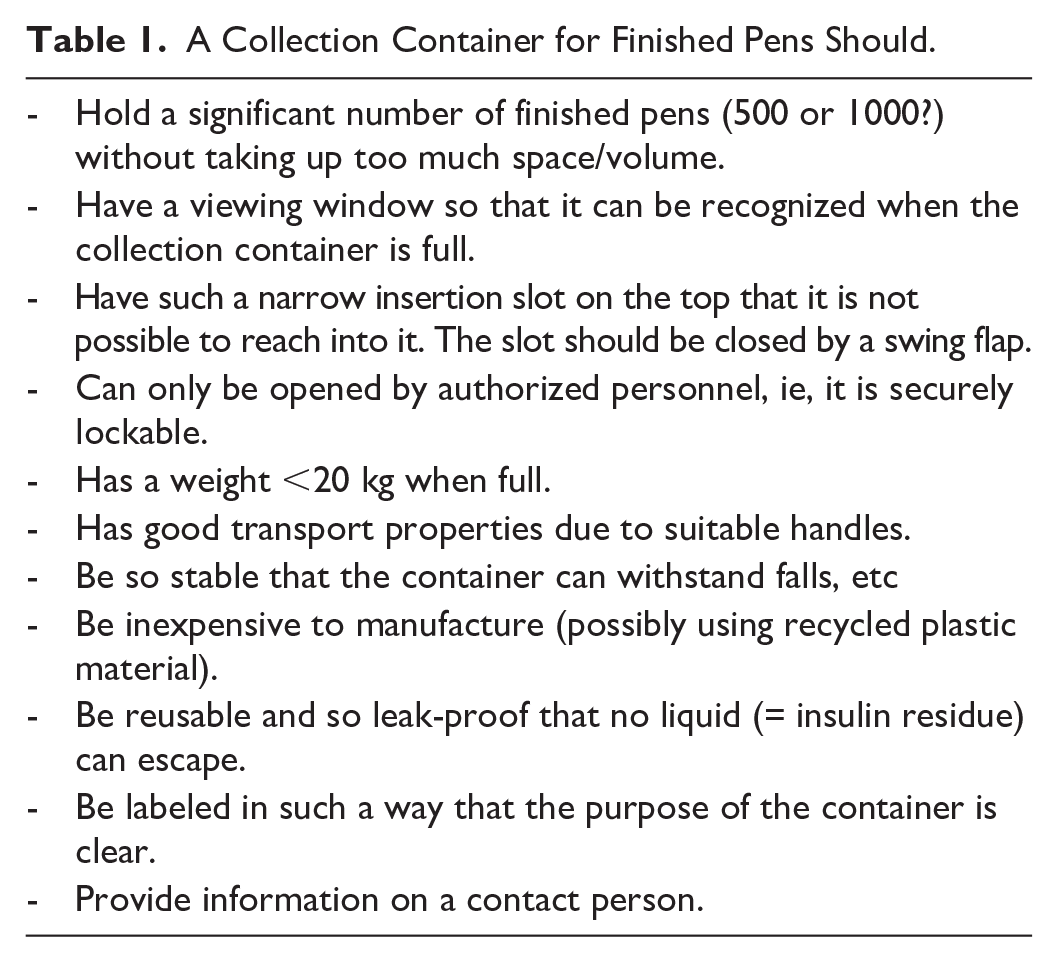
A prerequisite for pen recycling is the collection of insulin pens. Pragmatic, simple, and low-threshold solutions need to be established for this. The logistical effort is probably the lowest, and the practical implementation is most feasible if there are no separate collection containers depending on the manufacturer of the insulin pens, but one container for all pens (Table 1).
A Collection Container for Finished Pens Should.
These collection containers should be located at the point of sale, ie., in pharmacies, diabetes specialist practices, and clinics. The logistical effort for handling the collection containers should be low, ie, it should be possible to initiate the process of collecting and changing the container in everyday life via an app or a telephone number. Pharmacies are approached several times a day by wholesalers; here, a link with the collection of the containers with the lowest CO2 footprint would be connected. In the final step of the transport chain, the collection containers should be delivered to the relevant recycling companies in Germany with the lowest possible transportation costs.
Sorting the Collected Insulin Pens
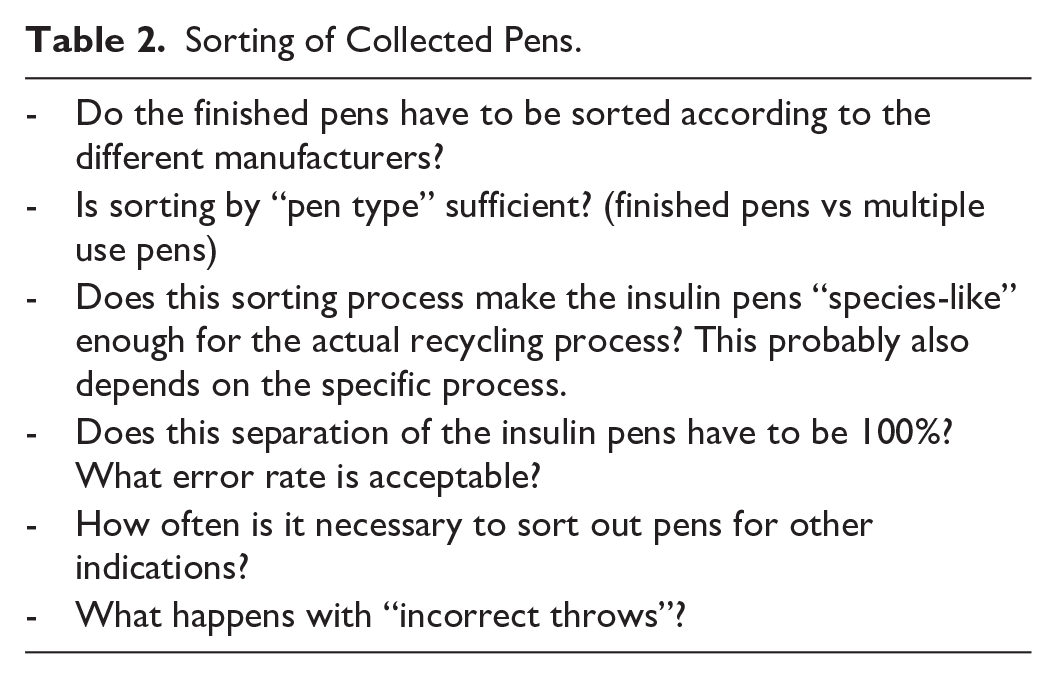
Before the actual recycling process can begin at the recycling company, the collected insulin pens must be sorted to remove non-targeted objects (Table 2). Incorrectly inserted pens, which are not within the scope of the recycling project, should also be fed into the recycling process. Possibly also completely different waste might be found in the collection. One would like to include as much pens as possible to lower the overall specific system costs; however, these should be the “right” pens to avoid impurities (see “Collecting the Insulin Pens” above), that makes the recycling end product less valuable.
Sorting of Collected Pens.
However, it is assumed that these problems are of little relevance, ie, that there are few such “misplaced items.” If this is not the practice case, this should be suitably recorded and appropriate responses implemented.
Another aspect is safety hazards. This specially comprises sharps occasionally ending up in the collection containers by mistake. They are potentially infectious and therefore classified as biohazardous. In order to avoid health risks to staff, the overall stability of the collection containers is important. In principle, the batteries in smart pens (see “Smartpens – A Special Pen-Recycling Problem” below) are a concern for fires; however, they are relatively small.
Costs
The establishment of such a pen-recycling process will involve costs, eg, for the production of the collection containers. On the contrary, the end product of the recycling process has a certain value. From a cost perspective, it is important to acknowledge that a high collection rate is key for achieving a high recycling rate, as the overall recycling rate is the product of collection rate, sorting efficiency, and mechanical recycling rate. With voluntary drop-off collection systems, the participation rates are usually low (= in the range of 10%-25%). Usually such rates go up a lot with deposit-refund systems; in this case, participation rates of 95% to 99% can be achieved. However, voluntary return systems would put an additional burden on the pharmacies; they will ask for a certain benefit for themselves. Nevertheless, there might be a need to do it to avoid an underperforming recycling system.
Regulatory and Legal Aspects
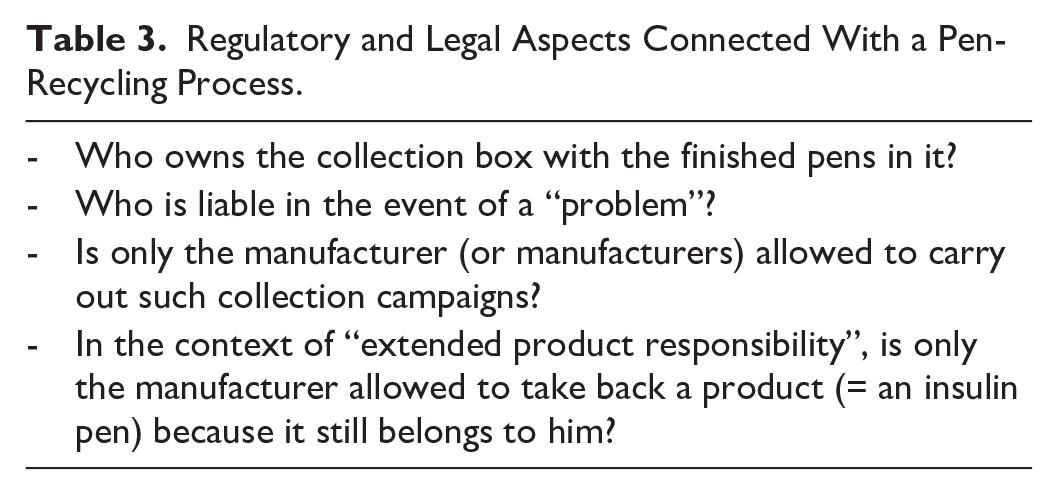
When establishing a pen-recycling process, it will also be important to consider and clarify regulatory and legal aspects (Table 3). Such questions may be seen as exaggerated, but there are various regulatory and legal requirements to be observed in connection with the handling of “waste,” many of which no longer appear to be up to date.
Regulatory and Legal Aspects Connected With a Pen-Recycling Process.
Smartpens—A Special Pen-Recycling Problem
Pen recycling poses a particular problem for smart pens, as batteries and electronic components are permanently installed. It must be clarified whether they therefore fall under the regulatory requirements for “waste electrical and electronic equipment.” Medical devices are partially exempt from other regulations. A distinction must also be made between “real” smart pens and smart pen caps that are attached to ready-to-use pens. Although the market for smart pens is rather small and smart pen caps are currently no longer being sold, they are likely to play a role again in the future. According to the DT-Report 2025, smart pens from one manufacturer have a market share of >90%, with a smaller share coming from competitors. Non-rechargeable smartpens are particularly problematic. Once the battery is exhausted, the smart functions are no longer available, and the pen can only be used as a conventional injection aid. Instructions on the collection containers should hopefully ensure that these are only intended for ready-to-use pens to avoid misuse, especially of smart pens.
Summary
It will be necessary to announce and advertise such a joint project (PenDE) accordingly. To this end, all partners involved should work together. The lead management of this project lies in the hands of the DUK working group as a neutral body. It would also be the point of contact for the communication aspects. The WG is in discussion with all partners and also reports on developments in other countries. We see the need to discuss with the pen manufacturer about the costs of pen recycling, how to improve the pen design to augment the recyclability of pens, and the need for a deposit-refund system to achieve a high recycling rate to allow for an (cost-) efficient recycling.
The PwD are informed by creating and distributing appropriate disposal instructions for the finished pens, which should ideally be enclosed directly with the products. All those involved, especially the PwD, should be made aware of this project via all conceivable communication channels, including through defined contact persons at the manufacturers to whom the PwD can turn if they have any questions. This is the only way to ensure a high recycling response rate.
Recycling projects are the sum of small steps, ie, the aim is to learn from the pen-recycling project and optimize the processes. The (long-term) goal is material cycles, ie, multiple use of materials such as recycled plastic and glass. In this sense, it will also be important to strive for “eco-design” in the development of new pens, ie, to consider the recyclability of pens in their design (= selection of the plastics used) and manufacture (= easy separability). The next step also involves the recycling of reusable pens and smart pens.
It is important to provide adequate training and information to all groups involved in this project and to raise awareness. Diabetes advisors in particular are a crucial interface in this regard. Disposal in collection bins should be as low-threshold as possible and accessible to PwD without further everyday burdens to promote acceptance. Throwing it in the garbage can is unfortunately too easy!
Footnotes
Acknowledgements
We would like to thank David Klonoff for his quite helpful comments.
Abbreviations
AG DUK, Diabetes, Environment & Climate Working Group; BVMed, German Medical Technology Association; PwD, people with diabetes
Declaration of Conflicting Interests
The author(s) declared the following potential conflicts of interest with respect to the research, authorship, and/or publication of this article: LH is a shareholder of the Profil Institut für Stoffwechselforschung GmbH, Neuss, Germany; Science Consulting in Diabetes GmbH, Düsseldorf, Germany; and diateam GmbH, Bad Mergentheim, Germany. LH is a consultant for several companies that are developing novel diagnostic and therapeutic options for diabetes treatment. SFP declares no conflict of interest. CU is a shareholder and managing director of TUN Training & Beratung GmbH. CU is a consultant for several companies that are developing and selling therapeutic options for diabetes treatment.
Funding
The author(s) received no financial support for the research, authorship, and/or publication of this article.
