




Abstract

Centers for Disease Control and Prevention reports 15% of US adults have diabetes, increasing to almost 30% among those age ≥ 65. 1 In 2018, of 1.3 million Medicare Advantage beneficiaries with diabetes, 65.1% had ≥10 active health conditions, 18.1% were taking ≥3 glucose-lowering medications, and 18.6% had an A1c ≥ 8.0%. 2 Important considerations in this older population are outlined in the American Diabetes Association Standards of Care 3 and a call to action 4 that emphasize barriers such as polypharmacy, frailty, cognitive impairment, access, and social determinants of health. A recent editorial exploring special considerations in elderly people reinforced that many regularly use diabetes technology, so age should not be seen as a barrier, while encouraging further studies supporting the utility of diabetes technology. 5
To this end, we investigated the impact of age on glycemic outcomes in people with type 2 diabetes (PwT2D) using the OneTouch Reveal (OTR) diabetes app in conjunction with a Bluetooth-connected OneTouch Verio Flex or Verio Reflect blood glucose meter (BGM). We analyzed anonymized glucose and app analytics for 55 650 PwT2D age ≥ 65 and a comparator group of 78 167 PwT2D age < 65 (age at OTR app registration). Glycemic data from their first 14 days using the app with their Bluetooth-connected BGM were compared with the 14 days prior to a 180-day timepoint using paired, within-subject differences.
The clinical outcomes achieved by different age groups are provided in Figure 1. People of Medicare age experienced clinically meaningful improvements in percent readings in range (RIR) of +9.3 percentage points (%pts). After 180 days of technology use, all age groups achieved more than 80% RIR (83.4% in age < 65 and 81.3% in age ≥ 65), with even the oldest people (age ≥ 75) reaching RIR of more than 80%.
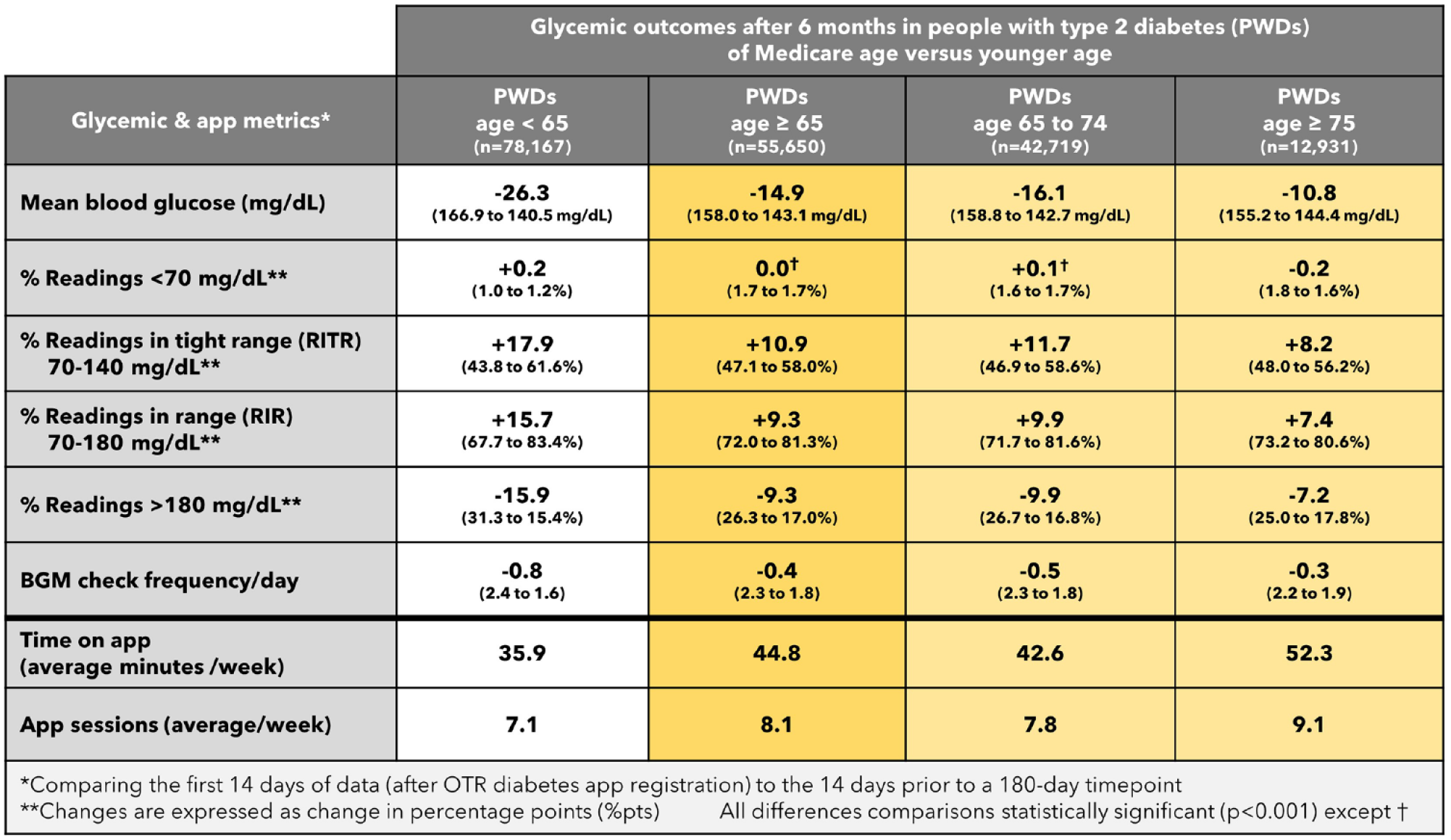
Glycemic outcomes in Medicare age people with type 2 diabetes using the OneTouch Reveal diabetes app with Bluetooth connected blood glucose meters.
Readings in tight range (RITR) is an important new metric that illuminates tighter management without crossing the hypoglycemia threshold. Encouragingly, we observed a +10.9 %pt increase (from 47.1 to 58.0%) in RITR in people age ≥ 65, mirrored by both older subgroups (ages 65-74 and ≥75). Minimizing hypoglycemia with any diabetes medication or technology is paramount, especially in the elderly, and therefore, it was reassuring that readings <70 mg/dL remained static (0.0 %pt change), despite people age ≥ 65 achieving +10.9 %pts more readings in the tight range. The driving force behind the improvement in tighter diabetes management was the marked reduction in hyperglycemic readings, which reached almost 10 %pts in those aged 65 to 74.
Challenges associated with aging can hamper diabetes management, but our real-world data support the observation that older people with type 2 diabetes derive great benefit when they regularly interact with a diabetes app and the latest Bluetooth-connected BGMs to gain important insights. In fact, the automatic diabetes insight and guidance features in the app and directly on the color screen of the OneTouch Verio Reflect BGM were specifically designed to help people with diabetes interpret and act upon their low or high glucose excursions. 6
Footnotes
Abbreviations
RWE, real-world evidence; RIR, readings in range; OTR, OneTouch Reveal; PwT2D, people with type 2 diabetes; BGM, blood glucose meter.
Declaration of Conflicting Interests
The author(s) declared the following potential conflicts of interest with respect to the research, authorship, and/or publication of this article: The authors are all current employees of LifeScan Inc or LifeScan Scotland.
Funding
The author(s) disclosed receipt of the following financial support for the research, authorship, and/or publication of this article: Funding for analysis and letter preparation was provided by LifeScan Inc, Malvern, PA 19355 USA.
