



Abstract
People with type1 diabetes mellitus (T1DM) have to deal with their disease in everyday life which can be challenging.1,2 On top of lifelong insulin replacement therapy, lifestyle modifications including exercise are recommended for management of T1DM.3,4 Guidelines for exercise with insulin pump therapy or automated insulin delivery (AID) systems are very rare. 5 The goal of this analysis of real-world data was to analyze an insulin-only open-source AID system with regard to safety for multiple daily aerobic exercise sessions. The Exercise Camp 2022 went over five days with cycling in the Alps from Salzburg, Austria to Grado, Italy (447 km and 3334 m). Patients with T1DM and also healthy subjects were included in the analysis. Digital applications (apps) were used for carbohydrate estimation and the patients used their own diabetes supply. With the help of apps, diabetes technology and the patients’ and subjects’ written consent, data and parameters were collected and calculated, retrospectively. As this retrospective analysis reflects a 5-day sports camp, the glycemic metrics of the Ambulatory Glucose Profiles (AGP) of the continuous glucose monitoring systems (CGM) for each day are presented. Also, the Glycemia Risk Index (GRI)—a summary of the glycemia quality 6 —is shown day by day to represent the daily changes.
The primary goal was to evaluate glycemic parameters day by day (time-in-range [TIR], GRI with time in hypo- and hyperglycemia) and the development over the days with exercise. The secondary goal was to count all consumed rescue-carbohydrates (CHO) to stay within or reach the TIR. An index (insulin-total daily dose [TDD]/carbohydrate)/calories/mean glucose) was calculated to show the change in insulin sensitivity over the five days of exercise.
The significance was tested by unpaired or paired t-test as appropriate. A two-sided P-value < .05 showed significance (IBM SPSS version 25 IBM Co., Armonk, NY, USA).
Six patients with T1DM and three healthy subjects were included in the analysis (see Table 1). The retrospective evaluation of the glycemic control extracted from the AGP demonstrated safety and control continuously with an open-source AID system during a multi-day exercise camp. Mean glucose was more variable from day to day—ranging from 125 (±23) mg/dL to 153 (±16) mg/dL; TIR decreased slightly but remained above the target of 70% (71%-84%). Level 2 hypoglycemia did not increase significantly with an absolute difference of 2.5% on day 1 and stayed stable throughout the Exercise Camp 2022. GRI was 42% on day 1 (slightly exceeding the cut-off of 40%) and stabilized again on day 2.
AID Systems Components: FreeAPSX Self-Adjusting Algorithm, Insulet OmniPod Eros (Patch Pump), RileyLink (Communication), Dexcom G6 (Continuous Glucose Monitoring, CGM) Insulin: Ultrafast Acting Insulin FIASP®.
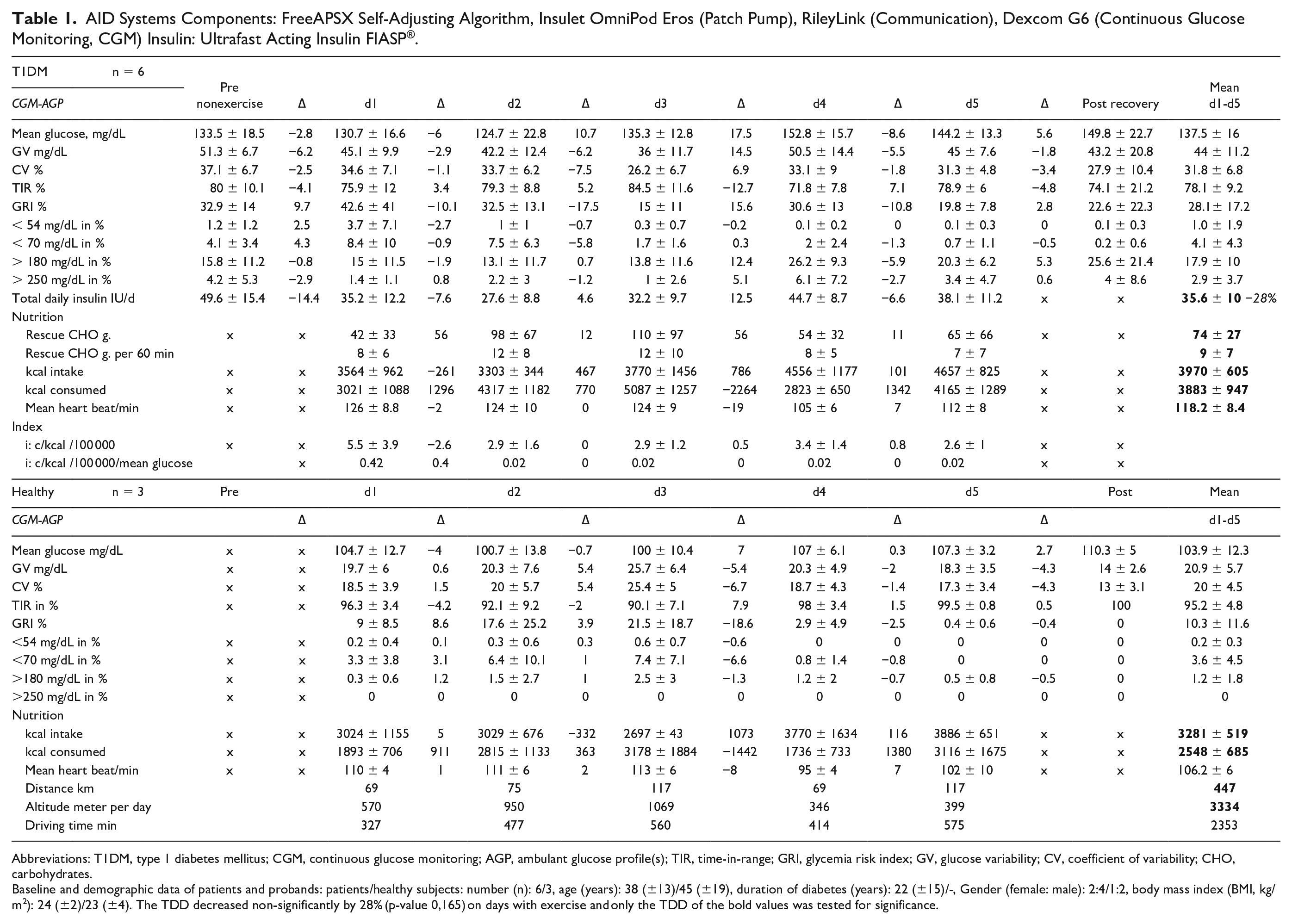
Abbreviations: T1DM, type 1 diabetes mellitus; CGM, continuous glucose monitoring; AGP, ambulant glucose profile(s); TIR, time-in-range; GRI, glycemia risk index; GV, glucose variability; CV, coefficient of variability; CHO, carbohydrates.
Baseline and demographic data of patients and probands: patients/healthy subjects: number (n): 6/3, age (years): 38 (±13)/45 (±19), duration of diabetes (years): 22 (±15)/-, Gender (female: male): 2:4/1:2, body mass index (BMI, kg/m2): 24 (±2)/23 (±4). The TDD decreased non-significantly by 28% (p-value 0,165) on days with exercise and only the TDD of the bold values was tested for significance.
The mean glucose correlated with the required performance and intensity: days 2 and 3 had the most inclines and longest distance, thus demanding the highest power. The daily requirement for rescue-CHO to maintain glucose within the target was relatively low with 74 (±27) g and again correlated with the intensity of the exercise-session.
The TDD decreased nonsignificantly by 28% on days with exercise. Interestingly, the calculated index demonstrated a steady state in the insulin sensitivity starting on day 3. Healthy subjects had a decrease in mean glucose on day 2 with an increase on day 4. On day 3, TIR decreased to a minimum of 90.1% and GRI rose up to 21.5%.
With an open-source AID system that self-adjusts variables, it is possible to safely accomplish intensive multiple-day exercise for patients with T1DM without serious deterioration in glycemic control. The international recommended goals for TIR, GRI, and level 2 hypoglycemia were achieved during the Exercise Camp 2022 under free-living conditions. Herein, the system did not require any further adjustments by the patient to function safely. Changes in AGP compared between the healthy subjects and T1DM were following similar patterns. The data of the Exercise Camp 2022 demonstrated a stable insulin sensitivity starting on day3.
Footnotes
Abbreviations
AGP, Ambulant Glucose Profile(s); AID, Automated Insulin Delivery System(s); APP, application; CGM, Continuous Glucose Monitoring; CHO, carbohydrates; g, gram; GRI, Glycemia Risk Index; T1DM, Type 1 Diabetes Mellitus; TDD, Total Daily Insulin Dose.
Declaration of Conflicting Interests
The author(s) declared no potential conflicts of interest with respect to the research, authorship, and/or publication of this article.
Funding
The author(s) disclosed receipt of the following financial support for the research, authorship, and/or publication of this article: This study was funded from Dexcom Ing. and NovoNordisk Austria.
