




Abstract
Introduction:
Mobile-based applications play a leading role in changes in life-style, improve medication adherence, and provide a unique opportunity to aid patients with type 2 diabetes mellitus (T2DM) elevate their healthcare level. Therefore, we aim to design and develop a mobile-based self-care application for patients with T2DM.
Methods:
The present study was an applied and developmental study to design and develop a mobile-based self-care application for people living with T2DM conducted in 2020. The design and development of the T2DM self-care application were done in 2 main phases of determining the key features and capabilities, and design and development of the T2DM self-care mobile app.
Results:
We identified the main model and a set of capabilities and features for the T2DM self-care application. By content analysis on 32 different applications and a previous study by the author, 18 features were extracted for the T2DM self-care mobile app. JAVA programming languages were used to design T2DM applications. Moreover, because of the cost-effectiveness, the Android operating system (AOS) was selected as a platform, and because of the widespread use of smartphones; these phones were chosen as the format of T2DM self-care application.
Conclusions:
In this study, we design and develop a mobile-based self-care application for patients with type 2 diabetes that shows potential in solving the shortcomings of mobile apps for diabetes care. By utilizing the T2DM self-care mobile app we are able to deploy a self-care application with a wide range of functionality such as text messaging, blood glucose monitoring, insulin dose suggestions, educational messaging, metabolic management, pedometer counts, and reporting. Future studies are needed to develop self-care applications for a different type of diabetes with different functions of diabetes care.
Introduction
Diabetes Mellitus (DM) is a major cause of morbidity and mortality globally, affecting more than 500 million people worldwide. 1 By 2019, DM was the ninth cause of deaths worldwide, with an 80% increase in related deaths in men since 2000. 2 It is one of the leading causes of cardiovascular disease (CVD), stroke, chronic kidney disease (CKD), blindness, neuropathy, foot ulcers, and limb amputation, among other medical problems.3-11 Type 2 Diabetes Mellitus (T2DM) is the most common form of this disease, accounting for 90%-95% of the cases. 12
Preventing non-communicable diseases and controlling their risk-factors such as DM and hypertension is of utmost importance among the health-care policymakers.13,14 Diabetes self-management is vital to achieve the ideal goals of patient care, elevate the quality of life, and improve the patients’ psychological, spiritual, and social status.15-17 In fact, patients with T2DM perform more than 95% of their treatment-related tasks personally. 18 The patients are encouraged to monitor their dietary intake, physical activity, blood glucose levels, medication adherence, foot care, eye status, and other means of self-care.19-26
Mobile applications play an undeniable role in aiding patients to implement their self-management tasks.15,18,26-31 They also allow the patients to participate in society without the time and place limitations. 32 Nevertheless, some patients, especially the elderly, face several hardships while using these applications.31,33 Continually using these applications may be physically tiresome, especially the patients having morbidities such as diminished eyesight, arthritis, and difficulties walking to the phone.27,33-35 Furthermore, older patients may not be familiar with the technology and find it difficult to utilize these applications.27,33,36
With benefits and limitations discussed, future mobile-based applications should try to maximize their efficiency. To achieve this goal, we aim to identify the desired features of T2DM self-care applications to design, develop, and evaluate an application for this purpose.
Methods
The present study was an applied and developmental study to design, develop, and implement a mobile-based self-care application for people living with T2DM conducted in 2020 in Iran. The design and development of the T2DM self-care mobile app were done in 2 main phases:
Determine the Key Features and Capabilities
To identify and determine the key features and capabilities of the self-care mobile application for T2DM, digital markets such as Google Play and App Store, as well as the CafeBazar and SibApp Iranian digital markets, were studied. Diabetes-related apps were downloaded and the capabilities of these applications were examined. A checklist of the required capabilities of the self-care application was prepared and provided to the experts of the technical team in order to determine these features. After identifying key features, we designed a conceptual model to help to create prototype mobile app. Based on the key features of similar available mobile applications, we found that the design and development of these mobile applications were executed in 2 parts; first the user registration and then home page for daily uses of apps.
Design and Development of T2DM App
The design and development of the T2DM self-care mobile app consisted of drawing a conceptual model of the user’s relationship with the app; design the prototype, the initial version, and finally the original version. Based on the results of the first phase to develop a self-care app, a conceptual and flowchart model of the overall trend was designed. According to this model and using the Java programming language in the integrated development environment (IDE) of Android Studio V 2.3.3, a prototype of a mobile application was created. In the operational section, Java object-oriented programming language, to design the database SQLite DB, and to design the layouts and user interface of the app, expandable Markup Language (XML) was employed. Mobile app sends information after receiving from user to database. After entering user information, the user saves them and can also edit profile information. Android Volley library were used to networking requests to handle. Volley is a library that makes networking for Android apps easier and most importantly, faster. Due to the popularity of the Android operating system in Iran, the initial version of the self-care apps was designed for the Android operating system version 4.4 KitKat and above.
Results
The Model of “T2DM Self-Care Mobile App”
We identified main model and a set of capabilities and features for T2DM self-care mobile app (Figure 1). The user must create an account for the first login after installing the T2DM self-care mobile app, after registering in the apps, can enter the app by providing a username and password. Another feature of this app is the personal health record (PHR); that the patient records information related to his illness and health. In the user profile, it is possible to view information and change these. In the main menu of the T2DM self-care mobile app, all the sections required by the user for easy access were placed in a layout based on the new material design methods.
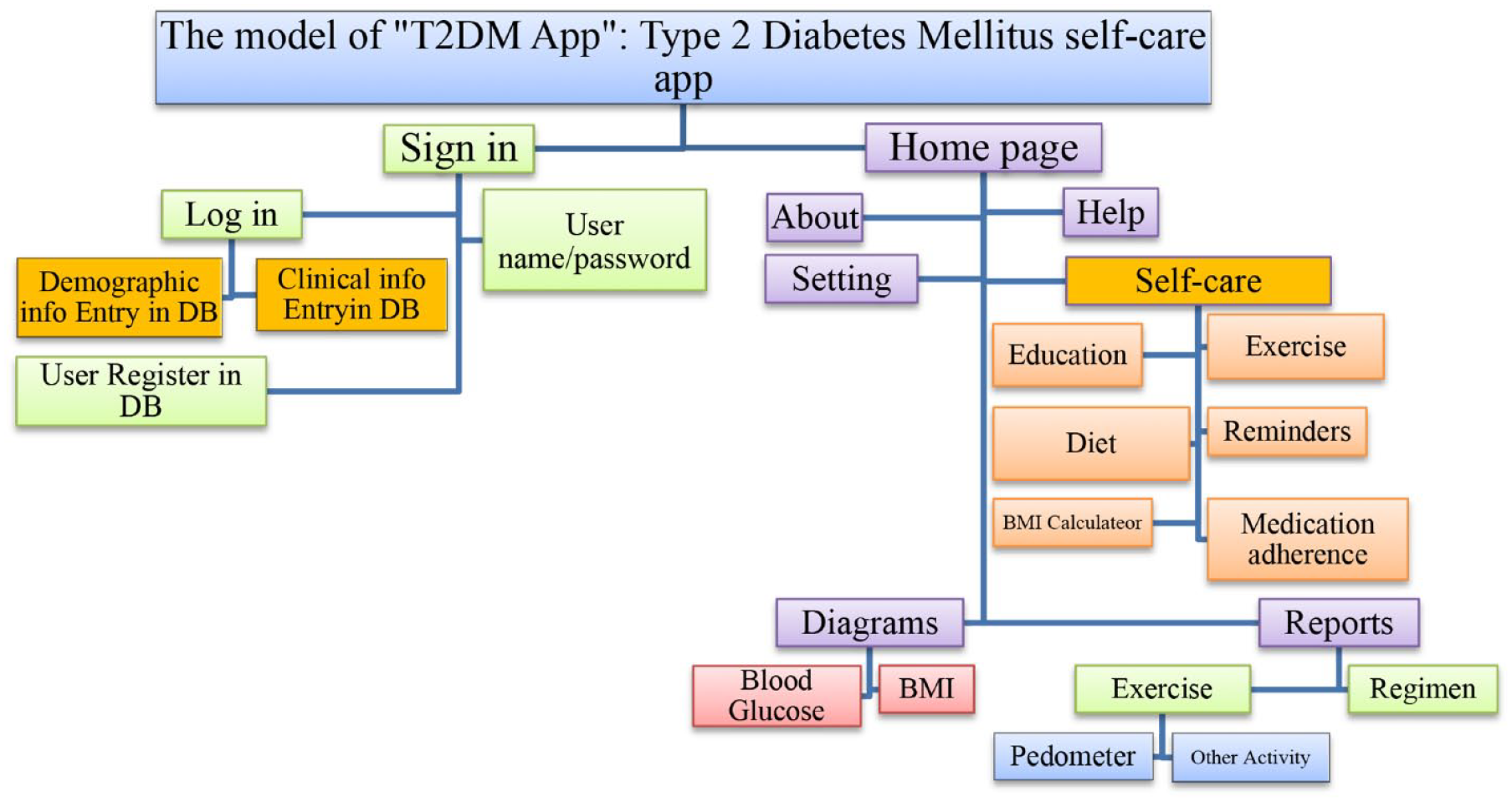
The tree model of the T2DM self-care mobile app.
JAVA programming languages were used to design T2DM self-care mobile app. Moreover, because of the cost-effectiveness, Android operating system (AOS) was selected as a platform and because of the widespread use of smart phones; these phones were chosen as the format of T2DM application. For receive and send data the Volley has been used to automation of the network operations. The architecture of T2DM self-care mobile app is shown in Figure 2.
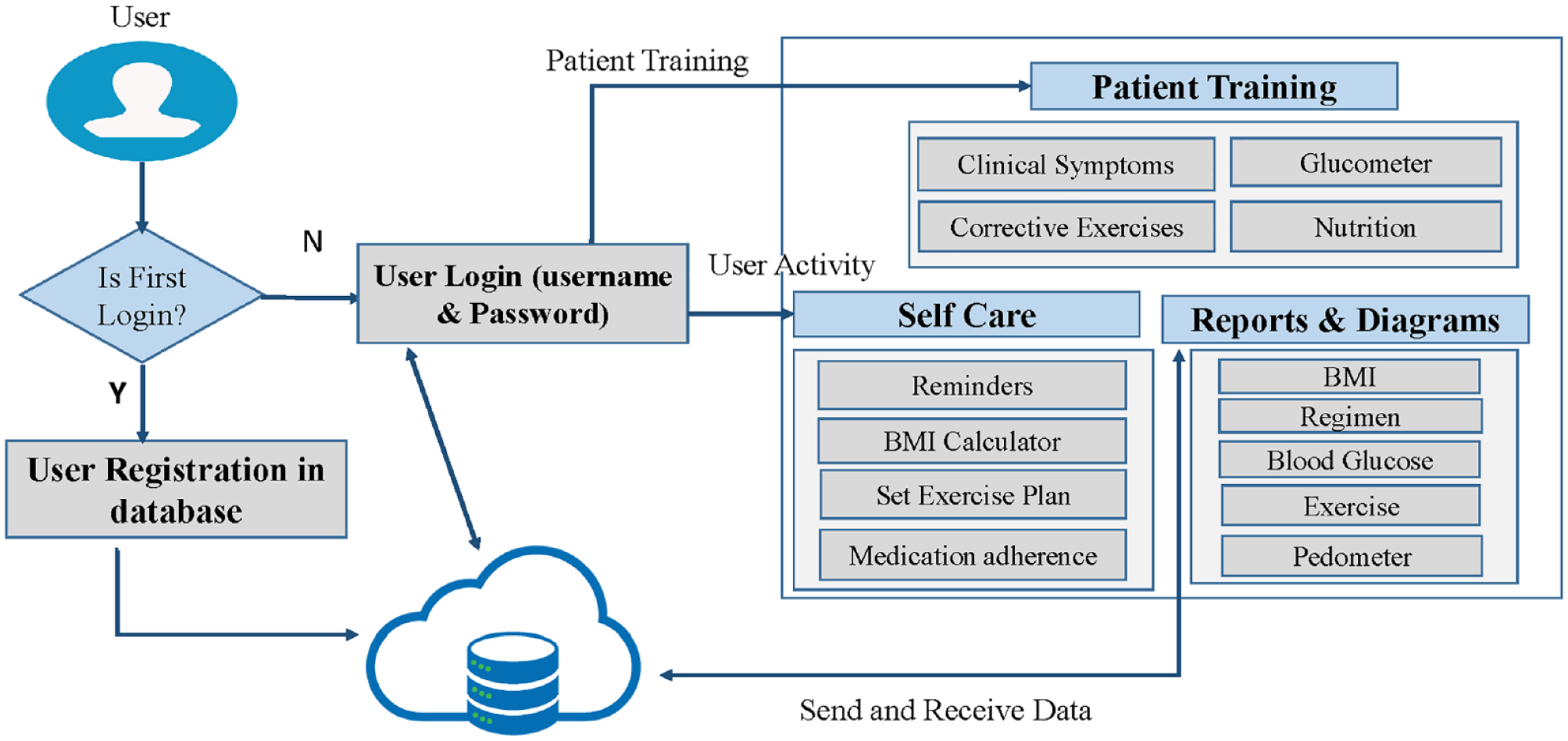
The architecture of the T2DM self-care mobile app.
Key Features and Capabilities
By content analysis on 32 different applications and previous study by author, 18 18 features were extracted for the T2DM self-care mobile app.
In order to examine these 32 applications, a questionnaire and a checklist of the most common frequent capabilities of these apps were designed, and then the main capabilities were examined by the technical team and experts. In evaluating these applications, we selected the features that users liked the most, based on user satisfaction and user rates, and the number of installs and downloads. Consequently, we checked which applications and features were interesting for the users.
Some of them had frequently been used in different self-care mobile applications, but there were some features that had been used unique in some models and received special data from the user. Based on the findings, the required features of the initial version design of T2DM self-care mobile app were considered as follows: text messaging, blood glucose monitoring, communication, decision support, insulin dose suggestions, educational messaging, physical exercise suggestion, alerts, medication reminders, weight monitoring, blood pressure checking, diet, behavioral lifestyle, self-monitoring, health behaviors monitoring, supporting personal health record (PHR),metabolic management, pedometer counts, and reporting. Herein, metabolic management means evaluating the caloric intake and food consumption under supervision of a nutritionist and managing them if necessary. The user-interface screen of main menu and reminders of T2DM self-care mobile app were shown in Figure 3.
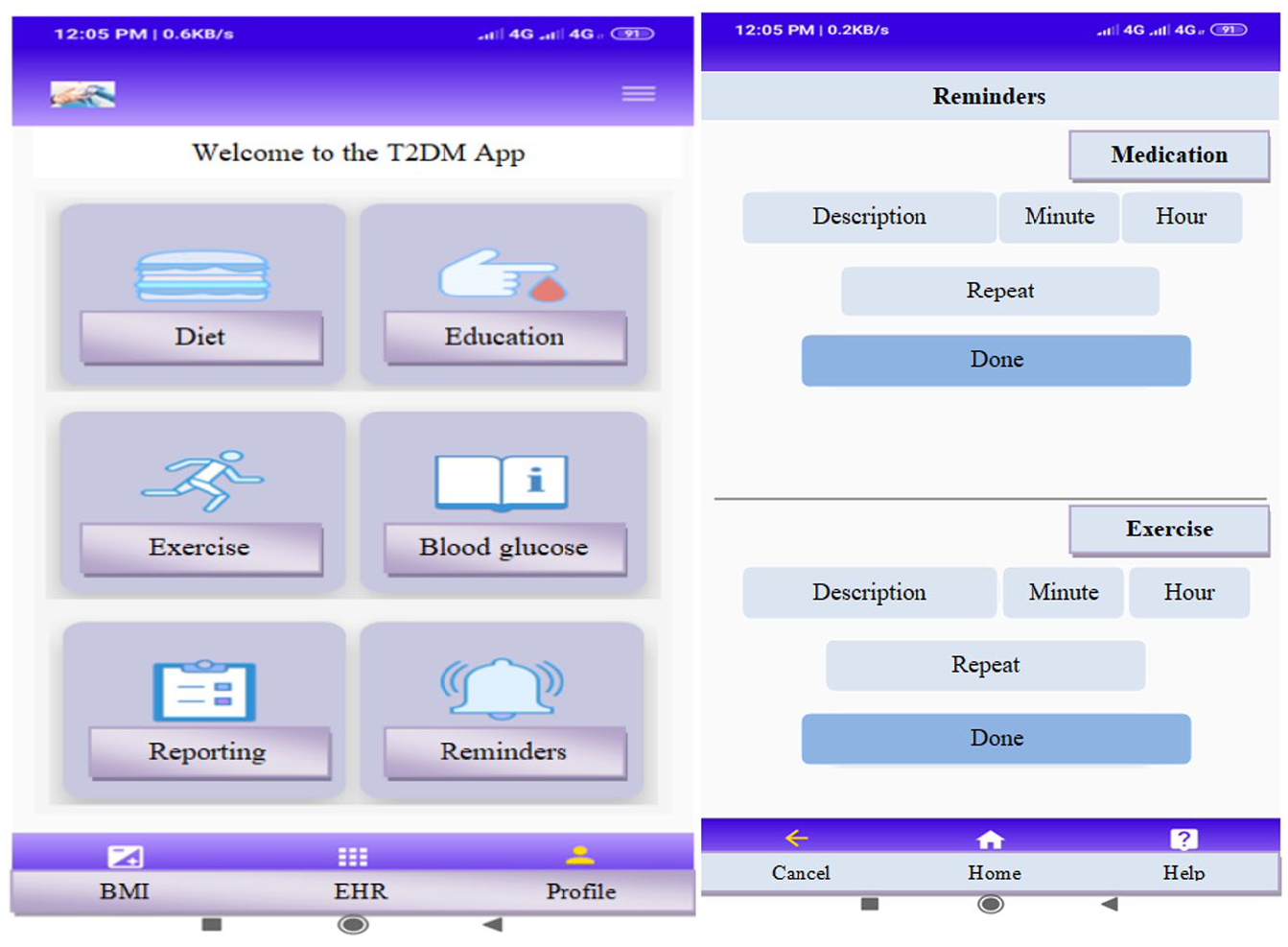
User-interface screen of T2DM app.
Discussion
Self-care activities of T2DM are essential to reducing its chronic progression and severe potential complications. Because of the physical and mental involvements ofT2DM adherence to self-care behaviors can quickly decline. 27 The growing number of available apps may be overwhelming for providers and patients who are searching for reliable and well-designed apps to support diabetes management. 18 In this study we developed a mobile-based self-care application for patients with type 2 diabetes (T2DM self-care mobile app).
The T2DM self-care mobile app including core functions such as teaching self-care instructions, control, manage and self-monitor of disease through reminders, receiving the amount of sports activities, alerts, and also prepare reports of the disease management process. Providing healthcare systems that are part of the user’s daily life is argued to be important by recent studies,18,37-39 for example, Krishna et al., who state that technologies that are already a part of people’s daily lives, such as mobile phones and SMSs, have potential to affect self-care and improve people’s health and well-being. 40 Moreover, according to the conclusion of Ballegaard et al., health care technology involves much more than informing clinicians; it is also about supporting the remote collaboration between patients and clinicians. 41 On the other hand, most of the existing self-care tools for chronically ill patients aim to provide help by interacting with health care workers. 42 As the number of the patients with diabetes is on the rise, the presented concepts of self-support and self-care is of utmost importance to help the patients achieve the best possible management. 43
Current diabetes self-care apps are able to make self-care more convenient for the patient by providing structured education programs, streamlining data collection and using inputted data to track the user’s progress. 44 A systematic review and meta-analysis has shown that smartphone-based self-care applications have moderate benefits on not only the reduction of the glycated hemoglobin level (−0.4%), but also the enhancement of diabetes knowledge and improvement of lifestyle changes. 45 Another major perceived advantage, when compared to traditional forms of monitoring health, included the discretion of using a mobile phone as well as the constant ability to monitor and record due to portability. Consistent with the findings of Brzan et al., also reported their apps to be useful for self-care tasks, including monitoring nutrition and increasing physical activity. 46
The T2DM self-care mobile app is available to support the international guidelines for care and self-management of T2DM such as blood glucose monitoring. Glucose recording/documenting was the most common app function with also including a reminder function. Given the importance of self-monitoring for health behavior change and the encouragement by medical providers of regular checking of blood sugar, it is unsurprising that this is a key feature of many apps. 47 In addition, -as was one of the features of the T2DM self-care mobile app—the use of behavior change theories as well as patient-centered motivational strategies could serve to improve app features for diabetes self-care, such as weight management, medication adherence, physical activity and integration of features focused on goal-setting and problem-solving of barriers to adherence.48,49 In other words, providing educational information and appropriate diet and exercise programs will gradually change people’s behaviors and improve their lifestyle. Also, people’s own intervention in disease management using the app increases their motivation to continue treatment. 18
While clinical guidelines emphasize the role of self-management education as an integral part of diabetes care, most diabetes self-management applications that aim to support self-management tasks do not integrate educational information. 50 Gagliardino et al., declared that diabetes education is significantly associated with effective self-management in people with T1DM, which in turn would favor the attainment of HbA1c target. 51 The T2DM self-care mobile applications also provide the patients with their educational needs, for example, guideline for diabetes care, food information, and expert questions and answers for users. These features have the potential to be improved in the developed application.
The other central feature of our application focuses on supporting personal health record (PHR) consist of demographic and clinical data of patients for some differences in self-care demands exist for each type of diabetes, tailoring apps for the specific condition may be beneficial for app designers to consider. For example, patients with Type 1 diabetes may need to check their blood sugar more regularly, or social media features may be more popular with younger patients. Demographic data are also considered as necessary data for identifying, calling, and tracking patients. 52 In addition to serving as an electronic logbook, decision support would be helpful. Primarily, these tools are used to process large and complex data and provide feedback relating to the insulin dosage, carbohydrate intake, and healthy behavior. In all, 19% of research articles employed some form of decision support.53,54
One of the major strength of T2DM self-care mobile app is the possibility of sharing data with treatment providers or other supporters. It can be regular reports in the form of graphs and printable text, for example, medications taken, daily chart of blood sugar and blood pressure. Sharing it helps the patient’s clinical team to adapt the data and track progress and improve diabetes. One of the unique features that can be mentioned in this application is its design. The design is based on evidence-based features obtained by research of a specialist clinical and medical team. This application is also designed in a way the patient can receive specific exercise, care, and nutrition instructions according to his blood sugar status. Unlike other applications, self-care, self-management, self-monitoring, reminder, alarm, and other items are integrated in one application, which is very important for patients who use this application. Another point of this app is that it has been localized for Iranian patients according to the special nutrition, herbal medicines, and sports. Also, patient records in the application can be used to build databases for advanced versions.
Communication functions are one of the primary ways in which app use can benefit providers, and given the many benefits of accessibility of physiologic data on the medical management of diabetes (eg, medication dosage, adherence information), maximizing the functionality of these features is likely to be a key preference of medical providers. More recent reviews demonstrating consistent and significant HbA1c reductions included the technology intervention components of the complete feedback loop between participants and the health care team. 55 Bonoto et al., determined that mobile apps have better outcomes when communication is possible with the health care team. 56
More recent studies demonstrating consistent and significant glycosylated hemoglobin level reductions included the technology intervention components of the complete feedback loop between participants and the healthcare services providers.54,57,58 Feedback may be based on evaluating blood glucose and other biometric health data, controlling nutrition, physical activity, insulin injection and other symptoms and complications. It allows the participant to consider the exchange of data, information and knowledge without the influence of their current circumstances or environmental factors in a “controllable and less stressful” environment compared to traditional face-to-face patient provider communications. 59 personalized feedback or advice based on patient data, was available in 9%–17% of apps. 52 In the “T2DM App,” we give feedback to patients in the form of text messages.
Conclusion
In this study, we design and develop a mobile-based self-care application for patients with type 2 diabetes that shows potential in solving the shortcomings of mobile apps for diabetes care. By utilizing the T2DM self-care mobile app we are able to deploy a self-care application with wide range of functionality such as text messaging, blood glucose monitoring, insulin dose suggestions, educational messaging, physical exercise suggestion, alerts, medication reminders, behavioral lifestyle, self-monitoring, supporting personal health record (PHR), metabolic management, pedometer counts, and reporting. Interests in mobile-based self-care apps for type 2 diabetes have lasted for years; many well-functioned apps are still to be developed. Future studies are needed to develop self-care applications for various aspects of diabetes care.
Limitations
Despite its strengths, this study had a certain limitation. Given the multiplicity of available diabetes mobile-base application, reviewing and selecting the most widely used application to identify essential features was a time consuming task.
Footnotes
Acknowledgements
The present study was extracted from the research project with code IR-KH-1398-04-013 in the field of health management entitled “Design, develop, implement and evaluation of a mobile-based self-care system for people living with diabetes” conducted at Khalkhal University of Medical Sciences in 2020. We thank all the participants for taking time to contribute to the study.
Abbreviations
AACE, American Association of Clinical Endocrinologists; ADA, American Diabetes Association; CKD, chronic kidney disease; CVD, cardiovascular disease; DM, diabetes mellitus; PHR, personal health records; T2DM, type 2 diabetes mellitus.
Declaration of Conflicting Interests
The author(s) declared no potential conflicts of interest with respect to the research, authorship, and/or publication of this article.
Funding
The author(s) received no financial support for the research, authorship, and/or publication of this article.
