



Abstract
There is no validated framework to evaluate health information technology (HIT) for diabetes self-management education and support (DSMES). AADE7 Self-Care Behaviors is a patient-centered DSMES designed by the American Association of Diabetes Educators (AADE). We developed a codebook based on the AADE7 Self-Care Behaviors principles as an evaluation framework. In this commentary, we demonstrate the real-life applications of this codebook through three diabetes research studies. The first study analyzed features of mobile diabetes applications. The second study evaluated provider documentation patterns in electronic health records (EHRs) to deliver ongoing patient-centered DSMES. The third study analyzed feedback messages from diabetes apps. We found that this codebook, based on AADE7, can be instrumental as a framework for research, as well as real-life use in HIT for DSMES principles.
Diabetes Self-Management Education in Health Information Technology
Diabetes mellitus (DM) is a chronic disease with an increasing burden globally. As a chronic disease, it has a significant impact on the person and the community in multiple ways, both health wise and economically. Diabetes self-management education (DSME) is the process of facilitating the knowledge, skill, and ability necessary for diabetes self-care. Diabetes self-management support (DSMS) refers to the support that is required for implementing and sustaining coping skills and behaviors needed to self-manage on an ongoing basis. 1 Consequently, diabetes self-management education and support (DSMES) helps to maintain the desired self-care behavior change.2-4 It can lead to improvement in clinical control of glycemia5-11 and health outcomes such as quality of life.12-14 AADE7 Self-Care Behaviors, 15 first compiled in 1997, play a central role in delivering patient-centered DSMES to people with DM for more than 20 years. The framework helps providers deliver the key points of DSMES in an organized manner to people with DM. The AADE7 principles are widely adopted in clinical care as well as in the development of protocols and programs focused on DSMES. Revisions and updates to these principles allowed for adaptation to technological advances. 16 Many research studies17,18 in diabetes utilized the seven principles. However, few research studies have investigated the application of AADE7 in the area of health information technology (HIT). We want to take this commentary as an opportunity to share our three applied research studies, where we employed AADE7 as an evaluation framework for HIT for DM.
Framework for Codebook Development
At the University of Missouri Health Care, we formed an interdisciplinary team with diverse expertise of several distinct but related disciplines—informatics (Kim, Narindrarangkura, Ye), endocrinology (Khan), diabetes education (Boren), and implementation science (Simoes). The principal goal of our research team is to enhance use of electronic health records (EHRs) in self-care behaviors of people with DM. Our aim was to develop a mechanism to allow the clinically relevant evidence-based AADE7 principles to apply objectively in a research setting. Over a period of five years, the team took a stepwise approach to develop and apply a framework based on AADE7 principles to health information data.
The research team developed and updated the framework by consulting the AADE7 guidelines for the most up-to-date education items. Each principle was systematically broken down into specific statements, and a code assigned to each statement. Through an iterative process, a code book was created with designated columns for “Category,” “ID,” “Statement,” and “Count” each statement (Table 1). Once we created the codebook, we explored its use in real-life research setting by applying to three research studies focusing on HIT in DMES. The results of each study allowed for a detailed review of the codebook in a stepwise fashion. We conducted revisions to the framework at each step. The sequential studies led to the current version that captures consistent and comprehensive DSMES items for application (Figure 1).
AADE7-Based Codebook Used for Evaluating Diabetes-Related Health Information Technology.
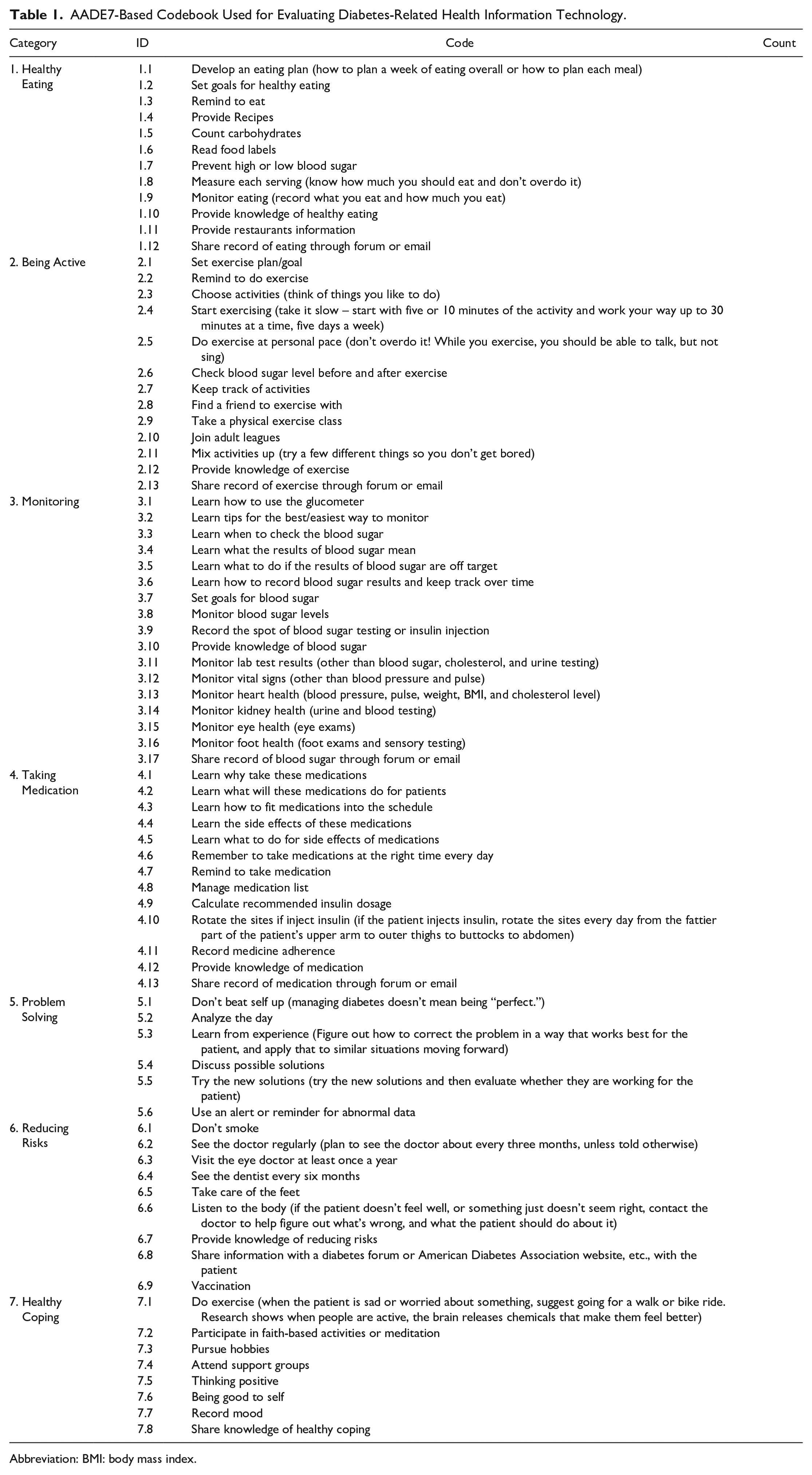
Abbreviation: BMI: body mass index.
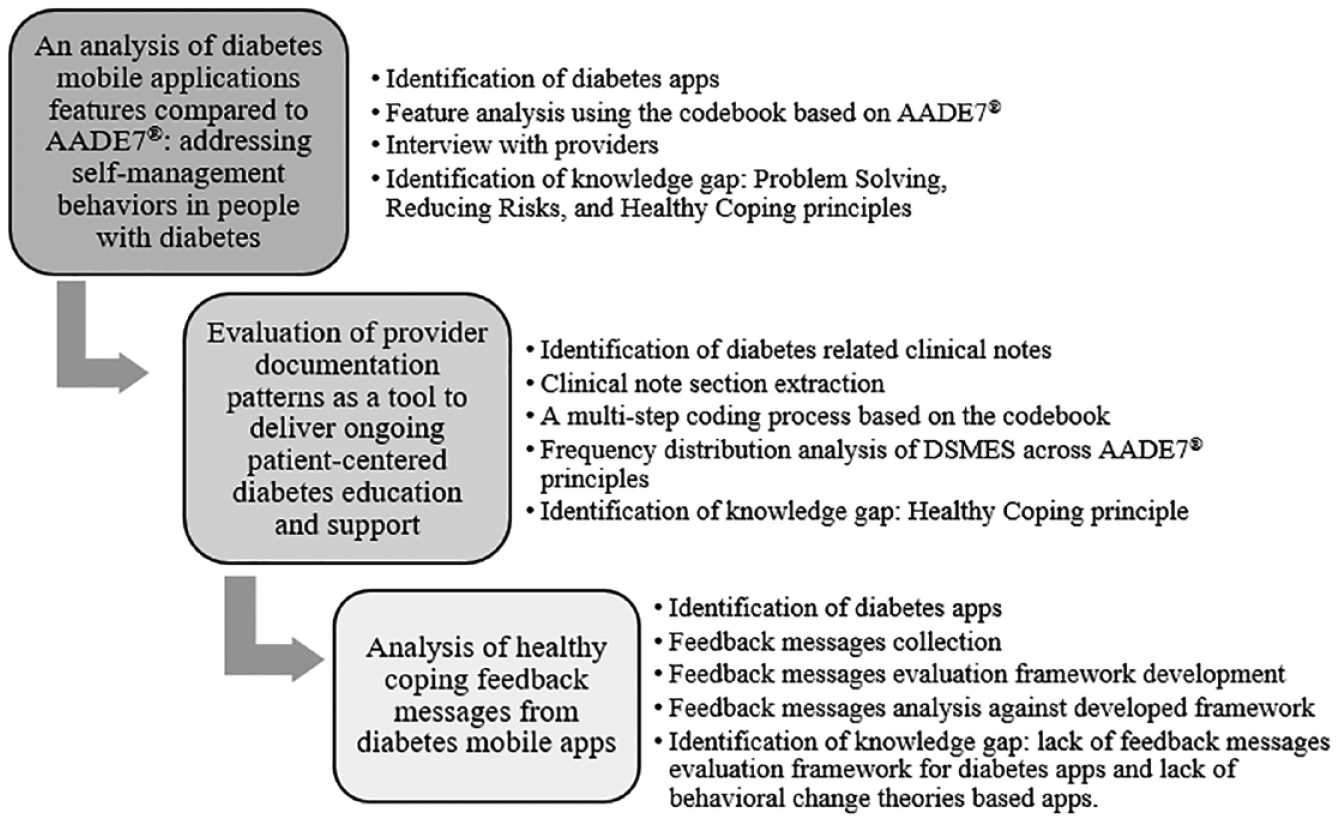
The codebook development and its applications.
These studies focused on creating and validating the codebook for use in a rigorous research setting. Based on our experience, we found the codebook was easy to use objectively, with excellent interoperator validity. This makes it useful not only in HIT-related research but also in real-world scenarios using digital technology in healthcare outcomes. New developments in EHR, including the use of clinical care pathways and patient portals, are areas where this codebook can be incorporated into programs for evaluating outcomes. We invite the utilization of the codebook for applying the AADE7 principles to improve clinical outcomes for people with DM.
Study 1: Application of the Codebook for Analysis of Features of Diabetes Mobile Application (Mobile Apps)
DSMES is a daily task and requires support between office visits on an ongoing basis. People with diabetes can benefit from using diabetes apps, and mobile apps are increasingly used in this area. However, few studies have evaluated the features of diabetes apps against evidence-based guidelines.
In the first study, 19 we systematically examined the content and functionality of current diabetes apps by utilizing a multi-step review process of two online stores with major market share (iTunes and Google Play). We analyzed and classified the features of each app according to the codebook developed by the team based on the AADE7 (Table 1). By applying the codebook, we confirmed a skewed app development trend in 179 eligible apps out of 750 apps searched. The majority of the apps were designed to support the principles of Healthy Eating (70%), Monitoring (70%), Taking Medication (51%), and Being Active (36%), all of which require quantitative information. On the other hand, few apps supported principles of Problem Solving (20%), Healthy Coping (9%), and Reducing Risks (4%), all of which need qualitative input to provide management guidance based on more patient-entered data.
Study 2: Using the Codebook to Evaluate Provider Documentation Patterns in EHR Regarding Patient-Centered DSMES for Long-Term Management
For people with diabetes to achieve the clinical and health benefits of DSMES, patients and providers must make decisions about DSMES together. The long-term management should be patient-centered and take into consideration comorbid conditions and social factors.
In the second study,20,21 we investigated whether providers delivered DSMES to adults with DM based on patient characteristics. We analyzed clinic notes of adults with diabetes that are stored in EHR. We compared DSMES items in clinic notes against the codebook based on AADE7 principles. We analyzed 200 clinic notes randomly selected from 2634 notes of adults with diabetes. Two specific sections “History of Present Illness (HPI)” and “Impression and Plan (I&P)” were deemed to be specific for provider-delivered DSMES and not resulting from auto population based on the computer program. A thematic analysis of these specific segments using the codebook revealed 3735 codes related to DSMES in the 200 notes (Figure 2). Monitoring (48%) was addressed most frequently, and Healthy Coping (2%) was addressed least frequently regardless of patient characteristics, including age, comorbidities, body mass index (BMI), and HbA1c. The study was limited to one center so findings cannot be generalized. Current studies do show that providers focus on clinical decision-making regarding drugs choices, rather than DSMES.22,23 We believe this information is thought-provoking and may indicate that in a busy clinic, it is a challenge for providers to deliver patient-centered DSMES effectively during the limited visit time.24-27 Consequently, the visit time may be fragmented and insufficient for providers to educate patients on individual DSMES topics. Further studies are needed to assess the clinic notes as an educational tool. The 21st Century Cures Act provides access to clinic notes for all patients. 28 This is also an opportunity to develop HIT protocol focusing on DSMES incorporated into clinic notes and provide an additional educational tool for patients.
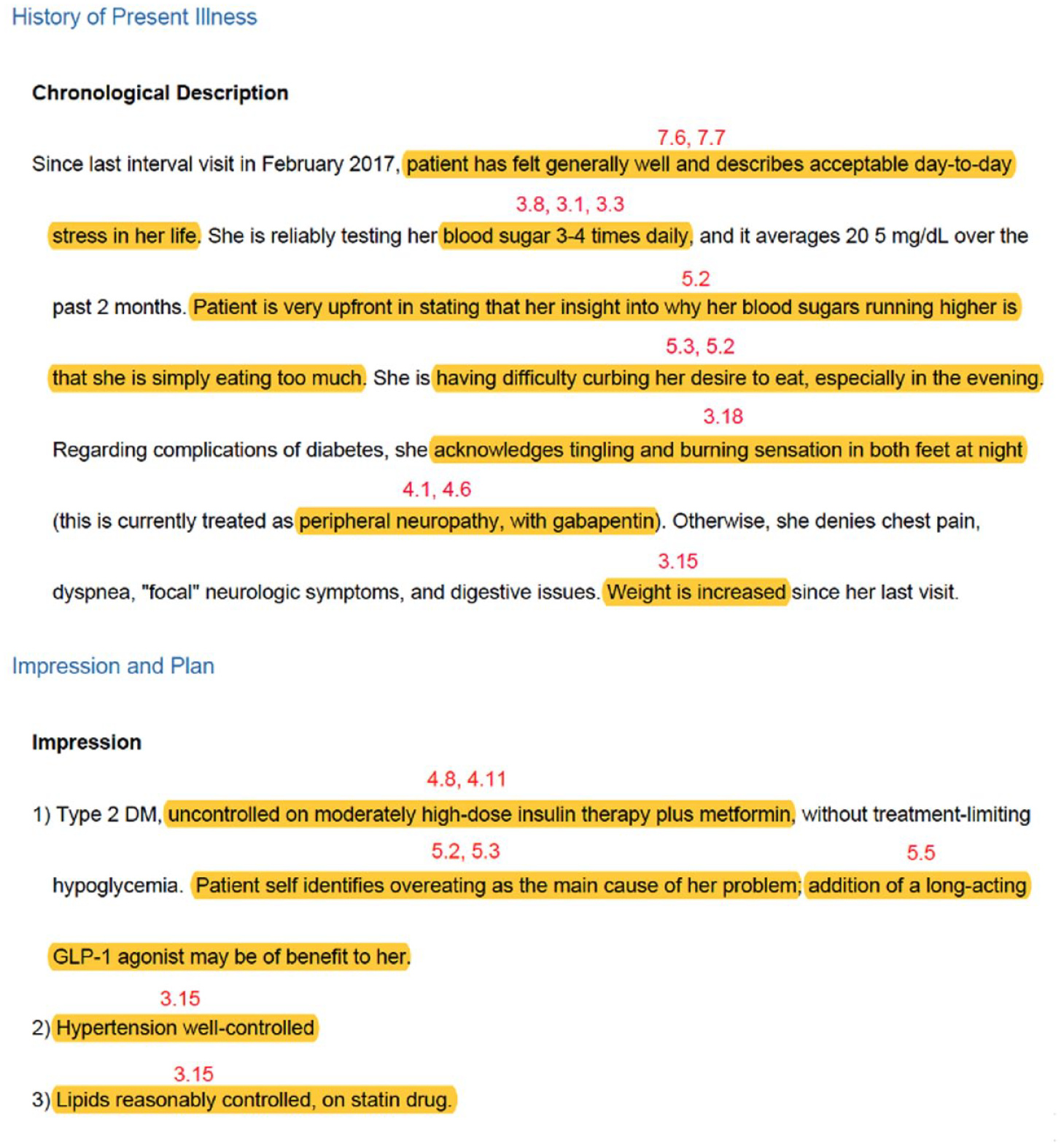
An example of clinical note analysis against the codebook.
Study 3: Analysis of Feedback Messages From Diabetes Mobile Apps Using the Codebook
Behavioral change theory-based feedback messages delivered in diabetes apps can be an effective way to provide DSMES to people with diabetes. Based on our experience as described in the previous two studies, we found that Healthy Coping, an important principle in DSMES, was underutilized. We evaluated the codebook to answer a targeted question to address Healthy Coping in mobile app messages.
In the third study,29,30 we focused on Healthy Coping-related feedback messages from diabetes mobile apps against the theoretical framework based on behavioral change theories. We used a framework by adopting validated behavioral change theory-based models and analyzed the feedback messages against three dimensions of timing, intention, and content (feedback response and feedback purpose). The feedback purposes were further categorized into seven purposes: warning, suggestion, self-monitoring, acknowledging, reinforcement, goal setting, and behavior contract. We identified 1749 apps from iTunes and Google Play stores, and found 156 eligible apps that generated a total of 473 feedback messages. The majority of feedback messages generated were about blood glucose under the diabetes-related measures domain (219, 46.3%), followed by messages about the mood domain (128, 27.0%). Only feedback messages on blood glucose under diabetes-related measures and mood domains encompassed all seven feedback purposes under the content dimension. Overall, few feedback messages generated supported the purposes of warning (39, 8.3%), suggestion (38, 8.0%), goal setting (36, 7.6%), behavioral contract (10, 2.1%), and reinforcement (8, 1.7%) across the three Healthy Coping domains.
Conclusion
We found that our codebook based on AADE7 could be instrumental in applying DSMES principles for the purposes of health data research and real-world management of people with diabetes. With the increasing prevalence of DM, and broader adoption of EHR by providers and patients, there is a need for evaluation DSMES in people with diabetes in both the research and clinical setting. Tools that allow for objective assessment in a variety of clinical settings may have a significant impact on patient-centered care in people with DM. We present this codebook based on AADE7 principles as a tool for HIT clinical research and incorporation into mobile applications and EHR-based clinical care pathways. We invite feedback from the healthcare provider community to extend the use of the validated AADE7 principles in a broad area of clinical application.
Footnotes
Abbreviations
AADE7, American Association of Diabetes Educators; DM, diabetes mellitus; DSMES, diabetes self-management education and support; EHR; electronic health records; HIT, health information technology.
Declaration of Conflicting Interests
The author(s) declared no potential conflicts of interest with respect to the research, authorship, and/or publication of this article.
Funding
The author(s) disclosed receipt of the following financial support for the research, authorship, and/or publication of this article: National Institute of Diabetes and Digestive and Kidney Disorders (NIDDK) P30DK092950 from Center for Diabetes Translation Research (CDTR) Pilot & Feasibility (P&F) program grant and University of Missouri Research Council grant URC-19-153 were available when this project was conducted.
