



Abstract

Optimal diabetes management during pregnancy requires intensive glucose monitoring, medication adjustment and frequent communication with providers. 1 Telemedicine strategies have been increasingly used to manage diabetes in pregnancy.2,3 Unfortunately, many of these methods depend on reliable patient access to cellular services and wireless internet. Cellular-enabled blood glucose meters (BGM) provide real time glucose monitoring data and obviate the need for personal cell phones, data plans and internet access. These meters have been adopted outside of pregnancy to reduce patient and provider burdens of care. In addition, glucose values are uploaded in real time to a secure website for immediate evaluation by the medical care team. Patient satisfaction with cellular-enabled BGM compared to standard BGM has not been assessed in pregnancy. Our aim was to determine patient satisfaction with using a cellular-enabled BGM compared to standard BGM during pregnancy.
Women with diabetes (gestational, type 1 and type 2) were surveyed following delivery but prior to hospital discharge (n = 100). This project was reviewed by the University of Iowa Institutional Review Board and deemed exempt (IRB No 201509749). We used a modified version of the validated Oxford Maternity Diabetes Treatment Satisfaction Questionnaire. 4 Survey response rate was 94%. This validated survey addresses patients’ satisfaction with diabetes control, use of glucose monitoring equipment, life style fit, overall understanding of diabetes and communication and relationship with the care team. 4 Survey responses on a 5-part Likert-type scale were analyzed using a Mann-Whitney two sample test.
Women who utilized a cellular-enabled BGM reported significantly more satisfaction with lifestyle fit (P = .001) and equipment (P = .022) compared to those using standard BGM (Figure 1). Trends of improved perception of diabetes control, relationship and communication with the healthcare team, and overall experience with the cellular-enabled BGM were noted, though these differences did not reach statistical significance. Of note, the same multidisciplinary team consisting of physicians, advanced practitioners, and nurses made weekly contact with both groups of women for blood glucose review and possible medication adjustments.
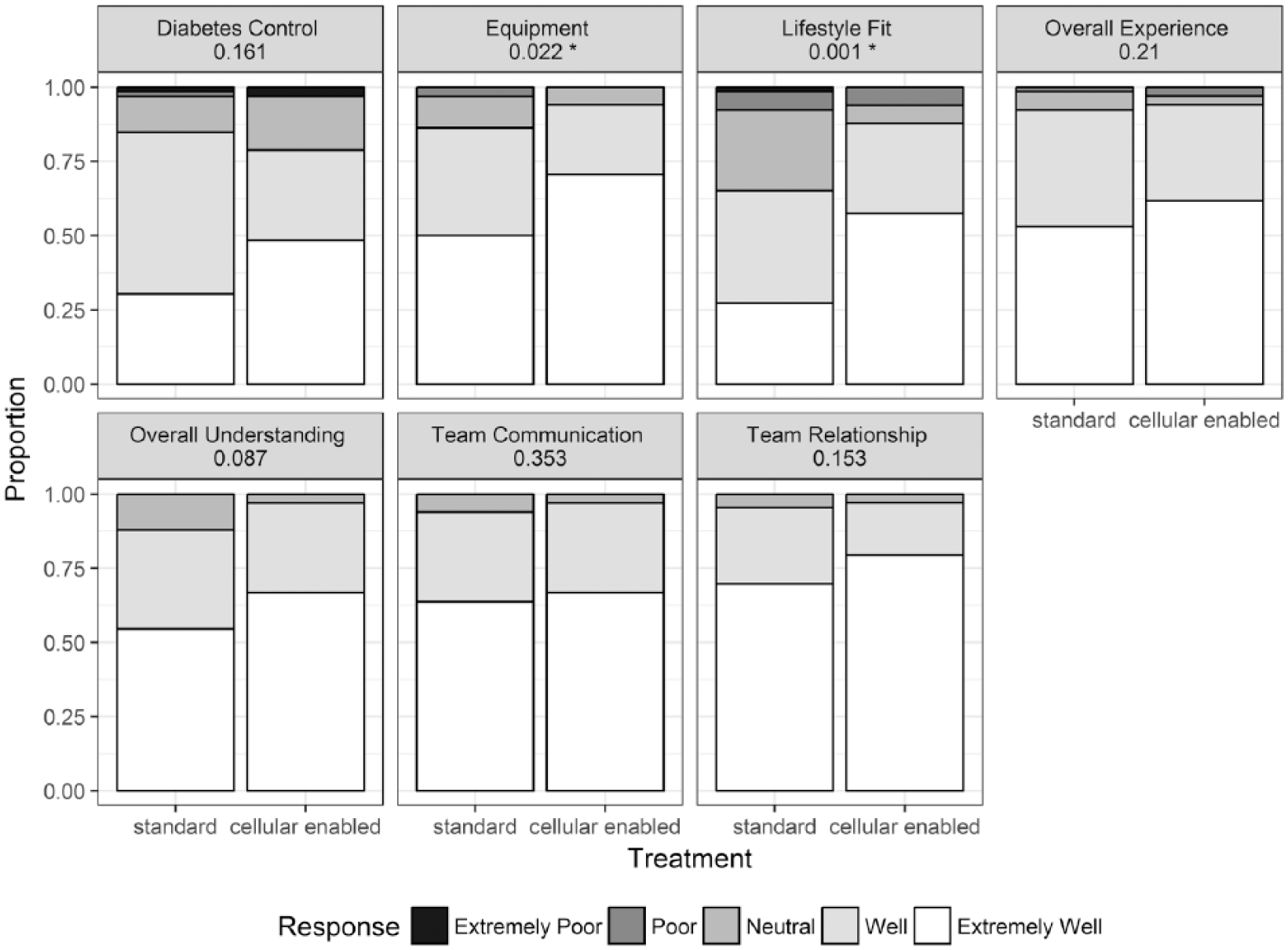
Patient satisfaction survey results of 7 questions related to diabetes management during pregnancy. The P values are displayed for each question. Women who utilized a cellular-enabled blood glucose meter reported significantly higher satisfaction with lifestyle fit (P = .001) and equipment (P = .022) compared to those using standard blood glucose meters.
Women describe significant burdens associated with the testing and reporting of blood glucose values in pregnancy. Efforts geared towards easing patient and provider burdens of care have increasingly employed telemedicine strategies to provide health services at a distance. Whether cellular-enabled BGM can significantly improve maternal glucose control in pregnancy and perinatal outcomes remains to be determined. However, when up to 37% of blood glucose values are falsified in pregnancy, 5 cellular-enabled BGM could play a critical role in providing more accurate and timely glucose values to care teams and provide a basis for better decision making and clinical management.
This work shows that cellular-enabled BGM increased patient satisfaction with several aspects of glucose management in pregnancy. Further studies are needed to assess whether programs employing this technology have improved perinatal outcomes, efficiency, and provider satisfaction.
Footnotes
Abbreviation
BGM, blood glucose meter.
Declaration of Conflicting Interests
The author(s) declared no potential conflicts of interest with respect to the research, authorship, and/or publication of this article.
Funding
The author(s) received no financial support for the research, authorship, and/or publication of this article.
