



Abstract

Keywords
Fructosamine is formed by the glycation of plasma proteins, mostly albumin but also immunoglobulins and other proteins. 1 In conditions where HbA1c measurement is unreliable,1,2 fructosamine is a recommended alternative glycemic biomarker.1,2 Unlike HbA1c, the effects of nonglycemic variables on fructosamine are largely unknown. Acute illness has no effect on HbA1c,3,4 but its effect on fructosamine has never been studied. We, therefore, investigated the effect of an acute phase response (APR), as provoked by elective orthopedic surgery, on fructosamine.
Twenty-nine nondiabetic patients (12 female; 70.1 [9.1] years) gave informed written consent to participate in this study approved by the National Research Ethics Service. Blood samples were collected before and 48 hours after surgery. Plasma glucose was measured and separated serum aliquoted and frozen until analyzed.
CRP (immunoturbidimetry), albumin (bromocresol purple), total protein (biuret) and glucose (hexokinase/glucose-6-phosphate dehydrogenase) were measured using reagents supplied by Abbott diagnostics on the Abbott ARCHITECT c16000 analyzer (Abbott Diagnostics, Abbott Park, IL, USA). Fructosamine (nitrotetrazolium blue method) was measured on the ARCHITECT c16000 analyzer using Roche reagents (Roche Diagnostics, Mannheim, Germany GmbH). Globulin is the difference between total protein and albumin concentrations. Corrected fructosamine was calculated using the equation: Corrected fructosamine [µmol/L] = (Measured fructosamine [µmol/L] ÷ Total protein [g/L]) x 72. 5
CRP data were nonparametric but were normally distributed following logarithmic transformation. Other data were parametric. Student’s t-test assessed the significance of pre- and postoperative differences in variables. Pearson’s linear correlation assessed the significance of association between variables. Data (including pretransformed CRP data) are expressed as means with standard deviations in parentheses.
Following surgery CRP and glucose increased, whereas fructosamine, albumin, and total protein decreased. Corrected fructosamine and globulin remained unchanged (Table 1). Logarithmic CRP correlated with fructosamine (r = –.3745, P = .0038), total protein (r = –.4279, P = .0008), albumin (r = –.7033, P < .0001) and glucose (r = .5665, P < .0001) but not with corrected fructosamine (r = .02638, P = .8441) or globulin (r = .02048, P = .8787).
Mean (SD) Biochemical Serum/Plasma Data in 29 Patients Before and 48 Hours After Elective Knee or Hip Surgery.
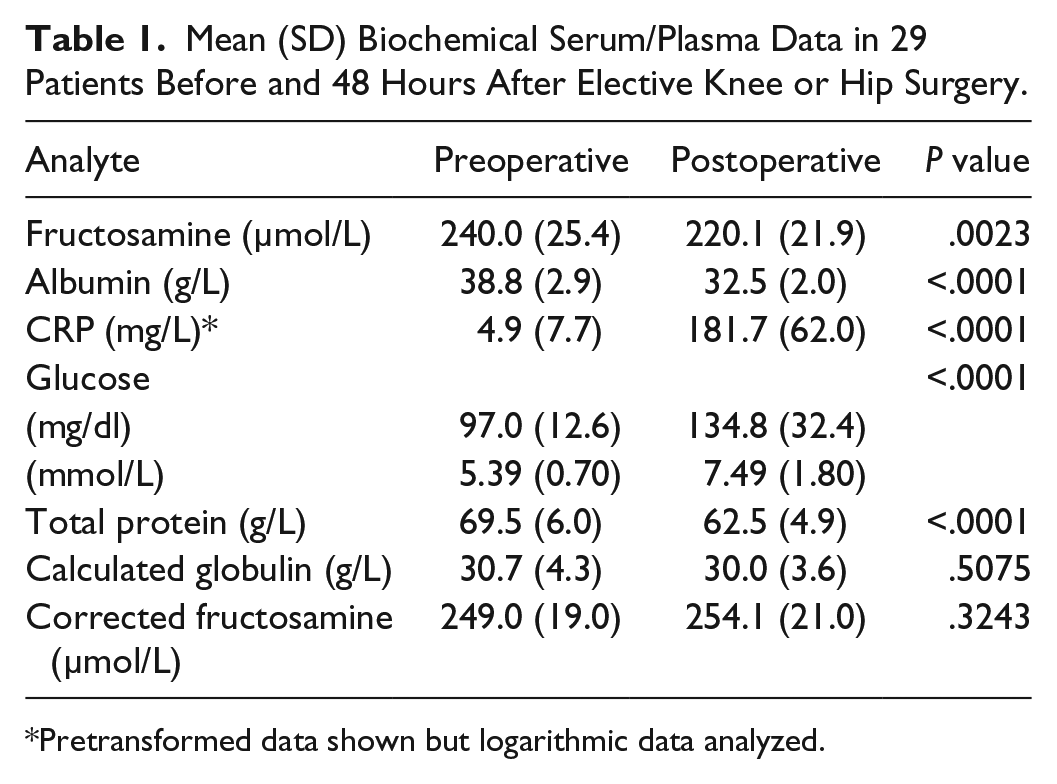
Pretransformed data shown but logarithmic data analyzed.
These data confirm an APR and are consistent with an APR-induced stress hyperglycemia. The data also confirm albumin and total protein to be negative acute phase reactants. Although not previously reported, our data indicate that fructosamine is also a negative acute phase reactant. Corrected fructosamine, however, was unaffected by surgery suggesting that it may be a reliable measure of average glycemia in acute illness but this requires further investigation.
This study has limitations. The longer term effect of an APR on fructosamine and corrected fructosamine requires further study. Although unlikely, the effects on fructosamine of the surgically induced APR reported in this study may not be applicable to an APR triggered by other acute nonsurgical inflammatory insults.
Fructosamine is a negative acute phase reactant and should not be used as glycemic biomarker in acutely ill patients. In circumstances where HbA1c is not valid,1,2 corrected fructosamine may be a useful glycemic biomarker in acute illness and may help differentiate stress hyperglycemia from type 2 diabetes in patients presenting with new onset hyperglycemia.
Footnotes
Acknowledgements
We thank Mr Pemmaraju and Mr Hart for allowing us to recruit patients under their clinical care.
Abbreviations
APR, acute phase response; CRP, C-reactive protein; HbA1c, glycated haemoglobin; T2DM, type 2 diabetes.
Declaration of Conflicting Interests
The author(s) declared no potential conflicts of interest with respect to the research, authorship, and/or publication of this article.
Funding
The author(s) received no financial support for the research, authorship, and/or publication of this article.