




Abstract
In the past decade diabetes management has been transformed by the addition of continuous glucose monitoring and insulin pump data. More recently, a wide variety of functions and physiologic variables, such as heart rate, hours of sleep, number of steps walked and movement, have been available through wristbands or watches. New data, hydration, geolocation, and barometric pressure, among others, will be incorporated in the future. All these parameters, when analyzed, can be helpful for patients and doctors’ decision support. Similar new scenarios have appeared in most medical fields, in such a way that in recent years, there has been an increased interest in the development and application of the methods of artificial intelligence (AI) to decision support and knowledge acquisition. Multidisciplinary research teams integrated by computer engineers and doctors are more and more frequent, mirroring the need of cooperation in this new topic. AI, as a science, can be defined as the ability to make computers do things that would require intelligence if done by humans. Increasingly, diabetes-related journals have been incorporating publications focused on AI tools applied to diabetes. In summary, diabetes management scenarios have suffered a deep transformation that forces diabetologists to incorporate skills from new areas. This recently needed knowledge includes AI tools, which have become part of the diabetes health care. The aim of this article is to explain in an easy and plane way the most used AI methodologies to promote the implication of health care providers—doctors and nurses—in this field.
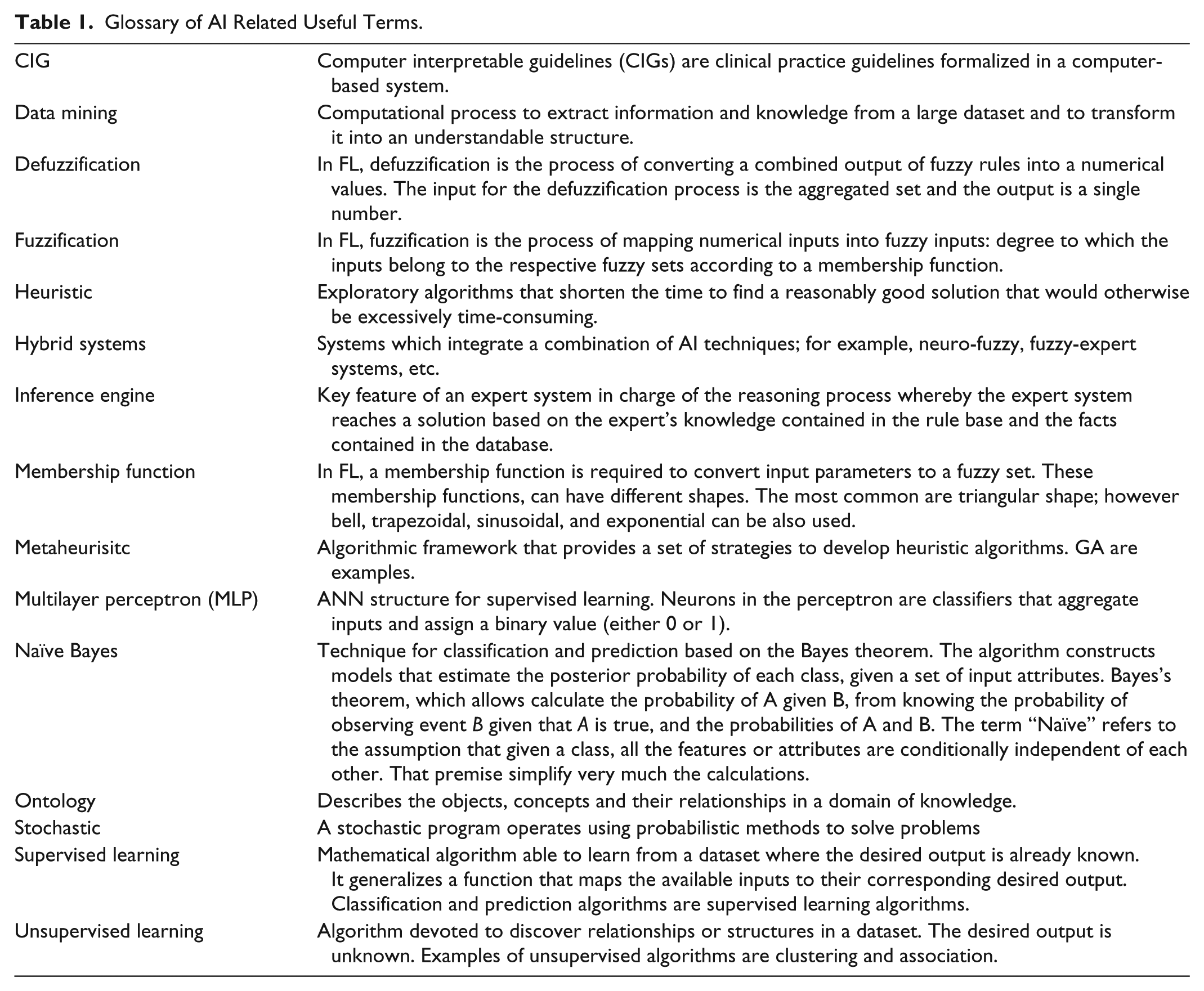
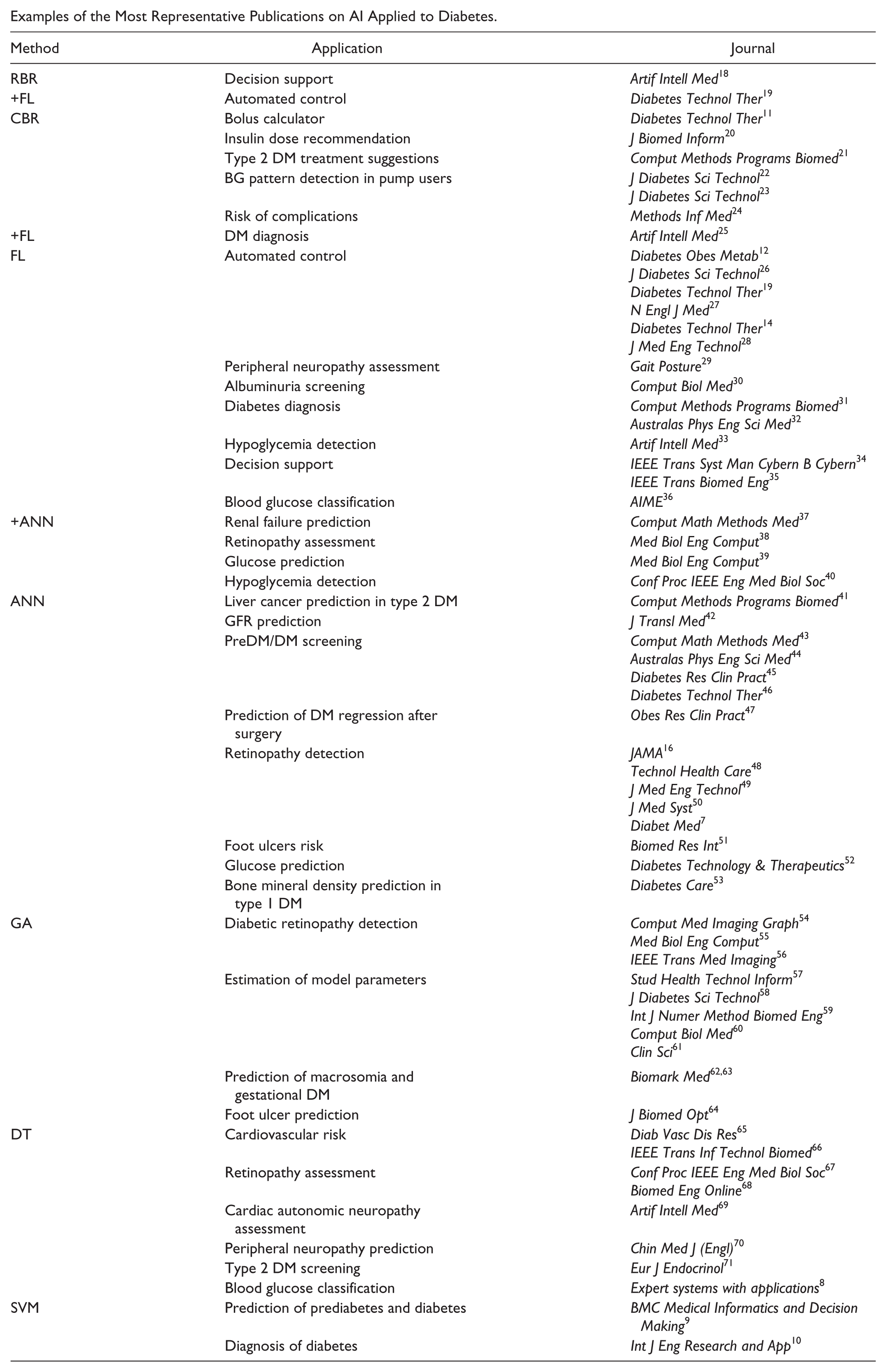
Artificial intelligence (AI) has been defined in many ways. Currently, the most accepted definition is the one made by Boden: 1 the ability to make computers do things that would require intelligence if done by humans. It is also not trivial to define intelligence. Intelligence is usually defined as a group of abilities such as understanding, learning and reasoning to make decisions and to solve problems. AI emulates these aspects of human intelligence by means of a number of tools. The aim of this review is to list and explain the most frequently used AI tools in simple words to facilitate understanding. AI methodologies and techniques have been applied to medicine and health in general over the past decades. Diagnosis, classification, therapy and robotics, among others, are common AI medical applications. Among the variety of different AI technologies, neural networks 2 and fuzzy logic (FL) are the most often used ones to date. However, there are other techniques and methodologies, which have been also selected and included in this review due to their relevance. In addition, a glossary of useful terms has been included (Table 1) as well as a list of examples of the most representative publications on AI applied to diabetes (appendix).
Glossary of AI Related Useful Terms.
AI Methodologies
Expert Systems in Medicine
Expert systems (ES) correspond to the most common type of AI system in routine clinical use. They are defined as systems with the ability to capture expert knowledge, facts and reasoning techniques to help care providers in routine work. ES attempt to mimic clinician’s expertise by applying inference methods to help in decision support or problem solving. ES have the ability to manage data to come up with reasoned conclusions. Uses of ES include image interpretation, diagnosis support and alarms generation, among other utilities.
Key features of an ES are:
A knowledge acquisition system: The system used to gather the knowledge and the rules used by the ES to solve the proposed problems. This process can be made either through direct input by the expert or the knowledge engineer or based on a database of past case studies and their results.
A knowledge base: It stores the knowledge and rules about the specific problem to be solved by the ES.
An inference engine: The control system that implements the knowledge and rules held within the knowledge base to the data, performing the reasoning process.
Rule-based reasoning (RBR), case-based reasoning (CBR), and fuzzy systems are the most common ES used in the diabetes domain.
RBR
RBR is based on the transfer of knowledge from an expert to a computer. As a consequence, the computer has to be able to find solutions to problems that otherwise should be solved by an expert. Knowledge is represented in statements in the form “if-then,” in such a way that the line of reasoning can be explained. The process of knowledge acquisition starts with a number of interviews between the expert and the knowledge engineer who will end up building and testing the ES. During these interviews, the domain expert establishes all the possible options and the engineer encodes this knowledge to become “computer interpretable.”
CBR
CBR finds solutions to new problems by adapting previously good solutions to similar problems. Case studies features need to be specified to be helpful in retrieving other cases. At the same time, features have to be discriminative enough to avoid the retrieval of cases studies which could lead to wrong solutions because of being too different. Unlike RBR, CBR does not require an explicit domain model, but just to identify new cases with significant features, which is in fact the way CBR “learns.”
CBR procedures are usually explained as the so called “CBR working cycle”, which includes five steps: (1) current problem description; (2) search for a successful solution of a similar case; (3) adaptation and reuse of the solution to the new problem; (4) evaluation; and (5) confirmed solution storage. The main CBR limitations are related to the need to get huge case studies databases, which could include nonrelevant information and make the retrieval often excessively time-consuming.
FL
Fuzzy ES are used for representing, in a computer-understandable way, expert knowledge that uses ambiguous terms. Thinking in terms of conventional logic, a blood glucose range >180 mg/dl is high and a range <80 mg/dl is low. This classification is not particularly useful for making decisions. In real life a blood glucose value of 181 mg/dl in most cases deserves a different action with respect to 281 mg/dl. In other words—in fuzzy words—181 mg/dl is high but almost acceptable while 281 mg/dl is very high and far from being acceptable. FL expresses this ambiguity assigning a certain degree of membership to different categories. In our previous example, we could say that 181 mg/dl pertains 70% to the category of “high” but only 30% to the category of “very high.”
Machine Learning
Machine learning (ML) algorithms are characterized by the ability to learn over time without being explicitly programmed. The main features of ML are problem solving usually based on a classification of data. There has been a gradual switch from heuristic approaches toward ML techniques. In the field of data mining, ML algorithms are being used to discover valuable knowledge from large databases such as in electronic medical records, which might include implicit regularities. Also ML can be applied to domains where a computer program needs to dynamically adapt to changing conditions. For example ML algorithms are useful to learn from each patient monitoring data and adapt along time in an artificial pancreas system.
ML draws on results from AI, probability and statistics, computational complexity theory, control theory, information theory, philosophy, psychology, neurobiology, and so on. 3
Methods in ML include decision trees (DT), artificial neural networks (ANN), genetic algorithms (GA), or support vector machines (SVM). All of them have been successfully applied in the field of diabetes.
ANN
ANN are based on the human brain function, that means, interconnected neurons. Each neuron, the simple unit, receives several inputs and generates only one output. Each connection has assigned a weight related with the importance of the output. The neural network “learns” by training with known inputs, comparing actual output with the known one and using the error to adjust weights. Thus, the links which produce right answers are strengthened and those which generate wrong answers, weakened.
When using a library of existing neural networks, the most common is that in the training process we obtain information about how the algorithm works in the form of a mean square error (MSE). For each example, the ANN evaluates the error in all its output neurons, raises each of those numbers squared, and finally the average is calculated. Using MSE, errors are always positive and the errors of some neurons do not nullify those of others.
Deep learning
Deep learning is a new branch of ML based on neuron behavior inside of human brains. It can be considered and evolution of ANN, it utilizes a hierarchical level of ANN to carry out the process of classification. Deep learning algorithms are particularly powerful in learning processes and provide a high degree of intelligence to systems based on them. In deep neural networks, the deep refers to the factor that multiple layers of processing transform the input data (whether it’s images, speech, or text) into some output useful for making decisions.
GA
GA belong to the so called “evolutionary computation” and were defined by John Holland almost 50 years ago. 4 GA simulate natural selection by creating a population of individuals (solutions) for optimization problems. The new solutions are obtained from operating “genetically” the initial population. The chromosome (set of “genes”) is represented as a string of 0 s and 1 s.
Once an initial population of chromosomes is generated, the first step is just to calculate the fitness of each chromosome. The fitness function value quantifies the optimality of a solution ranking it against the other solutions. If the solution created is not optimal, then a pair of chromosomes is selected for exchanging parts (crossover) and creates two offspring chromosomes. In the next step, a mutation randomly changes at least one gene in the chromosomes. The initial population is replaced with the new population and a new iteration starts. GA iterations end when one of the termination criteria (usually a predefined number of iterations) is satisfied. In the end, the more fit chromosomes survive.
DT
DT constitute a graphical representation of a dataset that describes the data by tree-like structures, which provides a very intuitive way of representing and understanding rules. A decision tree is composed of nodes, branches and leaves. A node represents a decision while a leaf represents an outcome. The DT always starts from the root node and grows down by splitting the data at each level into new nodes. DT are particularly good at solving classification problems.
DT are most often created based on a learning algorithm able to extract the knowledge accumulated in a specific dataset. After the DT structure has been defined, the knowledge can also be represented as sets of if-then rules to improve human readability. Some of the most widely used algorithms are ID3 5 and C4.5. 6
DT have been successfully applied in diabetes to a broad range of tasks such as screening in type 2 diabetes 7 and blood glucose classification. 8
SVM
SVM are currently one of the most popular, flexible and powerful ML algorithms used for classification.
SVM are maximum-distance classification algorithms. They define an hyperplane to separate two classes above and below it, providing the maximal distance between the classifying plane and the closest data points. The points that are closest to the border are called “support vectors.” In its most basic formulation, SVM can only work with binary classification problems but, with a relatively simple extension, they can also solve multiclass classification tasks.
In the field of diabetes, SVM have been used to predict prediabetes and diabetes disease 9 and in diabetes diagnosis. 10
AI Technologies and Diabetes: Areas of Application
All the AI technologies explained in section 1 have been applied to different areas of diabetes management (see the appendix). In this section some examples of these applications are going to be summarized to improve the overall understanding of their utility.
Decision Support for Patients Using CBR
One of the most relevant experiences on the application of ES to decision support for patients has been performed by researchers from the Imperial College in London. They have developed and tested a bolus calculator algorithm based on CBR. This system uses continuous glucose monitoring data and is implemented in the patients smartphone. A pilot feasibility study has been published 11 showing the potential benefits of this tool over conventional bolus calculators.
Closed-Loop Systems Based on FL
Apart from proportional derivative integral (PID) and model predictive control (MPC), FL-based algorithms have been successfully used for closed-loop studies, even in the ambulatory setting. 12
One of the first publications including FL for closed-loop system was done by Mauseth et al in 2010. The controller used as inputs BG and the rate of change of glucose. 13 Using a matrix the system assigned a coefficient which after defuzzification proposed insulin microbolus. Three years later the system was tested in an pilot study with good results. 14
Computer Interpretable Guidelines (CIGs) Applied to Gestational Diabetes Management
Clinical practice guidelines are worthy instruments for quality of care improvement. Through formalization as CIGs using a complex RBR system, decision-support tools can be developed.
Clinical experience with gestational diabetes CIGs used for patients and doctors decision support is shown in another article included in this special section of the journal. 15 In brief, a pilot study shown a high degree of patients’ satisfaction and higher compliance with blood glucose monitoring in comparison with usual care based on face-to-face visits.
Retinopathy Detection Using ANN
Recently, deep learning ANN has shown to identify diabetic retinopathy or diabetic macular edema in retinal fundus images with high sensitivity and high specificity. 16 The authors have developed an algorithm that computes diabetic retinopathy severity from the intensity of the pixels in a fundus picture. The function was trained with a large set of images and then evaluated at one operating point selected for high specificity and a second operating point for high sensitivity obtaining very high scores.
Conclusion
Diabetology needs to suffer an adaptation process to incorporate new tools for diabetes management. Technology and particularly sensors and computer applications have become a key instrument in diabetes management for health care providers and patients. Although modern diabetes care units should include a diabetes technologist 17 for dealing with technology, doctors and nurses cannot ignore the basics to better find solutions to each patient circumstances. Knowledge on insulin pumps and more recently on glucose sensors has been increasing progressively; however, comprehension about AI and smart applications performance remains largely inadequate. This article provides a general overview of the elementary concepts, definitions, and terminology frequently used in AI-related applications as well as a list of relevant publications of AI applied to diabetes.
Footnotes
Appendix
Examples of the Most Representative Publications on AI Applied to Diabetes.
| Method | Application | Journal |
|---|---|---|
| RBR | Decision support | Artif Intell Med 18 |
| +FL | Automated control | Diabetes Technol Ther 19 |
| CBR | Bolus calculator | Diabetes Technol Ther 11 |
| Insulin dose recommendation | J Biomed Inform 20 | |
| Type 2 DM treatment suggestions | Comput Methods Programs Biomed 21 | |
| BG pattern detection in pump users |
J Diabetes Sci Technol
22
|
|
| Risk of complications | Methods Inf Med 24 | |
| +FL | DM diagnosis | Artif Intell Med 25 |
| FL | Automated control |
Diabetes Obes Metab
12
|
| Peripheral neuropathy assessment | Gait Posture 29 | |
| Albuminuria screening | Comput Biol Med 30 | |
| Diabetes diagnosis |
Comput Methods Programs Biomed
31
|
|
| Hypoglycemia detection | Artif Intell Med 33 | |
| Decision support |
IEEE Trans Syst Man Cybern B Cybern
34
|
|
| Blood glucose classification | AIME 36 | |
| +ANN | Renal failure prediction | Comput Math Methods Med 37 |
| Retinopathy assessment | Med Biol Eng Comput 38 | |
| Glucose prediction | Med Biol Eng Comput 39 | |
| Hypoglycemia detection | Conf Proc IEEE Eng Med Biol Soc 40 | |
| ANN | Liver cancer prediction in type 2 DM | Comput Methods Programs Biomed 41 |
| GFR prediction | J Transl Med 42 | |
| PreDM/DM screening |
Comput Math Methods Med
43
|
|
| Prediction of DM regression after surgery | Obes Res Clin Pract 47 | |
| Retinopathy detection |
JAMA
16
|
|
| Foot ulcers risk | Biomed Res Int 51 | |
| Glucose prediction | Diabetes Technology & Therapeutics 52 | |
| Bone mineral density prediction in type 1 DM | Diabetes Care 53 | |
| GA | Diabetic retinopathy detection |
Comput Med Imaging Graph
54
|
| Estimation of model parameters |
Stud Health Technol Inform
57
|
|
| Prediction of macrosomia and gestational DM | Biomark Med 62,63 | |
| Foot ulcer prediction | J Biomed Opt 64 | |
| DT | Cardiovascular risk |
Diab Vasc Dis Res
65
|
| Retinopathy assessment |
Conf Proc IEEE Eng Med Biol Soc
67
|
|
| Cardiac autonomic neuropathy assessment | Artif Intell Med 69 | |
| Peripheral neuropathy prediction | Chin Med J (Engl) 70 | |
| Type 2 DM screening | Eur J Endocrinol 71 | |
| Blood glucose classification | Expert systems with applications 8 | |
| SVM | Prediction of prediabetes and diabetes | BMC Medical Informatics and Decision Making 9 |
| Diagnosis of diabetes | Int J Eng Research and App 10 |
Abbreviations
AI, artificial intelligence; ANN, artificial neural network; CBR, case-based reasoning; CIG, computer interpretables guidelines; DT, decision trees; ES, expert systems; FL, fuzzy logic; GA, genetic algorithms; ML, machine learning; MLP, multilayer perceptron; MSE, mean square error; RBR, rule-based reasoning; SVM, support vector machines.
Declaration of Conflicting Interests
The author(s) declared no potential conflicts of interest with respect to the research, authorship, and/or publication of this article.
Funding
The author(s) received no financial support for the research, authorship, and/or publication of this article.