




Abstract

A “difficult-to-handle” diabetic patient, on treatment with continuous subcutaneous insulin infusion (CSII), recently drove my attention to infusion set problems. CB, aged 46, has suffered from type 1 diabetes (T1D) since when he was 26. He has always been a slender sportsman, with slim, but muscular abdomen. Initially treated with multiple daily insulin (MDI) therapy, he recently moved from MDI to CSII (MiniMed-VEO insulin pump, connected with Silhouette® Paradigm® infusion set, with periodical integrated continuous glucose monitoring for real-time glucose readings and long-term trends; Medtronic MiniMed, Northridge, CA, USA) to achieve a better metabolic control. Basal insulin delivery ranged from 14 to 16 IU/day, boluses accounted for 15-18 IU/day. Nevertheless, A1c remained high (last year mean value: 8.9% = 74mmol/mol). Sensor monitoring revealed glucose variability immediately after some set changes. So, attention was pointed to flow interruptions or silent occlusions, because these are well-known conditions leading to instable insulin flow and to hyperglycemic episodes.1,2 Insulin infusion cannula insertion sites were planned, as the patient was previously taught during the educational period: abdomen (avoiding bony prominence, and umbilicus), and posterior-lateral aspect of both upper buttocks and flanks were selected. Healthy subcutaneous fat tissue zones were chosen, avoiding sites with underlying muscle; no skin irritation or lipodistrophic areas were evident. Infusion cannula sites were rotated in a clockwise manner at every set-change, to avoid complications. In-site duration was settled not to be more than 72 hours, unless infusion problems came along. Nevertheless, glucose variability remained unsatisfactory. A MiniMed® Quick-set® Infusion Set was proposed, but it was not well tolerated because of the right-angle insertion of the needle. Thus, the patient moved back to Silhouette Paradigm infusion set, a soft cannula that can be inserted at a variety of angles, and that is thought to be the ideal choice for those insulin pump users who are lean or live an active lifestyle. The Silhouette 23-inch (60 cm) tubing length with 13 mm cannula length was selected (cannula manufacturer: Unomedical a/s, Lejre, Denmark). Once again, immediately after some set changes, very high levels of glycemia were evident. At this point, used cannula were inspected, observing that, sometimes, the Teflon cladding wrapped itself up on the steel needle (Figure 1). Extremely dry skin was supposed to be the cause of such a rolling-up, so it was proposed to stain the skin area in which the novel set was to be inserted with VEA oil (HULKA S.r.l, Rovigo, Italy). VEA oil is an excipient free E-Vitamin (tocopherol acetate) oil base hydrating, and emollient lotion. 3 The solution, fortunately, worked: A1c improved (actual value 7.3% = 56 mmol/mol), and minor glucose variability was recorded by glucose sensor. In conclusion: a careful observation of infusion set and used needles should always be performed whenever an unexplained glucose variability occurs immediately after a set-change. In presence of a very dry skin, an emollient oil lotion should reduce Teflon crimping on the steel needle.
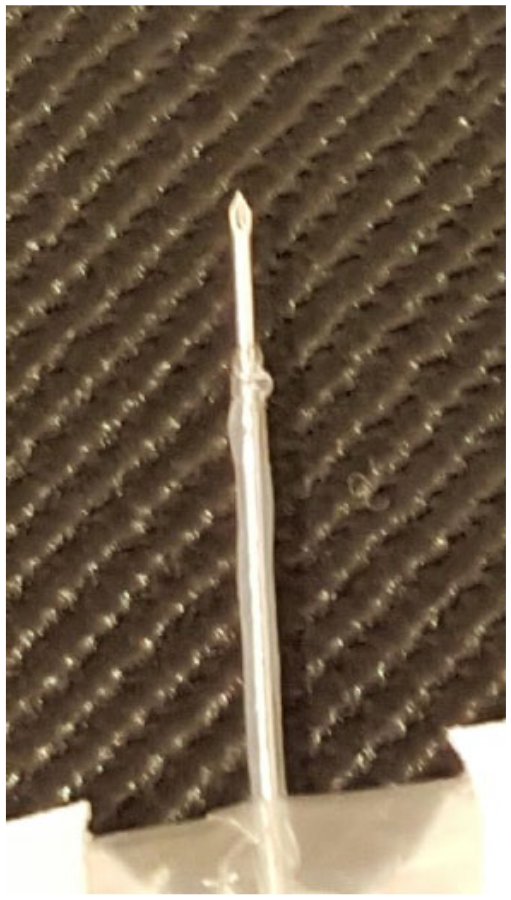
The Teflon cladding wrapped itself up in the steel needle of a Medtronic MiniMed Silhouette Paradigm infusion set. The picture was taken after a single insertion, and subsequent immediate removal.
Footnotes
Abbreviations
CSII, continuous subcutaneous insulin infusion; MDI, multiple daily insulin; T1D, type 1 diabetes.
Declaration of Conflicting Interests
The author(s) declared no potential conflicts of interest with respect to the research, authorship, and/or publication of this article.
Funding
The author(s) received no financial support for the research, authorship, and/or publication of this article.