




Abstract

Personal blood glucose meters (BGM) are used for the determination of glucose mainly by diabetic patients, but glucose meters for self-monitoring are also frequently in use in hospital wards as point-of-care test (POCT) devices. 1 The use of BGM, similarly to other diagnostic in vitro devices, requires permanent quality control (QC). The objective of the study was to analyze the recommendations of the QC performance of the BGM manufacturers and the evaluation of the compatibility of clinical practice with the recommendations.
The manuals of the 27 BGMs, available on the Polish market (Arkray, Bayer, BSI, Bionime, Beurer medical, CSL, Diagnosis, Genexo, I-sense, Johnson & Johnson, MedTrust, Pharmbos, PTS, Roche), were studied in the terms of the QC. The heads of 29 hospital medical laboratories in the Malopolska province (Poland) were obliged to analyze the performance of the QC of BGM used in the hospital’s wards and respond to the detailed questions presented in the questionnaire.
Most of the manufacturers of analyzed BGM recommend to perform the QC upon the first use of the device, and in the case of suspected malfunction of the device or when the test strips do not function properly. Twenty-three (85%) BGM manufacturers recommend performing the QC if the test result is not consistent with the clinical symptoms. A recommended once-a-week QC performance was found only in 5 devices user manuals (19%). Sixteen (59%) companies suggest performing the QC test when a new box/vial of test strips is opened.
Twenty-eight completed questionnaires, representing 96% of the distributed questionnaires, were returned. The internal QC performed, according to the manufacturers’ recommendations, was carried out in 10 (42%) hospitals. Only in 1 hospital (4%) was the QC performed daily. Eleven (46%) of surveyed hospitals do not carried out QC of POCT BGM at all (Figure 1).
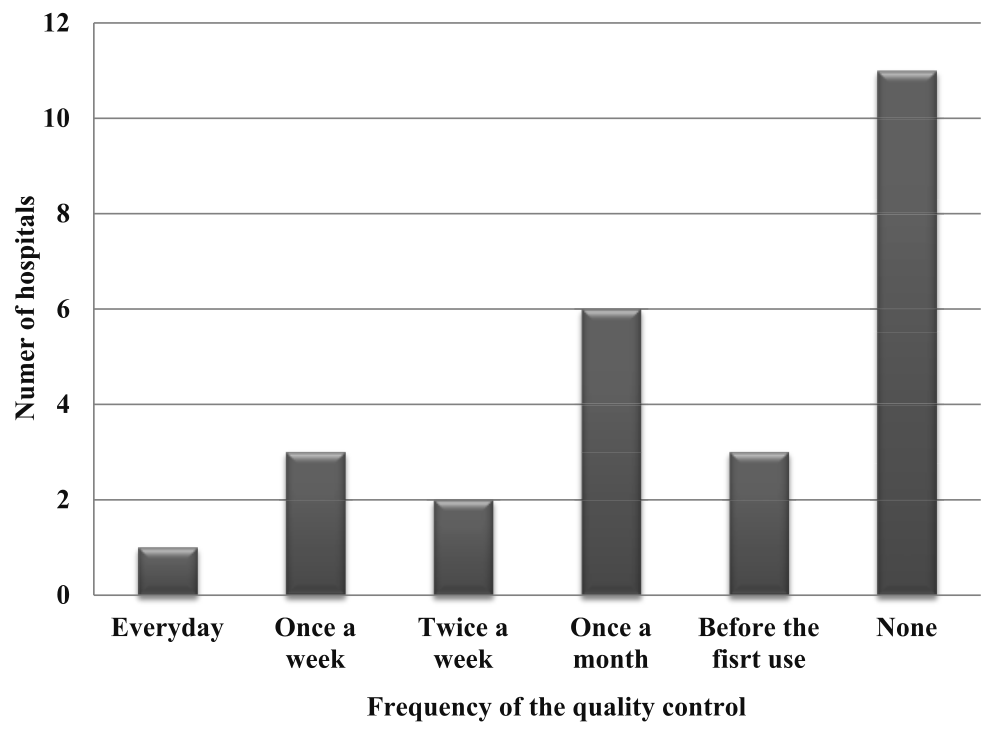
The practice of POCT glucose meters quality control in hospitals in Malopolska province (Poland).
It seems obvious that to receive reliable results of laboratory tests, the proper QC is required. The current standards for QC of BG measurement in laboratory require to perform it on 2 or 3 levels of glucose concentrations, 2 or 3 times every day. In the case of the QC for BGM according to the manufacturers suggestions are low-maintenance, and it is acceptable to perform QC once a week or less. Unfortunately, these nonrestrictive recommendations are not often respected in hospital wards where BGM are used as POCT devices. In many hospitals there is a lack of policy regarding QC for BGM. The potential risk of severe health consequences, when BGM are not properly controlled in the hospital, cannot be ignored.2,3 It is essential to ensure proper hospital policy regarding QC for BGM use in the POCT. Over the past 30 years, experience in clinical chemistry has shown that regular and properly performed control of BG has a beneficial effect on morbidity, mortality of patients, and costs of treatment. 4 Therefore both diabetes associations and manufactures should clearly define unified recommendations for QC for glucose meters in self-monitoring as well as in POCT.
Footnotes
Abbreviations
BG, blood glucose; BGM, blood glucose meter; POCT, point-of-care test; QC, quality control.
Declaration of Conflicting Interests
The author(s) declared no potential conflicts of interest with respect to the research, authorship, and/or publication of this article.
Funding
The author(s) received no financial support for the research, authorship, and/or publication of this article.