




Abstract

Wearable devices are being used increasingly for medical purposes. Smartwatches combine the potential for novel hardware and software solutions to assist patients with diabetes. The importance of smart gadgets for diabetes management was pointed out before. 1 Here, we present how it is possible to use available technologies on smartwatches to reduce the risk of death in unattended diabetic patients, which falls into a coma. To do this, we developed an application for a smartwatch and successfully tested its functionality in a simulated condition on healthy person; however the application is not in app market yet and not used by patients. To reduce mortality risk in diabetic coma, a novel algorithm for smartwatches’ applications was proposed. 2 Such applications finally can inform the patient’s relatives or emergency centers, if the patient does not respond to alarms based on readouts from mobility, heart rate, and skin moisture sensors. An exemplary working logic for such devices is presented in an algorithm flowchart (Figure 1). If the combination of immobility and tachycardia sensed by the accelerometer and heart rate sensor the status of sleeping, resting or coma can be differentiated according to the presented flowchart (more detail can be found in Ref. 2). In addition, some recent smartwatches have been equipped with a humidity sensor, 3 which is located in the watch case and reports environmental humidity changes. Such a sensor is reported to have enough accuracy to detect breathing humidity, which allows a person to interact with a device through blowing into the device (AirTouch™). We hypothesized that this unique property could detect excessive perspiration in diabetic patients, which almost always appears in hypoglycemia. 4 Therefore, sensing the local changes in environmental humidity caused by skin sweating can be used as an input to assess patient condition. However, it needs further validation in simulated experiments with a real sensor.
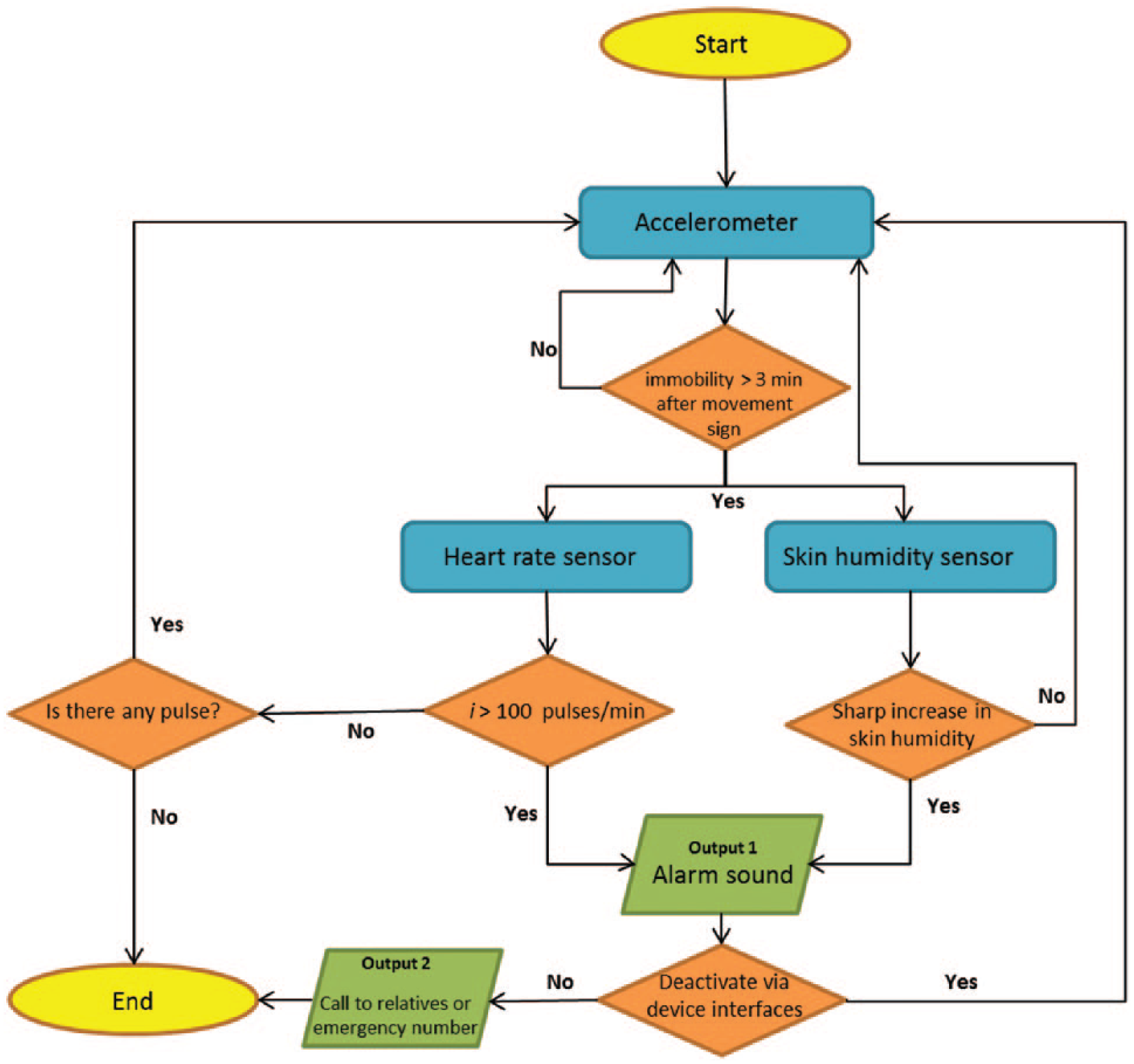
Application’s algorithm flowchart and descriptions.
The current available technologies to reduce the risk of diabetes complications and diabetic coma are based on continuous glucose monitoring. Yet such devices have high initial and maintenance cost. This is the main barrier for diabetic patients to use them in low-income families and developing countries. Therefore, many diabetic patients are vulnerable to diabetic coma and related complications. Since at the moment there are no other means of helping in such incidences, we believe such a health monitoring system could benefit diabetic patients. Moreover, the widespread availability of smartwatches with affordable prices will help similar applications diffuse easily. Finally, we would like to inform the community, NGOs, associations, developers, and manufacturers about the possibility for different wearable smart electronics and smartwatches, qualitatively identify hypoglycemia and warn patients to respond.
Footnotes
Acknowledgements
V.H. would like to thanks Professor Micheal Ristow (ETH Zurich) for his encouraging discussion and comments and Professor Viola Vogel (ETH Zurich) for her support.
Declaration of Conflicting Interests
The author(s) declared no potential conflicts of interest with respect to the research, authorship, and/or publication of this article.
Funding
The author(s) received no financial support for the research, authorship, and/or publication of this article.