



Abstract

Keywords
In Mexico, the Federal Commission for Prevention of Sanitary Risks (COFEPRIS) approved in 2000 the use of insulin glargine for glycemic control in adults and children with type 1 diabetes mellitus and in adults with type 2 diabetes mellitus.
Insulin glargine is a long-acting insulin analog, which has 53 amino acids with a molecular weight (MW) of 6063.0 Da and is produced in Escherichia coli K12 strains. This analog is constituted by A- and B-chain with 21 and 32 amino acids, respectively, linked by 2-disulfide bonds. 1
To develop cost-effective therapies, several manufacturers have been launched to the market biopharmaceuticals containing the same active principle as innovator products whose patent has been expired; these noninnovator products are considered biosimilar drugs when comparable efficacy and safety to the innovator product are demonstrated through structural and physicochemical assessment, as well as preclinical and clinical studies. 2
In Mexico, two insulin glargine formulations are commercially available: the innovator product, Lantus® (LNT), manufactured by Sanofi-Aventis (DF, Mexico), and a noninnovator version, Bonglixan® (BNG), which is manufactured and distributed in Mexico by Landsteiner Scientific (Toluca, Mexico). BNG was registered before the biosimilar regulatory guideline was published in Mexico, 3 therefore a lack of information exist about its structural and physicochemical properties, so here we report an analytical and biological assessment to confirm the properties of BNG compared to LNT as the originator product. Three batches of LNT and two batches of BNG were used. The evaluation was divided into three stages: (1) analytical assessment, including reducing and nonreducing SDS-PAGE, western blot, ESI-Q-TOF-MS, peptide mapping by UPLC-MS, and RP-HPLC, (2) structural analysis, including spectroscopic UV and CD and profiles, and (3) in vivo biological analysis in rabbits (see the Supple-mentary Methods and Information at https://drive.google.com/folderview?id=0BzcpakuIk-ajcjF6ZTZ2WGVOSFU&usp=sharing). Table 1 summarizes the analytical and biological properties determined with the corresponding method to characterize both LNT and BNG products. Some differences in secondary structure were found; however, all other properties had comparable results within analyzed batches of LNT and BNG. Biological activity performed in rabbits and based in the USP assay demonstrated no statistical differences between formulations. These findings suggest that slight structural differences between formulations do not have a biological activity impact.
Summary of Analytical and Biological Properties Determined in the Study for Both Lantus and Bonglixan.
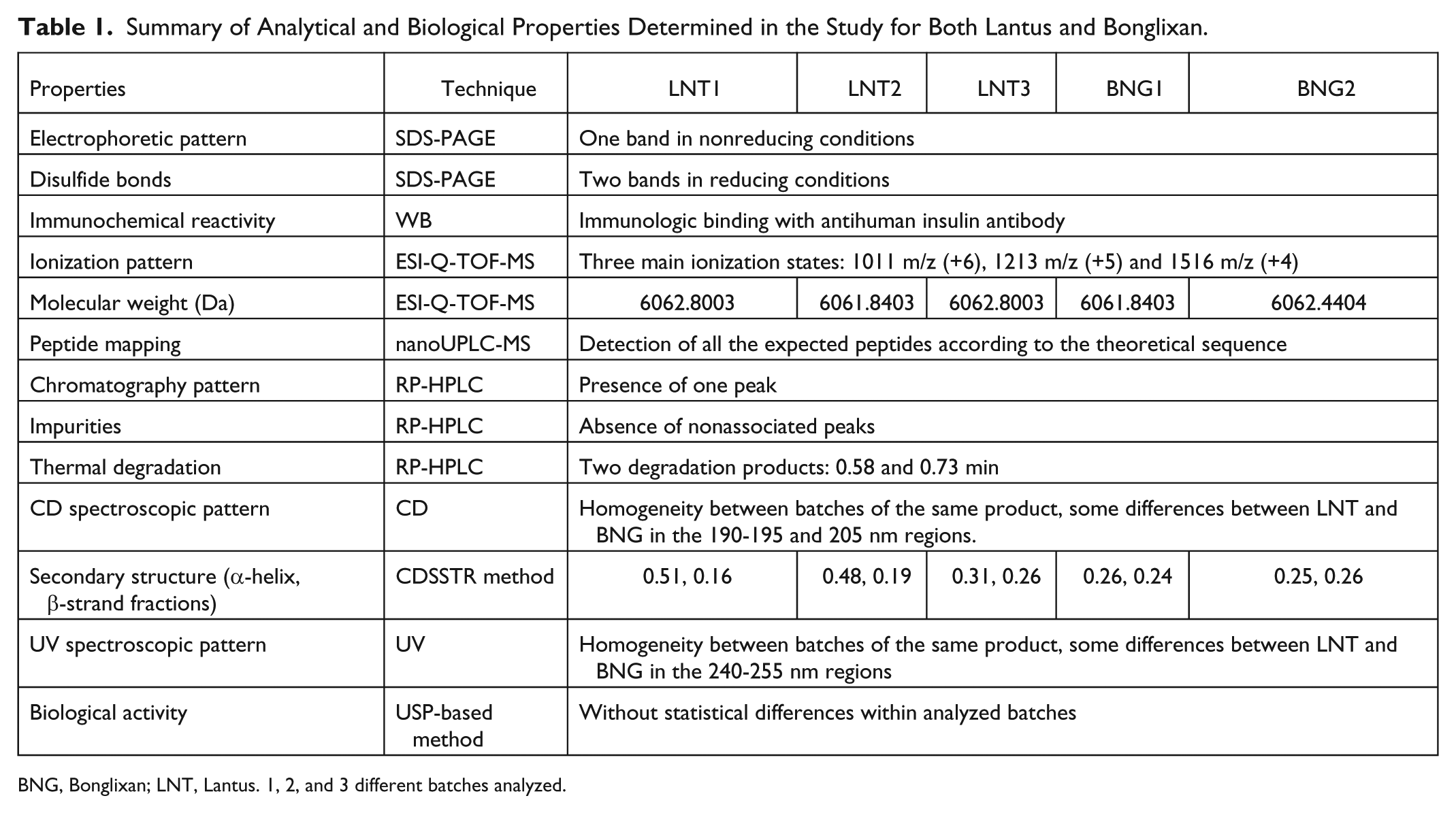
BNG, Bonglixan; LNT, Lantus. 1, 2, and 3 different batches analyzed.
In Mexican and international regulatory guidelines,3,4 a noninnovator biopharmaceutical can be considered a biosimilar product if it complies with comparable properties at a structural level, as well as clinical efficacy and safety, so this is the first step in the regulatory pathway of BNG as an insulin glargine proposed as biosimilar. It was not expected that BNG would be identical to LNT, because although they are made with the same E. coli strain, they are generated with a different manufacturing process, so the final product will be similar but not identical.2,4,5 However, different emphasis in regulation of biosimilar insulins is present across the world because each country (or continent in the case of European Union) has its own criteria; 6 in the case of Mexico, although regulation is now harmonized with the international guidelines 4 to provide effective and safe therapies to society, the guidelines are still broad compared with the European Union and countries like the United States and Canada, which have specific guidelines for insulins. 6
These results provide the basis to validate BNG as a proposed biosimilar according to Mexican regulatory guidelines.
Footnotes
Acknowledgements
We thank for their technical assistance Alberto Barrera-Pacheco for MS assays and Roberto Torres-Ramírez for the biological activity assay. We appreciate kindly the help provided in the CD analysis by Laboratorio de Fisicoquímica e Ingeniería de Proteínas (UNAM, Mexico). We also acknowledge CONACyT-Mexico grant 56787 (Laboratory for Nanoscience and Nanotechnology Research-LINAN) and INFRA-2013 no 204373. Thanks to Antonio Castellanos (CNS-IPICyT) for his valuable help and WATERS Mexico for their technical support.
Abbreviations
BNG, Bonglixan; CD, circular dichroism; COFEPRIS, Federal Commission for Prevention of Sanitary Risks; ESI, electrospray ionization; LNT, Lantus; MS, mass spectrometry; Q-TOF, quadrupole-time of flight; RP-HPLC, reversed phase high performance liquid chromatography; SDS-PAGE, sodium dodecyl sulfate-polyacrylamide gel electrophoresis; UPLC, ultra performance liquid chromatography; USP, United States Pharmacopeia; UV, ultraviolet spectrophotometry; WB, western blot.
Declaration of Conflicting Interests
The author(s) declared the following potential conflicts of interest with respect to the research, authorship, and/or publication of this article: Drug formulations and partial financial support for the study were provided by Landsteiner Scientific S.A. de C.V.
Funding
The author(s) disclosed receipt of the following financial support for the research, authorship, and/or publication of this article: AEM has a PhD scholarship fund (no 362391) provided by CONACYT, Mexico. Work was supported by PROINNOVA-PEI, no 179521.